
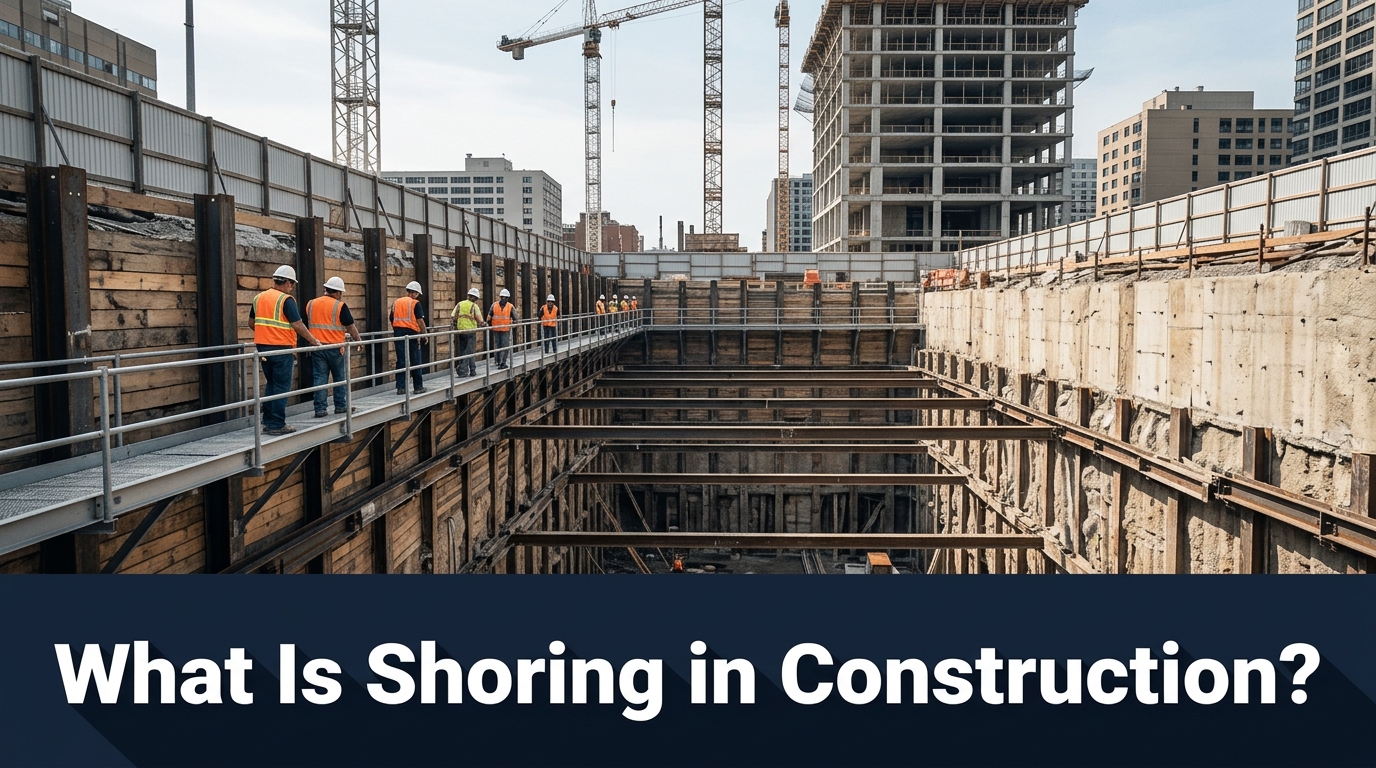
If you’ve ever walked past a deep hole in the ground on a job site and noticed a wall of steel beams and wooden planks holding back the earth, you’ve seen shoring at work. In simple terms, shoring is the temporary support system that keeps soil, trench walls, or even entire building facades from collapsing while construction, repair, or excavation work is underway. It’s one of those parts of a project that most people never think about, right up until the moment it prevents a disaster.
This guide walks through what shoring actually does, the different types you’ll run into on real job sites, and how contractors decide which system fits which situation. No dense engineering jargon, just a clear breakdown you can actually use.
What Is Shoring in Construction?
At its core, shoring in construction means installing temporary bracing, posts, or walls to hold up soil, an excavation face, or an existing structure so it doesn’t shift, crack, or cave in while work is happening nearby. Think of it as a stand-in support system. It’s not permanent, and it’s not meant to be pretty. It’s meant to buy safety and stability until the real, permanent structure (a foundation, a retaining wall, a repaired building) can take over the load.
Shoring shows up in two very different but related worlds:
- Excavation shoring, which protects trench and pit walls from collapsing on workers below grade.
- Structural shoring, which supports an existing building, wall, or floor during repairs, alterations, or demolition of a neighboring structure.
Both share the same basic goal: control lateral or vertical forces temporarily, so nothing moves that shouldn’t move.
Why Shoring Matters on a Job Site
Soil looks solid until it isn’t. Loose, sandy, or waterlogged ground can shift within seconds, and an unshored trench wall can collapse with almost no warning. That’s not a scare tactic, it’s the reason trenching and excavation is treated as one of the more hazardous categories of construction work by federal regulators. A cubic yard of soil can weigh well over a ton, and a cave-in gives workers little to no time to react.
On the building side, shoring in construction prevents settling walls, weakened foundations, or half-demolished structures from collapsing onto workers, neighboring properties, or the public sidewalk. Whenever a wall is being underpinned, an opening is being cut into a load-bearing wall, or an adjacent building is coming down, some form of shoring is almost always required.
When Is Shoring Required?
Shoring in excavation typically becomes necessary once a trench or pit reaches a certain depth, because deeper cuts put more lateral pressure on the surrounding soil. As a general rule, federal safety standards require a protective system, shoring, shielding, or sloping, whenever a worker enters an excavation that is five feet deep or greater, unless the excavation is made entirely in stable rock. Below is a quick look at common triggers for shoring on both excavation and structural jobs.
| Situation | Typical Shoring Response |
|---|---|
| Trench or pit deeper than 5 feet | Shoring, shielding, or sloping required |
| Excavation near an existing building | Shoring plus underpinning of adjacent foundation |
| Bulging, cracked, or settling wall | Raking or dead shoring |
| Demolishing part of a shared or party wall | Flying shoring |
| Cutting a large opening in a load-bearing wall | Dead shoring |
| Deep basement or urban excavation with tight space | Secant pile or soldier pile wall |
Types of Shoring in Construction
There isn’t just one type of shoring in construction. Different soil conditions, depths, budgets, and site constraints call for different systems. Broadly, shoring falls into two families: shoring systems used to support excavations and trenches, and shoring systems used to support existing buildings and walls. Let’s go through both.
Shoring Systems Used in Excavation
1. Timber Shoring
This is the oldest and simplest method, wooden planks and braces installed against trench walls, held in place with cross braces or screw jacks. Temporary shoring built with timber is still used on smaller trenches and residential jobs today, and it’s flexible enough to be cut and adjusted on site. It’s less durable than steel or aluminum systems, but it remains a cost-effective option for shallow, short-duration work. Detailed timber sizing tables for different soil types are laid out in federal timber shoring guidance that contractors use when designing a compliant system without hiring an engineer for every trench.
2. Aluminum Hydraulic Shoring
This is a pre-engineered shoring system built from aluminum hydraulic cylinders (crossbraces) paired with vertical or horizontal rails. It’s lightweight, fast to install and remove, and doesn’t require a worker to enter the trench to set it up, which is a major safety advantage. It’s become one of the most common shoring systems on utility and pipeline jobs because a two-person crew can install it quickly and adjust the pressure hydraulically as conditions change.
3. Hydraulic (Pneumatic or Screw Jack) Shoring
Similar in principle to aluminum hydraulic shoring, this method uses hydraulic or pneumatic pistons to press steel plates against trench walls, transferring pressure evenly and reducing wall movement. It’s especially useful in shallow trenches where face stability is a concern, and single-cylinder hydraulic shores are often used alongside timber shoring as an added layer of support.
4. Sheet Pile Shoring
Sheet pile shoring uses interlocking steel sheets driven into the ground to form a continuous wall along the excavation edge. Because the sheets interlock, this method works well where groundwater control matters, though it doesn’t seal out water completely on its own. It’s a common choice for deeper trenches, waterfront work, and sites where vibration from driving equipment is acceptable.
5. Soldier Pile and Lagging Shoring
This system uses vertical steel H-beams (soldier piles) driven or drilled into the ground at intervals, with horizontal timber or steel lagging boards installed between them as the excavation deepens. It’s a popular and relatively economical shoring wall option for urban basements and deep foundation work, particularly where the wall doesn’t need to be fully watertight.
6. Secant Pile Shoring
Secant pile shoring is one of the more advanced excavation support systems, and it’s worth understanding in more depth given how often it comes up on urban and deep-excavation projects.
A secant pile wall is built from a row of overlapping, drilled concrete piles known as primary and secondary piles. The primary piles go in first, spaced apart, and are typically made with lower-strength concrete so they can be easily cut into. The secondary, reinforced piles are then drilled between them so their edges overlap with the already-poured primary piles, creating a continuous, interlocking wall. Because the piles physically overlap rather than sitting side by side, the soil behind the wall is never fully exposed during excavation, which makes secant pile shoring especially useful near sensitive structures or in areas with a high water table.
Benefits of secant pile shoring include:
- Strong resistance to lateral earth pressure thanks to the stiffness of reinforced concrete
- Reduced groundwater infiltration compared to soldier pile and sheet pile systems
- Flexibility to follow curved or irregular excavation boundaries
- Lower vibration and noise than driven pile methods, which matters in dense urban areas
The tradeoff is cost and complexity. Secant pile walls require specialized drilling rigs, precise vertical alignment, and more engineering oversight, so they tend to show up on larger commercial or high-rise foundation projects rather than small residential digs.
7. Trench Boxes (Shielding)
Technically classified as shielding rather than shoring, trench boxes are steel or aluminum structures placed inside a trench to protect workers if a collapse occurs, rather than actively holding the trench walls back. They’re commonly used alongside shoring on utility work because they’re fast to move from section to section as a pipeline progresses.
Structural Shoring Systems (Building Shoring)
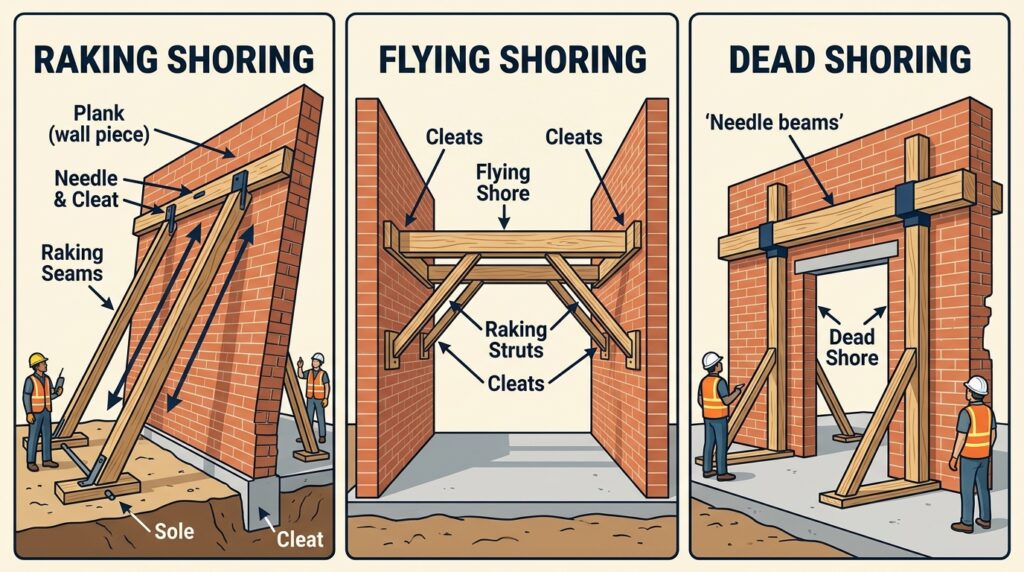
When the goal isn’t holding back soil but supporting an existing structure, contractors turn to structural shoring methods that have been used for well over a century. These fall into three main categories.
1. Raking Shoring
Raking shoring uses inclined timber or steel members, called rakers, set at an angle (usually somewhere between 45 and 75 degrees) against a wall to brace it laterally. The system includes wall plates, needles, cleats, and a sole plate anchored into the ground, and it’s typically spaced every 3 to 4.5 meters along the length of a wall that’s showing signs of bulging or instability. On taller buildings, a shorter “rider raker” is sometimes stacked on top of the main raker to extend support higher up the wall without needing one impossibly long beam.
2. Flying Shoring (Horizontal Shoring)
Flying shoring, sometimes called horizontal shoring, is used between two parallel walls, most often party walls, when the building or space between them is being demolished or rebuilt and the ground can’t be disturbed by vertical props. A horizontal shore is wedged between the two walls at floor level, with diagonal struts reinforcing the connection. This keeps both walls stable and independent of ground-level support while construction happens in between.
3. Dead Shoring
Dead shoring is a system of vertical posts, called dead shores, that support horizontal beams known as needles, which are inserted through holes cut into a wall. The needles transfer the wall’s dead load onto the vertical shores on either side, essentially taking the weight off the section of wall being worked on. Dead shoring is the go-to method when contractors need to:
- Rebuild or repair the lower, defective part of a load-bearing wall
- Deepen or strengthen an existing foundation (a process closely tied to underpinning)
- Cut a large new opening, like a door or window, into an existing wall
Because dead shoring carries the entire weight of the structure above, it’s usually left in place for at least a week, sometimes much longer, until new work has gained enough strength to stand on its own.
Concrete Shoring: A Quick Note
“Concrete shoring” usually refers to two slightly different things depending on context. In excavation work, it can mean cast-in-place concrete shoring walls, like secant pile or diaphragm walls, built specifically to resist earth pressure. In general construction, it more often refers to the temporary props, jacks, and formwork supports used to hold up newly poured concrete slabs, beams, or decks until the concrete has cured enough to support its own weight. Both uses share the same underlying idea: concrete needs support until it can support itself.
Temporary Shoring Wall vs. Permanent Retaining Structures
A common point of confusion is the difference between a temporary shoring wall and a permanent retaining wall. A temporary shoring wall is designed to do one job: hold soil or a structure in place only until construction is finished, at which point it’s often removed, cut down, or left buried and forgotten depending on the design. A permanent retaining wall, on the other hand, is engineered to stay in place indefinitely as part of the finished structure.
Some systems blur the line. Secant pile walls and soldier pile walls, for example, are sometimes designed to remain in place permanently as part of a basement or foundation wall, which can save on cost compared to building a temporary shoring wall and a separate permanent wall.
Shoring vs. Shielding vs. Sloping
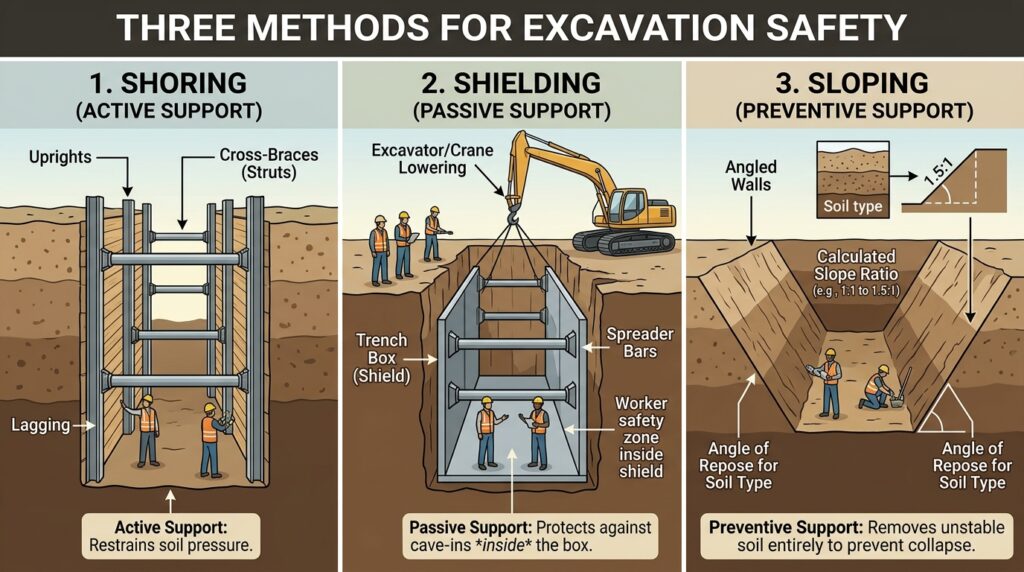
These three terms get mixed up constantly, so it’s worth separating them clearly.
- Shoring actively supports the excavation walls using a structural system that resists soil pressure directly.
- Shielding (trench boxes) doesn’t stop the soil from moving, it protects workers inside the box if a collapse happens.
- Sloping avoids the need for a support system altogether by cutting the trench walls back at an angle so they’re less likely to collapse.
All three are recognized as acceptable protective methods, and a qualified, competent person on site is responsible for deciding which one fits a given excavation, based on soil type, depth, and site conditions, according to federal excavation safety standards.
Soil Type and Shoring System Selection
Not every shoring system works for every soil condition. Soil is generally classified into three categories, from most stable to least stable, and that classification directly affects how a trench must be protected. Cohesive clay-like soils that hold together well fall on the more stable end, while loose, granular, or previously disturbed soils fall on the less stable end and typically need stronger or more conservative shoring.
A qualified professional, referred to as a competent person, must inspect the soil, classify it, and determine the right system before work begins, and again throughout the project as conditions change (after rain, for instance, or once groundwater is encountered). This isn’t a box-ticking exercise; soil conditions genuinely shift day to day, and yesterday’s safe trench can become today’s hazard.
Materials Used in Shoring Systems
Shoring in construction is built from a mix of materials depending on the system and the job:
- Timber – Traditional, flexible, cost-effective for shallow or short-duration jobs
- Steel – Used in sheet piles, soldier piles, and structural bracing for strength and reusability
- Aluminum – Lightweight and fast to deploy in hydraulic shoring systems
- Reinforced concrete – Used in secant pile and diaphragm walls for long-term stiffness and water resistance
Each material trades off differently between cost, speed, durability, and how much lateral pressure it can resist.
Pros and Cons of Common Shoring Methods
| Shoring Method | Pros | Cons |
|---|---|---|
| Timber Shoring | Low cost, flexible, easy to source | Labor-intensive, less durable, limited depth |
| Aluminum Hydraulic Shoring | Fast install, reusable, no trench entry needed | Higher upfront equipment cost |
| Sheet Pile Shoring | Good for deep trenches, some water resistance | Vibration and noise during driving |
| Soldier Pile and Lagging | Economical for deep urban excavation | Not fully watertight |
| Secant Pile Shoring | Strong, low vibration, watertight, works in tight alignments | Expensive, requires specialized equipment |
| Raking / Flying / Dead Shoring | Supports existing structures without demolition | Requires skilled design, long installation time |
Expert Tips for Safer Shoring on Site
- Never assume yesterday’s soil classification still applies after heavy rain or a change in groundwater level; re-inspect regularly.
- Keep excavated spoil piles and heavy equipment at least two feet back from the trench edge to reduce surcharge load on the walls.
- Always provide a safe way in and out of any trench four feet deep or more, with no more than 25 feet of lateral travel to reach it.
- Match the shoring system to the soil type and depth first, then think about budget, not the other way around.
- For structural shoring on occupied or historic buildings, bring in a structural engineer before cutting into any load-bearing wall.
- Document daily inspections. A quick photo log of shoring conditions can save enormous headaches if conditions shift.
If your project involves multiple structural systems working together, it can help to plan the load path holistically. For a broader look at how temporary support fits into the wider sequence of a build, this step-by-step excavation planning guide is a useful reference point for crews new to trenching work.
Frequently Asked Questions
What is shoring in construction, in the simplest terms?
Shoring in construction is a temporary support system, made of timber, steel, aluminum, or concrete, used to hold up soil, a trench wall, or an existing structure so it doesn’t move or collapse while work is being carried out.
What is shoring in excavation used for?
In excavation, shoring in excavation prevents trench and pit walls from caving in on workers. It’s one of three accepted protective methods, alongside shielding and sloping, and it’s typically required once a trench reaches five feet in depth.
What are the main types of shoring in construction?
The main excavation shoring systems include timber shoring, aluminum hydraulic shoring, sheet pile shoring, soldier pile and lagging, and secant pile shoring. Structural shoring, used on existing buildings, is grouped into raking shoring, flying shoring, and dead shoring.
What is dead shoring, and when is it used?
Dead shoring uses vertical posts and horizontal needle beams to support a wall’s weight from below, most often when contractors need to repair a weak foundation, rebuild a wall’s lower section, or cut a large opening into a load-bearing wall.
Is secant pile shoring better than sheet pile shoring?
Secant pile shoring is generally stronger and more watertight than sheet pile shoring, making it a better fit for deep urban excavations near sensitive structures or high water tables. Sheet pile shoring, though, is faster to install and more budget-friendly for less demanding sites, so “better” really depends on the ground conditions and project scale.
Final Thoughts
Shoring rarely gets the spotlight on a construction site, but it’s doing some of the most important work happening below the surface, literally. Whether it’s a simple timber brace in a shallow trench or a full secant pile wall holding back groundwater beneath a future high-rise, every shoring system exists for the same reason: to keep people and structures safe while the real, permanent work gets built around it.
If you’re planning a project that involves any kind of excavation or structural alteration, loop in a qualified engineer or competent person early. Getting the shoring system right from day one isn’t just a compliance checkbox, it’s what keeps everyone on that job site going home safe at the end of the day.

