
You found the perfect sofa. The color is right. The style is right. You order it, wait two weeks, and then the delivery team shows up only to discover it does not fit through the door.
That moment stings. And it happens more often than you think.
Measuring a room for furniture is one of those skills that sounds simple until you skip a step and end up with a sectional blocking your only window. Whether you are furnishing a new apartment, redecorating a bedroom, or finally getting that dining table you have been putting off, getting the measurements right from the start saves you time, money, and frustration.
This guide walks you through the full process in plain language. No interior design degree required.
Why Measuring Your Room Before Buying Furniture Matters
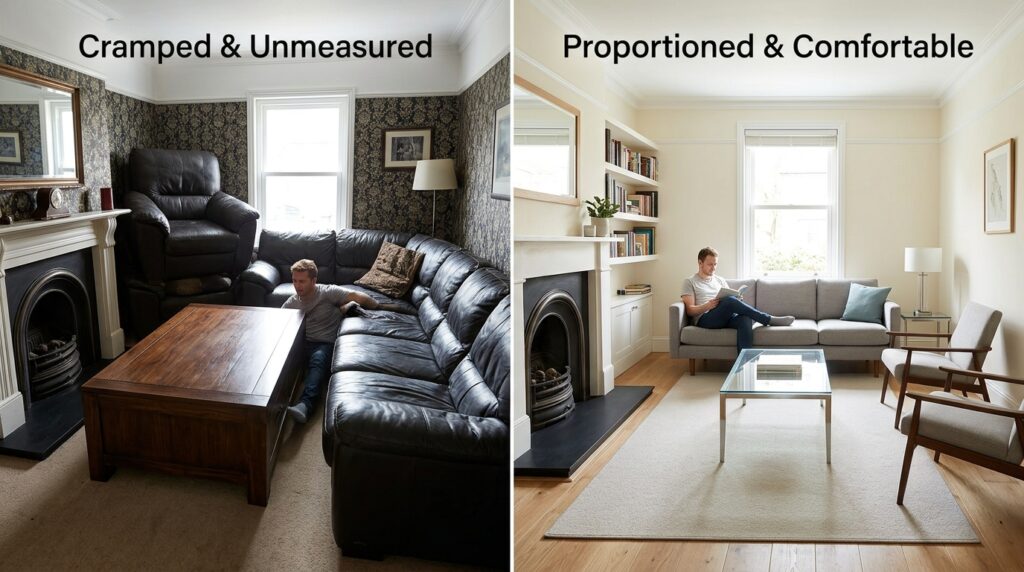
Furniture is one of the biggest investments you make in a home. A couch, a bed frame, a dining table — these are not impulse buys you can easily return. Yet most people walk into a store, fall in love with a piece, and only check if it “looks about right” in the space.
The problem with eyeballing it is that rooms are deceptive. A 10-foot wall looks much longer when it is empty. Add a sofa, a side table, and a floor lamp, and suddenly the hallway to the kitchen feels like a squeeze.
Measuring your room accurately before buying furniture helps you:
- Avoid buying pieces that are too large or too small
- Plan traffic flow so people can move comfortably
- Ensure furniture fits through doors, hallways, and stairwells
- Create a balanced, proportional look in every room
- Save money on returns, exchanges, and delivery fees
What Tools Do You Need to Measure a Room?
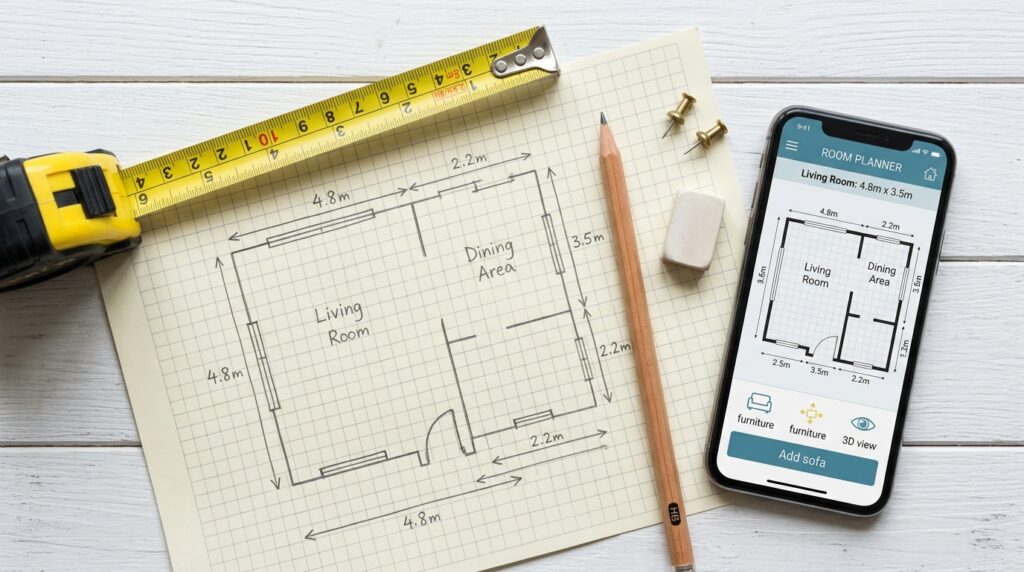
Before you start measuring, gather a few basic tools. You do not need anything fancy.
Essential Tools
| Tool | Purpose |
|---|---|
| Metal tape measure (25 ft) | Measure walls, doorways, and furniture |
| Graph paper or notebook | Sketch your room layout to scale |
| Pencil and eraser | Mark measurements and make adjustments |
| Smartphone or tablet | Use a room planning app for a digital layout |
| Laser distance measurer (optional) | Faster and more precise for large rooms |
A metal tape measure is far more reliable than a fabric one. It holds its shape across long distances, which matters when you are measuring a 15-foot living room wall.
If you want to go digital, a room planning app can help you visualize furniture placement without moving a single thing. These tools let you drop virtual furniture into a digital version of your room and see how everything fits.
How to Measure a Room Step by Step
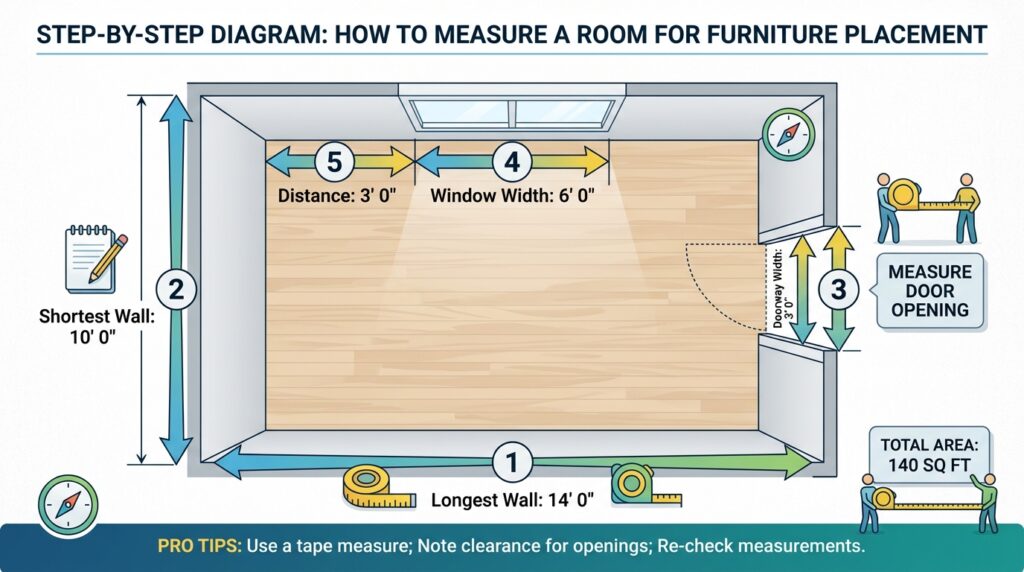
Here is the full process broken down into clear, manageable steps.
Step 1: Sketch the Room Layout First
Before you pull out the tape measure, draw a rough sketch of the room. It does not need to be perfect or to scale. Just outline the basic shape and mark where the doors, windows, closets, and any built-in features are located.
This sketch becomes your working document. You will fill it in with real numbers as you measure.
If your room has an unusual shape, like an L-shape or a room with alcoves, draw each section separately so you can measure each part accurately.
Step 2: Measure the Length and Width of the Room
Start with the overall dimensions of the room. Measure from wall to wall along the floor in both directions.
- Measure the length (the longer wall)
- Measure the width (the shorter wall)
- Record both numbers immediately on your sketch
For rectangular rooms, these two numbers give you the square footage when multiplied together. But more importantly, they tell you the maximum possible size of any furniture piece along each wall.
Pro Tip: Measure each wall in at least two spots, once near the floor and once at mid-height. Older homes especially can have walls that are not perfectly straight, and a few inches of difference can affect how furniture sits.
Step 3: Measure the Height of the Walls and Ceiling
Wall height is easy to overlook, but it matters more than people expect.
Tall bookcases, armoires, and bed canopies need clearance. If you have crown molding, measure from the floor to the base of the molding as well as to the ceiling.
Standard ceiling height in most homes is 8 feet, but many modern builds go to 9 or 10 feet. Knowing your ceiling height helps you choose furniture with the right vertical proportions.
Step 4: Measure Every Door and Doorway
This step saves people from the dreaded delivery-day disaster.
Measure every doorway the furniture will need to pass through, including:
- The main entrance to the home
- Any interior hallways leading to the room
- The doorway into the specific room
For each doorway, measure:
- Width: From frame to frame at the widest point
- Height: From floor to the top of the frame
- Door swing clearance: How far the door swings open into the room
Standard interior doors are typically 80 inches tall and between 28 and 32 inches wide. But if you are moving in a king-size bed frame or a large sectional sofa, even standard doors can create problems.
Some furniture arrives in boxes that are larger than the assembled piece, so check the boxed dimensions listed on the product page before ordering.
Step 5: Measure Windows and Their Clearances
Windows affect where you can place furniture. A sofa pushed in front of a window blocks natural light and can interfere with curtains and blinds.
For each window, measure and record:
- Distance from the floor to the bottom of the window sill
- Width of the window opening
- Distance from each side of the window to the nearest wall corner
Furniture placement near windows should account for at least a few inches of breathing room so curtains can hang freely and window handles remain accessible.
Step 6: Note Outlets, Switches, and Vents
Mark on your sketch where electrical outlets, light switches, HVAC vents, and radiators are located.
Blocking an outlet with a heavy dresser is a problem you will notice every time you try to plug in your phone. Blocking a heating or cooling vent affects the whole room’s temperature.
These details seem minor on paper but become daily frustrations once the room is furnished.
Step 7: Mark Architectural Features
Some rooms have built-in features that permanently affect furniture placement:
- Fireplaces (require clearance in front for safety)
- Built-in shelving or cabinetry
- Support columns or beams
- Staircases that cut into the room
- Bay windows or window seats
Each of these elements takes up visual and physical space. Factor them into your layout from the beginning.
How to Measure Furniture Before You Buy
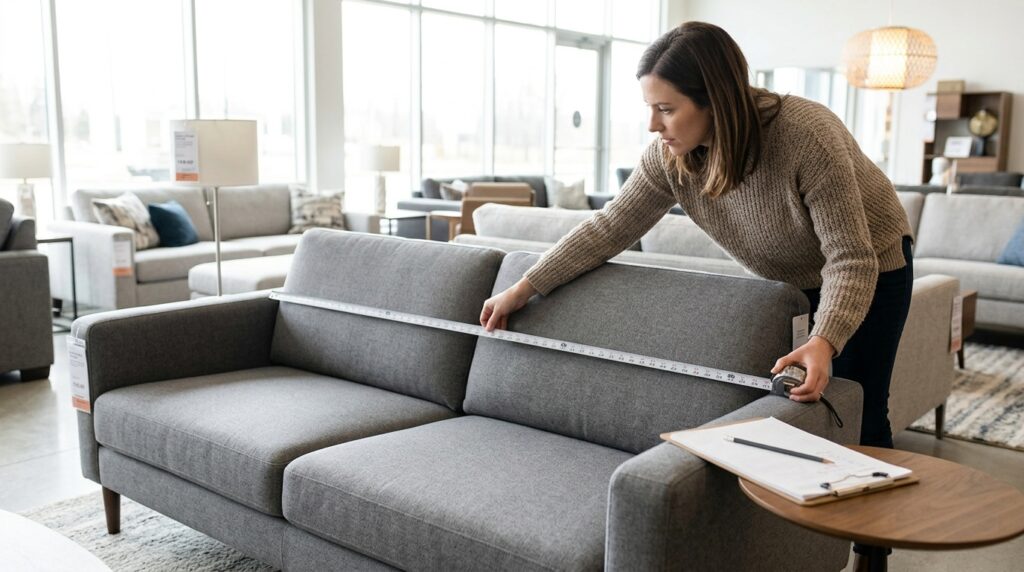
Once you have your room measurements, you need to know the dimensions of the furniture you want to buy.
Key Furniture Measurements to Check
Every piece of furniture has three critical dimensions:
- Height (how tall it is)
- Width (how wide from side to side)
- Depth (how far it extends from the wall)
For sofas and sectionals, also check the diagonal depth, which is the measurement from the highest point of the back to the front leg. This matters for getting the piece through narrow doorways.
Furniture Dimensions by Room Type
Living Room
| Furniture | Typical Width | Typical Depth | Typical Height |
|---|---|---|---|
| 3-seat sofa | 84–90 inches | 34–38 inches | 30–36 inches |
| Loveseat | 52–60 inches | 34–38 inches | 30–36 inches |
| Coffee table | 40–50 inches | 18–24 inches | 16–18 inches |
| TV stand | 48–72 inches | 16–20 inches | 20–28 inches |
Bedroom
| Furniture | Typical Width | Typical Depth | Typical Height |
|---|---|---|---|
| Twin bed | 38 inches | 75 inches | Varies |
| Full/Double bed | 54 inches | 75 inches | Varies |
| Queen bed | 60 inches | 80 inches | Varies |
| King bed | 76 inches | 80 inches | Varies |
Dining Room
| Furniture | Typical Width | Typical Depth | Typical Height |
|---|---|---|---|
| 4-person table | 36–48 inches | 36–48 inches | 30 inches |
| 6-person table | 60–72 inches | 36–40 inches | 30 inches |
| Dining chair | 16–20 inches | 18–22 inches | 34–40 inches |
Traffic Flow: The Golden Rule of Furniture Placement
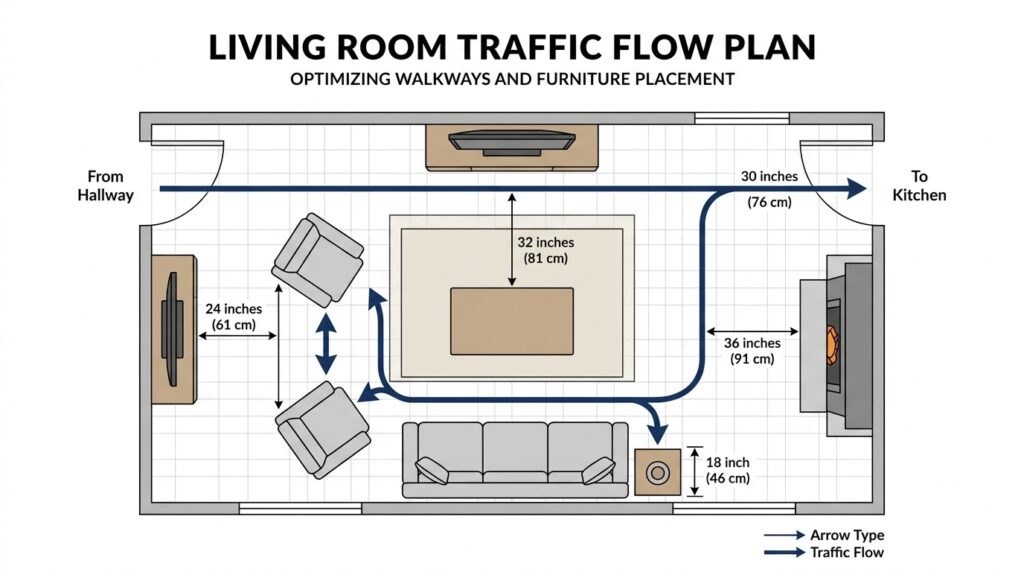
Measurements are only part of the equation. The other part is traffic flow — the way people move through the room.
Interior design traffic flow guidelines recommend leaving at least 36 inches of clearance for main walkways. This is enough space for two people to pass comfortably, or for someone to walk through without turning sideways.
Secondary pathways, like the space between a coffee table and a sofa, can be slightly smaller. A clearance of 18 inches is considered the comfortable minimum.
Standard Clearance Guidelines
| Area | Minimum Clearance |
|---|---|
| Main walkways | 36 inches |
| Between sofa and coffee table | 14–18 inches |
| Around dining table (with chairs pulled out) | 36–48 inches |
| Bedroom walkways | 24–36 inches |
| In front of dresser drawers | 36 inches |
| In front of closet doors | 36–48 inches |
If a room cannot meet these clearances, the furniture being considered is likely too large for the space.
How to Create a Floor Plan to Scale
A scaled floor plan is one of the best tools you can use when planning a room. It lets you experiment with different layouts on paper before moving anything in real life.
How to Draw a Floor Plan to Scale
- Choose a scale. A common choice is 1 inch on paper equals 1 foot in real life.
- Draw the walls of your room to scale on graph paper.
- Mark all doors, windows, outlets, and architectural features.
- Cut out small paper shapes representing each piece of furniture (to the same scale).
- Move the paper furniture around on the floor plan to find the best arrangement.
This old-school method is surprisingly effective and costs nothing.
If you prefer a digital approach, room planning tools let you build a virtual floor plan and drag furniture into place. Most have free basic versions that work well for simple layouts.
Room-Specific Measuring Tips
Every room type has its own unique challenges. Here is what to focus on in each space.
How to Measure a Living Room for Furniture
The living room tends to be the most complex room to furnish because it serves multiple purposes: relaxing, entertaining, watching TV, and sometimes working.
Key measurements for a living room:
- Distance from the TV wall to where you plan to place seating. For comfortable viewing, the ideal TV viewing distance is roughly 1.5 to 2.5 times the diagonal screen size.
- Width available for the sofa wall
- Depth of the sofa, and how far it will sit from the wall
- Clearance between seating and the coffee table
A common mistake in living rooms is choosing a rug that is too small. The rug should be large enough that at least the front legs of all seating pieces rest on it.
How to Measure a Bedroom for Furniture
Bedrooms are primarily about the bed. Everything else is arranged around it.
Start by choosing your mattress size, then measure the space the bed frame will take up. Add the box spring height if applicable, and account for a bed frame that may extend several inches beyond the mattress on each side.
Leave at least 24 inches on each side of the bed for getting in and out. If possible, aim for 36 inches.
Check the distance from the foot of the bed to any dressers, TV stands, or the wall. Three feet is a comfortable minimum.
For smaller bedrooms, a wall-mounted headboard or storage bed can help maximize the usable floor space.
How to Measure a Dining Room for Furniture
The dining table is the anchor, and everything else follows from it.
Key dining room measurements:
- Table length and width (add at least 24 inches per person seated)
- Chair depth when pulled out from the table (chairs typically add 18–20 inches when in use)
- Clearance around the entire table for pulling chairs in and out (at least 36 inches from table edge to wall or other furniture)
- If you have a chandelier or pendant light, measure its height from the floor. It should hang approximately 30 to 34 inches above the tabletop.
A dining table that is too large leaves no room to move. A table that is too small feels cramped during meals. Measuring the space correctly is the key to getting it right.
How to Measure a Home Office for Furniture
Home offices are often set up in spare bedrooms or awkward corners, which makes measuring even more important.
Key home office measurements:
- Desk width and depth (a standard desk is about 48 to 72 inches wide and 24 to 30 inches deep)
- Chair clearance behind the desk (you need at least 30 inches to pull out and sit comfortably)
- Monitor height relative to seated eye level
- Space for any filing cabinets, bookshelves, or storage pieces
Good ergonomic desk setup requires that your knees fit comfortably under the desk and that your arms rest at a natural angle. These factors affect the desk height and chair height you should be looking for.
Common Furniture Measuring Mistakes (And How to Avoid Them)
Even careful people make these errors. Here are the most common ones and how to sidestep them.
Mistake 1: Forgetting to Measure the Path, Not Just the Room
You measured the room. But did you measure the hallway leading to it? The stairwell? The front door?
Always trace the full delivery path from the street to the final placement spot and measure every bottleneck along the way.
Mistake 2: Not Accounting for Furniture Assembly
Some large furniture pieces are delivered in parts and assembled in the room. Others come fully assembled. Know which category your piece falls into before delivery day.
If it arrives assembled, the boxed dimensions may still be larger than the piece itself, so check both.
Mistake 3: Measuring Only Once
Walls are not always perfectly parallel. Floors are not always perfectly level. One measurement is a starting point; two or three confirm it. Always measure each dimension at least twice before writing it down.
Mistake 4: Ignoring the Depth of Furniture
Width gets all the attention. Depth is what eats up the room.
A sofa might be 85 inches wide, which sounds manageable, but if it is 42 inches deep, it extends nearly 3.5 feet into the room. In a small space, that depth changes everything.
Mistake 5: Forgetting About Baseboards and Molding
Baseboards stick out from the wall, sometimes by an inch or more. Furniture pushed flush against a wall may actually sit an inch or two away from the wall because of them.
This matters most for beds and sofas where you want a clean, tight fit against the wall.
How to Use Masking Tape to Test Furniture Fit
This is one of the most practical tricks in the furniture planning playbook.
Before buying anything, use masking tape or painter’s tape to mark out the footprint of each furniture piece on your floor. This gives you a real-world preview of how much floor space each piece will occupy.
How to do it:
- Write down the dimensions of the furniture you are considering.
- Use tape to outline the exact shape on your floor.
- Step back and walk around it. Open any nearby doors. Sit in the space as if the furniture were there.
- Check that traffic lanes are still clear.
This 15-minute exercise has prevented countless regrettable purchases.
Expert Tips for Measuring Rooms Like a Pro
These insights come from practical experience working with real spaces and real furniture.
Tip 1: Always measure in inches, not feet. Feet are great for estimating, but inches are what you need when comparing furniture specs. Most product listings use inches. Work in the same unit to avoid confusion.
Tip 2: The two-thirds rule for area rugs. A rug should cover roughly two-thirds of the seating area in a living room. If you have never measured your room before picking a rug, this is why it always looks off.
Tip 3: Check diagonal measurements for sectionals. L-shaped sectionals are notoriously difficult to get into rooms. Measure the longest straight section and the diagonal depth separately, and compare both to your doorway and hallway measurements.
Tip 4: Leave breathing room. Furniture jammed against every wall makes a room feel smaller, not larger. Leaving even a few inches between the back of a sofa and the wall allows sound to travel better and gives the room a more intentional, designed feel.
Tip 5: Photograph the empty room. Before you measure, take photos of the empty room from each corner. These photos are invaluable when you are in a furniture store and trying to remember what the space actually looked like.
Tip 6: Use a furniture template app. Apps like Magicplan use your phone camera to automatically generate a floor plan. While not perfect, they get you close fast and are useful for first-pass planning.
How to Measure for Specific Furniture Pieces
Measuring for a Sofa
- Measure the wall where the sofa will sit
- Subtract any space needed for end tables, lamps, or walkways on either side
- The remaining length is your maximum sofa width
- Check the depth — ensure you still have room to walk from the sofa to the coffee table or TV stand
- Check the sofa height against any windows behind it
Measuring for a Bed
- Start with your mattress size preference
- Add the bed frame dimensions (frames typically extend 2 to 5 inches beyond the mattress on each side)
- Ensure at least 24 inches of walkway on either side of the bed
- Check the headboard height against any windows or artwork on the wall behind the bed
Measuring for a Dining Table
- Measure the length of your dining area
- Subtract at least 36 inches on each end for chair pull-out clearance
- The remaining length is your maximum table size
- Consider round vs. rectangular tables — round dining tables are often better for smaller spaces because they have no sharp corners and allow easier movement
Measuring for a Dresser
- Measure the wall space available
- Check that dresser drawers can open fully without hitting the bed, door, or opposite wall
- For tall dressers, check the height against any mirrors, artwork, or light fixtures on the wall
Digital Tools That Make Room Measurement Easier
Technology has made the whole process significantly easier for people who prefer not to sketch by hand.
Free and Paid Room Planning Tools
Floor planner apps and tools can help you:
- Input your room dimensions and generate a digital floor plan
- Drag and drop virtual furniture from a built-in library
- Switch between 2D top-down view and 3D walkthrough views
- Share your layout with others for feedback
Many of these tools have furniture catalogs built in, so you can place a virtual version of the exact sofa you are considering and see how it looks in your space before buying.
Augmented reality furniture apps take this a step further by letting you use your phone camera to place virtual furniture in a live view of your room. You can walk around the virtual piece and see it from different angles.
This technology has improved dramatically and is now genuinely useful for making real purchasing decisions.
How to Measure for Furniture in Awkward or Small Spaces
Small rooms and awkward layouts require extra creativity, but the measuring process stays the same. What changes is what you do with those measurements.
Tips for Small Spaces
Choose furniture with a smaller footprint. Look for pieces with legs instead of solid bases. Furniture that sits off the floor creates a sense of visual space even in tight rooms.
Think vertically. In rooms where floor space is limited, height is your friend. Tall bookshelves and vertical storage solutions maximize space without adding to the floor footprint.
Consider multi-functional furniture. Multi-functional furniture like storage ottomans, sofa beds, and extendable dining tables serve multiple needs in one piece. These are especially useful in studio apartments or small living rooms.
Avoid blocking natural light. In small spaces, light is everything. Keep window clearances generous and avoid placing tall furniture in front of light sources.
Use mirrors strategically. While not furniture, a well-placed mirror can visually double the perceived size of a room. Measure the wall space to ensure your mirror is proportional.
FAQs: How to Measure Room for Furniture
What is the first thing I should measure when planning a room?
Start with the overall room dimensions: length, width, and ceiling height. These three numbers establish the boundaries of everything else. Once you have them, measure doors, windows, and any architectural features before thinking about specific furniture pieces.
How do I know if a sofa will fit through my door?
Measure your doorway width (frame to frame) and height (floor to top of frame). Then check the sofa’s diagonal depth, which is the measurement from the top-back corner to the bottom-front leg. If the diagonal depth is less than your doorway height, the sofa can usually be tilted through. If it is larger, you may need to remove the legs or choose a different piece.
What is the minimum space needed around a dining table?
Plan for at least 36 inches between the edge of the table and any wall or other furniture. This gives enough room to pull out chairs and move around comfortably. For a more relaxed feel, 42 to 48 inches is ideal.
Do I need to measure every room the same way?
The basic process is the same for every room: walls, ceiling, doors, windows, and features. What changes is which clearances matter most. In bedrooms, bedside walkways are the priority. In dining rooms, chair clearance dominates. In living rooms, traffic flow and TV viewing distance take center stage.
Can I rely on room planning apps instead of measuring manually?
Apps are a great complement to manual measuring, not a replacement. Use a tape measure to get accurate dimensions, then enter those numbers into a planning app to experiment with layouts. Some apps with augmented reality features can help you visualize pieces in your actual space, which is especially helpful for large or complex purchases.
Conclusion
Measuring a room for furniture is not complicated, but it does require patience and attention. Taking the time to gather accurate measurements before you buy protects your investment, prevents delivery disasters, and gives you the confidence to design a space that actually works.
The process is always the same: measure the room, measure the path the furniture will travel to get there, check the furniture dimensions, plan for traffic flow, and test your layout on paper or with tape on the floor before committing.
Once you do this once, it becomes second nature. You will never walk into a furniture store the same way again.
Ready to start planning your space? Grab a tape measure, sketch your room, and take it one measurement at a time. Your future self will thank you when everything fits perfectly on the first try.
Room Measuring Checklist
Use this checklist every time you plan a room:
- Room length (measured at floor level)
- Room width (measured at floor level)
- Ceiling height
- All doorway widths and heights (on the path to the room)
- Window sill heights and window widths
- Location of electrical outlets and switches
- Location of HVAC vents and radiators
- Any architectural features (fireplace, columns, built-ins)
- Existing furniture dimensions (if keeping any)
- New furniture dimensions (height, width, depth, diagonal depth)
- Clearances for traffic flow
- Rug size relative to seating area
- Tape test completed on floor
This article is intended for informational purposes only. Measurements and clearance guidelines are general recommendations. Actual needs may vary depending on your specific space, lifestyle, and furniture choices. For complex renovations or custom installations, consulting with a licensed interior designer is always a good idea.

