
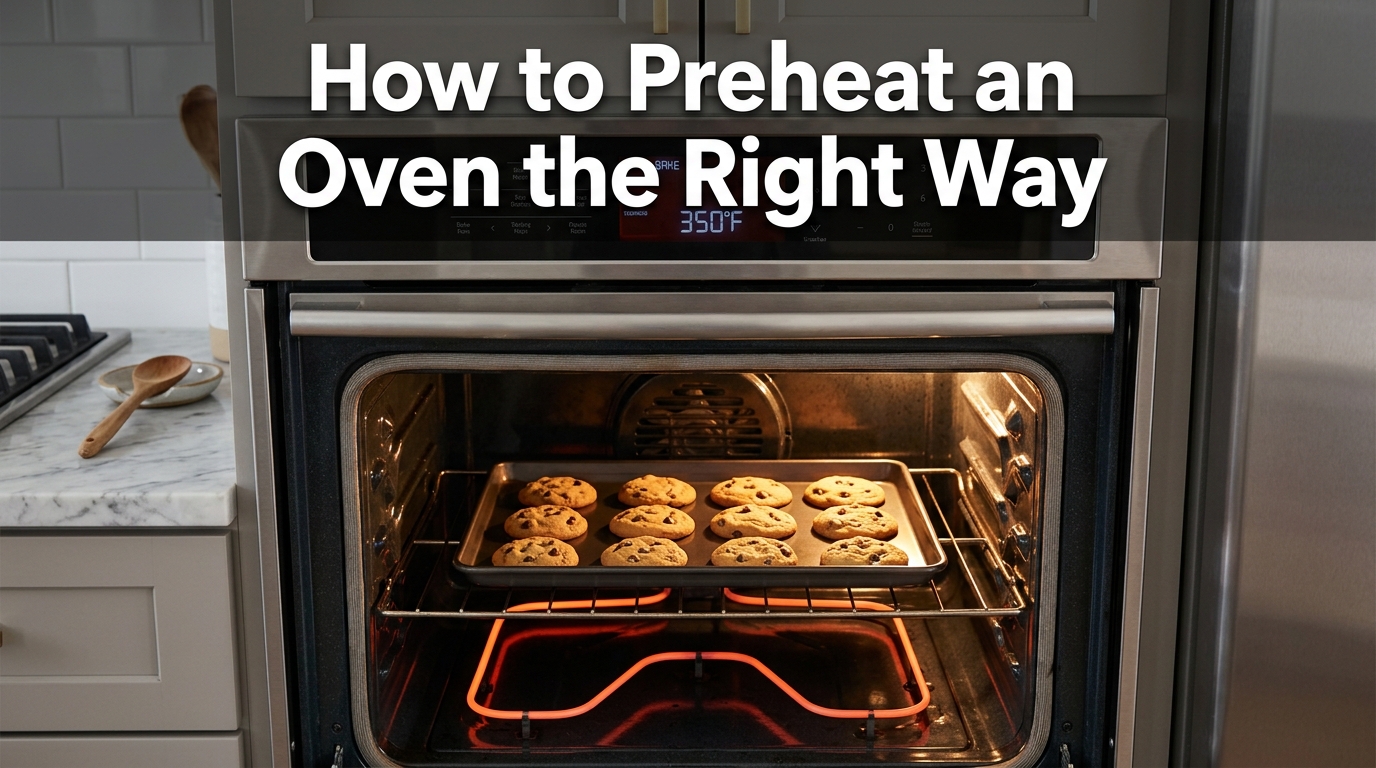
Every great meal starts before anything goes into the oven. That one small step — preheating — makes the difference between food that comes out perfectly cooked and food that is unevenly baked, undercooked in the center, or just plain disappointing.
If you have ever wondered how to preheat oven properly, you are not alone. It is one of the most commonly searched cooking questions online, and yet a lot of home cooks skip it or do it wrong. Whether you are baking a cake, making homemade pizza, or reheating lasagna, preheating is non-negotiable.
This guide walks you through everything — from basic steps to brand-specific instructions for electric ovens, gas ovens, and microwave ovens. No confusing jargon. Just simple, clear steps you can follow right now.
What Does It Mean to Preheat an Oven?
Preheating means turning your oven on and letting it reach the desired cooking temperature before you put any food inside.
Think of it like warming up a car engine on a cold morning. The oven needs time to heat the walls, racks, and air inside evenly. When the temperature is stable and consistent, your food cooks the way the recipe intended.
Skipping this step is one of the most common cooking mistakes. Food placed in a cold oven starts cooking too slowly, leading to uneven textures, collapsed cakes, and soggy crusts.
Why Preheating Matters
Here is why skipping preheat is a big deal:
- Even cooking: A stable temperature ensures heat reaches all parts of your food at the same time.
- Proper rising: Baked goods like cakes and bread need immediate heat to rise correctly. A cold oven causes them to sit too long and fall flat.
- Crispy textures: Foods like pizza or roasted vegetables need a hot environment from the first second to develop the right crust or caramelization.
- Accurate timing: Recipes are written assuming a preheated oven. If you skip it, the stated cooking time will be off.
The USDA Food Safety guidelines emphasize consistent oven temperatures to ensure food reaches safe internal temperatures quickly and evenly.
How to Preheat an Oven: Step-by-Step
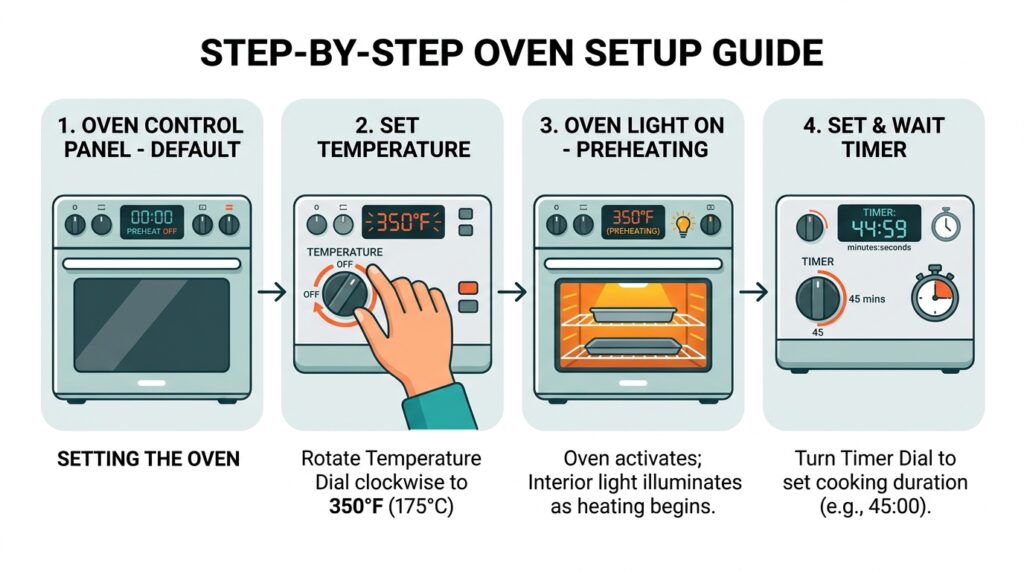
Here are the basic steps that apply to almost every standard oven:
Step 1: Clear the oven
Remove any pans, baking sheets, or foil left inside from last time. These affect air circulation and heat distribution.
Step 2: Adjust your oven rack
Position the rack before you turn the oven on. Moving racks once the oven is hot is dangerous.
Step 3: Set the temperature
Turn the dial or press the temperature buttons to your target heat. Most recipes call for somewhere between 325°F and 450°F.
Step 4: Press Bake or the appropriate mode
On most ovens, pressing “Bake” starts the preheating cycle. On some digital models, you must confirm with a “Start” button.
Step 5: Wait for the preheat signal
Most ovens will beep or display a light when they reach the set temperature. This usually takes 10 to 15 minutes for standard temperatures.
Step 6: Give it a little extra time
Even after your oven signals it is ready, the walls and racks may not be fully heated. Wait an additional 5 minutes before placing your food inside for best results.
How to Preheat Oven to Common Temperatures
Different recipes call for different temperatures. Here is a quick reference:
| Temperature | Best For |
|---|---|
| 325°F / 163°C | Slow roasting, cheesecakes, delicate custards |
| 350°F / 177°C | Cakes, muffins, cookies, casseroles |
| 375°F / 190°C | Sheet-pan dinners, biscuits, quick breads |
| 400°F / 204°C | Roasted vegetables, crispy chicken, pizza |
| 425°F / 218°C | Baked potatoes, thin-crust pizza, steak finishing |
| 450°F / 232°C | High-heat roasting, artisan bread, searing |
How to Preheat Oven to 350
350°F is the most common baking temperature in home cooking. To reach it, simply set your oven dial or digital display to 350 and let it preheat for 10 to 15 minutes. This is the go-to setting for most cake recipes, cookies, muffins, and brownies.
How to Preheat Oven to 400
For foods that need a crispier exterior, 400°F is a popular choice. Set your oven to 400 and allow 12 to 15 minutes for it to fully preheat. Roasted vegetables, chicken thighs, and flatbreads all benefit from this higher heat.
How to Preheat Oven to 220 (Celsius)
220°C is roughly 428°F — a high heat that works great for quick roasting or browning. Set your oven to 220°C and allow at least 15 minutes of preheat time. Good for sausages, potatoes, and crusty rolls.
How to Preheat Oven to 200 Degrees (Celsius)
200°C equals approximately 392°F. This is a common setting for roasting meats and vegetables. Set your oven to 200°C and preheat for 12 to 15 minutes before placing food inside.
How to Preheat Oven to 180 Degrees (Celsius)
180°C is roughly 350°F and is one of the most used baking temperatures globally, especially for cakes, biscuits, and sponge recipes. Set the temperature and allow 10 to 15 minutes of heating time before baking.
Understanding Oven Preheat Symbols
Modern ovens use symbols instead of words. If you are staring at a control panel full of unfamiliar icons, here is what the most common ones mean:
- Two horizontal lines (top and bottom): Standard bake mode using both top and bottom heating elements.
- Fan with a circle: Fan-forced or convection mode. Heat circulates evenly. Great for baking multiple trays at once.
- Fan with a bottom line: Fan bake — uses the bottom element with circulating air.
- Zigzag line at top: Broil or grill mode. Uses top heat only. Good for browning the top of a dish.
- Single bottom line: Bottom heat only. Useful for cooking pastry bases without browning the top.
Always check your oven’s user manual if a symbol is unclear. Manuals are often available for free on the manufacturer’s website.
How to Preheat Specific Oven Brands
Different brands have slightly different control layouts. Here is a quick breakdown for the most popular ones.
How to Preheat an LG Oven
LG ovens typically use a digital touch control panel.
- Press the “Bake” button on the panel.
- Use the arrow keys or number pad to enter your target temperature.
- Press “Start.”
- The display will show the current temperature rising toward the target. A tone will sound when preheating is complete.
LG ovens also have a “Preheat Boost” feature on some models that uses additional elements to speed up the process. Check your model’s manual for specifics.
How to Preheat a Whirlpool Oven
Whirlpool ovens are common in homes and are known for straightforward controls.
- Press “Bake” on the control panel.
- The display will default to 350°F. Use the + or “Up” arrow to increase, or – or “Down” to decrease to your desired temperature.
- Press “Start.”
- The oven will display the rising temperature and beep once it is ready.
Whirlpool also offers an AccuBake® System on some models that keeps temperature consistent throughout the cooking cycle. Visit the Whirlpool support page for model-specific guides.
How to Preheat a Samsung Oven
Samsung ovens often feature a touchscreen or flat-touch control panel.
- Press “Bake” or tap the bake icon on the touchscreen.
- Enter your preferred temperature using the number pad or slider.
- Press “Start” to begin preheating.
- Samsung ovens display real-time temperature and alert you with a chime when the target is reached.
Some Samsung models feature Rapid Preheat, which cuts preheat time significantly. It is ideal when you are in a hurry. For detailed instructions, consult Samsung’s official appliance support.
How to Preheat a Frigidaire Oven
Frigidaire ovens are known for being user-friendly and widely available.
- Press the “Bake” pad.
- Enter your desired temperature.
- Press “Start.”
- The word “PrE” or “Preheat” may appear on the display while the oven heats. Once it beeps, your oven is ready.
Frigidaire also includes a Quick Preheat function on some ranges. This uses multiple elements simultaneously to cut preheat time in half. You can visit Frigidaire’s support center for model-specific details.
How to Preheat Oven for Specific Foods
How to Preheat Oven for Cake
For cakes, the standard preheat temperature is 325°F to 350°F (163°C to 177°C). This moderate heat allows the batter to rise slowly and evenly without the outside cooking too fast before the center sets.
Always preheat for at least 10 to 15 minutes. Place the rack in the center of the oven for the most even heat distribution. Avoid opening the oven during the first two-thirds of baking time — this causes temperature drops that can cause a cake to sink in the middle.
For more baking guidance, King Arthur Baking has a comprehensive guide on oven temperatures for different cake types.
How to Preheat Oven for Pizza
Pizza needs high heat to get a crispy crust and properly melted cheese. Preheat your oven to 425°F to 475°F (218°C to 246°C) for at least 15 to 20 minutes.
If you are using a pizza stone, place it inside the oven during preheating so it gets fully hot before the pizza touches it. A hot stone is what gives homemade pizza that restaurant-quality crispy base.
How to Preheat Oven for Lasagna
Lasagna is typically baked covered in foil for most of the cooking time, then uncovered at the end to brown the cheese. Preheat your oven to 375°F (190°C).
Allow a full 15-minute preheat so the temperature is stable. This ensures the pasta layers heat through evenly without burning the cheese on top or leaving the center cold.
Expert Tips for Better Preheating
These tips come from professional bakers and home cooking experts who have tested these methods thoroughly:
Use an oven thermometer. Your oven’s built-in thermostat can be off by 25°F to 50°F. A simple oven thermometer placed on the rack tells you the true temperature.
Avoid placing food on the bottom directly. Always use a rack. Air needs to circulate under and around your food.
Do not use convection for every recipe. Convection mode circulates air, which is great for roasting but can dry out delicate cakes and soufflés. Stick with regular bake mode unless the recipe specifies convection.
Dark pans absorb more heat. If you are using a dark baking pan, reduce the oven temperature by 25°F to prevent over-browning on the bottom and edges.
Line the oven floor strategically. Placing a sheet pan on the rack below your food can help prevent the bottom from burning when baking at high temperatures.
Common Preheating Mistakes to Avoid
Even experienced home cooks make these errors:
Not waiting long enough. Just because the oven beeps does not mean it is fully ready. Wait 5 extra minutes after the signal for the walls to fully absorb heat.
Leaving foil on the oven floor. Many people line the oven floor with foil to catch drips, but this blocks heat circulation and can damage the oven floor over time.
Opening the door too often. Every time you open the oven door, the internal temperature can drop by 25°F or more. Use the oven light instead of peeking constantly.
Using the wrong rack position. The center rack is best for most baking. The top rack runs hotter (good for broiling), and the bottom rack runs hotter for roasting.
Ignoring the convection fan. If your oven has a convection setting and you use it without adjusting the temperature, your food will overcook. Reduce temperature by 25°F when using convection mode.
How Long Does It Take to Preheat an Oven?
Preheat time varies depending on the oven type and target temperature:
| Oven Type | Temperature | Average Preheat Time |
|---|---|---|
| Standard Electric | 350°F | 12 to 15 minutes |
| Standard Gas | 350°F | 8 to 12 minutes |
| Convection Electric | 375°F | 10 to 12 minutes |
| Microwave (Convection) | 350°F | 7 to 10 minutes |
| Commercial-style Range | 400°F | 15 to 20 minutes |
Gas ovens tend to preheat slightly faster because the flame delivers immediate heat. Electric ovens take a bit longer but often maintain temperature more consistently once heated.
Frequently Asked Questions
Do I always need to preheat the oven?
For baking (cakes, bread, cookies, pastries) — yes, always. For slow-cooked casseroles or dishes that will cook for over an hour, skipping preheat has a smaller impact. But as a rule, preheating ensures more consistent, reliable results for almost everything you cook.
What happens if I put food in before the oven is preheated?
The food starts cooking in a gradual heat environment. For baked goods, this means poor rise, uneven texture, and altered flavor development. For roasted foods, it means the exterior will not sear properly. It also throws off the timing listed in the recipe.
How do I know my oven is fully preheated?
Most ovens signal with a beep and show the target temperature on the display. For extra accuracy, use an oven thermometer to verify the actual temperature inside matches your setting.
Can I preheat an oven with the rack inside?
Yes. Racks should stay inside during preheat. If you are using a baking stone or cast iron skillet, these should also go in during preheat so they are fully hot when your food touches them.
Why does my oven take longer to preheat than before?
Over time, oven heating elements can wear out or thermostats can drift out of calibration. If your oven consistently takes much longer than 20 minutes to reach 350°F, consider having it checked or recalibrated. Most appliance service centers offer oven calibration services.
Conclusion
Knowing how to preheat an oven is one of those small habits that has a huge impact on everything you cook. It takes only 10 to 15 minutes but completely changes how your food turns out — better texture, better rise, better browning, and more accurate timing.
Whether you are working with an electric oven, a convection microwave, an LG, Samsung, Whirlpool, or Frigidaire, the core principle is the same: heat it up fully before the food goes in, and give it a few extra minutes after the signal to fully stabilize.
The next time you start cooking, make preheating your first step — before you measure, prep, or mix anything. Your food will thank you.
This article is for informational purposes only. Always refer to your specific oven’s manual for safety guidelines and accurate instructions.

