
Somewhere between “real sugar” and “artificial sweetener,” there’s a strange little molecule that tastes almost exactly like table sugar but barely registers on a blood sugar test. That molecule is allulose, and if you’ve stood in a grocery aisle squinting at an unfamiliar ingredient label recently, there’s a decent chance you’ve already met it without knowing its name.
So what is allulose, exactly? In short, it’s a naturally occurring sugar that your body absorbs but mostly doesn’t use for energy, which is why it behaves so differently from the sugar in your coffee or the syrup on your pancakes. It’s not a sugar alcohol, and it’s not an artificial sweetener in the way people usually mean that phrase. It sits in its own strange little category, and that’s exactly why it confuses so many people.
This guide walks through where allulose comes from, how it’s made, how it compares to sweeteners you already know like stevia, erythritol, and sucralose, and what the actual research says about its safety. No jargon, no scare tactics, just the facts laid out the way a curious friend would explain them to you over coffee.
Allulose, What Is It? The Short Answer
Allulose is what scientists call a “rare sugar.” It occurs naturally in tiny amounts in foods like figs, raisins, maple syrup, and wheat, but there’s nowhere near enough of it in nature to bottle and sell. Chemically, it’s a close cousin of fructose, close enough that your taste buds can barely tell the difference, but different enough that your body handles it in a completely different way.
Here’s the part that surprises most people: allulose is an epimer of fructose used by some commercial food and beverage manufacturers as a low-calorie sweetener. In plain terms, it’s built from nearly the same atoms as fructose, just rearranged slightly. That small rearrangement is the whole reason it acts so differently once it hits your digestive system.
Where Does Allulose Come From?
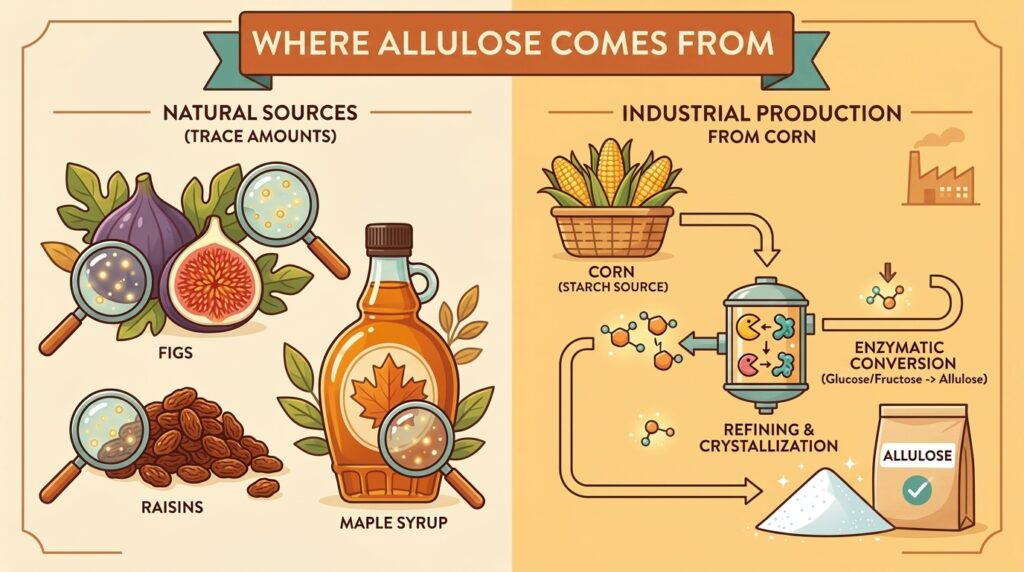
If you’re wondering where does allulose come from, the honest answer has two parts: nature and the factory.
In nature, it shows up in trace amounts in:
- Figs and raisins
- Maple syrup
- Brown sugar and molasses
- Wheat and some other grains
But those trace amounts are nowhere near enough to supply the sweetener aisle. So nearly all the allulose you’ll actually eat is manufactured. Here’s how is allulose made on a commercial scale: producers start with fructose, often derived from corn, and use enzymes to convert it into allulose through a process similar to how high-fructose corn syrup is made. The result is a sweetener that’s structurally close to nature but produced through an industrial enzymatic process, not extracted drop by drop from figs.
That’s an important nuance for anyone asking is allulose natural. It occurs naturally, yes, but the allulose in your pantry was almost certainly made in a lab or processing plant using enzymes, not harvested from fruit. Some people are comfortable calling that “natural” because the process mimics nature; others reserve that word for things pulled directly from a plant. Either way, it’s a fair question to ask, and the Cleveland Clinic’s overview of allulose is a good next stop if you want the clinical breakdown of how it’s produced and processed by the body.
Is Allulose a Sugar Alcohol? Clearing Up the Confusion
This is one of the most common mix-ups out there, so let’s settle it directly: is allulose a sugar alcohol? No, it isn’t. Sugar alcohols like erythritol, xylitol, and sorbitol belong to a completely different chemical family called polyols. Allulose is a monosaccharide, meaning it’s a simple sugar, structurally grouped with glucose and fructose rather than with the sugar alcohols.
That distinction actually matters for how your body handles it. Sugar alcohols are often only partially absorbed, which is why eating too much of them can cause bloating or a laxative effect. Allulose takes a different path.
Roughly 70% of allulose is absorbed in the small intestine and moves into the bloodstream within about an hour, but it isn’t metabolized for energy the way glucose or fructose are. Instead, most of it is simply filtered out by the kidneys and leaves the body largely unchanged. That’s a very different journey than what happens with sugar alcohols, and it’s part of why allulose tends to cause less digestive upset for most people, at least in reasonable amounts.
Is Allulose an Artificial Sweetener?
Another frequent question is is allulose an artificial sweetener, and this one deserves a nuanced answer rather than a flat yes or no.
Allulose isn’t synthetic in the way aspartame or saccharin are, those are built from scratch in a lab with no direct natural counterpart at meaningful scale. But it also isn’t extracted straight from a plant the way stevia leaf extract or monk fruit extract can be. It occupies a middle ground: a real sugar that exists in nature, produced at commercial scale through enzymatic conversion.
Most nutrition scientists classify allulose as a “rare sugar” or “low-calorie sugar” rather than lumping it in with artificial sweeteners, largely because of its natural chemical structure and the way the body processes it. If precision matters to you, “naturally occurring rare sugar produced through enzymatic conversion” is the most accurate label, even if it’s a mouthful.
What Is Allulose Made From, Step by Step
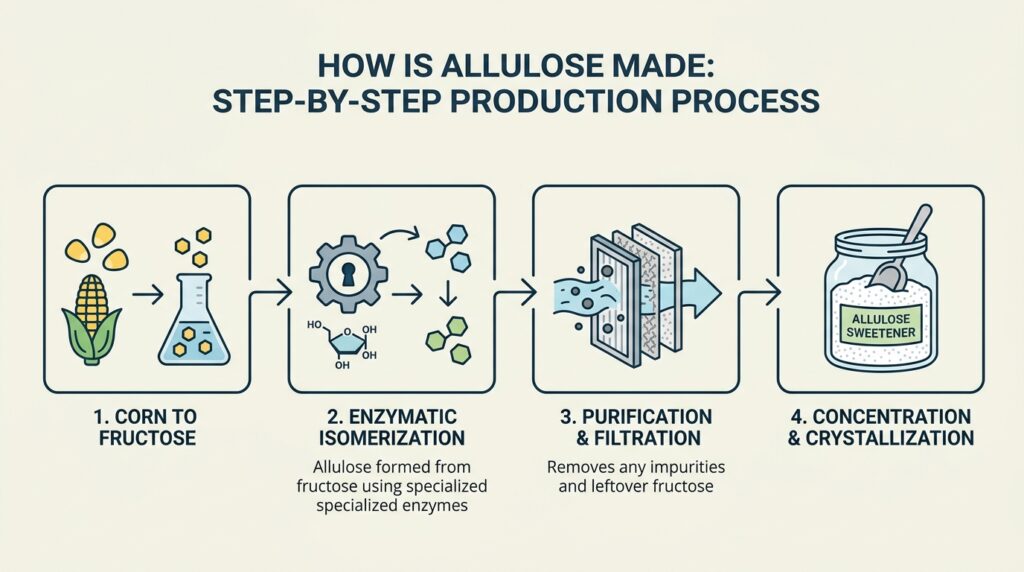
To really understand what is allulose made from, it helps to walk through the production process in simple terms:
- Starting material. Manufacturers typically begin with fructose, often sourced from corn.
- Enzymatic conversion. A specific enzyme (a D-psicose 3-epimerase) rearranges the fructose molecule into allulose. This is the same “epimer” relationship mentioned earlier.
- Purification. The resulting allulose is filtered, purified, and crystallized or turned into syrup form.
- Packaging. It’s then sold as granulated sweetener, liquid syrup, or blended into packaged foods like protein bars, ice cream, and baked goods.
This enzymatic process is the same general approach that unlocked large-scale allulose production in the 1990s, decades after the compound was first identified. It was first identified in the 1940s, although the enzymes needed to produce it on an industrial scale weren’t discovered until the 1990s.
Is Allulose Safe? What Regulators Actually Say
This is probably the question on most people’s minds, so let’s tackle is allulose safe head-on.
In the United States, allulose has been reviewed and accepted by the FDA multiple times since 2012. In June 2012, the FDA accepted the assertion that allulose is generally recognized as safe (GRAS) as a sugar substitute in various specified food categories, and similar GRAS notices followed for other manufacturers in the years after.
On top of that safety designation, the FDA has stated that allulose produces only negligible increases in blood glucose or insulin levels and does not promote dental decay, which is part of why the agency allows it to be excluded from total and added sugars on nutrition labels. You can read the agency’s own explanation in this FDA statement on allulose labeling.
That said, “generally recognized as safe” isn’t the same thing as “extensively studied for decades.” The FDA’s GRAS status doesn’t mean allulose has been rigorously tested over the long term, and researchers acknowledge there simply aren’t many long-term studies on allulose safety yet. That’s not necessarily alarming, most novel food ingredients start out this way, but it’s worth knowing before you decide is allulose good for you as a daily habit versus an occasional swap.
Allulose Health Risks and Side Effects Worth Knowing
If you’re researching allulose health risks or allulose sweetener side effects, the picture so far is reassuring but not spotless. The main known issue is digestive.
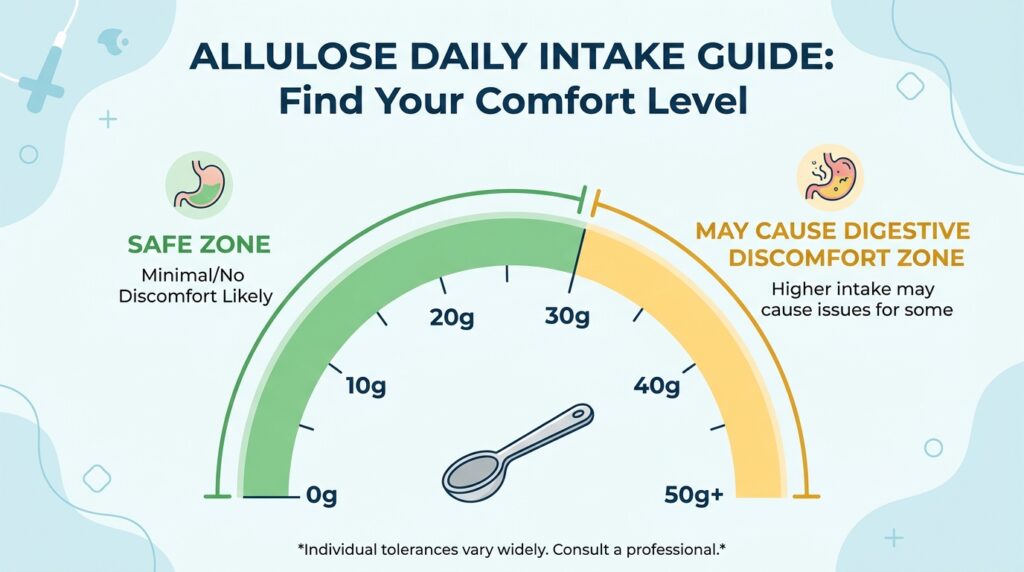
Several human clinical studies reviewed by the FDA reported no adverse effects of allulose in normal amounts, and the only known side effect identified so far is gastrointestinal discomfort when it’s consumed in large quantities. That typically shows up as bloating, gas, or an upset stomach if you overdo it.
So how much allulose is too much? Research submitted to the FDA suggested a practical ceiling. In 2020, the FDA accepted the conclusion that the maximum tolerable daily consumption for a 60 kg (about 132 lb) adult was roughly 33 to 36 grams. That’s a helpful benchmark, though your own tolerance may be lower or higher depending on your body and how much you’re used to eating.
A quick, practical rule that shows up across nutrition resources: start with a teaspoon or two in coffee or baking, see how your stomach reacts, and scale up gradually rather than swapping a whole cup of sugar for allulose on day one.
Why Is Allulose Banned in Europe and Canada?
This question comes up constantly, and the framing is a little misleading, so let’s clear it up properly. People often ask why is allulose banned in Europe as if regulators found a specific danger and pulled it from shelves. That’s not quite what happened.
Allulose is approved by the FDA in the United States and in several other countries including Japan, Mexico, Singapore, and South Korea, but it is not approved for use in Canada or Europe. In those regions, it’s classified as a “novel food,” meaning it hasn’t been on the market long enough to meet the extensive testing and approval timeline those regulatory systems require.
In other words, this is a case of allulose banned in Canada and the EU due to a slow-moving regulatory queue, not a documented safety failure. Europe’s “novel food” category is notoriously thorough and can take years to clear, regardless of how promising the underlying science looks. Products already popular in the U.S. market often wait a long time before they clear that particular hurdle. For a closer look at how this plays out for Canadian consumers specifically, this regulatory summary on allulose in Canada breaks down the current status and what it means for people trying to buy it there.
Does Allulose Raise Blood Sugar?
Short answer: not meaningfully, for most people. Allulose has a very low glycemic index of about 1, and it’s fully absorbed in the small intestine but not metabolized, instead being secreted through urine, which is part of why it helps regulate blood sugar rather than spike it.
That’s the mechanism behind why so many people specifically search does allulose raise blood sugar when they’re managing diabetes or prediabetes. Because it isn’t broken down into glucose the way table sugar is, it doesn’t trigger the same insulin response. That doesn’t mean it’s a treatment for blood sugar issues, but it does explain why it’s frequently recommended as a lower-impact alternative to regular sugar for people watching their glucose levels.
Is allulose keto-friendly, then? Generally yes. With a glycemic index near zero and minimal usable calories, it fits comfortably within most low-carb and ketogenic eating patterns, which is why you’ll see it show up in keto-labeled ice cream, protein bars, and baking mixes.
Allulose vs. Other Sweeteners: How It Really Compares
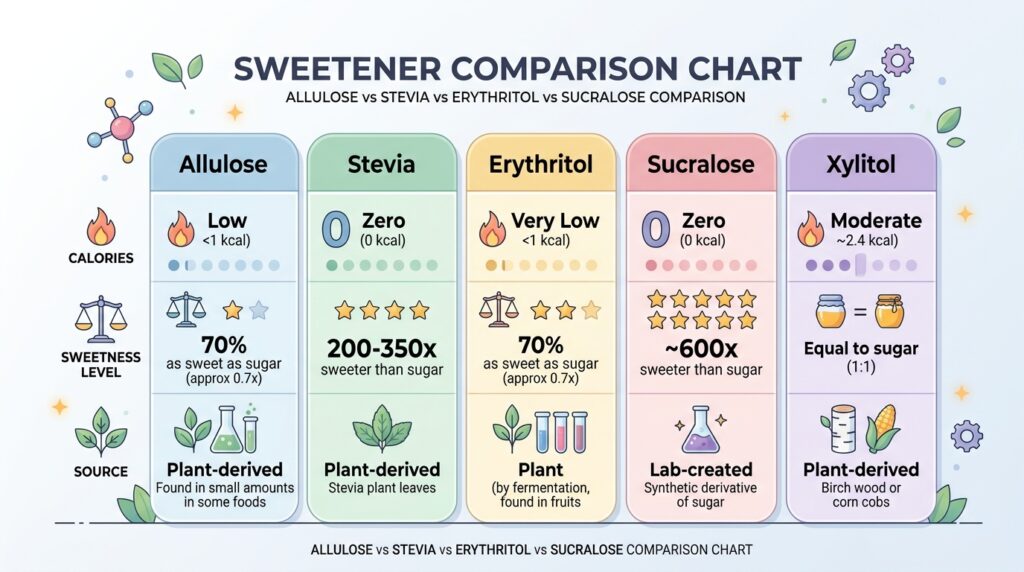
This is where things get practical. You don’t just want to know what allulose is, you want to know how it stacks up against the sweeteners already in your pantry.
Allulose vs. Stevia
The allulose vs stevia comparison usually comes down to sweetness intensity and taste. Stevia is a plant-derived, high-intensity sweetener, meaning a tiny amount goes a long way, and it’s calorie-free. Allulose is much closer to sugar in both sweetness level and how it behaves in cooking and baking, but it does carry a small number of calories. If you’ve ever noticed a slightly bitter or licorice-like aftertaste with stevia, that’s the main complaint people bring to allulose comparisons, since allulose tends to taste cleaner and more sugar-like.
Allulose vs. Erythritol
Allulose vs erythritol is probably the most searched comparison right now, and for good reason. Erythritol has come under real scrutiny recently. A 2023 study published in Nature Medicine found that higher blood levels of erythritol were associated with an increased risk of heart attack and stroke, and the researchers noted that further study of erythritol’s long-term cardiovascular risks is needed. That research came out of a large study led by the Cleveland Clinic, and you can read the National Institutes of Health’s summary of the findings in this NIH research summary on erythritol and cardiovascular risk.
Allulose hasn’t been linked to anything comparable in current research, which naturally raises the question is allulose safer than erythritol. Based on what’s published so far, allulose’s safety profile looks more favorable, but it’s also a newer ingredient with a shorter research history overall, so “no red flags yet” isn’t quite the same as “proven safe long-term.” Reasonable caution applies to both.
For texture, erythritol has a cooling sensation on the tongue and can crystallize oddly in some recipes, while allulose behaves more like real sugar in baking, including helping baked goods brown properly, something many sugar substitutes struggle to do.
Allulose vs. Sucralose
Sucralose vs allulose is a comparison between two very different categories. Sucralose (sold widely as Splenda) is an artificial, zero-calorie, high-intensity sweetener made by chemically modifying sugar molecules. Allulose is a low-calorie natural sugar used in much larger quantities to match sugar’s sweetness. If your priority is avoiding anything that reads as “artificial” on a label, allulose has the edge. If your priority is the lowest possible calorie count and you don’t mind synthetic sweeteners, sucralose still wins on that front. The allulose vs Splenda debate often really comes down to personal comfort with processed versus naturally derived ingredients rather than hard safety differences, since both are FDA-approved.
Allulose vs. Xylitol
Allulose vs xylitol is worth a quick mention too, mainly because xylitol is a sugar alcohol with its own quirks, including the fact that it’s toxic to dogs even in small amounts. Allulose carries no such warning for pets in the same documented way, and it doesn’t have xylitol’s tendency to cause digestive upset at lower doses. Xylitol does have a genuine dental health benefit, though, since it actively resists the bacteria that cause cavities, something allulose hasn’t been shown to do in the same targeted way.
Quick Comparison
| Sweetener | Type | Calories (approx.) | Sweetness vs. Sugar | Common Concern |
|---|---|---|---|---|
| Allulose | Rare sugar | ~0.2–0.4 kcal/g | ~70% | Digestive upset in large amounts |
| Stevia | Plant extract | 0 kcal | 200–300x | Aftertaste for some users |
| Erythritol | Sugar alcohol | ~0.2 kcal/g | ~70% | Recent cardiovascular research concerns |
| Sucralose | Artificial | 0 kcal | ~600x | Synthetic origin, heat stability debates |
| Xylitol | Sugar alcohol | ~2.4 kcal/g | ~100% | Toxic to dogs, digestive effects |
Allulose Benefits: Why People Are Switching
Setting aside the comparisons, here’s a straightforward rundown of the allulose benefits that keep coming up in nutrition circles:
- Minimal blood sugar impact, useful for people managing glucose levels
- Near-sugar taste, without the bitter or artificial aftertaste some substitutes leave behind
- Bakes and browns like real sugar, unlike many substitutes that behave strangely in the oven
- Very low calorie contribution, roughly a tenth of table sugar’s calories
- Tooth-friendly, since it isn’t fermented by mouth bacteria the way sugar is
- No known link to cardiovascular risk in current research, unlike some competing sweeteners
That combination, sugar-like performance with a much smaller metabolic footprint, is exactly why allulose has been showing up in more protein bars, ice creams, and baking mixes over the past several years.
Allulose Dangers: The Honest Downsides
To keep this balanced, here are the real allulose dangers and limitations worth knowing before you commit to it:
- Digestive discomfort in large amounts. Bloating, gas, or loose stools if you exceed your personal tolerance.
- Limited long-term human data. It’s a relatively new ingredient in the mainstream food supply, so multi-decade safety data simply doesn’t exist yet.
- Price and availability. It tends to cost more than sugar or erythritol and isn’t stocked everywhere.
- Regulatory gaps abroad. Since it’s not approved in Canada or the EU, travelers or online shoppers in those regions may run into availability issues.
- Not calorie-free. Unlike stevia or sucralose, it does contribute a small number of calories, which matters if you’re counting closely.
None of these amount to a documented health crisis, but they’re the honest tradeoffs, not just the marketing highlights.
Pros and Cons at a Glance
Pros:
- Tastes close to real sugar
- Minimal effect on blood glucose and insulin
- Performs well in baking
- FDA-recognized as GRAS
Cons:
- Can cause GI discomfort in high doses
- Not extensively studied long-term
- More expensive than table sugar
- Not approved in Canada or the EU
Allulose vs. Sugar and Sugar Substitutes: The Bigger Picture
Zooming out from the individual comparisons, the general allulose vs sugar debate boils down to trade-offs. Table sugar delivers reliable sweetness and browning but comes with the well-documented downsides of added sugar consumption, blood sugar spikes, extra calories, and dental decay. Allulose delivers most of the culinary performance of sugar with far less of that metabolic baggage, at the cost of a higher price tag and a shorter research track record.
As a broader allulose sugar substitute, it tends to work best in recipes where you want sugar’s texture and browning behavior without sugar’s blood sugar impact, think cookies, sauces, and glazes, rather than recipes relying purely on sugar’s structural role, like certain candy-making techniques where crystallization matters.
If you’re weighing sweeteners for baking specifically, the general rule holds up well in home kitchens too: sweeteners that mimic sugar’s crystal structure and moisture behavior, like allulose, tend to give you the most reliable texture and browning results.
Common Myths About Allulose, Cleared Up
A few misconceptions keep circulating, so let’s address them directly.
Allulose is the same as sugar alcohol. Already covered above, but worth repeating: it’s a monosaccharide, not a polyol. Different chemical family entirely.
Allulose has zero calories. Not quite. It has a small number of calories, around 0.2 to 0.4 per gram, far lower than sugar’s 4 calories per gram, but not literally zero.
If it’s banned in Europe, it must be dangerous. As covered earlier, this is a regulatory timeline issue tied to the EU’s novel food classification, not a documented safety failure.
Allulose can’t be used in baking. Actually one of allulose’s strongest selling points is that it browns and behaves remarkably close to real sugar in the oven, unlike many substitutes that leave baked goods pale or gummy.
Expert Tips for Using Allulose at Home
If you decide to give it a try, a few practical tips make the transition smoother:
- Start small. Replace a portion of the sugar in a recipe rather than swapping it entirely on your first attempt.
- Expect slightly less sweetness. Since it’s about 70% as sweet as sugar, you may need a little more by volume to match your usual taste.
- Watch your total daily intake. Stay mindful of the roughly 33 to 36 gram daily benchmark mentioned earlier, especially if you’re using multiple allulose-sweetened products in one day.
- Store it like sugar. A sealed container in a cool, dry pantry works fine, no special storage needed.
- Check labels on “keto” products. Many keto and low-carb snacks now use allulose specifically because of its blood sugar profile, so reading ingredient lists helps you understand what you’re actually eating.
FAQs About Allulose
Is allulose healthy?
For most people in moderate amounts, current evidence suggests allulose is a reasonable lower-impact alternative to sugar, particularly for blood sugar management. That said, “healthy” is relative, and whole, unsweetened foods remain the foundation of any balanced diet. Allulose is best viewed as a tool for reducing added sugar, not a health food in itself.
Is allulose bad for you in large amounts?
Consuming significantly more than the suggested daily benchmark can lead to digestive discomfort like bloating or gas. Outside of that, no serious health risks have been documented in current research, though long-term data is still limited.
Does allulose have an aftertaste?
Most people describe allulose as tasting notably close to real sugar, without the bitter or metallic aftertaste some report with stevia or certain artificial sweeteners. A very slight cooling sensation is sometimes noted, but it’s generally mild.
Is allulose better than erythritol?
Based on current research, allulose doesn’t carry the cardiovascular concerns recently raised about erythritol, which may make it the more comfortable choice for some people. However, allulose is a newer ingredient overall, so ongoing research is still filling in the long-term picture for both.
Where can I buy allulose, and is it expensive?
Allulose is sold in granulated, powdered, and liquid syrup forms through most major grocery retailers and online marketplaces in the U.S. It typically costs more per pound than table sugar or erythritol, reflecting its more complex production process.
Final Thoughts
Allulose sits in an unusual spot in the sweetener world: naturally occurring but industrially produced, sugar-like but metabolically distinct, well-reviewed by the FDA but still short on decades of long-term data. That combination makes it a genuinely useful option for people trying to cut back on added sugar without sacrificing taste and texture in cooking and baking, as long as you keep portions reasonable and stay aware that “generally recognized as safe” isn’t the same as “studied for fifty years.”
If you’re curious to try it, start small, read labels carefully, and pay attention to how your own body responds. That’s really the most reliable research you can do.
This article is for general informational purposes only and is not a substitute for professional medical or nutritional advice. Talk to your doctor or a registered dietitian before making changes to your diet, especially if you have diabetes or another metabolic condition.

