
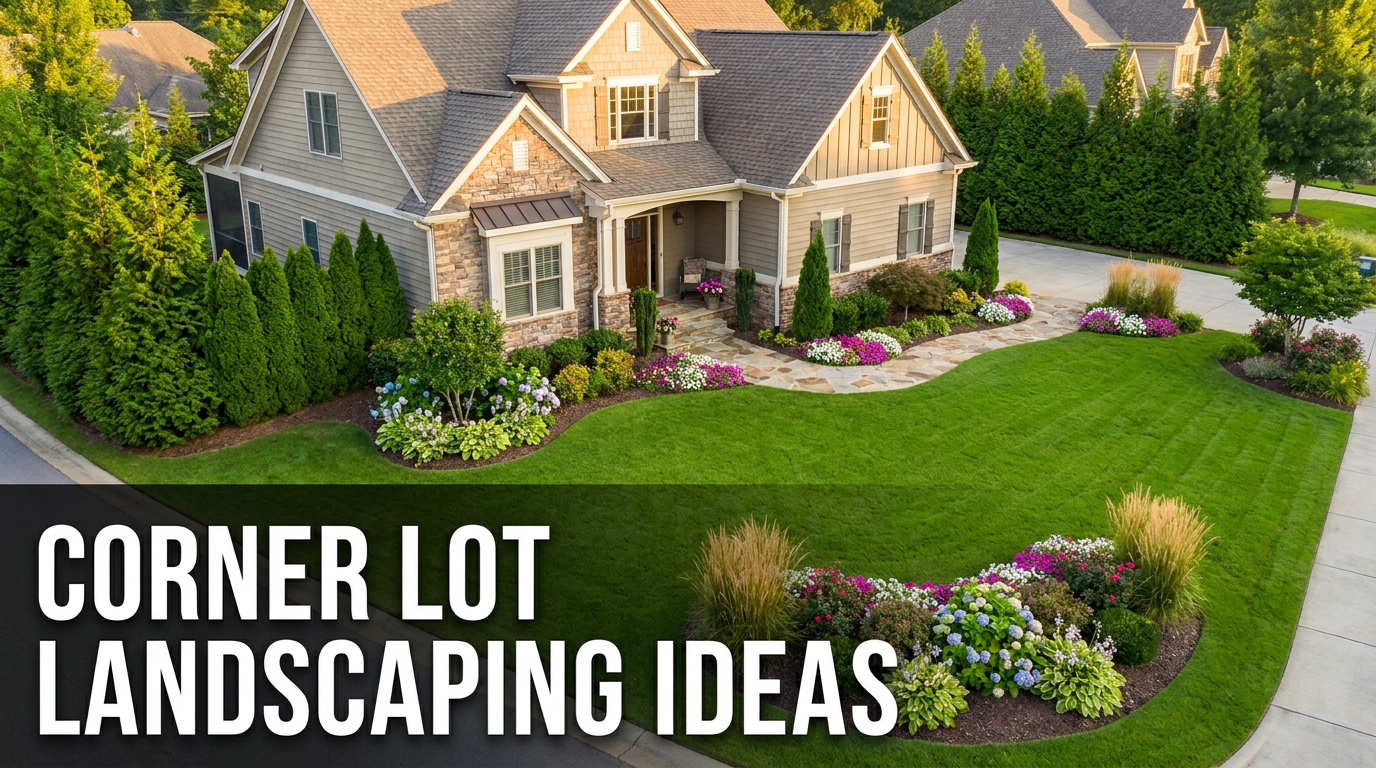
There’s a moment every corner lot homeowner knows well — you step outside, look at that wide-open, exposed yard wrapping around two street sides, and think: What do I even do with this?
Corner lots come with a rare mix of opportunity and challenge. You’ve got more square footage than a standard lot, great visibility from the street, and that satisfying feeling of owning the “statement home” on the block. But with all that visibility comes less privacy, tricky mowing patterns, and neighbors (or strangers) cutting across your grass like it’s a shortcut.
With the right corner lot landscaping ideas, that extra land becomes your biggest asset — not your biggest headache. And because these highly visible areas have such a strong effect on a property’s first impression, our guide to home exterior improvements that enhance curb appeal can help you plan the wider exterior.
Whether you’re starting from a bare patch of grass or refreshing a tired yard, this guide covers everything you need: privacy solutions, curb appeal boosters, plant picks, hardscaping ideas, low-maintenance designs, and expert tips to make it all come together beautifully.
What Makes a Corner Lot Different from a Standard Yard?
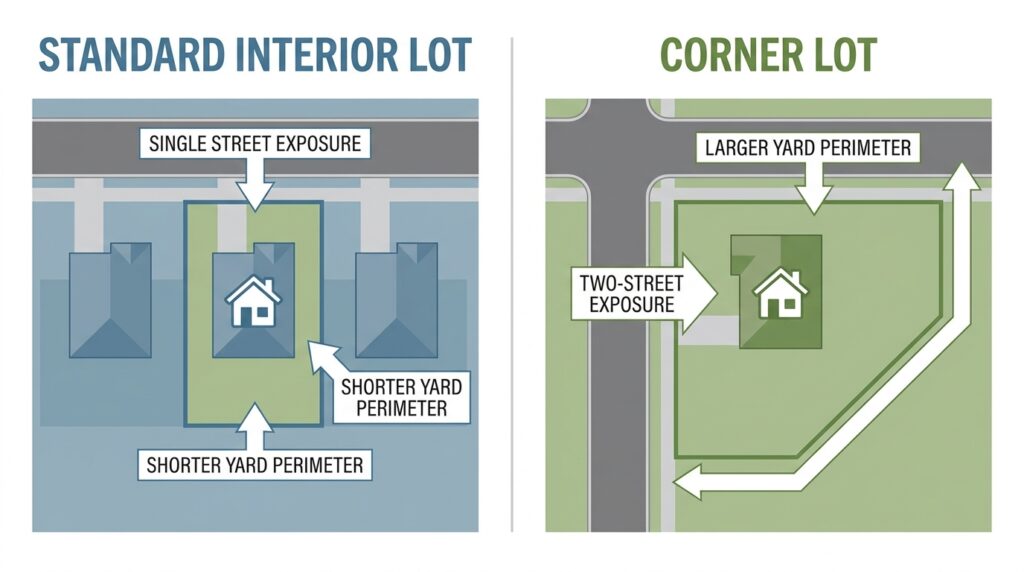
Before diving into design, it helps to understand what you’re working with.
A corner lot sits at the intersection of two streets, meaning two of your property’s sides face public roads. That creates a few unique characteristics:
- More curb appeal exposure — Your yard is visible from two directions, which doubles your first impression impact.
- Less natural privacy — Fences and hedges become more important here than on interior lots.
- Irregular shape — The yard often wraps around two sides, which can complicate lawn care and irrigation planning.
- Traffic and foot traffic — People may cut across your corner, especially if there’s no defined path or barrier.
- Increased visibility for signage — Great if you run a home-based business, want house numbers to pop, or simply want to show off your garden.
According to Zillow Research, curb appeal can add significant value to your home’s perceived worth, and corner lots — when well-landscaped — consistently rank as more visually appealing to buyers.
Define Your Goals Before You Dig
Good landscaping starts with a plan, not a plant purchase. Ask yourself:
- Do I need more privacy? If yes, you’ll prioritize hedges, fences, or living walls.
- Is low maintenance a priority? Then drought-tolerant plants, mulch, and hardscaping are your friends.
- Do I want to boost curb appeal? Focus on the front-facing beds, borders, and a strong entry.
- Are kids or pets using the yard? Safety and open play space must factor in.
- What’s my budget? A realistic budget shapes everything from plants to professionals.
Once you’re clear on goals, the design process becomes much more intuitive.
Corner Lot Landscaping Ideas That Actually Work
1. Use Curved Garden Beds to Break Up the Straight Lines
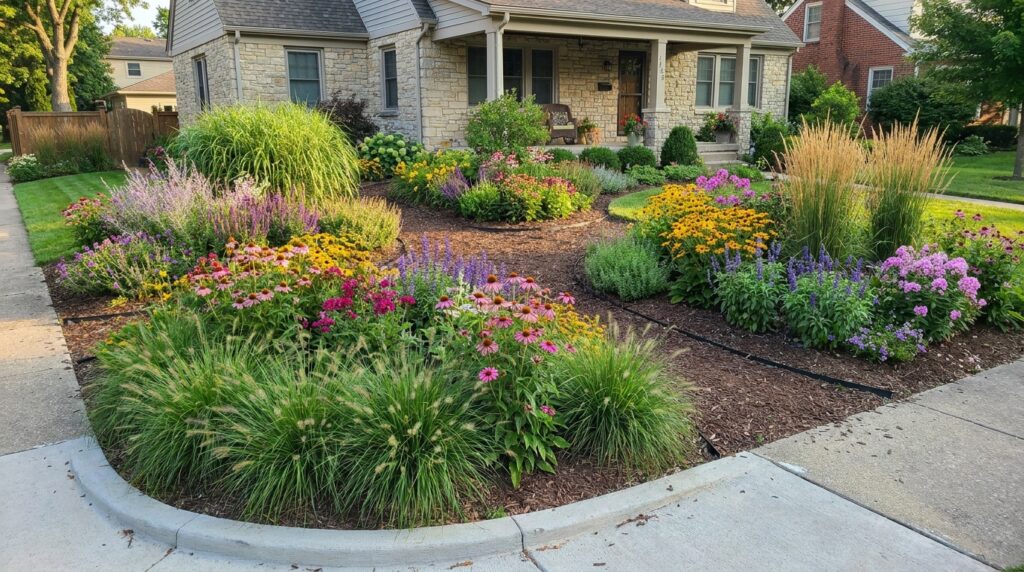
One of the most common mistakes on corner lots is relying on straight-edged beds that feel stiff and out of place. Curved garden beds follow the natural flow of a corner, softening that harsh 90-degree angle.
Here’s how to make it work:
- Use a garden hose or rope to lay out a curved shape before digging — it lets you visualize the flow.
- Keep curves gradual and wide — sharp curves are hard to mow around and look busy.
- Layer your planting: tall plants in back, medium in middle, low-growing ground covers in front.
Curved beds planted with a mix of ornamental grasses like Karl Foerster Feather Reed Grass and flowering perennials like black-eyed Susans or coneflowers create a naturalistic look that thrives with minimal intervention.
2. Add Privacy Without Building a Wall
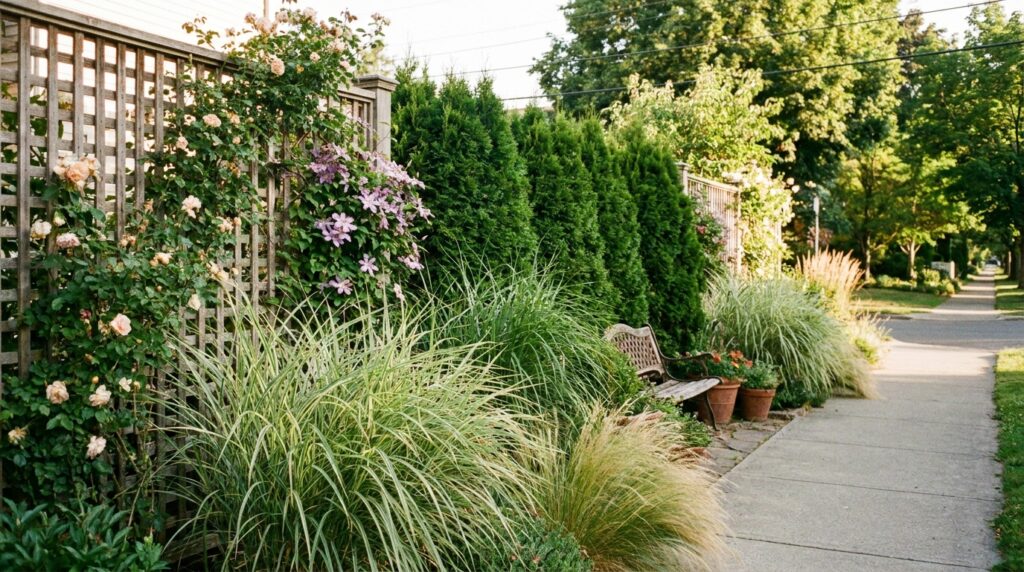
Privacy is the number-one challenge for corner lot owners. You don’t always need a solid fence to solve it — and in many neighborhoods, zoning laws restrict fence heights near street corners for sight-line safety.
Instead, try layered privacy planting:
| Plant Type | Example Species | Height | Maintenance |
|---|---|---|---|
| Tall evergreen shrub | Emerald Green Arborvitae | 10–15 ft | Low |
| Mid-level screen | Knockout Roses | 4–6 ft | Low–Medium |
| Low border | Ornamental grasses | 2–4 ft | Very Low |
| Ground cover | Creeping Juniper | 6–12 in | Very Low |
According to the University of Minnesota Extension, layered plantings not only provide better privacy than a single row of shrubs but also support local pollinators and improve soil health.
Pro Tip: Always check your local setback requirements before planting near a corner. Many municipalities require a clear sight triangle — typically a triangular zone near the intersection — to remain free of tall plantings for driver safety. Your local zoning office can clarify the rules.
3. Define the Corner with a Focal Point
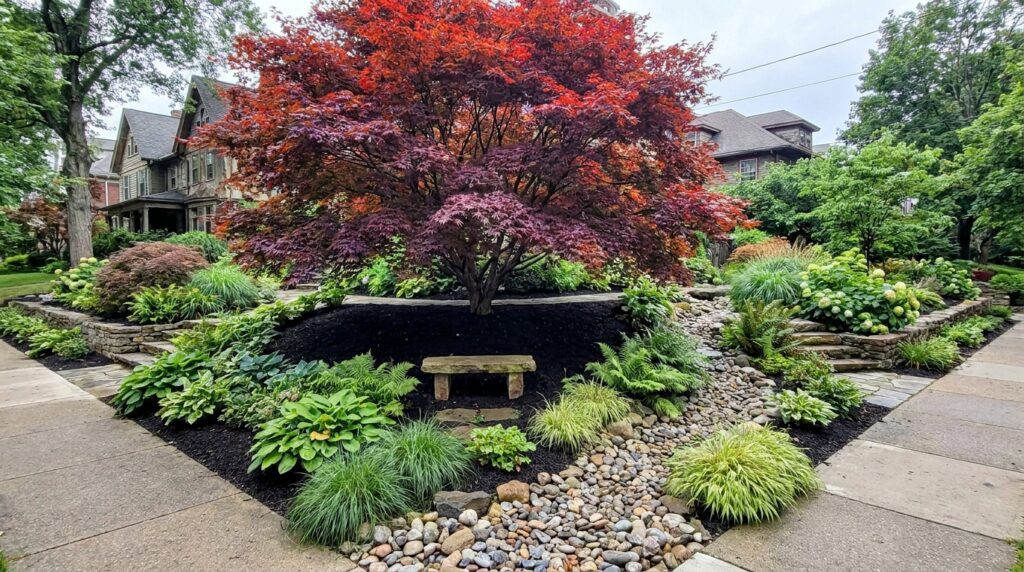
The actual corner — that point where your two street sides meet — is prime real estate for a design statement.
Popular focal point ideas include:
- A specimen tree — A Japanese maple, flowering dogwood, or river birch adds structure, seasonal interest, and vertical drama.
- A boulder or decorative rock — Large natural stones anchor a planting bed and look intentional.
- A birdbath or garden sculpture — Adds personality and draws the eye.
- A circular raised bed — Works beautifully at a corner and gives you the chance to pack it with seasonal color.
The American Horticultural Society recommends choosing a focal point plant that offers at least two seasons of interest — spring bloom and fall color, for example — to keep your corner looking great year-round.
4. Install a Defined Pathway to Prevent Foot Traffic Shortcuts
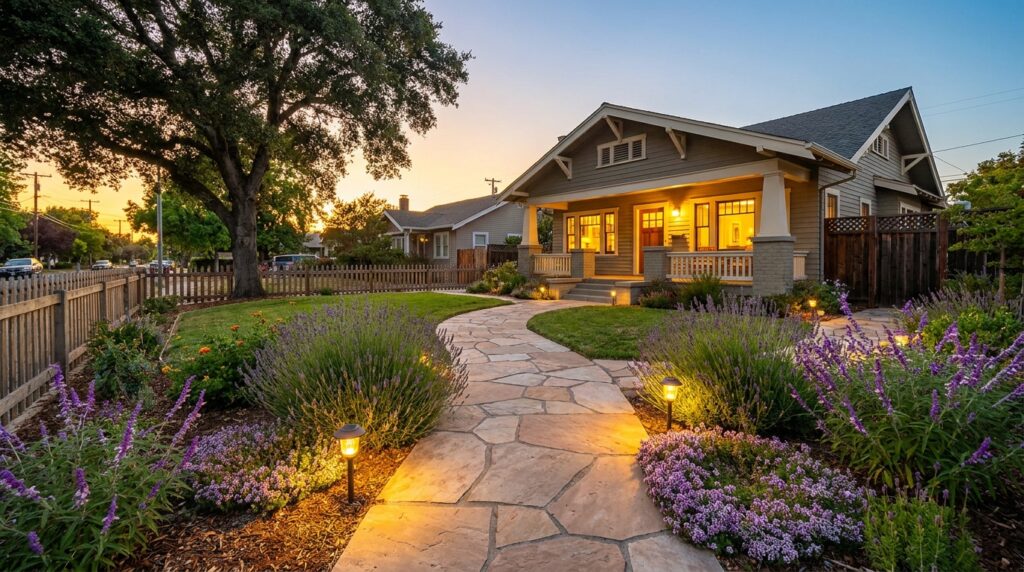
If people keep cutting across your grass, don’t fight it — guide it.
A clearly defined pathway from the sidewalk to your front entry signals to pedestrians where they should walk. It also adds a design element that ties your landscaping together.
Best materials for corner lot pathways:
- Flagstone — Natural, casual, and low-maintenance
- Concrete pavers — Durable and easy to install in patterns
- Gravel with edging — Budget-friendly and excellent for drainage
- Brick — Classic curb appeal, long-lasting when properly set
The National Association of Realtors has noted that exterior improvements like patios and walkways consistently show strong returns, both in perceived value and buyer interest.
Don’t forget path lighting — solar-powered stake lights are easy to install and add nighttime charm.
5. Plant a Rain Garden at the Corner to Manage Runoff
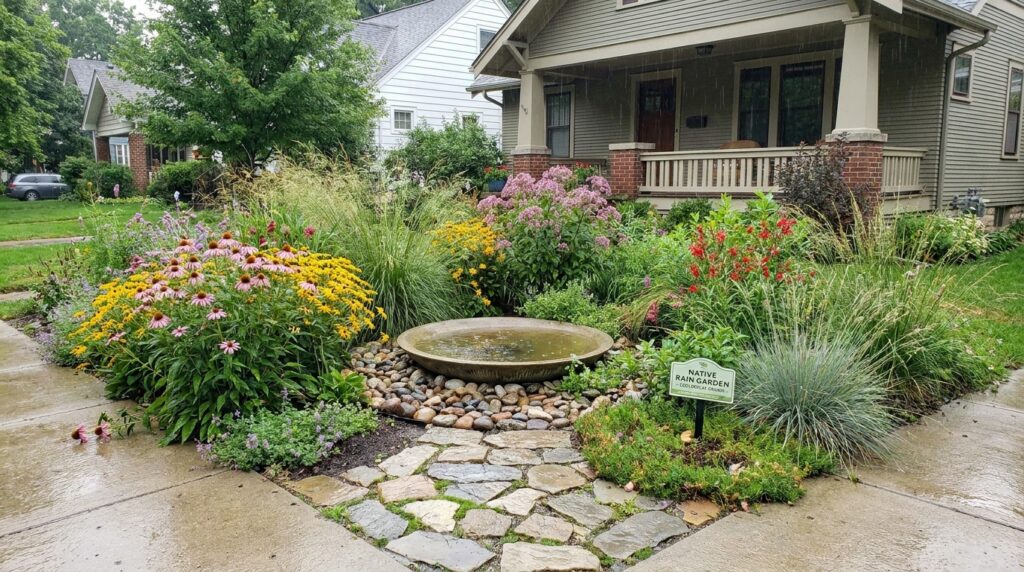
Corner lots are often at the lowest point of a slope or sit at an intersection where stormwater drains. If you’ve noticed puddles, erosion, or soggy patches, a rain garden is an elegant and eco-friendly fix.
A rain garden is a shallow, bowl-shaped depression planted with deep-rooted native plants that absorb and filter stormwater runoff. It typically:
- Reduces runoff into storm drains by 30–40%, according to Penn State Extension
- Supports local pollinators and native wildlife
- Requires minimal irrigation once established
- Looks beautiful even when dry
Good plants for rain gardens include native species like Joe-Pye Weed, Wild Iris, Cardinal Flower, and Switchgrass. The EPA’s Green Infrastructure resources offer detailed guidance for homeowners on rain garden installation.
6. Use Hardscaping to Reduce Lawn Maintenance
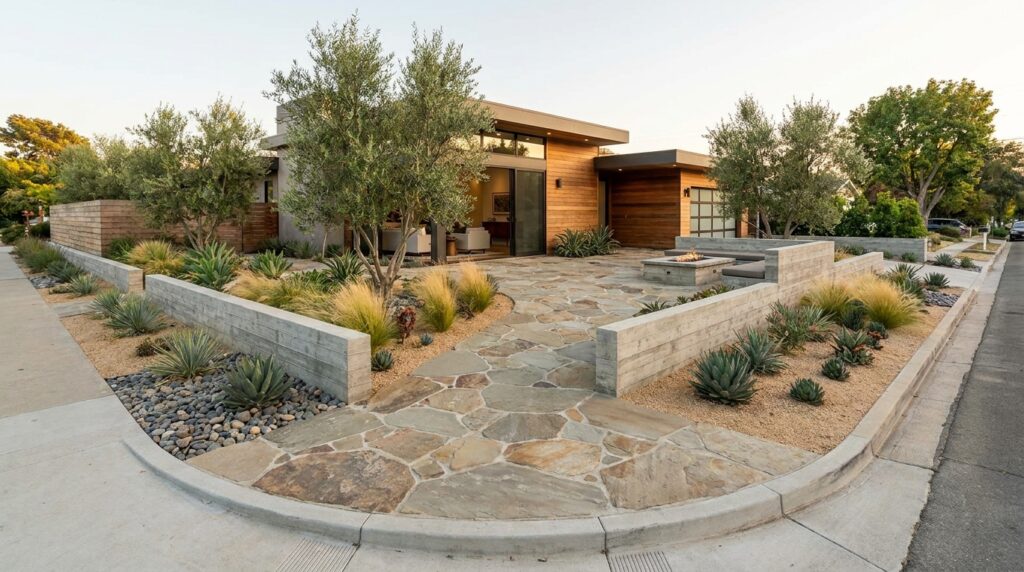
Mowing a corner lot’s irregular shape gets old fast. Hardscaping — using non-plant elements like stone, concrete, gravel, or wood — reduces the grassy area you need to maintain while adding beautiful structure.
Top hardscaping ideas for corner lots:
- Decorative gravel or river rock beds — Low-cost, weed-suppressing, and drought-proof
- Retaining walls — Useful if your lot has any slope; adds dimension and defines spaces
- Paver patios — Even a small front seating area can transform a corner lot into an inviting outdoor room
- Dry creek beds — Both decorative and functional for drainage
- Raised planting beds — Keep plants organized, elevated, and easy to tend
According to HGTV’s outdoor living resources, homes with well-defined outdoor living spaces — even small ones — consistently attract more buyer interest and higher offers.
7. Go Xeriscape for a Water-Wise Corner Lot
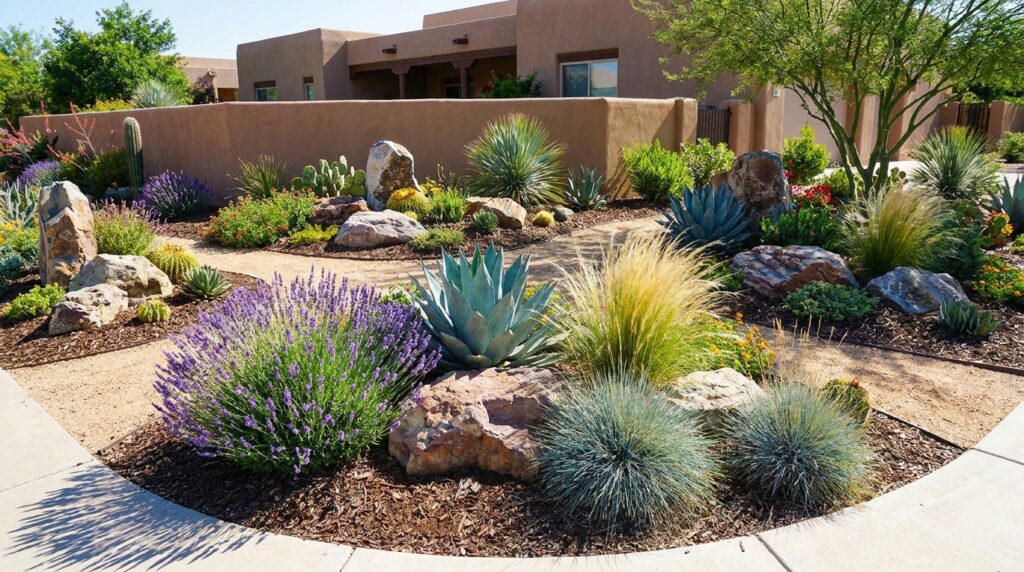
If you’re dealing with dry conditions or just want to slash your water bill, xeriscaping is one of the smartest corner lot landscaping ideas you can pursue.
Xeriscaping means designing your landscape to require little or no irrigation beyond natural rainfall. It’s not about putting rocks everywhere — it’s about smart plant selection and placement.
Xeriscape-friendly plants:
- Lavender — Fragrant, pollinator-friendly, and thrives in dry conditions
- Russian Sage — Tall, airy, and purple — perfect for a corner focal point
- Agave and Yucca — Architectural drama with zero water needs after establishment
- Creeping Thyme — Ground cover that handles foot traffic and smells wonderful
- Blanket Flower (Gaillardia) — Blazing color, drought-tolerant perennial
The Water Research Foundation estimates that turf grass accounts for up to 50% of residential water use in dry regions. Replacing even a portion of your lawn with xeriscape plantings can dramatically cut consumption.
8. Create Visual Interest with Elevation Changes
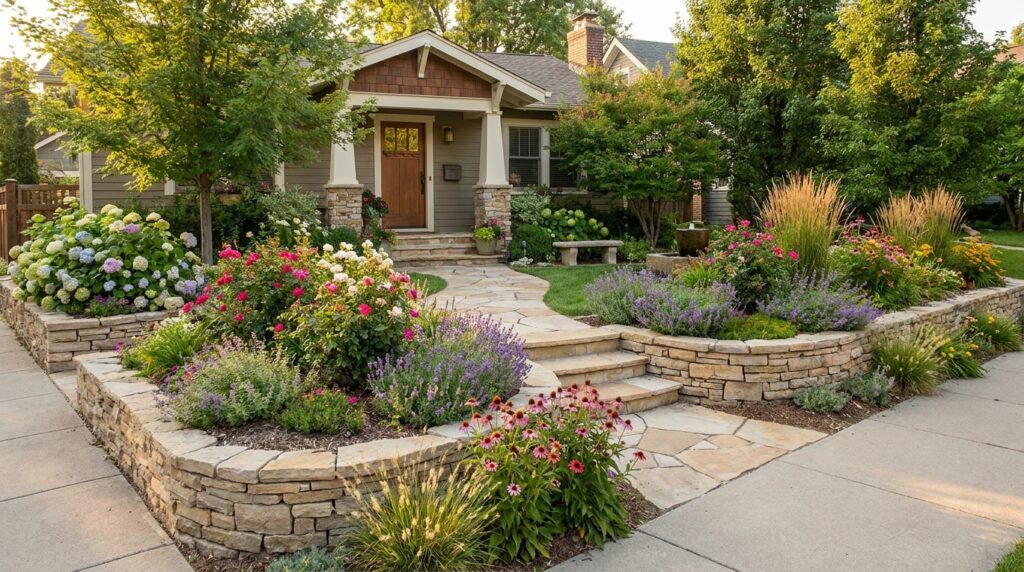
Flat corner lots often feel one-dimensional. Adding elevation — even subtle changes — creates depth, visual texture, and makes your yard feel intentionally designed rather than incidentally planted. For larger backyard projects, custom pool design and landscaping can further define separate areas for entertaining, relaxing, and recreation.
Ways to add elevation to a corner lot:
- Berms — Low mounded areas of soil that create gentle hills; plant the tops with ornamental grasses or shrubs
- Retaining walls — Stack natural stone or use manufactured concrete blocks to create tiered beds
- Raised garden beds — Even 12 inches of height adds definition
- Sloped lawn transitions — Gradual grading between different yard zones creates flow
Landscape architect-approved tip: make berms roughly 3 times as wide as they are tall for the most natural look. A berm that’s 2 feet tall should be at least 6 feet wide.
9. Frame the Property with a Border Planting Strip
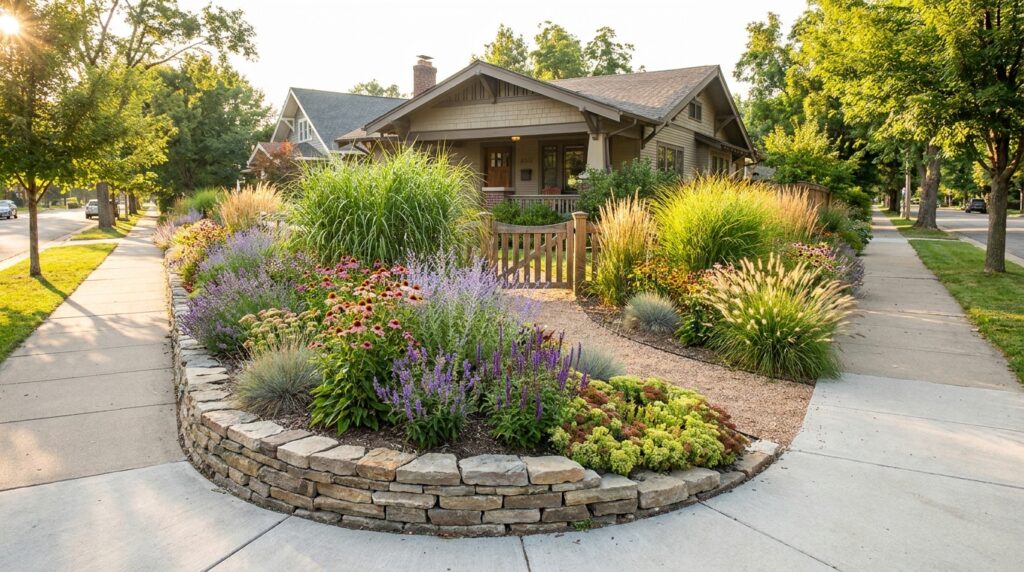
One of the most effective ways to unify a corner lot’s two-street exposure is to install a continuous border planting strip along both sidewalk sides.
This border creates a visual frame for your property and signals “designed intentionality” to anyone who walks or drives by.
Border planting tips:
- Keep the border 2–4 feet wide for most residential lots
- Use consistent plants across both sides for unity — then vary color or texture within the species
- Choose plants that stay below 3 feet unless your setback allows taller growth
- Install a clean metal or plastic edging strip to keep borders looking sharp
- Mulch with 2–3 inches of shredded bark or wood chips to suppress weeds
Some of the best border plants for corner lots include: Daylilies, Salvia, Catmint, Purple Coneflower, and Knock Out Roses. These are hardy, low-maintenance, and provide multi-season color.
10. Add Outdoor Lighting for Safety and Ambience
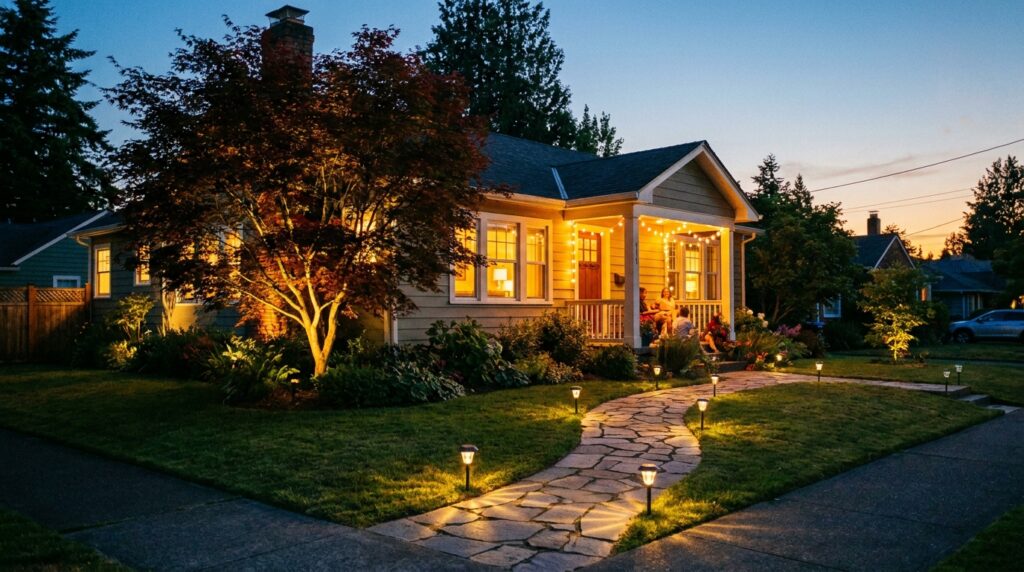
Lighting is the finishing touch that transforms a corner lot from “nice yard” to “wow, that looks incredible.”
Good corner lot landscape lighting serves two purposes: safety (illuminating walkways and corners) and ambience (making your home look welcoming at night).
Landscape lighting ideas for corner lots:
- Solar path lights — Line pathways and driveways without any wiring
- Uplighting — Place lights at the base of trees or large shrubs to create dramatic silhouettes
- Downlighting — Mount lights on your home’s eave to cast soft wash across garden beds
- Accent lights — Highlight your focal point tree or garden sculpture
- String lights — Draped along a fence or pergola for magical evening ambiance
The Illuminating Engineering Society recommends keeping landscape lighting on timers or motion sensors to avoid light pollution while maintaining the visual impact.
Expert Tips for Corner Lot Landscaping Success
Here are tips from professional landscape designers that can save you time, money, and headaches:
Start with the bones, then add color. Plant your structure first — trees, large shrubs, hardscaping — before filling in with perennials and annuals. Structure is what gives your yard form year-round.
Plant in odd-numbered groups. Groups of 3, 5, or 7 plants look more natural than even numbers. This is a principle used by professional designers across all landscape scales.
Match plants to your soil type. Before buying plants, do a quick soil test. Cooperative Extension Services in your state offer inexpensive soil testing kits. Planting in the wrong soil pH is the #1 reason landscaping fails.
Use the “thriller, filler, spiller” formula for containers and beds.
- Thriller — Tall, dramatic centerpiece
- Filler — Mid-height plants that fill gaps
- Spiller — Trailing plants that cascade over edges
Mulch everything. A 2–3 inch layer of organic mulch reduces weeding by up to 80%, conserves moisture, and keeps soil temperature stable. According to NC State Extension, proper mulching is one of the highest-impact, lowest-cost landscape maintenance practices.
Think year-round, not just spring. Choose plants that offer interest in at least two seasons. A yard that looks great in June but bare in October isn’t a fully designed landscape — it’s a seasonal garden.
Low-Maintenance Corner Lot Landscaping Ideas
Not everyone has hours to spend on yard work — and that’s perfectly fine. Here’s how to make your corner lot beautiful and manageable:
Go Native
Native plants are perfectly adapted to your local climate, soil, and rainfall. They require:
- No fertilizer (they evolved here)
- Minimal watering once established
- Less pest management
The Lady Bird Johnson Wildflower Center maintains a searchable native plant database by state — an excellent resource for finding what grows naturally in your region.
Reduce Turf Area
Every square foot of grass you replace with mulched beds or hardscaping is one less square foot to mow, edge, water, and fertilize. Even reducing your turf by 25–30% can significantly cut your weekly maintenance time.
Choose Shrubs Over Annuals
Annuals require replanting every year. Perennial shrubs — once established — return season after season with minimal care. Invest in quality shrubs the first year and enjoy years of low-effort beauty.
Install Drip Irrigation
A simple drip irrigation system on a timer delivers water exactly where it’s needed — at the root zone — reducing water use by up to 50% compared to overhead sprinklers while keeping your plants perfectly watered without lifting a finger.
Corner Lot Landscaping on a Budget
Great landscaping doesn’t require a giant budget. Here’s how to stretch every dollar:
| Budget Idea | Estimated Cost | Impact |
|---|---|---|
| Bag mulch from home store | $3–5/bag | High — instant polish |
| Wildflower seed mix | $10–20/lb | High — wide coverage |
| Metal landscape edging | $30–60/roll | Medium-High |
| Solar path lights (pack of 8) | $25–50 | Medium |
| Perennial division from neighbors | Free | High |
| Arborvitae from nursery (3-pack) | $50–120 | High — privacy impact |
Money-saving tips:
- Buy plants in late summer or fall — nurseries discount remaining inventory heavily.
- Divide perennials from your own yard or swap with neighbors.
- Start shrubs and trees from smaller, younger plants — they often catch up within 2–3 seasons.
- Join a local plant swap group on Facebook or Nextdoor.
- Use wood chip mulch from local tree services — many give it away free. ChipDrop connects homeowners with free wood chip deliveries from arborists.
Seasonal Corner Lot Landscaping Calendar
Spring
- Plant new perennials and shrubs
- Edge garden beds and refresh mulch
- Install pathway stones before summer growth
- Fertilize established plants as growth begins
Summer
- Water deeply but infrequently to encourage deep roots
- Deadhead flowers to extend bloom time
- Mow at higher height (3–4 inches) to reduce stress on grass
Fall
- Plant trees and shrubs — fall is ideal for root establishment
- Plant spring bulbs (tulips, daffodils, crocus)
- Cut back ornamental grasses and perennials after frost
- Apply fresh mulch to protect roots over winter
Winter
- Appreciate the structure: evergreens, bark texture, seed heads
- Plan next year’s additions
- Order seeds from catalogs (February)
- Prune dormant trees and shrubs (late winter)
FAQs: Corner Lot Landscaping Ideas
What is the best way to add privacy to a corner lot?
The most effective approach combines layered plantings with smart fence placement. Use tall evergreens like Arborvitae or Leyland Cypress as a backdrop, mid-level flowering shrubs in front, and low ornamental grasses at the border. Always check your local zoning for sight-triangle restrictions near intersections before planting tall plants near the corner itself.
How do I stop people from cutting across my corner lot?
Install a defined pathway that leads them where you want them to go — from the sidewalk toward your entrance. You can also use low barrier plantings (roses with thorns, dense ground cover, or a short decorative fence) to discourage shortcutting without being unfriendly. Physical deterrents feel less confrontational when they’re beautiful.
Are corner lots harder to landscape than regular lots?
They require a bit more planning due to their two-street exposure and irregular shape. But many homeowners find them more rewarding to landscape because you have more canvas to work with and your design becomes a neighborhood landmark. The key is working with the shape rather than fighting it.
What low-maintenance plants work well on a corner lot?
Some of the most reliable low-maintenance choices include: Knockout Roses, Ornamental Grasses (such as Blue Oat Grass or Fountain Grass), Coneflowers, Black-Eyed Susans, Catmint, Creeping Juniper, and Daylilies. These plants are hardy, return every year, and need minimal care once established.
How much does it cost to landscape a corner lot?
Costs vary widely depending on your goals and whether you DIY or hire a professional. A basic DIY refresh with mulch, plants, and edging might run $500–$2,000. A professionally designed and installed landscape typically ranges from $5,000 to $20,000+ for a full corner lot, depending on size and scope. Most homeowners do a phased approach — tackling one zone per season to spread out costs.
Conclusion
A corner lot is one of the most exciting landscaping challenges in residential design — and when done right, it becomes one of the most rewarding transformations you’ll ever make to your home.
You don’t need a massive budget or a landscape architecture degree. What you need is a clear plan, smart plant choices, and a design that plays to your lot’s natural strengths: high visibility, generous space, and the opportunity to create something your neighborhood genuinely notices.
Start with one idea from this list — maybe it’s defining your corner with a focal point tree, installing a pathway to stop foot traffic shortcuts, or simply edging and mulching your existing beds for a fresh, polished look. Small changes add up fast.
Your corner lot isn’t a problem to solve — it’s a stage waiting for your vision.

