
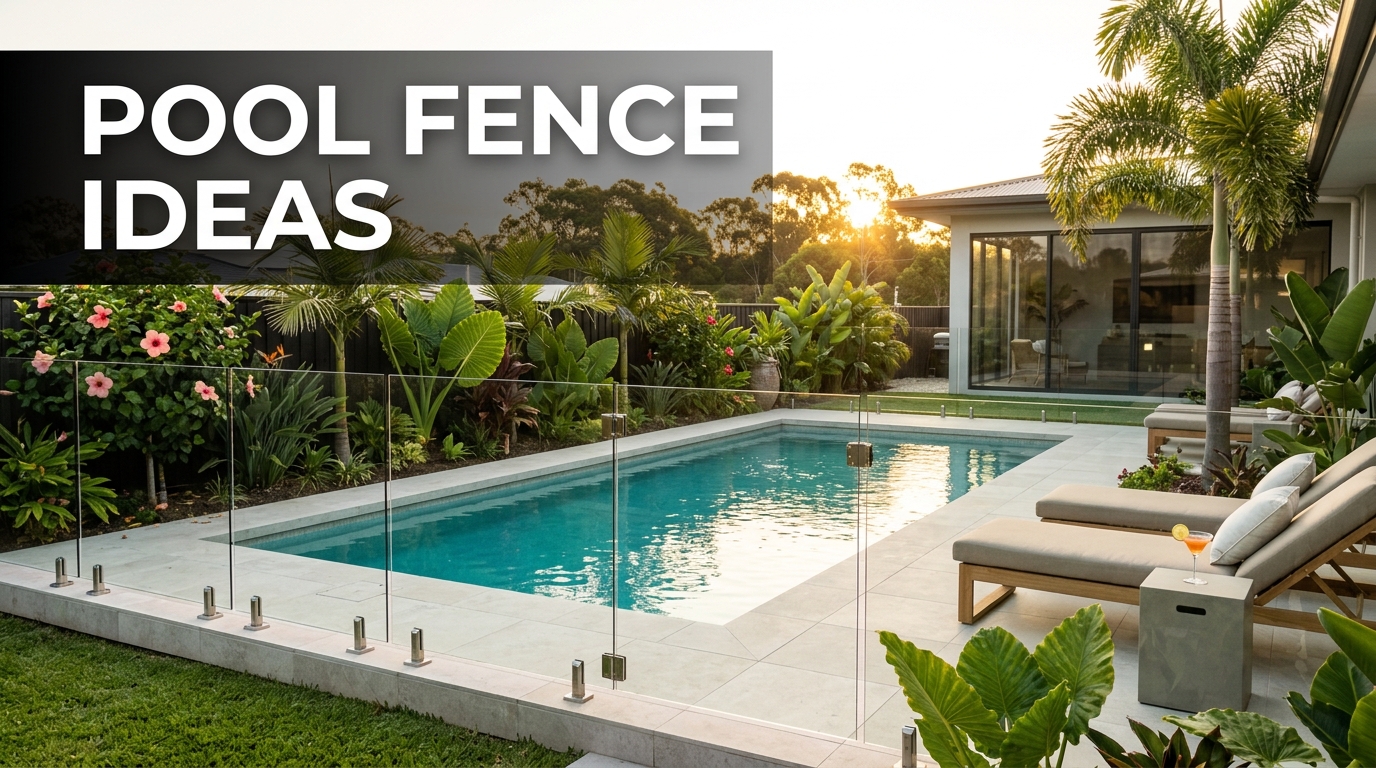
Most people think of pool fencing as a chore. A box to check for safety codes and insurance companies. But the truth is, your pool fence is one of the biggest design opportunities in your entire backyard. Get it right, and it can make your pool look like something out of a luxury resort. Get it wrong, and it becomes an eyesore that undermines everything else you’ve invested in.
This guide covers the best pool fence ideas available — from sleek glass panels to natural wood, budget-friendly aluminum to lush greenery — so you can find the perfect fit for your style, your space, and your safety requirements.
Whether you’re a first-time pool owner or redesigning an existing backyard, you’ll walk away with real ideas, practical advice, and the confidence to make a smart choice.
Why Your Pool Fence Choice Matters More Than You Think
Before we dive into specific designs, let’s talk about why this decision deserves serious thought.
Safety Is Non-Negotiable
Drowning is one of the leading causes of accidental death in children under 5, according to the Centers for Disease Control and Prevention (CDC). A properly installed pool fence is one of the most effective preventive barriers you can have.
The Consumer Product Safety Commission (CPSC) recommends that pool barriers be at least 4 feet high, have no footholds for climbing, and feature self-closing, self-latching gates. These aren’t optional suggestions — in most states, they’re legal requirements.
Local Codes Drive Your Decisions
Pool fencing regulations vary by state and even by municipality. Your local building department will have specific requirements for fence height, gate mechanics, and setback distance from the water. Always check with your local building authority before purchasing or installing any pool fence.
Aesthetics Affect Property Value
A well-chosen pool fence can meaningfully increase your home’s curb appeal and resale value. According to HGTV, pools with attractive, well-maintained surroundings — including quality fencing — tend to be viewed more favorably by buyers in warm-climate markets.
1. Glass Pool Fence Ideas
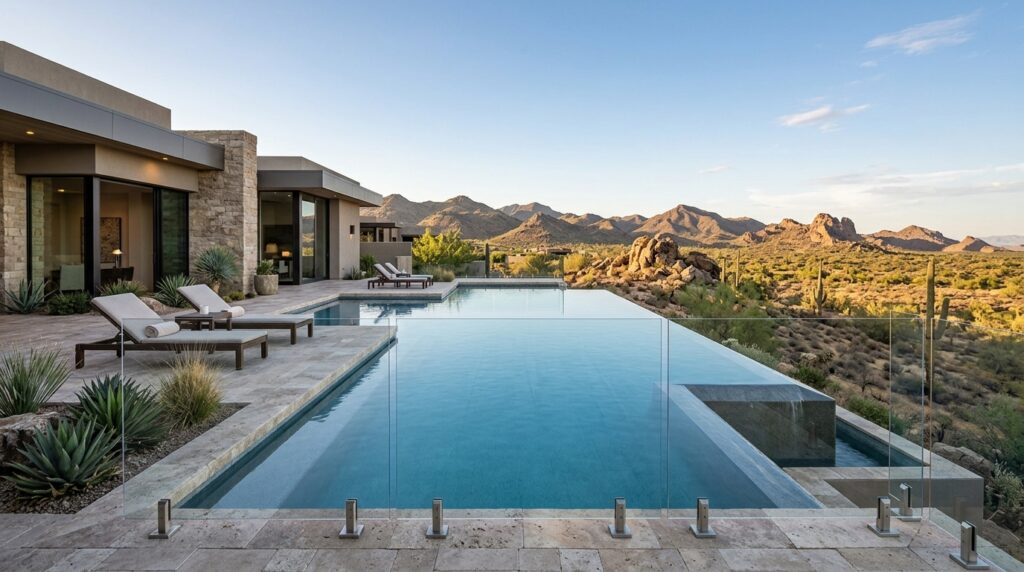
If you want your pool to look like it belongs in a five-star resort, glass fencing is your answer. Nothing else opens up the visual space the way glass does.
Frameless Glass Panels
Frameless glass panels are the premium choice. There are no visible posts or rails — the thick tempered glass (usually 12mm or more) is secured with ground-mounted spigots that are nearly invisible from a distance.
The result is an unobstructed view of your pool from every angle. It looks extraordinary, especially with a pool that has beautiful water features, a view, or an elaborate tile design you want to show off.
Pros:
- Maximally elegant, resort-like aesthetic
- Completely unobstructed sightlines
- Easy to clean with standard glass cleaner
- Extremely durable — tempered glass is four to five times stronger than regular glass
Cons:
- Among the most expensive pool fence options ($200–$500+ per linear foot installed)
- Shows fingerprints and water spots
- May require permits for installation depth
Semi-Frameless Glass Panels
Semi-frameless options use minimal aluminum posts between panels, which reduces cost while maintaining most of the visual appeal. This is a great middle-ground if you love the glass look but have a tighter budget.
Tinted and Frosted Glass Panels
Tinted glass adds privacy while maintaining elegance. Frosted glass panels are popular in urban settings where neighbors or passersby are nearby. Both still look sleek and modern while offering an extra layer of privacy.
Expert Tip: If you live in a windy area, consult with your glass fence installer about wind load ratings. Tempered glass can handle significant wind pressure, but proper installation depth matters, especially in coastal regions. The American Architectural Manufacturers Association (AAMA) publishes standards for structural glazing that reputable installers follow.
2. Aluminum Pool Fence Ideas
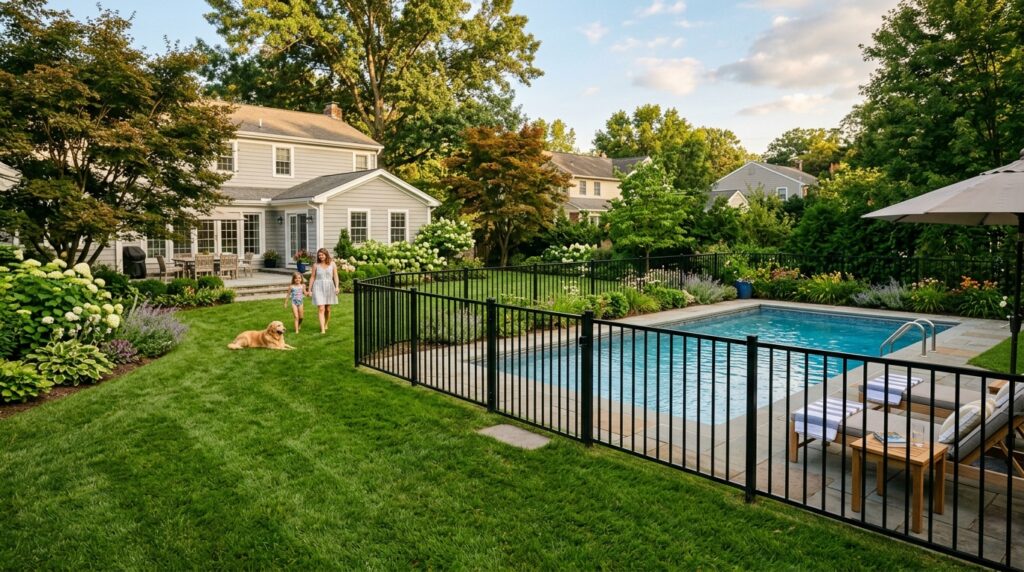
Aluminum fencing is the most popular pool fence material in the country — and for good reason. It’s affordable, durable, rust-resistant, and available in dozens of styles.
Classic Spear-Top Aluminum
The traditional spear-top aluminum fence has a timeless look that suits colonial, craftsman, and traditional-style homes. The vertical pickets with pointed tops meet most safety codes naturally since they’re difficult to climb.
Black is the most popular finish — it contrasts beautifully against blue water and green landscaping. But aluminum is also available in white, bronze, and custom colors through powder-coating.
Flat-Top Aluminum
For a more modern look, flat-top aluminum fencing creates clean horizontal lines that complement contemporary architecture. Combine it with a dark finish and wide-spaced pickets for a minimalist aesthetic.
Price Range
Aluminum pool fencing typically costs between $15 and $40 per linear foot for materials, with installation adding another $10–$30 per foot depending on terrain and complexity. This makes it one of the most budget-friendly options for permanent pool fencing.
Expert Tip: Look for aluminum rated for marine environments if you live near saltwater, as standard aluminum can eventually oxidize even though it doesn’t technically rust. The American Fence Association can help you locate certified installers in your area.
3. Wrought Iron Pool Fence Ideas
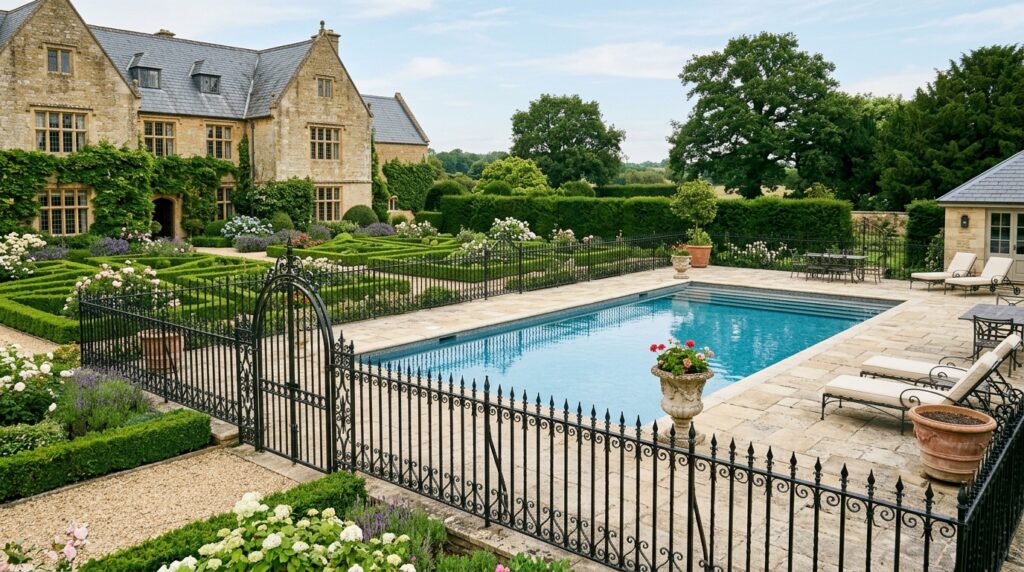
Wrought iron brings a sense of permanence and old-world elegance that no other material quite replicates. If you have a classic, formal, or Mediterranean-style home, wrought iron fencing can look extraordinary.
Traditional Ornamental Styles
Ornamental wrought iron fences come in a wide range of designs — from simple vertical pickets to elaborate scrollwork and finials. They’re heavy, imposing, and undeniably beautiful.
Pros:
- Extremely durable — properly maintained iron can last for generations
- Highly customizable designs
- Adds significant curb appeal and property value
Cons:
- Requires regular maintenance (painting or sealing) to prevent rust
- More expensive than aluminum
- Heavier and more difficult to install
Wrought Iron vs. Steel
True wrought iron is increasingly rare. Most “wrought iron” fences today are actually made from tubular steel, which is similar in appearance but lighter and more affordable. Tubular steel also requires rust prevention treatment, so maintenance needs are comparable.
Wood Pool Fence Ideas
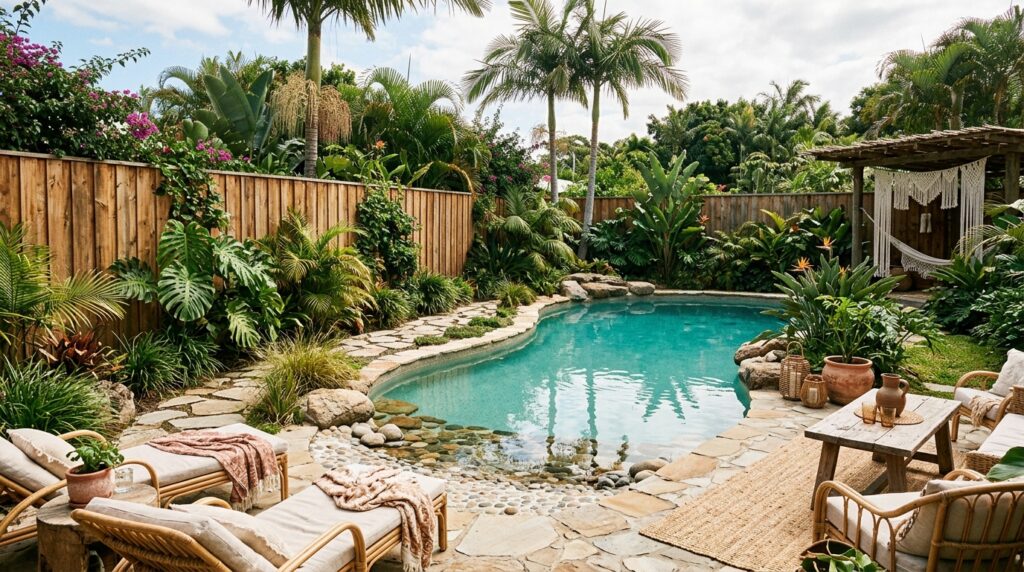
Wood fencing around a pool isn’t the most common choice — and there are good reasons for that — but done right, it creates an incredibly warm, natural aesthetic that glass and metal simply can’t match.
Cedar Privacy Fence
Cedar is the top choice for wood pool fencing because of its natural resistance to rot and insects. A tall cedar privacy fence around a pool creates an intimate, secluded atmosphere — like having your own private tropical retreat.
This works especially well with naturalistic “lagoon” pool designs, pools surrounded by tropical landscaping, or backyards where privacy from neighbors is a priority.
Board-on-Board Design
Board-on-board fencing alternates boards on either side of a rail, creating a fence that looks finished from both sides and provides excellent privacy without being completely solid. This design allows for some airflow, which helps prevent excessive moisture buildup against the wood.
Horizontal Slat Fence
Horizontal wood slat fencing has become enormously popular in modern landscaping. Evenly spaced cedar or redwood planks run horizontally, creating a sleek, contemporary look. Pair it with a stained dark finish and galvanized steel hardware for a sophisticated result.
Pros:
- Natural warmth and beauty
- Highly customizable stains and finishes
- Can be built to any height for maximum privacy
Cons:
- Requires regular sealing, staining, or painting (especially near water)
- Wood exposed to pool chemicals and moisture will degrade faster without maintenance
- Generally not as durable as metal over the long term
Expert Tip: The Forest Stewardship Council (FSC) certifies sustainably harvested wood. Look for FSC-certified cedar or redwood to make an environmentally responsible choice.
5. Vinyl Pool Fence Ideas
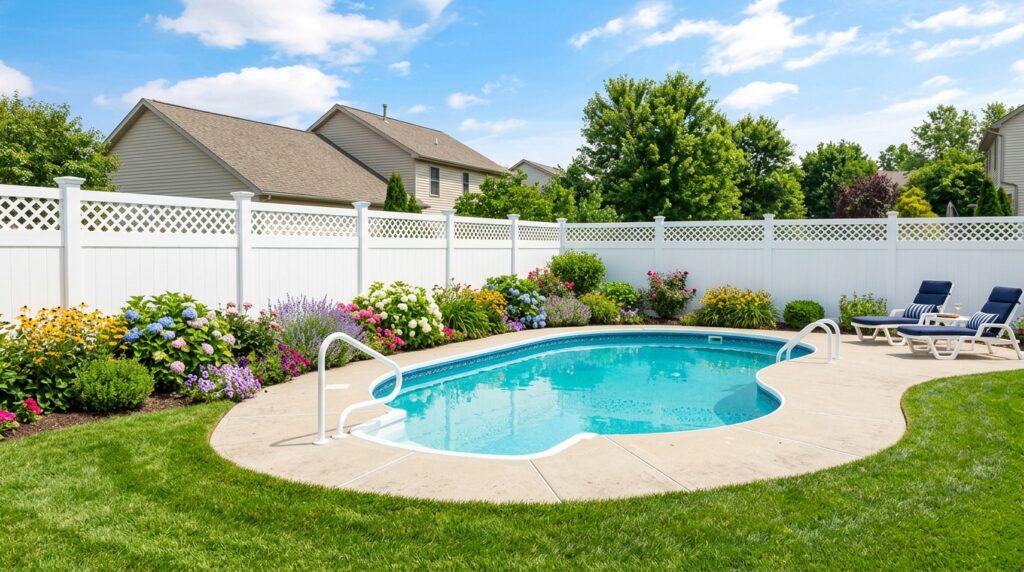
Vinyl (PVC) fencing offers the look of wood without the maintenance headaches. It won’t rot, rust, splinter, or fade (when UV-stabilized), making it an attractive option for pool owners who want a low-maintenance perimeter.
White Picket Vinyl
The classic white picket fence translates beautifully to vinyl around a pool. It’s cheerful, clean, and family-friendly. While it may not be the most sophisticated look, it’s welcoming, durable, and easy to clean with a garden hose.
Privacy Vinyl Panels
Solid vinyl privacy panels give you maximum seclusion. These are popular in densely populated suburbs where neighbors are close. They also act as a windbreak, which can extend your comfortable outdoor season.
Vinyl Lattice Top
A hybrid design with solid vinyl panels on the bottom and open lattice on top strikes a balance between privacy and airflow. It also adds decorative interest without significantly increasing cost.
Price Range: Vinyl fencing typically runs $20–$45 per linear foot installed, making it mid-range in cost.
6. Mesh and Removable Pool Fence Ideas
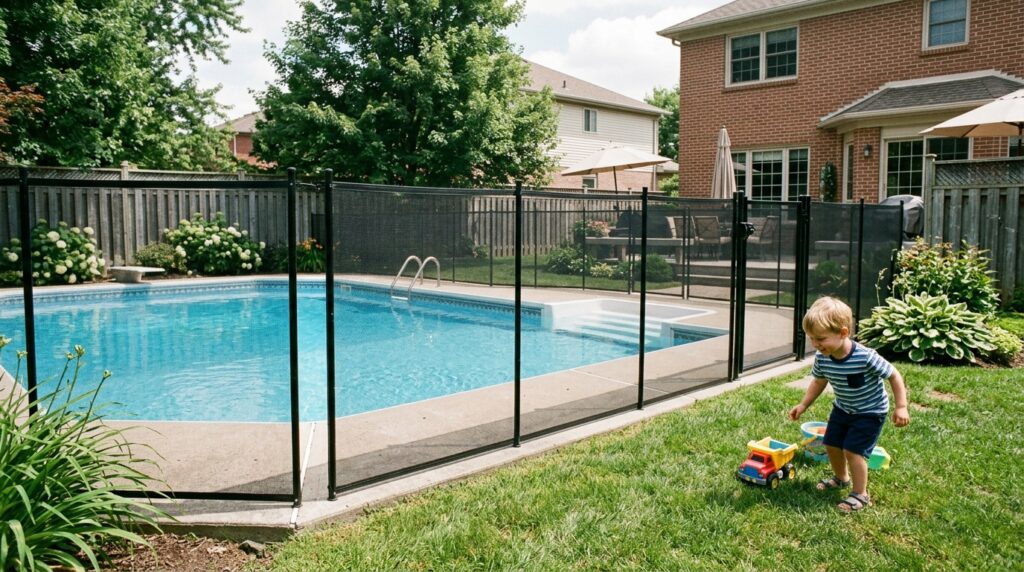
Not everyone needs a permanent fence. Removable mesh fencing has become a hugely popular option for families with young children who want safety during certain years of life — without permanently altering their backyard.
How Removable Mesh Fences Work
These systems use aluminum poles that insert into small anchor sleeves drilled into the pool deck. The mesh panels attach to the poles with hook-and-loop or snap connections. The entire fence can be installed or removed in under an hour by one person.
Brands like Life Saver Pool Fence and Guardian Pool Fence are among the most recognized in this category, and their products meet ASTM International safety standards for pool barriers.
Who It’s For
- Families whose children will eventually outgrow the need for a constant barrier
- Vacation rental property owners who want the fence only when certain guests are present
- Homeowners who want pool safety without a permanent visual impact
Pros:
- Flexible — install or remove as needed
- Lower cost than permanent fencing
- Meets most local safety codes
- Child-resistant gate latches included
Cons:
- Not as aesthetically sophisticated as glass or aluminum
- Must be reinstalled consistently to be effective
- Poles require deck anchors (small holes in your pool deck)
7. Natural Hedge and Landscaping as Pool “Fencing”
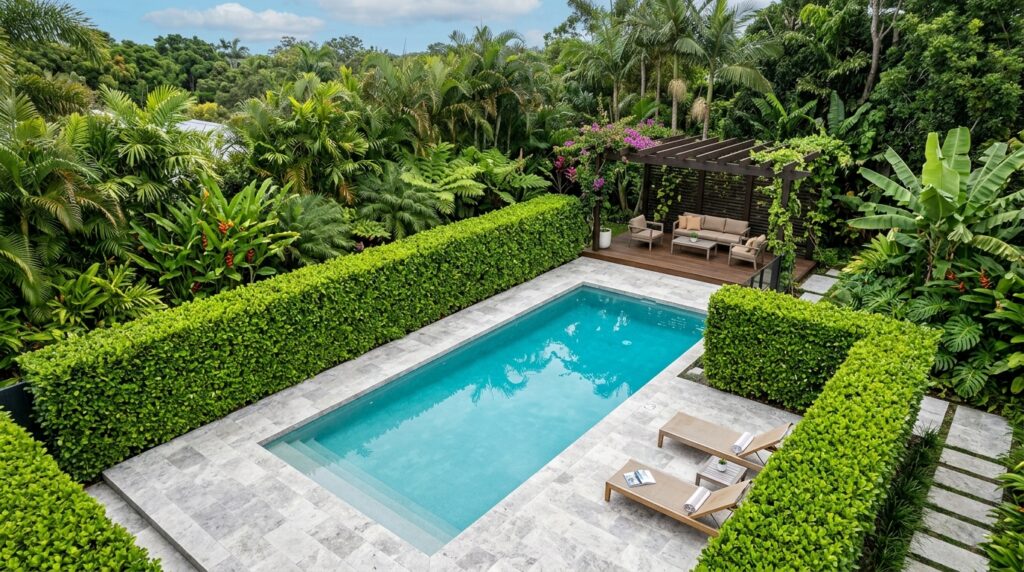
Can your pool “fence” actually be plants? In some cases, yes — but with important caveats.
Living hedges and dense landscaping can form a visual barrier around a pool and even serve as part of a layered safety strategy. However, in most jurisdictions, a living hedge alone does not satisfy pool fencing code requirements. It must typically be used in combination with a compliant physical barrier.
That said, landscaping can completely transform the look of your pool fence by:
- Softening the look of a metal or vinyl fence with plantings in front of it
- Creating a naturalistic backdrop behind a glass fence
- Adding privacy and windbreak benefits alongside a fence
Best Plants for Pool Surroundings
| Plant | Why It Works | Considerations |
|---|---|---|
| Clusia hedge | Dense, fast-growing privacy screen | Tropical, best in warm climates |
| Arborvitae | Tall, narrow, year-round green | Cold-hardy, grows slowly |
| Boxwood | Formal, dense, easy to shape | Deer-resistant, slow growing |
| Podocarpus | Elegant, fine-textured | South/warm climate only |
| Ornamental grasses | Movement, texture, low-maintenance | Not a privacy screen but adds softness |
Expert Tip: Avoid plants that drop excessive leaves, seeds, or flowers near the pool. Debris in your water increases cleaning demands and can stress your filtration system. The University of Florida IFAS Extension has excellent regional guides on pool-friendly landscaping.
8. Steel Cable and Wire Pool Fence Ideas
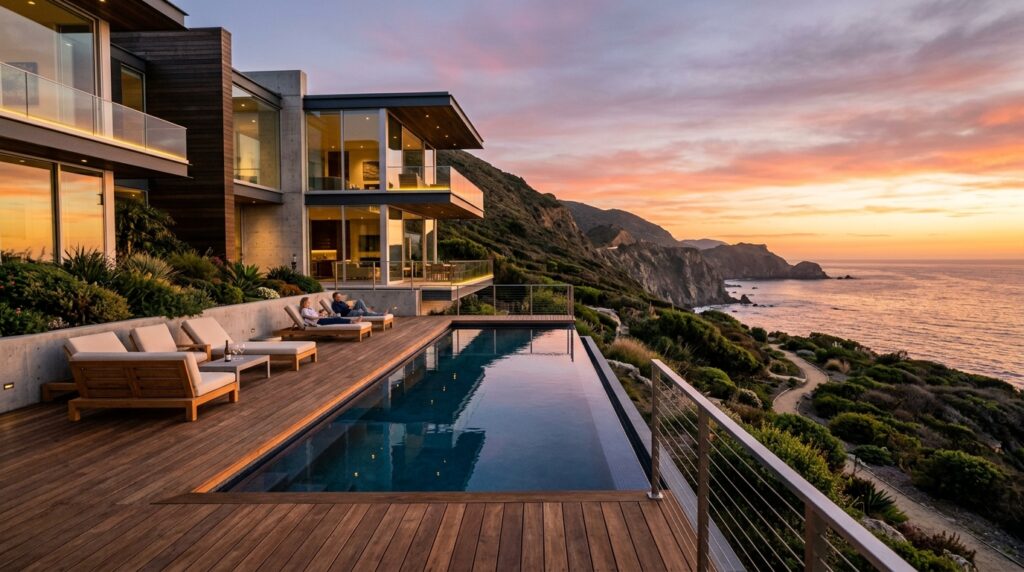
Cable fencing uses horizontal or vertical stainless steel cables stretched between posts to create a nearly invisible barrier. It’s a popular choice for properties with spectacular views — mountains, ocean, vineyards — where any solid fencing would block what you’re paying to look at.
Horizontal Cable Railing
Posts are typically wood or steel, and cables run horizontally between them. From a distance, the fence nearly disappears. This is one of the most architecturally clean looks available, and it pairs beautifully with modern and contemporary home styles.
Important Code Note: Many jurisdictions have specific requirements about cable spacing (typically no more than 4 inches between cables) to prevent climbing. Check your local codes carefully, as not all cable fencing configurations qualify as compliant pool barriers.
Pros:
- Maximum view preservation
- Sleek, modern aesthetic
- Stainless steel is extremely durable and requires minimal maintenance
Cons:
- Cable tensioning requires periodic inspection and adjustment
- Not suitable for all pool code requirements without verification
- Installation requires professional expertise
9. Decorative Metal and Powder-Coated Pool Fence Ideas
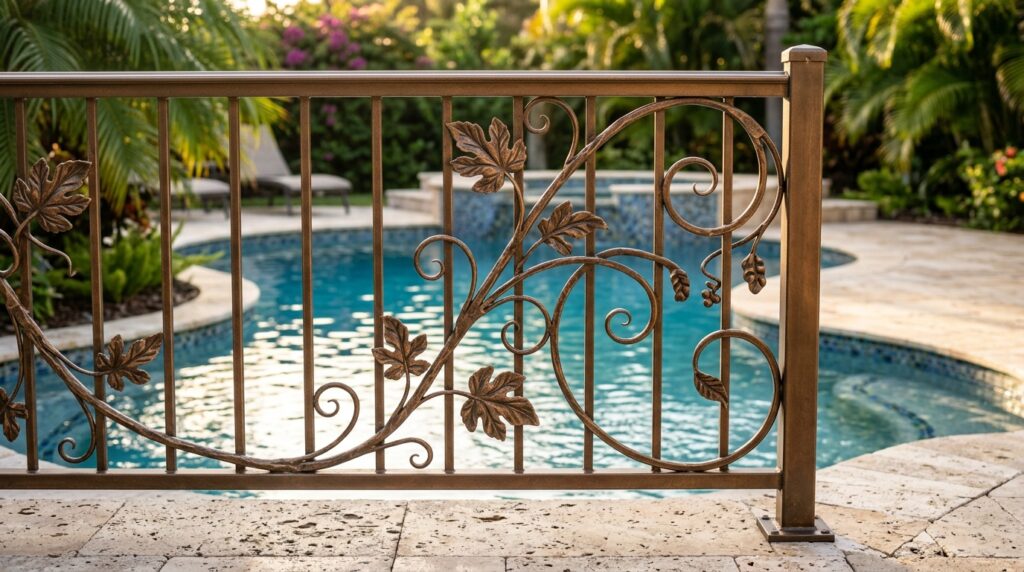
If you want a fence that’s both functional and genuinely artistic, decorative metal fencing offers a world of custom options.
Laser-Cut Metal Panels
CNC laser cutting allows metal panels to be cut into virtually any pattern — geometric designs, nature-inspired motifs, abstract art. These panels are typically made from steel or aluminum and powder-coated for weather resistance.
A laser-cut fence panel featuring a wave pattern, leaf design, or abstract geometric motif can turn your pool barrier into an actual focal point of your backyard.
Corten Steel (Weathering Steel)
Corten steel develops a rich, rusty-orange patina over time through a controlled oxidation process. The surface layer actually protects the steel underneath from further corrosion. A Corten panel fence around a pool creates a dramatic, earthy, sculptural look that’s unlike anything else.
10. Combining Fence Types for a Custom Look
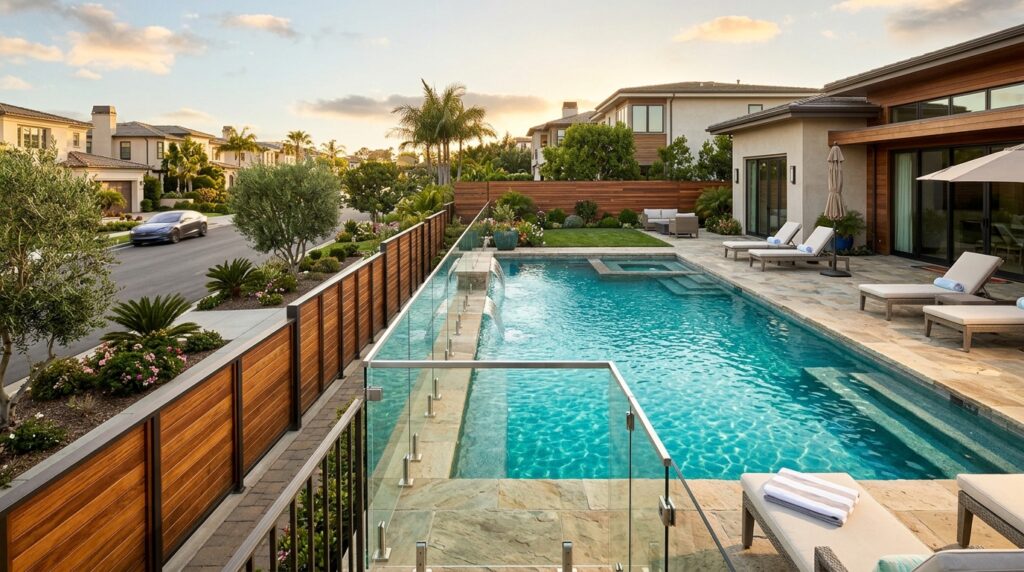
One of the best strategies is mixing fence materials to achieve different goals on different sides of the pool.
Common Combination Approaches:
- Glass on the view side + solid fence on the neighbor side: Preserve your best view while gaining privacy where it matters
- Aluminum fence + climbing plants: The clean lines of metal softened with natural greenery
- Removable mesh fence + permanent decorative gate: Flexibility with a designer entrance
- Wood privacy panels + cable railing on open sides: Blending seclusion and openness
This approach lets you optimize for aesthetics, privacy, safety, and view preservation simultaneously, rather than making compromises across the entire perimeter. For homeowners planning the entire backyard from the ground up, designing a custom swimming pool can help coordinate these elements from the beginning.
Pool Fence Costs: A Realistic Breakdown
Understanding what you’ll spend helps you plan realistically. Here’s a ballpark comparison based on industry pricing data from HomeAdvisor and Angi:
| Fence Type | Materials (per linear ft.) | Installation (per linear ft.) | Total Estimate |
|---|---|---|---|
| Frameless Glass | $100–$300 | $100–$200 | $200–$500+ |
| Semi-Frameless Glass | $60–$150 | $75–$150 | $135–$300 |
| Aluminum | $15–$40 | $10–$30 | $25–$70 |
| Wrought Iron / Steel | $25–$75 | $25–$50 | $50–$125 |
| Vinyl | $15–$35 | $10–$20 | $25–$55 |
| Cedar Wood | $10–$30 | $15–$30 | $25–$60 |
| Removable Mesh | $8–$20 | $5–$15 | $13–$35 |
| Cable Railing | $60–$150 | $50–$100 | $110–$250 |
Note: Prices vary significantly by region, terrain complexity, and contractor. These are general estimates only.
Pool Fence Safety Standards You Need to Know
Every pool fence, no matter how beautiful, must first do its primary job: keep children safe. Here are the key safety standards to understand:
The Four-Sided Fence Rule
The CPSC recommends that pool fences completely surround the pool on all four sides, rather than using the house as one wall. This is because homes often have easy-access doors that children can open.
Height Requirements
Most codes require a minimum fence height of 48 inches (4 feet). Some areas require 60 inches (5 feet) for additional protection. Check your local code.
Gate Requirements
Per CPSC guidelines:
- Gates must be self-closing and self-latching
- Latches should be on the pool side of the gate
- Latch height should be at least 54 inches from the bottom of the gate or placed on the pool side so it’s inaccessible to children
- Gates should swing outward, away from the pool
ASTM Standards
ASTM F2286 covers standards for in-ground residential pool enclosure systems. This is the benchmark that most removable mesh fence manufacturers certify their products against.
Expert Tips for Choosing Your Pool Fence
Here are insights that professionals in pool design and landscaping consistently recommend:
1. Start with your code, not your Pinterest board. Find out what’s required in your municipality before you fall in love with a design that won’t pass inspection.
2. Think about long-term maintenance before you decide. Glass looks spectacular, but do you want to clean it twice a week? Wood looks gorgeous, but are you willing to reseal it every two years? Be honest with yourself about your maintenance habits.
3. Consider the full visual picture. Your fence should complement your home’s architecture, your landscaping style, and your pool design. A sleek frameless glass fence looks wrong in front of a rustic country cottage. A wooden picket fence looks wrong around a minimalist modern pool.
4. Budget for the gate — and make it great. Your gate is both the most-used and most-visible part of your fence. It’s worth investing in a high-quality latch mechanism and a gate design that matches your fence beautifully.
5. Get at least three installer quotes. Pool fence installation costs vary enormously by contractor. Getting multiple quotes from certified installers ensures you’re not overpaying — and lets you compare experience levels. The Better Business Bureau (BBB) and Angi are good starting points for finding vetted local contractors.
Frequently Asked Questions
What is the best type of pool fence for safety?
For maximum child safety, any fence that fully encloses the pool, stands at least 4 feet high, and features a self-closing, self-latching gate is compliant with CPSC guidelines. Among materials, tempered glass and aluminum are highly recommended because they offer no footholds for climbing. Removable mesh fences that meet ASTM standards are also excellent options for families with young children.
How much does a pool fence cost on average?
The average cost for pool fencing depends heavily on material and perimeter size. A basic aluminum fence for a typical 12×24 foot pool might cost $1,500–$3,000 fully installed. A frameless glass fence around the same pool could run $8,000–$15,000 or more.
Do I need a fence around an above-ground pool?
In most jurisdictions, yes — above-ground pools still require a safety barrier. Some codes allow the pool wall itself to serve as part of the barrier if it’s tall enough (typically 48 inches) and the ladder is removable. Check your local pool safety laws via Pool Safely’s state law database.
Can I install a pool fence myself?
It depends on the material. Removable mesh fencing is genuinely DIY-friendly. Aluminum and vinyl panel fencing can be tackled by skilled DIYers with moderate experience. Glass fencing, cable railing, and ornamental iron/steel work should always be handled by professionals due to structural requirements, code compliance, and safety implications of improper installation.
What is the most low-maintenance pool fence?
Aluminum and vinyl are the most maintenance-free permanent pool fence options. Both resist rust, corrosion, and fading. Vinyl only needs occasional washing with soap and water. Aluminum may need a fresh coat of powder coating every decade or so. Removable mesh is also low-maintenance within its category.
Conclusion
Choosing your pool fence is one of those decisions that sits at the intersection of safety, style, and smart long-term thinking. The right fence will protect the people you love most, complement your outdoor space, and actually enhance your property value — not just check a regulatory box.
Whether you’re drawn to the invisible elegance of frameless glass, the timeless versatility of aluminum, the natural warmth of cedar, or the flexibility of removable mesh, there’s a pool fence solution that fits your needs and your budget.
The best move you can make right now is to:
- Check your local codes at Pool Safely or your municipal building department
- Get clear on your priorities — is it aesthetics, budget, privacy, view, or all of the above?
- Request quotes from at least three certified installers through Angi or the American Fence Association
Your pool is an investment in joy, relaxation, and family memories. Make sure the fence around it is worthy of everything on the other side.

