
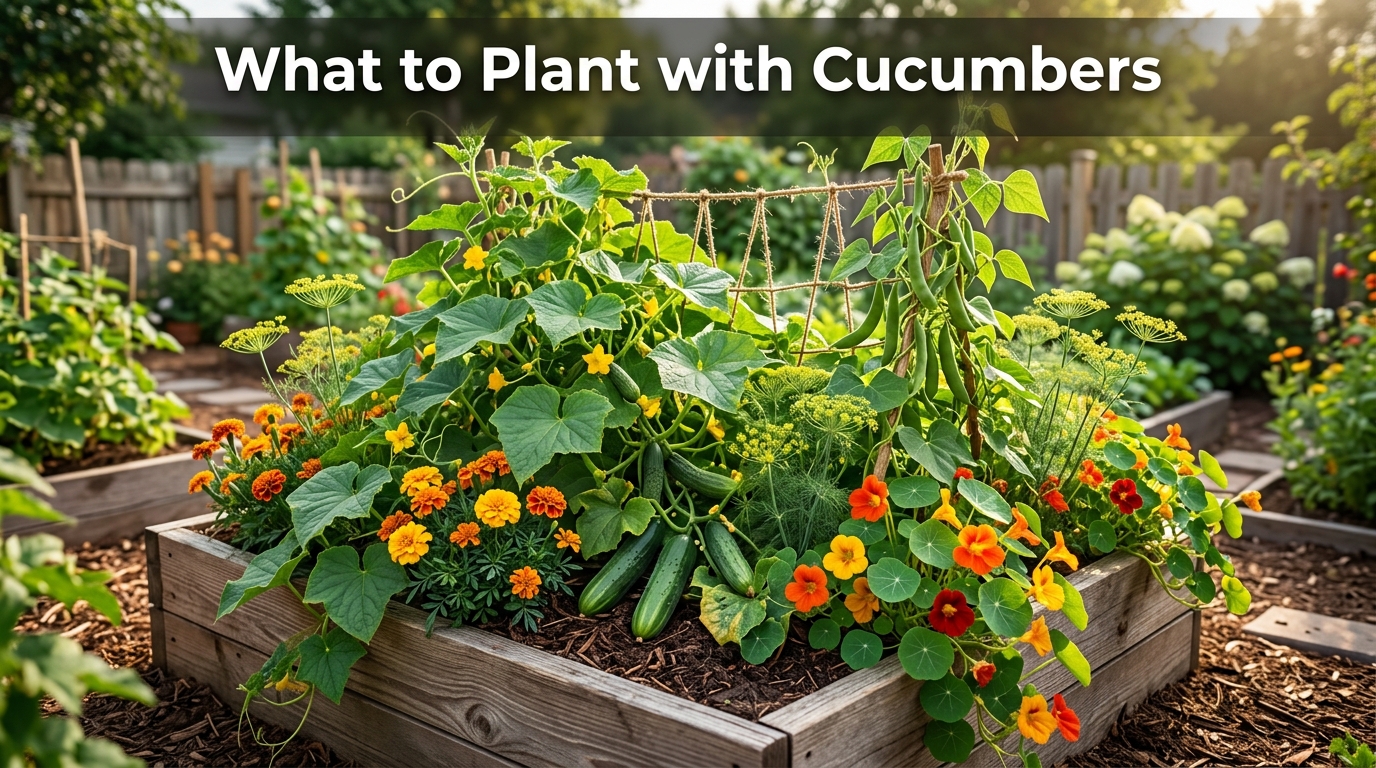
You’ve planted a row of cucumbers, watered them faithfully, and waited — only to watch them get devoured by beetles, wilt from disease, or produce far fewer fruits than you hoped.
Sound familiar?
Here’s what most gardeners don’t realize early on: cucumbers don’t thrive in isolation. What grows around them matters just as much as the soil they’re planted in. The right neighbors can attract beneficial insects, confuse harmful pests, improve soil health, and even make your cucumbers taste better.
That’s the magic of companion planting — a time-tested gardening strategy where certain plants are grown together for mutual benefit.
In this guide, you’ll discover exactly what to plant with cucumbers (and what to avoid), so your garden produces more, fights fewer pests, and looks absolutely beautiful doing it.
What Is Companion Planting and Why Does It Matter for Cucumbers?
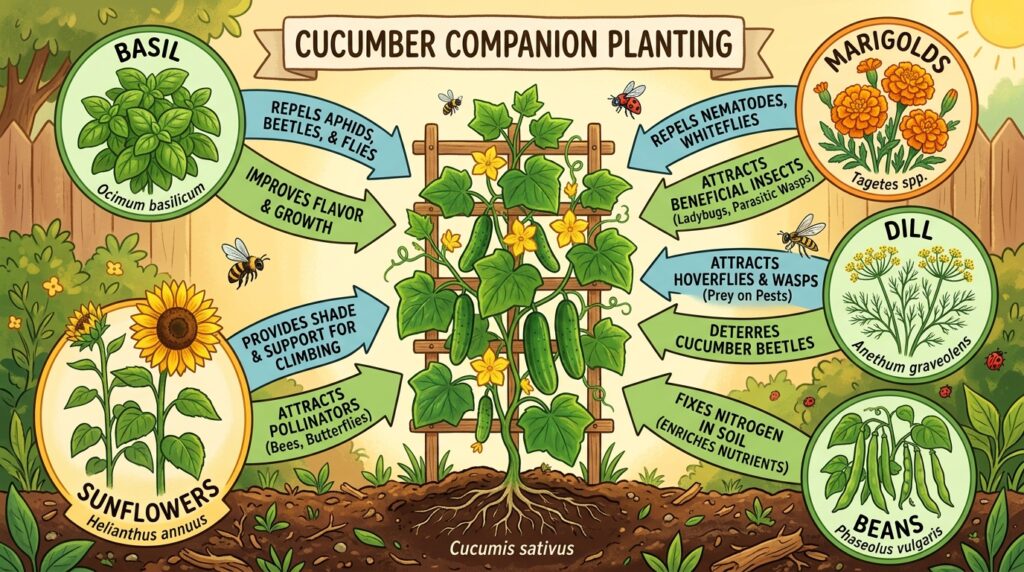
Companion planting is the practice of growing two or more plants near each other because they benefit one another in some way. Benefits can include:
- Pest deterrence (certain plants repel insects)
- Pollinator attraction (flowers bring bees to increase fruit set)
- Soil improvement (nitrogen-fixing legumes enrich the soil)
- Shade or structural support (tall plants offer shelter to shorter ones)
Cucumbers in particular are heavy feeders and somewhat vulnerable to a specific set of pests, especially cucumber beetles, aphids, and spider mites. They also rely heavily on pollinators to produce fruit — no bees, no cucumbers.
Choosing the right companions doesn’t require a botany degree. It just takes a little knowledge and some intentional garden planning.
The Best Companion Plants for Cucumbers
1. Marigolds
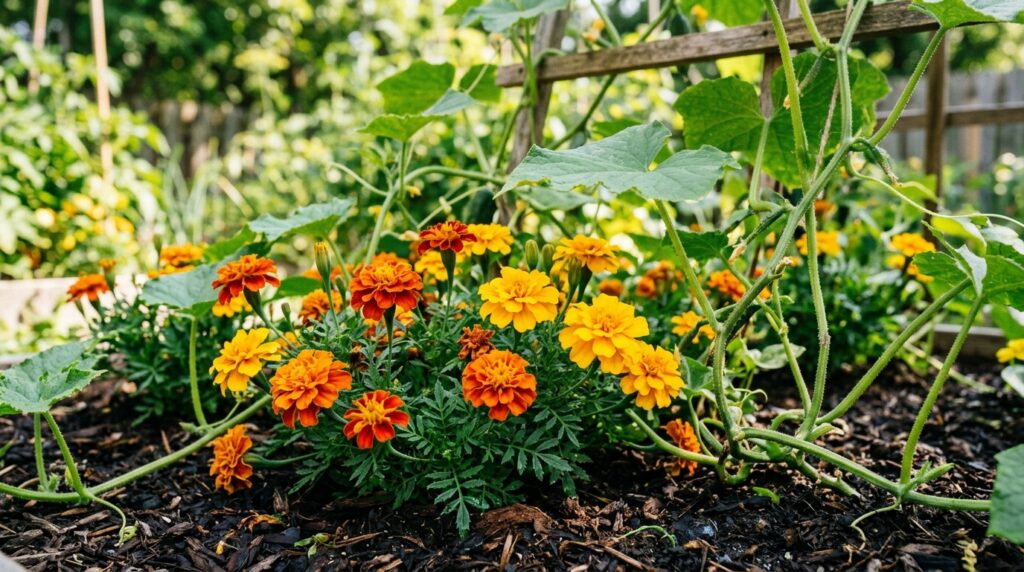
If you only add one companion plant to your cucumber bed, make it marigolds.
Marigolds are legendary in the gardening world for their pest-repelling properties. They emit a strong scent that deters aphids, cucumber beetles, and even nematodes in the soil. Their bright yellow and orange flowers also attract hoverflies and other beneficial insects that prey on garden pests.
Benefits:
- Repels cucumber beetles and aphids
- Attracts pollinators and beneficial predatory insects
- Easy to grow from seed or transplant
- Looks beautiful alongside cucumber vines
Plant French marigolds (Tagetes patula) around the perimeter of your cucumber patch or in between plants. According to The Old Farmer’s Almanac, marigolds are one of the most universally recommended companion plants in vegetable gardening.
2. Nasturtiums
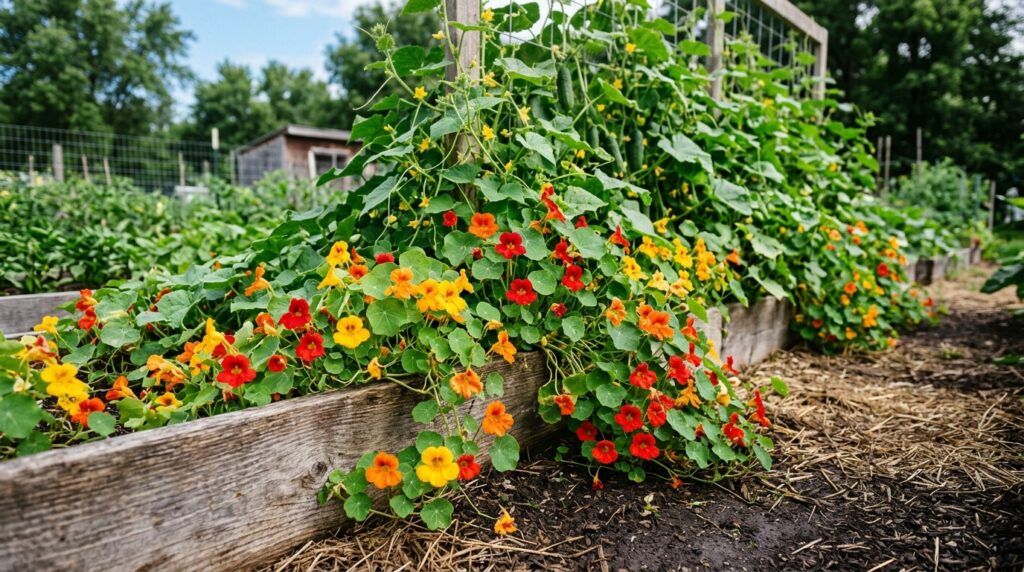
Nasturtiums are one of those plants that work as a trap crop — they’re so attractive to aphids that pests flock to them and leave your cucumbers alone.
Rather than spraying pesticides, you let the nasturtiums take the hit. Once the pests congregate on the nasturtiums, you can either remove the affected leaves or simply replant fresh nasturtiums nearby.
Bonus: nasturtium flowers and leaves are edible with a peppery flavor — great in salads!
Benefits:
- Acts as a trap crop for aphids and whiteflies
- Attracts beneficial insects like predatory wasps
- Edible flowers and leaves
- Ground cover that suppresses weeds
Plant nasturtiums at the border of your cucumber garden for maximum effectiveness.
3. Dill
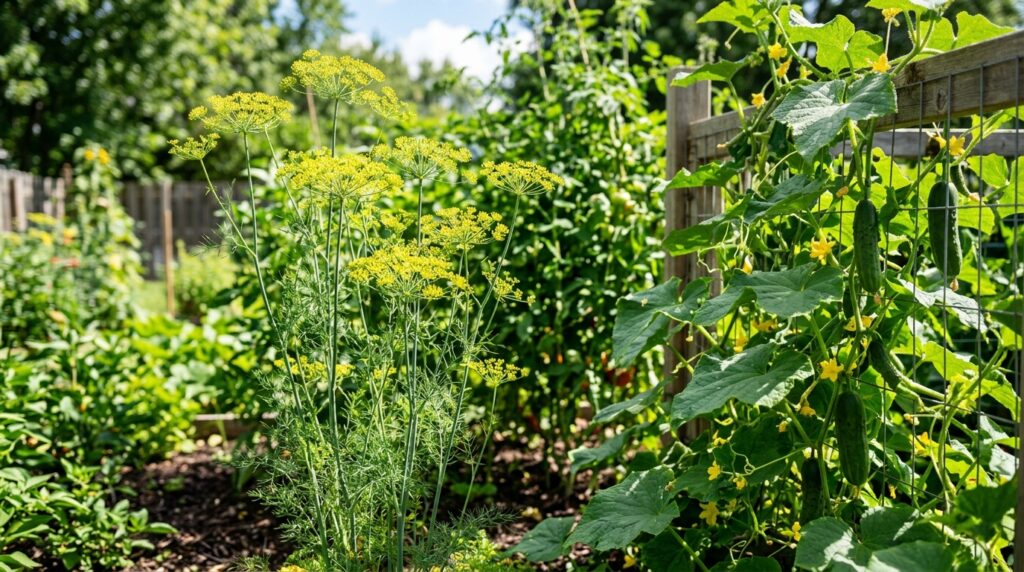
Dill and cucumbers have a fascinating relationship. Young dill plants support cucumbers by attracting beneficial insects like lacewings, ladybugs, and parasitic wasps — all natural predators of common cucumber pests.
However, here’s the nuance: mature dill can actually inhibit cucumber growth. Once dill flowers and goes to seed, it may compete with cucumbers for nutrients and even release allelopathic compounds that slow cucumber development.
The solution? Plant young dill near cucumbers and harvest it before it fully matures. Or plant dill at a slight distance so the benefits reach the cucumbers without direct competition.
Benefits:
- Attracts beneficial predatory insects
- Repels spider mites and aphids
- Pairs naturally in the kitchen — cucumbers and dill are a classic pickle combination
According to Oregon State University Extension, herbs like dill play an important role in attracting beneficial insects to vegetable gardens.
4. Beans (Bush or Pole)
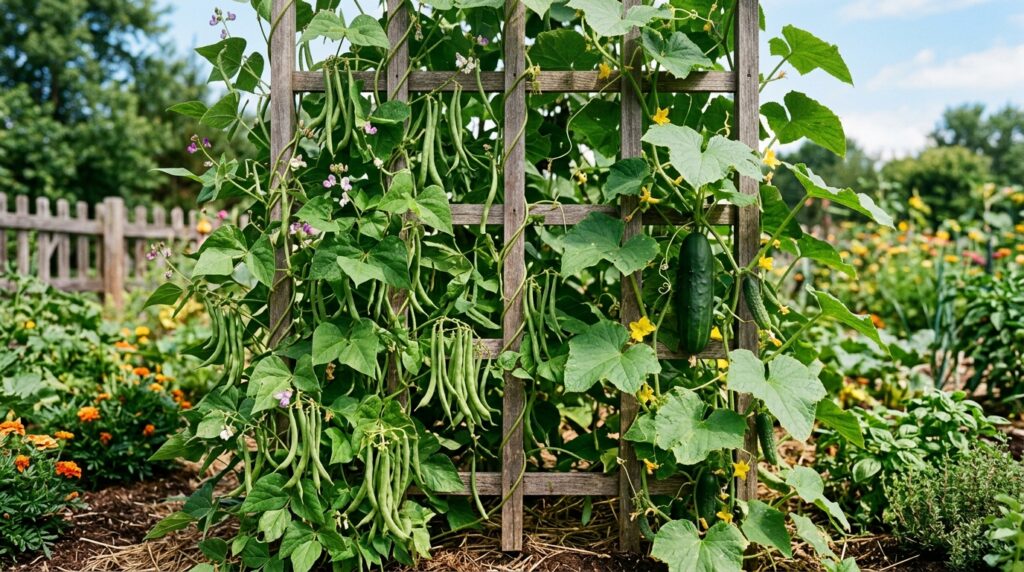
Legumes — including beans and peas — are nature’s soil fertilizers. They fix atmospheric nitrogen into the soil through a symbiotic relationship with rhizobia bacteria, making nutrients more available to hungry plants like cucumbers.
Bush beans are particularly compatible because they stay low and don’t compete for vertical space. Pole beans can also work if given their own trellis away from cucumber vines.
Benefits:
- Fix nitrogen into the soil, feeding cucumbers naturally
- Create a natural ground cover that retains soil moisture
- Low-growing bush beans don’t compete for space
Avoid planting cucumbers directly beside fennel — we’ll get to that — but beans are a safe, productive pairing that benefits the soil long after harvest.
5. Radishes
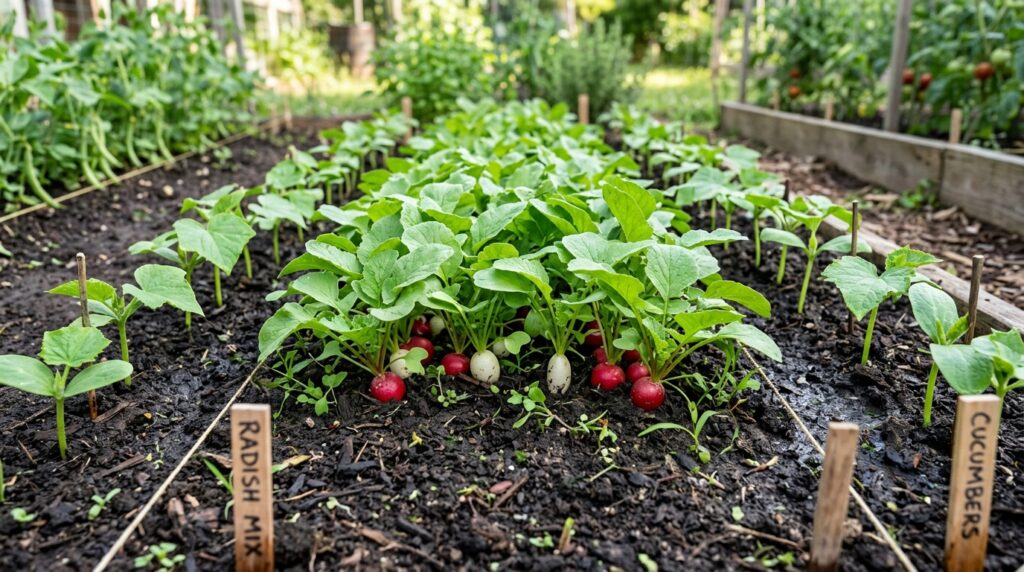
Radishes are a gardener’s secret weapon against cucumber beetles.
When planted near cucumbers, radishes act as a sacrificial plant — cucumber beetles prefer them over cucumber foliage. Some gardeners even leave radishes to bolt (go to seed and flower) specifically because cucumber beetles are strongly attracted to radish flowers.
Radishes also grow quickly — ready in as little as 25–30 days — so they don’t compete with cucumbers for long.
Benefits:
- Deters cucumber beetles as a trap crop
- Fast-growing and easy to manage
- Can be harvested before cucumbers need the space
6. Sunflowers
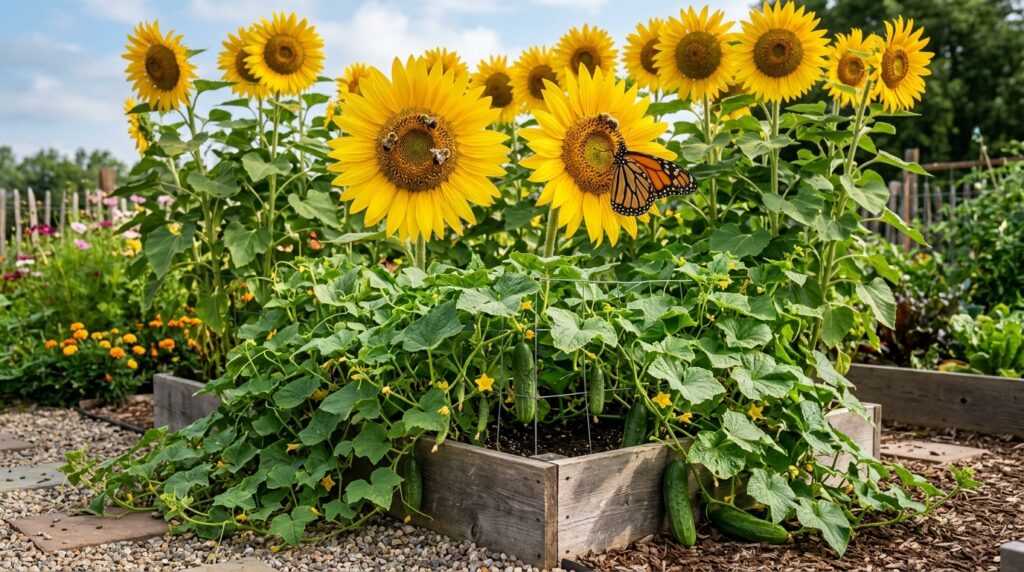
Cucumbers need bees. No pollination means no fruit. Sunflowers are one of the best plants you can grow to attract pollinators — including bees, butterflies, and even hummingbirds — to your garden.
Plant sunflowers on the north or west side of your cucumber bed so they don’t cast shade on your cucumber plants. Their height also makes them useful as a windbreak in exposed garden areas.
Benefits:
- Attracts pollinators to improve cucumber fruit set
- Provides a windbreak
- Can serve as a natural trellis for vining cucumbers
- Seeds attract birds that help with insect control
7. Corn
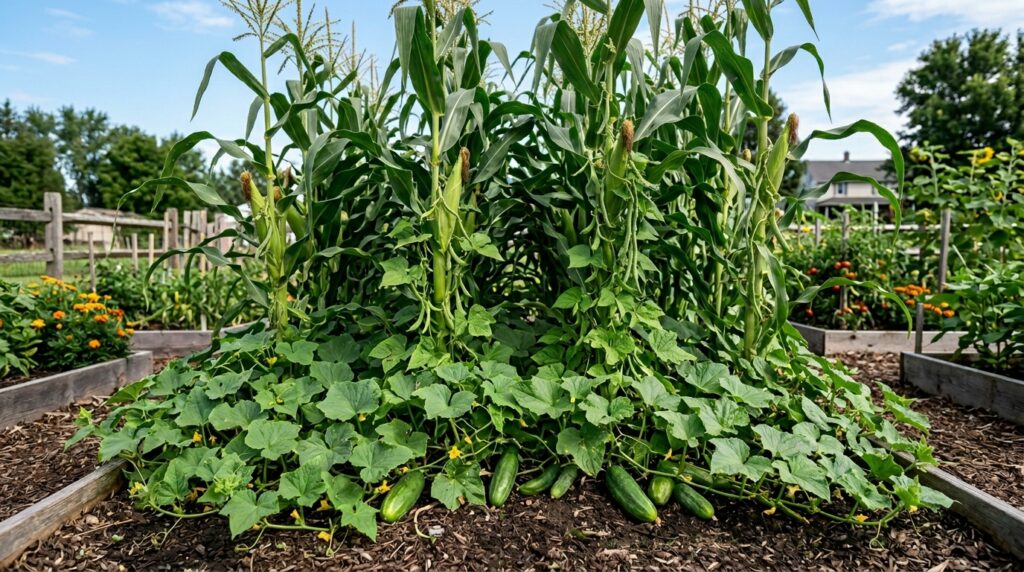
Corn and cucumbers form a surprisingly effective pairing. Corn stalks can act as a natural trellis for cucumber vines, giving them something to climb. Meanwhile, low-growing cucumber vines act as a living mulch, shading the soil around corn roots and retaining moisture.
This relationship is loosely inspired by the Three Sisters planting — the traditional Indigenous agricultural method of growing corn, beans, and squash together. Substituting cucumbers for squash works similarly in home gardens.
Benefits:
- Corn provides vertical support for vining cucumbers
- Cucumbers shade the soil, reducing moisture loss
- Space-efficient growing arrangement
Plant tall corn varieties on the north side of your cucumber bed to avoid shading issues.
8. Basil
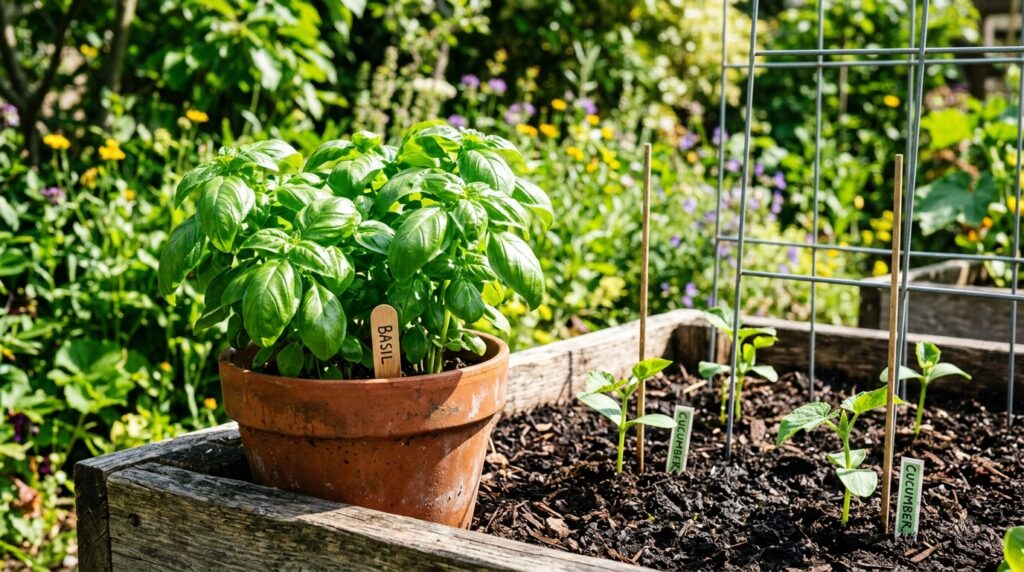
Basil is one of the most popular companion plants in vegetable gardens, and for good reason. Its strong aromatic oils are believed to repel thrips, aphids, and whiteflies — all of which can damage cucumber plants.
Some gardeners also swear that basil improves the flavor of nearby vegetables, though scientific evidence for this is anecdotal. What’s well-established is that basil’s flowers attract pollinators and beneficial insects.
Benefits:
- May deter aphids, thrips, and whiteflies
- Attracts beneficial pollinators
- Useful herb to grow alongside vegetables
- Easy to grow in containers near cucumber beds
9. Catnip
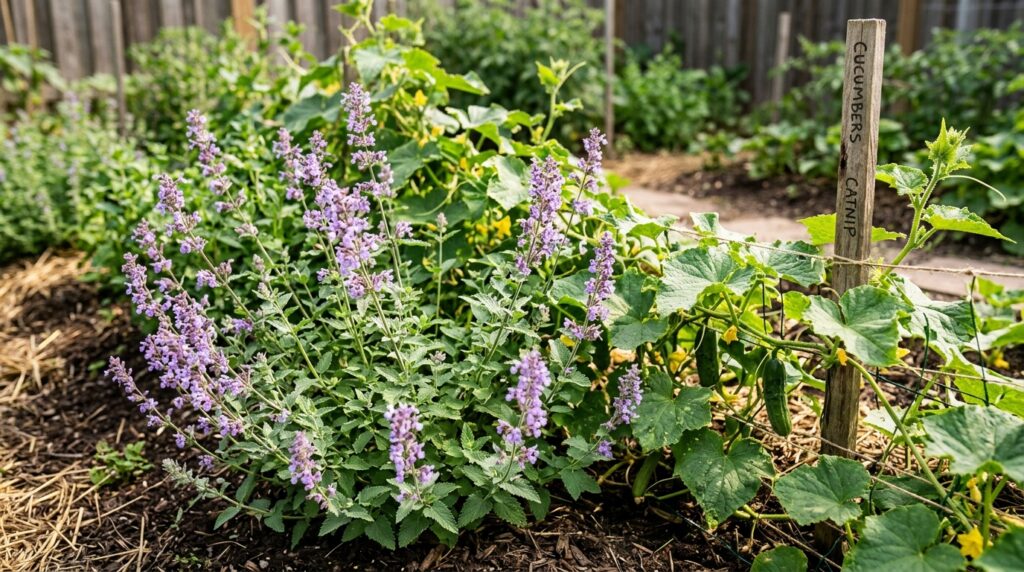
Catnip (Nepeta cataria) is not just for cats — it’s a powerful insect deterrent. Research published in various horticultural sources suggests that nepetalactone, the compound that makes cats go wild, also repels aphids, flea beetles, and squash bugs.
Plant catnip around the perimeter of your cucumber bed to create a protective boundary. Just know that if neighborhood cats visit your garden, they may become very interested in your planting area.
10. Peas
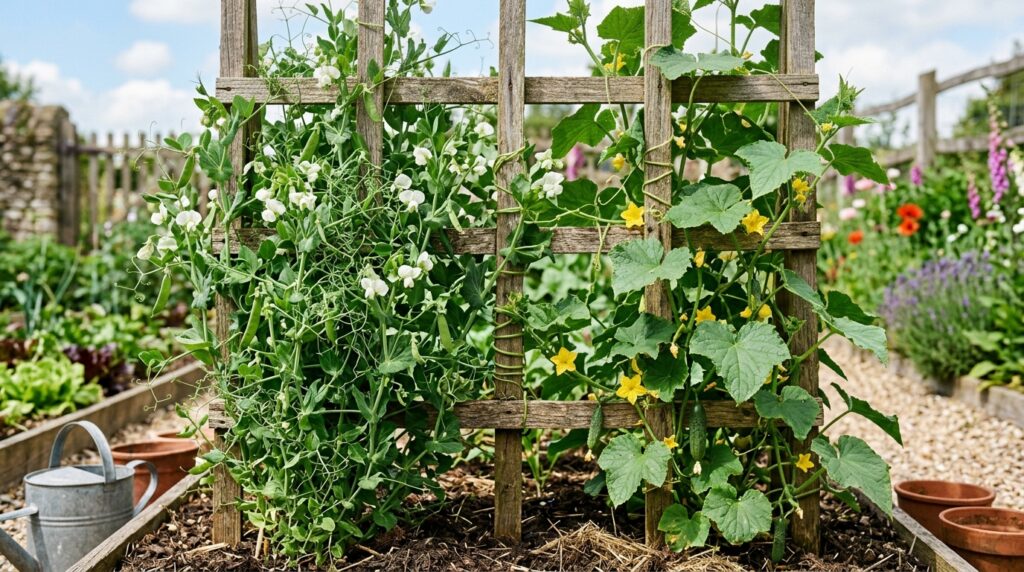
Like beans, peas are legumes that fix nitrogen into the soil. They’re an excellent early-season companion for cucumbers, especially because peas prefer cooler weather and are often done producing by the time cucumbers hit their peak in summer.
This timing creates a relay planting system where peas improve the soil with nitrogen, then cucumbers take over in the same bed, benefiting from the enriched growing environment.
Benefits:
- Fix nitrogen to feed cucumbers
- Cool-season crop that naturally gives way to cucumbers
- Don’t compete for space or resources when cucumbers are at peak production
Companion Planting Chart for Cucumbers
| Plant | Benefit | Notes |
|---|---|---|
| Marigolds | Repels pests, attracts beneficials | Plant around perimeter |
| Nasturtiums | Trap crop for aphids | Border planting |
| Dill (young) | Attracts beneficial insects | Harvest before maturity |
| Bush Beans | Fixes nitrogen in soil | Avoid pole beans on same trellis |
| Radishes | Deters cucumber beetles | Let some bolt for best effect |
| Sunflowers | Attracts pollinators | Plant on north/west side |
| Corn | Provides natural trellis | Tall varieties work best |
| Basil | Repels aphids and thrips | Great in containers nearby |
| Catnip | Repels multiple pests | Border planting |
| Peas | Fixes nitrogen, early season | Use as relay crop |
What NOT to Plant with Cucumbers
Just as important as knowing what to plant with cucumbers is knowing what to keep away. Some plants are genuinely harmful neighbors.
Fennel
Fennel is a notorious allelopath — it releases chemicals from its roots and leaves that inhibit the growth of most vegetables, including cucumbers. University of California Agriculture horticulture resources consistently list fennel as one of the worst vegetables to plant near other crops.
Keep fennel in its own isolated container or far away from your vegetable garden.
Sage
Sage produces oils and compounds that can inhibit the growth of cucumber plants. While it’s a wonderful herb on its own, it’s better kept in a separate herb garden.
Melons and Squash
Planting cucumbers near melons or squash isn’t toxic — but it’s still inadvisable. These plants are all members of the Cucurbitaceae family and share the same pests and diseases. Grouping them together creates a concentrated target for cucumber beetles, powdery mildew, and vine borers.
Practice crop rotation and spread cucurbit family plants throughout your garden.
Potatoes
Potatoes and cucumbers are poor companions because they compete for similar nutrients and can share some soil-borne diseases. If you grow both, keep them separated by at least a few rows.
Expert Tips for Cucumber Companion Planting Success
1: Think in Layers Cucumbers grow vertically on trellises, which leaves the soil and lower levels free. Use this space with low-growing companions like radishes, basil, or marigolds while cucumbers climb upward.
2: Use Flowers Generously A vegetable garden without flowers is missing its best pest-control allies. Marigolds, nasturtiums, and borage are all functional AND beautiful. Integrate them liberally throughout your cucumber patch.
3: Rotate Annually Even the best companion planting can’t substitute for good crop rotation. Move your cucumbers to a different bed each year to avoid the buildup of soil pathogens and pests. Cornell University Cooperative Extension recommends a minimum 3-year rotation for cucurbits.
4: Observe and Adjust Every garden is different. Keep notes on what pairings worked well and which didn’t in your specific microclimate. What works perfectly in one region may behave differently in another.
5: Plant in Drifts, Not Singles One marigold plant won’t repel much. A border of 8–10 marigold plants around your cucumber bed creates a meaningful deterrent effect. Plant companion herbs and flowers in clusters for maximum impact.
How to Design a Cucumber Companion Planting Layout
Planning your companion planting layout before you put seeds in the ground saves a lot of frustration.
Here’s a simple layout for a 4×8 raised bed with cucumbers:
Center: Install a vertical trellis. Plant 3–4 cucumber plants along the trellis.
Along one long side: Plant a row of bush beans. They’ll fix nitrogen and stay low.
Along the other long side: Plant a mix of basil and dill (young). Harvest dill before it bolts.
At the short ends and corners: Plant French marigolds for pest deterrence and color.
Along the outside border: Train nasturtiums along the outer edges as a trap crop barrier.
This layout uses every inch of space productively while keeping cucumbers healthy and protected.
Seasonal Companion Planting Calendar
| Season | What to Plant |
|---|---|
| Early Spring | Peas (cool season, fix nitrogen before cucumbers go in) |
| Late Spring | Transplant marigold and nasturtium starts; direct sow dill |
| Early Summer | Cucumbers + beans; all companions in full swing |
| Midsummer | Add sunflowers for pollinators; manage/replace nasturtiums |
| Late Summer | Allow dill to flower for beneficial insects; harvest beans |
| Fall | Remove cucumber vines; plant garlic or cover crops |
Common Mistakes in Cucumber Companion Planting
Even with the right plants, poor execution can backfire. Here are the most common mistakes:
1: Planting Companions Too Close Crowding plants causes competition for water, nutrients, and light. Leave adequate space — most cucumbers need 12–18 inches of space, and companions should be positioned at the edges rather than between individual plants.
2: Ignoring Mature Plant Size A dill seedling looks small and harmless, but it can reach 3–5 feet tall. A mature dill plant shading your cucumbers isn’t helping them.
3: Forgetting About Pollinators Planting only pest-deterrent companions without including pollinator attractors is a missed opportunity. Cucumbers are bee-pollinated, and without enough pollinator visits, fruit set suffers.
4: Planting Fennel Anywhere Nearby Fennel is so allelopathic that even positioning it 5–6 feet away from a cucumber bed can cause issues if you have a small garden. Be cautious.
Frequently Asked Questions
What is the best companion plant for cucumbers?
Marigolds are widely considered the single best companion plant for cucumbers. They repel the most damaging pests — including cucumber beetles and aphids — attract beneficial predatory insects, and pull pollinators to your garden. French marigolds (Tagetes patula) work especially well. Plant them around the perimeter of your cucumber bed for best results.
Can I plant tomatoes and cucumbers together?
Yes, tomatoes and cucumbers can coexist in the garden, but they’re not ideal companions. They have similar nutrient needs and can compete for resources. They also require different watering schedules — cucumbers prefer consistent, frequent watering while tomatoes benefit from slightly drier conditions between waterings. If space is limited, it’s better to prioritize the companions listed above. University of Illinois Extension provides helpful guidance on vegetable garden spacing and companion planning.
Can cucumbers and zucchini be planted together?
It’s best to avoid planting cucumbers and zucchini directly together. They’re both members of the cucurbit family, which means they attract the same pests and are vulnerable to the same diseases. Planting them close together creates a concentrated pest target. Separate them by at least 5–6 feet and use good crop rotation practices.
Does dill help or hurt cucumbers?
Both, depending on timing. Young dill plants attract beneficial insects that prey on cucumber pests — this is helpful. But once dill matures and flowers, it can compete with cucumbers for nutrients and may release growth-inhibiting compounds. The solution is to plant young dill near cucumbers and harvest it before it fully matures, or plant it slightly further away so it benefits without competing directly.
How far apart should companion plants be from cucumbers?
Most companion plants work best when planted 6–18 inches from cucumber plants. Marigolds and basil can be planted as close as 6–8 inches at the garden border. Taller plants like sunflowers or corn should be placed 18–24 inches away or on the north/west side to avoid shading cucumbers. The goal is proximity for benefits without crowding for resources.
Final Thoughts
Growing cucumbers is rewarding — but growing them with the right companions transforms your garden into a self-managing, high-yielding ecosystem.
Marigolds fight your pest battles. Nasturtiums sacrifice themselves for your cucumbers. Dill brings the good bugs. Beans enrich your soil. And sunflowers bring the bees.
None of this is complicated. You don’t need a big budget or a lot of land. Even a single raised bed, thoughtfully planted, can dramatically improve your cucumber harvest while reducing the need for pesticides or synthetic fertilizers.
Start small. Pick two or three companions from this list, observe how your garden responds, and build from there. Within a season, you’ll wonder how you ever gardened any other way.
Ready to dig in? Start planning your cucumber companion garden today. Sketch out a simple bed layout, choose your top three companion plants, and get your seeds ordered. Your cucumbers — and your garden ecosystem — will thank you.

