
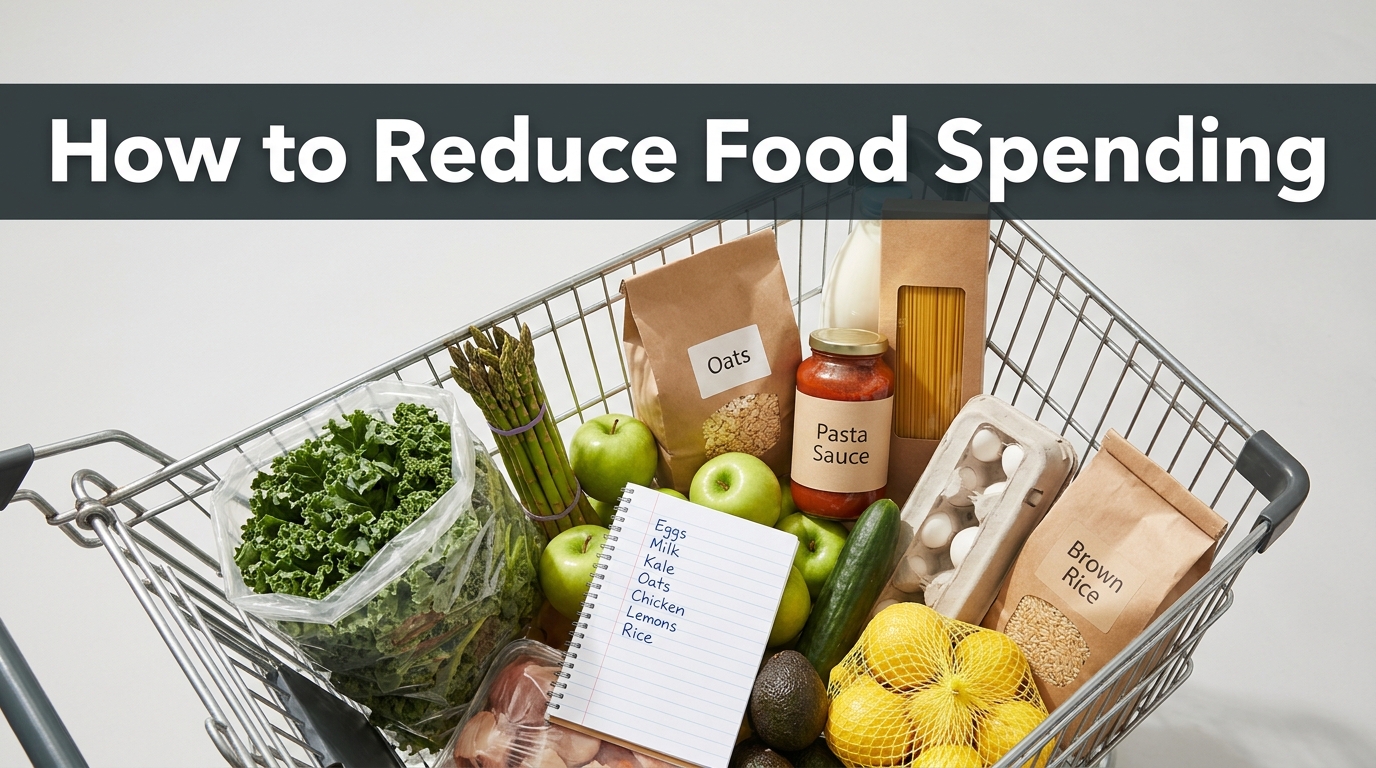
There’s a moment that happens to almost everyone at the checkout line. You watched the cashier scan maybe twelve items. You didn’t buy anything fancy — no steak, no imported cheese, nothing you’d call a splurge. And yet the total on the screen makes you do a double take.
If that scene feels familiar, you’re not imagining things and you’re not bad with money. Food is simply taking a bigger bite out of household budgets than it used to. Grocery prices have climbed faster than many other everyday expenses over the past several years, and that pressure hasn’t fully let up.
The good news is that food spending is one of the most controllable parts of a budget. Unlike rent or insurance, you have daily influence over what you spend on groceries — what you buy, where you buy it, and how much of it actually gets eaten instead of thrown away. This guide walks through exactly how to reduce food spending without turning every meal into a sacrifice, using strategies that are practical, realistic, and based on how actual households save money.
We’ll also cover how to reduce grocery spending specifically, since groceries usually make up the largest single chunk of any food budget. By the end, you’ll have a toolkit you can start using on your very next shopping trip.
Why Food Spending Has Become Such a Big Deal
Before jumping into tactics, it helps to understand the scale of the problem. This isn’t just a feeling — the numbers back it up.
Food-at-home prices climbed sharply in recent years, and while the pace of increases has slowed, costs haven’t gone back down. According to the USDA Economic Research Service, food prices rose by 2.3 percent in 2024 and 2.9 percent in 2025, slower than they had increased during the 2020–23 period. That sounds modest until you remember it’s stacked on top of several years of much sharper increases.
To put real numbers behind it, the USDA’s Official Food Plans — the same benchmarks used to calculate SNAP benefits — show just how much a household’s grocery bill can vary depending on how it’s managed. A single adult following a thrifty, cook-from-scratch approach can spend significantly less per month than someone on the more liberal end of the spectrum, where convenience and variety take priority over cost.
For a typical family of four, NerdWallet’s analysis of USDA data found that the average family of four spends just over one thousand dollars per month on groceries — more than twelve thousand dollars a year. That’s before factoring in restaurant meals, delivery apps, or coffee runs.
Here’s the part that should give everyone hope: a large chunk of that spending is avoidable. According to USDA research, food waste in the United States is estimated at between 30 and 40 percent of the entire food supply. That’s not a small leak — it’s nearly a third to nearly half of what gets purchased never being eaten. If you could plug even part of that leak in your own kitchen, the savings would show up almost immediately.
Food at Home vs. Food Away from Home
One distinction matters a lot when you’re trying to reduce food spending: where the money actually goes.
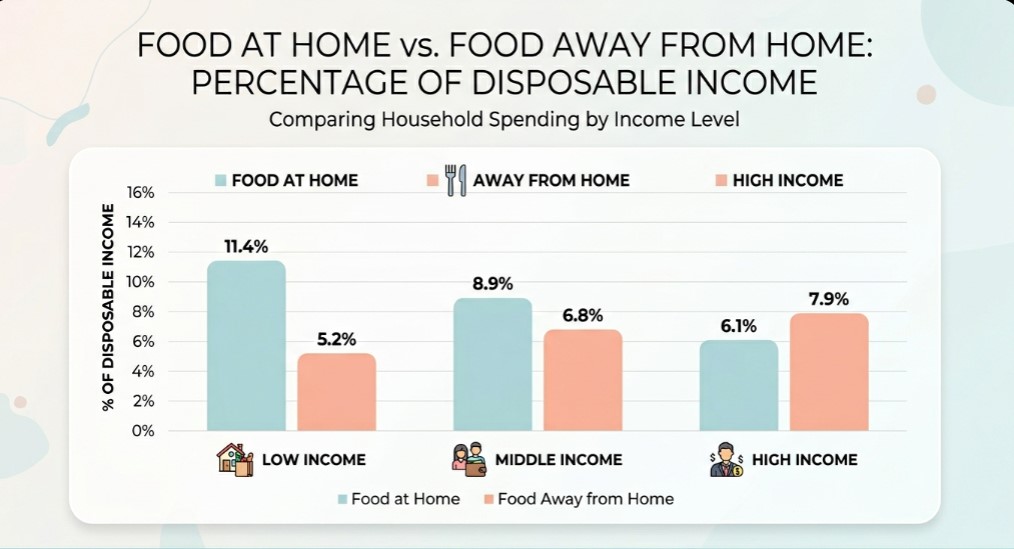
The USDA Economic Research Service tracks this split closely, and the trend is revealing. U.S. consumers spent an average of 9.7 percent of their disposable income on food, with the share spent on food away from home now exceeding the share spent on groceries. In other words, restaurant meals, takeout, and delivery have quietly become a bigger drain than the grocery cart itself for many households.
This matters because it means there are two separate levers to pull: spending less at the grocery store, and eating out less often (or more cheaply). Most people focus only on the first lever. The biggest wins usually come from working both.
How Much Should You Actually Be Spending on Food?
One reason it’s hard to know whether you’re overspending is that there’s no single “correct” number — it depends on household size, location, and goals. But having a benchmark helps.
The USDA publishes four official food spending tiers, updated monthly, that most financial counselors and SNAP-Ed nutrition educators reference:
| Plan Tier | What It Means | Typical Monthly Cost (1 Adult) |
|---|---|---|
| Thrifty | Bare-bones, everything cooked from scratch | Lowest tier; basis for SNAP benefits |
| Low-Cost | Tight but doable, some convenience items | Slightly above thrifty |
| Moderate | Average spending with reasonable variety | Most common benchmark |
| Liberal | Comfortable spending, more convenience and variety | Highest tier |
Source: USDA Food and Nutrition Service Cost of Food Reports
For a single adult, the thrifty plan generally lands in the low-$300s per month, while the moderate plan — the one most households actually fall into — runs noticeably higher. The Thrifty Food Plan is based on the idea that all meals and snacks are prepared at home, using current Dietary Guidelines for Americans recommendations, which is worth remembering: even the “frugal” benchmark assumes you’re cooking, not ordering in.
A useful rule of thumb that financial educators often cite: groceries should generally fall somewhere between 10 and 15 percent of your take-home income, though this naturally shifts based on household size, region, and dietary needs. If your grocery spending is creeping well past that, it’s worth digging into where the money is actually going before assuming you need a bigger income to fix it.
Step 1: Know Where Your Money Is Actually Going
You can’t reduce what you don’t measure. This sounds obvious, but most people who feel like they’re “bad at saving on groceries” have never actually tracked a single month of food spending in detail.
Start simple:
- Keep every grocery and restaurant receipt for two to three weeks
- Separate spending into categories: groceries, takeout, delivery fees, coffee shops, work lunches
- Add it all up at the end of the period
Most people are shocked by one category in particular — usually delivery and takeout, because the cost feels smaller in the moment (a $14 app order doesn’t feel like much) but adds up fast over a month.
A bank or budgeting app can also pull this data automatically by tagging transactions, which saves time if you don’t want to manually track receipts. Either way, the goal is the same: turn a vague feeling of “we spend too much on food” into an actual number you can work against.
A Simple Tracking Method That Works
- Pick a tracking tool — a notes app, spreadsheet, or budgeting app
- Log every food-related purchase for one full month
- Split the total into “groceries” and “eating out”
- Compare against the USDA benchmarks above for your household size
- Set a realistic target 10–15% below your current spending for month two
This single step — before changing anything else about how you shop — often reveals the easiest wins.
Step 2: Build a Weekly Meal Plan (The Single Biggest Lever)
If there’s one habit that moves the needle more than any other, it’s meal planning. It sounds almost too simple to matter, but the research backs it up.
The USDA’s MyPlate program recommends building a habit around it directly: before going shopping, take 15 to 20 minutes each week to plan your meals and make a grocery list of what and how much to buy, considering breakfast, lunch, dinner, and snacks for the week.
That 15-minute investment pays off in two ways. First, it prevents impulse purchases, because you’re shopping with a list instead of wandering the aisles deciding in real time. Second, and just as important, it dramatically cuts food waste — you buy what you’ll actually use instead of guessing.
How to Meal Plan Without It Becoming a Chore
You don’t need a color-coded spreadsheet or a Pinterest-worthy system. A workable plan can be built in four steps:
- Check what you already have. Look in the fridge, freezer, and pantry before writing anything down. Use foods already in your refrigerator, freezer, and pantry to avoid food waste and save money at the grocery store.
- Pick 4–5 dinners for the week. You don’t need seven unique meals — repeat-friendly meals (like a big batch of chili or a sheet-pan dinner that makes great leftovers) reduce both cooking time and waste.
- Build your list around the plan, not the other way around. Write the list directly from the meals you’ve chosen, ingredient by ingredient.
- Leave one or two flexible nights. Life happens. Building in a buffer night (leftovers, a freezer meal, or breakfast-for-dinner) keeps the plan from collapsing the moment your week gets busy.
Use Free Tools to Make This Easier
You don’t have to build a meal plan totally from scratch. Search recipes by ingredients you already own, which is genuinely useful when you’re trying to use up what’s already in the fridge instead of buying more.
Step 3: Master the Grocery List (and Actually Stick to It)
A meal plan is only half the battle — the list built from it is what protects you in the store itself.
Rules That Make a Grocery List Actually Work
- Organize it by store layout. Group items by section (produce, dairy, pantry, frozen) so you move through the store once instead of backtracking, which reduces both time and impulse buys.
- Set a soft item limit. If your list has 18 items, treat a 25-item cart as a signal something extra crept in.
- Avoid shopping hungry. This isn’t just folk wisdom — it’s a well-documented behavioral pattern. Shopping on an empty stomach reliably leads to more impulse purchases, especially of high-calorie convenience foods.
- Shop less often. Each trip to the store is another opportunity for unplanned spending. Cutting from four trips a month down to two can meaningfully reduce extras.
The “Save More at the Grocery Store” Approach
The USDA has a specific tip sheet built for this exact purpose. As outlined in the USDA’s “Save More at the Grocery Store” guidance, shoppers are encouraged to use strategies like comparing unit pricing, reading food labels to compare items, and checking sales on store brands as practical, everyday ways to spend less without sacrificing nutrition.
Unit pricing deserves special attention here, because it’s the single most underused tool on the shelf. That small “$0.21/oz” label tells you the true cost-per-unit regardless of package size — which means you can compare a $4.99 large bag against a $2.99 small bag and know instantly which is the better deal, instead of guessing based on sticker price alone.
Step 4: Shop Smarter — Where and How You Buy Matters
Even with a perfect list, where and how you shop changes the final total significantly.
Compare Store Brands vs. Name Brands
Store-brand (private label) products are typically made in the same or comparable facilities as name brands, often using nearly identical formulations, but priced lower because there’s no marketing budget baked into the cost. Swapping even half your cart to store brands — pantry staples, dairy, canned goods, frozen vegetables — is one of the lowest-effort, highest-impact changes you can make.
Use Cashback and Coupon Apps Strategically
Digital coupons and cashback apps have mostly replaced paper coupons, and they’re worth using — but only for items already on your list. The trap to avoid is letting a “deal” talk you into buying something you weren’t planning to buy in the first place. A 30% discount on something unnecessary isn’t a saving; it’s still a purchase you didn’t need.
Buy Seasonal Produce
Fruits and vegetables are cheapest — and usually tastiest — when they’re in season locally, because supply is high and transportation costs are low. Buying tomatoes in peak summer or squash in early fall typically costs noticeably less than buying the same item out of season.
Consider a Wholesale Club for Non-Perishables
For households of three or more, warehouse club memberships can pay for themselves quickly on non-perishable staples — rice, oats, paper goods, frozen proteins — bought in bulk. The math only works, though, if you actually use what you buy before it goes bad or expires, which brings us to the next major lever.
Watch Price Volatility on Specific Categories
Not all groceries move in price the same way. The food-at-home Consumer Price Index increased 0.7 percent from March 2026 to April 2026 alone, with fresh vegetables and beef seeing some of the sharpest single-month jumps. Categories like fresh meat and produce tend to swing more than shelf-stable staples, so building more meals around beans, lentils, eggs, frozen vegetables, and seasonal produce gives you a buffer against these spikes.
Step 5: Cut Food Waste — The Hidden Money Leak
This is the step most budgeting guides skip, and it might be the most important one.
Remember that statistic from earlier: food waste in the United States is estimated at between 30 and 40 percent of the entire food supply. That waste isn’t happening only at farms and grocery stores — a huge share of it happens in home kitchens, after the money has already been spent.
Separate research on the cost of this waste, compiled in an EPA-supported analysis, estimates the per-household financial impact runs into the hundreds of dollars annually when scaled to a typical family size — money that’s tossed in the trash, literally.
Where Food Waste Actually Happens at Home
- Produce that wilts before it’s used. This is the single biggest category for most households.
- Leftovers forgotten in the back of the fridge. Out of sight really is out of mind.
- Buying duplicates because you forgot what you already had. This is where a quick fridge/pantry check before shopping pays for itself.
- Over-buying in bulk without a plan to use it. Bulk savings disappear fast if half of it spoils.
Practical Fixes That Actually Reduce Waste
- First in, first out (FIFO). When you put away groceries, move older items to the front of the shelf so they get used before newer purchases.
- Freeze before it’s too late. Bread, meat, shredded cheese, and even some produce (bananas, berries) freeze well and buy you weeks of extra time.
- Learn the difference between “sell by,” “use by,” and “best by.” These dates are about quality, not always safety — many foods are perfectly fine to eat past the printed date, and confusion here causes a lot of unnecessary tossing.
- Designate a “use it up” shelf. A single shelf in the fridge reserved for items nearing the end of their life keeps them visible instead of buried.
- Repurpose leftovers intentionally. Plan one meal a week specifically built around using up odds and ends — a stir-fry, soup, or frittata are flexible enough to absorb almost anything.
The USDA’s food waste resources note that the best approach to reducing food loss and waste is not to create it in the first place, and that waste can be avoided by improving storage, shopping habits, and cooking methods. None of that requires special equipment — just a slightly different routine.
Step 6: Cook More, Order Less
This step is less about cooking skill and more about math. A homemade meal is almost always cheaper per serving than the same meal ordered through a delivery app or eaten at a restaurant, once you factor in delivery fees, service charges, and tipping.
The Real Cost of Convenience
Recall that, according to USDA tracking, the share of income spent on food away from home has grown to roughly match — and in 2025, slightly exceed — the share spent on groceries. That’s a significant shift. It means for many households, the fastest way to reduce total food spending isn’t a better grocery strategy at all — it’s simply cooking three more meals a week than they currently do.
You don’t need to eliminate takeout entirely to see a difference. Going from, say, four takeout meals a week down to one or two can free up a meaningful amount of monthly budget without feeling like deprivation.
Batch Cooking and Freezer Meals
Cooking in larger batches once or twice a week — a big pot of soup, a tray of roasted vegetables, a batch of grain bowls — gives you ready-to-eat meals for several days without repeating the cooking effort each time, even if you’re eating slightly different combinations.
A simple system:
| Day | Task |
|---|---|
| Sunday | Batch-cook 2 proteins + 2 starches + roast a tray of vegetables |
| Mon–Wed | Mix and match from what’s prepped |
| Thursday | “Use it up” meal from remaining odds and ends |
| Fri–Sat | Flexible — leftovers, simple meals, or planned takeout night |
Notice that last line — a planned takeout night isn’t a failure of the system. Budgeting for one intentional restaurant meal a week is very different from defaulting to delivery out of decision fatigue on a Tuesday night.
Step 7: Stretch Your Protein Budget
Protein is usually the most expensive line item in any grocery cart, so it’s worth its own section.
Lower-Cost Protein Swaps
- Eggs remain one of the most affordable protein sources per gram, even with periodic price swings.
- Dried or canned beans and lentils cost a fraction of meat per serving and add fiber that meat doesn’t.
- Frozen fish and chicken are often noticeably cheaper than fresh cuts, with no real difference in nutrition once cooked.
- Tofu and other plant proteins can replace meat in a portion of weekly meals without anyone feeling like they’re “missing out,” especially in dishes with strong flavors (stir-fries, curries, tacos).
- Whole chicken vs. parts. A whole chicken is almost always cheaper per pound than pre-cut breasts or thighs, and one bird can stretch across two or three meals plus stock.
A Simple Swap-In Strategy
Rather than eliminating meat entirely, try a “half-and-half” approach in dishes where it’s barely noticeable — using half the usual ground beef and bulking the rest with lentils or mushrooms in tacos, chili, or pasta sauce. The texture difference is minor, the cost difference is not.
Step 8: Use Technology to Stay on Track
Apps and tools can’t replace good habits, but they can make those habits easier to maintain.
Useful Categories of Tools
- Price-tracking and cashback apps that alert you to genuine sales on items you already buy regularly.
- Recipe tools that search by ingredients on hand, like the USDA MyPlate Kitchen, which helps turn “random pantry stuff” into an actual meal instead of food that gets forgotten and wasted.
- Budgeting apps that automatically categorize grocery vs. dining spending, so you don’t have to manually track receipts every week.
- Digital grocery lists synced between household members, so nobody duplicates a purchase or forgets an item and ends up making a second, unplanned trip.
The goal with any tool is the same: remove friction from the habits that actually save money — planning, listing, and tracking — so you’re more likely to stick with them past the first motivated week.
Expert Tips: What Actually Moves the Needle
Not every tip carries equal weight. Based on the research and guidance from nutrition and food policy organizations cited throughout this guide, here are the strategies that tend to produce the biggest results relative to the effort involved:
- Meal planning beats couponing. A 15-minute weekly plan, as recommended directly by USDA MyPlate, consistently prevents more waste and impulse spending than chasing individual deals.
- Reducing food waste is worth more than finding cheaper food. Since up to 30 to 40 percent of the food supply goes to waste, fixing storage and portioning habits often saves more than switching to cheaper brands.
- Cutting eating-out frequency has an outsized impact. Because food-away-from-home spending now rivals or exceeds grocery spending for many households, this single category often holds the biggest single opportunity.
- Unit pricing is underused but powerful. It’s printed on every shelf tag, takes seconds to compare, and directly prevents overpaying for larger packaging that isn’t actually a better deal.
- Protein swaps add up fast. Since protein is typically the priciest part of a meal, even partial substitutions (beans for half the meat) compound into real monthly savings.
Pros and Cons of Common Food-Saving Strategies
No strategy is free of trade-offs. Here’s an honest look at the most common approaches:
| Strategy | Pros | Cons |
|---|---|---|
| Meal planning | Cuts waste, reduces impulse buys, saves time during the week | Requires upfront planning time; less spontaneous |
| Bulk buying | Lower per-unit cost on staples | Risk of spoilage if not used in time; requires storage space |
| Store brands | Significant savings, often comparable quality | Occasional quality variance between brands |
| Batch cooking | Saves time and money simultaneously | Requires freezer space; some meals don’t reheat well |
| Cutting takeout | One of the biggest single savings levers | Requires more home cooking time and effort |
| Coupon/cashback apps | Easy savings on planned purchases | Can encourage unplanned spending if not used carefully |
A Sample Weekly Budget Framework
To bring everything together, here’s how a household might apply these steps in practice. This isn’t a rigid rule — it’s a framework to adapt based on your own household size and the USDA benchmarks discussed earlier.
| Category | Suggested Approach |
|---|---|
| Meal planning | 15–20 minutes every weekend before shopping |
| Grocery trips | Limit to 1–2 per week, list-based |
| Protein | Mix of eggs, beans, and one or two meat-based meals |
| Produce | Seasonal, supplemented with frozen vegetables for off-season staples |
| Leftovers | One “use it up” meal built in per week |
| Eating out | Budget for one intentional meal out, rather than reactive takeout |
| Tracking | Weekly check-in against your target spending number |
Frequently Asked Questions
How can I reduce my food spending without sacrificing nutrition?
Focus on swaps rather than cuts. Replacing some meat with beans or lentils, buying frozen vegetables instead of out-of-season fresh produce, and choosing store-brand staples typically lowers cost without lowering nutritional value. The USDA’s Healthy Eating on a Budget resources are built specifically around this balance.
What’s the fastest way to lower my grocery bill this month?
Two changes produce results almost immediately: building a meal plan before each shopping trip, and reducing the number of takeout or delivery orders per week. Both address the biggest spending categories directly, without requiring weeks of habit-building first.
How much should a family of four spend on groceries per month?
According to USDA-based estimates compiled by NerdWallet, a typical family of four spends just over one thousand dollars a month on groceries, totaling more than twelve thousand dollars annually. Your actual number will vary based on location, dietary needs, and how closely you follow a thrifty versus liberal spending plan.
Does buying in bulk actually save money?
It can, but only on items you’ll use before they expire — rice, oats, frozen meat, paper goods, and other non-perishables. Bulk buying perishable items like fresh produce or dairy often backfires, since spoilage erases the per-unit savings.
How much food does the average household waste, and does it matter for my budget?
It matters a lot. USDA estimates that food waste accounts for between 30 and 40 percent of the entire U.S. food supply. Since that waste happens after you’ve already paid for the food, reducing it — through better storage, portioning, and using up leftovers — is one of the most direct ways to lower your effective grocery spending without buying less.
Conclusion
Reducing food spending doesn’t require giving up good meals, eating bland food, or living off the cheapest possible ingredients. It comes down to a handful of repeatable habits: knowing your numbers, planning meals before you shop, sticking to a list, cutting down on waste, and being intentional about how often you eat out.
None of these changes need to happen all at once. Pick one — maybe it’s building your first real meal plan this week, or doing a fridge inventory before your next shopping trip — and build from there. Small, consistent changes in how you shop and cook tend to add up to real, lasting savings over a few months, without the burnout that comes from trying to overhaul everything overnight.
Start with your next grocery trip. Write the list, check the unit prices, and see how much of a difference one planned week makes.

