
Building a home from scratch is one of the most significant financial decisions most Americans will ever make. And if you’ve started researching costs, you already know: construction prices have surged. According to the U.S. Census Bureau, the average cost per square foot to build a new home in the United States now exceeds $150 — and in some states, it can climb well past $300.
But here’s the thing most contractors won’t tell you upfront: the materials you choose account for roughly 50% of your total build cost. Pick wisely, and you can shave tens of thousands off your budget without sacrificing structural integrity or livability.
This guide breaks down the absolute cheapest materials to build a house — organized by type, use case, and real-world pros and cons. Whether you’re building a primary home, a cabin, an ADU (accessory dwelling unit), or simply trying to understand your options before talking to a contractor, this is your roadmap.
What Determines the Cost of Building Materials?
Before diving into the list, it helps to understand why some materials are cheap and others aren’t.
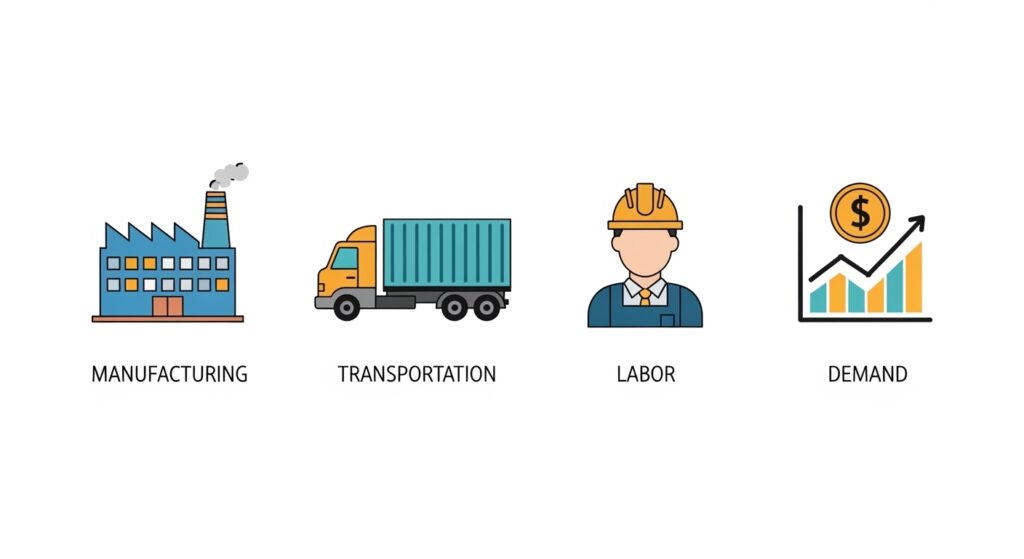
The price of any building material depends on several factors: raw material availability, manufacturing complexity, transportation and shipping distance, installation labor requirements, and regional demand. For example, concrete is inexpensive in most of the continental U.S. because the raw ingredients — limestone, water, and aggregate — are abundant. Meanwhile, certain specialty woods or imported materials carry costs tied to scarcity and supply chains.
The National Association of Home Builders (NAHB) regularly tracks material cost data and has consistently shown that framing lumber, concrete, and sheathing represent the largest material expenditure categories in new home construction.
Key takeaway: Cheap doesn’t always mean low-quality. Many of the most durable and time-tested building methods rely on the most affordable materials available.
The Cheapest Building Materials for a House (Full List)
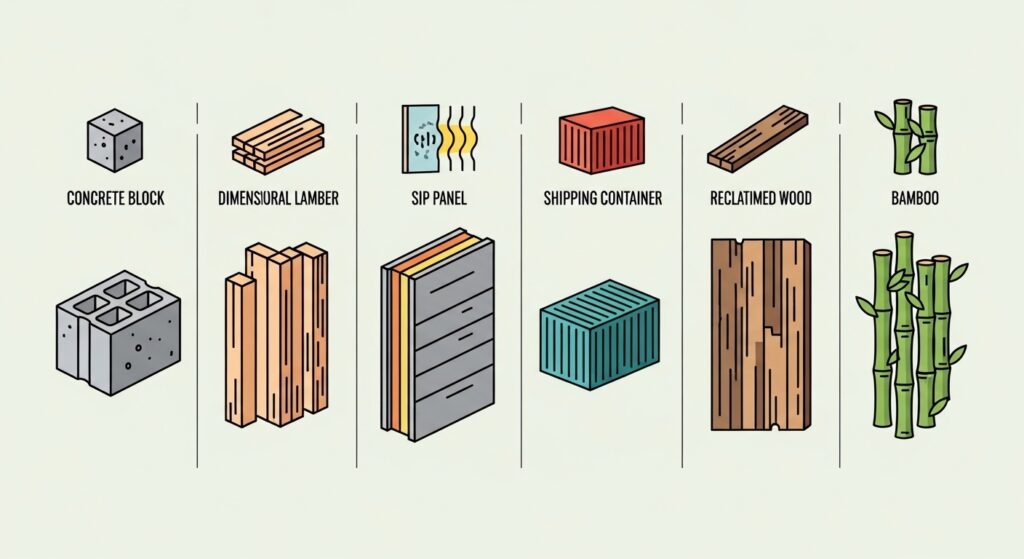
Here is a comprehensive list of low-cost building materials used in residential construction across the USA, ranked generally from most affordable to moderately affordable.
1. Concrete Blocks (CMU — Concrete Masonry Units)
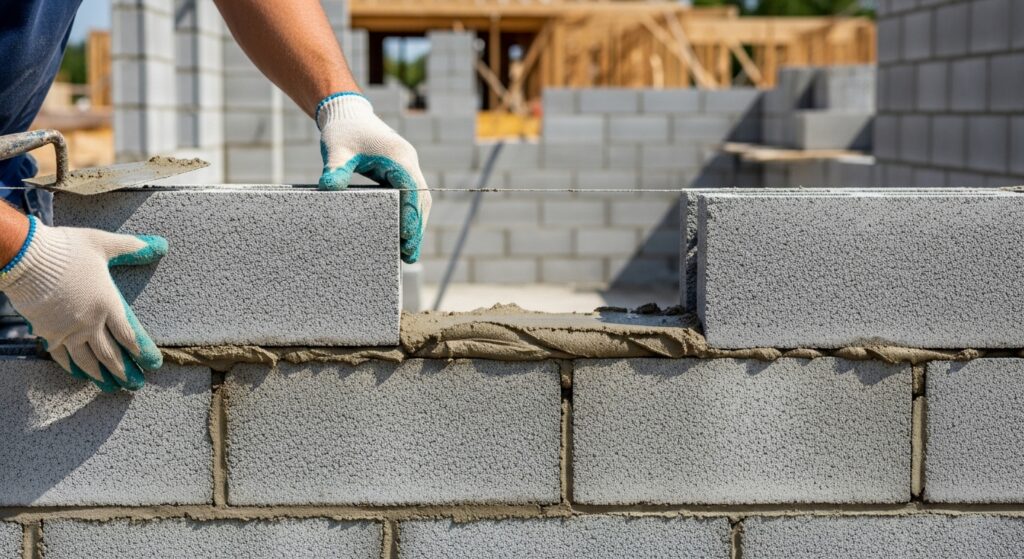
If you ask most structural engineers what the cheapest building material is that also performs reliably over decades, concrete blocks will be near the top of the list.
Concrete masonry units (CMUs), commonly called cinder blocks, cost between $1.50 and $3.50 per block on average, depending on size and your location. A standard 8″x8″x16″ block weighs about 30–35 pounds and is used to construct load-bearing walls, foundations, and retaining walls.
Why they’re so cheap: CMUs are manufactured locally in almost every state, which cuts transportation costs dramatically. Their production uses widely available aggregates and Portland cement.
Pros:
- Exceptional fire resistance
- High thermal mass (keeps homes cooler in summer)
- Pest-resistant and rot-proof
- Extremely durable — can last 100+ years with minimal maintenance
- Works well in hurricane and tornado-prone regions
Cons:
- Heavy and labor-intensive to install
- Poor insulation value without added insulation
- Aesthetically plain without finishing
Expert Tip: In Florida, Texas, and the Gulf Coast region, CMU construction is widely favored not just for its cost but because it outperforms wood framing in high-wind conditions. The Florida Division of Emergency Management even promotes CMU for disaster-resistant housing.
Estimated material cost for a 1,500 sq ft home: $10,000–$25,000 (structural walls only)
2. Conventional Wood Framing (Stick Framing)
For decades, wood stick framing has been the dominant construction method in the United States, and for good reason — it strikes the right balance between cost, ease of construction, and adaptability.
Standard dimensional lumber (2x4s, 2x6s, 2x8s) is produced at scale by mills across the Pacific Northwest, the South, and the Great Lakes region. According to Random Lengths, the lumber price index fluctuates, but standard framing lumber typically runs $0.40 to $0.80 per board foot under normal market conditions (prices spiked in 2021 but have since stabilized).
Pros:
- Universally understood by contractors — low labor costs
- Easy to modify, add to, or repair
- Compatible with standard insulation, wiring, and plumbing systems
- Fast build times
Cons:
- Vulnerable to moisture, rot, and termites without treatment
- Susceptible to fire
- Lumber prices can be volatile
Estimated material cost for a 1,500 sq ft home: $25,000–$50,000 (full framing package)
3. Structural Insulated Panels (SIPs)
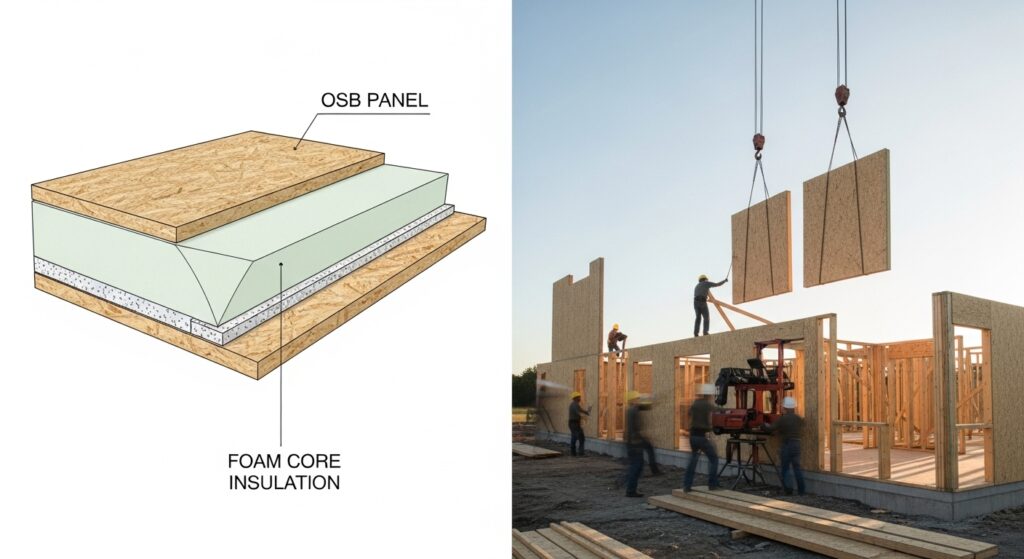
SIPs often surprise people by appearing on a “cheap materials” list — but when you look at the total cost of ownership, they deliver serious value.
A SIP panel consists of foam insulation sandwiched between two sheets of oriented strand board (OSB). They’re factory-manufactured to exact dimensions, which slashes on-site labor time by up to 55%, according to SIPA (Structural Insulated Panel Association).
Material cost per sq ft: $7–$12 (panels only)
Because SIP homes are highly energy-efficient, they typically reduce heating and cooling costs by 40–60%, meaning the upfront premium pays back within 5–7 years in most U.S. climates.
Pros:
- Exceptional energy efficiency
- Fast assembly
- Strong and rigid structure
- Less waste than stick framing
Cons:
- Higher upfront panel cost
- Requires precise planning (modifications are harder post-build)
4. Shipping Containers
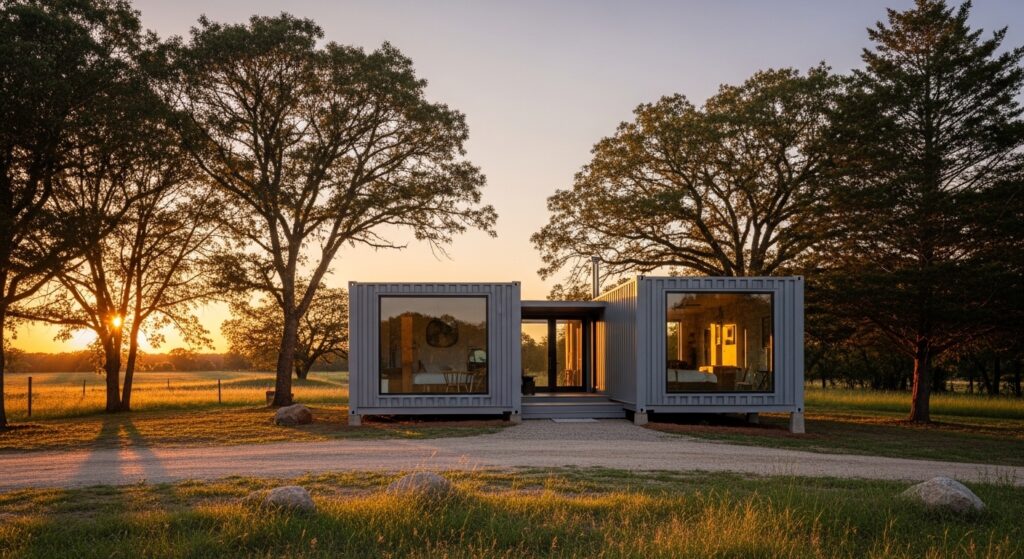
Repurposed shipping containers have become one of the most talked-about cheap home building materials in the past decade — and the numbers back it up.
A standard 20-foot ISO shipping container costs between $1,500 and $4,000 used, while a 40-foot container runs $2,500 to $6,000. Stack four to six containers and you have the structural shell of a home for $10,000–$24,000 — a fraction of traditional construction costs.
The Container Store Association notes that there are millions of unused shipping containers sitting in U.S. ports, making them locally available in most coastal and mid-continent states.
Pros:
- Extremely low structural material cost
- Durable steel construction — built to withstand ocean freight
- Modular and stackable
- Eco-friendly (reusing existing material)
Cons:
- Cutting openings requires specialized tools and welding expertise
- May contain residual chemicals from prior cargo
- Zoning laws in some U.S. counties restrict container homes
- Insulation is critical (steel conducts heat and cold)
Best for: Off-grid cabins, ADUs, workshop spaces, or budget primary homes in rural areas.
5. Reclaimed and Salvaged Wood
If you’re willing to put in some legwork, reclaimed wood is one of the cheapest — and most characterful — building materials available.
Old-growth timber salvaged from barns, factories, and demolished buildings is often stronger than new-growth lumber because trees grew slower historically, producing denser wood grain. And the price? Sometimes free, especially if you’re willing to deconstruct an old building yourself.
Where to find it for free or cheap:
- Search for “leftover construction materials free near me” on Freecycle, Craigslist, or Facebook Marketplace
- Contact local demolition companies — they often give away material to avoid landfill costs
- Check Habitat for Humanity ReStores for deeply discounted salvaged building materials
- Visit BuildItGreen in California or similar deconstruction nonprofits in your region
Pros:
- Can be free or very low cost
- Unique, high-character aesthetic
- Environmentally sustainable
- Often superior structural quality
Cons:
- Labor-intensive sourcing and preparation
- May need treatment for pests or rot
- Inconsistent sizing can complicate construction
- Not always code-compliant without documentation
6. Bamboo
Bamboo isn’t just for pandas. As a construction material, it’s one of the fastest-growing and most renewable resources on Earth — and its tensile strength rivals steel on a pound-for-pound basis, according to research published by the International Network for Bamboo and Rattan (INBAR).
In the U.S. market, structural bamboo panels and boards typically cost $2–$5 per square foot, making them highly competitive with hardwood while offering superior sustainability credentials.
Pros:
- Extremely fast-growing (harvestable in 3–5 years vs. 25+ years for hardwood)
- High strength-to-weight ratio
- Natural pest resistance
- Beautiful natural aesthetic
Cons:
- Availability varies significantly by region in the U.S.
- Not yet widely accepted by all local building codes
- Requires sealing to prevent moisture absorption
Best used for: Interior finishes, flooring, wall paneling, and supplemental structural elements.
7. Precast Concrete
Precast concrete panels are manufactured off-site in controlled conditions and then transported and assembled on location. This process eliminates much of the waste and time associated with poured-in-place concrete.
For residential use, precast panels offer one of the best cost-per-square-foot values for exterior walls, running approximately $20–$35 per square foot installed, which is competitive with traditional stucco or brick when you account for labor savings.
The Precast/Prestressed Concrete Institute (PCI) notes that precast construction can cut overall project timelines by 20–30% compared to conventional site-built methods.
Pros:
- Consistent quality (factory-controlled manufacturing)
- Faster on-site assembly
- Excellent durability and fire resistance
- Low long-term maintenance
Cons:
- Heavy — requires cranes and specialized equipment
- Less design flexibility than poured concrete
- Higher upfront cost vs. CMU blocks
8. Metal / Steel Framing
Cold-formed steel (CFS) framing is gaining ground as a wood alternative, particularly in regions where termites are a persistent problem. Steel studs run $2–$4 per linear foot, comparable to wood framing, and are completely impervious to rot and insects.
The Steel Framing Alliance reports that steel-framed homes can cost 2–3% more upfront than wood-framed homes but offer significant long-term savings in insurance premiums and maintenance.
Pros:
- No rot, warping, or termite damage
- Non-combustible (can lower homeowners insurance costs)
- Lightweight and easy to handle
- 100% recyclable
Cons:
- Lower insulation value than wood (thermal bridging)
- Requires specialized fasteners
- Less common — fewer local contractors familiar with CFS
9. Earthbag Construction
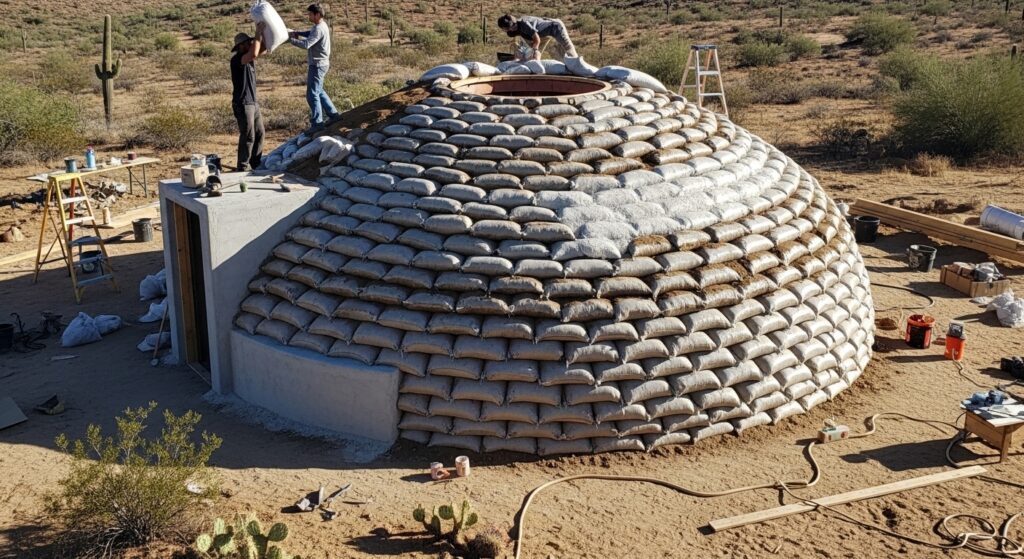
Earthbag homes may be the most unconventional entry on this list — and also potentially the cheapest of all.
The concept is simple: polypropylene bags (the type used for grain or sandbags) are filled with compacted earth or a sand-cement mixture and stacked in courses like oversized bricks. Barbed wire between layers provides tensile strength.
According to the CalEarth Institute, an earthbag home can be built for as little as $10–$15 per square foot in materials, excluding labor. That’s a 1,000 sq ft home for roughly $10,000–$15,000 in raw material costs.
Pros:
- Incredibly low material cost
- Excellent thermal mass
- Uses locally sourced earth
- Resistant to fire, flood, and earthquakes
Cons:
- Labor-intensive (high DIY requirement)
- Zoning and code approval can be difficult in urban areas
- Not widely understood by contractors
Best for: Owner-builders in rural areas, emergency housing, off-grid retreats.
10. Adobe (Mud Brick)
Adobe construction has been used in the American Southwest for over a thousand years — and it remains one of the cheapest building methods available in dry climates.
Adobe bricks are made from clay-rich soil, water, and organic material like straw, sun-dried into uniform blocks. In New Mexico and Arizona, where adobe is deeply rooted in vernacular architecture, the Adobe Association of the Southwest promotes its use as a sustainable and affordable alternative to conventional materials.
Material cost: $0.25–$0.60 per brick (or essentially free if you make your own from site soil)
Pros:
- Near-zero cost if made on-site
- Exceptional thermal mass
- Naturally fire and pest-resistant
- Beautiful, timeless aesthetic
Cons:
- Climate-specific — unsuitable for wet or cold climates without extensive waterproofing
- Heavy construction requires engineered foundations
- Slow to build
Cheapest Building Materials Compared: At-a-Glance Table
| Material | Avg. Cost/Sq Ft (Materials) | Durability | DIY-Friendly | Best Climate |
|---|---|---|---|---|
| CMU / Concrete Block | $3–$6 | ⭐⭐⭐⭐⭐ | Moderate | All |
| Wood Stick Framing | $5–$10 | ⭐⭐⭐ | Yes | All |
| Shipping Containers | $2–$5 | ⭐⭐⭐⭐ | Moderate | All |
| Reclaimed Wood | $0–$3 | ⭐⭐⭐ | Yes | All |
| SIPs | $7–$12 | ⭐⭐⭐⭐ | Moderate | Cold/Mixed |
| Precast Concrete | $20–$35 | ⭐⭐⭐⭐⭐ | No | All |
| Steel Framing | $5–$9 | ⭐⭐⭐⭐⭐ | Moderate | All |
| Bamboo | $2–$5 | ⭐⭐⭐ | Yes | Warm/Wet |
| Earthbag | $1–$3 | ⭐⭐⭐⭐ | Yes | Dry/Warm |
| Adobe | $0.50–$2 | ⭐⭐⭐⭐ | Yes | Dry |
What Is the Absolute Cheapest Material to Build a House?
When people search for the cheapest building material, they’re usually asking one of two questions: cheapest by upfront cost, or cheapest by total cost of ownership.
By upfront material cost: Earthbag and adobe construction win handily — you can source the raw material (earth) from your own building site at zero cost. Reclaimed and salvaged wood comes in a close second.
By total cost of ownership (including energy, maintenance, insurance): SIP panels and concrete block construction often come out ahead, because their durability and energy efficiency reduce costs over a 20–30 year ownership period.
By ease and speed of build: Wood stick framing remains the gold standard for cost-efficiency when you factor in labor. Virtually every contractor in America knows how to frame with dimensional lumber, which keeps labor costs competitive.
If you’re building in a standard U.S. suburb or city with code requirements, wood stick framing with CMU foundation walls is likely your most practical cheapest option. If you’re building off-grid or in a rural area with greater design freedom, earthbag or shipping containers can dramatically reduce your material budget.
How to Find Leftover Construction Materials Free Near Me
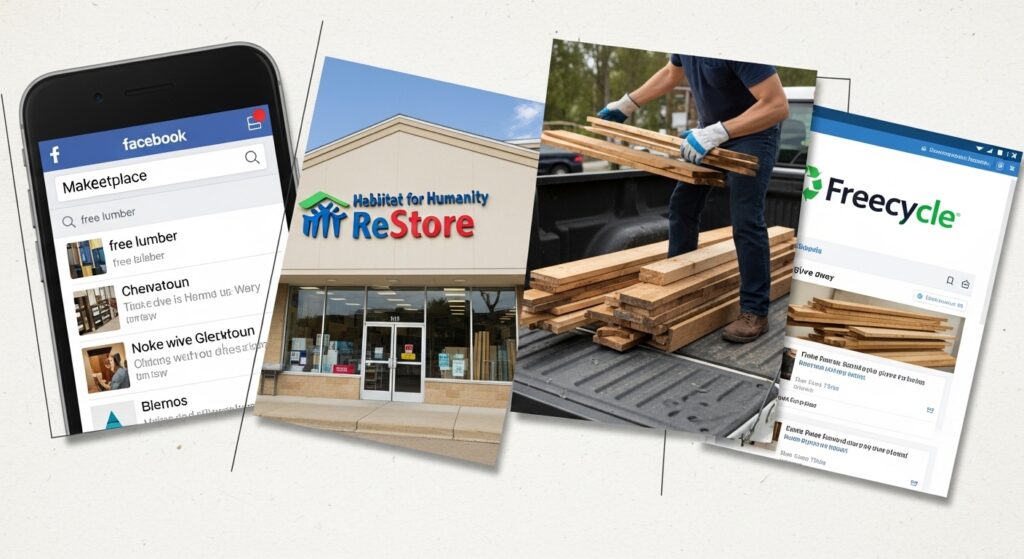
One of the most underutilized money-saving strategies is sourcing free or deeply discounted leftover construction materials. Here’s exactly how to do it:
Online Platforms:
- Craigslist Free Section — Search your metro area for “free lumber,” “free concrete blocks,” or “free construction materials”
- Facebook Marketplace — Excellent for finding surplus building materials from contractors and homeowners doing renovations
- Freecycle.org — A nonprofit network specifically dedicated to keeping usable goods out of landfills
- OfferUp — Similar to Marketplace with strong contractor listings
Local Resources:
- Habitat for Humanity ReStores — Over 900 locations across the U.S. selling donated new and gently used building supplies at 50–80% below retail
- Local demolition contractors — Contact them directly; many will let you salvage materials for free in exchange for doing the deconstruction labor
- Building supply company remnants — Big-box stores like Home Depot and Lowe’s regularly mark down damaged or seasonal inventory
Pro Tips for Salvage:
- Always inspect salvaged wood for rot, mold, and pest damage before use
- Ask your local building inspector whether reclaimed materials require testing or documentation for code compliance
- For structural elements, use salvaged materials only when you can verify their load rating
Material Cost to Build a House: Regional Breakdown
The cheapest building materials vary by region based on local availability, climate suitability, and labor familiarity. Here’s how material cost to build a house breaks down across different U.S. regions:
| Region | Most Cost-Effective Primary Material | Estimated Material Cost per Sq Ft |
|---|---|---|
| Southeast (FL, GA, AL) | CMU / Concrete Block | $50–$80 |
| Southwest (AZ, NM, NV) | Adobe, ICF, CMU | $40–$75 |
| Pacific Northwest (WA, OR) | Wood Framing | $55–$90 |
| Midwest (OH, IN, IL) | Wood Framing, Steel | $45–$75 |
| Northeast (NY, MA, CT) | Wood Framing, SIPs | $65–$110 |
| Texas | Wood Framing, CMU | $45–$80 |
Note: These figures reflect materials only, not labor, land, permits, or site work. Source: RSMeans Construction Data
Expert Tips for Reducing Your Material Costs
After examining dozens of budget home builds, here are the strategies that consistently deliver the biggest savings:
1. Buy in bulk or in advance. Lumber and concrete suppliers offer meaningful discounts — often 10–20% — for large-quantity orders. If your timeline allows, purchasing materials before you’re ready to build can lock in lower prices.
2. Use a hybrid material approach. The cheapest homes often combine materials strategically. For example: CMU block for the first floor (strength, fire resistance), wood framing for the second floor (lighter, cheaper), and SIP panels for the roof structure (energy efficiency).
3. Minimize your footprint. The single biggest driver of material cost is square footage. A well-designed 1,000 sq ft home with an open floor plan can live larger than a poorly planned 1,400 sq ft home. Work with an architect on a tight, efficient layout.
4. Choose materials your local contractors know. Using an uncommon material (like rammed earth) in an area where no one has built with it means expensive labor for a learning curve. Stick to materials your region’s workforce knows well.
5. Don’t ignore the structure. The cheapest wall material is useless if your foundation or roof fails. Invest appropriately in the structural envelope even while cutting costs on finishes and cladding.
Frequently Asked Questions
What is the cheapest material to build a house with?
Earthbag construction and adobe are the cheapest by raw material cost — sometimes costing as little as $10–$15 per square foot in materials alone. However, for most Americans building within standard building codes, concrete block (CMU) and wood stick framing offer the best balance of affordability, contractor availability, and regulatory compliance.
What is the least expensive building material that is also durable?
Concrete masonry units (CMUs) are widely considered the least expensive durable building material in the U.S. They’re resistant to fire, pests, moisture, and high winds, and can last well over 100 years with minimal maintenance — all at a material cost of $1.50–$3.50 per block.
Can I build a cheap house for under $50,000 in the USA?
Yes, but it requires specific conditions: owner-builder status (doing much of the work yourself), using the cheapest materials like reclaimed wood, earthbag, or container construction, and building in a rural area with fewer code restrictions and lower land costs. Organizations like The Owner-Builder Network document numerous examples of homes built for under $50,000 using these approaches.
Where can I find cheap building materials for houses near me?
Your best sources for cheap or free building materials are Habitat for Humanity ReStores, Craigslist’s free section, Facebook Marketplace, Freecycle.org, and direct outreach to local demolition contractors. For new materials at discount, check out surplus liquidators and check if your local Home Depot has a cull lumber rack or clearance section.
What is the fastest and cheapest house to build?
Prefabricated or modular homes are currently the fastest and among the cheapest to build — factory-manufactured sections are assembled on-site in as little as a few days. According to the Manufactured Housing Institute, manufactured homes cost an average of $80–$100 per square foot, compared to $150+ for site-built homes.
Shipping container homes are a close second for speed, since the structural shell is already complete. SIP-panel homes are the fastest traditionally constructed option.
Final Thoughts: Choosing the Right Cheap Building Material for Your Home
There’s no single answer to what the cheapest material to build a house is — because the right answer depends on your location, climate, building codes, DIY capacity, and long-term goals.
What’s universally true is this: the builders who save the most money don’t just pick cheap materials — they pick the right cheap materials and combine them intelligently.
Concrete block for your foundation and lower walls. Reclaimed lumber for interior framing. SIP panels on the roof for energy savings. Salvaged fixtures and finishes from a ReStore. These layered decisions add up to savings in the tens of thousands.
Start with a realistic budget, get at least three contractor quotes, and consult your local building department early about which materials are permitted in your jurisdiction. Then use this guide to have smarter conversations about where your money is — and isn’t — going.
Ready to start planning? Download a free construction cost estimator from BuildingAdvisor.com, or use the NAHB’s Cost-to-Build Calculator to benchmark your project against regional averages.
Have questions about affordable home construction? Leave a comment below or share this guide with someone planning a build. The more people know about these options, the more homes get built within budget.

