
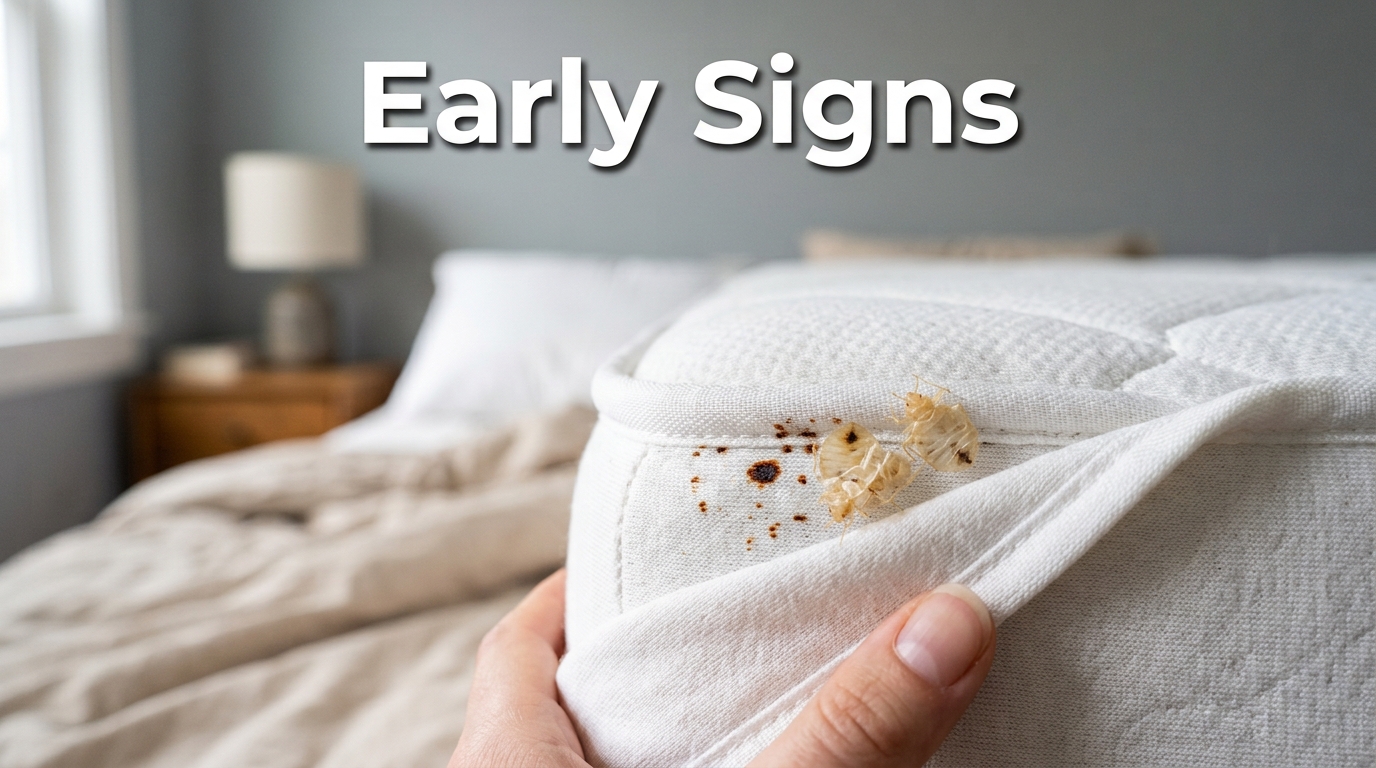
If you have noticed a few itchy bumps after a night’s sleep, or spotted tiny rust-colored specks on your pillowcase, you are probably searching for the early signs of bed bugs because something feels off. The good news is that the earliest clues rarely involve actually seeing a live bug crawling across your sheets. They show up first as tiny stains, shed skins, a faint musty smell, or bite marks that only appear days after the actual bite happened.
Catching the early signs of bed bugs quickly is what separates a quick, contained cleanup from a costly, weeks-long treatment involving multiple rooms. This guide walks through exactly what to look for on your mattress, sheets, walls, and skin, how to tell a bed bug bite apart from a mosquito bite, and what steps to take the moment you spot something suspicious.
What Counts as an “Early” Sign, and Why It’s Easy to Miss
Bed bugs are experts at staying hidden. A single fertilized female can start a colony that grows for weeks before anyone in the house notices a bite or a stain. Even when bugs are active, low-level infestations are genuinely hard to detect, and most people notice the signs bed bugs leave behind long before they ever spot an actual insect.
That delay matters. Bed bugs can survive for months without feeding, which means a small population can sit dormant in a seam or a wall crack while you sleep just a few feet away without any obvious symptoms. Learning to recognize the physical evidence, not just bites, gives you a much better chance of catching a problem while it is still small enough to manage yourself.
Early Signs of Bed Bugs on Mattress
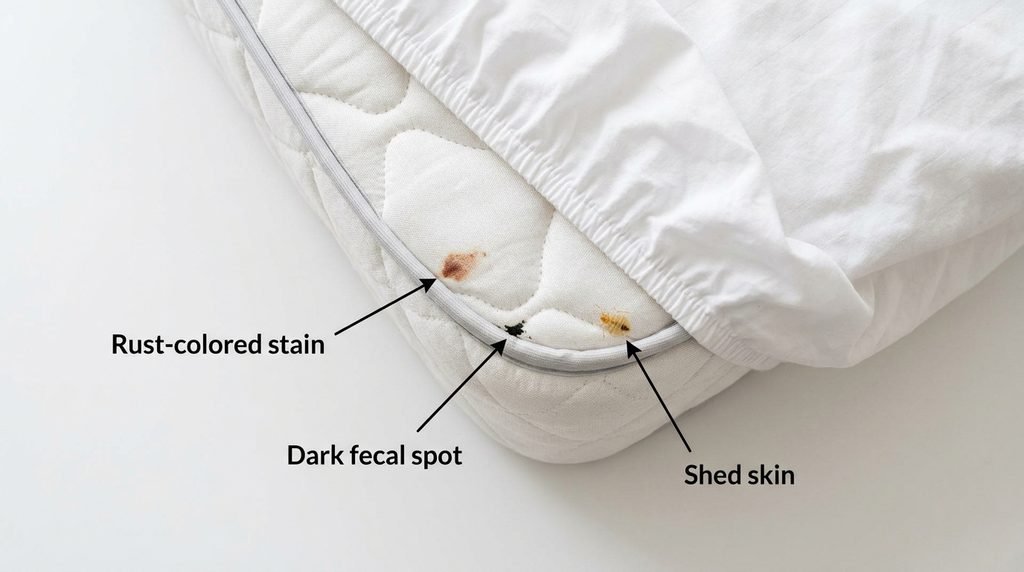
Your mattress is almost always the first place to check, and it is where the earliest physical evidence tends to collect. Start by stripping the bedding completely and examining the seams, piping, and tags closely, since these tight folds are where bed bugs prefer to hide and lay eggs.
Look for these specific clues:
- Small rust or reddish stains where a bug was accidentally crushed while feeding
- Tiny dark spots, roughly the size of a period, which are bed bug droppings and may smear or bleed slightly into the fabric
- Pale, papery shed skins left behind after a nymph molts
- Pinhead-sized pearly white or pale yellow eggs tucked into the seams
It helps to search near the piping, seams, and tags of both the mattress and box spring first, since roughly one in five feeding events leaves behind a visible rusty or tarry stain. A bright flashlight and a flat, stiff card, like an old gift card, make it much easier to check tight seams without tearing the fabric.
If your mattress is older or has fabric-covered seams that make inspection difficult, it may be worth reviewing this guide to choosing a mattress that fits your sleep style, body, and budget before you decide whether to treat, encase, or eventually replace it.
Early Signs of Bed Bugs Sheets
Sheets pick up evidence differently than the mattress itself, mostly because they move and shift throughout the night, spreading small stains across a wider area. After a few nights of undisturbed feeding, you may notice faint reddish smears where a bug was crushed, or small dark specks scattered near where your body normally rests.
A musty, sweetish odor is another clue that sometimes shows up on bedding before anything else does, particularly once a population grows past a handful of bugs. It is easy to mistake this smell for laundry that needs a wash, so pay attention if the odor returns quickly after clean sheets go on the bed. Washing linens in hot water and drying them on the highest heat setting the fabric allows is one of the most effective first steps once you suspect a problem, since heat above roughly 120°F kills bed bugs and their eggs.
Early Signs of Bed Bugs Eggs
Eggs are one of the most reliable signs because, unlike a bite, they cannot be confused with anything else once you know what to look for. Female bed bugs use a glue-like secretion to attach their eggs directly to surfaces, so they tend to stay put in the exact spot where they were laid, usually somewhere close to a hiding place near the bed.
| Feature | Description |
|---|---|
| Size | About 1 millimeter, roughly the size of a pinhead |
| Color | Pearly white to pale yellow when fresh |
| Shape | Oval, with a small hinged cap at one end |
| Age marker | A dark eye-spot appears once the egg is older than about five days |
| Hatch time | Roughly 7 to 14 days, depending on room temperature |
| Common locations | Mattress seams, box spring folds, bed frame joints, baseboard cracks |
Eggs are pearl-white and roughly the size of a pinhead, with a visible eye-spot developing once they pass the five-day mark. Because eggs are more resistant to many surface treatments than live bugs, finding them is often the clearest sign that professional treatment, rather than a simple cleaning, is needed.
Early Signs of Bed Bugs on Walls
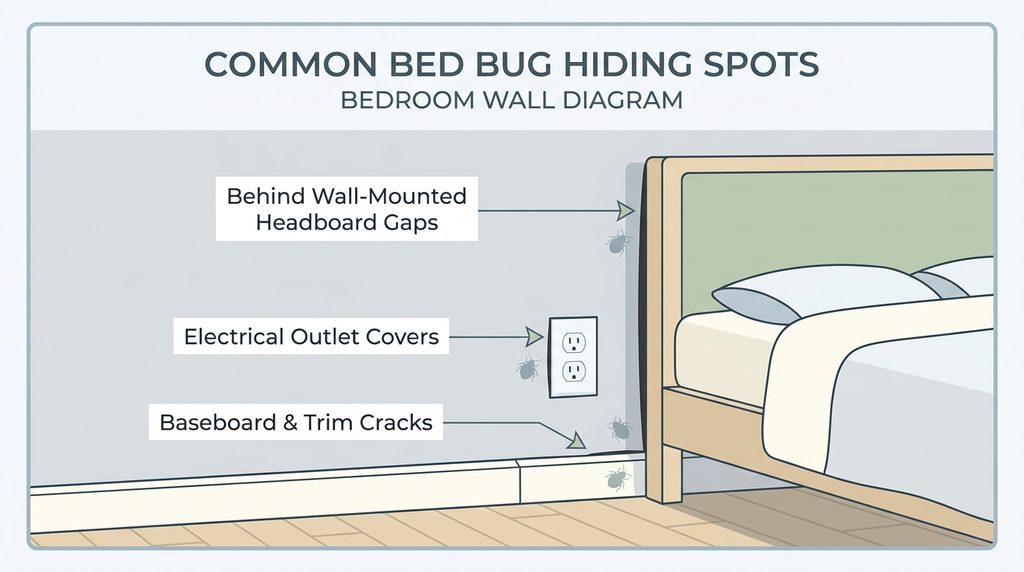
Bed bugs are not limited to the bed itself, especially once a population starts to outgrow its original hiding spot. In apartments and multi-unit buildings, they can travel through wall voids, electrical outlets, and shared pipes to reach neighboring rooms.
Check baseboards, the edges of wallpaper or peeling paint, picture frames, and outlet covers near the bed for the same rust stains, dark specks, and shed skins you would look for on a mattress. A thin gap behind a headboard mounted directly on the wall is a particularly common hiding spot that people overlook, since it is rarely checked during a normal cleaning routine.
Early Signs of Bed Bugs Bites and on Skin
Bites are usually what finally prompts people to search for answers, but they are also the least reliable sign on their own. Bite marks can take up to 14 days to appear in some people, and some people never react to a bite at all, which means bites alone are not enough to confirm or rule out an infestation.
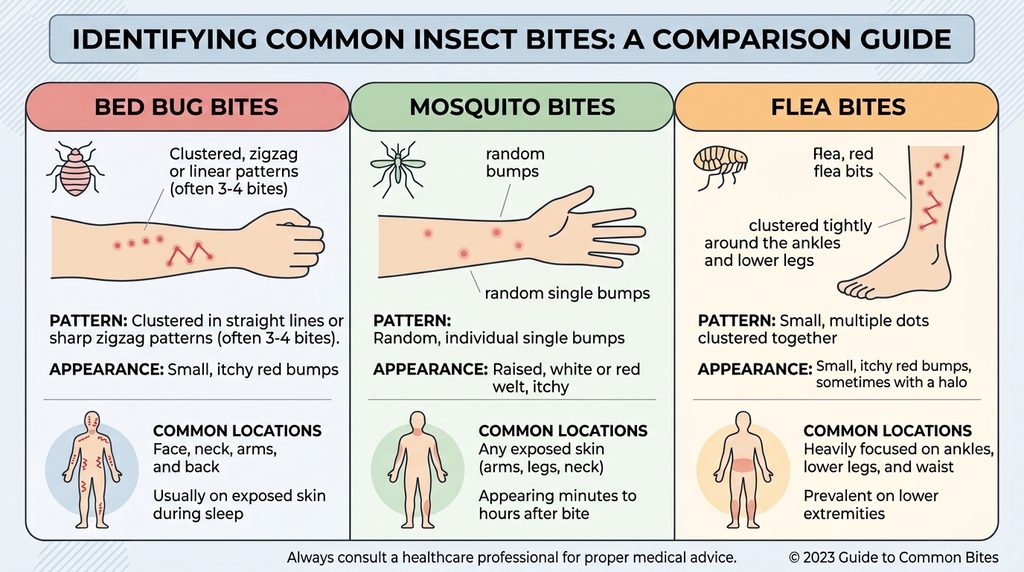
When bites do appear, they tend to show up as small, itchy red bumps that usually appear in clusters, often forming a line or a zigzag pattern on skin that was exposed while sleeping, such as the arms, neck, shoulders, and face.
| Feature | Bed Bug Bites | Mosquito Bites | Flea Bites |
|---|---|---|---|
| Pattern | Clustered lines or zigzags | Random, scattered | Clustered, often near ankles |
| Timing | May take up to 14 days to appear | Usually visible within hours | Usually visible within hours |
| Location | Exposed skin while sleeping | Anywhere exposed outdoors | Lower legs and ankles |
| Painful on contact | No, saliva numbs the area | Sometimes | Often itchy immediately |
Bed bugs cannot fly and cannot crawl long distances on their own, so they typically hitch a ride into a home on luggage, clothing, or used furniture rather than migrating in from outside.
If you are unsure whether a bite came from a bed bug or from something else entirely, it can help to compare the insect itself rather than relying on the bite alone. This guide to bugs that look like bed bugs walks through common look-alikes, including carpet beetles and spider beetles, that are frequently mistaken for the real thing.
Early Signs of Bed Bugs on Bed Frame and Furniture
Once you have checked the mattress, move on to the frame, headboard, and any furniture within a few feet of the bed. Bed bugs tend to stay within about eight feet of where people sleep, so nearby nightstands, upholstered chairs, and the joints of a wooden bed frame are all worth a careful look.
Use a flashlight and a flat tool to check screw holes, corner joints, and any place where two pieces of wood or fabric meet. Dark speckled droppings along a frame joint or inside a drawer track are a strong indicator, even if the mattress itself looks completely clean, since bugs sometimes prefer the frame over the mattress in the very early stages of a small infestation.
Other Warning Signs Worth Noticing
A few additional clues often show up alongside the signs above, especially as a small problem starts to grow. A faint, sweetish, musty odor in the bedroom can develop once a population reaches a noticeable size, though it usually is not detectable in the very earliest stages. Finding an actual live bug, reddish-brown, flat, and roughly the size of an apple seed, confirms an active infestation rather than just a suspicion, and pale, papery shed skins scattered near a hiding spot are proof that bugs have been present long enough to molt at least once.
Common Mistakes People Make When Checking for Bed Bugs
Even careful homeowners tend to make a few predictable errors when inspecting for an infestation.
- Checking only the mattress top and skipping the seams, tags, and underside
- Assuming a clean, tidy home rules out bed bugs, when cleanliness has no real bearing on whether they show up
- Relying on bites alone to confirm an infestation, even though other insects and skin conditions can look similar
- Treating a suspected area with a store-bought spray before confirming the source, which can scatter bugs into new hiding spots instead of eliminating them
- Waiting for visible bugs before taking any action, which usually means the population has already grown significantly
What to Do When You Spot Early Signs of Bed Bugs
Acting quickly once you notice any of the signs above makes a real difference in how contained the problem stays.
- Isolate the area. Strip all bedding immediately and avoid moving items out of the room until you have inspected them, since carrying infested items elsewhere is one of the most common ways an infestation spreads to other rooms.
- Wash and heat-treat fabrics. Wash sheets, pillowcases, and any removable fabric in the hottest water the material allows, then dry on high heat for at least 30 minutes.
- Vacuum thoroughly. Vacuum the mattress seams, bed frame, baseboards, and surrounding carpet, then seal and immediately dispose of the vacuum bag outside the home.
- Encase the mattress. A certified bed bug-proof encasement traps any remaining bugs or eggs inside and prevents new ones from getting in, and it should stay on for at least a year.
- Document what you find. Take photos of stains, eggs, or bugs so a pest control professional can assess severity accurately if the problem does not resolve on its own.
- Call a licensed pest control professional if signs persist. Do-it-yourself methods can manage very small, early-stage problems, but a licensed professional is strongly recommended once eggs, live bugs, or bites continue appearing after cleaning.
How Professionals Confirm and Treat an Infestation
A licensed pest control technician typically confirms an infestation through a visual inspection, sometimes supported by a trained detection dog or a monitoring trap placed near the bed for a week or two. Professional treatment options generally include targeted heat treatment, which raises room temperature high enough to kill bugs and eggs in every life stage, or a combination of insecticide applications spaced roughly two weeks apart to catch any eggs that hatch after the first treatment.
Cost and timeline vary widely depending on the size of the home, how many rooms are affected, and the treatment method chosen, so it is worth getting more than one quote and asking specifically whether the price includes a guaranteed follow-up visit. Because eggs are more resistant to chemical treatment than live bugs, a single visit is rarely enough to fully resolve even a small infestation.
Frequently Asked Questions
What is the very first sign of bed bugs?
The very first physical sign is usually small rust-colored stains or tiny dark fecal spots in the mattress seams, rather than an actual bite or a visible bug. Bites often take days to appear, so the fabric evidence tends to show up first if you know exactly where to look.
Can you have bed bugs and not know it?
Yes, this is actually common in the early stages. Bed bugs can survive for months without feeding and hide deep in seams and cracks, so a small population can go unnoticed for weeks before bites or visible stains become obvious.
Do bed bug bites appear immediately after being bitten?
Not always. Some people react within hours, while others may not notice any mark for up to two weeks, and a smaller number of people never develop a visible reaction to bites at all.
What do bed bug eggs look like?
Bed bug eggs are pearly white to pale yellow, oval shaped, and about the size of a pinhead. Eggs older than five days develop a small dark eye-spot, and they are usually glued into tight seams or cracks close to where the bugs feed.
Can bed bugs really be found on walls and not just the bed?
Yes. Once a population grows, bed bugs can move into baseboards, behind picture frames, around outlet covers, and even through wall voids into neighboring rooms in apartments and multi-unit buildings.
How can I tell bed bug bites apart from mosquito or flea bites?
Bed bug bites typically appear in a clustered line or zigzag pattern on skin exposed while sleeping, and they may take days to show up. Mosquito bites usually appear within hours and are scattered randomly, while flea bites tend to cluster around the ankles and lower legs.
Do bed bugs have a noticeable smell?
A heavier infestation can produce a faint, sweetish, musty odor in the affected room, though this smell usually is not detectable when a population is still very small. Relying on smell alone is not a reliable way to catch an infestation early.
How fast can bed bugs spread from one room to another?
Bed bugs cannot fly and move slowly on their own, but they spread easily by hitching rides on clothing, luggage, or furniture that gets moved between rooms. In shared buildings, they can also travel through small gaps around pipes, outlets, and wall voids.
Final Thoughts
Spotting the early signs of bed bugs comes down to knowing exactly where to look and what small, easy-to-miss clues actually mean. A rust-colored stain in a mattress seam, a pinhead-sized egg tucked into a crack, or a bite pattern that forms a line rather than a random scatter are all worth taking seriously well before you ever see a live bug crawling across your sheets. Checking your mattress, sheets, walls, and bed frame regularly, especially after travel or bringing home secondhand furniture, gives you the best chance of catching a problem while it is still small and manageable. If you have already spotted one or more of these signs, start with a thorough inspection and a hot wash of your bedding today, and do not hesitate to bring in a licensed pest control professional if the evidence keeps showing up after your first cleanup.

