
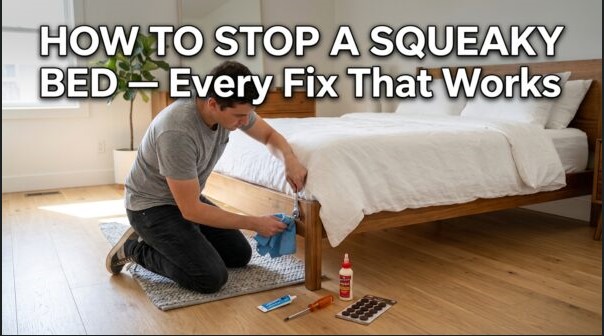
You shift positions at 2 a.m. and your bed screams. Your partner wakes up. The dog lifts his head from the corner. You freeze, stare at the ceiling, and wonder how a bed frame can possibly make that much noise from one tiny movement.
A squeaky bed is one of the most annoying sleep disruptions there is — and one of the most fixable. The problem is that most people tolerate the squeak for weeks or months because they assume fixing it is complicated. It almost never is.
The squeak is coming from one of a few specific places: your frame joints, your slats, your mattress, your box spring, or your floor. Once you know where it’s coming from, the fix is usually 15 minutes and a few dollars worth of supplies. This guide covers every source of squeaking and every fix that actually works — including how to stop a squeaky bed frame whether it’s wood or metal, how to deal with noisy slats and springs, and how to prevent the squeak from coming back.
Let’s find your squeak and kill it.
Why Do Beds Squeak? Understanding the Source

Before you start tightening bolts or spraying lubricant everywhere, it helps to understand what’s actually making the noise. Beds squeak for a handful of specific reasons, and diagnosing the right one saves you a lot of time.
The most common sources of squeaking are:
- Loose joints or bolts — where frame pieces connect, bolts loosen over time with movement and weight
- Wood rubbing against wood — at frame joints, slat ends, or where the headboard meets the wall
- Metal rubbing against metal — in metal frames, where brackets, rails, and supports contact each other
- Worn mattress springs — an aging innerspring mattress develops squeaky coils over time
- Box spring wear — the internal structure of a box spring loosens or the fabric cover rubs against the frame
- Slats shifting — bed slats that aren’t secured can move and create friction noise
- Floor friction — bed legs sliding on hard floors can produce low creaking sounds
One squeak can come from any one of these. A really bad squeak often involves two or three at once.
How to Find Exactly Where the Squeak Is Coming From

The fastest way to diagnose your squeak is to strip the bed down and test each component separately. This takes about five minutes and saves you from fixing the wrong thing.
Step-by-step squeak diagnosis:
- Remove the mattress from the frame and set it on the floor. Press down on it in different spots. If it squeaks, the mattress itself is part of the problem.
- Test the box spring (if you have one) the same way — press down and listen. Box springs often squeak independently.
- Put the mattress back without the box spring (if applicable) and lie down, roll around, and listen. If the squeak is gone, the box spring is your culprit.
- With the mattress off, press down on the bare slats and the frame itself. Listen for where the noise originates when you apply pressure.
- Shake individual parts — the headboard, footboard, side rails, and any center support legs. Loose hardware makes a distinctive rattle.
- Sit on each corner of the frame and listen. Corner joints are among the most common squeak locations.
Once you’ve isolated the source, you know exactly what to fix.
How to Stop a Squeaky Bed Frame Made of Wood

Wood bed frames are the most common source of squeaking — and fortunately, they respond to a wide range of easy fixes. How to stop a squeaky bed frame wood comes down to either tightening connections, lubricating friction points, or reinforcing joints that have shifted over time.
Tighten All the Bolts and Hardware First

Start here. This is the first fix to try on any wooden frame, and it solves the problem completely in a surprisingly large number of cases.
Every bolt, nut, and screw on your frame should be tight. Over months and years of nightly movement, they loosen. A slightly loose bolt allows two pieces of wood to shift against each other — that shift is your squeak.
Use a wrench or socket set for any large bolts (usually at the rail-to-post connections) and a screwdriver for any visible screws. Tighten everything firmly. Don’t overtighten on older frames — stripped wood can’t hold a bolt, so apply firm steady pressure rather than maximum torque.
After tightening all hardware, put the mattress back and test. You might be done.
Lubricate Wood-to-Wood Contact Points

If the bolts are tight but the squeak continues, the wood itself is rubbing somewhere. Wood-on-wood friction is solved with lubrication — and you almost certainly have what you need at home already.
Effective lubricants for wood frames include:
- Beeswax — the classic choice; rub a candle or a block of beeswax directly onto the contact surfaces at joints and slat channels
- Bar soap — a dry bar of soap rubbed along friction points works well and won’t stain
- Petroleum jelly — applied with a rag to joint contact surfaces, very effective
- WD-40 — spray into joints, then wipe away excess; works well but may need reapplication every few months
Apply your lubricant to any surface where wood contacts wood: the ends of slats where they rest in the frame, the inside faces of the rail-to-post joints, and any spots where the headboard or footboard makes contact with the rails.
Reinforce Loose Joints with Wood Glue

If a joint has become genuinely loose — you can see or feel movement where two pieces meet — wood glue is your best long-term fix.
Apply wood glue into the gap of the loose joint, work it in as deeply as you can, then clamp the joint closed and let it cure for 24 hours. Remove the clamp and test.
For frames where you can’t apply a clamp (because the joint is too complex), use a slow-setting wood glue and press the joint together firmly, then wedge something heavy against it to hold pressure while it cures.
This fix is more permanent than lubrication — once a joint is glued, it won’t reopen unless the frame is stressed heavily. Ideal for headboard wobble, corner joint movement, and any structural looseness you can identify.
Add Cork, Felt, or Rubber Padding at Contact Points

Sometimes wood surfaces fit together fine but the contact area is just too rigid — the wood can’t flex at all without squeaking against itself. Thin padding at contact points absorbs vibration and eliminates the noise without any structural change to the frame.
Materials that work well:
- Self-adhesive felt pads (furniture feet pads) — apply to the ends of slats and the undersides of frame contact points
- Cork strips — cut to fit and wedged into frame channels where slats rest
- Old socks or fabric strips — wrapped around slat ends to cushion them in the channel
- Rubber washers — placed between bolt heads and the wood surface to absorb vibration at hardware points
Any of these can be applied in minutes with no tools and make a noticeable immediate difference.
How to Stop a Squeaky Bed Frame Made of Metal

Metal frames squeak differently than wood ones — and the solutions are different too. Metal-on-metal friction has a distinctive, often sharper sound, and it tends to come from a specific set of places. Understanding how to stop a squeaky bed frame metal means addressing loose hardware, metal contact points, and worn joints.
Tighten Every Bolt — Then Add Thread-Locking Fluid
On metal frames, loose bolts are responsible for the vast majority of squeaking. Metal joints have much less natural give than wood — when a bolt is even slightly loose, the metal pieces slide against each other with every movement, producing that sharp metallic squeak.
Tighten every accessible bolt on your metal frame using the appropriate wrench or Allen key (hex key). Most metal bed frame bolts are either standard hex bolts or Allen-head bolts.
Once tightened, apply a small amount of thread-locking fluid (available at any hardware store) to each bolt before final tightening. This product seeps into the thread and hardens to prevent bolts from vibrating loose again. Use the removable type (typically blue) rather than the permanent type — you’ll want to be able to disassemble the frame eventually.
Lubricate Metal Contact Points
Where metal parts contact each other — at brackets, rail ends, and support connections — the friction from movement creates squeaking. A penetrating lubricant solves this quickly.
Options for metal frame lubrication:
- WD-40 — spray directly into joints and wipe away excess; works fast but may need reapplication every few months
- White lithium grease — longer-lasting than WD-40; apply with a brush into joint contact areas
- Petroleum jelly — less messy than sprays; work it into joints with a rag or old toothbrush
- Olive oil or vegetable oil — a surprisingly effective temporary fix in a pinch
Apply lubricant to any point where two metal pieces make contact. Pay particular attention to: rail-to-bracket connections, center support leg bases, headboard and footboard attachment brackets, and any adjustment notches on adjustable frames.
Add Plastic or Rubber Washers Between Metal Parts
When lubrication alone isn’t enough — or when you want a longer-term solution without reapplying lubricant every few months — inserting plastic or rubber washers between metal contact surfaces creates a permanent cushion that eliminates friction.
Remove each bolt at squeaky connection points, slide a rubber or nylon washer over the bolt before reinserting it, and retighten. The washer sits between the metal pieces, preventing direct metal-to-metal contact.
You can also use strips of furniture felt or rubber shelf liner cut to fit and wedged between metal surfaces. This approach works particularly well where rails sit in brackets or where the headboard brackets attach to the main frame rails.
How to Stop Squeaky Bed Slats
Slats are one of the most overlooked squeak sources. If your bed squeaks specifically when you roll toward the edge or when you get out of bed, the slats are often responsible. Learning how to stop squeaky bed slats involves securing them so they can’t shift and cushioning them so they don’t rub.
Secure Loose Slats So They Can’t Shift
Slats that aren’t secured can shift sideways with body movement, creating friction against the frame channel or against each other. The fix is to prevent that movement.
Options for securing slats:
- Screw them down — drill a pilot hole through the end of each slat into the frame ledge and drive a wood screw through. This permanently locks each slat in position. Use this approach for solid-bottom frames where you don’t need to remove slats.
- Non-slip shelf liner — cut strips and place them in the frame channels before laying the slats on top. The grip prevents lateral movement without permanently attaching anything.
- Velcro strips — attach one side to the frame ledge and the other to the underside of each slat. Pull-apart connection means you can still remove slats but they won’t shift during sleep.
- Slat holder clips — small plastic clips designed specifically for this purpose; they attach to the slat ends and hook over the frame ledge.
Cushion Slats at Contact Points
Even secured slats can squeak if the contact between the slat end and frame channel is rigid wood-on-wood. Adding cushioning material in the channel absorbs the vibration.
Most effective cushioning materials:
- Cork strips cut to fit the channel width
- Self-adhesive felt furniture pads applied to slat undersides at frame contact points
- Old socks cut open and wrapped around slat ends (genuinely works well)
- Rubber shelf liner strips cut and laid in the channels
Any of these can be applied in under 10 minutes to an entire set of slats. Combined with securing the slats so they can’t shift, this approach almost always eliminates slat-related squeaking completely.
How to Fix a Squeaky Bed with Squeaky Springs
If you’ve tightened the frame, secured the slats, and the squeak persists, your mattress springs might be the culprit. Squeaky bed springs are common in older innerspring mattresses and are one of the harder squeaks to fix permanently — because the problem is inside the mattress itself.
Testing Whether Your Mattress Springs Are Squeaking
To confirm the mattress springs are squeaking and not the frame, place your mattress on the floor and apply pressure to it in different spots — especially the areas where you typically sleep or where the squeak seems loudest when you’re in bed.
If the mattress squeaks when it’s on the floor with no frame contact, the springs are your problem. The squeak will be consistent regardless of whether the mattress is on the frame or not.
Temporary Fixes for Squeaky Mattress Springs
If your mattress spring situation isn’t quite bad enough to replace yet, these approaches can reduce or mask the noise in the short term:
- Place a plywood board between the mattress and the box spring (or bed slats). The rigid surface reduces mattress flex and often dampens the squeaking significantly.
- Rotate or flip the mattress. Shifting the pressure distribution sometimes moves the squeak away from where you sleep, making it much less noticeable. Check whether your mattress is flippable — many modern foam-hybrid mattresses are not.
- Add a mattress topper. A thick foam topper doesn’t fix the springs, but it adds enough cushioning that the springs flex less with body movement, reducing the noise.
When to Replace the Mattress
If your innerspring mattress is over 8 to 10 years old and the springs are audibly squeaking, the honest answer is that no temporary fix will solve the problem long-term. The springs are worn, compressed, and losing their structural integrity. You can reduce the noise, but you can’t restore damaged springs.
The Sleep Foundation recommends replacing most mattresses every 7 to 10 years, depending on construction quality and how heavily they’ve been used. A squeaking spring mattress typically also shows visible sagging, reduced support, and increased pain on waking — all signs that replacement is overdue.
When you do replace, consider a foam, latex, or hybrid mattress. These constructions have no metal coils and will never develop spring-related squeaking.
How to Stop Squeaky Bed Rails
Bed rails are the horizontal pieces that connect the headboard and footboard — and they’re a very common squeak location because they bear direct weight and movement stress. How to stop squeaky bed rails depends on whether your rails use bolt connections or hook-and-slot hardware.
Fixing Hook-and-Slot Rail Connections
Many bed frames use hook-and-slot (also called hook-plate) rail connections — the rail has metal hooks that drop into slots on the headboard and footboard brackets. These connections are quick to assemble but loosen over time as the hooks wear against the slots.
Fixes for hook-and-slot rail squeaking:
- Lift and reseat the rails. Sometimes the hook isn’t fully seated in the slot. Lift the rail, visually confirm the hook has dropped completely into the slot, and push it firmly down.
- Lubricate the hooks and slots. Apply petroleum jelly or white lithium grease to the hook surfaces and the inside of the slots. This reduces friction between the worn metal surfaces.
- Shim loose hooks. If the hook is visibly loose in the slot, a small rubber or plastic shim (cut from a rubber washer or a piece of shelf liner) wedged into the slot alongside the hook removes the play that causes squeaking.
- Replace worn hardware. If the hooks are significantly worn, replacement rail hook plates are available at hardware stores and are straightforward to install.
Fixing Bolted Rail Connections
For rails connected by bolts rather than hooks, the fix is straightforward: tighten the bolts, and if they loosen again repeatedly, add thread-locking fluid.
Also check the condition of the bolt holes in the wood. If a bolt hole has become enlarged from years of use — you can see daylight around the bolt shank even when it’s fully tightened — the hole needs to be repaired before the bolt can hold firmly.
Repairing a stripped bolt hole in wood:
- Remove the bolt completely.
- Fill the hole with wood glue mixed with sawdust (or use a wood toothpick dipped in glue inserted into the hole).
- Let the filler cure completely — 24 hours minimum.
- Carefully drill a new pilot hole through the filler at the original position.
- Reinsert the bolt and tighten firmly.
This restores the holding power of the hole and lets the bolt do its job again.
How to Fix a Squeaky Bed — The Floor and Legs
Sometimes the squeak isn’t coming from the frame at all — it’s coming from the bed legs rubbing or sliding on the floor. This is especially common with hardwood or tile floors.
Add Furniture Pads or Rubber Feet
Applying self-adhesive furniture felt pads or rubber furniture cups to the base of each bed leg eliminates leg-to-floor friction completely. This is one of the fastest possible fixes — five minutes, no tools required.
Felt pads work well on hardwood, laminate, and tile floors. Rubber cups or non-slip rubber feet are better for situations where the bed tends to migrate — the rubber grips and prevents the bed from shifting position, which also reduces the risk of creaking from frame stress.
Check and Stabilize the Center Support Leg
Many queen and king-size bed frames have a center support leg (or multiple legs) running down the middle. If this leg doesn’t make firm contact with the floor — even slightly shorter than the others due to floor unevenness — the entire frame flexes with weight, and that flex creates squeaking.
Check your center support leg by pressing down in the middle of the frame. If you feel any flex or bounce that you don’t feel at the corners, the center leg may not be fully in contact with the floor.
Fixes include:
- Adjusting the leg height — many center legs are threaded and adjustable; rotate the foot to extend it until it makes firm floor contact
- Adding a shim — for non-adjustable legs, place a rubber furniture pad or a thin wood shim beneath the leg foot
- Adding a second support leg — if your frame only has one and the frame still flexes, adding an aftermarket center support leg adds significant rigidity
Expert Tips for a Permanently Squeak-Free Bed
Here are the tips that take you from a temporary fix to a bed that won’t squeak again for years:
Do a full frame inspection twice a year. Set a reminder to check and retighten all bolts every six months. It takes five minutes and prevents small looseness from becoming a full squeak before you notice it.
Use thread-locking fluid on metal hardware from the start. If you’re assembling a new metal frame, apply thread-locking fluid to every bolt from day one. You’ll likely never have to deal with the squeak at all.
Choose felt over cork for slat channels in humid climates. Cork can absorb moisture and swell in humid environments, which may cause it to warp or compress unevenly over time. Self-adhesive felt maintains consistent thickness and performs reliably in all conditions.
Don’t use standard WD-40 as a long-term lubricant on wood. WD-40 is a water displacer that evaporates and leaves residue. For wood-on-wood contact, wax or petroleum jelly lasts significantly longer without needing reapplication.
Check your foundation. If you have a box spring, it has its own internal framework that can squeak. Consider replacing an aging box spring with a bunkie board or solid platform foundation — flat, solid bases don’t squeak.
Reassemble correctly after fixes. When you disassemble parts of your frame to lubricate or repair joints, reassemble with care. Misaligned pieces that are forced together create new squeak points. Take your time during reassembly.
Address the wall too. If your headboard is pressed against the wall, movement can cause it to rub against the wall surface and squeak. Move the bed 1 to 2 inches away from the wall — problem solved.
Pros and Cons of Each Fix Method
| Fix Method | Pros | Cons |
|---|---|---|
| Tighten bolts | Free, immediate, effective | May need repeating every 6–12 months |
| Lubrication (wax/petroleum jelly) | Cheap, fast, no tools needed | Needs reapplication over time |
| Thread-locking fluid | Long-lasting, very effective on metal | Requires bolt removal; wrong type = permanent |
| Wood glue for joints | Permanent fix for loose joints | Can’t be reversed; 24-hour cure time |
| Felt/cork padding | Silent, fast, non-destructive | May compress over time and need replacing |
| Rubber washers | Long-lasting, no reapplication | Requires disassembly to install |
| Plywood board under mattress | Quick, cheap, widely available | Doesn’t fix the spring; temporary measure |
| Mattress replacement | Fixes the root cause | Significant cost; necessary for old mattresses |
How to Prevent Bed Squeaks from Coming Back
Prevention is significantly easier than repair. These habits keep a silent bed silent:
- Tighten hardware during seasonal cleaning. Every time you deep-clean your bedroom, take two minutes to check and tighten all accessible bolts.
- Use a platform bed or solid slatted base instead of a box spring. Platform beds with fixed slats have fewer moving parts and far fewer squeak opportunities.
- Choose quality frame hardware. When replacing bolts or upgrading hardware, opt for bolts with locking washers or nylon-insert lock nuts — they resist vibration-loosening far better than standard nuts.
- Rotate your mattress regularly. Distributing wear evenly extends the life of innerspring mattresses and reduces the chance of specific coils being stressed to the point of squeaking. Aim for rotation every 3 to 6 months.
- Keep bed legs on stable flooring. Uneven floors stress frames unevenly, causing joints to flex. If your floor is uneven, use adjustable furniture levelers under the legs to create a level base.
- Address any squeak immediately. A very small squeak usually means one slightly loose bolt. Fix it when it starts and you prevent it from becoming a more complex multi-point squeak problem.
Frequently Asked Questions About Squeaky Beds
Why does my bed squeak when I move but not when I sit still?
Movement creates friction between slightly-loose components that don’t rub when static. Even 1mm of play in a bolt or joint is enough to produce a squeak under dynamic load — when you roll over or shift weight — but not when you’re sitting still. The fix is to tighten every bolt and lubricate any wood-on-wood contact points.
Can a squeaky bed be fixed without taking it apart?
Often, yes. Many squeaks can be addressed by tightening accessible bolts, applying lubricant into joints with a thin nozzle, adding felt or cork to slat contact points, and testing each fix without full disassembly. However, if the squeak comes from deep inside a joint or from the internal structure of the box spring, some disassembly will be necessary.
Does WD-40 fix a squeaky bed?
WD-40 can reduce squeaking at metal contact points and works as a short-term fix on wood joints too. Its limitation is longevity — it evaporates relatively quickly and leaves a residue that can attract dust. For a longer-lasting fix on metal parts, use white lithium grease. For wood, use beeswax, petroleum jelly, or bar soap, which last significantly longer.
How do I know if the squeak is from the bed frame or the mattress?
Place your mattress on the floor and press on it in different spots. If it squeaks independently, the mattress (or its springs) is the source. If it’s silent on the floor, the squeak is coming from the frame, slats, or box spring. This test takes under five minutes and removes all guesswork.
Why does my new bed squeak?
New bed frames can squeak for several reasons: bolts that were insufficiently tightened during assembly, wood-on-wood contact points that haven’t been lubricated, slats that aren’t secured in position, or hook-and-slot rail connections that weren’t fully seated. Go through the frame systematically — tighten all bolts, apply wax or petroleum jelly to wood contact points, and confirm all slats and rail connections are fully seated. New frame squeaks are almost always solvable within 30 minutes.
Final Thoughts — A Silent Bed Is 30 Minutes Away
A squeaky bed feels like a big problem at 2 a.m. when every shift wakes someone up. The good news is that it almost always isn’t. The squeak has a source — a loose bolt, a dry wood joint, a shifting slat, a worn spring — and every one of those sources has a straightforward fix.
The approach that works best: diagnose first, then fix. Strip the bed down, test each component, identify the source, and apply the right solution for that specific cause. Tighten the hardware, lubricate the friction points, secure the slats, pad the contact surfaces, and address the floor contact if needed.
If your frame is in reasonable shape, you’re probably 30 minutes and less than $10 in supplies away from a completely silent bed.
Start with the bolts. They solve it more often than you’d expect. Work through the checklist from there. And once it’s quiet — protect that silence with regular maintenance and the right prevention habits.
You’ll sleep better for it.

