
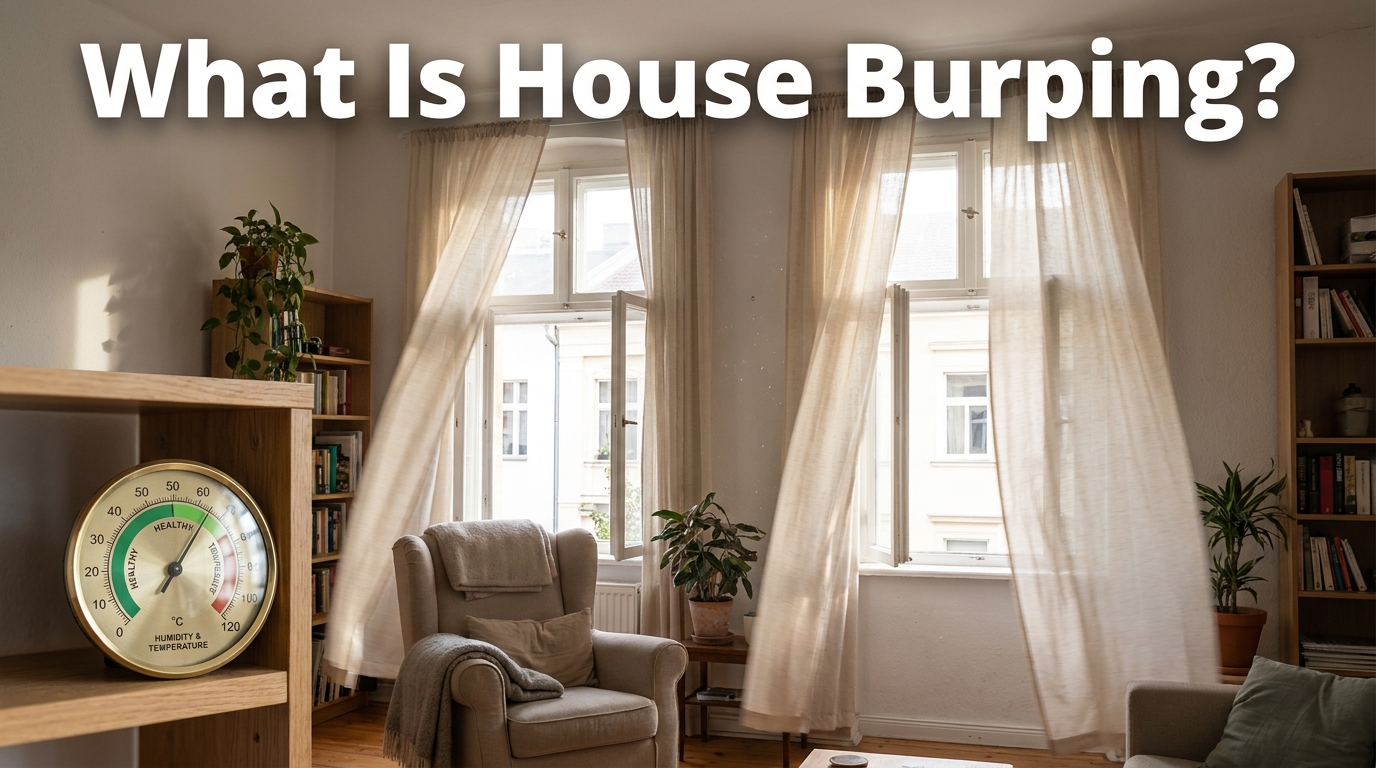
You wake up on a cold winter morning, and every window in your house is foggy with condensation. The air feels thick, a little stale — almost like the house itself has been holding its breath all night.
Sound familiar?
There’s actually a name for what your house needs in that moment. It’s called house burping, and once you hear about it, you’ll wonder why nobody told you sooner.
This isn’t some trendy interior design trick or a social media fad. House burping is a real, practical ventilation habit that can make a measurable difference in your home’s air quality, moisture levels, and even long-term structural health.
In this guide, you’ll learn exactly what house burping is, why it matters, how to do it correctly, and what happens when you skip it. Whether you’re a first-time homeowner or someone who’s been living in the same house for decades, this is information worth knowing.
Let’s get into it.
What Is House Burping?
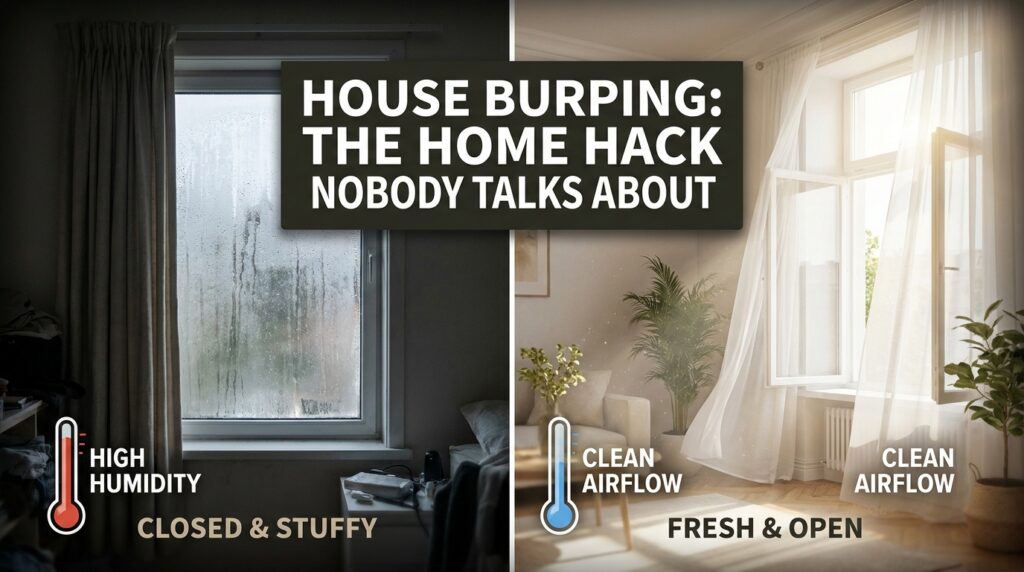
House burping is the practice of briefly opening your windows and doors — typically for 5 to 20 minutes — to flush out stale, humid, or polluted indoor air and replace it with fresh outdoor air.
Think of it exactly like burping a baby. A baby needs to release trapped air after feeding; your house needs to release trapped moisture, CO₂, volatile organic compounds (VOCs), and other airborne pollutants that build up inside sealed rooms.
The term is informal and colloquial, but the concept is firmly grounded in building science. It refers to intentional short-burst ventilation as opposed to passive ventilation (like always leaving a window cracked) or mechanical ventilation (like HVAC systems).
It’s the kind of thing your grandparents probably did without thinking about it — throwing the windows open every morning — but that many modern homeowners have stopped doing in the age of central air and insulated smart homes.
In simple terms: House burping = opening your home up intentionally for a short period to exchange indoor and outdoor air.
Is House Burping a Real Thing?
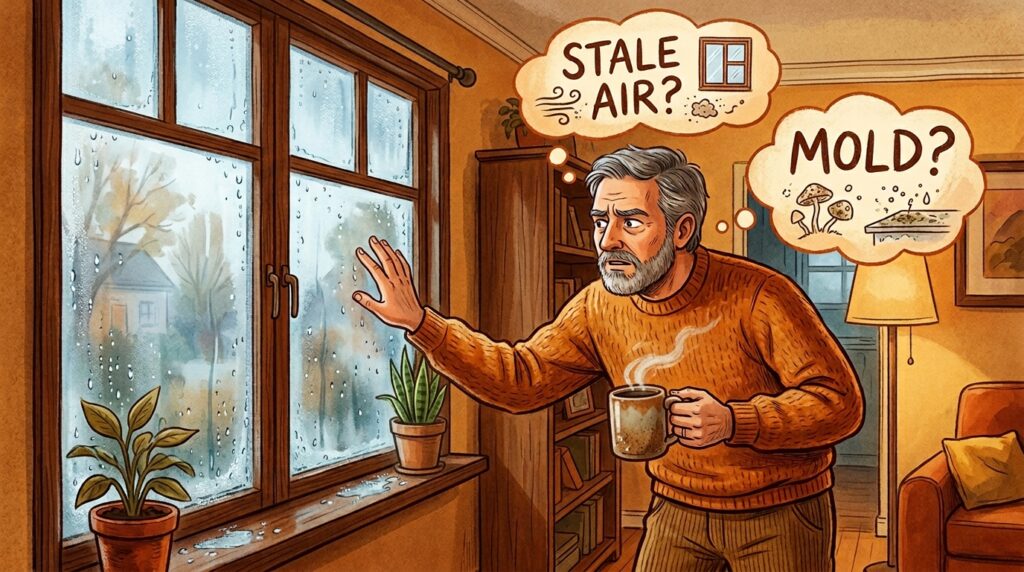
Yes, house burping is absolutely a real thing — even if it sounds made up.
The name itself might make you raise an eyebrow, but the practice is endorsed by building science experts, indoor air quality researchers, and even government health agencies under different terminology.
The U.S. Environmental Protection Agency (EPA) identifies poor indoor air quality as one of the top five environmental risks to public health. According to their research, indoor air can be 2 to 5 times more polluted than outdoor air — and in some cases, even more.
The EPA explicitly recommends increasing ventilation as one of the three main strategies for improving indoor air quality (alongside source control and air cleaners).
The American Lung Association also reinforces this, noting that proper home ventilation helps reduce exposure to indoor pollutants including radon, carbon monoxide, and mold spores.
So while “house burping” might be a casual, humorous phrase, the underlying principle is backed by environmental science, public health research, and home construction guidelines.
The name is unofficial. The practice is very real.
The Science Behind It — Why Houses Need to “Breathe”
Modern homes are designed to be energy-efficient. That’s largely a good thing — better insulation and tighter building envelopes mean lower energy bills and more comfortable temperatures.
But there’s a tradeoff.
When a home is too airtight, it traps everything inside: cooking fumes, shower steam, cleaning product fumes, carbon dioxide exhaled by occupants, off-gassing from furniture and flooring, pet dander, and biological contaminants like mold spores and bacteria.
The Moisture Problem
One of the biggest issues in sealed homes is excess moisture. Every time you cook, shower, breathe, or dry laundry indoors, you add water vapor to the air. Without a way to escape, that moisture accumulates.
According to the Building Science Corporation, excessive indoor humidity is one of the leading causes of:
- Mold and mildew growth
- Wood rot in structural elements
- Paint peeling and bubbling
- Condensation on windows and walls
- Dust mite proliferation
A healthy indoor relative humidity level should sit between 30% and 50%, according to ASHRAE (the American Society of Heating, Refrigerating and Air-Conditioning Engineers). When it creeps above 60%, problems begin.
The CO₂ Buildup Problem
Every breath you exhale raises the CO₂ level in a room. In a well-ventilated space, this isn’t a concern. In a tightly sealed bedroom where two people sleep for eight hours, CO₂ levels can rise to levels that impair sleep quality, cognitive function, and morning alertness.
Research published in journals like Indoor Air has consistently linked elevated indoor CO₂ to:
- Reduced decision-making ability
- Increased fatigue
- Headaches and grogginess
- Disrupted sleep patterns
House burping directly addresses this by flushing out CO₂-rich air and replacing it with oxygen-rich outdoor air.
The VOC Problem
Volatile Organic Compounds (VOCs) are chemicals emitted by paints, adhesives, carpets, furniture, cleaning products, and even personal care items. Many are harmful at sustained exposure levels.
VOCs don’t just disappear — they accumulate in sealed indoor air. Regular house burping creates a dilution effect that keeps VOC concentrations at manageable levels.
Burping Your House Benefits
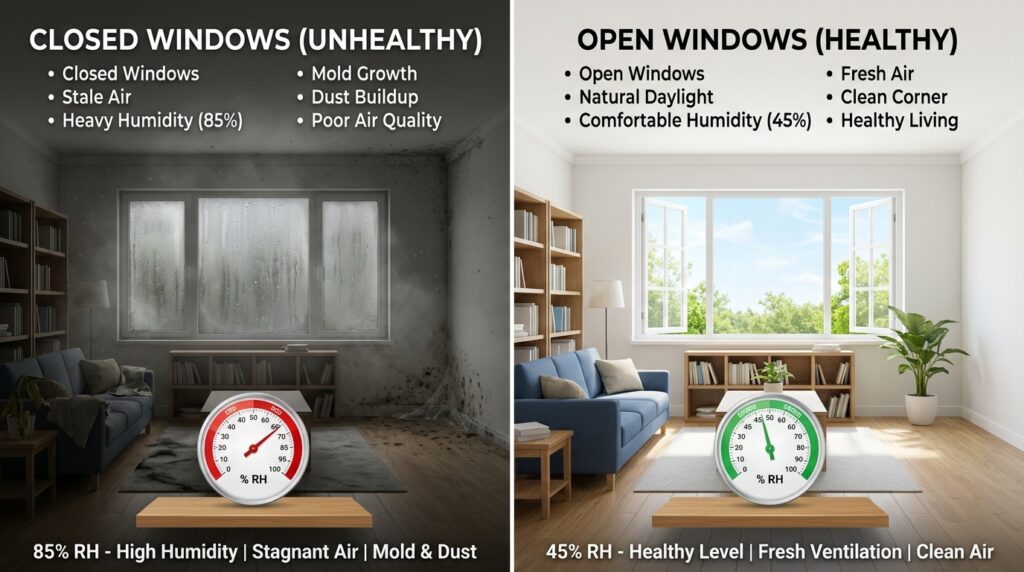
The benefits of house burping go well beyond just “fresher-smelling air.” Here’s a full breakdown of what regular ventilation does for your home and health:
1. Dramatically Improves Indoor Air Quality
The most immediate and obvious benefit. Burping your house flushes out accumulated pollutants — VOCs, CO₂, allergens, cooking fumes, and biological contaminants — replacing them with cleaner outdoor air.
The EPA’s Indoor Environments Division consistently emphasizes that ventilation is one of the most effective and low-cost strategies for improving the air your family breathes every day.
2. Controls Humidity and Prevents Mold
By allowing moist indoor air to escape and drier outdoor air to enter (especially in cooler seasons), house burping is a powerful natural dehumidifying tool.
Mold requires relative humidity above 60% to colonize surfaces. Keeping indoor humidity in check through regular ventilation directly reduces your mold risk — and mold remediation can cost thousands of dollars.
3. Reduces Allergens
Pet dander, dust mite particles, and pollen tracked indoors tend to recirculate in sealed homes. Opening windows — even briefly — helps dilute and remove these particles, which can meaningfully reduce allergy and asthma symptoms for sensitive household members.
4. Lowers Radon Concentrations
Radon is a naturally occurring radioactive gas that enters homes through foundation cracks. It’s the second leading cause of lung cancer in the country. Ventilation — including house burping — helps dilute radon concentrations.
5. Saves Money on HVAC Maintenance
HVAC systems work harder in poor air quality environments. Dust, moisture, and particulate buildup in ducts shortens system lifespan and increases maintenance costs. Regular house burping reduces the load on your mechanical ventilation systems.
6. Improves Sleep Quality
Better air = better sleep. Flushing out CO₂ and bringing in fresh oxygen before bedtime is a simple, free way to improve sleep depth and morning alertness — something even expensive sleep supplements can’t guarantee.
7. Reduces Cooking and Household Odors
That lingering smell of last night’s curry or fish dinner? House burping clears it faster and more effectively than air fresheners, which merely mask odors while adding more VOCs to the air.
Quick Benefits Summary Table
| Benefit | Why It Matters |
|---|---|
| Improved air quality | Removes CO₂, VOCs, allergens |
| Mold prevention | Lowers indoor humidity |
| Better sleep | Reduces CO₂ before bedtime |
| Reduced allergens | Dilutes dander, dust, pollen |
| Lower radon levels | Dilutes radioactive gas buildup |
| HVAC savings | Reduces dust and moisture in ducts |
| Odor elimination | Replaces stale air naturally |
What Is House Burping Called in Germany?
Here’s where things get genuinely fascinating.
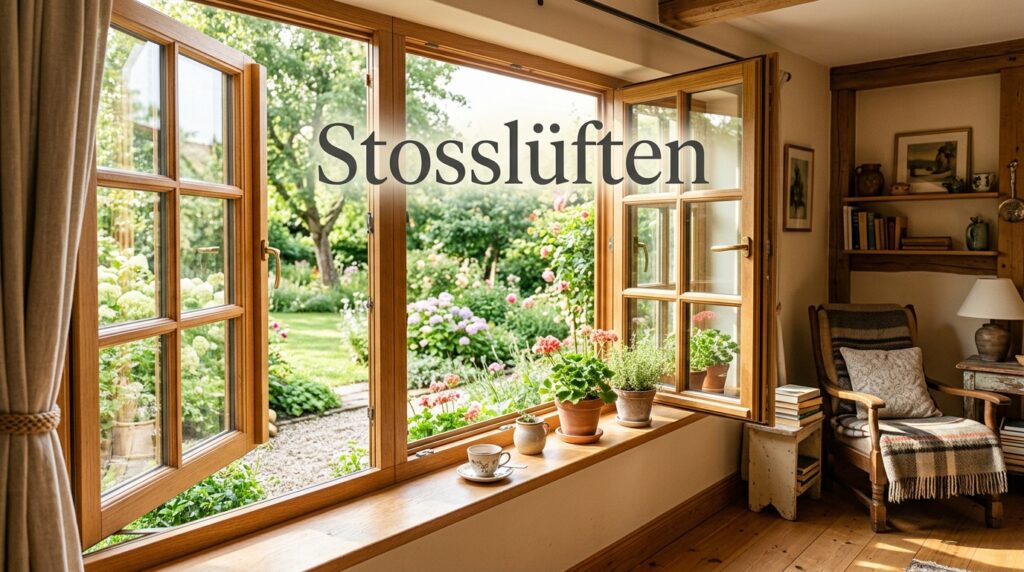
In Germany, house burping isn’t an informal hack or an internet curiosity — it’s a deeply ingrained cultural habit with an official name: Stosslüften (pronounced shtoss-lyuf-ten).
Directly translated, “Stoß” means “burst” or “push” and “Lüften” means “to air out” or “ventilate.” Together, Stosslüften means “shock ventilation” or “burst ventilation” — the practice of opening windows fully for a short, purposeful period to rapidly exchange indoor and outdoor air.
This isn’t considered unusual in German culture. It’s taught in schools, recommended by doctors, and even referenced in rental lease agreements. German landlords sometimes instruct tenants on proper Stosslüften technique to prevent mold damage — because in Germany, the relationship between ventilation, moisture, and mold is common knowledge.
Why Germany Takes Ventilation So Seriously
German homes and apartments are often extremely well-insulated (and have been for decades), which means they trap moisture and stale air easily. Stosslüften emerged as the cultural solution — a daily habit built around the building reality.
The German Federal Environment Agency (Umweltbundesamt) actively promotes Stosslüften as the recommended method of home ventilation, specifying that opening windows fully for 5–10 minutes is more effective than leaving them partially open for hours.
Their guidance even recommends doing it 3–4 times per day in occupied homes.
This German approach offers a compelling validation that house burping isn’t just an American internet trend — it’s an established best practice recognized by environmental authorities on the other side of the world.
How to Burp Your House — Step-by-Step
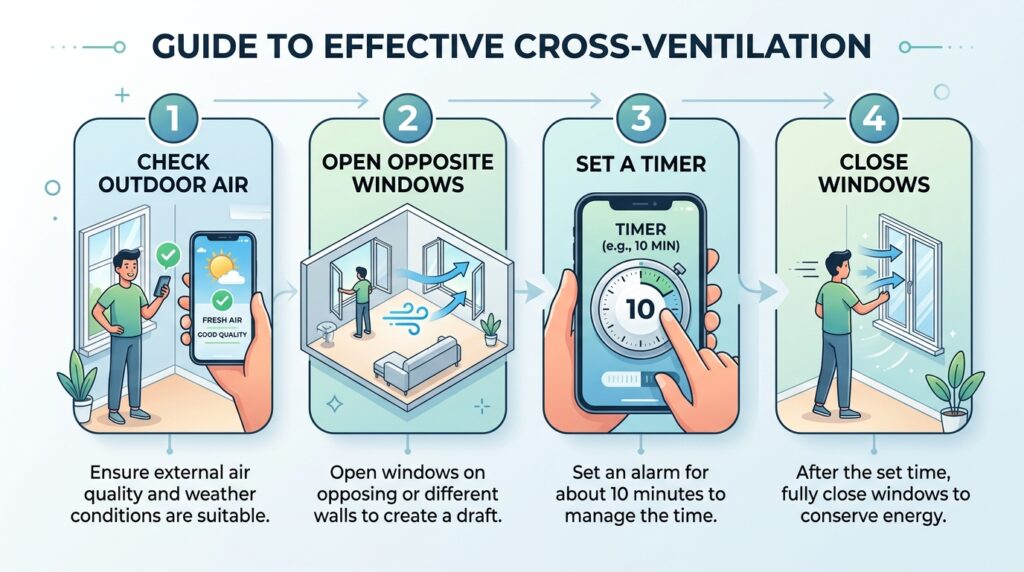
House burping isn’t complicated, but doing it strategically makes a significant difference. Here’s how to do it properly:
Step 1: Check Outdoor Conditions
Before you open anything, take a quick look outside. You want outdoor air to be:
- Drier than indoor air (usually in cooler months)
- Not actively raining (unless you’re managing a brief dry-air burst)
- Reasonably clean (avoid burping during high pollen days or air quality alert days — check AirNow.gov for real-time air quality data)
Step 2: Create Cross-Ventilation
The most effective house burping technique uses cross-ventilation — opening windows or doors on opposite sides of a room or home. This creates an air pressure differential that actively pulls fresh air through and pushes stale air out.
- Open a window on the east side of the house
- Open a window or door on the west side simultaneously
- Air flows through like a tunnel, rapidly exchanging the indoor air volume
Step 3: Open Wide, Not a Crack
The German Stosslüften approach specifically emphasizes opening windows fully for a short time rather than leaving them slightly open for hours. A fully open window exchanges air in minutes; a crack barely moves air at all.
Step 4: Time It Right
Set a timer. Most experts recommend:
- 5–10 minutes in cold weather (to avoid excessive heat loss)
- 15–30 minutes in mild weather
- Up to an hour on ideal spring or fall days
Step 5: Target Key Rooms
Focus your burping sessions on:
- Bathrooms (after showers)
- Kitchens (after cooking)
- Bedrooms (in the morning, after sleeping)
- Basements (seasonally, especially in spring when outdoor temps rise)
Step 6: Close Up Intentionally
After your burping session, close everything back up. You’re not trying to permanently air out the house — just exchange the stale indoor air for a fresh batch.
Ideal House Burping Checklist
- Outdoor air quality is acceptable (check AirNow.gov)
- Rain is not actively falling
- Opposite windows/doors are opened for cross-ventilation
- Windows are fully open, not cracked
- Timer is set for appropriate duration
- Bedrooms, bathrooms, and kitchen are prioritized
- Windows closed after session
How Often Should You Burp Your House?
The honest answer is: more often than you probably think.
Here’s a general frequency guide based on household size and occupancy:
Daily Ventilation (Recommended for Most Homes)
For occupied homes with multiple people, cooking, and daily activity:
- Morning burst: 5–10 minutes after waking up (clears overnight CO₂ and humidity)
- Post-cooking burst: 10–15 minutes after major cooking sessions
- Evening burst: 10 minutes before bed (refreshes air for sleeping)
Minimum Frequency for Smaller Households
For individuals or couples with minimal indoor activity:
- At least once per day in cooler months
- Twice per day in warmer months when indoor humidity rises faster
The German Recommendation
The German Federal Environment Agency specifically recommends 3 to 4 times per day — roughly every 4 hours during waking hours. This is their baseline for preventing moisture-related damage and maintaining healthy indoor air.
Seasonal Adjustments
| Season | Frequency | Duration | Notes |
|---|---|---|---|
| Winter | 2–3x/day | 5–10 min | Brief bursts to minimize heat loss |
| Spring | 3–4x/day | 15–30 min | Ideal ventilation season |
| Summer | 2–3x/day | Early AM/Late PM | Avoid peak heat and high pollen hours |
| Fall | 3–4x/day | 10–20 min | Great for humidity control before winter |
Burping Your House in Winter
Winter is actually when house burping matters most — and also when people are most reluctant to do it.
Here’s the irony: in winter, windows stay shut for weeks or months. Heating systems recirculate indoor air. Occupants spend more time inside. All of this creates the perfect storm for poor indoor air quality, high humidity from cooking and breathing, and mold development in hidden corners.
The Winter Case for House Burping
In winter, outdoor air is typically very dry and cold. When you bring it inside:
- It absorbs indoor moisture, helping control humidity
- It dilutes accumulated CO₂, VOCs, and other pollutants
- It refreshes oxygen levels that drop during long periods of sealed indoor living
The Energy Concern — And Why It’s Overstated
The #1 reason people avoid house burping in winter is fear of wasting heat. This is a legitimate concern — but less serious than most people assume.
Here’s why: a 5–10 minute burst ventilation (fully open windows) loses significantly less heat than leaving a window cracked for hours. The short burst removes the air volume; it does not chill the thermal mass of your walls, floors, and furniture.
Energy experts at the Department of Energy note that controlled ventilation — even brief window opening — is preferable to chronic moisture buildup, which can cause far more expensive structural damage than the energy cost of rewarming a room.
Best Practices for Winter House Burping
- Burp in the midday hours when outdoor temperatures are at their highest
- Keep sessions to 5 minutes maximum in freezing weather
- Use cross-ventilation for maximum air exchange in minimum time
- After closing windows, allow your heating system to restore room temperature normally — it recovers faster than you’d expect
- If you have a Heat Recovery Ventilator (HRV), this complements house burping by providing mechanical fresh air without the heat loss
Winter Warning: Don’t Skip It
According to the CDC’s guidance on healthy homes, poor winter ventilation is a leading contributor to:
- Indoor mold growth
- Chronic respiratory issues
- Sick building syndrome symptoms
- Carbon monoxide and radon accumulation
Five minutes of cold air is a small price to pay for months of healthier air.
Signs Your House Desperately Needs Burping
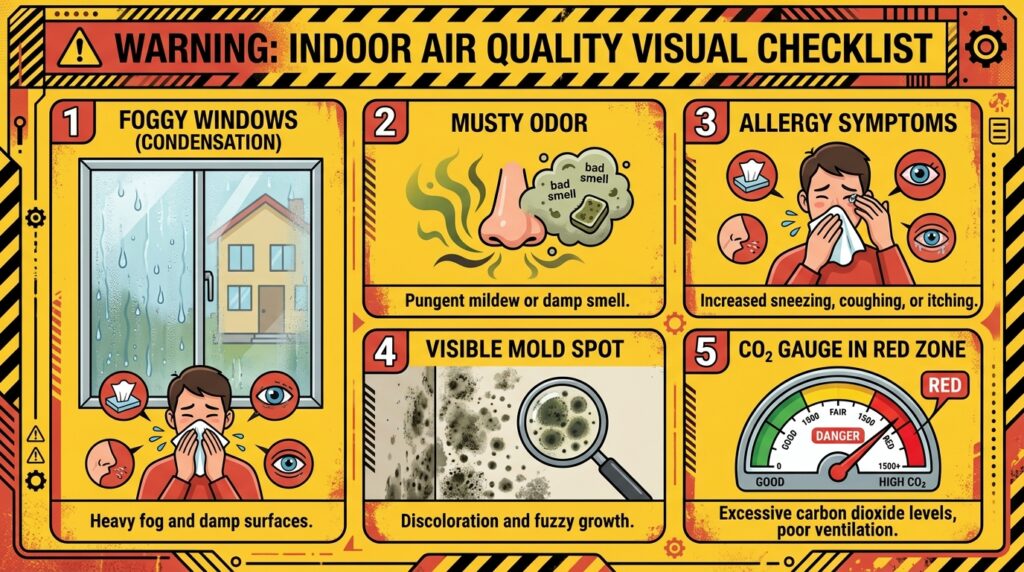
Your home often tells you when it’s overdue for a ventilation session. Watch for these signals:
Condensation on Windows
Water droplets or fogging on the inside of windows is a classic sign that indoor humidity is too high. This moisture needs somewhere to go — and if it’s not evaporating through ventilation, it’s soaking into wall cavities, window frames, and ceiling edges.
Musty or Stale Odors
A musty smell that persists even after cleaning is often a sign of microbial activity (mold or mildew) feeding on accumulated moisture. It can also indicate VOC buildup or stagnant air. Regular house burping prevents this from developing.
Allergy Symptoms That Worsen Indoors
If your allergies or asthma seem worse inside your home than outside, poor ventilation may be the culprit. Sealed air recirculates allergens, dust mite particles, and irritants rather than flushing them out.
Persistent Morning Grogginess
Waking up feeling foggy, headachy, or unrested — even after adequate sleep hours — may be linked to elevated CO₂ levels in your bedroom. This is one of the most underdiagnosed causes of poor sleep quality, and it’s completely reversible with better ventilation.
Visible Mold Spots
Small black, green, or white patches in bathroom corners, behind furniture, or around window seals indicate moisture has been sitting unaddressed. This is a clear call for more aggressive ventilation — and possibly professional mold assessment.
Humidity Readings Above 60%
If you own a hygrometer (a tool that measures indoor humidity), readings consistently above 60% indicate your home needs more ventilation. This is the threshold above which dust mites thrive and mold becomes likely.
Common Mistakes to Avoid
Even a simple practice like house burping can be done wrong. Here are the most common errors:
Cracking Windows Instead of Opening Fully
A tiny crack provides almost no meaningful air exchange. The German Stosslüften principle specifically emphasizes fully opening windows for a short time. This moves exponentially more air volume than a cracked window left open for hours.
Burping During High Pollen or Poor Air Quality Days
If outdoor air quality is worse than your indoor air, you’re making things worse, not better. Always check AirNow.gov before burping, especially in spring or near wildfire smoke.
Only Ventilating One Room
Single-room ventilation is limited. Air exchange is far more effective when multiple points are opened simultaneously to create cross-flow. Open windows in at least two rooms on opposite sides of the home.
Forgetting to Close Up Afterward
House burping is a controlled, intentional practice. Leaving windows open indefinitely — especially in humid summer conditions — can actually increase indoor humidity and introduce pollen and outdoor pollutants.
Avoiding Winter Ventilation Entirely
Many homeowners skip house burping in winter to conserve heat. This is the season when ventilation matters most. Short 5-minute bursts during midday in winter will not meaningfully raise your energy bill — but skipping ventilation all winter absolutely will damage your home’s air quality and moisture levels.
Ignoring Exhaust Fans
House burping works best alongside bathroom and kitchen exhaust fans. Running the exhaust fan before opening windows helps pull moisture and pollutants out actively, making your burping session even more effective.
Expert Tips from Home Ventilation Specialists
Based on guidance from building scientists, indoor air quality researchers, and home health professionals:
Tip 1: “The best time to burp your house is in the morning — within the first 30 minutes of waking. Overnight CO₂ and moisture buildup is at its peak, and a 10-minute burst of fresh air resets your home’s air chemistry for the day.” — Building science principle per ASHRAE Standard 62.2
Tip 2: “If you own a CO₂ monitor, use it to benchmark your home. Place it in your bedroom overnight. If morning readings consistently exceed 1,000 ppm, your home needs significantly more ventilation.” — Per CO₂ monitoring guidance from the Harvard T.H. Chan School of Public Health
Tip 3: “House burping is most effective when combined with source control. Fix leaky pipes, install proper exhaust fans in bathrooms, and use low-VOC paints and materials. Ventilation dilutes problems; source control eliminates them.” — Per EPA Indoor Air Quality guidance
Tip 4: “In very cold climates, consider a Heat Recovery Ventilator (HRV) or Energy Recovery Ventilator (ERV) for mechanical fresh air that doesn’t sacrifice heat. These complement — rather than replace — manual house burping.” — Per Energy Star’s guidance on home ventilation
Tip 5: “Pay special attention to rooms with the least natural airflow: basement spaces, interior bathrooms with no windows, and large closets. These areas accumulate VOCs, mold spores, and particulates fastest.” — Building science best practice
FAQs About House Burping
What is house burping and is it actually effective?
House burping is the practice of opening windows and doors for a short period to exchange stale indoor air with fresh outdoor air. Yes, it is genuinely effective. Numerous studies and government agencies — including the EPA and CDC — confirm that improved ventilation directly reduces indoor air pollutants, controls moisture, and improves occupant health outcomes.
How long should I keep windows open when burping my house?
The ideal duration depends on the season and outdoor conditions. In winter, 5–10 minutes of fully open windows is sufficient for effective air exchange. In mild weather, 15–30 minutes is ideal. The key is to open windows fully rather than partially — this maximizes air movement in minimum time.
Can house burping replace an air purifier or HVAC system?
No — house burping complements but does not replace mechanical ventilation or air purification. Air purifiers (especially HEPA models) remove fine particulates that ventilation alone can’t address. HVAC systems regulate temperature and filter air continuously. House burping is a low-cost, high-impact supplement to these systems — not a replacement. Learn more about HEPA air purifiers from the EPA.
Should I burp my house if I have allergies?
It depends on the season and outdoor pollen counts. During high pollen season, check AirNow.gov and National Allergy Bureau pollen counts before opening windows. On low-pollen or rainy days (when pollen is washed from the air), house burping is fine and beneficial even for allergy sufferers. In fall and winter, it’s generally safe and recommended.
Is house burping safe during wildfire smoke or high pollution events?
No. During active wildfire events or days when outdoor air quality is in the “Unhealthy” or worse range on AirNow.gov, keep windows closed and rely on indoor air purifiers. The EPA’s Wildfire Smoke Guide specifically advises against opening windows during these events. House burping is only beneficial when outdoor air is cleaner than indoor air.
Conclusion: Your House Has Been Holding Its Breath
Here’s the bottom line: your home is not a sealed container, and it shouldn’t be treated like one.
Modern construction has made our homes more energy-efficient than ever — but in doing so, we’ve also created environments where air, moisture, and pollutants can stagnate in ways that silently affect our health, comfort, and property value.
House burping is the simplest possible remedy. No products to buy. No tools required. No expertise needed.
Just open your windows. Let your house exhale. Close them after 10 minutes.
Do that a few times a day, pay attention to the seasons, prioritize the right rooms, and you’ll notice the difference — in the smell of your home, the quality of your sleep, the clarity of your mornings, and even the long-term condition of your walls and structure.
The Germans have been doing it for generations and calling it Stosslüften. The EPA recommends ventilation as a core indoor air quality strategy. Your grandparents did it without thinking twice.
Now you know why.
Start Today — Your House Burping Action Plan
- This morning: Open 2 windows on opposite sides of your home for 10 minutes
- This week: Check your indoor humidity with a hygrometer — aim for 30–50%
- This month: Build a house burping routine — morning, post-cooking, and bedtime
- This season: Adjust your frequency based on the guidance above
If you found this guide helpful, share it with a friend or neighbor who might benefit. And if you want to go deeper on indoor air quality, the EPA’s Indoor Air Quality resource hub is the most comprehensive free resource available.
Your house has been holding its breath. It’s time to let it breathe.
Disclaimer: This article is for informational purposes only. For serious mold, radon, or air quality concerns, consult a certified indoor air quality professional or your local health department.

