
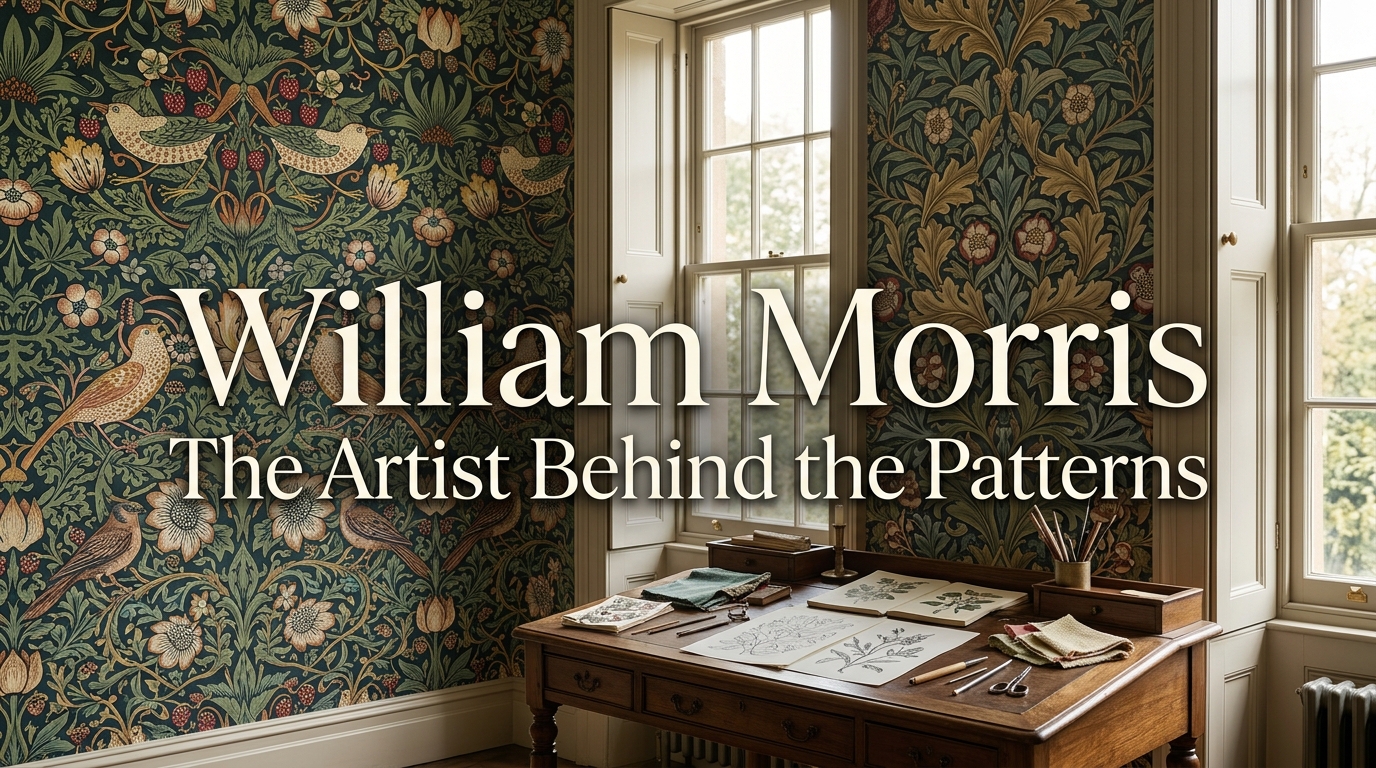
William Morris was an English designer, artist, poet, and craftsman who lived from 1834 to 1896. He’s the person behind some of the most loved wallpaper and textile patterns ever made, designs like Strawberry Thief, Willow Boughs, and Acanthus that still hang on the walls of homes nearly a hundred and fifty years after he first drew them. He’s also the founder of the Arts and Crafts movement, which changed how people thought about handmade things in a world that was becoming more and more mechanical.
Morris isn’t a name most people know off the top of their head. But if you’ve ever walked into a room and felt drawn to a wall covered in birds, berries, and twisting vines, there’s a good chance you were looking at his work, or something built from his bones.
A Quick Look at His Life
William Morris was born in Walthamstow, just east of London, in March 1834. His family was well-off. His father worked in finance, and the boy grew up in a big house with a large garden and the open Essex countryside just beyond. You can almost trace his whole career back to that garden. The plants, birds, and wild corners he drew later all came from a childhood spent outdoors, looking closely at what most people walk straight past.
He went to Oxford planning to become a clergyman. That didn’t last. At university he met Edward Burne-Jones, who became a lifelong friend, and through Burne-Jones he was pulled into a circle of young artists called the Pre-Raphaelites. They wanted art that felt true and rich, not the slick factory-made stuff that the Victorian middle class loved. Morris was hooked.
By the late 1850s the clergy plan was done. He was painting, writing poetry, and helping to design furniture for his first home, the Red House in Kent, built by his friend Philip Webb in 1859. The Red House is still standing today, and you can visit it. It’s basically the birthplace of everything that came after.
The Patterns That Made Him Famous
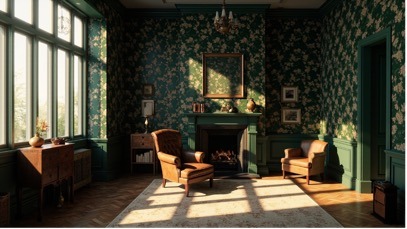
The wallpaper and textile designs Morris created starting in the 1860s are the work he’s known for today. He didn’t just make pretty patterns. He drew real plants, willows, honeysuckle, larkspur, acanthus leaves, and turned them into repeats that worked across whole walls without ever feeling busy or tired.
His first wallpaper, called Trellis, came out in 1862. It shows climbing roses on a wooden frame, with small birds drawn by his friend Philip Webb perched among the flowers. That print is over a hundred and sixty years old and is still being sold today. That tells you something. Morris’s patterns have outlived almost every other Victorian wallpaper because they weren’t trying to be in fashion. They were trying to be good.
A few of his most famous patterns are worth knowing by name:
● Strawberry Thief (1883): small thrushes stealing berries from his garden at Kelmscott Manor
● Willow Boughs (1887): sweeping willow branches in soft greens, one of his most calming designs
● Acanthus (1875): bold curling leaves; his first really large-scale pattern
● Pimpernel (1876): small flowers on twining stems; he used this one in his own dining room
● Honeysuckle (1874): designed by his daughter May, working in his style
You can still find faithful versions of these patterns today. Some of the cleanest collections live at William Morris Wallpaper, where the designs keep the hand-drawn quality the originals were famous for. It’s a good place to see how the patterns translate to a modern room.
The Arts and Crafts Movement
The Arts and Crafts movement was Morris’s response to the Industrial Revolution. He hated what mass production was doing to the people who made things. Workers in factories spent their days doing one small task over and over, with no chance to see the finished product or feel proud of their work. The goods coming out of those factories were often ugly, badly built, and meant to be thrown away.
Morris wanted something different. He believed the people who made things should be treated as artists, and that a chair, a book, a stained-glass window, or a roll of wallpaper deserved the same care as a painting. In 1861 he co-founded a firm (now known as Morris & Co.) to make handmade goods using traditional skills. They produced furniture, stained glass, embroidery, tiles, books, and of course wallpaper. The pieces were expensive. But they were built to last.
That idea, beauty and good craft together, made by hand, spread far beyond his own firm. The Arts and Crafts movement shaped architects, potters, weavers, and book printers across Britain, Europe, and America for decades. It’s the reason your grandmother’s old bungalow probably has built-in bookshelves and tiled fireplaces. That whole style, called Craftsman in the United States, owes a lot to Morris.
Why His Designs Still Feel Modern
Morris’s patterns still feel modern because they were drawn from real life, not fashion. He drew plants the way a botanist would, flat, clear, and recognizable. The leaves on his Acanthus pattern aren’t pretty swirls. They’re acanthus leaves. The birds in Strawberry Thief look like real thrushes you might spot in a garden.
That’s why the patterns age well. A design based on a real plant doesn’t go out of style the way a trend-driven one does. It just stays a plant.
The colors help too. Morris used natural dyes whenever he could, indigo for blue, madder root for red, weld for yellow. These pigments give his patterns a softness and depth that machine-printed wallpapers struggle to copy. The greens are mossy and warm. The reds lean toward brick or rust rather than fire-engine. Even on a screen, you can tell the difference.
Where to See His Work Today
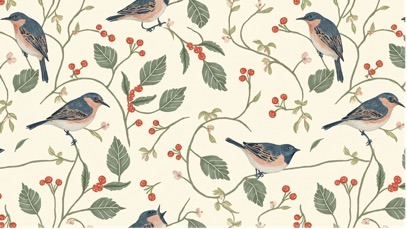
You can see William Morris’s work in several places. Two of the best are his actual homes, both restored and open to visitors:
● The Red House in Bexleyheath, where he lived from 1860 to 1865
● Kelmscott Manor in Oxfordshire, where he spent his later years
The William Morris Gallery in Walthamstow, in the house where he grew up, has one of the largest collections of his work in the world. The V&A Museum in London also holds many of his original drawings and printed fabrics.
If you want to bring his designs into your own space, the patterns are still being made. Sanderson and Morris & Co. both print official versions from his original blocks. There are also good curated collections online. The selection at William Morris Wallpaper brings many of his most famous patterns together in formats that suit modern rooms. Get close to them, even on a screen, and you start to see why they’ve lasted. The depth is real.
Frequently Asked Questions
What Is William Morris Most Famous For?
He’s most famous for his wallpaper and textile designs from the 1860s through the 1890s. Strawberry Thief, Willow Boughs, and Acanthus are probably his most recognised patterns. He’s also remembered as the founder of the Arts and Crafts movement and as a poet, novelist, and social thinker.
When Did William Morris Live?
Morris lived from 1834 to 1896. He was 62 when he died, having packed in enough work for several lifetimes. He produced over fifty wallpaper designs, dozens of textiles, ran a publishing house, wrote books, and helped lead a major artistic and social movement.
Are William Morris Wallpapers Still Made?
Yes. Many of his original designs are still in production today, by Morris & Co. and Sanderson, among others. Several online retailers also carry the patterns, including William Morris Wallpaper, which gathers his designs in one place. The patterns are either reprinted from his original wood blocks or carefully recreated to match the originals.
Is William Morris Wallpaper Expensive?
It can be, especially the hand-blocked or limited-edition runs. But there are now machine-printed versions and peel-and-stick options that put his designs within reach of more home budgets. For a wall you want to keep for decades, the higher price is often worth it. These patterns hold up.
What Was the Red House?
The Red House was William Morris’s first home as a married man. He built it in Kent in 1859 and 1860 with his friend Philip Webb, and it became the testing ground for everything the Arts and Crafts movement would stand for, handmade tiles, custom furniture, stained glass, and wall paintings, all designed by Morris’s circle. You can visit it today through the National Trust.
Who Are Some Designers Influenced by William Morris?
His influence runs deep. Arts and Crafts architects like Charles Voysey and M.H. Baillie Scott. American designers like Gustav Stickley and Frank Lloyd Wright. Modern textile artists, book designers, and even illustrators trace something back to him. Anyone who believes design should be both beautiful and well-made owes Morris a small debt.

