
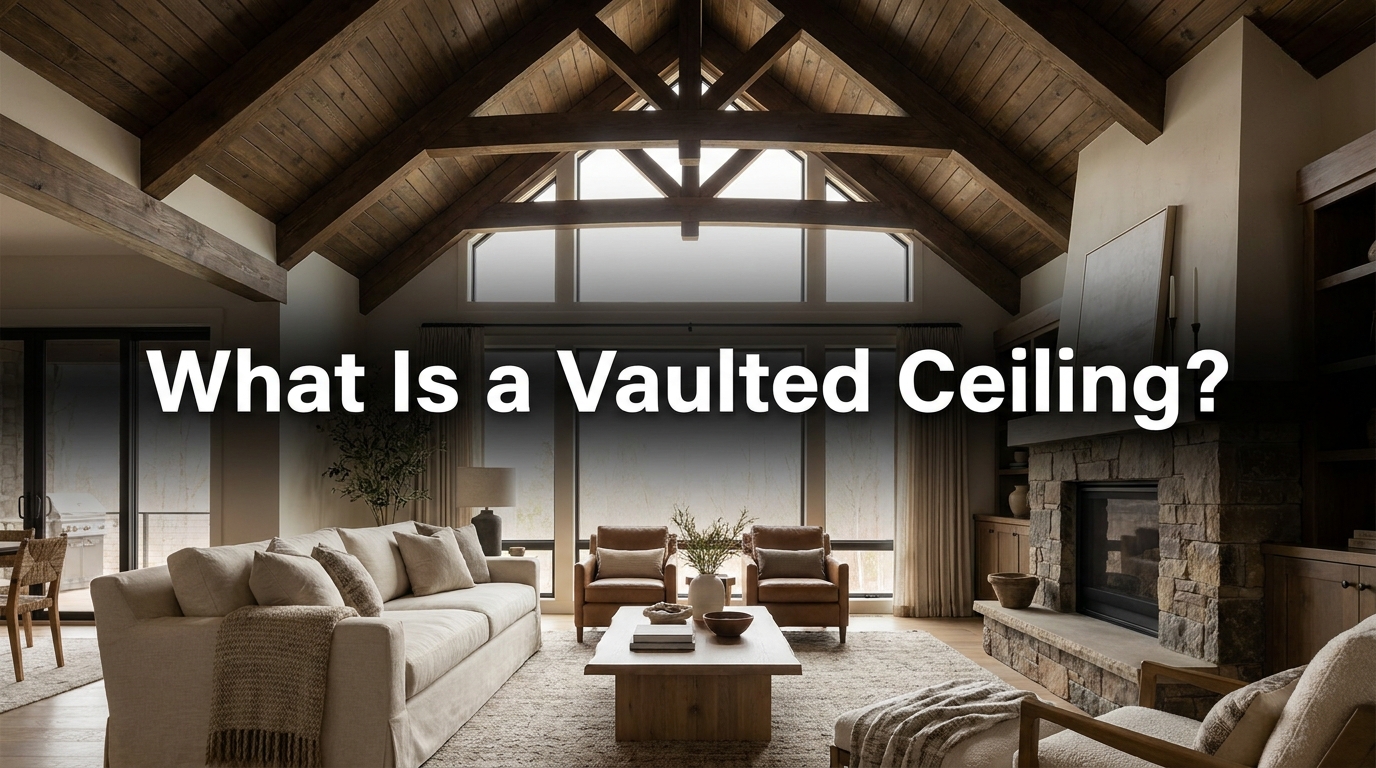
Imagine walking into a room and immediately feeling like it’s twice the size it should be. The air feels lighter. The walls seem to breathe. You look up — and there it is: a ceiling that soars above you, dramatic and beautiful, instead of the flat box most of us are used to.
That’s a vaulted ceiling.
If you’ve been house hunting, renovating, or just scrolling through home design boards on Pinterest or Houzz, you’ve probably seen these architectural features everywhere. But what exactly is a vaulted ceiling? What does it mean for your home, your budget, and your daily living experience?
This guide breaks it all down — clearly, practically, and without the architect-speak.
What Is a Vaulted Ceiling?
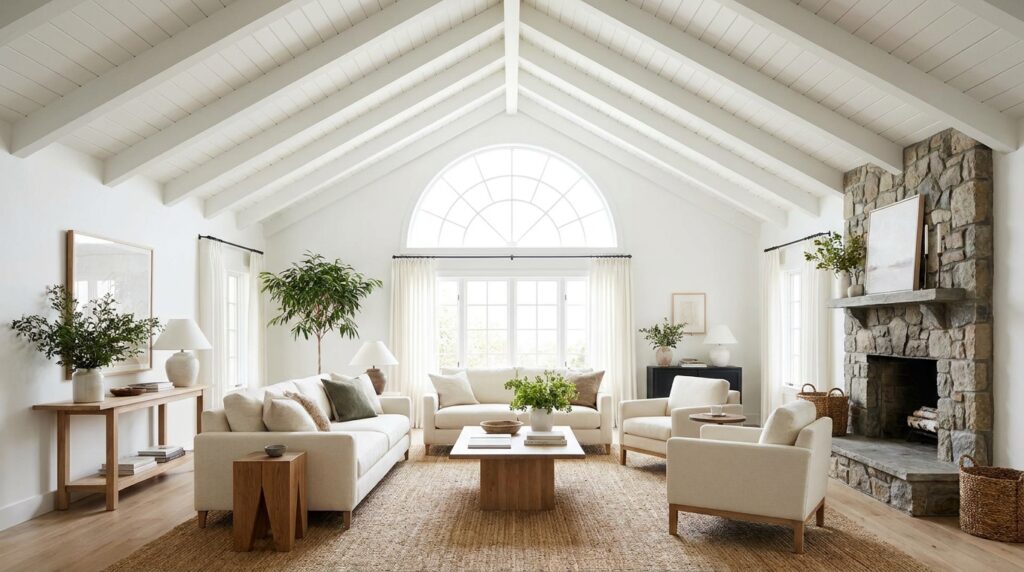
A vaulted ceiling is any ceiling that is higher than the standard flat ceiling height and follows an arched, angled, or curved upward slope. Instead of a uniform flat surface running parallel to the floor, a vaulted ceiling rises — sometimes dramatically — toward a peak, ridge, or curve above you.
The term “vaulted” comes from architecture and historically referred to arched or curved ceiling structures used in medieval cathedrals and grand European buildings. Today, the term is used more broadly to describe any ceiling that breaks away from the standard 8- to 9-foot flat ceiling common in most homes.
What Does Vaulted Ceiling Mean in Modern Homes?
In modern residential design, what vaulted ceiling means is simply a ceiling that adds vertical volume to a room. It can be symmetrical or asymmetrical, it can follow the roofline or be independently framed, and it can incorporate beams, skylights, or decorative elements.
The key characteristic is this: the ceiling is not flat and it rises above the standard ceiling height — typically starting above 9 feet and often reaching 12 to 25 feet at the apex.
According to the National Association of Home Builders (NAHB), higher ceilings — including vaulted designs — have consistently ranked among the most desired home features in buyer surveys.
What Does a Vaulted Ceiling Look Like?
This is one of the most common questions people have — and understandably so. The look of a vaulted ceiling varies widely depending on the type of vault, the materials used, and the overall design of the home.
Here’s what you can generally expect:
- Height: The ceiling visibly rises from the walls toward a central peak, ridge, or curve.
- Angles: You’ll often see sloped planes that mirror the shape of the roof above.
- Beams: Many vaulted ceilings feature exposed wooden beams running along the slope or across the apex, adding a rustic or contemporary detail.
- Light: Because of the extra height, vaulted ceilings often accommodate larger windows, clerestory windows, or skylights — flooding the room with natural light.
- Space: The room feels immediately larger, more dramatic, and more open than a room with a flat ceiling.
In a craftsman-style home, a vaulted ceiling might show natural wood tongue-and-groove planking and heavy timber beams. In a modern minimalist home, it might be a clean white surface with subtle recessed lighting following the slope. In a farmhouse, it might feature shiplap and black iron pendant lights hanging from exposed rafters.
The look of a vaulted ceiling is highly adaptable — which is a large part of why designers and homeowners love them.
What Is Considered a Vaulted Ceiling? (Height & Standards)
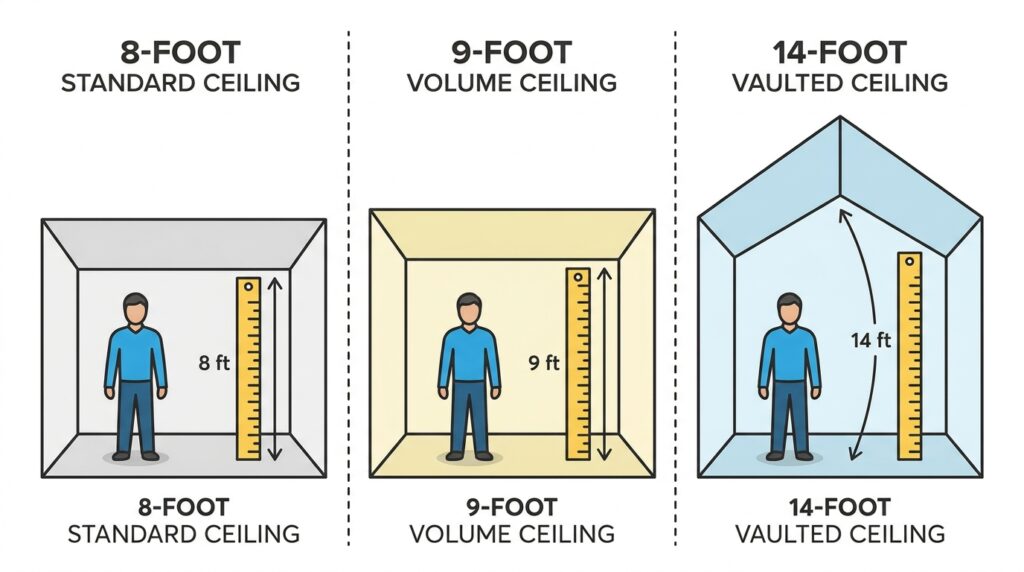
There’s no single universal building code that defines a vaulted ceiling by a specific height number, but industry standards and real estate conventions give us a practical benchmark.
A ceiling is generally considered vaulted when:
- The ceiling height exceeds 9 feet at its highest point
- The ceiling slopes or curves rather than remaining flat
- The design creates a visible sense of elevated volume in the room
Standard residential ceilings in most homes built before the 1980s measured 8 feet. Today, standard new construction often uses 9-foot ceilings. Anything above 9 feet that follows an angled or arched shape qualifies as vaulted.
In real estate listings, you’ll typically see terms like:
- Vaulted ceilings (general)
- Cathedral ceilings (specific type, detailed below)
- Volume ceilings (a related term)
- Soaring ceilings
- High ceilings with beams
What Is a Volume Ceiling?
A volume ceiling is a closely related term to “vaulted ceiling” — and the two are often used interchangeably in real estate and interior design. However, there is a subtle distinction.
A volume ceiling is any ceiling that extends higher than the standard flat ceiling height — it emphasizes the vertical cubic footage of the space. Volume ceilings can be flat (just very high, like a 12-foot flat ceiling) or they can be sloped and vaulted.
A vaulted ceiling, by contrast, specifically implies that the ceiling follows an angled or curved shape rather than being a flat high ceiling.
So: all vaulted ceilings create volume, but not all volume ceilings are technically vaulted.
In everyday use — especially in real estate — the two terms are used interchangeably, and you shouldn’t get too caught up in the distinction.
Types of Vaulted Ceilings
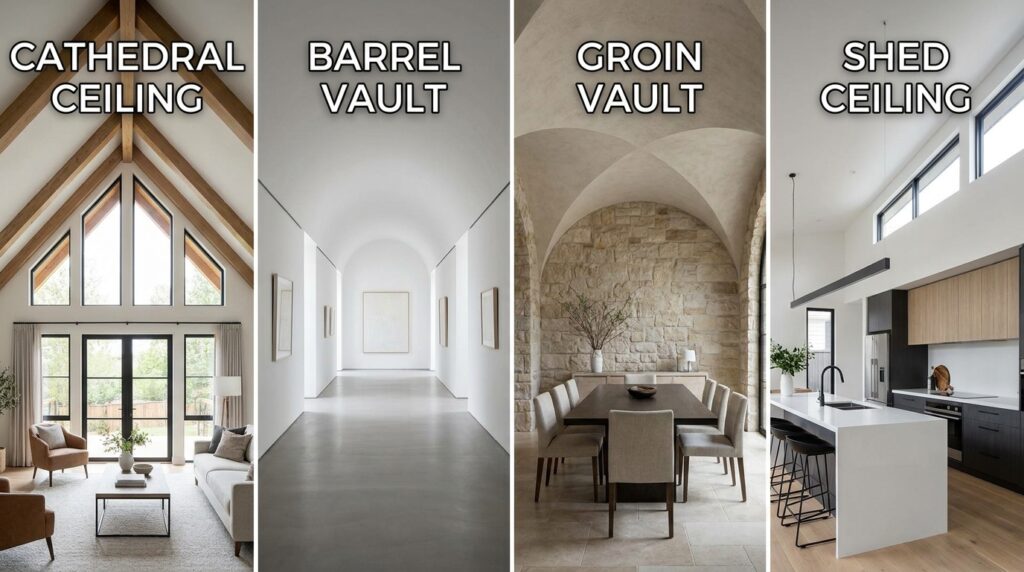
Not all vaulted ceilings are created equal. Each type has a distinct shape, structural requirement, and visual effect. Here’s a breakdown of the most common types you’ll encounter in residential architecture:
1. Cathedral Ceiling
This is the most iconic type of vaulted ceiling. A cathedral ceiling follows the pitch of the roof, with two symmetrical slopes that rise from opposite walls and meet at a central ridge at the peak.
Think of the inside of a Gothic church — that’s the original inspiration. In homes, cathedral ceilings create a grand, symmetrical, and light-filled space. They work beautifully in living rooms, great rooms, and master bedrooms.
Key characteristics:
- Two equal slopes meeting at a central ridge
- Often 12 to 25+ feet at the peak
- Frequently paired with a large window at the gable end
- Classic, timeless appearance
2. Barrel Vault Ceiling
A barrel vault (also called a tunnel vault) features a continuous, curved arch that spans the length of the room — like the inside of a half-cylinder or a tunnel cut lengthwise.
Common in Mediterranean, Spanish Colonial, and Tuscan-style homes, barrel vaults lend an elegant, old-world feel. They’re also used in hallways and entry foyers to add drama to a transitional space.
Key characteristics:
- Smooth, continuous curved arc
- Works well in narrower spaces like hallways
- Requires significant structural support
- Timeless, luxurious aesthetic
3. Groin Vault Ceiling
A groin vault is formed where two barrel vaults intersect at right angles, creating four curved sections that meet at a central point. The “groin” is the edge where the two vaults meet.
This is a more complex and visually dynamic design, historically found in medieval architecture and now used in high-end custom homes, wine cellars, and formal dining rooms.
Key characteristics:
- Four curved sections intersecting at a central point
- Highly architectural and dramatic
- Requires expert craftsmanship
- Works best in square or nearly square rooms
4. Shed (Mono-Pitch) Ceiling
A shed ceiling — sometimes called a mono-pitch or single-slope ceiling — slopes in one direction only, rising from one wall to the opposite wall.
This is a popular choice in modern, contemporary, and mid-century modern homes. It’s cleaner and more asymmetrical than a cathedral vault, and it’s structurally simpler to build.
Key characteristics:
- Single slope from low to high
- Modern, minimalist aesthetic
- Often incorporates clerestory windows at the high wall
- Popular in new construction and additions
5. Coved (Curved) Ceiling
A coved ceiling uses a concave curve to transition from the wall to the ceiling, creating a softer, more rounded shape. It doesn’t necessarily reach cathedral heights, but it adds volume and architectural interest.
Coved ceilings are common in Art Deco buildings, formal dining rooms, and traditional-style homes.
6. Coffered Ceiling
Technically a form of recessed ceiling rather than a vault, coffered ceilings feature a grid of sunken panels (coffers) separated by beams. When coffered ceilings are elevated in height, they are often grouped with vaulted ceiling designs in design discussions.
Vaulted Ceiling vs. Cathedral Ceiling: What’s the Difference?
This causes a lot of confusion — and the terms are often used interchangeably, even by real estate agents and builders. But there is a technical difference.
| Feature | Vaulted Ceiling | Cathedral Ceiling |
|---|---|---|
| Shape | Any non-flat, elevated ceiling | Specifically follows the roof pitch |
| Symmetry | Can be asymmetrical (shed vault) | Always symmetrical (two equal slopes) |
| Relation to roof | May or may not follow roofline | Always mirrors the roofline |
| Common styles | Modern, farmhouse, traditional | Traditional, craftsman, Mediterranean |
| Example | Shed ceiling in a modern home | Peaked ceiling in a chapel-style home |
Bottom line: A cathedral ceiling is always a type of vaulted ceiling, but a vaulted ceiling isn’t always a cathedral ceiling.
Pros and Cons of Vaulted Ceilings
Vaulted ceilings are beautiful — but they’re not right for every home or every budget. Here’s an honest look at both sides.
Pros of Vaulted Ceilings
1. Dramatic visual impact A vaulted ceiling transforms a room instantly. It adds grandeur and makes even modest-sized rooms feel open and impressive — something flat ceilings simply cannot replicate.
2. More natural light The extra height accommodates larger windows, skylights, and clerestory windows. Rooms with vaulted ceilings are typically brighter without relying on artificial lighting.
3. Improved air circulation More vertical volume means better airflow. With ceiling fans positioned at the correct height, vaulted ceiling rooms can actually be more comfortable to heat and cool when managed properly.
4. Higher resale value According to real estate professionals and Redfin data, homes featuring architectural details like vaulted ceilings consistently appeal to more buyers and can command higher prices, particularly in the mid-to-luxury market.
5. Design flexibility Vaulted ceilings work across virtually every design style — from rustic farmhouse with exposed beams to ultra-modern with minimalist lines.
6. Sense of space without square footage If you can’t expand outward, you can expand upward. A vaulted ceiling creates a psychological sense of space without adding actual floor area.
Cons of Vaulted Ceilings
1. Higher energy costs More cubic volume = more space to heat and cool. If your HVAC system isn’t designed for the extra volume, your energy bills may be noticeably higher. The U.S. Department of Energy notes that proper insulation is critical in vaulted ceiling spaces.
2. Difficult and costly maintenance Changing a light bulb, repainting, or repairing drywall 18 feet above the floor requires ladders, scaffolding, or professionals. This is one of the most overlooked downsides.
3. Higher construction cost Building or converting to a vaulted ceiling costs significantly more than a flat ceiling. Structural engineering, additional lumber, specialized HVAC design, and insulation all add cost.
4. Noise and acoustics Hard, high surfaces can create echo and sound issues. This is particularly noticeable in open-concept homes with vaulted ceilings.
5. Limited upstairs space A vaulted ceiling in a two-story home often means sacrificing storage or livable space above. In ranch-style homes, it can limit attic space and insulation depth.
How Much Does a Vaulted Ceiling Cost?
Costs vary widely based on whether you’re building new or converting an existing flat ceiling, the type of vault, your location, and the finishes you choose.
New Construction Cost
In new construction, adding a vaulted ceiling versus a standard flat ceiling typically adds:
- $5 to $30+ per square foot of ceiling area
- A typical great room with a cathedral ceiling may add $8,000 to $25,000 to a home’s build cost
Conversion Cost (Existing Home)
Converting an existing flat ceiling to a vaulted ceiling is a major structural project — not a simple renovation. It involves:
- Removing the existing ceiling joists (which may be load-bearing)
- Adding structural supports (ridge beams, collar ties, etc.)
- Re-insulating the new sloped ceiling cavity
- Reworking HVAC, electrical, and lighting
According to HomeAdvisor (Angi), vaulting an existing ceiling typically costs between $18,000 and $30,000 for a standard room, depending on complexity.
Cost Summary Table
| Project Type | Estimated Cost Range |
|---|---|
| New construction (added feature) | $5–$30 per sq ft |
| Conversion of flat ceiling to vault | $18,000–$30,000+ |
| Adding exposed beams (decorative) | $1,500–$6,000 |
| Skylights added to vaulted ceiling | $1,500–$4,500 per unit |
| Repainting vaulted ceiling (professional) | $500–$2,500 |
Note: Always get multiple quotes from licensed contractors in your area. Costs vary significantly by region.
How to Design a Room With a Vaulted Ceiling
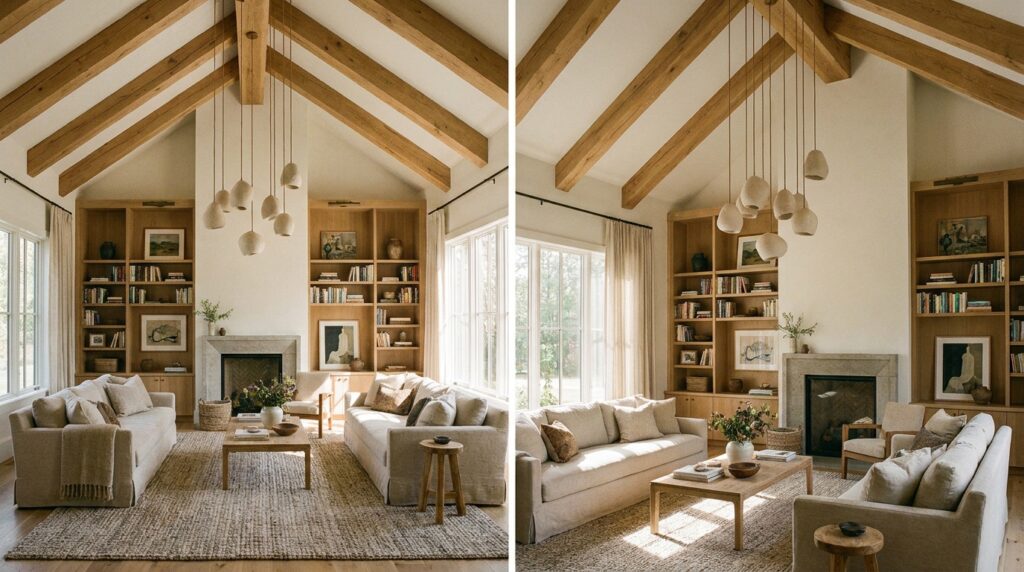
Getting the design right in a room with a vaulted ceiling is both exciting and a little tricky. The extra height changes how you approach furniture scale, lighting, and acoustics.
Lighting
This is often the biggest challenge. Standard ceiling fixtures won’t work when your peak is 18 feet above the floor.
Design tips:
- Use pendant lights on long cords or rods that drop the fixture down to a usable height
- Install recessed lighting along the slope of the ceiling, angled toward the room
- Add wall sconces to bring light down to the human level
- Consider track lighting along structural beams
Furniture Scale
Oversized or tall furniture works better in vaulted ceiling rooms. Low, flat furniture can make a high-ceilinged room feel oddly disconnected.
Design tips:
- Choose tall bookshelves or armoires that draw the eye upward
- Use large-scale art — don’t hang small pieces that get lost on tall walls
- Add vertical decorative elements like tall floor lamps or tall plants
Color and Finish
High ceilings can feel cold or cavernous if not handled well.
Design tips:
- Paint the ceiling a warm or darker hue to bring it down visually if it feels too vast
- Use natural wood beams or planks to add warmth and texture
- Consider tongue-and-groove or shiplap on the ceiling plane for visual interest
Acoustics
Sound echoes in vaulted spaces. Combat this with:
- Area rugs on hard floors
- Upholstered furniture
- Curtains and drapery
- Soft furnishings like throw pillows and blankets
Expert Tips: What Architects and Designers Say About Vaulted Ceilings
We’ve gathered insights from architectural and design industry best practices to give you an expert perspective on vaulted ceilings:
“The biggest mistake homeowners make with vaulted ceilings is under-lighting the space. The ceiling draws the eye up, but if the light doesn’t follow, you end up with a beautiful architectural feature that’s invisible at night.” — A commonly repeated principle in architectural lighting design practice
Consult a structural engineer first. If you’re converting an existing flat ceiling, never assume the work is purely cosmetic. The ceiling joists in your home may be preventing the roof from spreading. A licensed structural engineer — not just a general contractor — should assess the project before any work begins. The American Institute of Architects recommends professional consultation for any major structural modification.
Invest in spray foam insulation. Standard batt insulation loses significant R-value per inch in a sloped ceiling cavity. Spray foam insulation applied directly to the roof deck provides far better thermal performance in vaulted ceiling spaces. Learn more from the Spray Polyurethane Foam Alliance.
Size your HVAC for the actual cubic volume. Most HVAC calculators default to square footage. A room with a 20-foot peak has dramatically more cubic air volume than a room with an 8-foot ceiling of the same footprint. Make sure your HVAC contractor performs a Manual J calculation based on actual cubic volume, not square footage alone.
Use ceiling fans — at the right height. Ceiling fans in vaulted spaces are effective but must be positioned at the correct height (7–9 feet above floor level for optimal airflow). Use extension rods to lower the fan to an effective height, and make sure it’s rated for sloped ceiling mounting.
Think about maintenance before you build. That exposed beam 22 feet above the floor looks incredible. Cleaning it, staining it, or fixing a light fixture attached to it in five years will require professional-grade scaffolding. Plan your design with future maintenance in mind.
Vaulted Ceilings in Different Home Styles
Vaulted ceilings aren’t one-size-fits-all. Here’s how they show up across popular home design styles:
Craftsman / Bungalow
In craftsman homes, vaulted ceilings often feature exposed timber beams, wood-paneled soffits, and warm earth tones. The vault is often modest in scale — enhancing warmth without sacrificing the cozy, handcrafted character of the style.
Modern / Contemporary
Modern homes favor shed-style vaults with clean angles and minimal ornamentation. High-gloss paint, recessed lighting on sloped tracks, and large clerestory windows are hallmarks of this approach.
Farmhouse
The farmhouse design trend — popularized over the past decade — loves cathedral ceilings with shiplap planking, black iron fixtures, and natural wood beams. The contrast of rustic texture against a soaring space is quintessential modern farmhouse.
Mediterranean / Spanish Colonial
In Mediterranean-style homes, barrel vault ceilings in hallways and entryways are a signature feature. Often finished with plaster, they create a beautiful old-world atmosphere that’s cooler and more formal.
Transitional / Traditional
Transitional homes often use coffered or coved ceilings at elevated heights, adding architectural detail and volume without the dramatic slope of a cathedral vault.
Are Vaulted Ceilings Still in Style in 2026?
Great question. Home design trends evolve, and some features that were wildly popular in one decade become dated in the next.
Vaulted ceilings, however, have proven remarkably durable as a design choice — and here’s why:
They remain popular because:
- They are structural features, not just decorative trends. You can update paint colors or swap out light fixtures; a vaulted ceiling is a permanent architectural statement.
- The demand for open, airy, light-filled spaces — accelerated by the work-from-home shift of the 2020s — has kept vaulted ceilings relevant and desirable.
- According to Zillow research, homes with architectural details like vaulted ceilings spend less time on the market and receive more buyer interest than comparable homes without them.
What has changed is the stylistic treatment:
- The heavily ornate, ceiling-medallion, chandelier-in-every-room approach of the 1990s vaulted ceiling has given way to cleaner, more restrained designs.
- Exposed beams remain popular, but in natural or whitewashed finishes rather than heavy dark stains.
- Modern interpretations often pair vaulted ceilings with industrial or Scandinavian-inspired minimalism.
In short: vaulted ceilings aren’t going anywhere — but how they’re decorated continues to evolve.
Frequently Asked Questions
What is the difference between a vaulted ceiling and a cathedral ceiling?
A cathedral ceiling is a specific type of vaulted ceiling. A cathedral ceiling features two symmetrical slopes that follow the pitch of the roof and meet at a central ridge — exactly like the inside of a traditional cathedral. A vaulted ceiling is the broader term that encompasses any non-flat ceiling that rises above standard height, including cathedral ceilings, shed ceilings, barrel vaults, and more.
What is a vaulted ceiling in a house?
In a house, a vaulted ceiling is any ceiling that angles upward or curves rather than running flat and parallel to the floor. It creates a sense of vertical volume and openness in the room. Vaulted ceilings can appear in living rooms, bedrooms, kitchens, entryways, and great rooms, and they range from modestly sloped to dramatically high.
Is a 9-foot ceiling considered vaulted?
Not typically. A standard 9-foot flat ceiling is not considered vaulted — it’s just a taller-than-average flat ceiling. A ceiling is generally considered vaulted when it slopes or curves upward, regardless of the exact height. However, a 9-foot ceiling that slopes up to 12 or 14 feet would absolutely qualify as a vaulted ceiling.
What is a volume ceiling vs. a vaulted ceiling?
A volume ceiling refers to any ceiling that is higher than the standard 8-foot flat ceiling, adding vertical cubic volume to the room. A vaulted ceiling specifically refers to a ceiling that slopes, curves, or angles upward. All vaulted ceilings create volume, but a volume ceiling can also refer to a very high flat ceiling. In everyday use — especially in real estate listings — the two terms are often used interchangeably.
Do vaulted ceilings add value to a home?
Yes, in most markets, vaulted ceilings are considered a desirable and value-adding feature. They increase buyer appeal, create a sense of luxury and space, and differentiate a home from comparable properties. The actual value added depends on the local market, the quality of execution, and buyer demographics — but architectural features like vaulted ceilings are consistently cited as positive selling points by real estate professionals and organizations like the National Association of Realtors.
Conclusion: Is a Vaulted Ceiling Right for Your Home?
A vaulted ceiling is one of the most powerful architectural tools in residential design. It transforms how a room feels, how light moves through it, and how impressive it is to anyone who walks in.
But it’s not a decision to make lightly. The costs — in construction, energy, and maintenance — are real. The design challenges — lighting, acoustics, furniture scale — require thought and planning.
If you’re building new, adding a vaulted ceiling to your great room, master bedroom, or entryway is often worth every penny. If you’re considering converting an existing flat ceiling, start with a structural engineer and get honest numbers before falling in love with the vision.
And if you’re buying a home with a vaulted ceiling? Ask about insulation quality, HVAC capacity, and lighting setup — the details that determine whether that beautiful high ceiling is an asset or an ongoing maintenance challenge.
Either way, there’s no denying it: when done right, a vaulted ceiling is a design statement that never gets old.

