
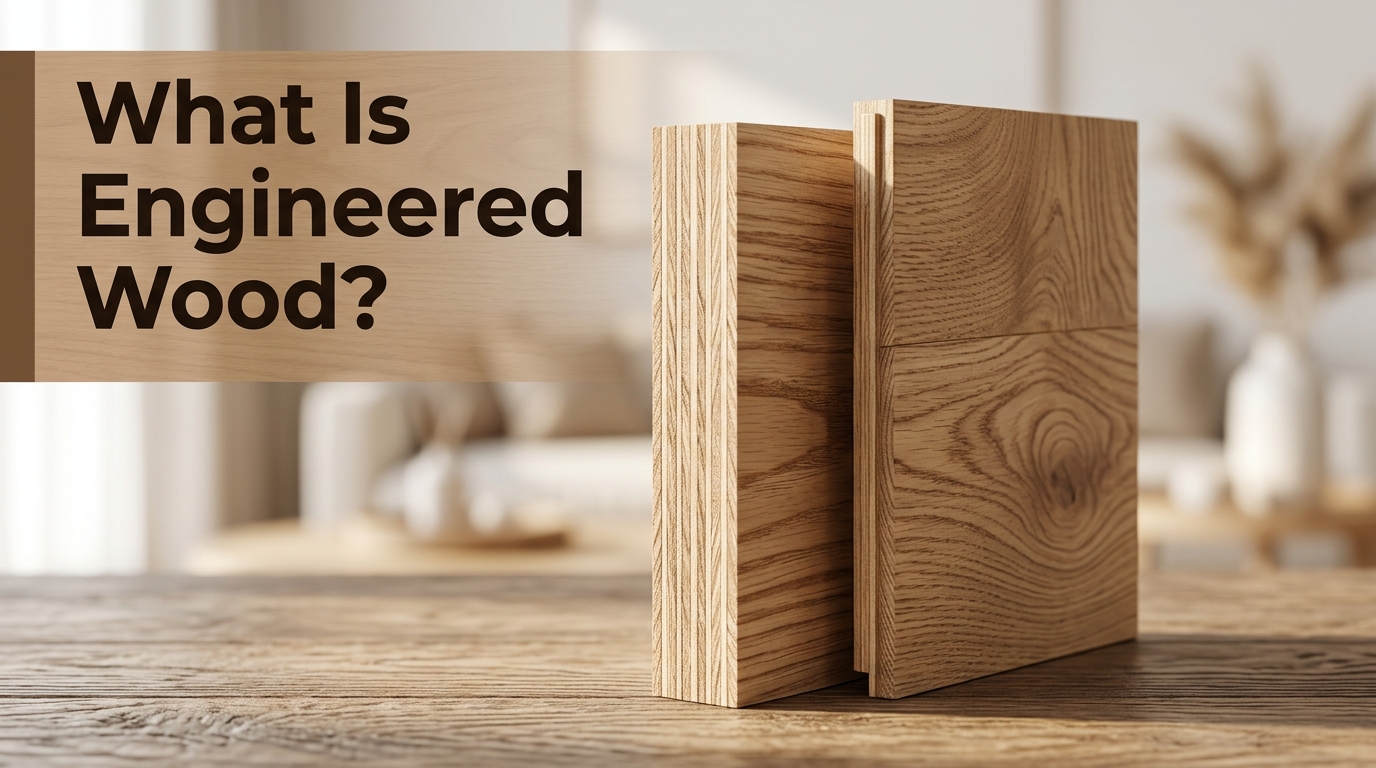
You pull open a cabinet door, walk across a “hardwood” floor, or lean against a bookshelf, and odds are you’re touching engineered wood without even realizing it. It’s everywhere in modern homes, yet most people can’t actually explain what separates it from a plain wood board.
So what is engineered wood? In simple terms, it’s wood that’s been taken apart and put back together on purpose. Instead of cutting a single plank straight from a tree trunk, manufacturers combine layers, strands, fibers, or particles of wood with adhesives to build a new material that’s often stronger, flatter, and more predictable than solid lumber.
That single idea explains almost everything else in this article: why engineered floors don’t warp the way solid oak sometimes does, why cabinet boxes stay flat for decades, and why an entire skyscraper can now be framed in wood instead of steel.
What Does Engineered Wood Mean, Exactly?
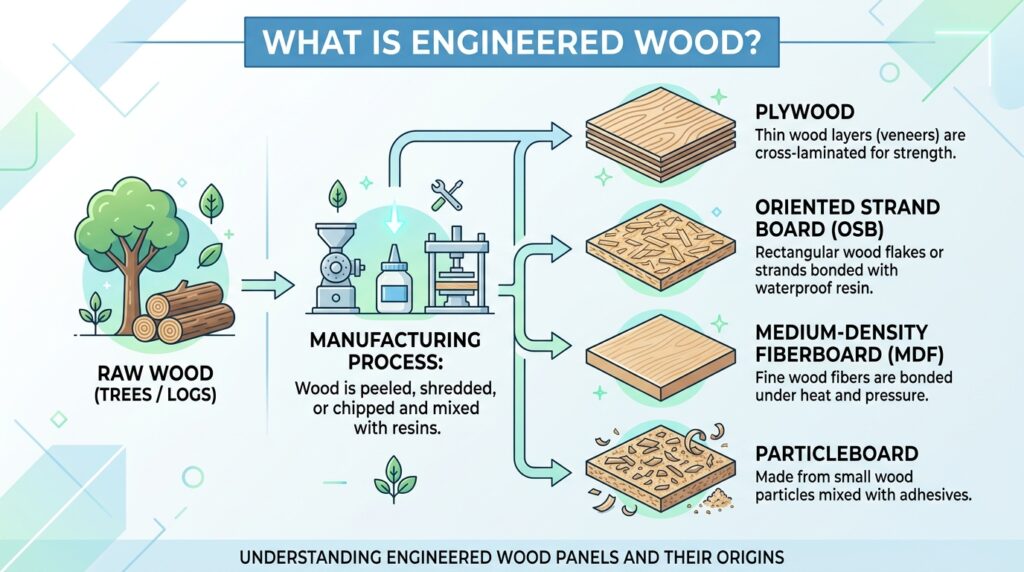
If you’re wondering what engineered wood means at a technical level, here’s the short version: it’s an umbrella term for any wood-based product manufactured by bonding wood pieces together rather than sawing them whole from a log.
Engineered wood, also called mass timber, composite wood, man-made wood, or manufactured board, covers a range of derivative wood products manufactured by binding strands, particles, fibers, veneers, or boards of wood together with adhesives. That’s a mouthful, but the practical takeaway is simple: it’s not one product, it’s a whole family of products.
Some are paper-thin veneers glued into flooring. Others are massive structural panels used to replace steel beams in commercial buildings. What ties them together isn’t appearance — it’s the manufacturing process.
What Is Engineered Wood Made Of?
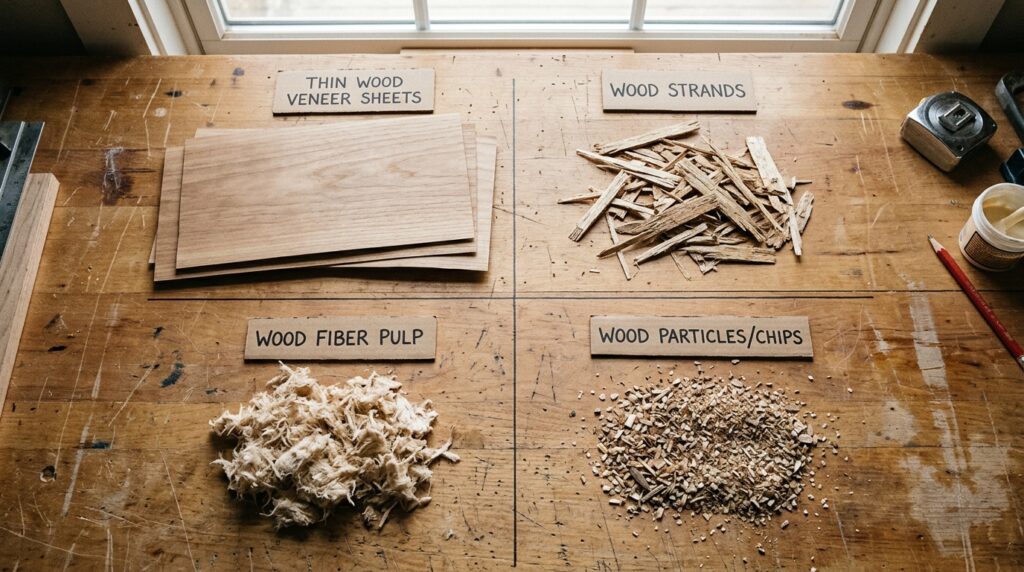
So what is engineered wood made of, physically? Depending on the product, it starts with one of these raw materials:
- Wood veneers — thin sheets peeled or sliced from logs
- Wood strands or flakes — larger, uniform pieces cut from smaller trees
- Wood fibers — broken down almost to a pulp-like consistency
- Wood particles or chips — leftover sawmill scraps and shavings
These are then combined with adhesives (usually phenol-formaldehyde or similar resins) and pressed under heat, which cures the glue and locks the layers or particles into a rigid panel. Sawmill scraps and other wood waste can be used for engineered wood composed of particles or fibers, while whole logs are usually reserved for veneers used in products like plywood or medium-density fiberboard.
This is also why engineered wood is considered a more resource-efficient use of timber — very little of the tree goes to waste.
Is Engineered Wood a Real Material or Just “Fake Wood”?
This is one of the most common misconceptions. Engineered wood isn’t fake — it’s made from actual wood fiber, just reorganized into a more stable format. The confusion usually comes from confusing it with laminate or vinyl, which mimic wood using printed images rather than real wood content.
Real engineered products, whether it’s a cabinet panel or a structural beam, contain genuine wood material. They’re manufactured, not synthetic.
What Is Engineered Wood Called in Different Industries?
Here’s something that trips people up: what is engineered wood called changes depending on which industry you’re shopping in.
| Industry | Common Name |
|---|---|
| Flooring | Engineered hardwood, engineered wood flooring |
| Furniture | Engineered wood, composite wood, man-made board |
| Construction framing | Mass timber, engineered lumber, structural composite lumber |
| Siding | Engineered wood siding, composite wood siding |
| Cabinetry | MDF, particleboard, engineered panel |
So if a salesperson calls something “composite wood” or “mass timber,” they’re likely talking about a version of the same underlying category.
The Main Types of Engineered Wood You’ll Actually Encounter
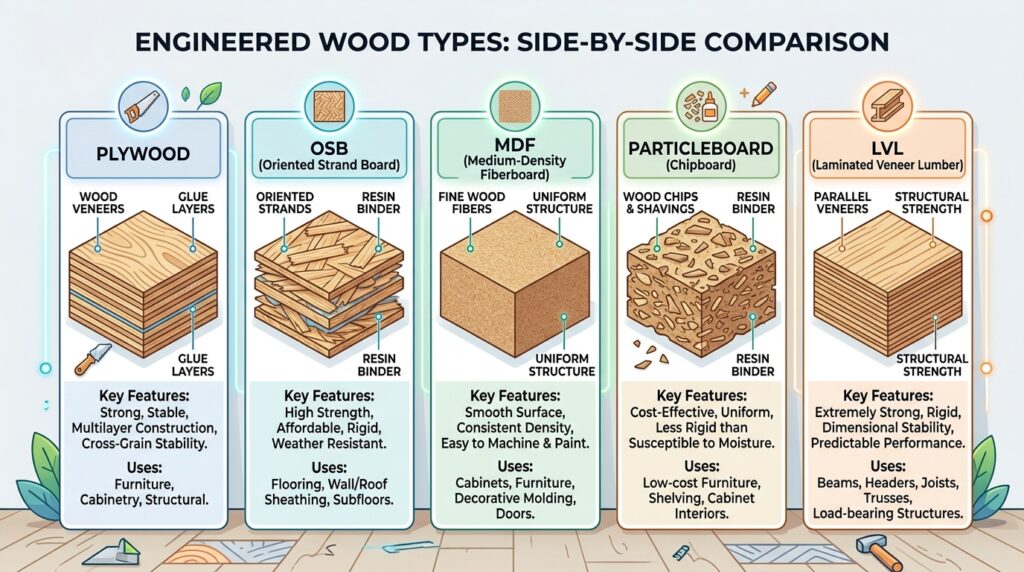
Rather than treating engineered wood as one single product, it helps to break it into the categories homeowners run into most often.
Plywood
Plywood is the original engineered wood product, and it’s still one of the most widely used. Thin layers of veneer are stacked with the grain of each layer running perpendicular to the one beneath it, then glued and pressed. This cross-grain construction is what makes plywood strong relative to its weight, letting it resist warping and splitting in ways solid lumber can’t match. If you want a full breakdown of grades, cores, and species, this detailed types of plywood resource covers it in depth.
Oriented Strand Board (OSB)
OSB is a type of engineered wood formed by adding adhesive to layers of wood strands laid in specific orientations and compressed together, and in North America it’s now more common than plywood, holding roughly 66% of the structural panel market as of 2016. It’s the rough, flaky-looking sheathing you often see under house wrap during construction.
Medium-Density Fiberboard (MDF)
MDF is made by breaking wood down into fine fibers, combining them with resin, and pressing them into dense, smooth panels. It has no visible grain, which makes it ideal for painted furniture and cabinet doors.
Particleboard
Particleboard uses coarser wood particles — think sawdust and shavings — bonded with resin under pressure. It’s the least expensive engineered wood product and commonly shows up in flat-pack furniture and shelving.
Laminated Veneer Lumber (LVL) and Glulam
These are structural engineered wood products used in framing. LVL stacks veneers with the grain running the same direction (unlike plywood) to create strong, straight beams, while glulam glues together dimensional lumber boards to form large structural members — sometimes even full building columns.
Engineered Wood vs Plywood: What’s the Difference?
This one confuses a lot of people because plywood technically is a type of engineered wood — so asking about engineered wood vs plywood is a bit like asking “cars vs sedans.” Plywood is a subcategory.
That said, in everyday conversation — especially in flooring — “engineered wood” usually refers specifically to engineered hardwood flooring, which is different from a raw sheet of plywood in a few important ways:
| Feature | Engineered Hardwood Flooring | Plywood Sheet |
|---|---|---|
| Top layer | Real hardwood veneer, finished | Usually unfinished veneer or none |
| Purpose | Ready-to-install flooring | Raw building material |
| Core | Plywood, HDF, or stone-polymer composite | N/A (it is the core material) |
| Finish | Factory-applied topcoat | Often unfinished |
Engineered wood flooring is crafted with a top layer of real hardwood bonded to multiple layers of high-density materials, such as plywood or fiberboard, and this layered structure is what gives it superior stability and moisture resistance compared to solid wood planks.
Engineered Wood vs MDF: Which One Wins?
Technically, MDF is a type of engineered wood, so this comparison usually means “solid-core or veneer-core engineered wood vs MDF-core engineered wood.”
- MDF is heavier, extremely smooth, and takes paint beautifully, but it doesn’t hold screws at the edges very well and can swell if it gets wet.
- Veneer-core or plywood-core engineered wood is lighter, holds fasteners better, and handles moisture more gracefully.
For furniture that will be painted and stay indoors in a stable environment, MDF is often fine. For anything structural, load-bearing, or moisture-prone, a plywood or veneer-core product is the safer bet.
Engineered Wood vs Particle Board
Is engineered wood particle board? Not exactly — particle board is engineered wood, but not all engineered wood is particle board. This is where a lot of shoppers get confused when comparing engineered wood vs particle board products at a furniture store.
Particle board is the most basic and least expensive engineered wood option. It’s made from coarse wood particles and offers the lowest strength and moisture resistance of the group. It’s fine for lightweight shelving or budget furniture that won’t take heavy loads, but it tends to sag over time and doesn’t tolerate water well at all.
If someone asks is engineered wood particle board, the accurate answer is: sometimes, but it’s the entry-level tier of a much bigger category that also includes plywood, MDF, and structural products far stronger than particleboard.
Engineered Wood vs Laminate: Don’t Mix These Up
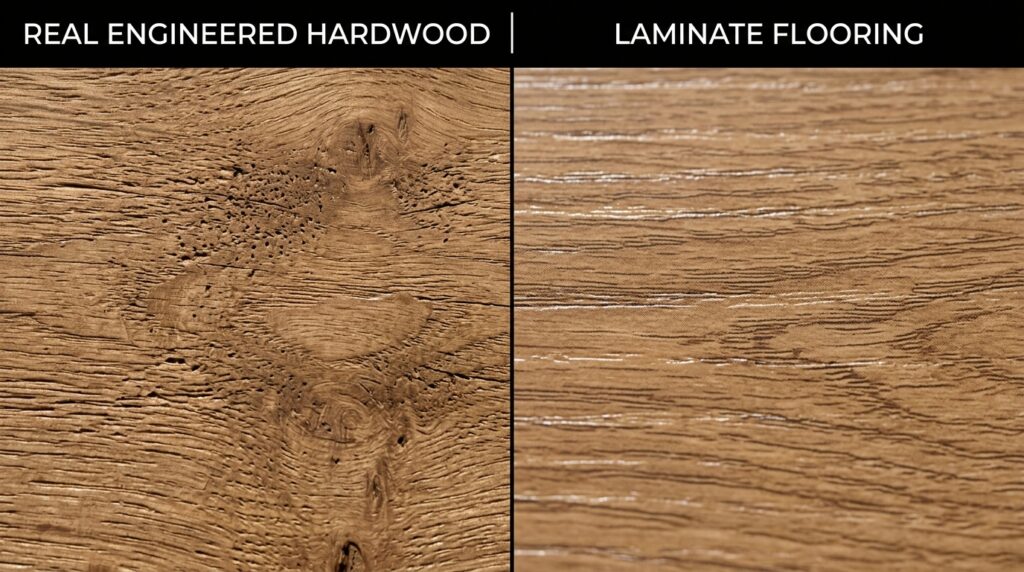
This comparison trips up more shoppers than any other. Engineered wood vs laminate flooring looks similar in photos but couldn’t be more different in composition.
- Engineered wood flooring has a real hardwood veneer on top — it’s genuine wood you can see and touch.
- Laminate flooring has a printed image of wood grain under a protective wear layer, sitting on a fiberboard core. There’s no real wood surface at all.
Laminate is generally more scratch-resistant and budget-friendly. Engineered wood offers the authentic look, feel, and refinishing potential of real hardwood. If resale value or an authentic finish matters to you, engineered wood tends to be the stronger long-term choice.
What Is Engineered Wood Flooring, Specifically?
Since flooring is where most people first encounter this material, it deserves its own section. What is engineered wood flooring? It’s a flooring product built in layers: a real hardwood wear layer on top, bonded to a stable core made of plywood, high-density fiberboard, or composite material.
Engineered hardwood flooring is made of compressed wood, plywood, and fiberboard topped with a wood veneer, and some versions can be sanded and refinished depending on the thickness of that top veneer layer.
Why does this construction matter? Because the durable layered core makes engineered hardwood less affected by fluctuations in temperature or moisture, which makes it a safer choice in humid environments, and it’s often installed in basements, kitchens, and over concrete slabs where solid hardwood would struggle.
Professional wood flooring installation guidelines back this up directly: engineered wood floors are commonly rated for installation on, above, or below grade level, and can go over concrete or a wood subfloor — something solid hardwood generally can’t do.
Quick Pros and Cons of Engineered Wood Flooring
Pros:
- More dimensionally stable than solid hardwood
- Can be installed below grade and over concrete
- Real wood surface, unlike laminate or vinyl
- Often more affordable than solid hardwood
Cons:
- Not fully waterproof, despite better moisture resistance
- Can typically only be refinished a limited number of times, depending on veneer thickness
- Lower-end products may use less durable core materials
What Is Engineered Wood Siding Made Of?
Siding is another area where engineered wood shows up constantly, though it looks nothing like a flooring plank. So what is engineered wood siding made of?
Engineered wood siding is made up of wood strands coated with a resin binder and compressed to create a board with superior strength, which helps it stand up to inclement weather better than some traditional materials. That resin-and-strand combination is also typically coated with wax and borate treatments to improve moisture and insect resistance, then finished with a texture that mimics natural wood grain.
What is engineered wood siding, functionally? It’s a wood-based alternative to solid wood clapboard or shingles, designed to resist the rot, insect damage, and warping that plague untreated natural wood siding, while still giving you a wood-look exterior.
Pros and Cons of Engineered Wood Siding
Pros:
- More resistant to rot, pests, and moisture than raw wood
- Lighter and easier to install than solid wood
- Often less expensive than natural wood siding
Cons:
- Long-term performance depends heavily on manufacturing quality and proper installation
- Some products are more sensitive to moisture intrusion at cut edges and seams if not sealed correctly
- Not all engineered siding brands perform equally — quality varies by manufacturer
What Is Engineered Wood Furniture?
Walk through nearly any furniture store today and most of what you see qualifies as engineered wood furniture. What is engineered wood furniture, in plain terms? It’s furniture built from manufactured wood panels — MDF, particleboard, or plywood — rather than solid lumber boards.
This isn’t automatically a bad thing. Engineered wood panels resist warping better than solid wood in many cases, and they’re significantly more affordable, which is why so much flat-pack and mass-market furniture uses them.
The catch is durability under stress. Solid wood furniture can be sanded, repaired, and passed down for generations. Engineered wood furniture — especially particleboard pieces — is more vulnerable to chipping, moisture swelling, and screw stripping over repeated assembly and disassembly.
For furniture that gets heavy daily use (dining tables, bed frames, dressers), look for plywood or solid-wood-frame construction. For lighter-use pieces like bookshelves or accent tables, MDF or particleboard is often a reasonable trade-off for the price.
What Is Engineered Wood Veneer?
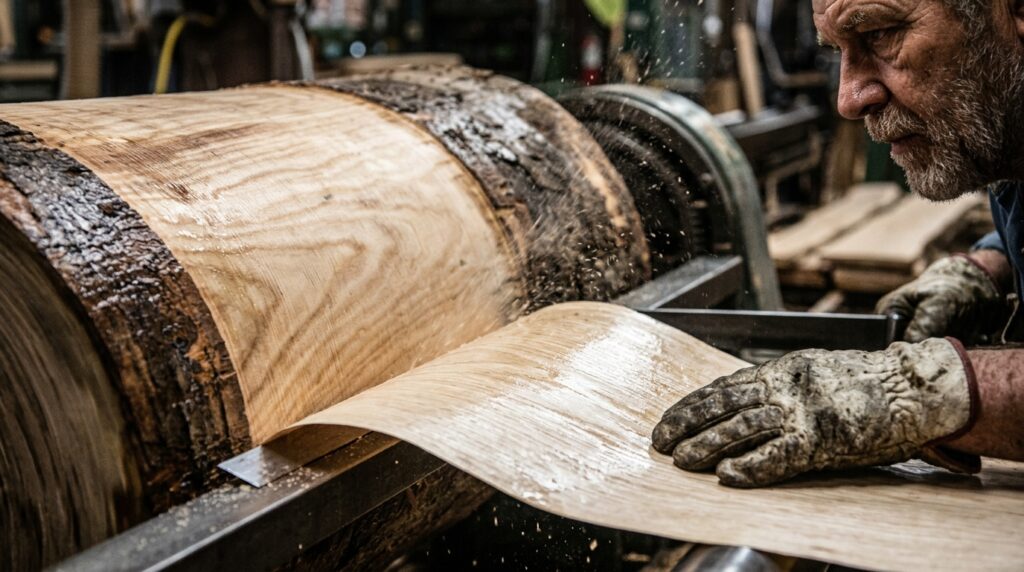
What is engineered wood veneer? It’s not a separate product exactly — it’s the thin decorative wood layer applied to the surface of an engineered core. Veneer is sliced or peeled from a log into sheets often less than a millimeter thick, then glued onto plywood, MDF, or particleboard to give it the appearance (and partially the feel) of solid wood.
This is how manufacturers stretch expensive or rare wood species — like walnut or exotic hardwoods — much further than solid lumber would allow, since a single log can be sliced into dozens of veneer sheets.
What Is Engineered Wood Material Used For, Beyond Furniture and Floors?
The applications go far beyond what most homeowners realize:
- Structural framing — I-joists, LVL beams, and glulam columns now replace steel and solid lumber in many builds
- Subfloors and sheathing — plywood and OSB form the skeleton under nearly every modern roof and wall
- Cabinetry — kitchen and bathroom cabinet boxes are almost universally engineered wood
- Doors — many interior doors use engineered wood cores with veneer or laminate faces
- Musical instruments and specialty products — aircraft-grade plywood and specific veneer plywoods are used in guitar bodies and precision applications
Engineered wood products are used in a variety of applications, from home construction to commercial buildings to industrial products, and can even be used for joists and beams that replace steel in many building projects — a shift that’s reshaping how mid-rise buildings get constructed in some regions.
Is Engineered Wood Good? Weighing the Real Trade-Offs
So, cutting through the marketing: is engineered wood good? The honest answer is that it depends entirely on the product tier and the application — but for most residential uses, yes, it’s a genuinely solid choice.
Where engineered wood shines:
- Dimensional stability (resists warping, cupping, and expansion better than solid wood in most cases)
- More efficient use of timber resources, since manufacturers can use smaller trees and mill scraps
- Cost savings compared to equivalent solid wood products
- Consistent, predictable performance thanks to manufacturing standards
Where it falls short:
- Lower-grade products (especially basic particleboard) don’t hold up well to repeated moisture exposure
- Refinishing options are limited compared to solid wood
- Not all engineered wood is created equal — grade and core material matter enormously
Engineered Wood Disadvantages You Should Actually Know About
No material is perfect, and being upfront about engineered wood disadvantages is part of making a smart buying decision.
- Moisture sensitivity varies by product. While engineered wood generally resists warping better than solid wood, cheaper particleboard and MDF products can swell permanently if soaked.
- Limited refinishing. Engineered hardwood flooring can usually only be sanded and refinished a small number of times — sometimes not at all — depending on how thick the top veneer layer is.
- Adhesives and formaldehyde concerns. Because engineered wood relies on resins and binders, formaldehyde emissions have historically been a concern in some composite wood products. In the U.S., this is now tightly regulated — composite wood products including hardwood plywood, MDF, and particleboard must be labeled as compliant with national formaldehyde emission standards before they can be sold.
- Quality varies widely by manufacturer. Two products labeled “engineered wood” can perform completely differently depending on core material, adhesive quality, and veneer thickness.
- Not always as repairable. Deep scratches or dents in engineered wood furniture can be harder to fix invisibly compared to solid wood.
How to Judge Engineered Wood Quality Before You Buy
Since quality swings so widely across this category, here’s a practical checklist:
- Check the core material. Plywood or veneer cores generally outperform particleboard for strength and moisture resistance.
- Look at the wear layer thickness on flooring — thicker veneers can be refinished more times.
- Ask about formaldehyde certification. Reputable products will note TSCA Title VI or CARB Phase II compliance.
- Check for third-party grading or certification, since hardwood plywood grading standards typically range from premium to economy tiers and help confirm you’re getting the quality level you’re paying for.
- Consider the application. A basement rec-room bookshelf doesn’t need the same core quality as a load-bearing beam.
Expert Tip: Reading the Grade Stamp
Most structural engineered wood panels — plywood, OSB, and similar products — carry a grade stamp somewhere on the sheet. This small printed mark typically tells you the species group, exposure rating (interior vs exterior), and span rating. It’s easy to overlook, but it’s the fastest way to confirm you’re buying a panel actually rated for your intended use, rather than guessing based on appearance alone.
Frequently Asked Questions About Engineered Wood
Is engineered wood as durable as solid wood?
It depends on the application. For flooring and structural framing, quality engineered wood often outperforms solid wood in dimensional stability and resistance to warping. For furniture under heavy daily stress, solid wood generally has an edge in long-term repairability and lifespan, though high-grade engineered wood furniture can still last many years with proper care.
Can engineered wood get wet?
Some can tolerate occasional moisture better than solid wood thanks to its layered construction, but most engineered wood products are not waterproof. Extended water exposure can still cause swelling, delamination, or core damage, so spills should always be wiped up promptly.
Is engineered wood cheaper than solid wood?
Generally, yes. Because engineered wood makes efficient use of smaller trees, veneers, and mill byproducts, it typically costs less to manufacture than equivalent solid lumber, and that savings is usually passed on to the buyer.
Does engineered wood flooring add value to a home?
Quality engineered hardwood flooring is generally viewed favorably by buyers and appraisers, especially compared to laminate or vinyl, since it features a genuine hardwood surface. Value impact depends on the wear layer quality, brand reputation, and installation.
How long does engineered wood last?
Lifespan varies significantly by product type and quality. High-quality engineered hardwood flooring with a thick wear layer can last several decades with proper care and occasional refinishing, while lower-grade particleboard furniture may only last a handful of years under regular use.
The Bottom Line
Engineered wood isn’t a single product — it’s an entire category built around one core idea: reassembling wood in a controlled, engineered way to solve the weaknesses of solid lumber. Some versions, like structural LVL beams, are engineering marvels holding up entire buildings. Others, like basic particleboard, are budget-friendly shortcuts for furniture that won’t see decades of heavy use.
The smartest move as a buyer isn’t to treat “engineered wood” as automatically good or bad — it’s to look at the specific product, its core material, and its intended use before deciding if it fits your project.

