
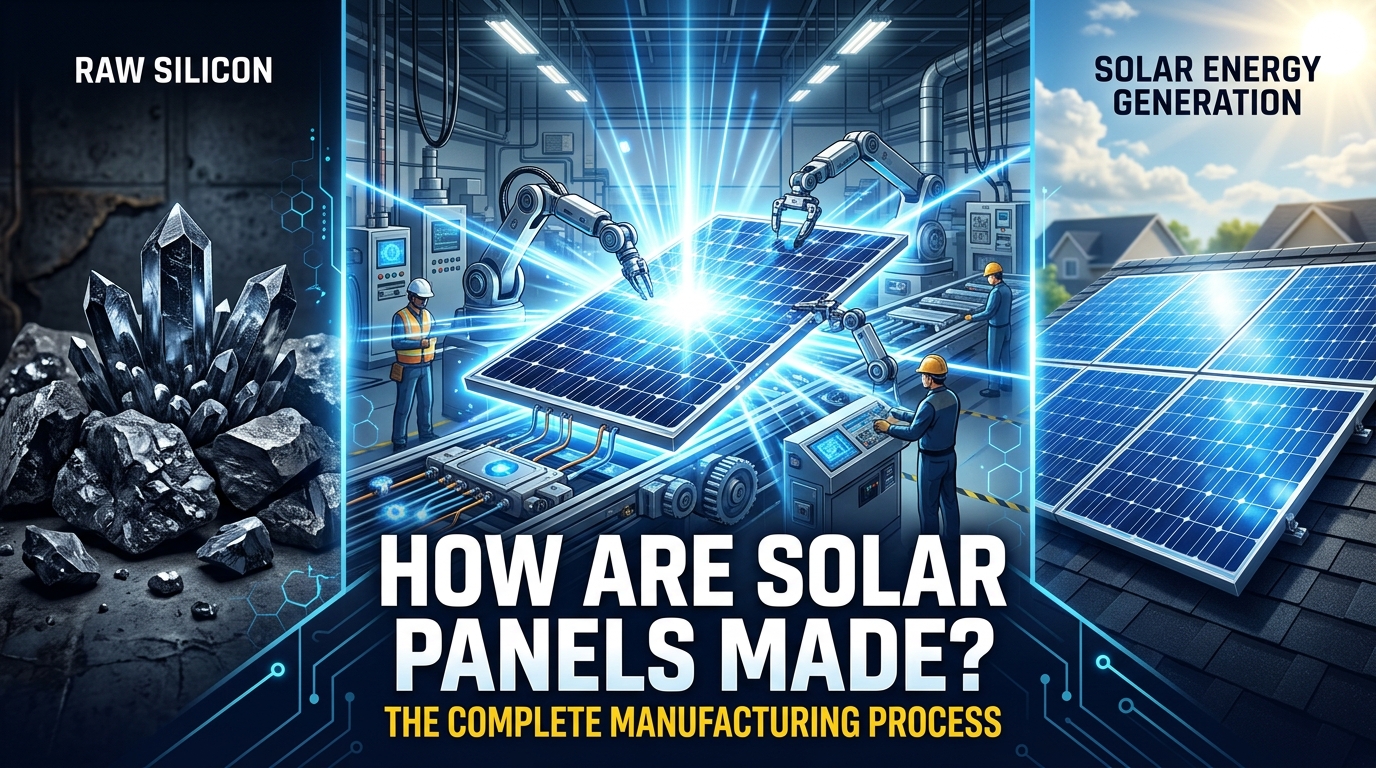
Solar panels have quietly transformed the way we think about energy. Whether they’re powering a remote cabin in the mountains or an entire neighborhood grid, these sleek blue rectangles are doing something remarkable: turning sunlight directly into electricity.
But how does that actually happen? How do you go from raw earth materials to a device that can power your home for 25+ years?
This guide walks you through the entire process — clearly, step by step — so you understand not just what solar panels do, but how they’re actually made.
What Are Solar Panels Made Of?
Before diving into manufacturing, it helps to understand what you’re working with. A standard solar panel is made up of several distinct layers, each with a specific job:
| Component | Material | Purpose |
|---|---|---|
| Solar Cells | Crystalline Silicon | Converts sunlight into electricity |
| Tempered Glass | Low-iron glass | Protects while allowing light through |
| Encapsulant | EVA (ethylene vinyl acetate) | Seals and protects cells |
| Backsheet | Polymer (typically Tedlar) | Rear protection layer |
| Frame | Anodized Aluminum | Structural support |
| Junction Box | Plastic + copper | Electrical connection point |
The real heart of the panel is the solar cell — and those cells are made almost entirely of silicon, the second most abundant element in Earth’s crust. According to the U.S. Department of Energy, when light hits a solar cell, it knocks electrons loose, creating the electrical current we call solar power.
Step 1: Extracting and Purifying Silicon
Everything starts in the ground.
Silicon doesn’t come out of the earth ready to use. It’s extracted from quartz (silicon dioxide) — essentially a very pure form of sand. The raw quartz is then processed in large arc furnaces at temperatures exceeding 1,800°C (3,272°F), where it’s reduced with carbon materials to produce metallurgical-grade silicon.
But metallurgical silicon still isn’t pure enough for solar cells. Solar panels require solar-grade silicon — a purity level of 99.9999% (called “six-nines” purity).
Achieving this involves a process called the Siemens process (or an alternative called the fluidized bed reactor method), where silicon is chemically purified into polysilicon — a grainy, glittering material that looks a bit like gravel.
The National Renewable Energy Laboratory (NREL) notes that the quality of this silicon directly impacts how efficiently the final panel converts sunlight into electricity.
Step 2: Growing Silicon Ingots
Once purified polysilicon is ready, it’s melted down again (yes, again) and grown into ingots — large cylindrical or rectangular blocks of crystalline silicon. This is where the two most common solar cell types diverge:
Monocrystalline Silicon (Mono-Si)
Molten silicon is grown into a single continuous crystal using the Czochralski method — a seed crystal is dipped into molten silicon and slowly pulled upward while rotating, forming a perfect cylindrical ingot.
This method produces the most efficient solar cells available today. Monocrystalline panels typically achieve efficiencies of 20–23%, meaning they convert more sunlight per square foot than any other type.
Polycrystalline Silicon (Poly-Si)
Rather than a single crystal, molten silicon is poured into square molds and allowed to cool and solidify into a block made of many silicon crystals. This is faster and cheaper but results in slightly lower efficiency — typically 15–18% — because electrons bump into the crystal boundaries.
Most modern installations favor monocrystalline due to falling price differences, but polycrystalline is still widely used, especially in utility-scale solar farms where cost-per-watt is the priority.
Step 3: Slicing Silicon Wafers
Once ingots are grown, they’re sliced into incredibly thin wafers — typically about 180 micrometers thick (roughly the width of two human hairs).
This slicing is done with multi-wire saws, where a single thin wire runs in parallel loops through the ingot while an abrasive slurry does the cutting. The precision required here is extraordinary — any inconsistency can crack a wafer or reduce cell efficiency.
After slicing, wafers are cleaned to remove any surface contamination from the cutting process. At this point, they look like thin, shiny squares or pseudo-squares (monocrystalline wafers are typically cut with slightly clipped corners to reduce waste when packing round ingots into square panel configurations).
Step 4: Turning Wafers into Solar Cells
This is the most chemically complex part of the process. A bare silicon wafer doesn’t generate electricity on its own — it needs to be turned into a photovoltaic (PV) cell through a series of treatments.
Texturing the Surface
First, wafers are etched with chemicals (typically sodium hydroxide or acid mixtures) to create a microscopically rough, pyramid-textured surface. This texture reduces light reflection — instead of bouncing off, photons are trapped and absorbed more effectively.
Without texturing, a silicon surface reflects about 35% of incoming light. After texturing, that drops to around 10% — a massive improvement in energy capture.
Creating the P-N Junction
This is the electrical heart of every solar cell.
Silicon by itself is a semiconductor — it doesn’t conduct electricity well on its own. To make it work, manufacturers introduce tiny amounts of other elements in a process called doping:
- The bottom layer (P-type) is doped with boron, creating a region with “holes” (positive charge carriers)
- The top layer (N-type) is doped with phosphorus using a process called diffusion, creating a region with extra electrons (negative charge carriers)
Where these two layers meet is the P-N junction — an electric field forms here that forces electrons freed by sunlight to flow in one direction. That directional flow of electrons is electricity.
According to Britannica, this photovoltaic effect was first observed by physicist Edmond Becquerel in 1839.
Applying Anti-Reflective Coating
Even after texturing, silicon still reflects too much light. A thin layer of silicon nitride is deposited on the surface using a process called plasma-enhanced chemical vapor deposition (PECVD). This coating gives solar cells their distinctive dark blue color and further reduces reflection to under 3%.
Screen Printing Metal Contacts
Now the cell needs a way to collect the electrons flowing through it.
Silver paste is screen-printed onto the front and back of the wafer in precise patterns — thin finger-like lines on the front (to collect electrons without blocking too much light) and a full contact on the back.
These contacts are then fired in a high-temperature furnace (around 800°C), which burns the paste through the anti-reflective coating and bonds it to the silicon.
The cell can now generate electricity. A single silicon solar cell produces about 0.5–0.6 volts — not much on its own, which is why dozens of them must be wired together.
Step 5: Testing Individual Solar Cells
Every solar cell is tested under a solar simulator — a light source calibrated to mimic real sunlight (defined as AM1.5 spectrum, 1000 W/m²). Sensors measure each cell’s:
- Open-circuit voltage
- Short-circuit current
- Maximum power output
- Efficiency percentage
Cells are sorted by performance in a process called binning. Manufacturers match cells of similar performance together so that a single underperforming cell doesn’t drag down the entire panel — a real problem because in a series circuit, the weakest cell limits the whole string.
Step 6: Assembling the Solar Panel
Now individual cells are assembled into a complete panel — the flat rectangle we recognize on rooftops.
Cell Stringing and Tabbing
Solar cells are connected in series using thin copper ribbons coated with solder. Stringing machines automatically solder cells together end-to-end to form rows (called strings). These strings are then connected in a matrix to reach the panel’s target voltage and current.
A typical 60-cell panel (now more commonly 72-cell or 144 half-cut cell designs) connects cells to produce around 30–40 volts.
Layering and Lamination
The strung cells are then sandwiched into a multi-layer “stack”:
- Tempered glass (front) — low-iron for maximum light transmission
- EVA encapsulant — a clear plastic that bonds everything together
- Solar cells — the strung matrix
- Another EVA layer — below the cells
- Backsheet — protects from moisture and UV on the rear
This stack goes into a laminator — a large vacuum oven that heats and presses everything together at around 150°C. The EVA melts and flows around every cell, completely sealing the assembly. Once cooled, the cells are permanently encapsulated and protected from weather.
Framing and Junction Box
A powder-coated aluminum frame is attached around the perimeter, adding structural rigidity and making the panel mountable. Attachment holes are pre-drilled in the frame.
On the back, a junction box is attached with weatherproof adhesive. This small plastic box contains bypass diodes — critical components that allow current to route around shaded cells so a single shaded cell doesn’t kill the whole panel’s output.
Cables with MC4 connectors (the industry standard) are attached to the junction box for easy, weatherproof electrical connections during installation.
Step 7: Final Testing and Certification
Before a panel ships, it undergoes rigorous testing — this is what separates reliable panels from cheap knock-offs.
Flash testing (STC test): Each panel is flashed with simulated sunlight and its output measured to verify it meets its power rating (e.g., 400W ± 3%).
Electroluminescence (EL) imaging: A current is passed through the panel in a dark room, making it glow. The glow pattern reveals any internal microcracks, broken fingers, or cell defects invisible to the naked eye.
Hi-pot (dielectric) testing: High voltage is applied between the circuit and the frame to test electrical insulation and safety.
Temperature cycle and humidity freeze testing: Panels are subjected to extreme temperature swings (−40°C to +85°C) and high humidity to simulate years of real-world exposure.
For a panel to be sold in the market, it must pass certification by independent labs under standards like IEC 61215 (photovoltaic module qualification) and UL 1703. These standards are overseen by organizations like UL Solutions and TÜV Rheinland.
Types of Solar Panels: Quick Comparison
| Type | Efficiency | Cost | Best For |
|---|---|---|---|
| Monocrystalline | 20–23% | Higher | Residential, limited space |
| Polycrystalline | 15–18% | Lower | Budget installs, large farms |
| Thin-Film (CIGS/CdTe) | 10–13% | Lowest | Flexible, portable, commercial |
Thin-film panels are worth a separate mention. Rather than silicon wafers, they’re made by depositing ultra-thin photovoltaic materials (like cadmium telluride or CIGS) onto glass or even flexible substrates. They’re less efficient but much lighter and can be applied to curved surfaces. First Solar is one of the largest manufacturers of CdTe thin-film panels.
A newer category — perovskite solar cells — is generating significant research excitement, with lab efficiencies exceeding 29% in tandem configurations. These could become the next generation of mainstream solar panels.
Expert Tips: What to Know When Buying Solar Panels
Understanding how panels are made also helps you make smarter buying decisions. Here’s what experts recommend paying attention to:
- Efficiency rating matters more in small spaces. If your roof is limited, monocrystalline’s higher efficiency squeezes more power from the same area.
- Temperature coefficient is underrated. Panels get hot in summer — a lower temperature coefficient (like −0.29%/°C) means less efficiency loss on hot days. This is listed on every spec sheet.
- Check the product warranty AND the performance warranty. Product warranties (typically 10–15 years) cover manufacturing defects. Performance warranties (25–30 years) guarantee the panel will still produce a certain percentage of its rated power.
- Manufacturer track record matters. A 25-year warranty is only as good as the company offering it. Stick with established manufacturers — SunPower, LG Solar, Panasonic, and Jinko Solar are consistently ranked at the top.
- Look for PID resistance. Potential Induced Degradation (PID) is a reliability issue — quality manufacturers engineer their cells to resist it.
The Environmental Cost of Making Solar Panels
No technology is without environmental cost, and solar panels are no exception. Manufacturing requires energy, water, and some hazardous chemicals.
The key metric is Energy Payback Time (EPBT) — how long a panel must operate to generate as much energy as was used to make it. According to NREL research, modern silicon panels have an EPBT of approximately 1 to 4 years, depending on the technology and where they’re manufactured.
Since most panels operate for 25–30 years, they generate 6–30 times more energy than it took to produce them — a strongly positive energy return.
Solar panel recycling is a growing challenge. Glass and aluminum are easily recyclable, but the silicon cells require more complex processing. The Solar Energy Industries Association (SEIA) has established a national recycling program, and several companies are now developing cost-effective processes to recover high-value silicon and silver from end-of-life panels.
FAQs: How Are Solar Panels Made
1. What raw material is used to make solar panels?
The primary material is silicon, derived from quartz sand. It’s purified to extreme purity levels before being grown into crystalline ingots that are sliced into wafers and turned into solar cells. Other materials include silver (for electrical contacts), aluminum (for frames), glass, and EVA plastic.
2. How long does it take to manufacture a solar panel?
The full manufacturing chain — from raw silicon to finished panel — typically takes several weeks when accounting for the entire supply chain. However, the final assembly stages (stringing, laminating, framing, testing) can be completed in a matter of hours on modern automated lines.
3. Are solar panels made with toxic materials?
Some thin-film panel types (like cadmium telluride) use materials classified as hazardous. Standard silicon panels use silver, which is valuable but not toxic. The manufacturing process does involve acids and chemicals that require proper handling, but the finished panel itself is generally considered safe.
4. Can solar panels be recycled at end of life?
Yes, though the industry is still developing efficient large-scale recycling infrastructure. Glass (about 75% of a panel by weight) and aluminum are easily recyclable. The Silicon Valley Toxics Coalition and the SEIA are among the groups pushing for stronger recycling standards.
5. Where are most solar panels manufactured?
As of 2024, China dominates global solar panel manufacturing, producing roughly 80% of the world’s solar panels, according to the International Energy Agency (IEA). This has prompted significant policy efforts in the United States and Europe to expand domestic manufacturing capacity through incentives like the Inflation Reduction Act.
Conclusion: From Grain of Sand to Gigawatts
Solar panels are one of humanity’s more remarkable industrial achievements — taking ordinary silicon and engineering it into devices that can silently harvest energy from the sun for decades.
The manufacturing process is sophisticated: purifying silicon to extraordinary levels, growing perfect crystals, slicing them wafer-thin, doping them with atoms, coating them, printing circuits on them, and sealing them in glass and plastic — all at industrial scale, all with enough precision to guarantee performance for 25+ years.
Understanding how solar panels are made gives you a deeper appreciation of what you’re actually putting on your roof (or investing in). It also helps you evaluate quality — knowing that a good panel starts with high-purity silicon, goes through rigorous testing, and comes from a manufacturer likely to be around in 25 years to honor a warranty.
The solar revolution isn’t just about clean energy — it’s a story of extraordinary manufacturing engineering that started with beach sand.
Ready to go solar? Use resources like EnergySage to compare quotes from certified installers, or check the SEIA’s guide to understand your options. And if you found this guide useful, share it with someone who’s curious about solar energy.

