
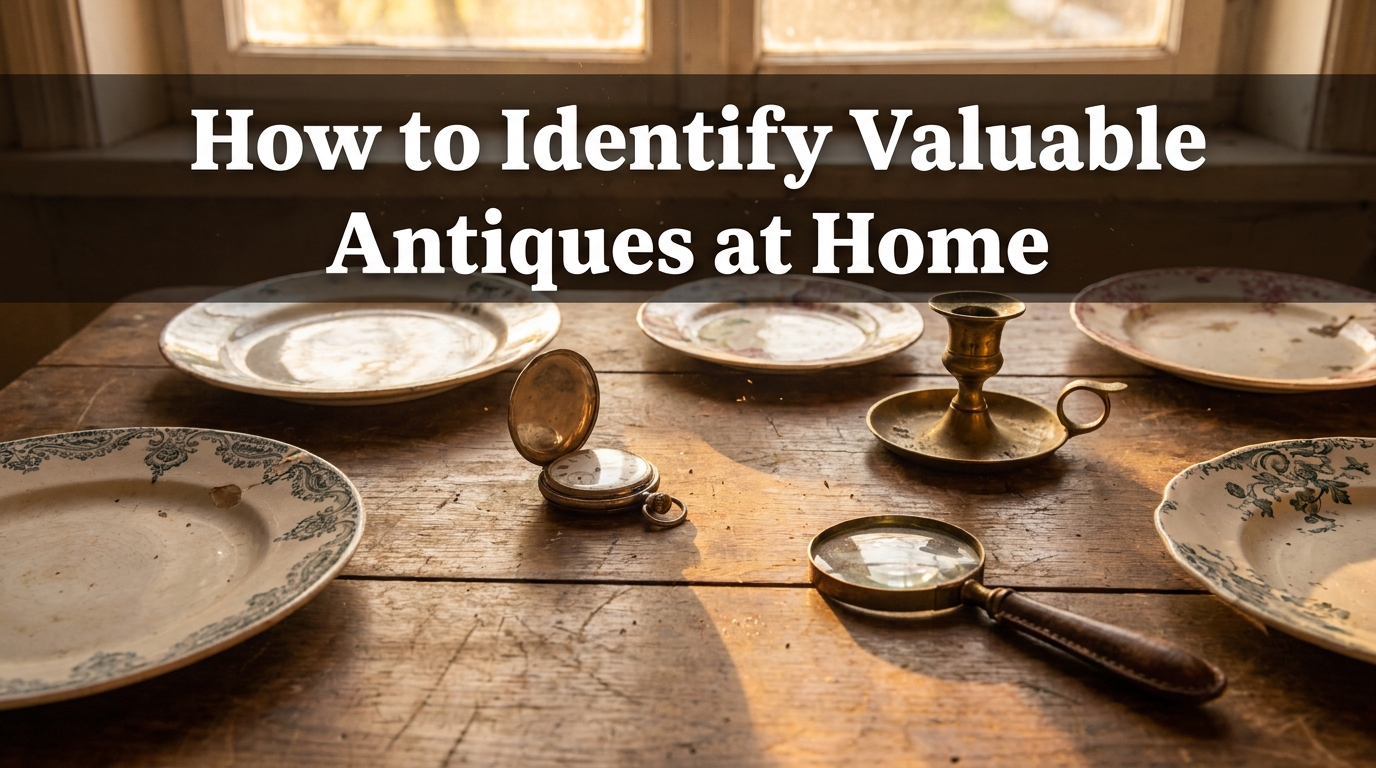
You’re cleaning out your grandmother’s attic and come across a dusty old cabinet full of mismatched dishes, strange figurines, and a few pieces of worn jewelry. Your first instinct might be to drop them at the nearest thrift store — but what if one of those items was worth hundreds or even thousands of dollars?
That exact scenario has played out countless times on shows like Antiques Roadshow, where ordinary families discover they’ve been unknowingly storing a small fortune. The truth is, valuable antiques are hiding in plain sight in homes across the country.
You don’t need to be an expert to start identifying them. You just need to know what to look for — and that’s exactly what this guide will teach you.
What Qualifies as an Antique?
Before you start hunting, it helps to understand the definition. According to U.S. Customs and Border Protection, an item must be at least 100 years old to be classified as a true antique. Items between 20 and 99 years old are generally called “vintage.”
This distinction matters — not just for legal reasons, but for value. True antiques often carry more collector interest, historical significance, and monetary worth.
That said, not every old item is valuable. Age alone doesn’t make something worth money. The real value comes from a combination of:
- Rarity — How many were made?
- Condition — Is it intact, restored, or damaged?
- Provenance — Where did it come from? Who owned it?
- Demand — Are collectors currently seeking it?
Understanding these factors is your first step to evaluating what’s sitting in your home.
Step 1: Start with a Visual Inspection
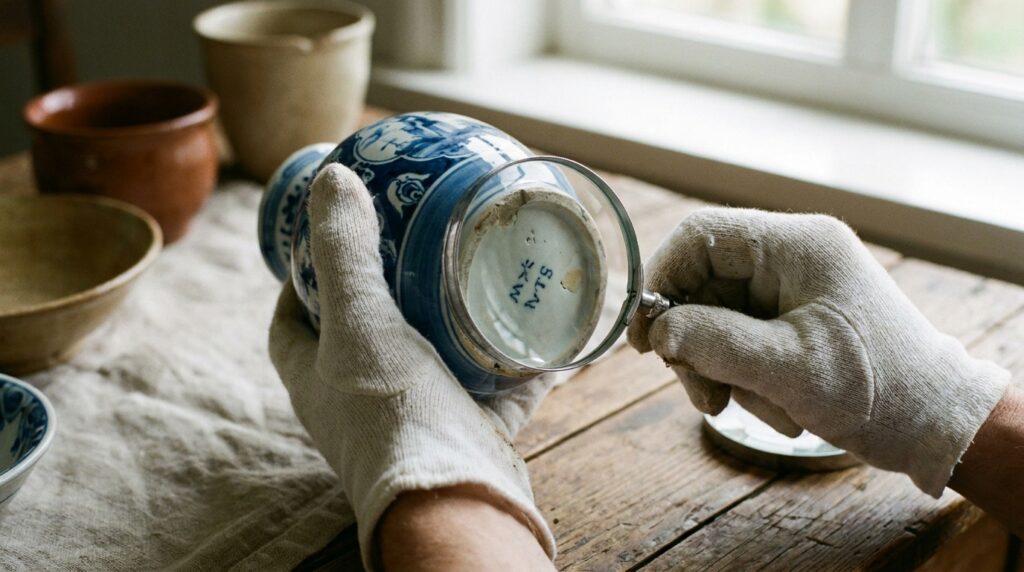
The first thing any seasoned antique dealer does is look — closely and carefully. Here’s how to do your own visual assessment:
Check the Overall Condition
Examine the item from every angle. Look for chips, cracks, missing pieces, repairs, or discoloration. Original, unrestored pieces in excellent condition are almost always worth more than repaired ones.
However, don’t be discouraged by imperfections. Some collectors prefer items with “honest wear” — signs of age that confirm authenticity.
Look for Signs of Handmade Craftsmanship
Mass production became widespread after the Industrial Revolution, roughly after 1760–1840. Items made before that era were crafted by hand, and you can often tell.
Look for:
- Slight asymmetry or irregularity in shape
- Tool marks or hand-stitching
- Uneven glazing on pottery
- Dovetail joints in furniture made by hand (slightly irregular spacing, not machine-perfect)
Examine the Back, Bottom, and Hidden Areas
The most revealing marks are usually hidden. Flip your item over. Look at the back of paintings, the underside of furniture, the base of ceramics. This is where makers’ marks, signatures, and stamps often live.
Step 2: Decode Maker’s Marks and Hallmarks
This is where real identification begins. Maker’s marks are essentially signatures left by craftspeople, manufacturers, and artisans. Learning to read them can transform a mystery object into a documented piece of history.
Silver and Precious Metals
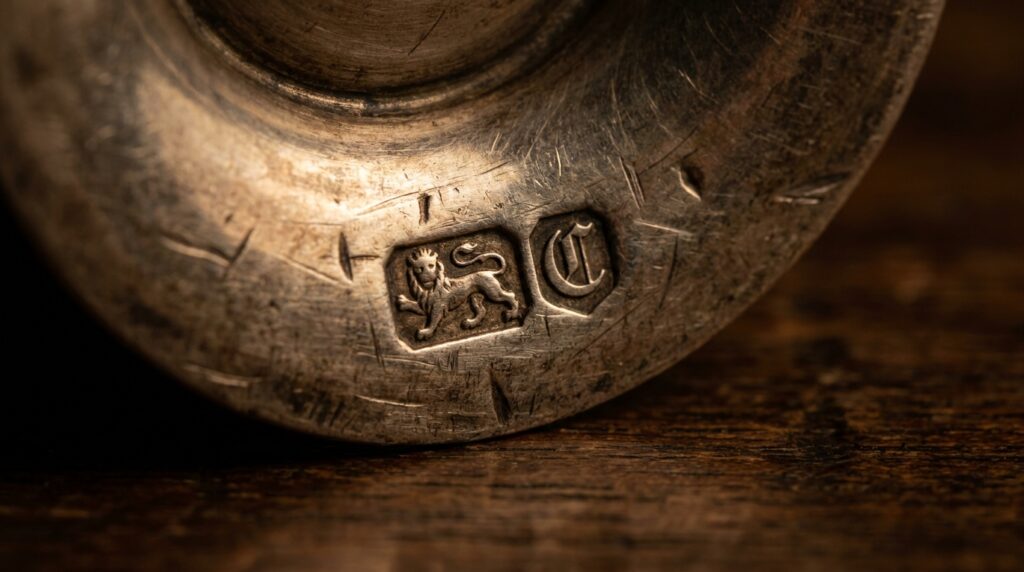
British silver uses a formal hallmarking system dating back to 1300. These tiny stamps include:
| Symbol | Meaning |
|---|---|
| Lion Passant | Sterling silver (92.5% pure) |
| Date Letter | Year of assay (changes annually) |
| Town Mark | Where it was tested (anchor = Birmingham, castle = Edinburgh) |
| Maker’s Mark | Initials of the silversmith |
For American silver, look for “925,” “Sterling,” or a maker’s name. Resources like Replacements, Ltd. maintain massive databases of silver patterns.
Ceramics and Porcelain
Pottery marks vary enormously. Key things to identify:
- Country of origin: Pieces marked “Made in Germany” date after 1887, when the McKinley Tariff Act required imports to be marked. “Germany” alone (without “Made in”) suggests pre-1914.
- Factory marks: Meissen’s crossed swords, Wedgwood’s impressed name, Royal Doulton’s lion and crown.
Use the Kovels’ marks database — one of the most trusted references in antique identification — to cross-reference what you find.
Furniture
Furniture rarely has formal marks, but you can look for:
- A cabinetmaker’s paper label (sometimes glued inside drawers)
- A brand or stamp burned or carved into a hidden surface
- Regional stylistic characteristics
Step 3: Identify the Era and Style
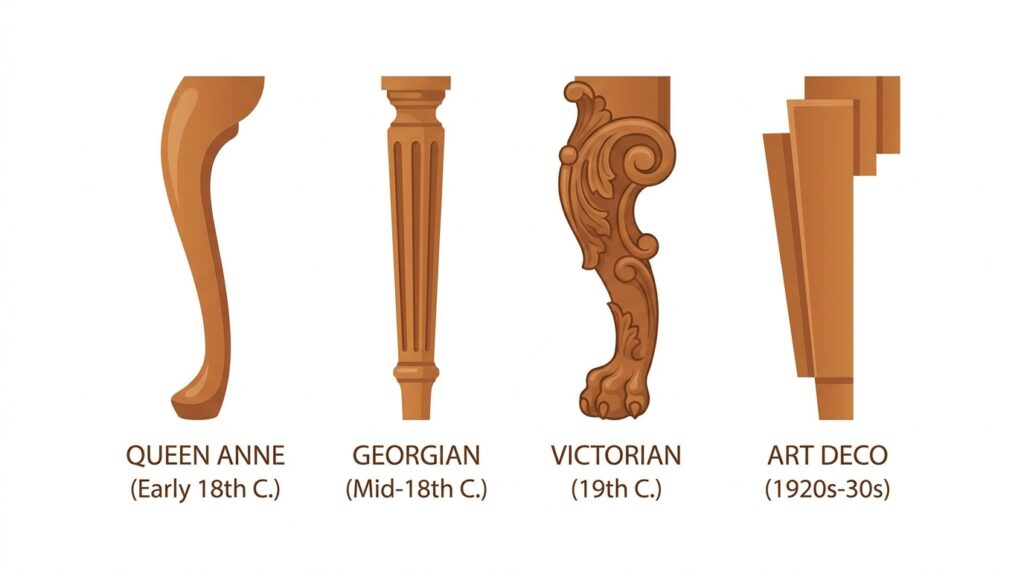
Style is one of the most powerful clues for dating an object. Each historical period had recognizable design trends.
A Quick Style Reference Guide
| Era | Approximate Dates | Key Characteristics |
|---|---|---|
| Queen Anne | 1700–1730 | Cabriole legs, walnut wood, curved lines |
| Georgian | 1714–1830 | Symmetry, mahogany, classical motifs |
| Victorian | 1837–1901 | Heavy ornamentation, dark woods, eclectic |
| Arts & Crafts | 1880–1920 | Simple forms, handcrafted look, oak |
| Art Nouveau | 1890–1910 | Nature-inspired curves, asymmetry |
| Art Deco | 1920–1940 | Geometric, bold colors, exotic materials |
| Mid-Century Modern | 1940–1970 | Clean lines, functional, organic shapes |
The Victoria and Albert Museum has an exceptional online resource for furniture styles across history.
Match the Style to the Construction
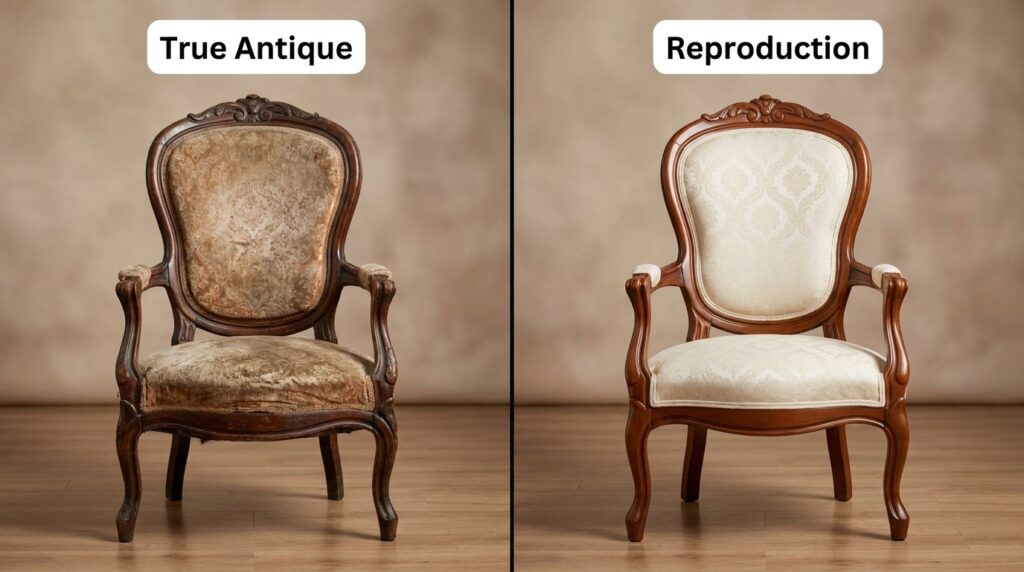
A “Victorian” chair should have construction methods consistent with the 1800s. If the joinery is done with modern screws or the wood has been stained with a synthetic finish, it may be a reproduction.
Step 4: Examine the Materials
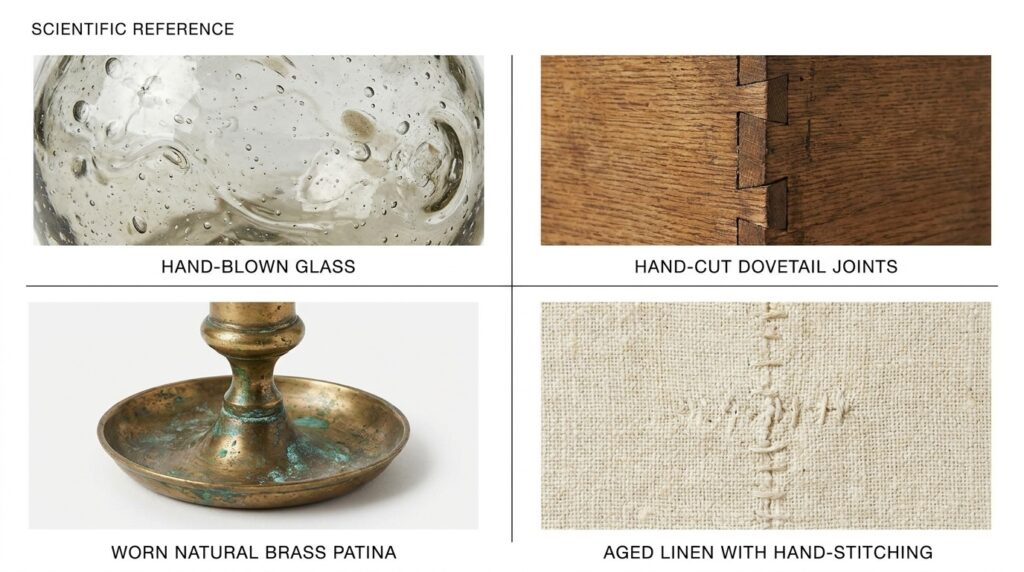
Materials tell a story that style alone cannot. Many synthetic materials simply didn’t exist before certain dates.
Wood
Old wood has a distinct look and smell. In antique furniture:
- Shrinkage and warping are natural in pre-20th century pieces
- Softwood backs and bottoms on formal furniture indicate earlier craftsmanship
- Hand-planed surfaces (visible in unfinished areas inside drawers) show tool marks in one direction, unlike machine-planed wood
- Wormholes can indicate age but can also be faked — look for tunnels going in inconsistent directions (natural) vs. uniform drilled holes (fake)
Glass
Early glass (pre-1900) is almost always imperfect. Look for:
- Bubbles or impurities trapped inside
- Slight thickness variations across the pane or piece
- A slight blue, green, or purple tint (from naturally occurring minerals)
Machine-made glass is perfectly uniform. If it’s flawless, it’s likely modern.
Metals
Old iron and steel rust in a natural, layered way that’s hard to fake. Brass and bronze develop a patina over decades — a greenish-brown layer that takes real time to develop. Chemical patina applied to new metals looks different: it’s more uniform and lacks depth.
Textiles
Vintage fabrics often contain natural fibers — wool, silk, linen, cotton. Synthetic fibers like polyester and nylon weren’t widely used until after the 1940s. The Textile Society of America offers resources for dating fabric types.
Step 5: Assess the Patina and Wear Patterns
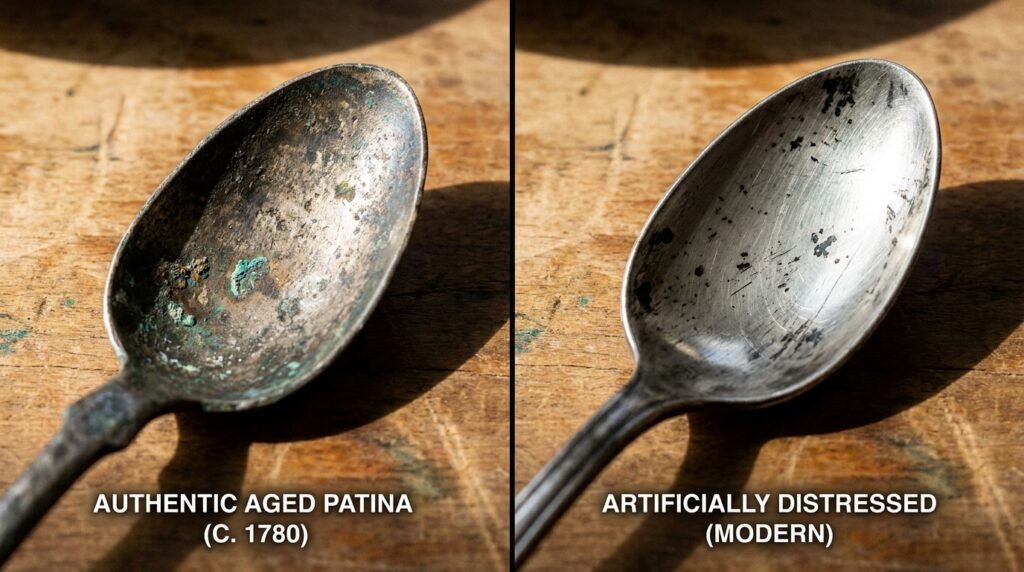
Patina is the natural aging of a surface over time — and it’s nearly impossible to perfectly fake.
What Authentic Aging Looks Like
- Wood furniture: Rounded corners from decades of handling, softened edges. The finish is usually worn in places people touched most — drawer pulls, armrests, seat edges.
- Metal objects: Wear is concentrated on high points — where fingers grabbed, where surfaces rubbed. The recesses stay darker.
- Ceramics: Fine crazing (a network of tiny cracks in the glaze) develops over decades. It should appear across the entire glaze, not just in selected areas.
What Fake Aging Looks Like
- Artificially “distressed” items often have worn areas in illogical spots
- Chemical patina is uniform — real patina is varied
- “Crackling” applied to new ceramics is often too uniform and too dramatic
A reputable guide on patina identification is available through Christie’s auction house.
Step 6: Research Provenance
Provenance is the documented history of an object — who made it, who owned it, and how it traveled through time. Good provenance can significantly increase an item’s value.
How to Research Provenance at Home
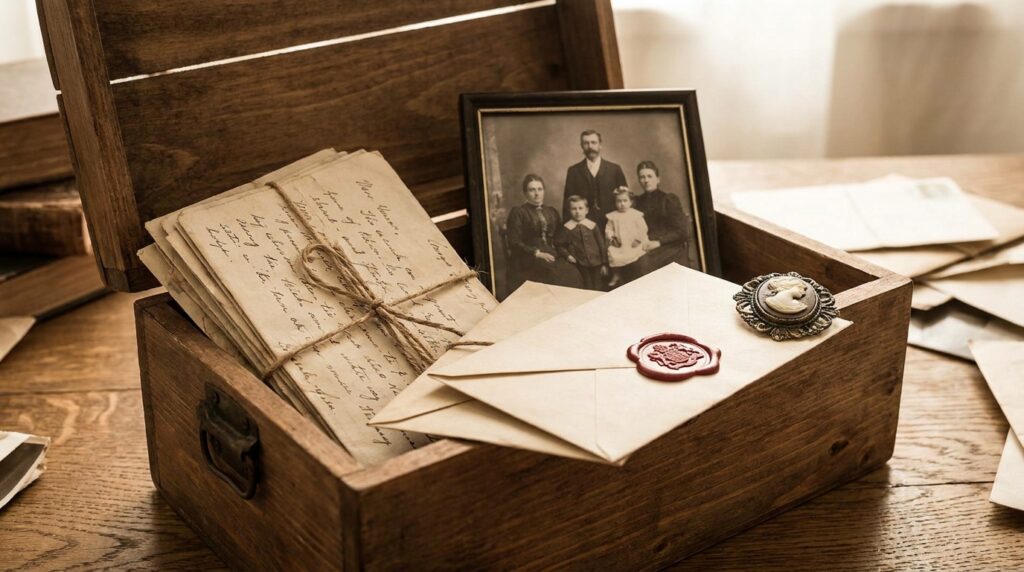
- Check family records. Letters, photographs, diaries, and estate documents can place an object in a specific time and place.
- Look for receipts or labels. Old price tags, auction stickers, or shop labels are gold. A sticker from a 1950s department store confirms pre-1960 origin.
- Search newspaper archives. Newspapers.com and Chronicling America (Library of Congress) let you search historical news for estate sales, collector exhibitions, and notable items.
- Check estate and probate records. Many historical estate inventories are archived at county courthouses or state historical societies.
Step 7: Use Online Databases and Tools

Technology has made antique research more accessible than ever. Here are the most reliable tools:
Free Online Resources
- Kovels.com — One of the most comprehensive databases of antique marks, prices, and identification guides. Trusted by dealers and collectors for decades.
- WorthPoint — Searchable archive of auction results. Paid subscription, but extremely valuable for price research.
- Google Lens — Take a photo of your item and let Google reverse-image-search it. Surprisingly useful for identifying patterns, figurines, and pottery.
- LiveAuctioneers — Browse past auction results to see comparable sales.
- eBay Sold Listings — Filter searches by “sold” to see real transaction prices, not just asking prices.
Specialized Databases
| Item Type | Best Resource |
|---|---|
| American pottery | Pottery & Porcelain Marks |
| Silver hallmarks | Online Encyclopedia of Silver Marks |
| Coins | PCGS CoinFacts |
| Stamps | Scott’s Catalogue via APS |
| Books | AbeBooks Rare Books |
Expert Tips: What Professionals Look For
Here’s what the professionals know that most beginners overlook:
Use a Black Light (UV Lamp)
A UV lamp reveals repairs and restorations invisible to the naked eye. New glue, filled cracks, and repainted areas fluoresce differently under UV light. Old, original finishes glow with a uniform warmth.
Weigh Metal Objects
Genuine silver and gold are dense and heavy. Plated items feel lighter. A simple kitchen scale can help flag potential impostors.
Check Drawer Construction Closely
In furniture, look at the inside of drawers. Hand-cut dovetails (pre-1860 roughly) are slightly irregular. Machine-cut dovetails (post-1860s) are perfectly uniform. Secondary woods (used inside the furniture, not visible) are also telling — craftsmen didn’t waste expensive woods on hidden parts.
Smell the Item
Old wood, old paper, and old textiles have distinctive scents. They smell of time — a mustiness that’s hard to replicate. Modern reproductions often smell of fresh wood stain, lacquer, or plastic.
Trust Asymmetry
Handmade objects are rarely perfectly symmetrical. If something looks too perfect, it was probably machine-made or is a modern reproduction.
Common Antique Categories Found at Home
Furniture
Antique furniture is one of the most commonly found valuable items. American Colonial, Federal, Victorian, and Arts & Crafts pieces are all actively collected. Condition, original hardware, and original finish matter enormously.
Ceramics and Porcelain
Look for pieces from recognized makers: Meissen, Wedgwood, Royal Doulton, McCoy, Roseville, Fiesta, and Hull. Depression-era glass in rare colors (pink, cobalt, amber) also commands strong prices.
Jewelry
Antique jewelry is evaluated on materials, craftsmanship, period style, and maker. Victorian mourning jewelry, Art Deco platinum pieces, and signed costume jewelry from houses like Miriam Haskell or Eisenberg can be surprisingly valuable.
Artwork
Original oil paintings, watercolors, and prints can be valuable even without a famous signature. Look for gallery stamps on the back, stretcher bar construction consistent with the claimed era, and canvas aging.
Books and Paper Ephemera
First editions, signed books, antique maps, original photographs, and historical documents can be highly collectible. The Antiquarian Booksellers’ Association of America offers guidance on evaluating rare books.
Coins and Currency
Old coins don’t need to be rare to be valuable — but rarity, grade, and mint marks all matter. The Professional Coin Grading Service (PCGS) sets the standard for coin evaluation.
When to Get a Professional Appraisal
There are times when your own research reaches its limits — and that’s perfectly fine. A professional appraisal is worth it when:
- You believe an item may be worth $500 or more
- You’re preparing to sell or insure the item
- You need documented value for an estate or tax purpose
- The item appears to be a significant historical piece
Finding a Qualified Appraiser
Avoid anyone who charges based on a percentage of the item’s value — that creates a conflict of interest. Look for appraisers certified by:
- American Society of Appraisers (ASA)
- Appraisers Association of America (AAA)
- International Society of Appraisers (ISA)
For informal assessments, local auction houses like Heritage Auctions often offer free appraisal days. Antique dealer associations in your state may also provide referrals.
Pros and Cons of DIY Antique Identification
| Pros | Cons |
|---|---|
| Free or low-cost to start | Easy to make costly misidentifications |
| Educational and rewarding | Fakes and reproductions are increasingly sophisticated |
| Access to online databases | Some items require hands-on expert assessment |
| Great for initial screening | No legal standing for insurance or estate purposes |
| Builds long-term expertise | Time-intensive for rare or obscure items |
FAQs: How to Identify Valuable Antiques at Home
1. How do I know if something is an antique or just old?
The standard definition of “antique” requires an item to be at least 100 years old. Items younger than that are typically “vintage.” Age can be established through maker’s marks, construction techniques, materials, and documented provenance. If you’re unsure, a certified appraiser can help confirm.
2. What’s the fastest way to identify a pottery or ceramic piece?
Start by looking for any marks on the base. Then cross-reference those marks on Kovels.com or use Google Lens to image-search the piece. Pattern databases at Replacements, Ltd. are also extremely helpful for identifying china patterns.
3. Can I tell if something is valuable just from eBay?
You can get a rough idea. Search for your item on eBay and filter by “Sold” listings — this shows what buyers actually paid, not just asking prices. Keep in mind condition, provenance, and rarity will affect your specific item’s value.
4. What household items are most likely to be valuable antiques?
Common high-value finds include: antique furniture with original finish, signed or marked silver, Victorian or Art Deco jewelry, early American pottery, first-edition books, Depression-era glassware in rare colors, and original oil paintings. Don’t overlook old toys, advertising items, and coins either.
5. How do I find an honest antique appraiser?
Look for appraisers certified by professional bodies like the American Society of Appraisers or the Appraisers Association of America. Avoid anyone who charges a percentage of the appraised value. Many auction houses also offer free informal appraisals.
Conclusion: Start Looking with Fresh Eyes
The truth is, most people walk past potential treasures every day without realizing it. That worn rocking chair in the corner, the mismatched plates in the china cabinet, the old pocket watch in a velvet box — any of these could be something special.
You now have a systematic approach: visually inspect for craftsmanship, decode maker’s marks, identify historical styles, evaluate materials and patina, research provenance, and use the powerful databases available online. That’s not beginner knowledge — that’s the same process experienced collectors use.
Start small. Pick one item in your home, apply these steps, and see where the research takes you. The hobby has a way of becoming addictive once that first discovery clicks into place.
And if you find something that genuinely excites you, don’t hesitate to seek a professional appraisal from a certified expert. One conversation could change what you thought was clutter into something worth preserving — or selling.
Ready to start hunting? Share what you find — and let your attic surprise you
This article is for educational purposes. Always consult a certified appraiser before making financial decisions based on antique valuations.

