
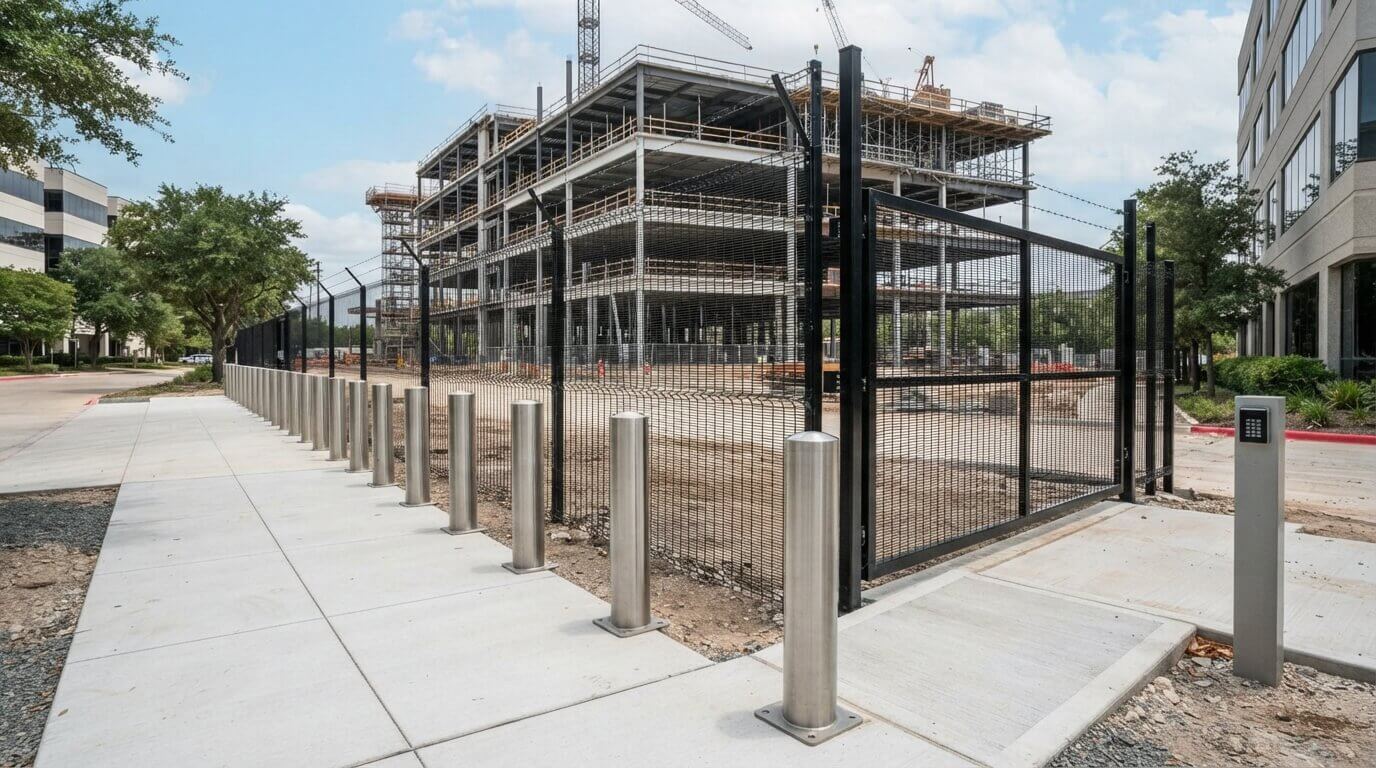
Physical security in commercial construction involves more than placing barriers around a property. It combines perimeter design, vehicle control, structural anchoring, site planning, pedestrian movement, and safe access to help reduce risks around commercial facilities, municipal centers, and industrial properties.
Modern commercial sites often need to remain accessible to employees, visitors, deliveries, and emergency services while also limiting unauthorized vehicle access. This makes perimeter protection an important part of site design rather than a separate feature added after construction. Whether protecting building entrances or organizing pedestrian traffic flow, perimeter planning should also account for commercial parking lot care, including drainage, markings, access routes, and pavement conditions.
Traditional approaches may rely on landscaping, fencing, or lightweight barriers, but locations exposed to vehicle traffic can require engineered systems designed to manage significant impact forces. The appropriate solution depends on the property’s layout, traffic patterns, access requirements, and applicable safety standards.
How Do Bollards Support Physical Security?
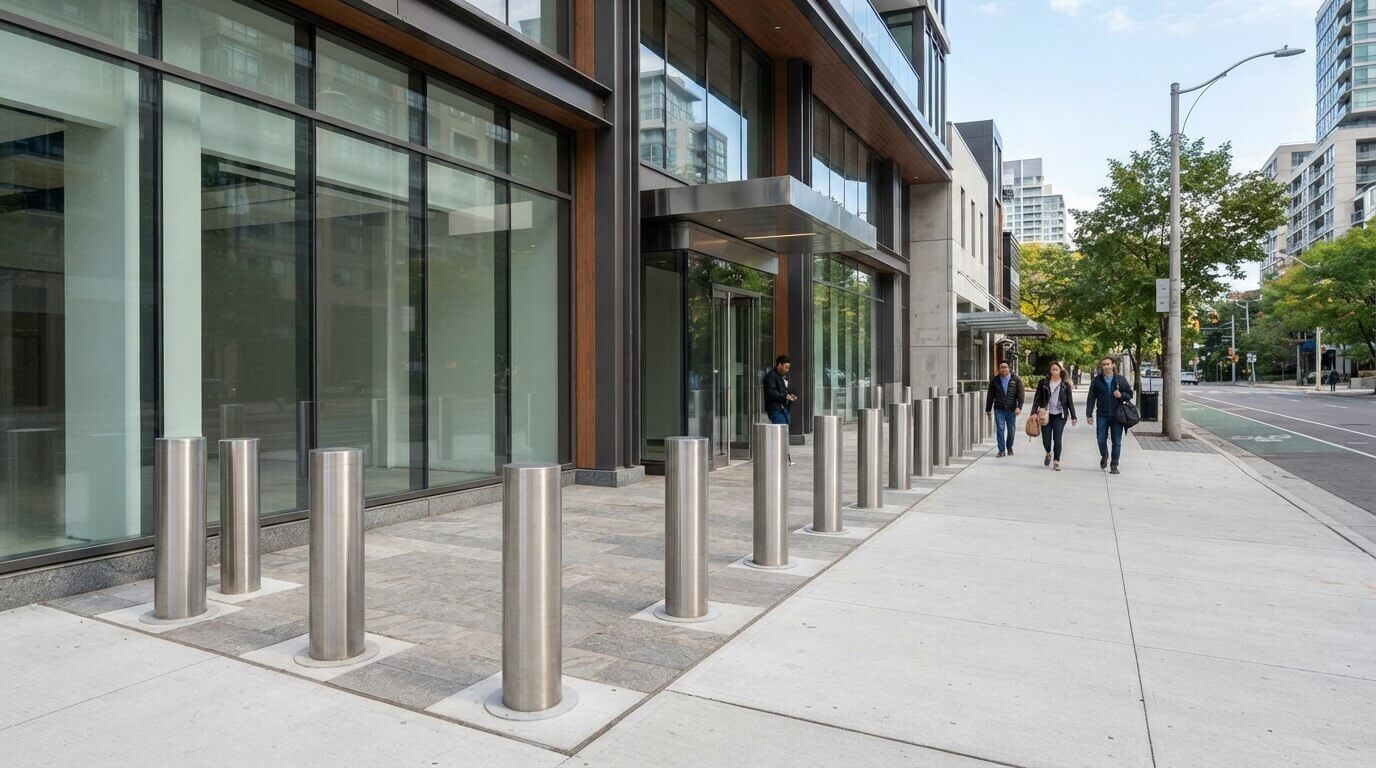
One of the most common perimeter protection systems is the bollard. These vertical barriers can be positioned along sidewalks, storefronts, building entrances, utility areas, and parking structures to help separate vehicles from pedestrian or building areas.
Bollard systems are available in several configurations. Crash-rated models are designed and tested for specific vehicle-impact conditions and may be used around facilities where vehicle intrusion is a concern. Other systems can be flexible, removable, or retractable when a property needs controlled vehicle access for deliveries, maintenance, or emergency services.
Selecting a bollard system requires more than considering its appearance. Site conditions, expected vehicle types, impact requirements, installation depth, foundation construction, and access needs can all affect which system is appropriate.
What Is Involved in Bollard Installation?
Installing specialized protective systems into existing reinforced concrete slabs or asphalt surfaces is a complex technical process, so pre-construction site planning can help identify existing site conditions before excavation begins.
The installation may involve core drilling, trenching, reinforcing steel, excavation, and high-strength concrete work around the bollard bases. The required depth and foundation design depend on the bollard system and the conditions specified by its manufacturer or project engineer.
Poor installation can reduce the effectiveness of an otherwise suitable barrier. Problems such as inadequate anchoring, incorrect foundation dimensions, or damage to the surrounding pavement can affect long-term performance.
Commercial projects may therefore use bollard installation contractors with equipment and experience suited to concrete cutting, drilling, excavation, and structural anchoring. The installation process should follow the applicable project specifications, manufacturer requirements, and local construction requirements.
Why Is Subsurface Utility Detection Important?
Excavation and core drilling can create significant risks when underground infrastructure has not been identified beforehand. Commercial slabs and paved areas may contain electrical conduits, gas lines, water pipes, communications infrastructure, rebar, and post-tensioning systems.
Damaging one of these systems can interrupt services, delay construction, increase repair costs, and create serious safety hazards. For this reason, subsurface investigation should be considered before drilling or excavation begins.
Ground Penetrating Radar (GPR) is one method used to investigate subsurface conditions without immediately breaking into the surface. The equipment sends electromagnetic signals into the ground and records reflections that can help technicians identify buried features.
GPR scans may help locate rebar, conduits, post-tension cables, and other subsurface structures. The information can then be used to identify safer areas for drilling or excavation. GPR does not replace appropriate utility-location procedures, engineering review, or other required site investigations, but it can provide useful information before concrete is disturbed.
How Can Perimeter Design Improve Site Access?
Physical security should account for how people and vehicles move through a property. A barrier that blocks unauthorized vehicles but also interferes with deliveries, emergency access, or pedestrian movement may create operational problems.
Access points should therefore be planned around the normal activities of the property. Delivery entrances, employee parking, visitor areas, emergency routes, loading zones, and pedestrian crossings may each require different arrangements.
Clear pavement markings and defined circulation routes can help drivers and pedestrians understand where they should travel. In commercial parking areas, maintaining visible markings and addressing drainage or pavement problems can also support safer daily movement.
Bollards can be positioned to create separation without necessarily making a property appear heavily fortified. Their spacing, height, material, and placement should be selected according to the specific site requirements.
Can Lighting Be Part of Physical Security?
Lighting can complement physical barriers by improving visibility around entrances, walkways, driveways, parking areas, and other perimeter locations. Exterior lighting can also help improve visibility around entrances, driveways, and other perimeter areas.
Lighting design should consider glare, shadows, coverage, energy use, maintenance, and the activities taking place around the property. Motion controls or scheduled lighting may be appropriate in some areas, while continuously illuminated spaces may be necessary where people regularly move through the property.
Lighting should not be treated as a replacement for physical barriers when vehicle impact protection is required. Instead, it can form part of a broader site-security approach that addresses visibility and movement alongside structural protection.
How Should Environmental and Workplace Risks Be Managed?
Physical security installations can create environmental and workplace concerns during construction. Core drilling and concrete sawing may generate slurry and respirable crystalline silica dust, while enclosed work areas can create additional ventilation concerns.
Work practices should be selected to control dust, water, debris, and equipment emissions. Wet cutting, slurry collection, appropriate ventilation, and suitable filtration equipment can help reduce exposure and keep work areas cleaner.
Equipment selection also matters when installation takes place inside parking structures, covered walkways, or other enclosed areas. Electric equipment can reduce combustion emissions in locations where engine exhaust could become a concern.
Construction teams should follow applicable workplace safety requirements and use the controls appropriate for the specific equipment and work environment.
What Should Be Considered Before Installing Perimeter Barriers?
Several factors can affect the design and installation of a commercial perimeter protection system:
- Vehicle exposure: Consider the types and volumes of vehicles operating near the protected area.
- Pedestrian movement: Maintain clear and accessible routes around barriers.
- Emergency access: Ensure required emergency routes remain usable.
- Subsurface conditions: Identify utilities, reinforcement, and other buried structures before drilling or excavation.
- Foundation requirements: Match the installation method to the bollard system and site conditions.
- Drainage: Avoid creating locations where water can collect around foundations or pedestrian routes.
- Visibility: Consider lighting, sightlines, signs, and pavement markings.
- Maintenance: Plan for inspection, cleaning, repairs, and replacement of damaged components.
- Local requirements: Check applicable building, construction, accessibility, and safety requirements before work begins.
A broader review of exterior improvements can also be useful when perimeter barriers are being incorporated into an existing property, particularly where pathways, lighting, and other exterior elements need to work together.
What Does a Complete Physical Security Approach Look Like?
A commercial perimeter does not depend on a single protective feature. Effective planning considers the relationship between barriers, building entrances, parking areas, pedestrian routes, lighting, underground utilities, drainage, and construction methods.
Bollards may provide a physical separation between vehicles and vulnerable areas, while pavement markings and site planning can help organize movement. Subsurface investigation can reduce the risk of damaging hidden infrastructure during installation, and appropriate work controls can address dust, slurry, ventilation, and other construction hazards.
The final design should reflect the actual conditions and operational requirements of the property rather than relying on a one-size-fits-all solution. Reviewing the site before installation can help identify potential conflicts and determine which protective measures are appropriate for the project.
Conclusion
Physical security in commercial construction involves coordinating structural barriers, site access, subsurface conditions, pedestrian movement, and construction safety. Bollards can provide an important layer of protection where vehicle access presents a risk, but their performance depends on appropriate selection, foundation design, and installation.
Careful site planning is equally important. Identifying underground utilities, reviewing traffic and pedestrian routes, considering drainage and lighting, and following applicable construction requirements can help create a perimeter that functions effectively without disrupting normal property operations.
When these factors are considered together, physical security becomes an integrated part of commercial site design rather than an isolated installation.

