
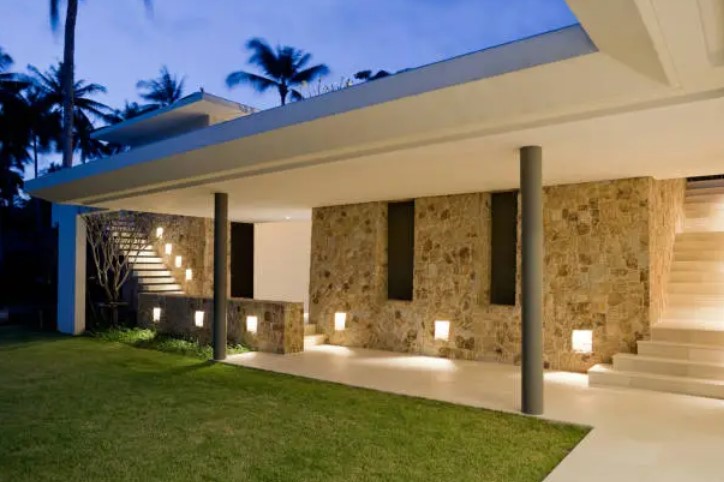
The Evolution of Residential Outdoor Lighting
For years, homeowners had to settle for flimsy, big-box store outdoor lights that barely survived a single harsh winter. The plastic housings would crack, and the bulbs would quickly dim. However, the landscaping world has shifted dramatically.
Today, the same robust engineering used in street and stadium lighting is being integrated into high-end residential design. Homeowners are realizing that investing in commercial-quality fixtures is a smarter, long-term choice.
For example, leading LED lighting manufacturers like WOSEN implement rigorous IP65 rating waterproof testing and 24-hour aging protocols for their commercial outdoor fixtures.
By adopting these industrial-grade standards, modern residential setups now offer vastly superior heat dissipation, ensuring your backyard lighting can last for decades without significant lumen depreciation.
Commercial-Grade vs. Standard Retail Lights: What’s the Difference?
When browsing the hardware store, standard retail lights often look similar to professional fixtures. However, the internal components and engineering tell a completely different story.
The primary difference lies in how the fixture handles prolonged use and harsh weather. Standard lights degrade rapidly, while commercial fixtures maintain their original brightness.
Here are the core technical differences you need to consider before making a purchase:
- Luminous Efficacy: Commercial LEDs provide higher lumens per watt, meaning they generate much brighter light while consuming less electricity.
- Heat Dissipation: Industrial-grade fixtures use heavy-duty aluminum heat sinks. Proper heat dissipation prevents the internal chips from frying, which is the #1 cause of LED failure.
- Weatherproofing: A true IP65 rating (or higher) ensures the fixture is completely sealed against dust and low-pressure water jets from any direction.
- Light Decay: Standard bulbs lose up to 30% of their brightness within a year. Commercial LEDs are engineered to maintain 90% of their brightness for over 50,000 hours.
Top 3 Areas to Upgrade Your Home’s Lighting
Driveways and Perimeter Security
The front of your home requires bright, reliable illumination to deter trespassers and ensure safe parking. Weak retail floodlights often fail to cover wide angles effectively.
- Upgrade Strategy: Install commercial LED floodlights with motion sensors above garage doors and side alleys.
- Optimal Specs: Look for a high output of 3000 to 5000 lumens to blanket the entire driveway in light.
- Color Temperature: Choose a crisp 5000K daylight CCT (Correlated Color Temperature), which produces maximum visibility for high-definition security cameras.
Backyard Patios and Landscape Accents
While the front yard prioritizes security, the backyard is all about creating a relaxing, inviting atmosphere. This becomes especially important when designing a custom swimming pool and its surrounding outdoor space. Harsh, blue-tinted lights can ruin the mood of an evening gathering.
- Upgrade Strategy: Use low-voltage LED spotlights to highlight trees, and wall sconces to illuminate patio seating areas softly.
- Optimal Specs: Focus on fixtures with superior color rendering (CRI > 80) to make the green foliage and wood decking pop.
- Color Temperature: Select a warm 2700K to 3000K CCT. This mimics the cozy, relaxing glow of traditional incandescent bulbs or firelight.
Eco-Friendly Solar Solutions
Wiring new outdoor lights across a large backyard can be expensive and destructive to your lawn. Modern solar lighting has evolved far beyond the dim pathway stakes of the past.
- Upgrade Strategy: Mount commercial-grade solar wall packs on fences or freestanding solar post lights along distant garden paths.
- Battery Technology: Ensure the fixture uses built-in Lithium Iron Phosphate (LiFePO4) batteries, which are safer and last significantly longer than standard lithium-ion.
- Efficiency: High-efficiency monocrystalline solar panels allow these fixtures to charge even on overcast winter days.
The Environmental Impact of High-Efficiency LEDs
Beyond improving your home’s curb appeal and nighttime security, transitioning to advanced outdoor lighting carries a profound ecological benefit.
Traditional incandescent and halogen bulbs are notorious energy wasters, converting more power into heat than actual light. This inefficiency places a massive, unnecessary burden on our power grids.
According to the U.S. Department of Energy, the widespread use of LEDs could save the equivalent annual electrical output of over 44 large power plants by 2027.
Upgrading your exterior fixtures isn’t just an aesthetic choice; it is a measurable step toward a sustainable, energy-efficient future. Higher luminous efficacy means a smaller carbon footprint for your household.
Key Takeaways
| Area | Key Takeaway | Impact/Data |
| Hardware Lifespan | Utilize aluminum heat sinks | Secures 50,000+ hours at 90% brightness |
| Durability | Require IP65+ weatherproofing | Prevents #1 failure cause (water/chip frying) |
| Security Setup | Install 5000K daylight floodlights | Delivers 3000-5000 lumens for HD cameras |
| Landscape Design | Deploy 2700K-3000K low-voltage fixtures | Achieves CRI > 80 for vivid foliage |
| Solar Infrastructure | Adopt monocrystalline panels with LiFePO4 | Guarantees charging even on overcast days |
Conclusion: Making the Smart Switch
Treating your home’s exterior lighting as a professional engineering project rather than a quick weekend fix pays massive dividends.
By prioritizing commercial-grade components, excellent heat dissipation, and proper IP ratings, you eliminate the frustration of constantly replacing burnt-out bulbs.
Whether you are illuminating a dark driveway or creating a cozy backyard oasis, make the smart switch to industrial-grade LEDs. It is an investment in your home’s safety, beauty, and environmental sustainability.

