
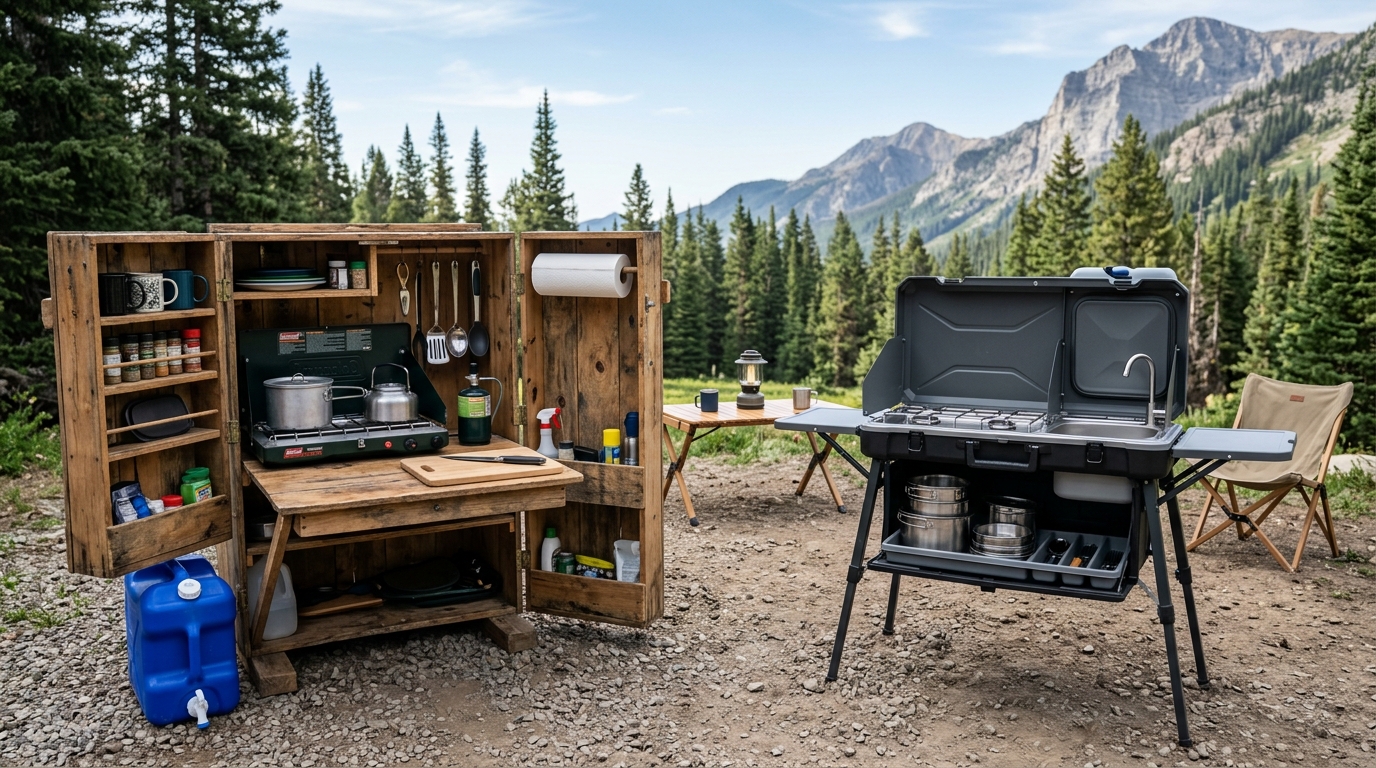
For many handy homeowners, a DIY camp kitchen starts with a classic garage project: a plywood box with hinged doors that opens into an outdoor cooking station. It’s satisfying to build and useful for years. The alternative is an all-in-one kitchen: a single weatherproof case with the stove, sink, water, and utensils already built in.
Both will feed a family outdoors. But they differ a lot in cost, time, durability, and how much space they take up in your garage. Here’s a practical side-by-side comparison to help you decide whether to build or buy.
What Each One Is
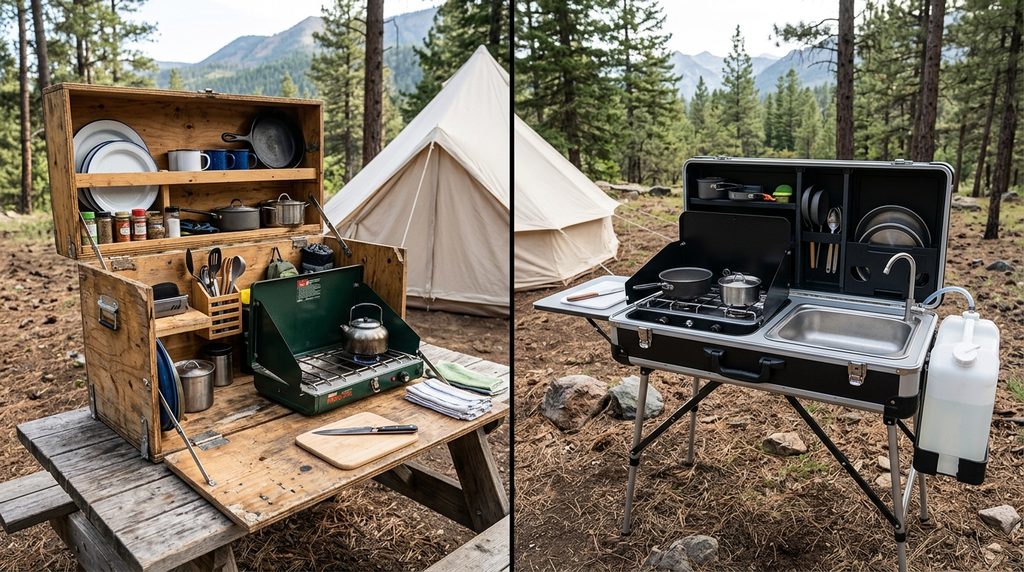
The DIY chuck box dates back to 1800s cattle drives. Today it’s usually a plywood box with a drop-down front that becomes a work surface, plus compartments sized for a stove, dishes, and staples. It organizes your gear, but it doesn’t include any. You still supply everything that goes inside.
The all-in-one kitchen is a complete cooking system in one case: stove, sink, faucet, water tank, utensils, cutting board, lighting, and many other items, all designed to fit and work together.
If You’re Building: What the Project Involves
A solid chuck box usually requires:
- Materials: Choosing the right type of plywood is important for a chuck box, especially when the finished box will spend time outdoors, so consider the grade, thickness, and moisture exposure before buying materials.
- Tools: A circular or table saw, a drill/driver, a jigsaw for handle cutouts, clamps, and a sander.
- Time: About 20–40 hours for most DIYers, including design, cutting, assembly, finishing, and fitting compartments to your gear.
- Materials cost: Roughly $50–$200, depending on plywood grade and hardware.
Build tips: measure your stove and largest pot before you design, seal every edge (end grain is where water gets in), use stainless hardware if you camp near the coast, and keep the loaded weight under what two people can comfortably lift.
Setup Time
A well-designed chuck box beats a pile of loose gear, and camping comfort can improve further when cooking equipment, tables, lighting, and other essentials stay organized and easy to reach. Expect 15–25 minutes per setup.
An all-in-one kitchen unlatches and opens with the stove mounted and the faucet already connected to the tank. Latching and lifting takes seconds, and filling water and connecting fuel takes another two to three minutes.
Over a three-day weekend, that difference can add up to about an hour a day.
Real Cost
The chuck box looks cheaper, but it’s only the container. A working kitchen also needs a stove ($80–$200), cookware ($60–$150), utensils and dishes ($40–$100), a water jug with a spigot ($30–$80), a basin ($20–$50), a folding table ($60–$150), and a light ($25–$60). The realistic total is $365–$1,190, plus your build time.
All-in-one kitchens range from about $700 to $1,500+, with everything included. The chuck box only comes out clearly cheaper if you already own most of the supporting gear.
Weight and Storage at Home
A loaded chuck box usually weighs 60–90 pounds. A loaded all-in-one case typically weighs 50–65 pounds and is shaped to fit vehicles and garage shelving.
The chuck box’s advantage is modularity: you can leave the table at home when space is tight. The all-in-one’s advantage is having a single storage spot. One case sits on one garage shelf, so anyone in the household can grab it.
Durability and Weather
Wood looks great but warps, rots, and splinters when it’s exposed to rain. A well-sealed marine-plywood chuck box can last 10–20 years with maintenance. A poorly sealed one may only last a few seasons.
Most all-in-one kitchens use food-grade LLDPE plastic or aluminum with rubber gaskets. They’re dustproof, weatherproof, and UV-resistant, and the only maintenance is a rinse.
Customization
The chuck box wins here. You can build it around your favorite stove, your grandfather’s cast iron, and your exact spice rack. An all-in-one reflects the manufacturer’s choices. For people who care about only two or three specific items, that standardization is usually a benefit.
Water and Cleanup
Adding running water to a chuck box is a second project: an external tank, a USB faucet, a mounted basin, and a graywater path. It works, but it doubles the parts list.
Integrated systems treat water as a core feature. An all-in-one camp kitchen includes a 2-gallon tank, a USB-rechargeable faucet, and a collapsible sink in the same case as the stove and 30+ items, so water and cleanup are handled without any extra plumbing work.
Which One Fits You?
Build a chuck box if you:
- enjoy woodworking and have the tools
- already own a stove, cookware, and water containers
- camp mostly in fair weather
- want a fully custom layout
- camp only once or twice a year
Choose an all-in-one if you:
- camp six or more weekends a year
- camp with kids, or need a fast setup
- camp in variable weather
- would need to buy most of the supporting gear anyway
- want running water without engineering it yourself
The Verdict
If the build is the point, and many homeowners enjoy it, a chuck box is a rewarding project and a practical piece of gear. If the goal is simply to cook outdoors often with as little friction as possible, the all-in-one approach usually wins on setup time, weather resistance, and built-in water. The best outdoor kitchen is the one you’ll actually load into the car.

