
If you’ve ever checked a clothing tag and wondered whether that “100% polyester” label is something to worry about, you’re not alone. So, is polyester bad for you? The honest answer is: not in the dramatic, throw-away-your-wardrobe sense, but it does come with a handful of real, evidence-backed concerns worth understanding, especially around skin sensitivity, sleep comfort, microplastic shedding, and certain chemical finishes. This guide breaks down what the research actually shows, separates solid evidence from overblown claims, and gives you practical ways to reduce any risk without panicking over every synthetic shirt in your closet.
Polyester itself, the base plastic fiber, is considered chemically stable and low-risk during normal wear. The bigger questions center on what gets added to it during manufacturing, how it behaves against your skin over long periods, and what happens to it once it’s washed, worn out, or thrown away. Let’s walk through each concern one at a time.
What Is Polyester, Made From, and Why Is It Everywhere?
Polyester is a synthetic fiber made primarily from polyethylene terephthalate, or PET, the same plastic used in water bottles. It’s produced through a chemical reaction between petroleum-derived ethylene glycol and terephthalic acid, then spun into long, smooth threads. Because it’s cheap, durable, wrinkle-resistant, and easy to dye, manufacturers use it in everything from t-shirts and activewear to bed sheets, curtains, upholstery, and carpets.
Roughly half of the clothing produced worldwide today contains polyester, and synthetic fibers now account for a majority of global textile production. That scale is exactly why questions about safety and environmental impact keep coming up. A fiber this common touches nearly everyone’s skin, sheets, and home textiles at some point, so it’s worth understanding what the science says rather than relying on guesswork.
Is Polyester Bad for You? The Short, Honest Answer
For most people, wearing polyester occasionally under normal conditions is not acutely dangerous. The solid fiber itself doesn’t easily leach chemicals into your skin the way a heated or liquid plastic might, and there is no strong evidence linking ordinary polyester clothing to serious illness in the general population.
That said, “not acutely dangerous” isn’t the same as “risk-free.” The legitimate concerns cluster around three areas: chemical finishes applied during manufacturing, including certain flame retardants, formaldehyde-based wrinkle treatments, and in some performance wear, PFAS coatings linked to reproductive and developmental health effects, reduced breathability that can trap heat, sweat, and bacteria against the skin, and the steady shedding of microplastic fibers into water, air, and eventually your own body. None of these make polyester an emergency, but they do make it worth being selective about where and how often you wear it, particularly for items that sit against your skin for hours at a time.
Is Polyester Bad for Your Skin?
This is one of the most common complaints, and it has a reasonable explanation. Polyester doesn’t absorb moisture the way cotton does, so sweat stays trapped against your skin instead of evaporating. That warm, damp environment can encourage bacterial and fungal growth, which is part of why some people notice more breakouts, rashes, or body odor after wearing synthetic fabrics for long stretches, especially during exercise or in hot weather.
People with eczema, psoriasis, or generally sensitive skin tend to react more noticeably to polyester. The friction from a less breathable fabric combined with trapped heat can trigger or worsen contact irritation in susceptible individuals. Chemical finishes applied to some polyester garments, such as dyes, formaldehyde-based anti-wrinkle treatments, or antimicrobial coatings, can also act as irritants or allergens for a subset of wearers, even though the base polyester fiber itself is generally considered non-allergenic.
What tends to help:
- Choose polyester blends with natural fibers (cotton or modal) for anything worn close to skin all day
- Wash new garments before wearing to remove residual finishing chemicals
- Reserve pure polyester for outerwear, activewear you wash promptly, or occasional use rather than daily basics
- If you already know you have sensitive skin or eczema, patch-test new synthetic garments before wearing them extensively
Is Polyester Bad for You to Sleep On?
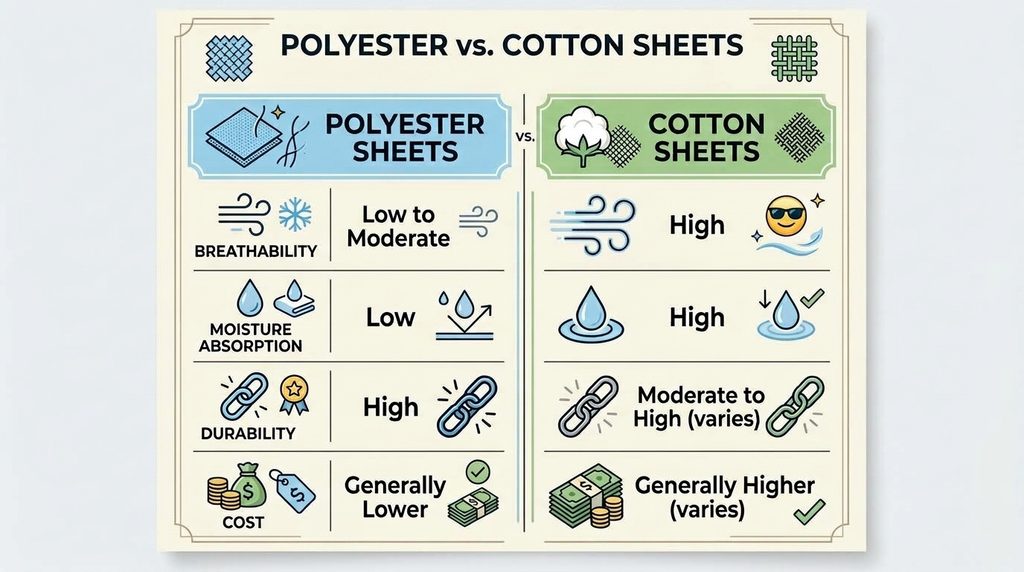
Bedding is one place where breathability matters most, since you spend roughly a third of your life in contact with your sheets. Polyester sheets and pillowcases are less breathable than cotton because the fiber lacks the microscopic hollow structure that lets cotton absorb and release moisture. Cotton can absorb a large share of its own weight in water and lets air circulate, while polyester tends to trap both heat and sweat against the skin overnight.
For hot sleepers or anyone prone to night sweats, this difference is noticeable. Polyester sheets can feel warmer and slightly “clammy” compared to breathable percale cotton or linen. If you’re evaluating how to choose a mattress and bedding that actually support restful sleep, fabric breathability is just as important as mattress firmness, since overheating is one of the most common reasons people wake up during the night.
That doesn’t mean polyester bedding is unsafe. Microfiber polyester sheets are affordable, wrinkle-resistant, and hold up well to frequent washing, which makes them practical for kids’ rooms, guest beds, or anyone on a budget. If you do sleep hot, look for polyester blended with more breathable fibers, or consider cooling blanket technology designed specifically to manage heat and moisture overnight as a middle-ground solution.
| Feature | Polyester Sheets | Cotton Sheets |
|---|---|---|
| Breathability | Low, traps heat | High, allows airflow |
| Moisture absorption | Under 1% of weight | 24 to 27% of weight |
| Cost | Lower | Moderate to high |
| Durability | Very durable, resists wrinkles | Softens over time, less wrinkle-resistant |
| Best for | Budget shoppers, low-maintenance care | Hot sleepers, sensitive skin |
Is Polyester Clothing Bad for You in Everyday Wear?
Outside of sleepwear and underwear, most people wear polyester clothing without any noticeable issue. Jackets, workwear, athletic gear, and outerwear benefit from polyester’s durability, quick-drying properties, and resistance to shrinking, and casual exposure to a finished polyester garment is very different from the concentrated occupational exposure seen in textile manufacturing settings.
The context that matters most is how close the fabric sits to skin and for how long. Underwear, sports bras, leggings, and base layers worn for hours in hot, sweaty conditions create more friction and moisture than a polyester jacket worn over a cotton shirt. That’s also where chemical finishes, if present, have the most direct and prolonged skin contact.
Common mistakes people make with polyester clothing:
- Wearing tight, non-breathable polyester activewear for hours without changing out of sweaty gear afterward
- Assuming “moisture-wicking” means the same thing as “breathable” (it doesn’t; moisture-wicking fabric can still trap heat)
- Skipping the first wash on new synthetic garments, which can leave finishing chemicals and manufacturing residue on the fabric
- Choosing 100% polyester for humid climates or high-intensity workouts instead of a natural-fiber blend
If you’re building a more practical, durable wardrobe generally, it’s worth reading about utility clothing designed around function and durable fabric choices, since many of the same principles around breathable, purpose-built materials apply.
Is Polyester Bad for You Because of Microplastics?
This is where the science is clearest and, frankly, the most concerning. Polyester is a plastic, and like all plastics, it sheds microscopic fragments over its lifetime. Every time you wash a polyester garment, the friction of the washing machine releases thousands of tiny plastic fibers into the wastewater. Research has estimated that a single load of polyester laundry can release hundreds of thousands of microfibers, and washing one polyester shirt regularly can shed tens of thousands of fibers annually.
These fibers are small enough to pass through many wastewater treatment systems and end up in rivers, oceans, soil, and eventually the food chain. Synthetic textile laundering is now recognized as one of the largest sources of primary microplastic pollution reaching the world’s oceans. Microplastics have since been detected in human blood, lungs, and other tissues, and scientists are still working to understand the long-term health implications of that exposure, though the environmental pathway is well documented.
What actually reduces microfiber shedding:
- Wash polyester items in cold water on a gentle cycle, which reduces fiber breakage
- Use a washing bag or filter designed to capture microfibers before they enter wastewater
- Wash full loads rather than small ones, since less friction occurs per garment
- Air dry when possible, since tumble drying also releases fibers into indoor air and lint traps
Is Polyester Bad for the Environment?
Beyond microplastics, polyester’s environmental footprint starts before it ever reaches a store shelf. Producing polyester requires significant amounts of crude oil, and unlike cotton or wool, it does not biodegrade. A polyester garment sent to a landfill can persist for centuries, essentially functioning the same way a plastic bottle would.
The rise of “recycled polyester,” made from recycled plastic bottles, is often marketed as a sustainable fix, but recent laboratory research has found that recycled polyester fibers can actually shed more microplastic particles than virgin polyester during washing, because the recycling process makes the fibers more brittle. That doesn’t mean recycled polyester is worse across every measure. It does reduce demand for new petroleum extraction, but it does not solve the microfiber shedding problem on its own.
If sustainability matters to you when shopping, look past the word “recycled” alone and consider the fabric’s overall lifecycle, including how often you’ll actually wear and wash the item.
Is Polyester Bad for Your Hair?
Hair-related concerns usually come up around pillowcases and headwear rather than clothing broadly. Polyester pillowcases create more friction against hair strands than smoother materials like satin or silk, which can contribute to tangling, frizz, and breakage over time, particularly for people with curly, textured, or chemically treated hair. The fabric can also absorb moisture from hair overnight rather than letting it stay hydrated, which may leave strands drier by morning.
This is a comfort and hair-texture issue rather than a health hazard. Switching to a satin or silk pillowcase, or a smoother-finish polyester blend, is a simple fix if you notice more tangling or frizz after sleeping on standard polyester bedding. Scalp irritation from polyester is uncommon but can occur in people who are already prone to contact dermatitis, usually from friction and trapped heat rather than the fiber itself.
Is Polyester Bad for Fertility or Testosterone?
This is one of the more debated questions, and it deserves a careful, non-alarmist answer. The concern traces back to older research on scrotal temperature and sperm production, since the testes function best when kept slightly cooler than core body temperature. A widely cited animal study found that dogs wearing polyester underpants for an extended period showed a significant drop in sperm production compared to those wearing cotton, though notably, testosterone levels themselves did not change significantly in that study.
Human research on this topic is more limited and mixed. Some studies on underwear type and scrotal temperature have found no meaningful difference between fabric types, while a small, older human study on tight polyester athletic supports worn continuously for many months did find temporary, reversible reductions in sperm production. More recent reviews have concluded that fit and tightness likely matter more than fabric type alone, and that no large-scale human study has directly compared polyester and cotton underwear on real-world fertility outcomes.
The practical takeaway: there’s currently no strong evidence that polyester clothing lowers testosterone, but there is a plausible, partially supported connection between tight, non-breathable synthetic underwear and temporary reductions in sperm quality through heat retention rather than hormonal disruption. If fertility is an active concern for you, choosing looser-fitting, breathable underwear made from cotton or a cotton blend is a reasonable, low-cost precaution while the research continues to develop.
Polyester vs. Natural Fibers: A Practical Comparison
| Factor | Polyester | Cotton | Wool |
|---|---|---|---|
| Breathability | Low | High | Moderate to high |
| Moisture-wicking | Yes (surface only) | Absorbs moisture | Absorbs and regulates |
| Biodegradable | No | Yes | Yes |
| Durability | Very high | Moderate | High |
| Cost | Low | Moderate | High |
| Best use | Outerwear, structured items | Sleepwear, underwear, sheets | Cold-weather layers |
When Polyester Is Actually a Fine Choice
It’s easy to come away from this topic thinking polyester should be avoided entirely, but that’s not what the evidence supports. Polyester is a reasonable, even practical, choice in several situations:
- Outerwear and structured garments that don’t sit directly against skin for long periods
- Budget-friendly bedding for guest rooms or growing kids, where durability and easy care matter more than premium breathability
- Rain gear and technical outdoor wear, where water resistance is the priority
- Upholstery and curtains, where skin contact is minimal to none
The concerns intensify specifically for high-contact, high-moisture uses like underwear, sportswear, sleepwear, and daily bedding, which is exactly why those categories are worth being more selective about.
Common Myths About Polyester
It’s worth clearing up a few claims that circulate online but aren’t well supported by evidence.
Myth: Polyester causes cancer just by wearing it. There is no established causal link between everyday polyester clothing and cancer development in wearers. Some chemical finishes applied to certain textiles have raised concern, but that’s different from the base fiber itself being carcinogenic through normal clothing contact.
Myth: All polyester contains PFAS. PFAS “forever chemical” coatings are mainly used in specific performance and water-resistant textiles, not standard polyester garments across the board. Checking for “water-resistant,” “stain-resistant,” or “odor-resistant” labeling is a more useful indicator than the fiber content alone.
Myth: Polyester will definitely tank your testosterone. As covered above, current research does not support a direct hormonal effect from wearing polyester clothing in typical, everyday conditions.
Frequently Asked Questions
Is polyester bad for you to sleep on every night?
Sleeping on polyester sheets occasionally or long-term isn’t unsafe, but it can make you sleep hotter and sweatier due to poor breathability. If you tend to overheat at night or have sensitive skin, breathable cotton or a cotton-polyester blend is generally more comfortable for regular use.
Is polyester bad for skin with eczema or psoriasis?
People with eczema or psoriasis often find polyester more irritating than natural fibers because it traps heat and moisture against inflamed skin. Choosing soft, breathable cotton or bamboo-blend fabrics for daily wear tends to reduce flare-ups for sensitive skin conditions.
Is polyester bad for the environment compared to cotton?
Polyester is not biodegradable and sheds microplastics throughout its life, while conventionally grown cotton uses more water and pesticides during cultivation. Both fabrics carry environmental trade-offs, so the more sustainable choice often depends on how the garment is produced, used, and cared for over its lifetime.
Is polyester clothing bad for you if I only wear it occasionally?
Occasional wear of polyester clothing is very low-risk for most people. Concerns mainly apply to prolonged, tight, or high-sweat contact, such as daily activewear or underwear worn for extended periods.
Is polyester bad for you microplastics-wise, and can I reduce my exposure?
Polyester clothing does shed microplastic fibers, especially during washing, which contributes to environmental pollution and potential exposure over time. Washing in cold water, using a microfiber-catching laundry bag, and air-drying can meaningfully reduce the number of fibers released.
Is polyester bad for testosterone specifically?
There is no strong scientific evidence that wearing polyester clothing directly lowers testosterone levels. Some limited research suggests tight, non-breathable synthetic underwear may affect sperm production through heat retention, but this appears unrelated to hormone levels.
Is polyester bad for your hair if used in pillowcases?
Polyester pillowcases can increase friction on hair strands, leading to more tangling, frizz, or breakage compared to smoother fabrics like satin. This is a texture and hair-care issue rather than a health risk, and it’s easily addressed by switching pillowcase materials.
Can polyester cause allergic reactions?
The base polyester fiber rarely causes true allergic reactions, but chemical finishes, dyes, or resins applied during manufacturing can trigger contact dermatitis in sensitive individuals. Washing new garments before wearing them can help remove some of these residues.
Final Thoughts and Next Steps
So, is polyester bad for you? Not inherently, but it’s not a fabric to use without any thought either. The strongest, best-supported concerns are reduced breathability that can affect sleep and skin comfort, chemical finishes in certain performance and water-resistant items, and ongoing microplastic shedding that matters more for the environment than for any single wearer’s immediate health. The fertility and hormone claims circulating online are the least supported by current research, while the skin, sleep, and environmental concerns have real evidence behind them.
The most practical approach is selective use: save polyester for outerwear, budget items, and technical gear where its durability shines, and lean toward breathable natural fibers for anything worn against your skin for hours at a time, especially bedding, underwear, and daily basics. Small changes, like washing new synthetics before wearing them, choosing looser-fitting underwear, or upgrading your bedding to a more breathable option, go a long way without requiring a full wardrobe overhaul. If better sleep is part of your goal, start by looking at your mattress and sheet materials together, since the two work as a system for temperature regulation through the night.

