
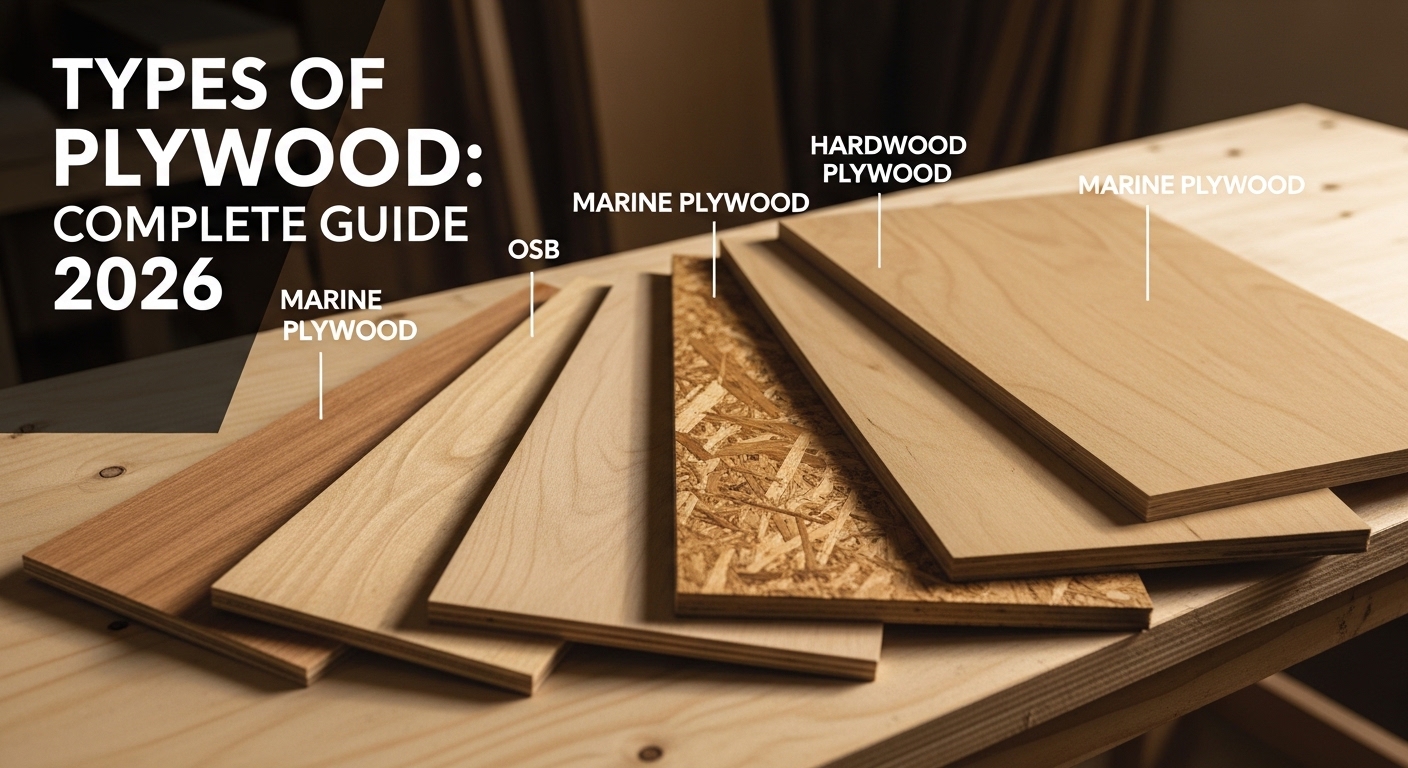
Walk into any lumber yard or big-box hardware store and you’ll immediately face a wall of flat brown panels stacked floor to ceiling. Half of them look the same. The labels are confusing. And the guy in the orange vest is three aisles away helping someone else.
Sound familiar?
Here’s the thing: buying the wrong plywood can cost you real money. Use interior plywood outdoors and it swells and delaminates within a season. Pick the wrong grade for a furniture top and you’ll sand forever trying to get a smooth finish. Choose undersized sheathing and you’ll fail a building inspection.
This guide cuts through all of it. Whether you’re building a deck, finishing a basement, crafting a dining table, or just patching a subfloor — you’ll finish this article knowing exactly which plywood you need and why.
Let’s start at the beginning.
What Is Plywood, and Why Does It Matter?
Plywood is an engineered wood panel made by bonding thin layers of wood veneer (called “plies”) together with adhesive, with each layer’s grain running perpendicular to the one above and below it. This cross-grain construction is the reason plywood is so strong relative to its weight — it resists warping, cracking, and splitting in ways that solid lumber simply can’t match.
According to the APA – The Engineered Wood Association, plywood has been a staple of American construction since the early 20th century, and today it remains one of the most widely used structural panel products in the U.S.
The perpendicular grain alignment distributes stress evenly across the panel, which is why a ¾-inch plywood sheet can often outperform a solid board of the same thickness under load.
The 4 Main Types of Plywood (And What Sets Them Apart)
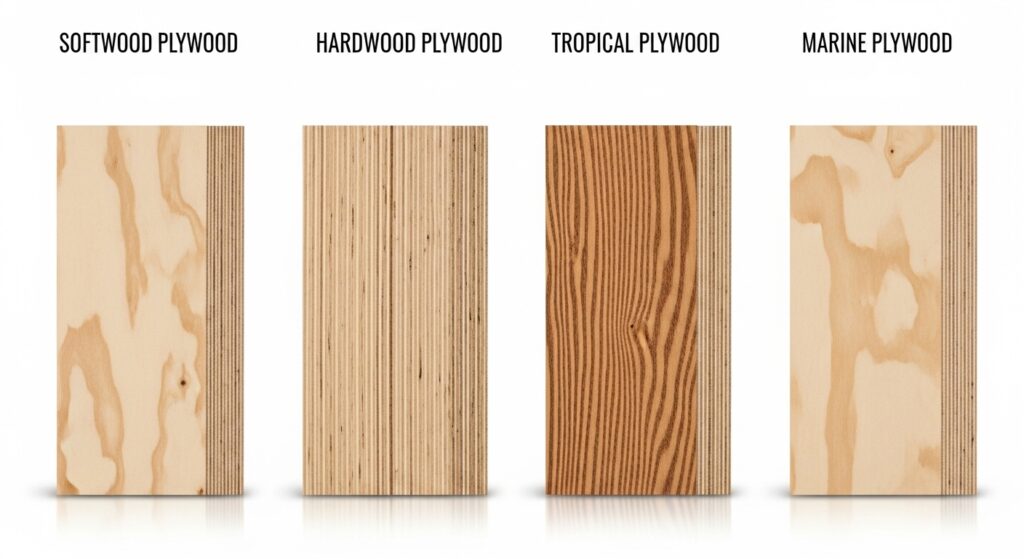
People often ask: “What are the 4 types of plywood?” The answer depends on how you classify them. The most practical way is by wood species category and intended use. Here’s the breakdown:
1. Softwood Plywood
Softwood plywood is made from coniferous trees like Douglas fir, Southern yellow pine, and spruce. It’s the most commonly available type in the United States and the one you’ll find stacked 30 sheets deep at your local Home Depot or Lowe’s.
It’s durable, affordable, and strong — which makes it the go-to choice for structural applications like wall sheathing, roof decking, and subfloors.
Common uses: roof sheathing, wall sheathing, subfloors, concrete forming, temporary structures
Pros:
- Widely available and affordable
- Strong across a range of structural applications
- Available in large panel sizes
Cons:
- Rough surface grain — not ideal for painting or finishing
- Not naturally attractive (visible knots)
2. Hardwood Plywood
Hardwood plywood uses a hardwood veneer face (like oak, maple, birch, cherry, or walnut) over a core of either hardwood or a combination material. The face veneer is what you see, and it’s typically sanded smooth.
This is the plywood cabinet makers, furniture builders, and finish carpenters reach for.
Common uses: cabinetry, furniture, interior paneling, shelving, decorative applications
Pros:
- Beautiful, smooth finish-ready surface
- Wide variety of face species available
- Takes stain and paint exceptionally well
Cons:
- More expensive than softwood
- May require special ordering for some species
3. Tropical Plywood
Tropical plywood is manufactured in Southeast Asia and South America using tropical hardwood species. It’s exported to the U.S. in substantial quantities and is known for its dense, uniform core and high strength.
Common uses: formwork, scaffolding, export packaging, heavy-duty applications
Pros:
- Very high strength and density
- Uniform core structure
Cons:
- Sustainability concerns — look for FSC-certified options
- Quality can vary significantly by manufacturer
4. Marine Plywood
Marine plywood is built for one purpose: surviving wet environments. It’s manufactured using waterproof adhesive (typically phenol-formaldehyde resin), a void-free core, and high-quality face veneers — usually okume or Douglas fir — all meeting strict standards like BS 1088.
Common uses: boat building, docks, outdoor furniture, wet area installations
Pros:
- Superior moisture resistance
- Void-free core prevents water infiltration
- Extremely strong and durable
Cons:
- Significantly more expensive
- Overkill for most interior projects
Different Types of Plywood by Construction and Core Material
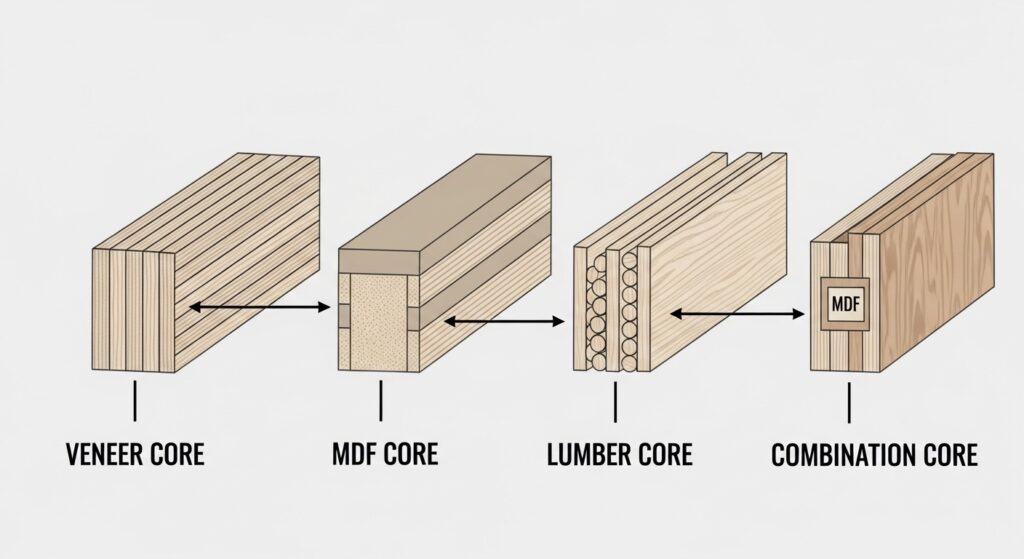
The face veneer is what you see. The core is what determines how the panel performs. And this distinction matters more than most beginners realize.
Veneer Core Plywood
The most traditional construction. Multiple layers of thin wood veneer are glued together, alternating grain direction. Veneer core panels are lightweight, strong, and hold fasteners (screws, nails, staples) better than most alternatives.
Best for: structural applications, cabinets, furniture where weight matters
MDF Core Plywood
An MDF (medium-density fiberboard) center is sandwiched between face veneers. The result is a very flat, very smooth panel that’s ideal for painted finishes or vacuum-pressing veneers.
The trade-off: it’s heavy and doesn’t hold screws at the edges as well as veneer core.
Best for: painted cabinet doors, flat panel work, veneering projects
Lumber Core Plywood
A solid wood core (usually basswood or poplar strips) is used instead of veneer layers, with face veneers on either side. This gives excellent screw-holding ability and a smooth face.
Best for: tabletops, doors, heavy shelving, projects where screws need to go into the edge
Combination Core Plywood
Combines veneer core construction with an MDF crossband immediately beneath the face veneer. This gives you the flatness of MDF with more of the weight and fastener performance of veneer core.
Best for: high-end cabinetry and furniture where both flatness and strength matter
Plywood Types and Grades: What the Letters and Numbers Actually Mean
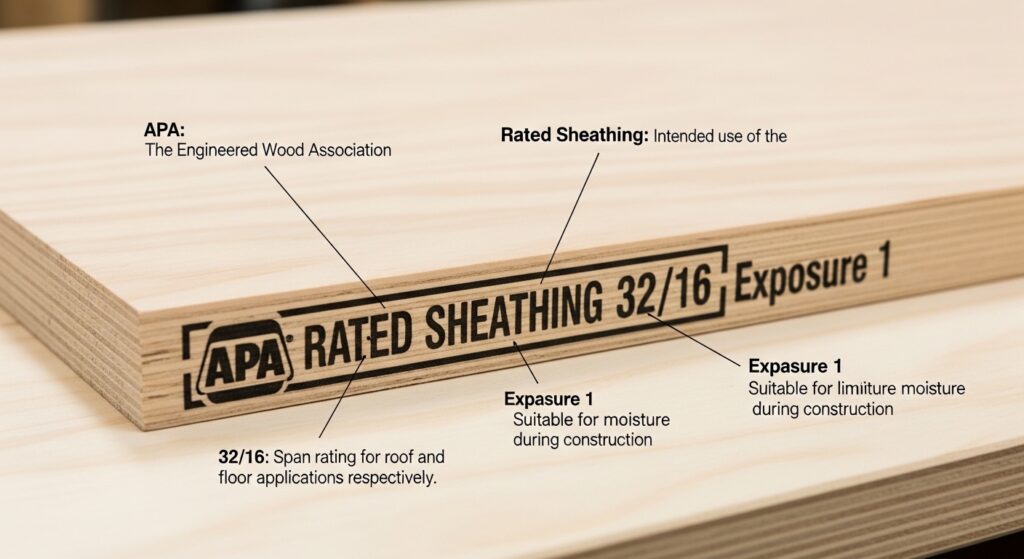
This is where most people’s eyes glaze over — but understanding plywood grades is the single most useful skill you can have when shopping for sheets. The grading system describes the quality of the face and back veneer surfaces.
Face and Back Veneer Grades (A through D)
The APA grading system uses letter grades to describe the quality of each side:
| Grade | Description | Best Use |
|---|---|---|
| A | Smooth, paintable surface; minor repairs allowed | Cabinets, furniture, visible surfaces |
| B | Solid surface; minor splits, patches allowed | Cabinet backs, underlayment |
| C | Knotholes up to 1 inch; some splits allowed | Structural, hidden applications |
| D | Larger knots and defects allowed | Interior structural only |
A panel graded A-C has a Grade A face (the “good side”) and a Grade C back. C-D is typical for sheathing where neither face is visible.
Structural (Exposure) Ratings
Beyond letter grades, plywood panels carry an exposure rating that tells you how they handle moisture:
- Exterior: Fully waterproof glue bond; designed for permanent outdoor exposure
- Exposure 1: Waterproof glue, but face veneer species may not be moisture-resistant; suited for protected construction
- Exposure 2: Some moisture resistance; for protected interior conditions
- Interior: Interior use only, no significant moisture tolerance
Span Rating (for Structural Panels)
Sheathing panels carry a span rating like 32/16. The first number is the maximum rafter spacing (in inches) when used as roof sheathing. The second is the maximum joist spacing when used as subfloor sheathing.
“Sanded” vs. “Unsanded” Panels
- Sanded panels (like A-C or B-C) have smooth, finish-ready surfaces
- Unsanded panels (like C-D or OSB) are for structural applications where aesthetics don’t matter
Types of Plywood Used in Construction
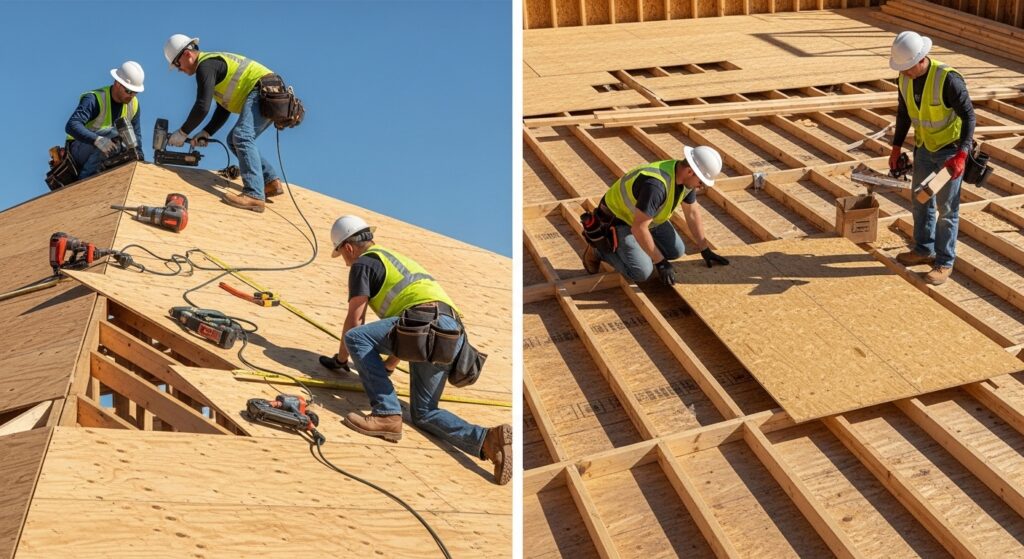
Construction-grade plywood is the backbone of American residential and commercial building. Here are the most common types you’ll encounter on a job site:
Sheathing Plywood (Wall and Roof)
Sheathing panels are rated by the APA as Rated Sheathing and carry a span rating. They’re typically C-D Exposure 1 — strong, affordable, and built to survive the construction process before the exterior cladding goes on.
Wall sheathing is nailed to studs and serves as a structural diaphragm, while roof sheathing spans between rafters to form the base for roofing material.
Standard size: 4×8 feet, ⅜” to ¾” thickness Common species: Southern yellow pine, Douglas fir
Subfloor Plywood
Subfloor panels get nailed or screwed directly to the floor joists and serve as the base for finished flooring — tile, hardwood, carpet, or vinyl. They’re typically Rated Sturd-I-Floor panels, which combine subfloor and underlayment into a single panel.
According to the National Wood Flooring Association, a minimum of 23/32″ (≈ ¾”) is recommended for subfloors over joists spaced 16 inches on center.
Concrete Form Plywood (Plyform)
Plyform is a specialized construction plywood designed to be used as molds for poured concrete. It has a smooth, sealed surface (often with a resin overlay) that releases from cured concrete cleanly and can typically be reused multiple times.
Common types:
- Class I Plyform: Made from denser species, suitable for heavier concrete pressures
- Structural I Plyform: For very high concrete pressures and engineered applications
- HDO/MDO (High/Medium Density Overlay): Resin-impregnated paper overlay for extra-smooth surfaces and extended reuse life
OSB vs. Plywood: The Construction Debate
Oriented Strand Board (OSB) is technically not plywood — it’s made from compressed wood strands, not veneer plies — but it’s widely used in the same structural applications and often compared directly to plywood.
| Feature | Plywood | OSB |
|---|---|---|
| Cost | Higher | Lower |
| Weight | Lighter | Heavier |
| Edge swell (moisture) | Less | More |
| Screw holding (face) | Good | Good |
| Screw holding (edge) | Better | Fair |
| Availability | Wide | Very wide |
For most structural sheathing applications, OSB is a perfectly acceptable — and cheaper — alternative. However, in areas with high moisture exposure, many builders prefer plywood for its superior edge performance.
Types of Plywood for Furniture and Interior Use
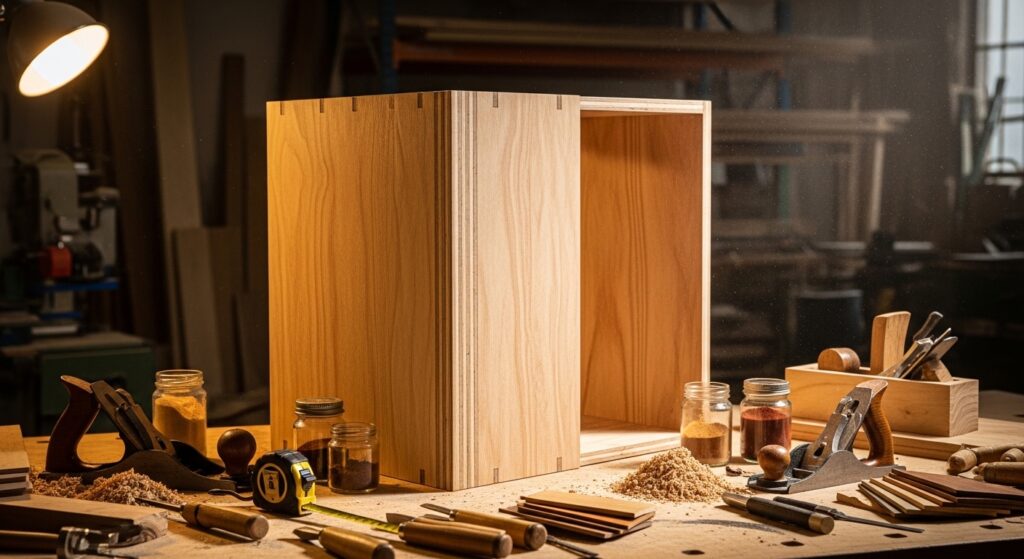
If you’re building furniture, shelving, cabinets, or anything that will live inside your home and be seen up close, your plywood choices are very different from construction applications.
Baltic Birch Plywood
Baltic birch is the darling of furniture makers and woodworkers — and for good reason. Imported from Russia and the Baltic states (Finland, Latvia, Estonia), it’s manufactured with more plies than standard plywood (typically 13 plies in a ¾” sheet), using birch veneer throughout — not just on the face.
The result is an incredibly strong, stable, and visually attractive panel. The edge shows those multiple thin plies, which many woodworkers leave exposed as a design feature.
Key specs:
- Typically sold in 5×5 foot sheets (not 4×8)
- Void-free core
- Available in thicknesses from 3mm to 24mm (metric sizing)
Best for: cabinetry, drawer boxes, shop fixtures, speaker enclosures, furniture
Cabinet Grade Plywood (Hardwood Plywood)
Cabinet-grade panels have a hardwood face veneer — typically maple, birch, oak, cherry, or walnut — and are sanded smooth on the face side. The core is often veneer core, MDF core, or combination core depending on the manufacturer and price point.
The Hardwood Plywood and Veneer Association (HPVA) sets the grading standards for these panels, with grades ranging from AA (premium) to E (economy).
Common face species in the U.S.:
- Maple: Bright, light-colored, takes stain evenly — ideal for kitchen cabinets
- Oak (red and white): Prominent grain, very popular for traditional furniture
- Birch: Similar to maple, slightly warmer tone, very smooth
- Cherry: Rich reddish-brown tone, darkens beautifully with age
- Walnut: Dark, dramatic grain — premium pricing
Furniture Plywood: Choosing the Right Core
| Core Type | Flatness | Weight | Screw Holding (Face) | Screw Holding (Edge) |
|---|---|---|---|---|
| Veneer Core | Good | Light | Excellent | Excellent |
| MDF Core | Excellent | Heavy | Good | Poor |
| Lumber Core | Very Good | Medium | Good | Excellent |
| Combination | Excellent | Medium-Heavy | Good | Good |
For most furniture and cabinetry, a veneer core hardwood plywood panel is the best balance. If you’re painting and want zero grain telegraphing through the paint, MDF core is worth the weight penalty.
Birch Plywood (Domestic)
Not to be confused with Baltic birch, domestic birch plywood from U.S. manufacturers is graded like standard hardwood plywood (A-B, A-C, etc.) and is more widely available in 4×8 sheets. It’s a solid, affordable choice for painted cabinets and interior shelving.
Types of Exterior Plywood: What to Use Outdoors
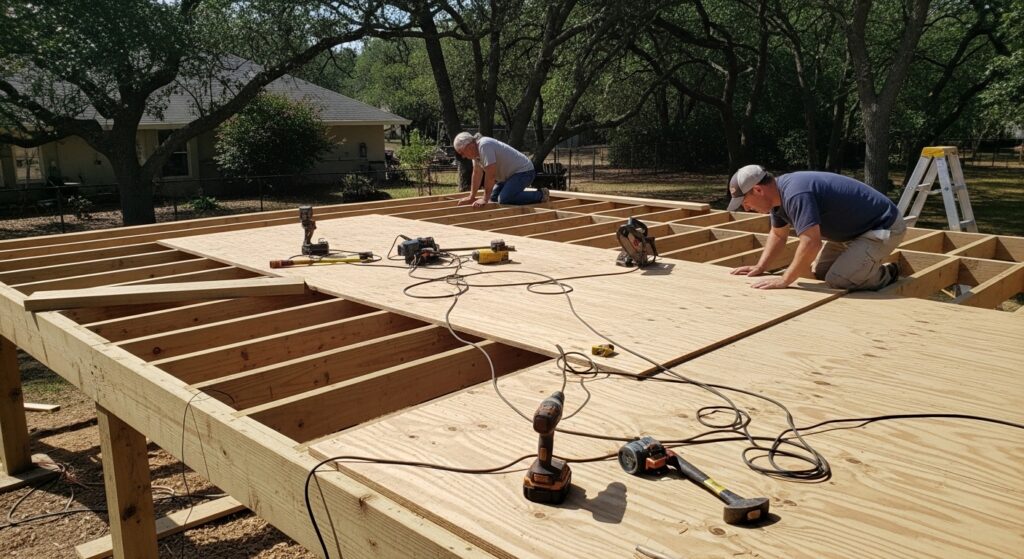
Any plywood used outdoors — or in wet environments — must be rated Exterior. This means the adhesive is waterproof (phenol-formaldehyde resin) and the veneer species are appropriate for sustained moisture exposure.
Using interior or Exposure 1 plywood in a genuinely outdoor setting is one of the most common — and costly — mistakes DIYers make.
Exterior-Rated Sheathing
Standard exterior sheathing (C-C Exterior or C-D Exterior) is used for wall sheathing that will be covered by siding, or roof sheathing that will be covered by underlayment and roofing material. It has a waterproof glue bond but isn’t designed for sustained direct exposure to weather.
ACX Plywood
ACX stands for A-face, C-back, Exterior rated. This is the smooth-faced, exterior-glued panel you’d use for projects where one face needs to look good: outdoor signs, boat trailer floors, soffits, or boxed eaves.
Marine Plywood
As covered earlier, marine plywood is the highest-performance option for truly wet environments. Unlike standard exterior plywood, marine plywood has a void-free core — critically important because voids trap water and create rot pockets.
True marine plywood in the U.S. is certified to ANSI/APA Standard 1455 or British Standard BS 1088.
What to look for: Look for the “Marine” designation on the grade stamp, void-free core certification, and waterproof adhesive.
MDO and HDO Plywood (Medium and High Density Overlay)
MDO (Medium Density Overlay) and HDO (High Density Overlay) plywood have a resin-impregnated fiber overlay bonded to the face. This overlay creates an extremely smooth, hard surface that’s ideal for:
- Outdoor signs
- Concrete forms
- Highway signs (HDO)
- Any application requiring a super-smooth painted finish outdoors
MDO takes paint exceptionally well and holds it for years, making it a favorite for exterior signs and soffits.
Standard Plywood Thickness and Sheet Sizes
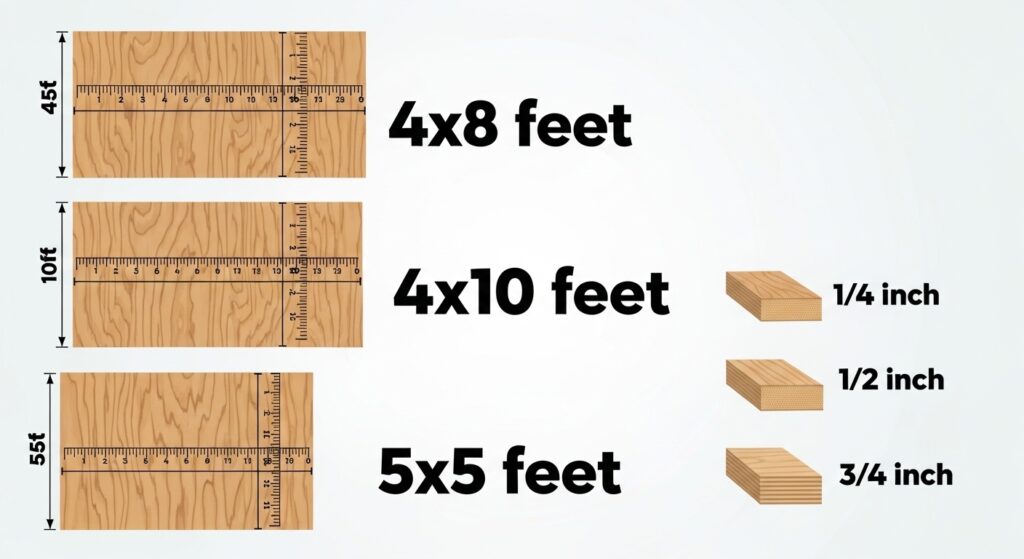
One of the most common beginner mistakes is not accounting for actual plywood dimensions versus nominal dimensions.
Standard Plywood Sheet Size
In the United States, the standard plywood sheet size is 4 feet × 8 feet (48″ × 96″). This is by far the most common size you’ll find at retail lumber yards and home improvement stores.
Other available sizes include:
- 4 × 9 feet (for longer span applications)
- 4 × 10 feet (less common, special order)
- 5 × 5 feet (standard for Baltic birch and some import panels)
Standard Plywood Thickness Options
| Nominal Thickness | Actual Thickness |
|---|---|
| ¼” | 7/32″ (~5.5mm) |
| ⅜” | 11/32″ (~8.7mm) |
| ½” | 15/32″ (~11.9mm) |
| ⅝” | 19/32″ (~15.1mm) |
| ¾” | 23/32″ (~18.3mm) |
Note that actual thickness is always slightly less than nominal — a “¾ inch” plywood panel is really 23/32 inches. This matters when you’re fitting panels into dados, grooves, or when dimensions are critical. Many woodworkers purchase ¾” plywood and discover the dado they routed is slightly too wide.
For Baltic birch and metric-sized European panels, thicknesses are in millimeters: 3mm, 6mm, 9mm, 12mm, 15mm, 18mm, 21mm, 24mm.
Which Thickness for Which Application?
| Application | Recommended Thickness |
|---|---|
| Roof sheathing (16″ rafter spacing) | ⅜” – ½” |
| Roof sheathing (24″ rafter spacing) | ½” – ⅝” |
| Wall sheathing | ⅜” – ½” |
| Subfloor (16″ joist spacing) | 23/32″ (¾”) |
| Cabinet boxes | ¾” |
| Cabinet doors | ½” – ¾” |
| Drawer boxes | ½” |
| Furniture tops | ¾” |
| Small shelves | ¼” – ½” |
| Heavy shelving | ¾” |
Plywood Species: What Wood Is It Made From?
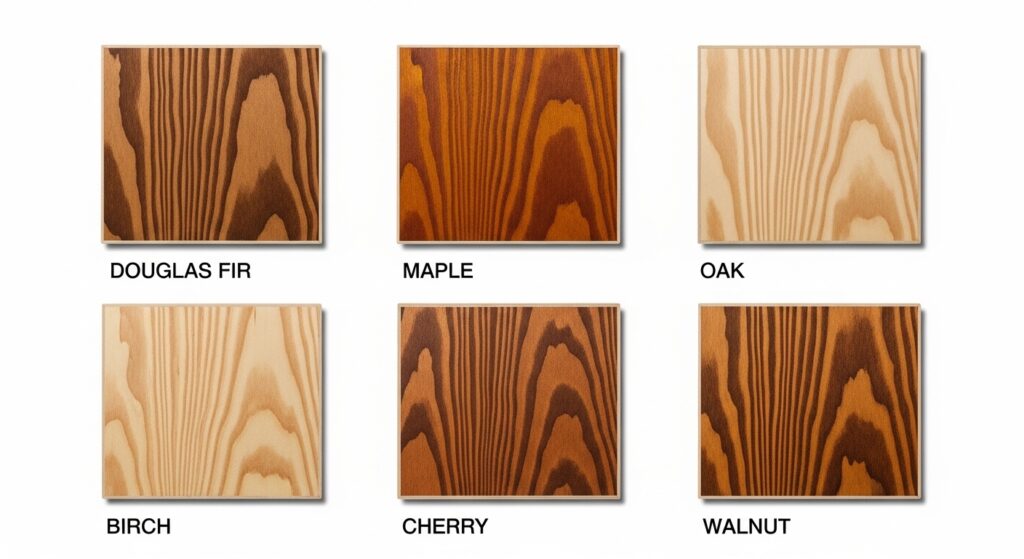
The species of wood used in plywood affects its strength, appearance, weight, workability, and price. The U.S. Forest Products Laboratory classifies wood species into strength groups (Group 1 being the strongest).
Softwood Species (Structural Plywood)
- Douglas Fir: The most widely used species for structural plywood in the U.S. west. Excellent strength-to-weight ratio, moderate cost.
- Southern Yellow Pine (SYP): Dominant in the U.S. South. Very strong, slightly heavier than Douglas fir, often used for pressure-treated applications.
- Spruce-Pine-Fir (SPF): Common in the Pacific Northwest and Canada. Lighter than SYP.
- Western Red Cedar: Used in siding and exterior applications for natural rot resistance.
Hardwood Face Species (Furniture Plywood)
- Maple (Hard and Soft): Very popular for kitchen cabinets, light-colored, fine grain, excellent finishing
- Red Oak: Traditional American furniture favorite, open grain, takes stain well
- White Oak: Tighter grain than red oak, more water-resistant, very popular currently
- Birch (Yellow): Similar to hard maple, slightly warmer tone
- Cherry: Premium species, pinkish-red color that deepens with light exposure
- Walnut (Black): Dark chocolate brown, open grain, premium pricing
- Poplar: Used as a core or secondary species; takes paint extremely well
Tropical and Specialty Species
- Okume (Okoume): The standard face species for marine-grade plywood; light, stable, very smooth
- Meranti (Lauan): An inexpensive tropical hardwood used in door skins and economy panels; not moisture-resistant despite its use in some exterior applications
- Teak: Premium tropical species used in marine furniture and boat decking
What Is Plywood Used For? A Room-by-Room and Project Guide
Understanding what plywood is used for makes it much easier to choose the right type and grade.
Kitchen
- Cabinet boxes: ¾” hardwood plywood (maple, birch face), veneer or combination core
- Cabinet doors: ¾” solid wood or MDF, or ½” plywood with solid wood frames
- Drawer boxes: ½” Baltic birch — the industry standard for quality kitchen drawer boxes
Bathroom
- Underlayment: ¼” or ⅜” plywood under tile (use Exposure 1 or Exterior rated)
- Vanity boxes: ¾” hardwood plywood
Living Room / Bedroom
- Subfloor: 23/32″ (¾”) Rated Sturd-I-Floor
- Furniture: ¾” hardwood plywood for shelving, bed frames, storage units
- Built-in bookshelves: ¾” hardwood or Baltic birch plywood
Garage and Workshop
- Wall sheathing: ½” CDX plywood
- Workbench tops: ¾” Baltic birch or MDF
- Storage cabinets: ¾” hardwood plywood or BCX
Exterior / Outdoors
- Deck sheathing: Exterior-rated structural panels
- Outdoor furniture: ACX or marine plywood depending on exposure
- Soffits: MDO or ACX
Boats and Marine Applications
- Hull planking: Marine-grade BS 1088 okume or Douglas fir
- Interior cabinetry: Marine plywood with epoxy sealing
Best Plywood for Specific Projects: Practical Recommendations
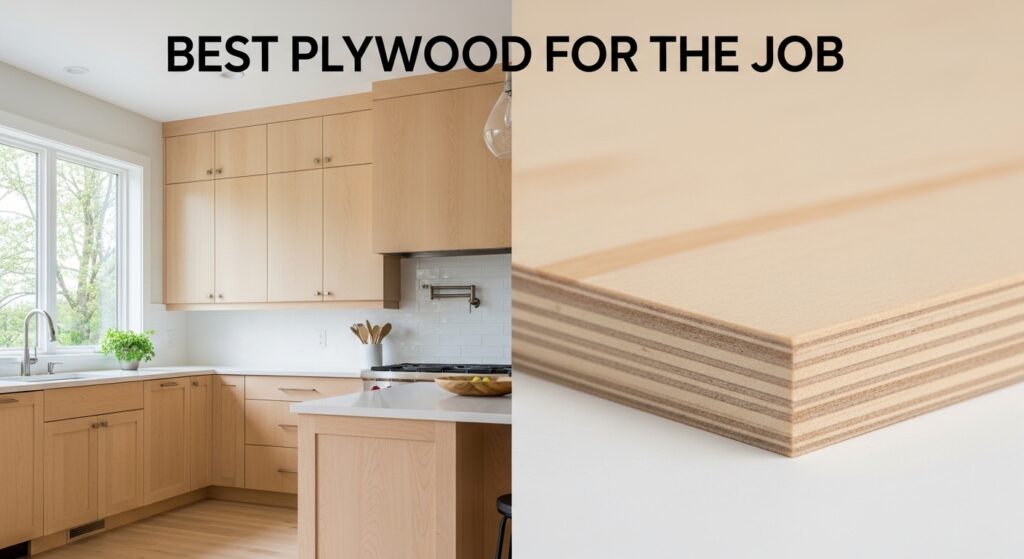
Here’s the practical shortcut guide — the plywood recommendations that experienced woodworkers and contractors actually use.
Best Plywood for Flooring (Subfloor)
Winner: 23/32″ (¾”) Rated Sturd-I-Floor, Exposure 1
For subfloor applications over joists spaced 16″ on center, the APA’s Rated Sturd-I-Floor is the correct choice. It’s engineered specifically for this application and is tested under concentrated and uniform loads.
Always use tongue-and-groove (T&G) panels for subfloors — they eliminate edge sag between joists.
Best Plywood for Cabinets
Winner: ¾” Birch or Maple Hardwood Plywood (Veneer Core, A1 or A2 grade)
For painted cabinets, domestic birch plywood with MDF core gives the smoothest surface. For natural or stained cabinets, maple or oak hardwood plywood with veneer core gives the best balance of workability and beauty.
Best Plywood for Furniture
Winner: ¾” Baltic Birch (for natural finish) or ¾” Maple Hardwood Plywood (for stained)
Baltic birch’s void-free, multi-ply construction makes it the choice of professional furniture makers. The exposed edge detail can even become a design feature.
Best Plywood for Roofing
Winner: ½” or ⅝” APA Rated Sheathing, Exposure 1 or Exterior
For most residential roofs, ½” sheathing over 24″ rafter spacing or ⅝” over wider spacing. Always verify with your local building code.
Best Plywood for Exterior Walls
Winner: ½” or ⅝” APA Rated Sheathing, Exposure 1
Standard wall sheathing is covered by house wrap and siding and doesn’t need exterior-rated glue in most cases (Exposure 1 is fine). Check with your local building authority.
Smoothest Plywood for Painting
Winner: MDO (Medium Density Overlay) Plywood or MDF-Core Hardwood Plywood
MDO’s resin-fiber face is as smooth as it gets — it requires minimal prep and holds paint beautifully. For interior painted applications, MDF-core birch plywood is the choice.
Which Plywood Is Strongest?
Answer: It depends on the type of strength you’re measuring.
- Stiffness (bending strength): Structural I-rated plywood using Group 1 species (Douglas fir, Southern yellow pine) — Structural I panels have higher allowable stresses than standard sheathing
- Impact resistance: Thicker veneer core panels outperform MDF core
- Shear strength: Plywood panels generally outperform OSB in shear applications, according to APA research
Specialty and Less-Common Plywood Types Worth Knowing
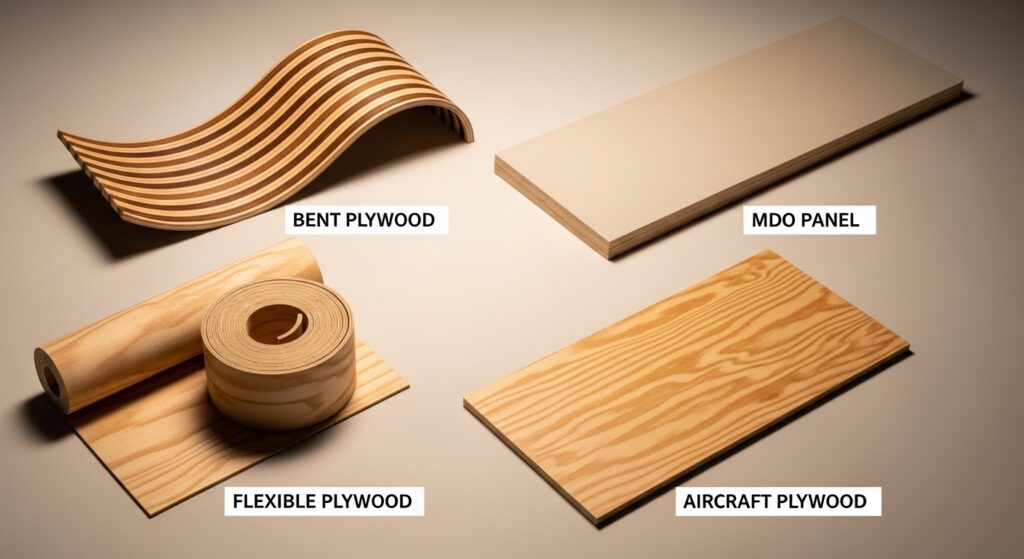
Flexible Plywood (Bendy Board)
Flexible plywood is manufactured with all plies running in the same direction, which allows the panel to be bent into curved shapes. It’s available in thin sheets (⅛” and ¼”) and is used for curved furniture, archways, curved cabinetry, and decorative millwork.
Also called: Wiggle board, bending plywood, curve-ply
Aircraft Plywood
Aircraft plywood is manufactured to extreme precision using high-strength hardwood veneer (typically birch or mahogany) bonded with moisture-resistant adhesive. Originally developed for aircraft construction, it’s now used for model building, musical instruments (guitar bodies), and high-performance applications where weight and strength are critical.
Military Standard MIL-P-6070 governs some aircraft plywood specifications.
Fire-Rated Plywood
Fire-rated plywood (also called Type X or FR-S) is treated with fire retardants either as a core treatment or surface treatment. It’s required by building code in certain occupancies and is tested to ASTM E84 for flame spread and smoke development.
Required for: Multi-family construction, commercial buildings, specific garage applications
Pressure-Treated Plywood
Pressure-treated plywood is infused with preservatives (currently ACQ or CA-B in the U.S. following the phase-out of CCA) that resist rot, decay, and insect damage. Used for applications where the panel is in contact with the ground or concrete, or is exposed to persistent moisture.
According to the American Wood Protection Association (AWPA), treated plywood must meet Use Category specifications — UC3B for above-ground exterior, UC4A/4B for ground contact.
Structural I Plywood
Structural I is a classification within APA Rated Sheathing that indicates the panel is manufactured from the strongest veneer species (Group 1) and meets higher allowable stress values than standard sheathing. It’s used in shear walls and other engineered applications where higher racking strength is required.
Expert Tips: How to Buy Plywood Like a Pro
Whether you’re at a big-box store or a specialty hardwood dealer, these are the things experienced woodworkers and contractors check before buying:
1. Sight Down the Length Pick up the panel and look down the length from one end. A good panel is flat or has only a slight bow. Severe warps are impossible to flatten in most assemblies.
2. Check the Edges for Voids On furniture-grade panels, voids in the core are unacceptable — they create weak spots and can cause blowout when drilling. Look at all four edges.
3. Feel the Face Run your hand across the face veneer. Any roughness, rough patches, or obvious repairs should factor into your decision — especially if you plan to finish clear.
4. Read the Grade Stamp The grade stamp (usually on the back or end of the panel) tells you everything: APA certification, species group, thickness, span rating, and exposure rating. Don’t assume — always read it.
5. Buy One Extra Sheet On any project, buy one more sheet than you think you need. Cutoffs, mistakes, and grain matching always consume more material than planned.
6. Acclimate Your Panels Like solid lumber, plywood needs time to acclimate to your shop or installation environment. Stand panels on edge (not flat) and give them 48–72 hours before cutting.
7. Understand “Shop Grade” Panels Many lumber yards sell “shop grade” or “reject” panels at significant discounts. These may have face veneer defects, slight warps, or off-spec thickness — but for painted applications or structural uses, they’re often perfectly fine.
Where to Buy Plywood: Your Options
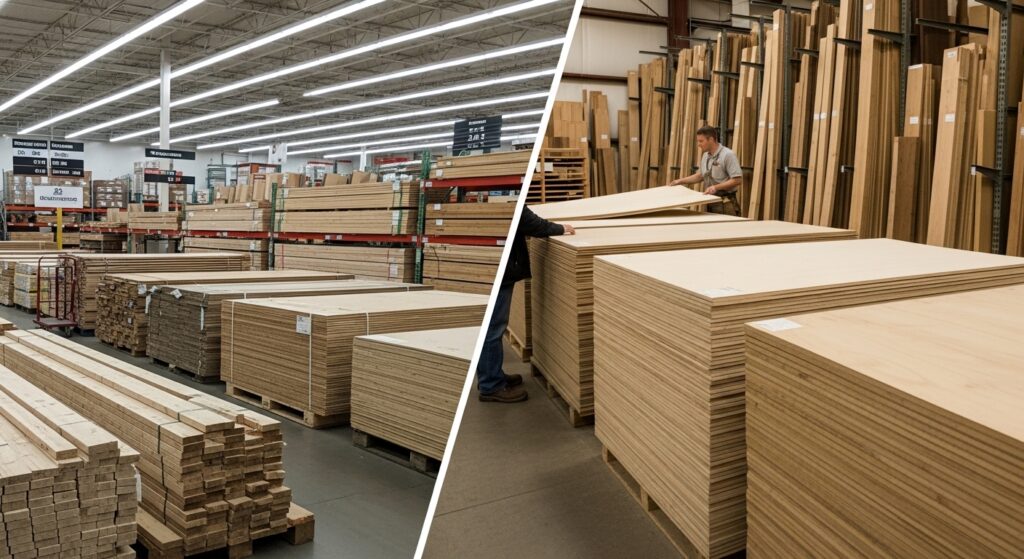
Big-Box Stores (Home Depot, Lowe’s)
Best for: construction plywood, CDX, OSB, standard sanded plywoods, pressure-treated
The selection is limited but the prices are competitive and availability is excellent. Most carry:
- CDX (C-D Exterior) sheathing
- OSB sheathing
- ¾” sanded plywood
- Pressure-treated plywood
- Some hardwood plywood (usually birch or oak)
Home Depot’s plywood section and Lowe’s plywood section are good starting points for pricing and availability.
Specialty Hardwood Lumber Yards
Best for: furniture-grade hardwood plywood, Baltic birch, exotic species, full panel sizes
Specialty dealers stock a much wider selection of hardwood plywoods and often sell Baltic birch, MDO, marine plywood, and uncommon face species. Many will also mill panels to size.
Find dealers through the Wood Dealers directory or local searches.
Online Plywood Suppliers
For specialty panels (aircraft plywood, thin plywoods, exotic species), online suppliers like Woodcraft and Rockler are reliable sources.
Shipping large panels is expensive, so online buying makes more sense for small, specialty items.
Frequently Asked Questions About Plywood Types
What are the 3 types of plywood?
The three most fundamental categories of plywood are softwood plywood (used for construction and structural applications), hardwood plywood (used for furniture, cabinetry, and interior finish work), and specialty plywood (which includes marine plywood, fire-rated plywood, flexible plywood, and other purpose-built panels). Some sources also identify tropical plywood as a fourth major category, giving the most complete breakdown as four types.
What is the difference between CDX and ACX plywood?
Both CDX and ACX are exterior-glued plywood panels. The difference is in the face veneer quality. CDX has a C-grade face and D-grade back — it’s structural, unfinished, and intended to be hidden. ACX has an A-grade face (smooth, paint-ready) and a C-grade back, making it suitable for applications where one face will be visible, such as soffits, outdoor signs, or marine trailer floors.
What is the best plywood for furniture making?
For most furniture projects, ¾” Baltic birch plywood is the professional’s choice. Its void-free core, consistent thickness, and attractive exposed edge make it ideal for case goods, shelving, and structural furniture components. For pieces that will be stained or have a natural finish, matched hardwood plywood (maple, walnut, cherry, or oak face) with a veneer core is the premium option.
What are the standard sizes of a plywood sheet?
The standard plywood sheet size in the United States is 4 feet × 8 feet. Some panels are available in 4×9 and 4×10 sizes. Baltic birch panels are typically 5×5 feet. Standard thicknesses range from ¼” to ¾”, though actual manufactured thickness is always slightly less than the nominal dimension.
What plywood grades should I use for a subfloor?
For subfloors, use APA Rated Sturd-I-Floor, which is specifically engineered and tested for subfloor applications. The correct thickness depends on joist spacing: 19/32″ (⅝”) for 20″ or 24″ on-center joists, and 23/32″ (¾”) for 16″ on-center joists. Always use tongue-and-groove panels to prevent edge deflection between joists, and use APA Rated Sturd-I-Floor Exposure 1 for most applications.
Conclusion: Choose the Right Plywood and Your Project Will Thank You
By now you know something important: there is no single “best plywood.” There’s only the right plywood for the job you’re doing — and now you have the knowledge to make that call with confidence.
To summarize the key decision framework:
- Building a structure? Use APA Rated Sheathing (CDX for covered applications, Exterior-rated for exposed)
- Installing a subfloor? Use Rated Sturd-I-Floor, ¾” tongue-and-groove, Exposure 1
- Building cabinets or furniture? Use ¾” hardwood plywood (birch or maple) with veneer core, or Baltic birch
- Working outdoors? Use Exterior-rated plywood — ACX for visible faces, marine for wet exposure
- Want a smooth painted finish? Choose MDO plywood for exterior or MDF-core birch for interior
If you’re ever in doubt, look for the APA grade stamp, confirm your exposure rating, and when possible, ask the folks at a specialty lumber yard rather than a big-box store — they speak the language fluently.

