
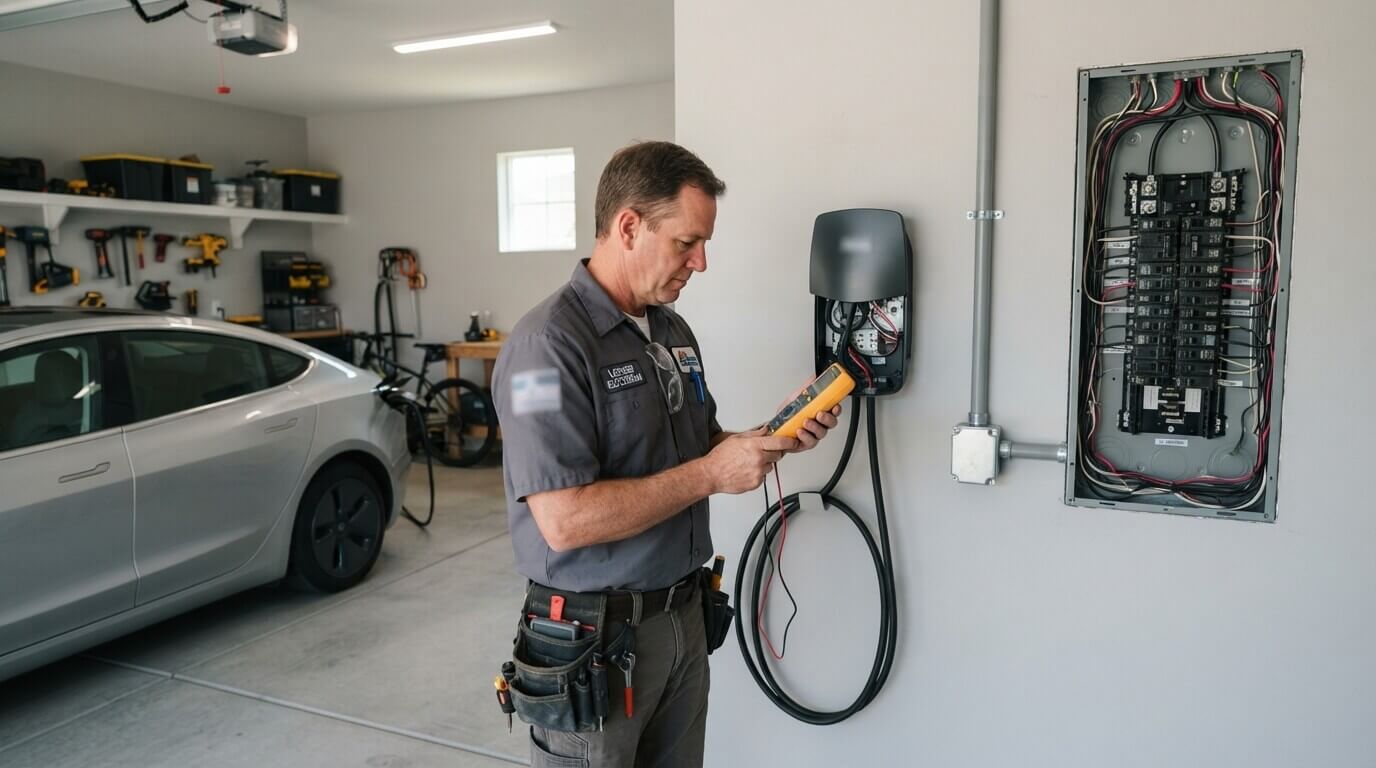
Who installs EV chargers, and what should homeowners look for before choosing an installer? The answer depends on more than the charger brand. A safe EV charger installation can involve the electrical panel, a dedicated circuit, wire length, permits, routing for a detached garage, outdoor equipment, and future electrical needs. The U.S. Department of Energy’s home-charging guidance explains that Level 2 charging typically uses 240 volts for faster at-home charging, while Level 1 charging uses a standard 120-volt outlet.
This comparison looks at six companies that publicly advertise EV charger installation or closely related electrical work in Chicago and nearby suburbs. The companies are presented as examples rather than ranked from best to worst. Factors that may help homeowners compare them include EV-specific services, stated licensing or certification, equipment options, experience, service area, electrical capabilities, and publicly reported project information. Final costs can vary substantially depending on panel upgrades, trenching, conduit, permit requirements, wire length, and charger location.
Green Tech Construction
Green Tech Construction advertises residential EV charger installation in Chicago and describes services that include panel-capacity evaluation, permitting, wiring, mounting, and connection. Its published service information includes both Level 1 and Level 2 charging, outdoor installations, and charging setups for detached garages. The company also describes compatibility with several major EV brands.
Services and Features
- Offers Level 1 charging using a standard 120-volt outlet.
- Offers Level 2 charging using a 240-volt connection.
- Lists hardwired and plug-in configurations.
- Advertises smart charging and load-balancing options.
- Lists compatibility with EV brands including Tesla, Rivian, and Ford.
- Offers outdoor charger installations.
- Also advertises solar and battery-storage services.
The company’s published service information places EV charging within a broader electrical and home-energy offering. Homeowners considering multiple electrical upgrades can therefore ask whether the charger installation should be planned alongside other projects.
Eco Energy Services
Services and Features
Eco Energy Services advertises home and commercial EV charging alongside broader electrical services. Its website states that the company is licensed, insured, and bonded in Illinois and identifies authorizations involving brands such as SPAN, Tesla, ChargePoint, and GM. It also says its own team performs the work rather than subcontracting it.
- Offers residential and commercial electrical services.
- Advertises home EV charging.
- Lists smart-panel and battery-backup services.
- States that it has completed hundreds of smart-panel, EV charger, battery, and lighting installations.
- Serves multiple communities across the Chicagoland area.
This type of service range may be relevant when an EV charger is being considered as part of a larger electrical modernization project.
Infinity EV
Services and Features
Infinity EV focuses heavily on EV charger installation for residential, commercial, condo, and fleet applications. Its current service information lists Level 2 installations, panel assessments, dedicated 240-volt circuits, outdoor mounting, panel-upgrade coordination, and several charger brands. It also advertises permit and rebate assistance.
- Works with residential, commercial, condo, and workplace charging projects.
- Lists Tesla Wall Connector, ChargePoint Home Flex, Emporia, and Autel equipment.
- Advertises licensed and insured electricians.
- Provides dedicated 240-volt circuit installation.
- Offers panel-upgrade coordination when required.
- Advertises ComEd rebate processing for qualifying projects.
For homeowners comparing installers, the important questions are whether the quoted work includes the electrical assessment, circuit installation, permitting, charger hardware, testing, and any required panel modifications.
InChargeE
Services and Features
InChargeE describes itself as a general electrical contractor and EV installation specialist. Its website states that it provides consultation, design, permitting, and installation and identifies the company as a City of Chicago-licensed electrical contractor. It also states more than 25 years of experience as licensed electricians.
- Provides Level 2 EV charger installation.
- Handles 240-volt circuit work.
- Lists residential and commercial electrical services.
- States that it is licensed, bonded, and insured.
- Provides consultation, permitting, and installation services.
For homeowners, the relevant comparison points are the scope of electrical work, charger compatibility, permit handling, warranty coverage, and whether the installation requires modifications to the existing electrical system.
HomeEVCharger
Services and Features
HomeEVCharger focuses on residential EV charger installations in Chicago’s North Shore and northwest suburban areas. Its website states that it is a licensed and certified electrician service with 40 years of electrical experience and lists Tesla Wall Connectors, ChargePoint, and other Level 2 chargers among its installation options.
- Offers 240-volt charging installations.
- Lists Tesla Wall Connector and ChargePoint equipment.
- Serves Chicago North Shore and surrounding areas.
- Handles installations involving garages and outdoor locations.
- Lists Illinois Commerce Commission and ComEd certifications.
The company also publishes service-area information and reports individual installation totals for several communities.
For homeowners with a detached garage or a longer distance between the electrical panel and parking location, it is useful to ask about conduit routing, wire length, panel capacity, and any additional electrical work before accepting a quote.
Daniel’s Imperial Electric
Services and Features
Daniel’s Imperial Electric advertises EV charger installation alongside Tesla Powerwall, generator, and other electrical services. The company states that it is licensed, insured, and bonded and identifies itself as ICC certified for ComEd rebate programs. It also states that it has more than eight years of experience.
- Offers Level 2 EV charger installation.
- Lists Tesla Wall Connector and Powerwall services.
- Provides generator and electrical-panel services.
- States that it is licensed, insured, and bonded.
- Advertises ICC certification for ComEd rebate programs.
- Serves customers across the Chicagoland area.
EV charging may also be considered alongside backup power equipment when a homeowner is planning broader electrical resilience.
What To Confirm Before Hiring an Installer
Before choosing an installer, ask for a detailed explanation of what the quoted project includes.
- Ask whether the quote includes permits, inspection coordination, breakers, wiring, conduit, mounting, and testing.
- Request an electrical load assessment before choosing a Level 2 charger.
- Confirm whether a hardwired charger or NEMA 14-50 outlet best suits the vehicle and installation location.
- For outdoor projects, verify the equipment, installation method, and electrical safety considerations for year-round weather exposure.
- Ask whether a panel upgrade is required or recommended.
- Confirm the maximum charging amperage the existing electrical service can support.
- Get the project scope, warranty terms, charger compatibility, and final price in writing.
Questions About EV Charger Installation
Does Every Home Need a Panel Upgrade for an EV Charger?
No. The answer depends on the home’s existing electrical service, current loads, available circuit capacity, and the charger’s requirements. An electrical assessment can determine whether the existing panel and service can support the additional load.
Older homes may require more extensive electrical work before a Level 2 charger can be added. Dedicated circuits, panel upgrades, or other modifications may be necessary depending on the existing system.
Is a Hardwired Charger Better Than a NEMA 14-50 Outlet?
Neither option is automatically right for every home. A hardwired charger can provide a dedicated installation, while a NEMA 14-50 outlet can offer flexibility for compatible charging equipment.
The appropriate choice depends on the vehicle, charger, electrical system, installation location, and applicable electrical requirements.
What Should an EV Charger Installation Quote Include?
A detailed quote should identify the charger or outlet being installed, circuit requirements, wire length, conduit, breaker, mounting method, permits, inspection coordination, testing, and any panel modifications.
If the charger is being installed in a detached garage, ask specifically how the electrical connection will be routed between the main panel and garage.
Does Outdoor EV Charger Installation Require Different Considerations?
Outdoor installations require equipment and mounting methods suitable for the environment. The installer should also consider weather exposure, cable routing, physical protection, drainage, and the location of the electrical equipment.
For any outdoor electrical work, homeowners should also consider broader electrical safety requirements and local code requirements.
Final Thoughts
Choosing an EV charger installer involves more than comparing charger brands or advertised installation prices. Homeowners should look at the electrical capacity of the property, the required circuit, charger compatibility, installation location, permits, inspection requirements, warranty terms, and the total project scope.
The six companies discussed here advertise different combinations of EV charging, electrical work, panel upgrades, smart-energy equipment, or related services. Comparing those specific capabilities against the requirements of the property can help homeowners determine which type of installer is appropriate for their project.
A detailed electrical assessment and written project scope are useful starting points. They can clarify whether the existing electrical system can support the charger, what additional work may be required, and what the final installation is expected to include.

