
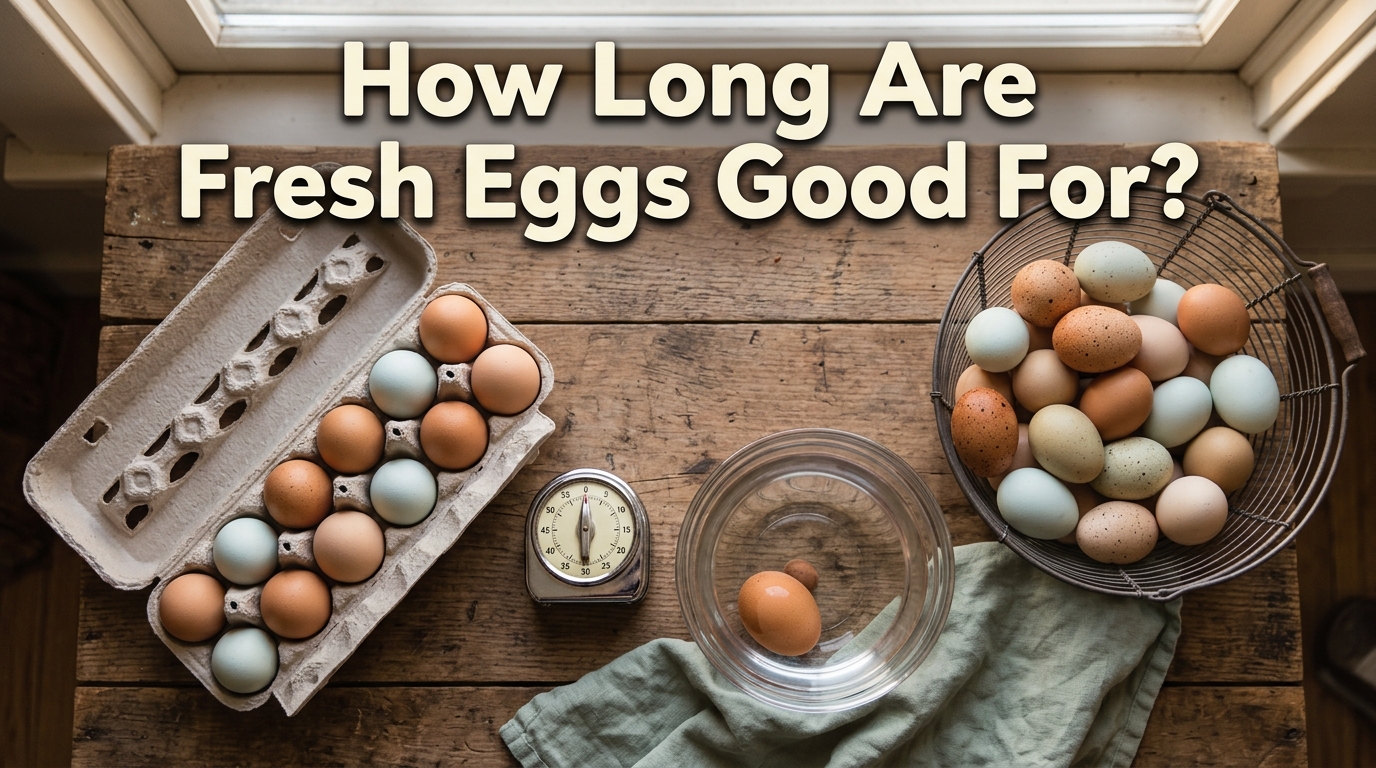
A dozen eggs sitting on the counter after a farmers market trip raises one obvious question: how long are fresh eggs good for before they turn? The honest answer depends less on the calendar and more on two things: whether the eggs were washed, and where they’ve been sitting since.
That single detail, washed or unwashed, changes everything else about storage. It decides whether an egg belongs in the fridge door, the back shelf, or a bowl on the kitchen counter. Below is a breakdown that actually makes sense of it, without the guesswork.
Why “Fresh” Doesn’t Mean “Just Laid”
People use “fresh eggs” two different ways, and mixing them up is where most confusion starts.
Sometimes it means eggs collected from backyard hens or a farm stand within the last day or two. Other times it just means eggs that haven’t gone bad yet, including the carton from the grocery store. Both are valid, but they age on completely different clocks.
Backyard and farm eggs usually still have their natural coating, called the bloom or cuticle, intact. Store eggs almost never do, because U.S. processing plants wash and sanitize every egg before it’s packed. That one processing step is the reason grocery store eggs must live in the fridge, while a basket of unwashed farm eggs can sit safely on a counter for a while.
How Long Are Fresh Eggs Good For in the Refrigerator
This is the number most people actually need. Once shell eggs go into the fridge, they’re good for three to five weeks from the day they were refrigerated, not from the date printed on the carton. The USDA’s food safety guidance on shell eggs confirms this window, and it applies whether the eggs came from a store or were washed at home.
A few habits stretch that window and keep quality higher for longer:
- Keep eggs in their original carton instead of an open egg tray. The carton blocks moisture loss and keeps odors from other fridge items out.
- Store them on an interior shelf, not the door. Door shelves swing through warmer temperatures every time the fridge opens.
- Keep the fridge itself at or below 40°F. A refrigerator running warm shortens shelf life for everything inside it, not just eggs, so it’s worth checking that the appliance is actually holding temperature. If the unit is older and struggling to stay cold, it might be worth checking how long refrigerators typically last before troubleshooting the eggs.
For anyone specifically asking how long are fresh eggs good for in the fridge unwashed, the range is a little wider. Unwashed eggs with the bloom still on can often hold quality in the refrigerator for two to three months, since that natural coating is doing extra work on top of the cold temperature.
How Long Are Fresh Eggs Good For on the Counter
Room temperature storage is where washed and unwashed eggs really part ways.
Unwashed, bloom-intact eggs can typically sit out for about two to three weeks in a cool spot away from direct sun, and some sources report closer to a month in ideal conditions. Farm storage guidance on unwashed eggs generally lands in that same range, with the caveat that quality (not just safety) declines faster outside the fridge than in it.
Washed eggs are a different story. Once that protective layer is scrubbed off, bacteria has a much easier path through the shell’s pores. Washed eggs left unrefrigerated should be treated with caution and, realistically, used within a couple of hours if the room is warm. This is also why the question “how long are fresh eggs good for unrefrigerated” doesn’t have one clean answer. It depends entirely on that wash step.
A quick way to think about it:
| Egg Type | Room Temperature | Refrigerated |
|---|---|---|
| Washed (store-bought) | Not recommended, few hours max | 3–5 weeks |
| Unwashed (bloom intact) | ~2–3 weeks | 2–3 months |
How Long Are Fresh Eggs Good for on the Counter Unwashed
Since this comes up so often, it deserves its own quick answer. Unwashed, clean, uncracked eggs kept somewhere below roughly 75°F and out of direct sunlight generally hold up for two to three weeks on the counter, sometimes longer in a cooler kitchen. The moment humidity climbs or the eggs sit near a stove or sunny window, that window shrinks fast, because temperature swings encourage condensation on the shell, which is exactly the kind of moisture bacteria like.
If a household regularly runs warm, or if there are young kids grabbing snacks nearby, refrigerating even unwashed eggs from day one is the simpler, safer default. Nothing is lost by doing that except a little counter charm.
The Bloom Explained: Why Washing Changes the Timeline
The bloom is a thin, natural protein coating a hen applies to the egg as it’s laid. Under a microscope, an eggshell looks more like a sponge than a solid wall, riddled with thousands of tiny pores. The bloom seals those pores shut, keeping air, moisture, and bacteria from moving in or out.
Wash the egg, and that seal disappears. Explanations of egg bloom and washing note that this is precisely why U.S. commercial eggs, which are required to be washed and sanitized before packing, need refrigeration to stay safe, while many countries that sell unwashed eggs store them at room temperature as standard practice.
This is also the answer to how long are fresh eggs good for after washing. The clock effectively resets and shortens the moment the shell gets wet. A washed egg needs the fridge promptly, and from that point it follows the same three-to-five-week refrigerated timeline as any grocery store carton.
How Long Are Fresh Eggs Good for Not Refrigerated
For anyone who simply forgot a carton on the counter overnight, the safety math is fairly forgiving for a single lapse, but it’s not something to make a habit of.
Food safety agencies generally advise against leaving washed eggs out for more than about two hours at room temperature, similar to other perishable foods. Unwashed eggs have more built-in buffer thanks to the bloom, which is why homesteaders can leave a basket out for weeks without issue. But once an egg (washed or not) has been sitting in a warm kitchen, above roughly 90°F, for more than two hours, it’s safer to treat it as compromised rather than gamble on it.
The safest habit is a simple one: if there’s any doubt about how an egg was handled before it reached the kitchen, refrigerate it and let the fridge do the guessing for you.
Simple Ways to Tell if an Egg Has Gone Bad
Dates and rules only go so far. These quick checks work regardless of how long an egg has been stored:
- Float test: Lower the egg into a bowl of water. Fresh eggs sink and lie flat. Older but still usable eggs tip upright. Eggs that float should be tossed, since that means enough air has built up inside to be a red flag.
- Smell test: Crack it into a clean bowl first, not directly into a pan. A sulfur or rotten smell means it’s done, no second-guessing needed.
- Look: Pink, green, or unusual discoloration in the white is a sign of bacterial growth. A cloudy white, on the other hand, is actually a good sign. It just means the egg is very fresh.
- Texture: A watery, flat egg white with a yolk that breaks easily usually means an older egg. Still safe to eat if it passed the other checks, just better suited for baking than a sunny-side-up breakfast.
How Long Are Fresh Eggs Good for Unwashed vs. Washed: A Quick Recap
Since this is the crux of nearly every version of the question, here’s the short version one more time:
- Unwashed, bloom-intact eggs: about 2–3 weeks on the counter, 2–3 months refrigerated.
- Washed eggs: refrigerate promptly, good for 3–5 weeks in the fridge, not meant for extended counter storage.
- When unsure how an egg was handled: default to the fridge.
Expert Tips for Keeping Eggs Fresh Longer
A few small habits make a real difference in day-to-day storage:
- Store eggs pointed end down. It keeps the yolk centered and slightly slows moisture loss through the wider, more porous end.
- Don’t wash eggs until right before use, even ones headed for the fridge. Washing strips the bloom the moment it happens, so timing it right before cracking preserves protection as long as possible.
- Avoid storing eggs next to strong-smelling foods like onions or fish. Shells are porous enough to pick up odors that transfer into the egg itself.
- Rotate stock. Use older eggs first and keep newer ones toward the back, the same logic used in any kitchen with perishables.
Pros and Cons of Each Storage Method
Refrigerating eggs
- Pros: Longest reliable shelf life, most consistent safety, works for both washed and unwashed eggs.
- Cons: Slightly firmer texture for baking recipes that call for room-temperature eggs, takes up fridge space.
Counter storage (unwashed only)
- Pros: Convenient, keeps that classic farmhouse look, eggs are ready at baking temperature.
- Cons: Shorter usable window, more sensitive to a warm kitchen, not viable at all for washed eggs.
Frequently Asked Questions
How long are fresh eggs good for in the refrigerator once collected?
Generally three to five weeks for washed eggs, and often closer to two to three months for unwashed eggs with the bloom intact, assuming the fridge stays at or below 40°F.
Can unwashed farm eggs really stay out of the fridge?
Yes, as long as the bloom hasn’t been washed off. Two to three weeks on a cool counter is a reasonable, commonly cited range, though refrigerating them extends both safety margin and shelf life.
Do fresh eggs need to be washed before storing them?
No. In fact, waiting to wash eggs until right before cooking preserves the natural bloom and keeps storage flexible longer.
What’s the fastest way to check if an egg is still good?
The float test in a bowl of water is quick and reliable: sinking and lying flat means fresh, floating means it’s time to toss it.
Is it safe to eat eggs past the printed date on the carton?
Often yes, since that date reflects packing quality more than a hard safety cutoff. The float test and a smell check after cracking are better indicators than the printed date alone.
Wrapping It Up
The real answer to how long are fresh eggs good for comes down to one fork in the road: washed or unwashed. Everything else, counter versus fridge, two weeks versus five, follows from that single detail. Keep unwashed eggs cool and dry on the counter if that’s the preference, refrigerate washed ones without delay, and lean on the float test whenever there’s any doubt. That’s really all it takes to keep a carton, or a basket, safe and usable for as long as possible.
This article is for general informational purposes only and isn’t a substitute for official food safety guidance from agencies like the USDA or FDA.

