
There’s something quietly satisfying about succulents. They sit on your windowsill without demanding much. They come in dozens of shapes, colors, and textures. And once you understand a few basic rules, they practically grow themselves.
Whether you’ve just picked up your first echeveria at a grocery store or you’re ready to build a full succulent garden outdoors, this guide covers everything you need to know about how to plant succulents the right way — from choosing soil to propagating new plants from a single leaf.
No jargon. No guesswork. Just clear, simple steps that actually work.
What Makes Succulents Different From Other Plants?
Before planting, it helps to understand why succulents need slightly different care than most houseplants.
Succulents store water in their thick leaves, stems, and roots. That’s their superpower. They evolved in arid environments — deserts, rocky hillsides, dry coastlines — where rain is rare and drainage is fast. Their roots are not designed to sit in damp soil.
Because of this, the two biggest mistakes beginners make are:
- Overwatering (the number one killer of succulents)
- Using the wrong soil (regular potting mix holds too much moisture)
Keep those two things in mind throughout this guide, and you’ll already be ahead of most people.
How to Plant Succulents in Pots
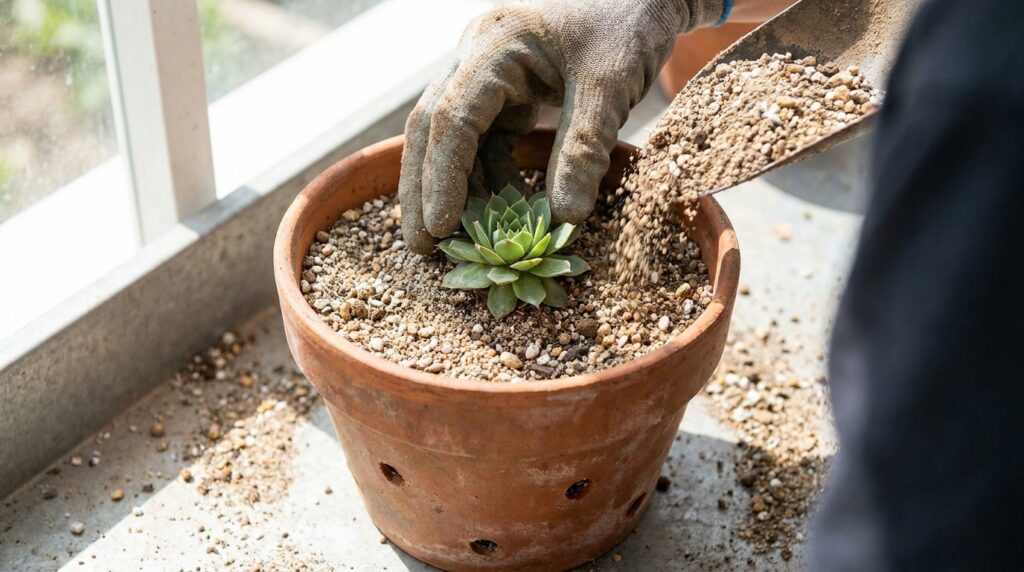
Pots are the most popular way to grow succulents, and for good reason. They give you total control over soil, drainage, and placement.
Choosing the Right Pot
The pot you choose matters more than most people realize. Always look for:
- Drainage holes — non-negotiable. Without drainage, water pools at the bottom and rots the roots.
- Terracotta or ceramic material — these are breathable and help soil dry out faster.
- Snug sizing — a pot that’s slightly larger than the root ball is ideal. Too much extra space means too much damp soil around the roots.
Avoid glass containers without drainage unless you’re an experienced grower who can carefully control watering.
The Best Soil for Succulents
Regular potting soil stays too wet for succulents. You need something that drains fast.
The go-to option is a cactus and succulent potting mix, often sold at garden centers. You can also improve regular potting mix by adding perlite — a lightweight volcanic glass material that dramatically improves drainage and aeration.
A good ratio is:
| Component | Amount |
|---|---|
| Cactus/succulent potting mix | 50% |
| Perlite | 50% |
This combination gives roots the air and drainage they need to stay healthy.
Planting Steps
- Add a layer of soil to the pot (about one-third full).
- Remove the succulent from its nursery container, gently loosening the roots.
- Position the plant in the center, making sure it sits at the same depth it was growing before.
- Fill in around the roots with soil and press gently to remove air pockets.
- Wait 2–3 days before watering to let any disturbed roots settle.
How to Plant Succulents Outdoors
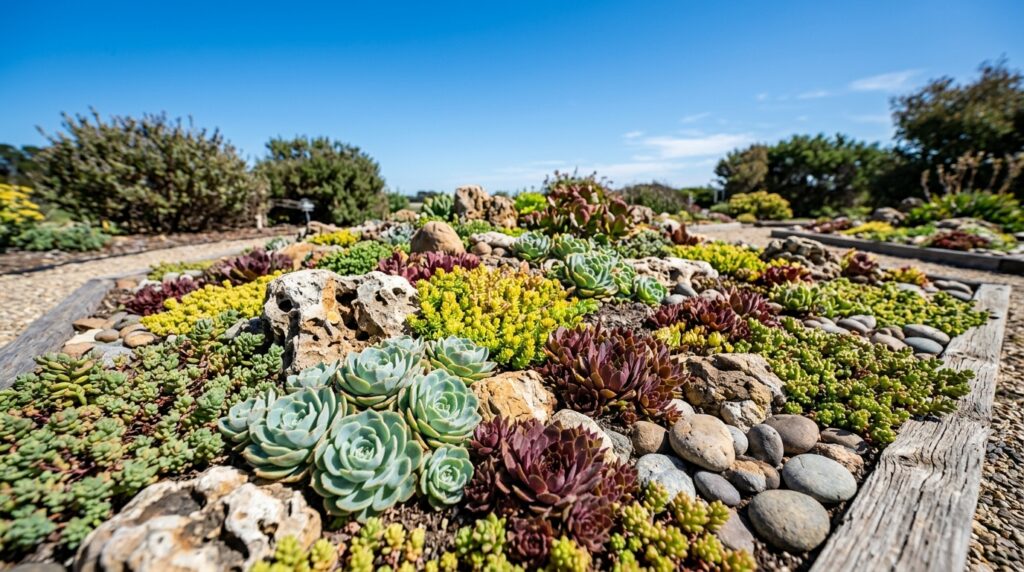
Succulents can thrive outdoors in many climates, especially in areas with mild winters and low humidity.
Choosing a Spot
Planting succulents outside works best in a location that gets at least 6 hours of direct sunlight daily. South or east-facing spots are usually ideal.
Avoid low-lying areas where water collects after rain — that standing moisture is the enemy.
How to Plant Succulents in the Ground
If you’re going straight into garden soil, test the drainage first. Pour a bucket of water into your planting area. If it drains within 30 minutes, your soil is workable. If it puddles for longer, you need to amend it.
Improving outdoor soil:
- Mix in coarse sand or perlite to improve drainage.
- Add a layer of gravel at the base of the planting area.
- Raise the bed slightly to promote runoff.
Once the soil is ready:
- Dig a hole slightly larger than the root ball.
- Place the succulent so the base of the plant is level with the soil surface.
- Backfill with amended soil and press lightly.
- Mulch with gravel or pebbles — this keeps moisture away from the crown of the plant.
Succulents That Grow Well Outdoors
Some varieties handle outdoor conditions better than others. Hardy options include:
- Sempervivum (Hens and Chicks) — tolerates cold winters
- Sedum — spreads easily as ground cover
- Agave — thrives in full sun and poor soil
- Delosperma (Ice Plant) — low-spreading, drought-tolerant
How to Plant Succulents Indoors
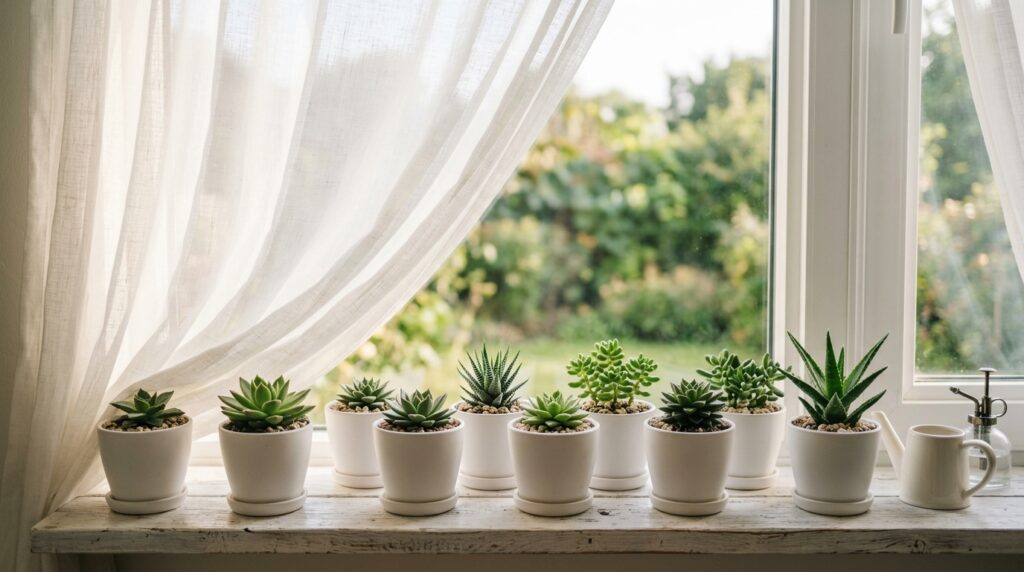
Growing succulents indoors is very achievable — with the right setup.
Light Requirements
This is the most important factor indoors. Succulents need bright, direct light for at least 4–6 hours per day. A south-facing window is the ideal spot.
Signs your succulent isn’t getting enough light:
- Leaves stretch upward and apart (called “etiolation”)
- Colors fade or turn pale green
- The plant leans toward the window
How to Grow Succulents Indoors Without Sunlight
If your home doesn’t have strong natural light, a grow light is your best friend. Full-spectrum LED grow lights placed 6–12 inches above the plant for 12–14 hours per day can fully replace sunlight.
Look for lights labeled “full spectrum” with a color temperature between 5000K–6500K (daylight range).
Watering Indoors
Indoors, you’ll water far less frequently than you might think. A common schedule:
- Spring/Summer (growing season): Every 7–14 days, when the top inch of soil feels dry
- Fall/Winter (dormant season): Once a month or less
Always water deeply — soak the soil until it drains from the bottom — then let it dry out completely before watering again.
How to Plant Succulents in a Bowl
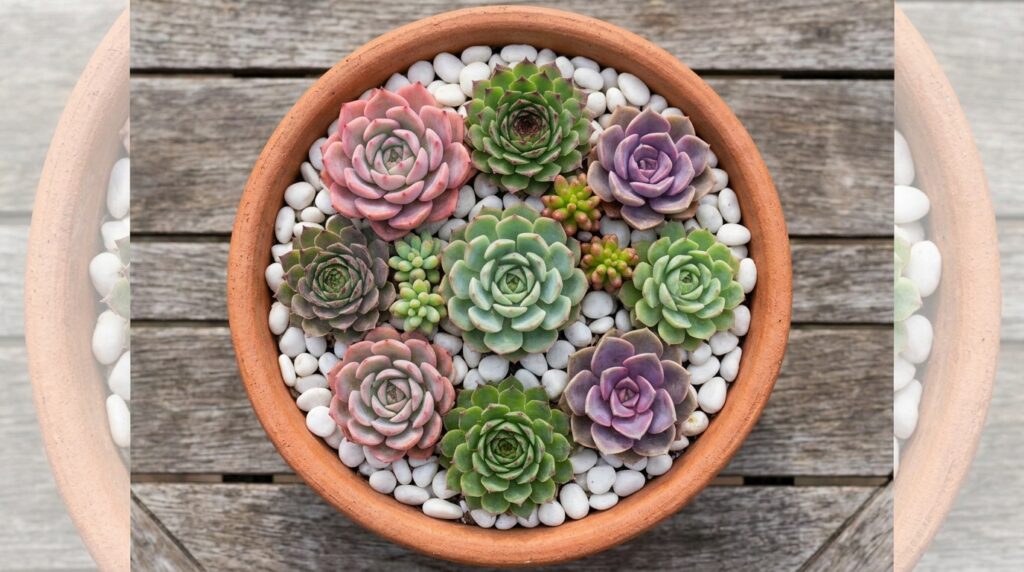
A succulent bowl is one of the most popular centerpiece projects, and it’s easier than it looks.
What You’ll Need
- A shallow bowl (at least 3–4 inches deep) with drainage holes if possible
- Succulent potting mix with added perlite
- Small gravel or pebbles for top dressing
- A variety of small succulents in complementary colors
Steps
- Fill the bowl with 2–3 inches of fast-draining soil.
- Plan your arrangement before planting — place the tallest variety in the center or back, cascading types at the edges.
- Remove each succulent from its container and brush off excess soil.
- Plant them snugly, leaving minimal gaps.
- Fill gaps with extra soil, then top-dress with gravel.
- Mist lightly on the first day, then resume a normal deep-water routine after a week.
How to Plant Succulents in a Glass Bowl
Glass bowls look stunning but present a real challenge: no drainage. To make it work:
- Add a 1-inch layer of gravel at the very bottom before soil (this creates a temporary drainage buffer).
- Water extremely sparingly — just a few tablespoons at a time.
- Place in bright indirect light (direct sun heats glass and can cook roots).
For long-term success, a glass bowl without holes is best treated as a display piece that needs very close monitoring.
How to Plant Succulents Together
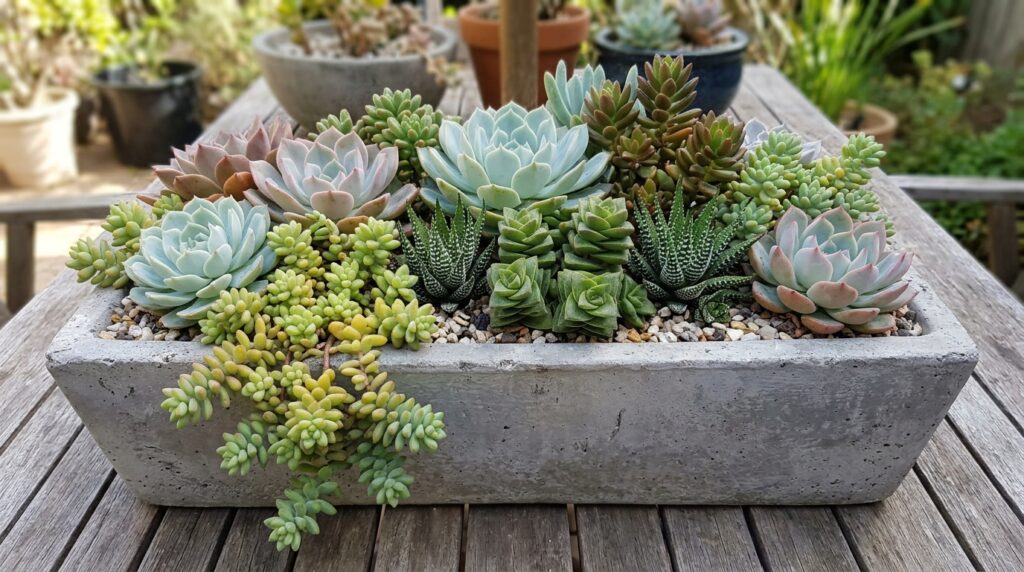
Mixing succulents in one container creates a living tapestry of color and texture. The key is choosing plants that share the same care needs.
Tips for Grouping Succulents
- Match light needs: Combine varieties that all prefer full sun or all prefer partial shade.
- Match water needs: Most succulents are compatible, but avoid mixing true cacti with softer succulents in very small pots.
- Vary heights and shapes: Pair rosette shapes with trailing types or tall spiky varieties for visual interest.
- Space appropriately: Leave a little breathing room between plants — they’ll fill in over time.
Good combinations include echeveria + sedum + crassula, or sempervivum + delosperma for outdoor plantings.
How to Plant Succulents in Rocks
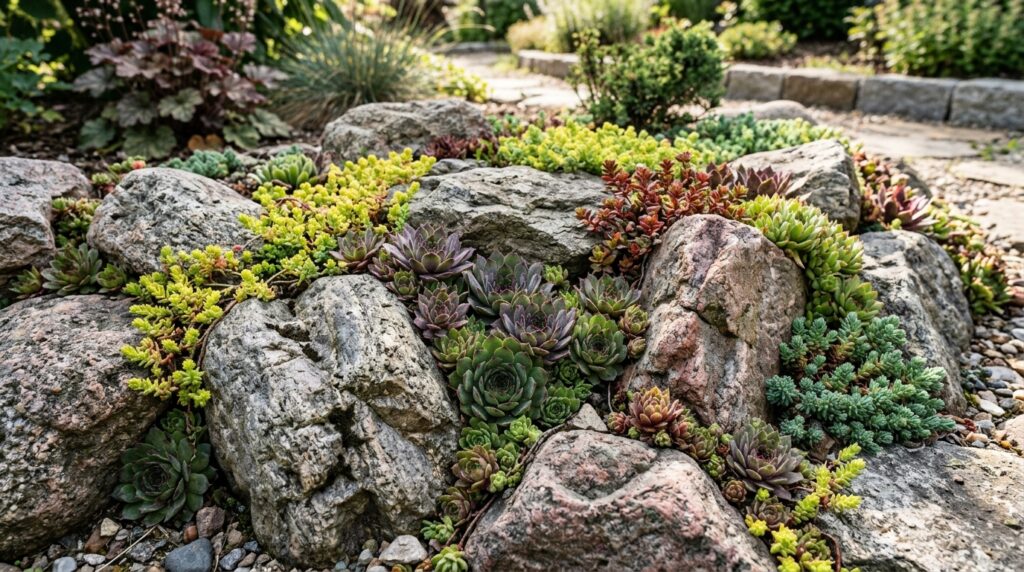
Planting succulents in rocks creates a natural, low-maintenance look that suits dry gardens beautifully.
In a Rock Garden Bed
- Loosen the existing soil between rocks and mix in sandy, fast-draining material.
- Tuck small succulents into pockets between rocks, making sure roots have contact with soil beneath.
- Press pebbles around the crown to keep moisture away.
- Water lightly until established, then rely on rainfall in most climates.
In a Container with Rocks Only
Growing succulents in a decorative rock-filled container without soil is not sustainable long-term — roots can’t anchor or absorb nutrients without some growing medium. If you want a “rock look,” use a layer of gravel on top of soil rather than replacing soil entirely.
How to Plant Succulents in a Strawberry Pot
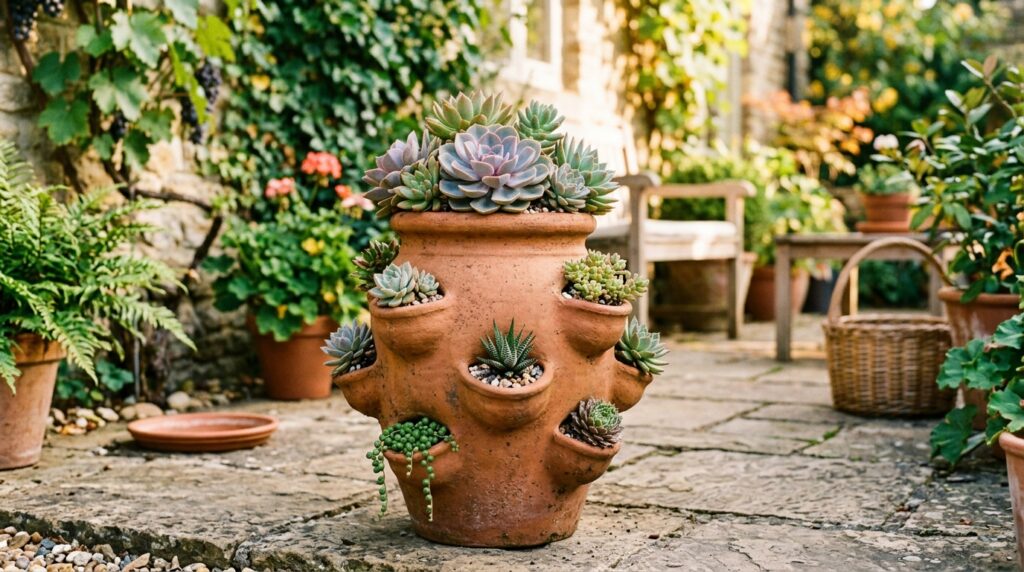
Strawberry pots are a creative and space-efficient way to display succulents. Each pocket becomes a miniature planting spot.
The Challenge with Strawberry Pots
Watering evenly is tricky. Water poured from the top often doesn’t reach the lower pockets. The classic solution is a drainage pipe trick:
- Insert a PVC pipe (capped at the bottom, with small holes drilled along its length) down the center of the pot as you fill it with soil.
- Water through the pipe — this distributes moisture to all levels.
Planting Steps
- Cover the drainage hole with a coffee filter or mesh to prevent soil loss.
- Add soil up to the first pocket level.
- Tuck a small succulent into the pocket from the outside, roots pointing inward.
- Add more soil to the next pocket level and repeat.
- Plant the top opening with a slightly larger or upright variety.
- Water through the central pipe for even moisture distribution.
Growing Succulents From Cuttings
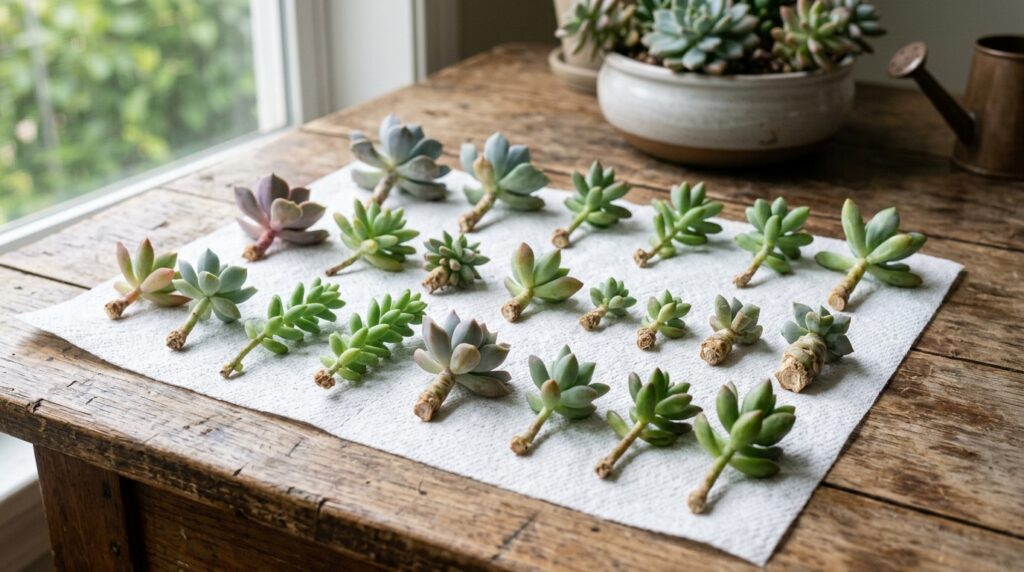
Growing succulents from cuttings is one of the most satisfying parts of the hobby — and one of the easiest ways to multiply your collection for free.
What You’ll Need
- A healthy parent plant
- Clean, sharp scissors or a knife
- A small pot with succulent soil
- Patience (usually 2–4 weeks)
Steps
- Take the cutting: Snip a stem 3–5 inches long just below a leaf node (where leaves branch off).
- Remove lower leaves: Strip the bottom 1–2 inches of leaves so the bare stem can be buried in soil.
- Let it callus: Lay the cutting on a dry surface out of direct sun for 2–5 days. The cut end will dry and form a protective callus. This step is essential — planting a fresh cut leads to rot.
- Plant the cutting: Insert the bare stem into barely-moist succulent soil, deep enough to stand upright.
- Wait before watering: Give it 5–7 days before any water, then water lightly at the base of the stem (not from above).
- Look for roots: After 2–4 weeks, gently tug the cutting. Resistance means roots have formed.
How to Plant Succulents Without Roots
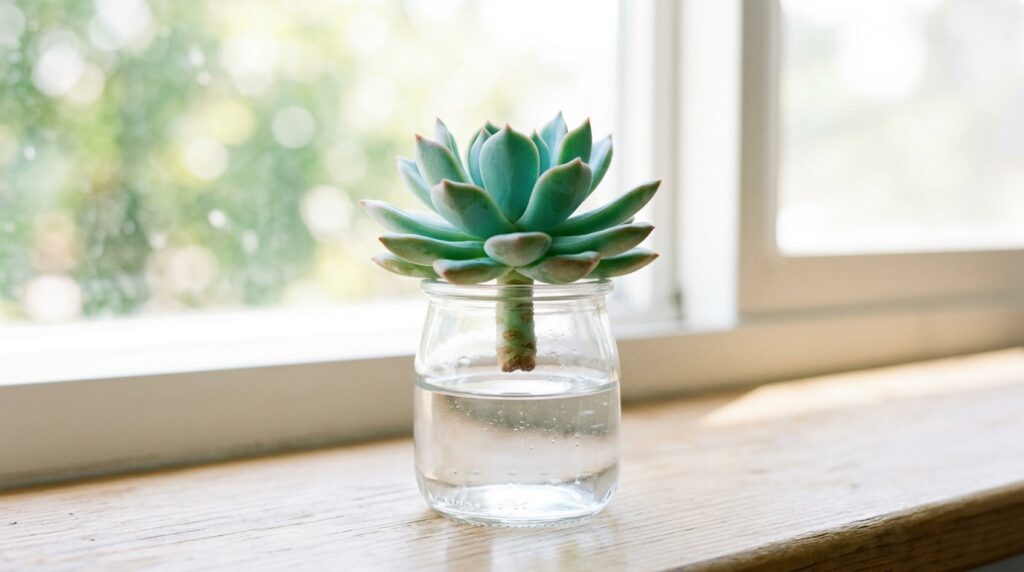
Sometimes you end up with a cutting or a detached leaf with no roots at all. Don’t throw it away.
For Stem Cuttings Without Roots
Follow the same callusing and planting process described in the section above. Roots will develop in the soil within 2–4 weeks.
For Leaves Without Roots
Lay individual leaves flat on top of moist succulent soil. Within a few weeks, tiny pink roots will emerge from the base, followed by a miniature rosette. This is called leaf propagation.
Tips for leaf propagation:
- Choose plump, healthy leaves that came off cleanly (with the base intact)
- Keep them in indirect bright light
- Mist lightly every 2–3 days
- Don’t bury them — just lay them on the surface
How to Grow Succulents From Leaves Without Soil
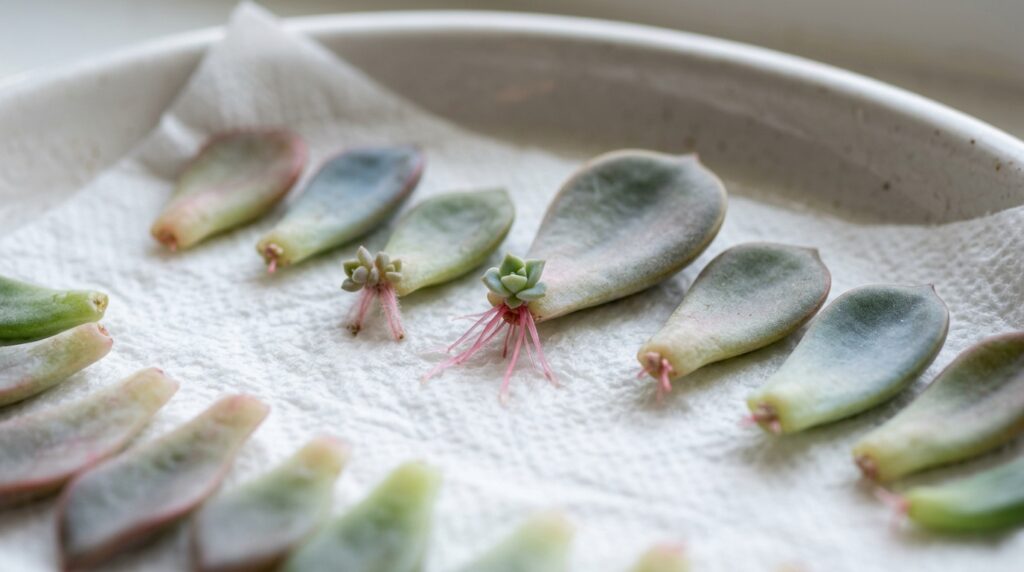
It’s actually possible to start succulent leaves without any soil at all — especially during early propagation stages.
Paper Towel Method
- Lay healthy succulent leaves on a slightly damp paper towel.
- Place in indirect bright light.
- Mist every 1–2 days to keep the towel barely moist.
- Once roots and a tiny rosette form (usually 2–4 weeks), transfer to succulent soil.
This method lets you monitor root development easily, which is why many propagators prefer it for the early stage.
Perlite: Why It Matters for Succulents
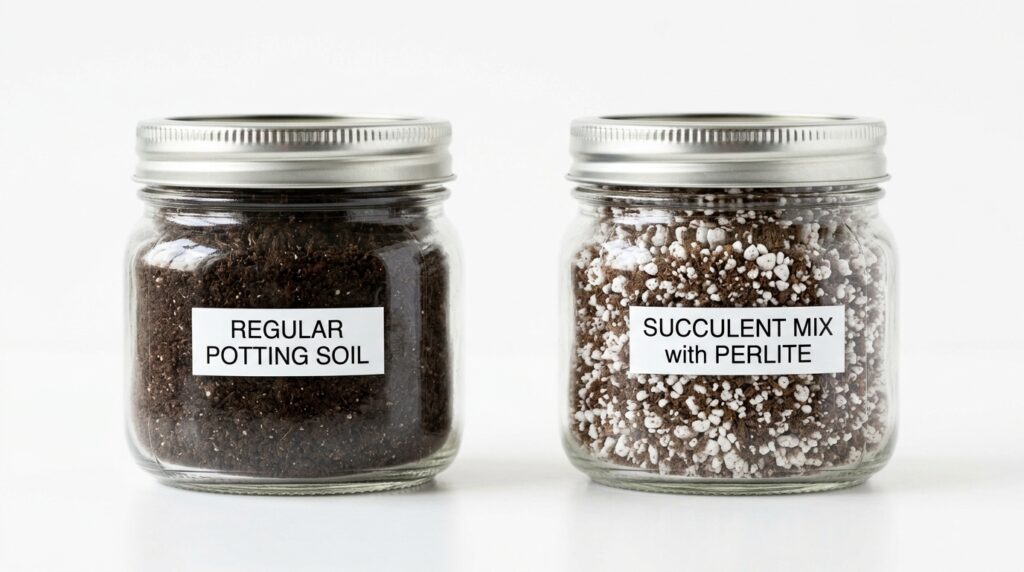
Perlite is one of the most useful materials in the succulent grower’s toolkit. It’s a naturally occurring volcanic glass that’s been expanded by heat into lightweight white granules.
Why Add Perlite?
| Benefit | What It Does |
|---|---|
| Improves drainage | Water flows through quickly, preventing root rot |
| Increases aeration | Roots have access to oxygen between waterings |
| Prevents compaction | Soil stays loose and workable over time |
| Lightweight | Reduces pot weight, especially for hanging planters |
For succulents, a 50/50 mix of cactus soil and perlite is the gold standard.
Expert Tips
Here are some pro-level insights to take your succulent growing to the next level:
Tip 1: The Soak-and-Dry Method
Water thoroughly until it runs from the drainage holes, then don’t water again until the soil is completely dry. This mimics natural desert rainfall and builds stronger, deeper root systems.
Tip 2: Rotate Your Pots
Indoor succulents will lean toward the light source. Rotating pots a quarter-turn every week keeps growth even and symmetrical.
Tip 3: Watch for Etiolation
If a succulent starts to stretch and the leaves space far apart, it’s reaching for more light. Move it closer to a window or add a grow light immediately.
Tip 4: Don’t Fear Brown Lower Leaves
Lower leaves naturally dry up and fall off as the plant grows. This is normal. Only worry if leaves in the center or upper portions are yellowing or turning mushy.
Tip 5: Repot Every 1–2 Years
Succulents eventually outgrow their containers, or the soil loses its drainage over time. Repot in fresh succulent mix to refresh the growing medium and give roots more room.
Tip 6: Feed Lightly in Spring
A diluted balanced fertilizer (half-strength) applied once in early spring can give established succulents a boost going into the growing season. Skip fertilizer in fall and winter.
Common Problems and Solutions
| Problem | Likely Cause | Solution |
|---|---|---|
| Mushy, translucent leaves | Overwatering | Let soil dry completely; repot if roots are rotted |
| Wrinkled, shriveled leaves | Underwatering | Deep water thoroughly, then resume regular schedule |
| Pale, stretching growth | Insufficient light | Move to brighter spot or add grow light |
| Brown crispy leaf tips | Too much direct sun or dry air | Provide afternoon shade or move away from hot glass |
| White powdery residue on soil | Mineral buildup from hard water | Use filtered water; flush soil occasionally |
| Black spots on leaves | Fungal disease or frostbite | Remove affected leaves; improve airflow |
Pros and Cons of Growing Succulents
Pros
- Low maintenance and drought-tolerant
- Available in an enormous variety of colors and forms
- Can be grown indoors or outdoors
- Easy to propagate and share
- Long-lived when cared for correctly
- Pet-friendly varieties exist (though many are mildly toxic to cats/dogs)
Cons
- Very sensitive to overwatering
- May struggle in high-humidity climates
- Need specific soil that regular potting mix can’t provide
- Some varieties are toxic to pets (always check individual species)
- Indoor growing often requires supplemental grow lights
FAQs
How deep should succulents be planted?
Succulents should be planted at the same depth they were growing in their nursery container. The base of the plant (where stem meets roots) should sit just at or slightly above the soil surface. Burying the stem too deep can cause rot.
Can you plant succulents in regular potting soil?
Regular potting soil holds too much moisture for succulents. It’s best to either buy a dedicated cactus and succulent mix or amend regular potting mix with 50% perlite to improve drainage.
How long does it take for succulent cuttings to root?
Most succulent cuttings develop roots within 2–4 weeks when kept in indirect bright light with minimal watering. Leaf propagation can take 4–8 weeks before a recognizable rosette appears.
Do succulents need direct sunlight?
Most succulents prefer at least 4–6 hours of bright, direct sunlight. Indoors, a south-facing window is ideal. If natural light is limited, a full-spectrum LED grow light used for 12–14 hours daily works well.
How often should I water newly planted succulents?
After planting, wait 2–3 days before the first watering. After that, water when the top inch of soil feels completely dry — typically every 7–14 days in warm months and once a month or less in winter. Always water deeply and allow full drainage.
Conclusion
Succulents are genuinely rewarding plants. Once you get the basics right — fast-draining soil, proper sunlight, and disciplined watering — they reward you with years of color, texture, and even new plants to propagate and share.
Whether you’re planting succulents in pots on your kitchen counter, building an outdoor rock garden, or experimenting with growing succulents from cuttings for the first time, the fundamentals are always the same: give them light, give them drainage, and resist the urge to overwater.
Start small. Pick one or two varieties you love. Learn how they respond. Then expand from there.
The world of succulents is deep, creative, and endlessly satisfying. You’ve got everything you need to get started.
This article is for informational purposes only. While every effort has been made to provide accurate and helpful gardening guidance, results may vary depending on your local climate, soil conditions, and specific plant varieties. Always consult a local horticulture expert for advice tailored to your specific situation.

