
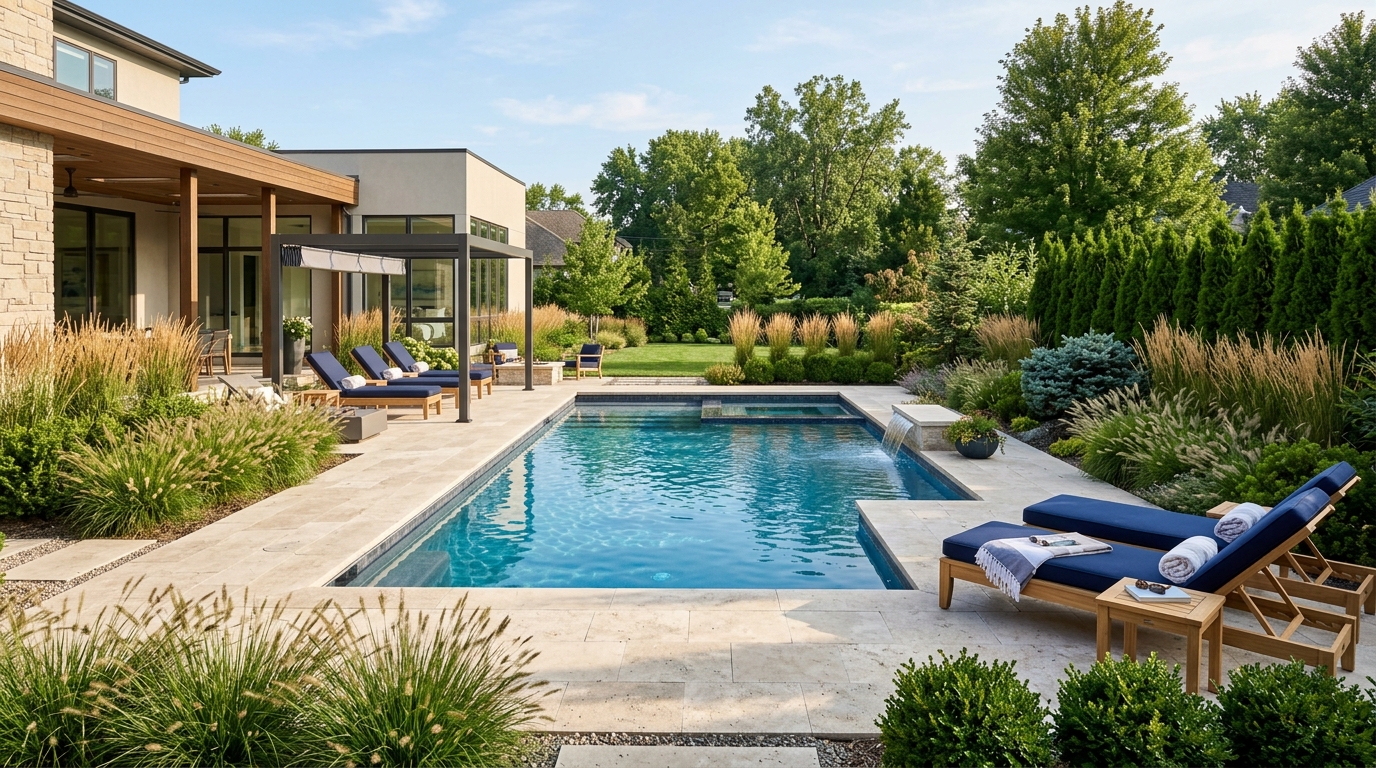
A beautiful swimming pool can transform any backyard into a personal oasis. But without thoughtful landscaping, even the most stunning pool might feel like it dropped out of the sky, rather than being an integrated part of your home.
Thoughtful backyard pool landscaping isn’t just about aesthetics. It profoundly impacts maintenance, functionality, and how much you truly enjoy your outdoor space. From managing debris to enhancing privacy and creating a resort-like ambiance, every design choice matters.
Whether you’re planning a brand-new installation or renovating an existing space, designing your backyard pool landscape is a critical step. From the initial concept for your custom in-ground swimming pools to the final plant selection, every decision shapes your outdoor experience.
In this extensive guide, we will explore everything you need to know. We’ll cover essential design zones, practical hardscape materials, and low-maintenance plant choices. We’ll also dive into ambiance-enhancing lighting, water features, and common mistakes to avoid. Our goal is to help you balance beauty with ease of care, ensuring your pool area becomes a true extension of your home.
Before any digging begins, a comprehensive understanding of your backyard’s structural layout and how you intend to zone the space is paramount. This foundational planning prevents costly mistakes and ensures a harmonious, functional outdoor environment. We consider factors like property boundaries, existing structures, sun exposure, and wind patterns. The goal is to create distinct, yet interconnected, areas that serve different purposes, much like rooms within a house.
We always begin by assessing the site. This includes understanding the grade and slope of your land, which will influence drainage and the need for retaining walls. For instance, steep hillsides might necessitate an infinity-edge pool to maximize panoramic views, as seen in some luxury builds. Conversely, a flat yard offers more flexibility for traditional designs. We also map out essential elements like utility lines, septic systems, and any municipal setbacks that dictate where structures can be placed. A well-executed plan ensures that your pool and surrounding landscape integrate seamlessly, enhancing both curb appeal and usability.
Defining Activity Zones and Circulation
Effective pool landscaping revolves around defining clear activity zones and incorporating practical landscaping ideas that ensure smooth circulation. Think about how you and your guests will use the space. The pool deck, for example, is your primary hardscape area directly surrounding the water. We recommend extending this deck at least 4 feet, and ideally 6 feet on lounging sides, to provide ample space for sunbathing and easy movement.
Beyond the immediate deck, we consider areas for lounging, dining, and even hidden storage. A rough hardscape-to-softscape ratio for pool areas is often 60–70% hardscape and 30–40% softscape within 10 feet of the pool, inverted for areas beyond 10 feet. This ensures a clean, low-debris zone close to the water while allowing for lush greenery further out. Walkways should be designed for comfort and safety; a 36-inch width is suitable for single-file traffic, while 48–60 inches allows two people to walk side-by-side. Crucially, we always plan for equipment access, ensuring 24–36 inches of clearance around pool pumps, heaters, and filters for maintenance. Establishing clear sightlines from your home to the pool is also vital, especially for families with children, allowing for easy supervision.
Integrating Sun Shelves, Spas, and Compact Basins
Modern pool design often incorporates features that enhance relaxation and functionality. Sun shelves, also known as Baja shelves or tanning ledges, are shallow areas within the pool where you can place lounge chairs or simply relax in a few inches of water. These create a resort-like feel and are perfect for cooling off without fully swimming.
For smaller backyards, plunge pools, cocktail pools, or integrated spas offer high-end functionality without requiring extensive space. Plunge pools are compact, deep pools ideal for cooling off or hydrotherapy, while cocktail pools are slightly larger, perfect for intimate gatherings. Integrating a spa with a spillover feature adds a dynamic water element and year-round enjoyment. When planning these features, consider their placement relative to the main pool and surrounding zones, ensuring they feel like a natural extension of your outdoor living space.
Key Phases of Custom Swimming Pool Construction
Building a custom swimming pool is a multi-phase project, each step critical to the final outcome’s quality and longevity. From the initial excavation to the intricate plumbing, every detail requires meticulous planning and execution. Understanding these phases helps manage expectations and ensures a smooth construction process.
The journey typically begins with excavation, where the pool’s shape is dug out of the earth. This is followed by the installation of a steel rebar cage, forming the structural skeleton of the pool. Shotcrete or gunite is then applied over the rebar to create the durable shell. Throughout this process, geotechnical tests might be conducted to assess soil stability, especially in sloped yards, often leading to the integration of retaining walls for slope stabilization. Proper plumbing diagrams are followed meticulously to ensure efficient water circulation and filtration. Furthermore, careful consideration is given to drainage, with swales or French drains designed to direct rainwater away from the pool area, preventing erosion and waterlogging.
Engineering and Permitting in Custom Swimming Pool Construction
Before any ground is broken, securing the necessary permits and adhering to local building codes is non-negotiable. This phase involves structural engineering to ensure the pool’s design can withstand local soil conditions and environmental factors, such as freeze-thaw cycles in colder climates. Municipal zoning regulations dictate where on your property a pool can be built, often including setback requirements from property lines and other structures.
Crucially, barrier codes and safety regulations, such as fencing requirements, must be met to ensure the safety of children and pets. These regulations vary by municipality and state, so working with experienced professionals who are well-versed in local ordinances is essential. For instance, in colder regions, understanding the local frost line is vital for proper foundation and plumbing installation to prevent damage from ground heaving. Neglecting this phase can lead to significant delays, costly rework, or even legal issues down the line.
Shell Installation, Rough-Ins, and Utility Integration
Once the excavation and structural engineering are complete, the focus shifts to the shell installation and the integration of all necessary utilities. This includes the precise placement of electrical conduit for lighting and pumps, as well as plumbing lines for water circulation, filtration, and features like deck jets or waterfalls.
The bond beam, a reinforced concrete beam around the top edge of the pool shell, is a critical structural component, providing a solid base for coping and decking. Skimmer plumbing, return lines, and main drains are installed, along along with hydrostatic valves to prevent the pool from floating out of the ground in areas with high water tables. Careful planning in this “rough-in” stage prevents future headaches, ensuring all systems are properly connected and accessible for maintenance. It’s also the ideal time to install any subsurface drainage like French drains or to lay conduit for future landscape lighting, avoiding the need to dig up finished hardscaping later.
Hardscaping Materials and Architectural Features
The hardscape forms the backbone of your pool landscape, defining pathways, lounging areas, and the immediate surround of the pool itself. The choice of materials significantly impacts aesthetics, durability, and comfort underfoot.
When selecting materials, we prioritize those that are slip-resistant, durable, and complement your home’s architectural style. For instance, outdoor tile for wet areas must maintain a minimum Dynamic Coefficient of Friction (DCOF) rating of 0.42 for safety. Polymeric sand is often used in paver joints to inhibit weed growth and ant activity, contributing to a cleaner, more stable surface. From classic tumbled travertine to modern concrete pavers, each material offers unique benefits and considerations.
Choosing Decking and Coping Materials
The materials you choose for your pool deck and coping are central to both the look and feel of your pool area. Travertine pavers are a popular choice, known for their natural beauty, durability, and ability to stay relatively cool underfoot, even on hot summer days. Standard 16×16 inch tumbled travertine pavers cost $4–$7 per square foot in materials and $14–$22 per square foot installed professionally.
Concrete pavers offer a more budget-friendly option while still providing versatility in color, shape, and pattern, costing $8–$14 per square foot installed. Natural limestone and stamped concrete are other viable choices, each providing a distinct aesthetic. When it comes to coping—the material capping the pool’s edge—options like bullnose, cantilever, or rough-cut edges can dramatically alter the pool’s profile. We recommend selecting coping that harmonizes with your decking material for a cohesive look. For example, travertine coping is commonly paired with stamped or poured concrete decking for poolside installations.
Incorporating Water Elements and Fire Features
To elevate the ambiance of your pool area, consider integrating water and fire features. Water features like sheer descents, deck jets, and bubblers add soothing sounds and visual interest. Deck jets, which shoot arcs of water into the pool, range from $800–$1,500 per jet including labor. Sheer descent waterfalls, often integrated into a raised bond beam wall, cost $1,500–$3,500 per waterfall. These elements can transform a simple pool into a dynamic focal point.
Fire features, such as linear fire pits or strategically placed fire bowls, extend the usability of your outdoor space into cooler evenings and create a cozy, inviting atmosphere. A fire pit close to the pool allows swimmers to warm up after a swim and allows homeowners to enjoy their outdoor living space at night and into cooler seasons. When incorporating fire, always maintain a safety buffer of at least 10 feet between open flames and the edge of the pool water, and ensure proper ventilation and material clearances are met. These elements, when thoughtfully designed, create a captivating sensory experience.
Low-Maintenance Poolside Landscaping and Planting Strategies
While lush greenery is desirable, low-maintenance landscaping requires a strategic approach to minimize maintenance and debris around the pool. The average pool owner spends 4–6 hours per week on pool maintenance during the swim season, and surrounding landscaping should add no more than 30–45 minutes to that weekly workload. This means selecting plants that are low-litter, tolerant of pool chemicals, and have non-invasive root systems.
We consider the unique microclimate around a pool, where plants might be exposed to splash-out with chlorinated or saltwater, as well as increased humidity. Proper drainage is crucial to prevent waterlogging around plant roots. We also advocate for automated irrigation systems, such as drip irrigation, to ensure plants receive consistent moisture without overwatering, which can lead to runoff into the pool. Container plantings offer flexibility, allowing you to introduce tropical species that can be moved indoors during colder months.
Selecting Low-Debris and Chemical-Tolerant Plants
The key to low-maintenance pool landscaping lies in choosing the right low-maintenance plants. We prioritize species that don’t shed excessive leaves, flowers, or fruit, which can clog skimmers and filters. Ornamental grasses like Karl Foerster Feather Reed Grass or Blue Oat Grass are excellent choices, providing texture and movement with minimal debris. Non-fruiting perennials and evergreen shrubs also work well.
It’s also vital to select plants tolerant of chlorine and other pool chemicals. While no plant thrives on direct chemical exposure, some are more resilient to occasional splash-out. Agave, Drift Roses, Loropetalum, and Lantana are examples of plants that perform well in poolside environments. We advise against planting large, deciduous trees too close to the pool (maintain at least 15–20 feet distance) to avoid root intrusion into plumbing and excessive leaf drop. For areas closer to the pool, low-growing ground covers or shallow-rooted ornamental grasses can be placed 2–3 feet from the deck edge.
Designing Privacy Screens and Nighttime Illumination
Privacy is a common concern for pool owners. We can create effective privacy screens using columnar evergreens like certain varieties of arborvitae, planted 3 to 4 feet apart to form a dense visual barrier. These provide year-round screening without taking up too much horizontal space. Layered plantings with varying heights can also create a sense of enclosure and seclusion.
Outdoor lighting transforms your pool area into a magical retreat while improving safety and extending the usability of the space after dark. In-pool LED lighting creates stunning visual effects, while path and step lighting ensures safety. Landscape uplighting can highlight architectural features or specimen plants, adding dramatic flair. Overhead string lights draped across a pergola or seating area create a festive, intimate atmosphere. For security, motion-activated lights can be integrated discreetly. Installing electrical conduit and low-voltage wiring before hardscaping and planting saves significant time and expense, allowing for easy integration of accent uplighting, under-stair LEDs, and other security lighting elements.
Project Budgeting and Investment Planning
Understanding the financial scope of a pool landscaping project is crucial. A complete professional pool landscape installation for an average-sized backyard (including deck pavers, plants, lighting, and irrigation) typically costs $15,000–$45,000. However, a phased DIY approach can significantly reduce costs, ranging from $6,000–$18,000 in materials. These figures are general for August 2026 and can vary widely based on location, material choices, and project complexity.
Key cost drivers include material costs for hardscaping (pavers, stone, concrete), labor expenses for installation, electrical runs for lighting and features, and grading needs for proper drainage. Infinity edge pools, for example, often incur 25–40% higher construction costs than standard pools due to their complex engineering. We always recommend building in a contingency reserve, typically 10–15% of the total budget, to cover unforeseen expenses.
Budget Planning for Custom Swimming Pool Construction
When budgeting for a custom swimming pool, we break down costs into several categories. The pool shell itself is a major component, with a naturalistic freeform pool with tumbled stone and mature landscaping potentially totaling between $75,000 and $125,000, including $50,000–$80,000 for the pool/hot tub shell. Hardscape square footage, including pavers or concrete, will be a significant line item. Standard 16×16 inch tumbled travertine pavers cost $4–$7 per square foot in materials, while quality concrete pavers cost $8–$14 per square foot installed.
Drainage solutions, such as French drains or extensive grading, are essential but often overlooked budget items. Automated irrigation systems, while an upfront cost, save time and water in the long run. Electrical runs for pumps, heaters, lighting, and water features also need to be factored in. For those looking to manage costs, a phased installation, tackling different elements over time, can make the project more financially manageable. Always obtain detailed quotes from reputable contractors, ensuring all aspects of the project are clearly itemized.
Frequently Asked Questions About Custom Swimming Pools
What hardscape materials stay coolest underfoot around a pool?
Travertine pavers and light-colored concrete are generally the coolest hardscape materials for pool decks. Their light hues reflect sunlight rather than absorbing it, making them more comfortable to walk on during hot days. Travertine, in particular, has natural pores that help dissipate heat. In contrast, dark stones like slate or dark granite absorb significant heat, becoming uncomfortably hot. Surface texture also plays a role; materials with a slightly rough or porous finish tend to feel cooler than smooth, dense surfaces.
How far should trees and large shrubs be planted from the pool shell?
To prevent potential damage from root systems and minimize debris in the pool, we recommend planting trees at least 15 to 20 feet away from the pool shell. Large shrubs should be positioned at least 10 feet away. This distance helps protect plumbing lines and the pool structure from invasive roots. Furthermore, it significantly reduces the amount of leaf, flower, or fruit drop into the pool, which can clog skimmers and increase the workload on your filtration system. For smaller plants and ornamental grasses, a distance of 2–3 feet from the deck edge is often sufficient, provided they are low-litter and have shallow root systems. Root barriers can also be considered for certain species if closer planting is desired, but general setback standards are always the safest approach.
How can swimming pool landscaping be designed for low weekly maintenance?
Designing for low weekly maintenance involves a combination of smart material choices and strategic planting. Firstly, aim for a higher hardscape-to-softscape ratio (around 60–70% hardscape within 10 feet of the pool) to minimize areas requiring mowing or extensive planting. Secondly, select low-litter foliage; avoid trees and shrubs that shed heavily or produce messy fruit/flowers near the pool. Ornamental grasses and evergreen shrubs are excellent choices.
Thirdly, manage mulch effectively, keeping depth between 2 to 3 inches to prevent fungal growth and ensure it doesn’t wash into the pool. Fourth, install automated drip irrigation systems for targeted watering, reducing manual effort. Lastly, ensure your pool’s skimmer efficiency is optimized by keeping surrounding areas clean and free of debris, which is easier with low-maintenance plants. A well-designed landscape should complement your pool, not become another chore.
Conclusion
Designing your dream custom swimming pool is an exciting journey that extends far beyond just the water itself. It’s about creating a holistic outdoor living space that reflects your lifestyle, balances beauty with practicality, and provides lasting enjoyment for years to come. By thoughtfully planning your structural layout, defining activity zones, and carefully selecting hardscape materials and low-maintenance plants, you can create an environment that feels like a true extension of your home.
The goal is to build what works for your real life, then make it beautiful. Prioritizing elements like proper drainage, chemical-tolerant plants, and strategic lighting will ensure long-term durability and minimize the weekly maintenance burden. As we move into August 2026, the trend continues towards integrated, functional, and aesthetically pleasing outdoor spaces. With careful master planning and attention to detail, your backyard pool landscape will not only enhance your property value but also provide a serene, resort-like escape right outside your door.

