
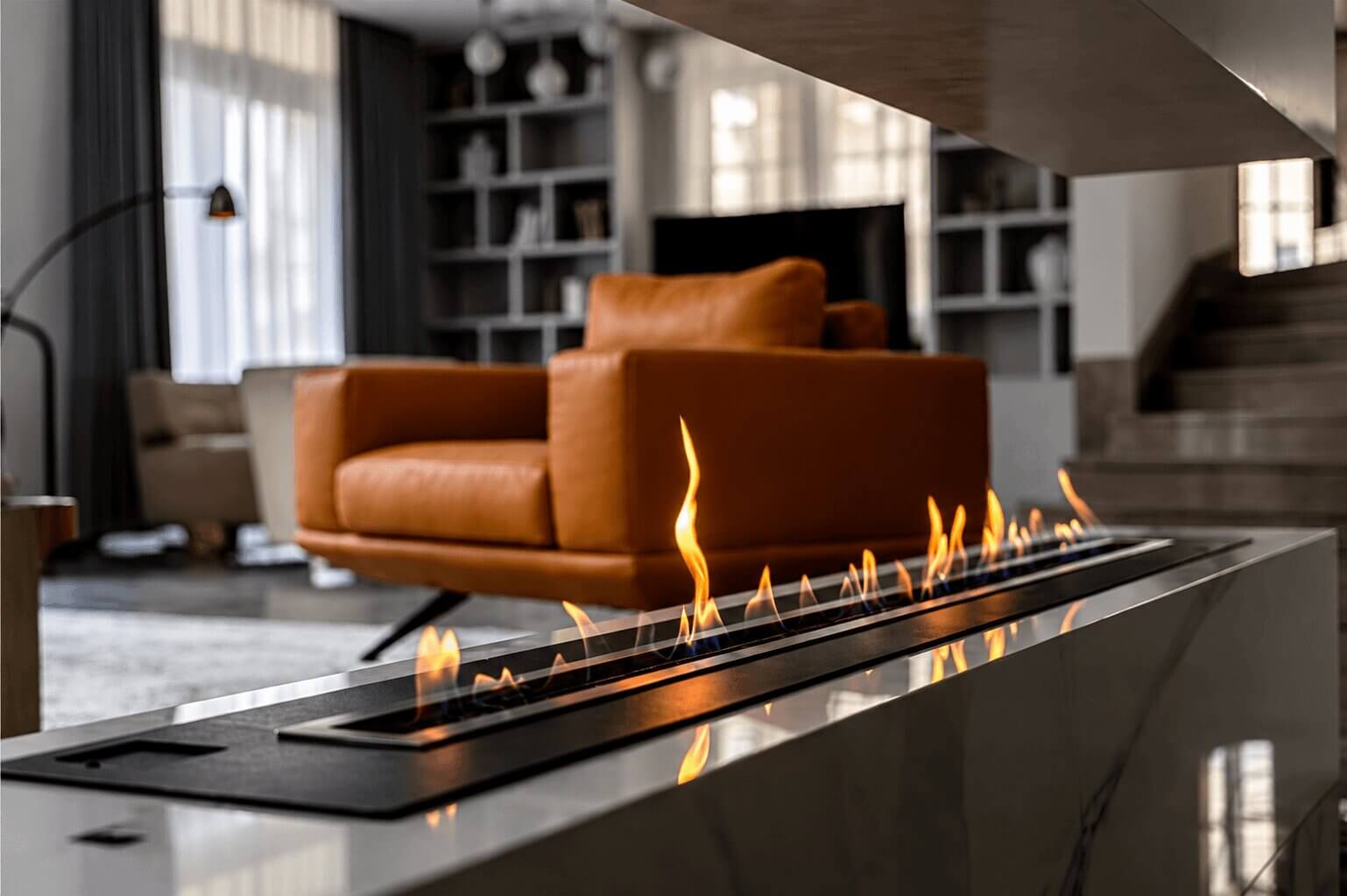
Before choosing a bioethanol fireplace, consider when you would actually use it. If evenings mean children playing on the floor, a dog settling beside the sofa and adults moving between rooms, an open flame adds another responsibility. The first decision is whether you can give it the space and supervision it needs.
That responsibility continues after the flame goes out, while the appliance cools. Before comparing finishes or burner lengths, agree who will operate the fire, where the fuel will live and how children and pets will be kept away.
Start with the routes people already use: from the kitchen to the sofa, past the toy cupboard or through to the garden. A fireplace beside a busy route may be awkward even in a large room. Try marking out its proposed position before committing to building work.
Allow for furniture moving, too. An armchair may be pulled forward for a visitor; a stool may end up beside the hearth. Combustible furnishings must stay outside the appliance’s specified clearances in everyday use, not just in the planned layout.
Height alone will not settle the question of access. A chair beneath a wall-mounted unit can become a climbing step, and a low ledge may invite someone to sit. Look at what children can reach using the furniture around the fireplace, as well as where pets tend to rest.
If you plan to use a guard, ask the supplier and installer to check its suitability for the appliance, including airflow, clearances and access. If you cannot reliably keep children and pets away from the flame and hot surfaces in that position, choose another location or reconsider having the fireplace.
What automatic controls actually do
The word “automatic” can cover different functions. Ask which steps the exact model handles and which remain your responsibility: filling, ignition, flame adjustment and shutdown. Do not assume that electronic controls mean hands-off operation.
A demonstration should cover the whole sequence, including what happens when something goes wrong. Where does the fuel go? How do you know filling has finished? What does a fault message mean? Ask to see the instructions you will receive with the appliance.
When reviewing options such as SXFireplace’s automatic bioethanol burners, check the exact model and configuration being supplied. Have the seller demonstrate any advertised filling, ignition or flame-adjustment functions rather than relying on a feature list for the wider range.
If a child lock is included, find out which controls it disables and how to activate it. A lock may restrict operation, but it cannot keep a child away from the flame or hot surfaces. It does not remove the need for adult supervision.
Give the remote a fixed place out of children’s reach, even when the fireplace is off. Everyone allowed to operate it should know the same procedure. Make the arrangement clear to visitors and babysitters; they should not have to guess whether they are expected to manage the fire.
Planning for fuel storage and filling
Fuel storage is easy to overlook when choosing a fireplace. Decide on it before ordering. Follow the fuel label and appliance instructions, keep the container tightly closed and inaccessible to children, and store it away from heat and ignition sources. A spare cupboard beside the fireplace is not automatically a suitable place.
Check access to the filling point with the installer. The adult handling the fuel needs to see and reach it comfortably, keep children away and finish without interruptions. A deep ledge or an armchair in front of the connection can turn a routine task into an awkward one.
Use only the fuel specified for the appliance. Never refill while it is burning or hot; the flame must be fully extinguished and the appliance completely cool, with the manual’s cooling requirements met. Health Canada’s guidance on pourable fuels warns that alcohol flames can be hard to see. Pouring fuel into a hot or burning reservoir can cause flame jetting, sending burning fuel towards the person refilling it and anyone nearby. A quick glance is not enough to decide it is ready.
If the model uses pump-assisted filling, follow its instructions and use the designated connection. Do not pour fuel into the flame opening. Stay with the filling process, even if an automatic stop is provided. If fuel spills or a fault appears, leave the appliance off and follow the manual’s procedure; get help from the supplier if the instructions do not resolve the problem.
When the room is busy or you are likely to be interrupted, leave filling for later. That needs to be a realistic option in your household, rather than a rule everyone intends to follow but struggles to fit into the evening.
Choosing a surround for the room
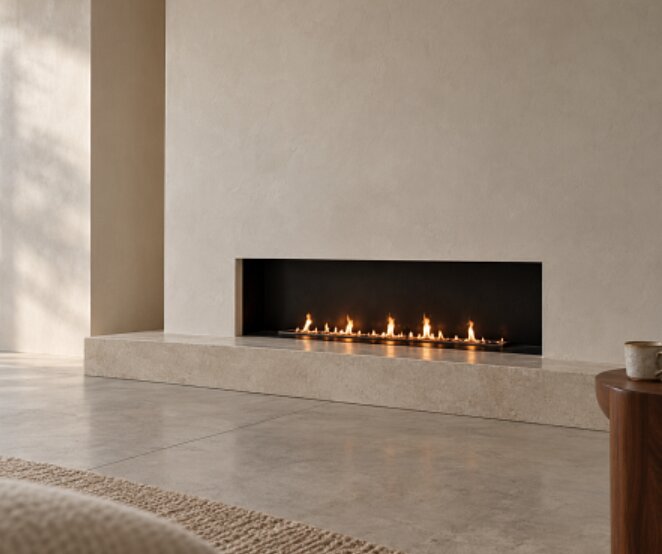
Once the position and operating routine make sense, look at the fireplace with the flame off as well as on. A dark recess can stand out against pale walls, while heavily veined stone may compete with artwork or a patterned rug. Try material samples beside furniture you intend to keep. A simpler finish may suit the room better than another prominent feature.
Check the surround’s full depth, not just its front elevation. It may take space from a walking route or the area beside a chair. Mark the footprint on the floor and the opening on the wall, allowing for all specified clearances.
Before ordering stonework or cabinetry, confirm that the model is intended for the proposed indoor use and that the room meets its installation requirements. Comparing different types of fireplace inserts and their installation requirements can also help clarify the safety considerations associated with different fireplace designs. Ask the installer to review the support, construction materials and anything above the fire, including a shelf or television. Burner air openings and room ventilation are separate requirements: a vent in the surround does not establish that the room has adequate ventilation.
Find out how the unit will be inspected and serviced once the surround is finished. Keep that access and the specified air paths clear when rearranging furniture or adding decorations.
Staying until the fire is out
Consider the end of the evening before lighting the fire. A responsible adult needs to supervise it through shutdown until the flame is fully extinguished. If everyone is about to go upstairs or leave the house, keep it off.
At handover, ask to see the shutdown sequence and find out whether a flame can remain after the stop command. Pressing a button is not proof that the fire is out. Keep children and pets away from the appliance while it cools, too.
Keep the model details and instructions where the adults who operate the fireplace can easily find them.
A fireplace has to fit an ordinary evening, including the untidy and rushed parts. If fuel storage, supervision or cooling would be difficult to manage, resolve that before buying. You may need a different position, a different type of fireplace or simply to wait until it suits the household better.
Images courtesy of SXFireplace. Photographs are design references, not installation instructions.

