
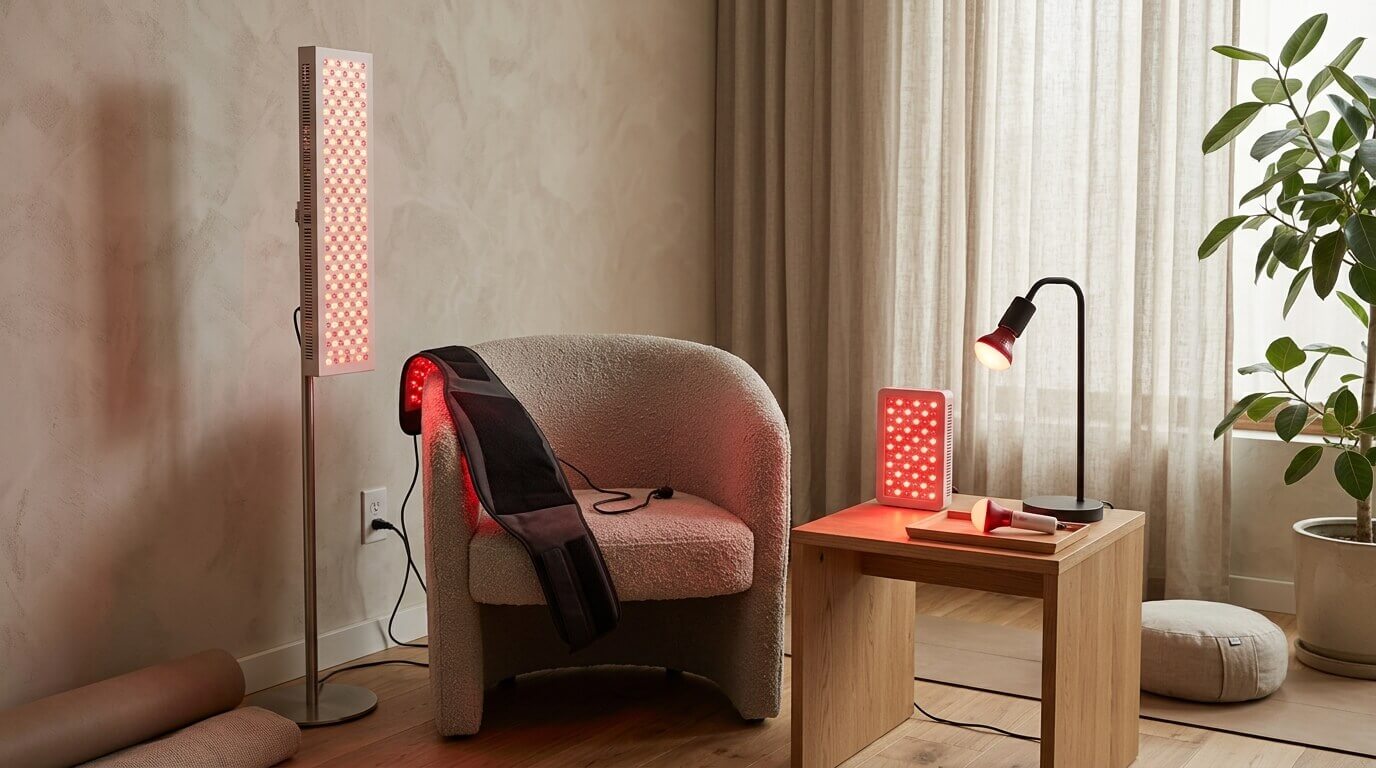
Red light therapy devices have become increasingly common in home wellness routines, but the growing number of formats can make the category confusing. Panels, lamps, belts, bulbs, and larger full-body systems may use similar terminology while offering very different coverage, positioning, and day-to-day convenience.
For consumers comparing these products, the most useful starting point is not deciding which device looks the most advanced. It is considering how and where the device will realistically be used.
A large panel may suit someone who wants broad coverage from a fixed setup, while a wearable belt may make more sense when portability and targeted positioning are the priority, similar to how layered lighting is selected according to the needs of a particular space.
Understanding these differences can make comparing red light therapy formats much easier.
What Are Red Light Therapy Panels Designed For?

Panels are one of the most recognizable formats in this category.
They typically contain multiple LEDs arranged across a flat surface and are positioned in front of the user rather than being held directly against the body.
The main advantage is coverage. Depending on panel size, a single device can illuminate a relatively large area at once.
When comparing red light therapy panels, consumers should look beyond overall dimensions and check practical specifications such as:
- Stated wavelengths
- Output information
- Recommended operating distance
- Treatment area
- Timer and control options
- Mounting or stand configuration
A larger panel is not automatically the better choice. It also requires more space and usually works best when there is a convenient location where it can remain set up.
What Should You Know About Full-Body Red Light Therapy Panels?
Full-body red light therapy panels extend the same basic concept to a larger surface area.
Their size can make them attractive for users who prefer broader coverage without repeatedly repositioning a smaller device. However, they also require more room and may be less convenient in apartments or multipurpose spaces.
Before choosing a large panel, consider where it will actually be positioned and whether the recommended operating distance can be maintained comfortably.
Installation also matters. Some products use floor stands, while others may be designed for wall or door mounting. The physical setup can influence everyday usability as much as the light specifications themselves.
How Do Red Light Therapy Lamps Differ From Panels?
A red light therapy lamp generally offers a smaller and more flexible format than a large panel.
Lamps can be useful when the goal is to position the light toward a more limited area. They may also be easier to store and move between rooms.
This format can make sense for consumers who do not want a permanent wellness setup occupying significant floor or wall space.
The trade-off is coverage. A compact lamp may require repositioning when a larger area is being considered.
Adjustability is therefore important. A lamp with a practical stand, flexible arm, or easily repositioned head can be significantly easier to use than a similarly sized device with limited positioning options.
What About Red Light Therapy Bulbs?
Bulb-style products offer another compact option.
They can resemble conventional lighting bulbs but are designed specifically to produce particular wavelengths rather than ordinary room illumination.
The important point is compatibility. Consumers should confirm that the bulb matches the intended fixture, voltage, socket type, and operating requirements.
A red light therapy bulb should also not be treated as interchangeable with an ordinary red-colored household bulb. Product specifications matter because visible color alone does not explain the wavelengths or output being produced.
How Do Red Light Therapy Belts Work Differently?
Belts differ significantly from panels and lamps because they are designed to sit close to or wrap around a particular area.
A red light therapy belt can therefore offer more freedom of movement and does not require the user to remain positioned in front of a stationary panel.
Potential practical advantages include:
- Portability
- Compact storage
- Targeted positioning
- Easier use in limited spaces
- Less need for a permanent setup
However, consumers should still compare device dimensions and coverage carefully. A belt designed for one area may not provide the same coverage as another model, even when the products appear similar in photographs.
Fit and comfort also matter because wearable products are used differently from freestanding lights.
Which Red Light Therapy Format Provides the Most Coverage?
One of the simplest ways to compare formats is by asking how much area the device can realistically cover.
A practical comparison often looks like this:
- Bulbs and small lamps: Relatively targeted illumination
- Belts: Targeted coverage with wearable positioning
- Medium panels: Broader stationary coverage
- Full-body panels: Large-area stationary coverage
This does not mean one category is inherently superior.
Someone interested in a compact setup may find a smaller device far easier to use consistently than a full-body panel. Conversely, users who want to cover larger areas may find repeatedly repositioning a small lamp inconvenient.
The most useful format is therefore often the one that matches the intended routine and available space.
What Specifications Should You Compare?
Two devices in the same category can still differ substantially.
When reviewing different at-home light therapy devices, consumers should compare the actual specifications rather than relying only on labels such as “professional,” “high power,” or “full body.”
Wavelengths
Check which wavelengths the manufacturer states the LEDs produce rather than assuming all red light therapy devices operate identically.
Different products may use different wavelength combinations, so the specifications should be reviewed before comparing devices.
Output and Recommended Distance
Output figures need context. A manufacturer should ideally explain the distance or positioning at which the device is intended to be used.
Comparing output numbers without considering operating distance can make two devices appear more similar or different than they actually are.
Controls
Timers, intensity settings, and straightforward controls can make regular use simpler, especially when smart home controls are already part of the household setup.
Simple controls may also be preferable when a device is intended for frequent use.
Physical Size
Consider not only the illuminated area but also storage, mounting, and available space.
A full-size panel may provide broader coverage but can be harder to store. A small lamp or belt may take up much less space between sessions.
Manufacturer Instructions
Recommended session duration, positioning, and safety guidance can vary between devices.
Follow the instructions supplied with the particular product rather than applying one routine to every format.
Does Device Size Affect Everyday Convenience?
Size affects more than coverage.
A large panel may require a dedicated space, a suitable stand, or a permanent mounting location. A smaller lamp can usually be moved or stored more easily, while a belt may require very little setup space.
Storage is worth considering before purchasing because a device that is difficult to put away may eventually become inconvenient to use.
For a bedroom or multipurpose room, for example, the overall setup should fit comfortably alongside existing furniture and routines. Practical bedroom lighting decisions follow a similar principle because convenience and room layout can affect how consistently a setup is used.
How Should You Choose Between Targeted and Broad Coverage?
The choice between targeted and broad coverage depends largely on the intended use.
A small lamp or belt may make sense when a limited area is the focus. A medium or full-body panel may be more practical when broader coverage is the priority.
It is also worth considering how often repositioning would be required. If a smaller device needs to be moved repeatedly to cover different areas, the convenience advantage may be reduced.
Rather than assuming that a larger device is better, consider the balance between coverage, setup time, storage, positioning, and available space.
What Should You Consider Before Buying Red Light Therapy Equipment?
A device that looks impressive but is inconvenient to set up may end up being used less often than a simpler format that fits naturally into an existing routine.
Consumers should therefore start with practical questions:
- Where will the device be used?
- How much space is available?
- Is portability important?
- Is broad or targeted coverage preferred?
- Will the device remain installed or need to be stored after each use?
- What operating distance does the manufacturer recommend?
- Which wavelengths are specified?
- What controls are included?
These answers can narrow the choice considerably before detailed specifications are compared.
Conclusion
Red light therapy panels, lamps, bulbs, belts, and full-body systems all approach the same general category from different physical and practical angles.
Panels can provide broader stationary coverage, while lamps offer a smaller and more directional setup. Bulbs can be compact but require careful attention to compatibility, and wearable belts provide targeted positioning with less dependence on a fixed setup.
Rather than choosing based on size, appearance, or marketing terminology alone, compare the actual specifications, coverage, operating distance, controls, mounting requirements, storage needs, and manufacturer instructions.
The most suitable format is ultimately the one that fits the intended use, available space, and practical routine.

