
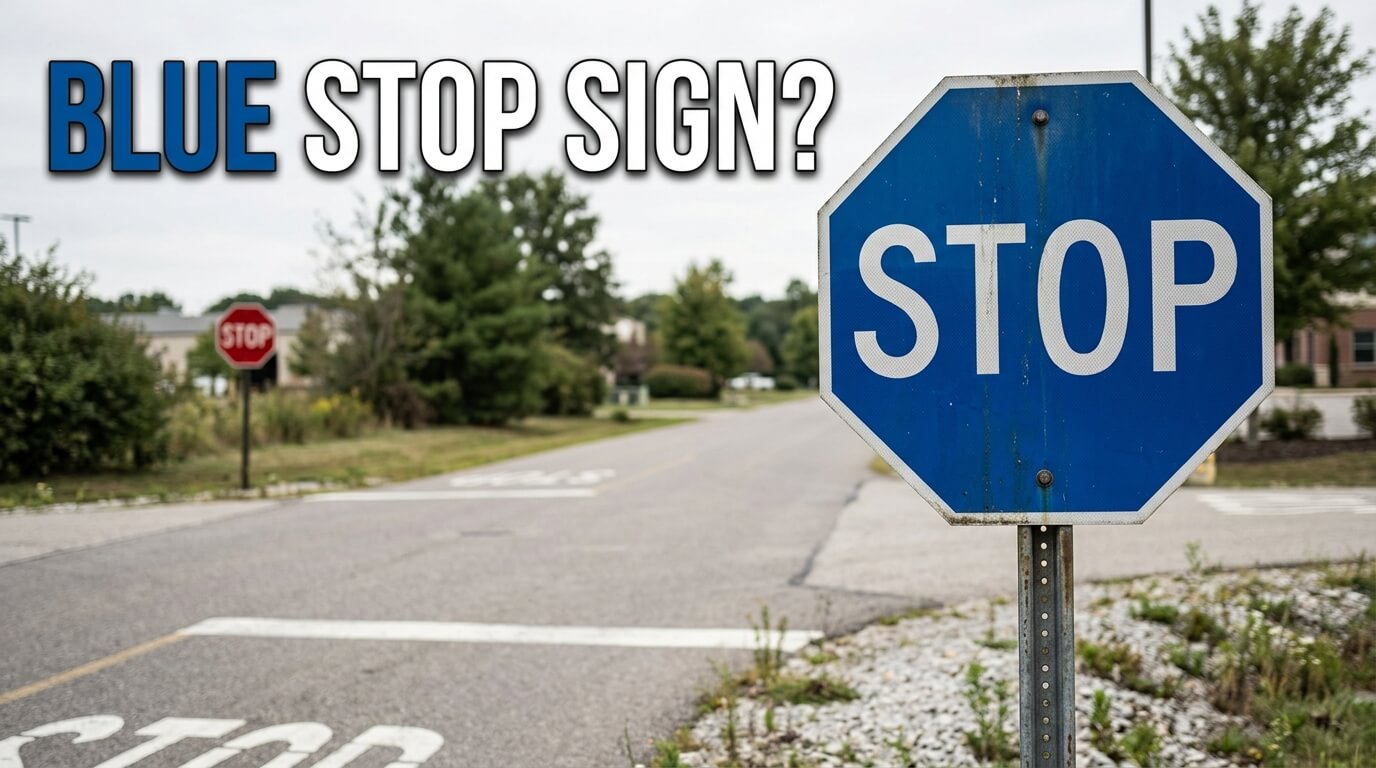
If you have spotted an octagonal STOP sign that is blue instead of red, it is reasonable to wonder what does a blue stop sign mean in the united states and whether you actually have to obey it. The short answer is that a blue STOP sign usually communicates the same practical instruction, stop before proceeding, but it is not the standard official STOP sign used for normal traffic control.
Official traffic-control standards specify a red octagonal STOP sign with white lettering and a white border. A blue version is therefore a nonstandard STOP sign and is most often encountered on privately controlled property, such as parking areas, gated developments, campuses, resorts, or private roads.
For drivers, the safest response is simple: stop, check for vehicles and pedestrians, and proceed only when it is safe. The fact that the sign is blue does not make the intersection or crossing less dangerous.
Why Is a Normal Stop Sign Red Instead of Blue?
Traffic signs are standardized so drivers can understand them quickly without having to read every word. Under current federal traffic-control standards, the STOP sign is represented by the familiar octagonal shape with a red background and white legend.
The combination of shape and color is intentional. An octagon is strongly associated with stopping, while the consistent red color allows drivers to recognize the command quickly in changing traffic conditions.
That standardization also explains why a blue STOP sign deserves attention. It resembles a regulatory sign in shape and wording, but its color tells you that it does not match the normal standardized design.
Drivers who want more background on why these unusual signs appear can also see this blue stop sign meaning guide.
What Does a Blue Stop Sign Actually Tell You to Do?

A blue STOP sign normally tells a driver to make a full stop before continuing through the area it controls. It may be positioned where two parking aisles meet, where a private road crosses another roadway, or where pedestrians frequently cross.
The important distinction is between the instruction and the legal status of the sign. The instruction is easy to understand because the sign literally says STOP, but whether it qualifies as an official traffic-control device depends on where it is installed, who installed it, and the laws governing that roadway.
That is why statements such as “blue stop signs never have to be obeyed” are too broad. A private road can sometimes be subject to local or state traffic rules, and a driver’s other legal duties, such as yielding, avoiding collisions, and stopping before entering certain roads, may still apply even when the sign itself is nonstandard.
Blue Stop Sign vs. Red Stop Sign
The easiest way to understand the difference is to separate standardized public traffic control from privately installed traffic guidance.
| Feature | Red STOP Sign | Blue STOP Sign |
|---|---|---|
| Shape | Octagonal | Usually octagonal |
| Wording | STOP | Usually STOP |
| Background | Red | Blue |
| Standard design | Yes | No |
| Common location | Public roads and official traffic-control areas | Private roads, parking areas, campuses, and resorts |
| Driver response | Come to a complete stop | Stop and check before proceeding |
| Legal status | Governed by applicable traffic laws | Depends on the property, roadway, and local laws |
A blue sign should not automatically be treated as meaningless simply because it differs from the standard color. In a busy parking area, for example, the sign may exist because approaching vehicles have poor visibility or because pedestrians regularly pass through the crossing.
Property managers also have to think beyond signs alone. Clear arrows, crosswalks, lane markings, lighting, pavement condition, and visibility all contribute to safer circulation, which is why commercial parking lot care and traffic-flow planning can be just as important as the sign itself.
Where Are Blue Stop Signs Usually Found?
You are more likely to encounter a blue STOP sign away from a normal city street or highway. These signs are commonly associated with locations where a private owner or organization manages vehicle movement.
Examples can include:
- Apartment or condominium developments
- Gated neighborhoods
- Shopping-center parking areas
- Private campuses
- Resorts and recreational properties
- Industrial facilities
- Privately maintained roads
- Large business or office complexes
The exact reason for choosing blue can vary. In some situations, owners want a clear STOP instruction while visually distinguishing their internal sign from the standard government traffic-control sign.
Blue signs are also particularly well known from private-property settings in Hawaii, although seeing one there does not create a separate nationwide definition of the color. The location and road status still matter more than the color by itself.
Do You Legally Have to Stop at a Blue Stop Sign?
There is no reliable nationwide rule saying that every blue STOP sign is legally enforceable in exactly the same way as every official red STOP sign. An official regulatory sign must satisfy applicable standards and be installed under the proper authority, while a privately installed blue sign generally does not meet the standard design for an official STOP sign.
That does not mean you should drive through it without stopping. Traffic laws can extend to certain private roads or areas open to public travel, and separate right-of-way rules may require you to stop or yield regardless of the color of the sign.
If the road’s legal status is unclear, stopping is usually the safest and simplest choice. A few seconds spent checking both directions is preferable to entering an intersection where another driver or pedestrian expects you to stop.
Legal note: Traffic enforcement rules differ by state, municipality, roadway type, and property arrangement. This article provides general information and should not be treated as legal advice about a specific citation or accident.
What Does a Blue Stop Sign Mean in Florida?
If you are searching what does a blue stop sign mean in florida, the practical answer remains the same: it is not the standard design used for an official STOP sign, and it is most likely to appear in a privately controlled area. Drivers should still stop and assess cross traffic, pedestrians, and any nearby roadway before continuing.
Florida law also restricts unauthorized signs placed on or in view of highways when they imitate official traffic-control devices or attempt to direct traffic in prohibited ways. The relevant rules governing unauthorized traffic signs help explain why location and sign authority matter.
There is another important point for private driveways and roads. State law requires a driver emerging from certain private roads or driveways to stop before crossing a sidewalk area and to yield before entering the highway, as described in the private-road and driveway right-of-way requirements.
So even if the blue sign itself is nonstandard, a separate legal duty to stop or yield may still exist.
What Does a Blue Stop Sign Mean in Texas?
For what does a blue stop sign mean in texas, blue does not replace red as the official STOP-sign color. Current state traffic-control standards maintain standardized designs for traffic signs, including the familiar red octagonal STOP sign.
State law also requires motorists to comply with applicable official traffic-control devices and provides rules for who may install them. The traffic signs, signals, and markings law also restricts unauthorized signs that imitate official traffic-control devices or attempt to direct highway traffic.
A blue STOP sign in an apartment complex, ranch road, private development, or parking area should therefore be viewed as a nonstandard traffic instruction unless the roadway has some special legal arrangement. From a driving standpoint, however, stopping remains the sensible response.
What Does a Blue Stop Sign Mean in California?
If you are wondering what does a blue stop sign mean in california, it does not represent a separate official type of STOP sign. Current official traffic-control standards for the state are aligned with the national system and provide standardized specifications for official traffic-control devices.
Driver guidance also tells motorists to make a full stop at a STOP sign before the crosswalk, limit line, or intersection and to check traffic before proceeding. Those basic stopping practices are explained in the driver rules for traffic signs and intersections.
A blue STOP sign seen inside a private residential development, parking area, campus, or privately maintained road should therefore not be confused with a new statewide sign category. Treat it as a clear warning that the property operator expects traffic to stop.
Why You Should Stop Even If the Sign Is Nonstandard
Imagine leaving a large parking area. A blue STOP sign is placed at the end of the aisle, but because it is not red, you assume it can be ignored.
A delivery vehicle may be approaching from your left while a pedestrian is walking across the exit on your right. The purpose of stopping becomes obvious only after you reach the conflict point, which may be too late to react comfortably.
- Check both directions for moving vehicles.
- Look for pedestrians, cyclists, children, and mobility-device users.
- Identify blind corners or parked vehicles blocking your view.
- Determine which traffic movement has priority.
- Enter the crossing slowly when it is clear.
The best way to interpret a strange sign is not to ask whether you can technically get away with ignoring it. First ask what hazard or conflict the sign may have been installed to address.
What If You See a Blue Stop Sign on a Public Road?
A blue STOP sign on what clearly appears to be an ordinary public street would be unusual because it does not match the standard STOP-sign design. Do not assume that gives you permission to continue through the intersection without stopping.
Stop first if doing so is safe, observe the intersection, and continue carefully. If the sign appears damaged, altered, unauthorized, or incorrectly installed, you can report the location to the agency responsible for the roadway after you have safely left the area.
Do not remove, alter, rotate, cover, or replace the sign yourself. A strange sign may be under investigation, located at the edge of private property, or associated with traffic-control arrangements that are not obvious from inside your vehicle.
Common Misunderstandings About Blue STOP Signs
Several claims about these signs are repeated online even though they oversimplify the issue. Understanding the distinction between a nonstandard sign and the driver’s broader legal responsibilities prevents most confusion.
“Blue means stopping is optional.” Not necessarily. The sign may not be a standard official STOP sign, but other traffic, property, or right-of-way rules can still apply.
“Police can never enforce traffic rules on private property.” That is too broad. Enforcement authority varies with state law, local rules, public access, and the legal status of the roadway.
“Every blue sign means private property.” Often, but not automatically. Color alone cannot prove who owns a road or who installed a sign.
“Blue is an official alternative STOP-sign color.” It is not the standardized alternative to the familiar red STOP sign.
FAQs
What does a blue stop sign mean?
A blue STOP sign usually tells drivers to stop in a privately controlled or otherwise nonstandard traffic area. It does not match the standard red design of an official STOP sign, but drivers should still stop and check that the way is clear.
What does a blue stop sign mean in Florida?
It usually indicates a nonstandard or privately installed STOP instruction rather than a new official traffic sign. Separate laws concerning private driveways, intersections, and right-of-way can still require stopping or yielding.
What does a blue stop sign mean in Texas?
It normally indicates a nonstandard STOP sign, often associated with private property. Standard official STOP signs remain red and octagonal, so drivers should not interpret blue as a new statewide traffic-sign category.
What does a blue stop sign mean in California?
A blue STOP sign is not the normal standardized official STOP sign. It may appear on privately controlled property, but the safest driving response is still to come to a complete stop and check for traffic and pedestrians.
Can you get a ticket for running a blue stop sign?
It depends on the roadway, property, state law, local ordinance, and circumstances. Even if the blue sign itself is not an enforceable official traffic-control device, another violation may occur if a driver fails to yield, enters a roadway improperly, drives carelessly, or causes a collision.
Are blue stop signs legal?
A privately installed blue STOP sign may be permitted in some private settings, but regulations vary by jurisdiction and location. Signs placed on or near public highways can face stricter requirements because they must not create dangerous confusion with official traffic-control devices.
Why are some stop signs blue in Hawaii?
Blue STOP signs have become especially associated with privately controlled properties there. They are not a replacement for the standardized red STOP signs used for official traffic control.
Is a blue stop sign the same as a blue traffic-information sign?
No. Blue is used in standardized traffic signage for certain informational or service purposes, while a blue octagonal sign reading STOP is not the standard design for an official STOP sign.
Should I report a blue STOP sign?
You generally do not need to report one simply because it appears inside private property. If it is installed on what appears to be a public road, creates confusion, blocks visibility, or seems dangerously positioned, reporting the location to the responsible roadway authority is reasonable.
Conclusion
So, what does a blue stop sign mean in the united states? In most situations, it is a nonstandard STOP instruction found on private or privately managed property rather than an official red regulatory STOP sign.
The practical response is much less complicated than the legal terminology. Stop completely, look for pedestrians and cross traffic, and proceed only when the path is clear. If you manage a private road or parking area yourself, review local traffic-sign requirements before installing any sign so drivers receive a clear, safe, and legally appropriate message.

