
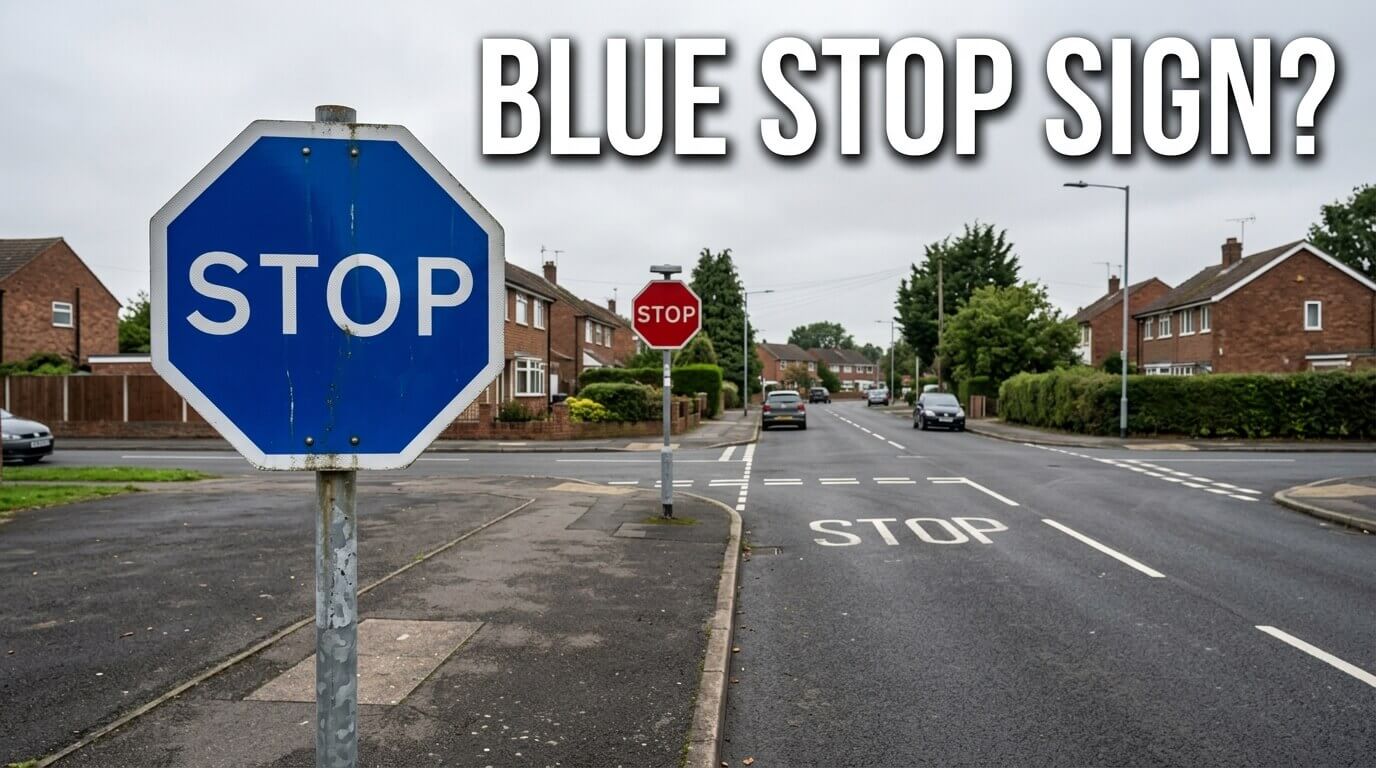
There is no standard UK public-road traffic sign consisting of a blue octagon with the word STOP in the way drivers recognise the official red STOP sign. The official STOP sign and regulatory-sign guidance identifies STOP as one of the important exceptions to the usual shape rules for traffic signs.
A blue STOP-style sign should therefore be treated as unusual rather than as a new category of official STOP sign. If it appears on private premises, a car park, an industrial estate or another controlled site, it may simply be telling drivers where the property operator expects them to stop.
If you are wondering what does a blue stop sign mean in the UK, the most important point is that a blue octagonal STOP sign is not the standard prescribed STOP sign used on UK public roads. The familiar official STOP sign is a red octagon with a white border and the word STOP in white, while blue is used for several other types of road instruction and information.
If you actually encounter a blue sign carrying the word STOP, do not assume that blue has acquired a new official meaning. It may be a private-property sign, a site-management instruction, a custom sign, or another non-standard traffic-control device whose significance depends on where it has been installed.
Quick Answer: What Does a Blue Stop Sign Mean in the UK?
There is no standard UK public-road traffic sign consisting of a blue octagon with the word STOP in the way drivers recognise the official red STOP sign. The official STOP sign and regulatory-sign guidance identifies STOP as one of the important exceptions to the usual shape rules for traffic signs.
A blue STOP-style sign should therefore be treated as unusual rather than as a new category of official STOP sign. If it appears on private premises, a car park, an industrial estate or another controlled site, it may simply be telling drivers where the property operator expects them to stop.
What Does an Official UK STOP Sign Look Like?

The official STOP sign has a distinctive red octagonal background, white border and white STOP lettering. Its unusual shape is deliberate because drivers need to recognise the instruction quickly, including when visibility is poor or part of the sign is obscured.
The official Traffic Signs Manual guidance for STOP signs explains that the STOP sign imposes a mandatory requirement on drivers. It is normally accompanied by the prescribed transverse stop line and the word STOP marked on the carriageway.
Where a proper STOP sign applies, a driver must stop before crossing the transverse line. If that line cannot clearly be seen, the applicable rules require the driver to stop before entering the major road.
| Feature | Official STOP Sign | Blue STOP-Style Sign |
|---|---|---|
| Background | Red | Blue |
| Shape | Octagon | May be octagonal |
| Lettering | White STOP | Usually white or contrasting text |
| Standard public-road sign | Yes | No |
| Meaning | Mandatory stop | Depends on location and context |
| Typical location | Junctions and certain crossings | Often private or controlled areas |
Why Are Some UK Road Signs Blue?
Blue itself has an established role in the UK signing system, but it does not turn an octagonal STOP sign into the normal public-road STOP sign. The official UK traffic-sign signing system explains that blue circles generally give positive mandatory instructions, while blue rectangular signs can provide information or directions.
Common blue circular signs can tell a driver to:
- Turn left or right
- Proceed straight ahead
- Pass a feature on a particular side
- Use a route intended for certain classes of traffic
- Follow another positive mandatory instruction
Blue rectangles have different purposes. For example, blue is widely used for motorway direction signs and certain information signs, so the shape and symbol matter just as much as the colour.
A Blue Circle Does Not Mean “Stop”
This is where some of the confusion comes from. The Highway Code traffic-sign guidance states that signs with blue circles and no red border mostly give positive instructions.
A proper STOP sign is deliberately different. It uses the distinctive red octagon so that it cannot easily be confused with a standard circular mandatory sign.
Where Might You See a Blue STOP Sign?
A blue STOP sign is more plausible in a place where normal highway signage is not being used in the usual way. Examples can include private car parks, business premises, warehouses, industrial facilities, gated land, private access roads or sites that use their own internal traffic-management signs.
For example, a business may want drivers leaving a loading area to stop before crossing a pedestrian route. Clear commercial parking lot markings and traffic routes can reduce confusion where vehicles, deliveries and pedestrians share the same space.
You should not assume that every blue STOP sign has the same legal status simply because it is on private property. Whether road traffic law applies can depend on the nature of the location, access to the public and the circumstances, so the safest approach is to follow the instruction while assessing the surrounding traffic environment.
Is a Blue STOP Sign Legally Enforceable?
You cannot determine enforceability from colour alone. On ordinary public roads in England, Scotland and Wales, traffic signs are governed by prescribed designs and conditions under the Traffic Signs Regulations and General Directions framework.
The standard prescribed STOP sign is not blue. That means seeing a blue octagonal STOP sign should immediately tell you that more context is needed before treating it as an ordinary statutory STOP sign.
Northern Ireland has its own traffic-sign regulations. Its official Highway Code signs and markings guidance also uses the familiar red octagonal STOP sign, rather than a blue version.
This distinction does not mean that a driver should deliberately ignore a blue sign. A property operator may have legitimate safety rules, and ignoring an instruction could put pedestrians, cyclists, workers or other drivers at risk.
What If It Is on a Private Road?
“Private road” does not automatically mean “traffic law does not apply.” The legal position can depend on whether an area falls within the legal meaning of a road and how the public uses or accesses it.
For an ordinary driver, trying to resolve that legal question while approaching an intersection is unnecessary. If a sign clearly says STOP, stopping, checking that the way is clear and proceeding cautiously is usually the sensible response.
What Should You Do If You See a Blue STOP Sign?
Do not treat the unusual colour as permission to drive straight through. A sign telling drivers to stop is normally placed where there is a potential conflict, poor visibility, a crossing, a gate, another traffic stream or some other reason for caution.
- Slow down early. Give yourself time to understand the road layout.
- Check for road markings. Look for a stop line, GIVE WAY markings, arrows or lane markings.
- Look for other official signs. There may be another regulatory sign nearby that provides the actual legal instruction.
- Check for pedestrians and cyclists. Car parks and private developments often have frequent pedestrian movement.
- Stop if the sign clearly instructs you to do so. This removes uncertainty and gives you time to assess the situation.
- Proceed only when it is safe. Never rely on sign colour alone when deciding whether a junction is clear.
The same principle applies to other unusual property traffic controls. Understanding the broader meaning of a blue stop sign and where one may appear can help distinguish privately installed signs from the recognised public-road design.
Blue STOP Sign vs Blue “No Stopping” Sign
These two signs should not be confused. A blue circular sign with a red border and red diagonal cross is a recognised sign associated with a prohibition on stopping, while a blue octagon containing the word STOP would be a completely different and non-standard design.
| Sign | Appearance | Basic Meaning |
|---|---|---|
| STOP | Red octagon with white STOP lettering | You must stop |
| No stopping | Blue circle with red border and red cross | Stopping prohibited |
| Blue mandatory sign | Blue circle with white symbol | Follow the instruction shown |
| Blue information sign | Usually rectangular | Provides information or directions |
| Blue STOP-style sign | Blue octagon with STOP lettering | Non-standard; check context |
This distinction is important because a driver who searches for “blue stop sign” may actually have seen a blue no stopping sign instead. Colour alone cannot tell you what a traffic sign requires.
What If a Blue STOP Sign Appears on a Public Road?
If you see a genuinely blue octagonal STOP sign controlling traffic on what appears to be a normal public road, treat the situation cautiously. Slow down, look for accompanying road markings and check whether temporary traffic control, road works or another standard sign explains what drivers are expected to do.
Do not remove, turn, cover or alter a road sign yourself. If the sign looks incorrect, damaged, tampered with or unofficial, note its location when it is safe to do so and report it to the relevant highway or roads authority.
Temporary road works do sometimes use STOP instructions, but that does not create a general blue STOP-sign category. Official guidance for temporary STOP and GO traffic control describes recognised arrangements for controlling traffic through temporary works.
Common Mistakes Drivers Make
One mistake is assuming that every blue sign simply provides optional information. Some blue circular signs actually give mandatory positive instructions, so treating all blue signs as advisory can lead to the wrong decision.
Another mistake is thinking a blue STOP sign must carry exactly the same statutory meaning as the recognised red octagon. It is better to distinguish between the message someone intends the sign to convey and whether the device is a prescribed or authorised traffic sign.
A third mistake is ignoring the surrounding road environment. Stop lines, GIVE WAY markings, traffic signals, pedestrian routes and standard regulatory signs can provide much more reliable information than an unusual sign viewed in isolation.
Frequently Asked Questions
Are STOP signs red or blue in the UK?
Standard STOP signs are red octagons with white lettering. A blue octagonal STOP sign is not the standard prescribed public-road STOP design.
What do blue road signs mean in the UK?
The answer depends on the sign’s shape and symbols. Blue circular signs generally give positive mandatory instructions, while blue rectangular signs can provide directions or information.
Does a blue circle mean you must stop?
No. A plain blue circular regulatory sign normally contains a symbol showing a positive instruction, such as proceeding in a particular direction.
A STOP requirement uses the distinctive red octagonal STOP sign. Always read the symbol and consider the entire sign rather than relying on colour alone.
What does the blue sign with a red cross mean?
A blue circle with a red border and red cross indicates no stopping. It should not be confused with an unusual blue octagonal sign containing the word STOP.
Do you legally have to stop at a red STOP sign?
Yes. When facing a lawful STOP sign, a driver must stop before crossing the associated transverse line and must not enter the major road unsafely.
A rolling stop is not the same as stopping. The vehicle should come to a complete halt at the required position.
Can private property have its own STOP signs?
Property owners can use signage to help control vehicles and pedestrians within their premises. However, the legal status of any sign can depend on where it is installed, how the location is accessed and which road-traffic rules apply.
Can a blue STOP sign be used at road works?
A blue octagonal STOP sign is not the normal prescribed STOP device simply because road works are taking place. Temporary traffic management has its own recognised signs, signals and STOP/GO arrangements.
Does a blue STOP sign mean the same thing as a red one?
The intended practical message may still be “stop,” particularly on private premises. However, a blue version should not automatically be treated as the same prescribed traffic sign as the standard red octagon.
Should I ignore a blue STOP sign because it is non-standard?
No. Slow down and assess why the sign has been placed there, especially if there are pedestrians, blind corners, gates or crossing traffic.
Stopping when the sign clearly instructs you to do so is the safer choice. Once stopped, check the surroundings and proceed only when the route is clear.
Conclusion
So, what does a blue stop sign mean in the UK? A blue octagonal STOP sign is not the standard prescribed public-road STOP sign; the recognised STOP sign is the familiar red octagon with white lettering.
The meaning of a blue version depends on its location and who installed it, with private car parks, industrial premises and controlled sites being possible settings. Do not ignore it just because its colour looks unusual. Slow down, check the markings and other signs, stop where appropriate, and continue only when you can do so safely.

