
Standing in the produce aisle, staring down a row of spiky, identical-looking pineapples, is its own kind of gamble. Pick wrong, and you’re stuck with a fruit that’s either tooth-achingly sour or mushy and fermented. The good news is that once you know how to tell if pineapple is ripe, the guesswork disappears almost completely.
Pineapples are non-climacteric, which is a fancy way of saying they stop ripening the moment they’re cut from the plant. Unlike bananas or avocados, they won’t get any sweeter sitting on your counter. So the selection you make at the store is final. That’s exactly why the checks below matter so much before the fruit ever makes it into your cart.
Part of the reason pineapple confuses so many shoppers is that its outer shell doesn’t behave like most other fruit. A peach or a plum will visibly soften and change texture as it matures. A pineapple’s thick, armored rind barely budges, even as the interior transforms from tart and fibrous to sweet and juicy. That mismatch between what you see and what you’re actually getting is exactly why relying on a single test, like color alone, so often leads people astray.
The tests in this piece aren’t complicated or technical. They’re the same handful of checks that grocers, farmers, and longtime home cooks rely on, just broken down so you can run through them in under a minute at the store.
Why Pineapples Don’t Ripen After Picking
Most fruit continues to soften and sweeten after harvest because of a natural gas called ethylene. Pineapples produce very little of it once removed from the plant, so the sugar content is essentially locked in at harvest time. This is because pineapple is a non-climacteric fruit, meaning it only ripens on the plant, not once it’s harvested.
That single fact changes how you should shop. There’s no “let it ripen on the counter” strategy here. What you buy is what you get, which makes the five checks below worth memorizing before your next grocery run.
Check the Color First
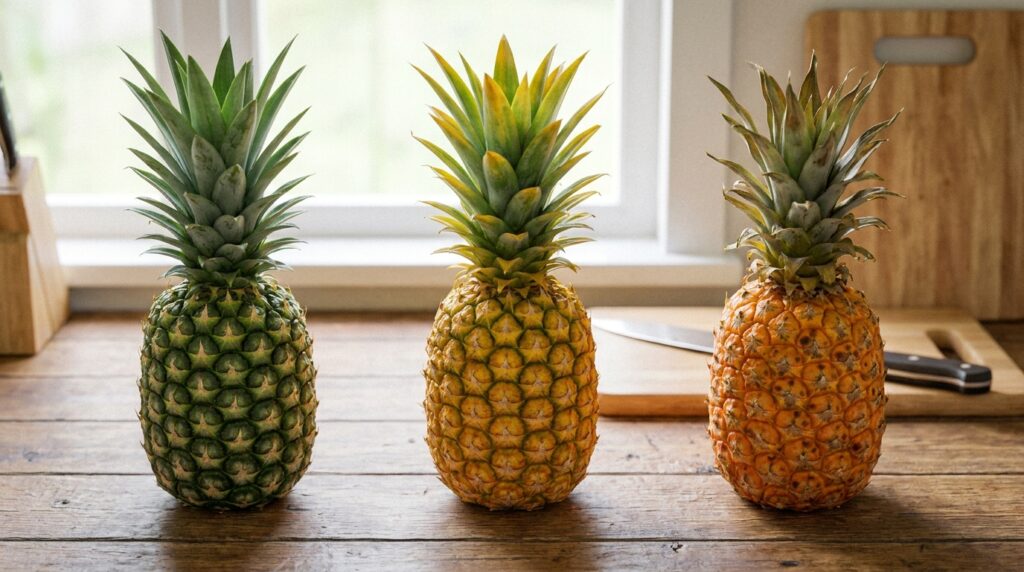
Color is the fastest visual cue, though it isn’t the whole story. As pineapple ripens, the exterior shifts from a green-gray tone to yellow, so as a general rule, the more yellow a pineapple’s exterior is, the riper the fruit will be.
A few things to keep in mind:
- A pineapple that’s still mostly green all over is very likely underripe and will taste sharp and acidic.
- One that’s turned a deep orange, especially near the base, has probably gone past peak ripeness.
- Some green patches near the crown are completely normal, even on a ripe fruit, since pineapples rarely ripen in one uniform shade.
Color varies a bit by variety too, so don’t rely on it alone. Pair it with the smell test below for a more accurate read.
It helps to know that most grocery store pineapples in the United States are shipped from Central America and are often picked with at least some color already showing, since fully green fruit doesn’t travel or sell well. That means the pineapples you’re choosing from have usually already cleared the earliest, least-ripe stage. Your job is mostly about distinguishing “good” from “great” rather than “bad” from “good,” which is a little less stressful once you realize it.
One more nuance worth knowing: the eyes, those small diamond-shaped segments covering the skin, can also offer a clue. As a pineapple ripens, the eyes tend to flatten out slightly and become less pronounced, while an underripe fruit often has eyes that look more raised and tightly closed. It’s a subtler signal than overall color, but useful as a tiebreaker if you’re standing between two fruits that look nearly identical.
What About Pineapple Crowns?
The leafy crown on top can also hint at freshness, separate from ripeness itself. Look for leaves that are a healthy, vivid green rather than brown, dry, or wilted at the tips. A crown that looks tired or yellowing at the edges often means the fruit has been sitting on the shelf longer than ideal, even if the body of the pineapple still looks fine.
Trust Your Nose
If there’s one tip that food experts return to again and again, it’s smell. There’s more than one way to decide if a pineapple is ripe, but the best way is to use your nose. Bring the fruit close to its base, the wider, flatter end, and take a sniff.
A ripe pineapple should give off a warm, faintly sweet, tropical scent. If you smell nothing at all, the fruit probably needs more time on the shelf before it hits peak flavor (even though, as mentioned, it won’t ripen further at home). And if the smell is fermented or sour, the pineapple may be overripe or starting to spoil.
This one test alone can save you from a disappointing first bite, especially when the color looks ambiguous.
There’s a practical reason smell works so well as an indicator: sugar and aromatic compounds develop together as the fruit matures on the plant. A pineapple that’s genuinely ready to eat is releasing some of those volatile compounds even through its tough skin, which is why you can pick up on it without cutting into anything. An unripe fruit simply hasn’t produced enough of those compounds yet, so there’s little for your nose to detect.
If you’re shopping somewhere busy or the produce section is cold enough to dull scents, hold the pineapple a bit longer than you normally would, ten to fifteen seconds is enough, and try smelling from a couple of different spots around the base rather than just one. Refrigerated or heavily air-conditioned stores can mute aroma slightly, so a fruit that seems to have almost no smell in that environment might actually smell stronger once it warms up a little at home.
The Squeeze and Feel Test
Texture tells you almost as much as smell does. Give the pineapple a gentle squeeze between your palms.
- Rock hard: underripe, and the flesh inside will likely be tough and starchy.
- Slight give, still firm: exactly what you want. It signals juicy flesh without being mushy.
- Soft or squishy in spots: overripe, and possibly starting to spoil in that area.
Weight matters here too. Look for a pineapple that feels heavy for its size, which often means that it’s more ripe, since a heavier fruit usually holds more juice.
An easy way to practice this test is to compare two or three pineapples side by side rather than judging just one in isolation. Pick each one up and note how they compare in weight relative to their size. The differences can be subtle at first, but after doing this a handful of times, you’ll start noticing it almost instantly, the same way you learn to judge a ripe melon or avocado by feel over time.
Keep your grip gentle throughout this test. Pressing too hard, especially with fingertips rather than an open palm, can bruise the flesh underneath even on a pineapple that hasn’t been cut. Bruised spots tend to brown and soften faster than the rest of the fruit, so a firm but light squeeze across a broader area gives you a more accurate read without damaging what you’re about to buy.
Try the Leaf Pull Trick
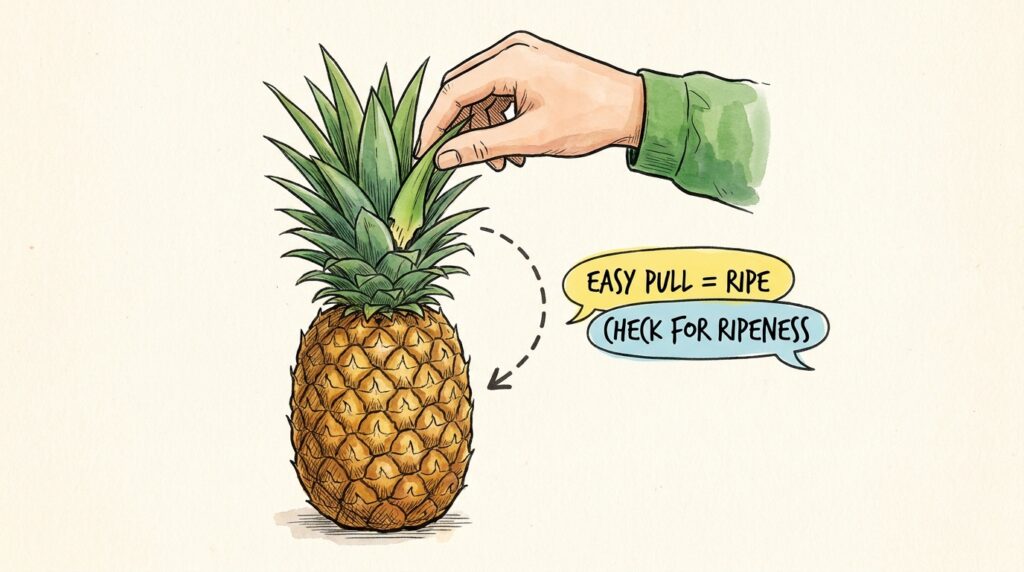
This is the test most people have heard of, and it does work, though it isn’t foolproof on its own. Grab one of the spiky green leaves near the center of the crown and give it a light tug.
If it comes away with just a little effort, the fruit is ripe; if it’s hanging on, it’s a sign the fruit is underripe.
A word of caution: this trick isn’t 100% reliable by itself, since leaf tightness can vary between individual fruits regardless of ripeness. Use it as a tiebreaker alongside color and smell rather than your only test.
Some produce staff will tell you not to bother with this method at all, since a leaf can pull loose on a fruit that’s been handled roughly during shipping, not just one that’s genuinely ripe. Treat a successful leaf pull as supporting evidence rather than proof on its own, especially if the color and smell tests point in a different direction. When all three line up, though, you can feel confident about your pick.
Also worth noting: don’t yank too hard or pull multiple leaves in a row while testing in the store. One gentle tug on a single leaf is plenty of information, and repeatedly tugging at a display pineapple isn’t exactly considerate to other shoppers or the store staff restocking the produce section.
Sound Isn’t a Reliable Indicator (Despite the Myth)
You may have heard that thumping or tapping a pineapple, listening for a dull versus hollow sound, reveals ripeness the way it can with watermelon. In practice, this test is far less consistent for pineapple because of its dense, fibrous core, so it’s best treated as a fun folk tip rather than something to base your purchase on. Stick with color, smell, feel, and the leaf pull instead.
Does the Variety of Pineapple Matter?
Most grocery stores in the United States carry one dominant variety, often labeled simply “gold” or “extra sweet,” which was bred specifically to be less acidic and more consistently sweet than older varieties. That said, you may occasionally come across other types at specialty or international markets, and it helps to know they don’t all follow identical ripeness rules.
- Golden/MD-2 pineapples: The most common variety in supermarkets. Ripens to a fairly uniform golden-yellow color, making the color test reasonably reliable.
- Red Spanish pineapples: Smaller and more cylindrical, with skin that can stay pale yellow or even slightly reddish even when fully ripe, so color is less trustworthy here than smell.
- Sugarloaf pineapples: These often stay green or pale even at peak ripeness, which makes the smell and feel tests essential rather than optional.
If you’re not sure which variety you’re looking at, default to smell and feel over color. Those two tests hold up reasonably well across most types, while color can be genuinely misleading depending on what you’ve picked up.
Choosing Pre-Cut Pineapple
Not everyone wants to deal with a whole pineapple, and pre-cut containers are everywhere in grocery stores now. The ripeness rules shift slightly here, since you can’t smell the base or squeeze the exterior the same way.
Instead, look at:
- Color consistency: Pieces should be a fairly uniform golden-yellow throughout, not pale white or greenish at the edges.
- Moisture level: A little juice pooled in the container is normal and even a good sign. Dry-looking pieces with no visible moisture are often less flavorful.
- Texture through the packaging: The pieces should look plump rather than shriveled or curling at the edges.
- Sell-by date: Since cut pineapple has a much shorter shelf life than a whole fruit, checking the date matters more here than almost anywhere else in the produce section.
Pre-cut pineapple is convenient, but it’s worth remembering that once a pineapple is sliced, its flavor starts to fade faster than when it’s left whole. If you have the option and a little extra time, a whole pineapple chosen using the tests above will usually taste noticeably better.
Common Mistakes People Make When Picking Pineapple
Even shoppers who know the basics sometimes fall into a few avoidable traps:
- Judging entirely by color. As covered above, color is useful but not definitive, especially across different varieties.
- Skipping the smell test because it feels awkward in public. It’s a completely normal thing to do in a produce aisle, and it’s the single most reliable check available.
- Assuming bigger means better. Size is mostly about variety and growing conditions, not ripeness or sweetness.
- Ignoring the crown. A wilted, browning crown is an easy, at-a-glance signal that a fruit has been sitting around longer than you’d like.
- Buying based on tapping or thumping sound. As mentioned earlier, this method is far less reliable for pineapple than it is for melons.
A Quick Reference Table
| Sign | Underripe | Ripe | Overripe |
|---|---|---|---|
| Color | Mostly green | Golden yellow, some green is fine | Deep orange, dark patches |
| Smell | Little to no aroma | Sweet, faintly tropical | Sour or fermented |
| Feel | Very firm, no give | Slight give when squeezed | Soft, mushy in spots |
| Leaves | Hard to pull | Comes away with light tug | May pull out very easily or look dried |
| Weight | Light for size | Heavy for size | Heavy but may feel uneven |
What Happens If You Pick the Wrong One
An underripe pineapple isn’t ruined, it just needs a different plan. Its tartness actually works well in cooked dishes like grilled skewers, stir-fries, or a tangy salsa where heat and other ingredients balance the acidity. Slightly overripe fruit, as long as it isn’t spoiled, is often perfect for smoothies, sorbet, or baking, where extra sweetness and softness aren’t a problem.
If a piece smells distinctly alcoholic or shows visible mold, that’s a different story. That’s a sign of spoilage rather than simple overripeness, and it should be discarded.
Storing Your Pineapple After Purchase
Once you’ve picked a good one, storage matters just as much. A whole, uncut pineapple can sit at room temperature for a day or two, but for anything longer, the refrigerator is the better call. A fresh pineapple should be cut up and refrigerated within 1-2 days of purchasing.
Cut pineapple pieces, meanwhile, belong in an airtight container in the fridge, where they’ll typically stay good for about three to five days. If you want more general guidance on keeping fresh produce from turning to mush before you get around to using it, the same core storage principles, cool temperatures, airtight containers, and minimal moisture exposure, apply across most fruits and vegetables, not just pineapple.
Why Ripeness Actually Matters Nutritionally
Beyond flavor, a properly ripe pineapple delivers more of what makes it worth buying in the first place. It’s naturally rich in vitamin C and manganese, and it also contains bromelain, a group of enzymes unique to pineapple that has been studied for its potential health benefits when used as a supplement, such as reducing inflammation and helping heal wounds, though researchers note that large-scale human studies are still limited. Bromelain is present throughout the fruit, not just in ripe portions, but a fully ripe pineapple simply makes for a more pleasant way to get it into your diet.
For a closer look at how the fruit is grown, harvested, and used beyond the fruit bowl, university extension resources on pineapple cover everything from nutrition basics to backyard cultivation.
A single cup of fresh pineapple chunks is mostly water, low in fat, and covers a substantial portion of your daily vitamin C needs, which supports immune function and skin health. It also contains manganese, a mineral involved in bone formation and metabolism, along with a modest amount of fiber that supports digestion. None of these nutrients disappear if the fruit is slightly underripe or overripe, but the eating experience, and the odds you’ll actually finish the fruit instead of tossing half of it, improve significantly when you start with one that’s properly ripe.
Expert Tips for Picking Better Every Time
- Shop with your nose first, then confirm with color. Smell is consistently rated as the most reliable single indicator.
- Avoid pineapples with soft, dark, or wet-looking spots on the skin, which often signal internal bruising or early spoilage.
- Don’t judge by size. A smaller pineapple can be just as sweet as a larger one; size relates to variety, not ripeness.
- If you’re buying pre-cut pineapple, check that the pieces look plump and moist, not dry or discolored at the edges.
- Buy pineapple in peak season (typically spring through mid-summer) for better odds of finding naturally sweeter fruit.
Pros and Cons of Each Ripeness Test
| Method | Pros | Cons |
|---|---|---|
| Color | Fast, easy to check at a glance | Can be misleading on its own |
| Smell | Very reliable, hard to fake | Requires getting close to the fruit |
| Feel/Weight | Good secondary confirmation | Some experience needed to judge “right” firmness |
| Leaf pull | Simple, no tools needed | Inconsistent across individual fruits |
Frequently Asked Questions
How do you know if a pineapple is ripe without cutting it?
Check the base for a sweet aroma, look for a mostly golden-yellow skin, and give it a gentle squeeze to feel for slight softness. If two or more of these line up, the fruit is very likely ripe.
Does a green pineapple ever ripen at home?
Not meaningfully. Since pineapples stop ripening once picked, a green one will stay tart. It may soften slightly, but the sugar level won’t increase.
Why does my ripe-looking pineapple taste sour?
This usually happens when a fruit was picked too early despite developing some yellow color, or when only part of it ripened evenly. Smell is a better predictor than color alone for this reason.
Can you eat an overripe pineapple?
Yes, as long as there’s no mold, off odor beyond mild fermentation, or leaking juice. Overripe pineapple works well in smoothies or baked goods where extra softness isn’t an issue.
What part of the pineapple is sweetest?
The base tends to be sweeter and juicier than the top, since sugars accumulate closer to the stem during growth. That’s also why smelling the base gives the most accurate ripeness signal.
Bringing It All Together
Picking a good pineapple comes down to trusting a few simple senses over guesswork. Smell the base, glance at the color, give it a gentle squeeze, and tug a leaf if you want a final confirmation. None of these tests require any special tools, just a few extra seconds in the produce aisle.
Next time you’re standing in front of that pile of pineapples, run through these checks before you commit. Your fruit salad, smoothie, or grilled skewers will thank you.

