
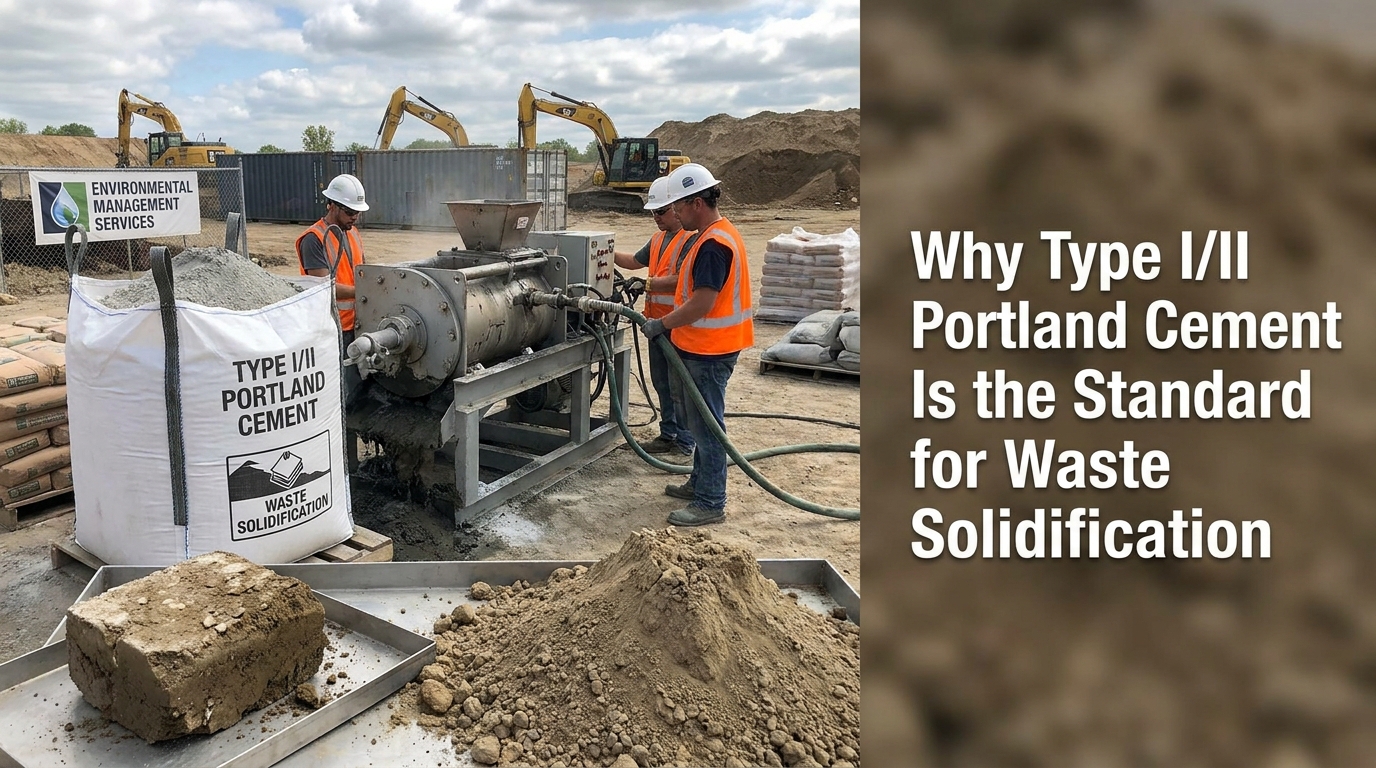
When environmental contractors, waste-management crews, and oilfield service companies need to turn a liquid or contaminated waste stream into a stable, disposable solid, one material shows up more than any other: Portland cement. And within the Portland family, Type I/II is the workhorse. Understanding why comes down to chemistry, regulatory fit, and plain availability.
What solidification/stabilization asks of a binder
Solidification/stabilization (S/S) mixes a binding reagent into a waste to reduce the mobility of its contaminants — physically locking them into a solid matrix and chemically tying them up so they don’t leach. The U.S. EPA regards S/S as a Best Demonstrated Available Technology for a wide range of hazardous wastes, and it has been one of the most frequently selected treatment approaches at Superfund cleanup sites for decades.
A good binder has to do two jobs at once. It has to solidify — convert free liquids into a handleable solid that passes the paint filter test (EPA Method 9095), the threshold most landfills use to reject loads carrying free liquid. And it has to stabilize — chemically immobilize contaminants so the treated material can pass the Toxicity Characteristic Leaching Procedure (TCLP, EPA Method 1311). Few reagents do both as reliably, or as cheaply, as Portland cement.
Why Portland cement, chemically
Portland cement earns its position because of how it hydrates. When water hits cement, it forms calcium–silicate–hydrate (C-S-H) gel — the same binding phase that gives concrete its strength. That gel physically encapsulates waste particles inside a dense, low-permeability matrix. At the same time, the high-pH environment cement creates drives several immobilization mechanisms: heavy metals precipitate as insoluble hydroxides, carbonates, or silicates; some substitute directly into the mineral structure of the hardened matrix; and a few are converted to less-toxic valence states.
The result is that cement doesn’t just soak up liquid — it chemically binds the water into hydration products and traps contaminants in a durable solid. That dual action is exactly why cement remains the default reagent for solidifying free liquids that RCRA land-disposal restrictions would otherwise keep out of a landfill.
Why Type I/II specifically
Portland cement comes in several ASTM C150 types, but Type I/II is the one most operations reach for, for three reasons.
Versatility. Type I is the general-purpose cement, and it’s the type most often specified in S/S systems because it performs predictably across the broadest range of waste chemistries.
Sulfate resistance. Type II is formulated with a capped tricalcium aluminate content, giving it moderate resistance to sulfate attack. Many contaminated soils, drilling wastes, and industrial sludges carry sulfates that can degrade a treated waste form over time. A dual-rated Type I/II cement covers both bases in one product — general-purpose performance plus that added durability margin — which is why it’s stocked as the practical standard rather than buying two separate cements.
Availability and documentation. S/S work lives and dies on paperwork; treated waste has to be defensible on a manifest. Type I/II is produced to a well-understood ASTM C150 spec, and sourcing it from a consistent, spec-verified bulk Portland cement supplier means every load arrives with a mill test certificate you can file against the job. In the hazardous-waste world, that documentation is as valuable as the material itself.
What it looks like in the field
Practically, most S/S crews don’t want silos of cement on a remediation site. They want reagent delivered in a form they can stage and meter into a pug mill, excavator bucket, or roll-off box. That’s why one-ton super sacks are the common format for environmental and oilfield solidification work — no fixed infrastructure, easy to position, and simple to dose against a target cement-to-waste ratio.
For oilfield operators, the economics are stark: a large share of drilling cost goes to hauling liquid waste away in vacuum trucks. Solidify those cuttings and muds with cement so they pass the paint filter test, and the same material can move by cheaper dump transport — sometimes disposed of locally if it also clears TCLP.
The bottom line
Type I/II Portland cement sits at the intersection of the right chemistry, the right regulatory fit, and the right availability. It solidifies free liquids, immobilizes contaminants, resists sulfate degradation, and arrives with the documentation that hazardous-waste disposal demands. For contractors who need a binder that simply works, load after load, it remains the standard for good reason.

