
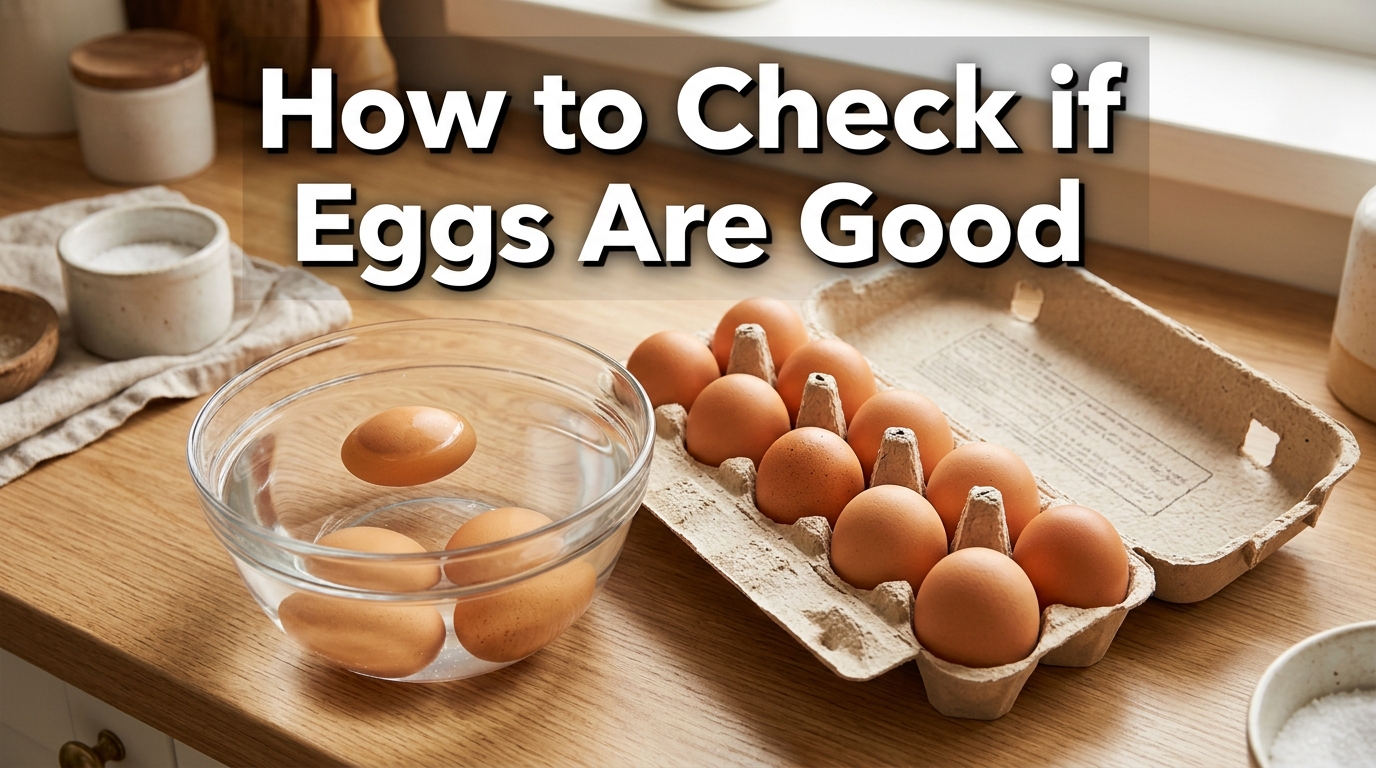
Cracking open an egg only to catch a whiff of sulfur is one of those small kitchen disasters nobody wants to repeat. Knowing how to check if eggs are good takes less than a minute, and once you’ve done it a couple of times, it becomes second nature.
You don’t need any special equipment either. A bowl of water, your nose, and a quick look at the carton will tell you almost everything you need to know about whether those eggs belong in your skillet or in the trash.
Why Bother Testing Egg Freshness at All
Store-bought eggs are usually fine for weeks past the date printed on the carton, but “fine” isn’t the same as “fresh.” As an egg ages, it loses moisture through tiny pores in the shell, the air pocket inside grows larger, and the white gets thinner and runnier.
None of that necessarily means the egg has gone bad. It just means the egg is older, and older eggs behave differently in the kitchen. A slightly aged egg poaches messier, whips less dramatically for meringue, and separates less cleanly. A genuinely spoiled egg, on the other hand, is a different story entirely and one you want to catch before it hits a hot pan.
Testing freshness also matters for food safety. Fresh eggs with clean, uncracked shells can still carry bacteria, so a quick check before cooking is a habit worth keeping, especially for anyone cooking for young kids, older adults, or someone with a weaker immune system.
The Water Float Test
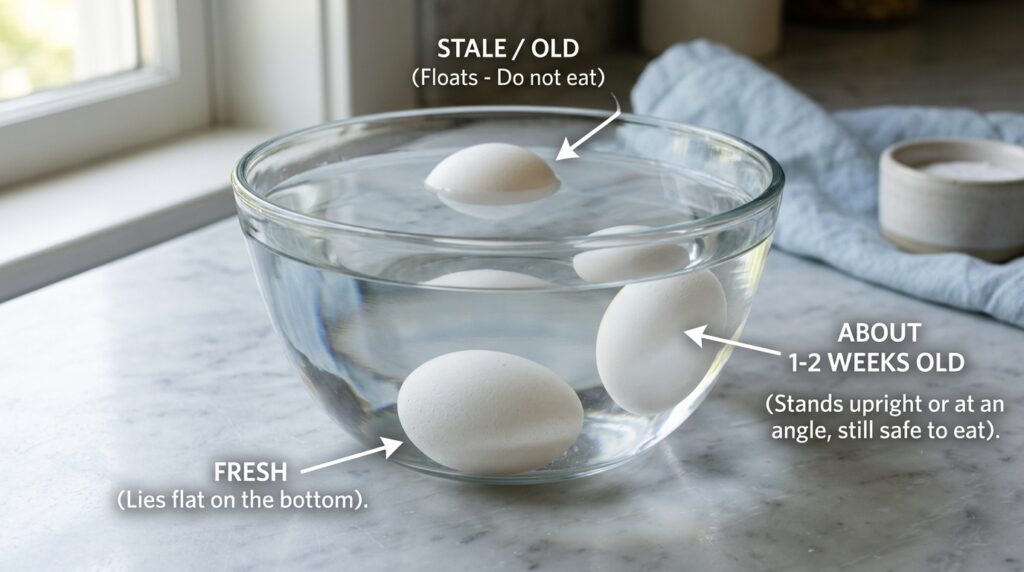
This is the test most people reach for first, and for good reason. It’s fast, it doesn’t waste an egg, and it works on any egg still in its shell.
How to do it:
- Fill a tall glass or bowl with plain, room-temperature water, deep enough to fully submerge an egg.
- Gently lower the egg into the water.
- Watch what it does over the next few seconds.
| What the egg does | What it means |
|---|---|
| Sinks and lies flat on its side | Very fresh, only a few days to a couple weeks old |
| Sinks but stands upright or tilts | Still good, just a few weeks old |
| Floats to the surface | Old and likely past its prime, discard it |
The science here is simple. Eggshells are porous, so air slowly seeps in and replaces the moisture that evaporates out over time. The bigger that air pocket grows, the more buoyant the egg becomes. A floating egg isn’t automatically dangerous, but it’s old enough that it’s not worth the risk, especially since a smell or visual check only takes a few more seconds.
Reading the Carton: What Those Numbers Actually Mean
Before you even reach for a bowl of water, the carton itself can tell you a lot. Most US cartons carry a three-digit Julian date, a number between 001 and 365 that represents the day of the year the eggs were packed.
January 1 is 001, February 1 is 032, and December 31 is 365. If a carton shows 045, that means the eggs were packed on the 45th day of the year, which is mid-February.
Cartons stamped with the USDA grade shield also carry a sell-by date that, by regulation, can’t fall more than 30 days after the pack date. That date is about inventory rotation, not safety. Under normal refrigeration, raw eggs typically stay good for three to five weeks past the date you bought them, per federal food safety guidance on shell eggs.
A few things worth checking on the carton while you’re at it:
- Look for cracked or leaking shells before you buy, and reject any carton with even one damaged egg.
- Note whether the eggs are graded AA, A, or B. Grade affects quality, not safety, but AA eggs hold their shape better for frying and poaching.
- Check that the carton has actually been kept cold in the store. Warm eggs on a shelf, rather than in a refrigerated case, are a red flag regardless of the printed date.
The Shake Test
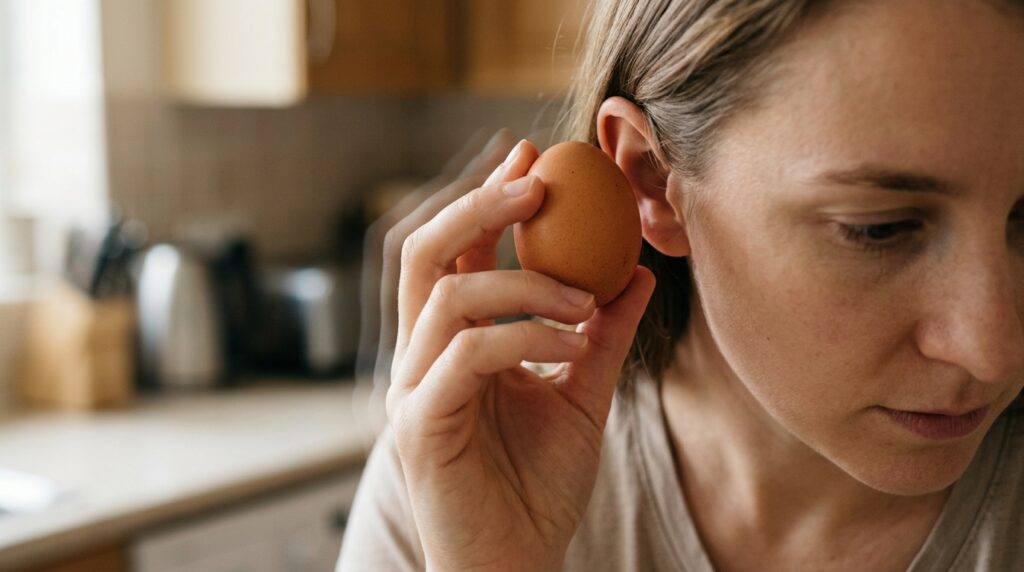
If you don’t want to dirty a bowl, the shake test is a quick backup, though it’s less precise than the float test.
Hold the egg near your ear and gently shake it side to side. A fresh egg is essentially silent because the contents are firm and fill the shell almost completely. An older egg produces a faint sloshing sound, since the shrinking whites and yolk leave more room to move around inside the shell.
This test is best used as a rough screener, not a final verdict. Pair it with the float test or a visual check before deciding whether an egg goes in the pan or the bin.
Cracking It Open: What a Good Egg Looks Like
Sometimes the most reliable check happens after the shell is already off. Crack the egg onto a clean, flat plate rather than directly into a hot pan, so you have a moment to look before it starts cooking.
Signs of a fresh egg:
- The yolk sits high and round, holding its dome shape.
- The white has a thick, slightly cloudy layer close to the yolk and a thinner layer spreading further out.
- There’s little to no odor.
Signs of an aging (but often still usable) egg:
- The yolk sits flatter and spreads more.
- The white is thinner and runs further across the plate.
- Still no noticeable smell.
Signs to discard immediately:
- Any pink, green, black, or unusual discoloration in the white or yolk.
- A visible mold-like film on the shell’s interior.
- A strong, unmistakable sulfur or rotten smell the moment it’s cracked.
A flatter yolk and thinner white are completely normal for an egg that’s a few weeks old and are not a safety concern on their own. Color changes and off smells are the real warning signs.
The Smell Test
This one needs no explanation once it happens to you: a spoiled egg smells unmistakably like sulfur or rotten eggs, and there’s no mistaking it for anything else.
If you’re not sure whether an egg is bad just from looking at the carton, crack it into a separate small bowl before adding it to whatever you’re cooking. That way, if something smells off, you haven’t already ruined a full batch of pancake batter or a cake mix.
Interestingly, a bad smell can sometimes be detected even before cracking the shell, particularly with eggs that have been sitting for a long time or stored somewhere too warm. If a carton smells even faintly sulfurous when you open it, it’s worth testing each egg individually rather than trusting the whole dozen.
Candling: The Method Commercial Graders Use
Candling sounds old-fashioned because it is. The technique dates back to when producers literally held eggs up to a candle flame to see inside the shell. Today it just means holding an egg in front of a bright light source in a dark room.
How to candle an egg:
- Turn off the lights or move to a dark room.
- Hold the egg’s wider end against a bright flashlight or phone light.
- Look through the shell at the air cell and the general clarity of the contents.
A small, shallow air cell at the wide end signals a fresher egg. A large air cell, cloudiness, or visible dark spots suggest an older egg or one with a quality issue. Candling won’t tell you about bacterial contamination, but it’s a genuinely useful way to judge age without cracking the shell, and it’s the same basic principle used in commercial egg grading facilities.
This method takes a little practice to read accurately, so don’t worry if the first few eggs are hard to interpret. It gets easier with repetition, and it pairs well with the float test for a more complete picture.
How Long Eggs Actually Stay Good
Freshness tests are useful, but it also helps to know the general timelines so you’re not testing every single egg out of habit.
| Egg type | Refrigerator | Room temperature | Freezer |
|---|---|---|---|
| Raw, in shell | 3 to 5 weeks from purchase | Not recommended, 2 hours max | Not recommended in shell |
| Raw, out of shell (beaten) | 2 to 4 days | Not recommended | Up to 1 year |
| Hard-boiled, in shell or peeled | 1 week | 2 hours max | Not recommended |
| Egg whites only | 2 to 4 days | Not recommended | Up to 1 year |
These figures reflect widely cited food-safety timelines rather than strict cutoffs. An egg that’s technically within its window can still go bad if it was mishandled, and an egg slightly past the window can still be perfectly fine if it was properly refrigerated the whole time. That’s exactly why the float test, smell check, and visual inspection matter more than any date printed on a carton.
Unwashed farm eggs behave differently than commercial ones. They retain a natural protective coating called the bloom, which lets them sit safely at room temperature for one to two weeks before refrigeration becomes necessary. Once that coating is washed off, though, the eggs need the same cold storage as anything from a grocery store.
If you’re curious how these same spoilage principles apply beyond eggs, the logic of checking texture, smell, and visible warning signs carries over to almost any perishable item sitting in a fridge or pantry, including produce like potatoes that show their own distinct warning signs of spoilage.
Proper Storage Tips to Keep Eggs Fresh Longer
A good storage routine does more to extend egg freshness than any single test ever will, and keeping eggs consistently refrigerated matters more than almost any other single factor. A few habits make a real difference:
- Keep eggs in the main body of the refrigerator, not the door. Door shelves see more temperature swings every time the fridge opens.
- Store eggs in their original carton. It blocks moisture loss and prevents eggs from soaking up strong odors from other foods.
- Keep the fridge at 40°F (4°C) or below, and check it occasionally with an actual thermometer rather than trusting the dial.
- Use the oldest eggs first. A simple first-in, first-out approach avoids forgotten cartons pushed to the back.
- Avoid moving eggs in and out of the fridge repeatedly. Temperature swings can cause condensation on the shell, which makes it easier for bacteria to work through the pores.
Pros and Cons of Each Freshness Test
No single method is perfect on its own, which is why combining two or three tests gives the most reliable answer.
| Test | Pros | Cons |
|---|---|---|
| Water float test | Fast, free, doesn’t damage the egg, works on multiple eggs at once | Won’t detect bacterial contamination, less accurate for cracked shells |
| Shake test | Instant, needs no tools | Rough estimate only, hard to judge on very fresh eggs |
| Crack and inspect | Very reliable visual confirmation | Uses the egg even if it turns out to be fine |
| Smell test | Extremely reliable for genuinely spoiled eggs | Only works once the shell is cracked |
| Candling | Doesn’t damage the egg, reveals internal quality | Takes practice to interpret, needs a dark room |
Expert Tips for Buying and Testing Eggs
A few extra habits go a long way toward avoiding wasted eggs and unpleasant surprises:
- Buy eggs near the end of your shopping trip so they spend less time out of refrigeration before you get them home.
- Check for a cold carton at the store. If the eggs feel warm to the touch, skip that carton entirely.
- When baking something that relies heavily on egg structure, like meringue or soufflé, use the freshest eggs available, since older eggs whip up less reliably.
- For dishes that call for raw or barely cooked eggs, such as homemade mayonnaise or Caesar dressing, choose pasteurized eggs to lower the risk of Salmonella exposure.
- If you keep chickens or buy directly from a farm, remember that unwashed eggs follow different rules than store-bought ones and shouldn’t be judged by supermarket timelines.
When to Toss an Egg Without Overthinking It
Some signs don’t need a second test. If any of the following show up, skip the rest of the checklist and just throw the egg away:
- A strong sulfur or rotten smell, cracked or uncracked.
- Visible mold on the shell, often appearing as a powdery or fuzzy spot.
- A slimy or sticky shell texture.
- Pink, black, or green discoloration inside the egg.
- A shell that’s cracked and has been sitting unrefrigerated.
There is a well-known kitchen principle that applies here: when in doubt, throw it out. Eggs are inexpensive enough that risking a bout of foodborne illness over one questionable egg is never worth it.
Frequently Asked Questions
Can you tell if an egg is bad just by looking at the shell?
Not always. A clean, uncracked shell can still contain bacteria, and a slightly stained or rough shell doesn’t necessarily mean the egg inside has spoiled. The shell alone isn’t a reliable freshness indicator, which is why the float test or a smell check matters more than appearance.
Do floating eggs always mean the egg is bad?
Not necessarily bad, but definitely old. A floating egg has a large air pocket, which usually means several weeks have passed since it was laid. It may still be safe if it doesn’t smell off, but most people choose to toss floaters rather than risk it, especially for raw preparations.
Is it safe to eat an egg past its sell-by date?
Often yes, as long as it’s been continuously refrigerated and passes a smell and visual check. The sell-by date is a retailer guideline for freshness and inventory, not a hard safety cutoff, and eggs commonly stay good for several weeks beyond that printed date.
Why do some fresh eggs smell slightly different when cracked?
A faint, mild egg smell is completely normal and not a warning sign. What you’re checking for is a strong, sharp sulfur odor, which is distinct and unmistakable once you’ve smelled it. If it’s subtle and doesn’t linger, the egg is fine.
How can you tell if hard-boiled eggs have gone bad?
Hard-boiled eggs spoil faster than raw ones because cooking removes the shell’s protective coating. Look for a chalky or slimy texture, a grayish tint around the yolk, or a sulfur smell, and use hard-boiled eggs within about a week of cooking regardless of how they look.
Final Notes
Checking whether an egg is still good takes seconds once you know what to look for. A quick float test, a glance at the carton, and a sniff after cracking cover almost every situation you’ll run into in a normal kitchen.
This article is for general informational purposes only and isn’t a substitute for professional food safety or medical advice. If you’re ever genuinely unsure about an egg, or about food safety more broadly, it’s always safest to discard the item or consult a qualified professional.

