
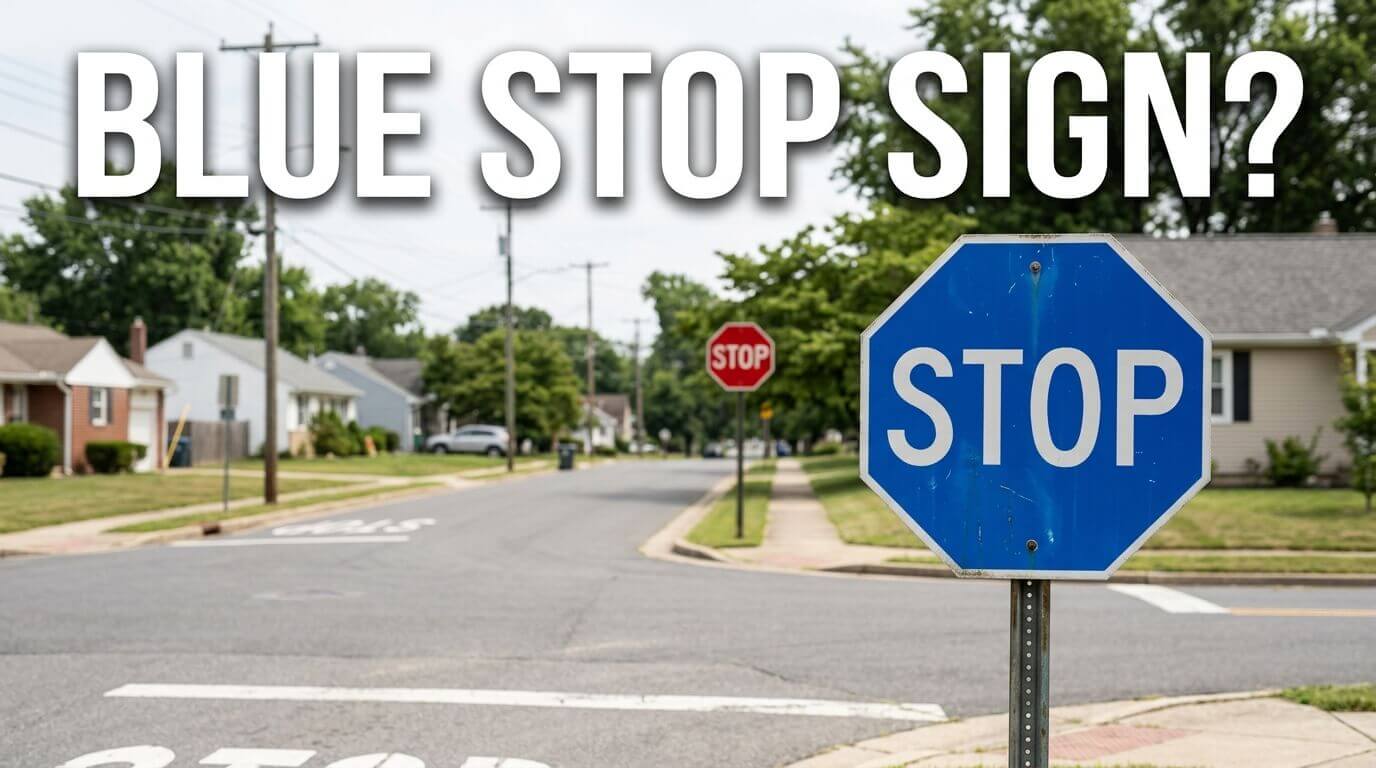
If you are wondering what does a blue stop sign mean in australia, the short answer is that a blue octagonal STOP sign is not the normal standard STOP traffic sign used on public roads. The recognised regulatory STOP sign is a red octagon with white lettering, and drivers facing an official STOP sign must come to a complete stop.
A blue sign carrying the word STOP may instead be a private-property sign, site-control sign, decorative sign, or another non-standard sign. You might encounter one in a car park, private road, industrial site, residential complex, business entrance, or similar controlled area.
That does not mean you should simply ignore it. The safest response is to slow down, assess the surroundings and follow any legitimate directions applying to the location.
Quick Answer: What Does a Blue Stop Sign Mean in Australia?
A blue STOP sign does not have the same standard appearance as the official regulatory STOP sign. Official guidance for STOP signs and stop lines shows the familiar red octagonal STOP sign and requires drivers to come to a complete stop when facing it.
A blue version is more likely to have been installed for traffic management on private or controlled property rather than as the standard public-road STOP control. Its exact significance can therefore depend on its location, accompanying markings, property rules and any other signs around it.
What Does an Official STOP Sign Look Like?
The official STOP sign is one of the easiest road signs to recognise because both its colour and shape are distinctive. It is an eight-sided red sign with a white border and the word STOP displayed prominently in white.
Official information about regulatory road signs confirms that a STOP sign requires a complete stop. Regulatory signs communicate instructions road users must obey rather than optional advice.
The octagonal shape is especially important. Even if dirt, poor lighting or another obstruction makes some of the lettering difficult to see, the distinctive shape helps drivers recognise the sign quickly.
| Feature | Standard STOP Sign | Blue STOP Sign |
|---|---|---|
| Typical colour | Red with white lettering | Blue with contrasting lettering |
| Shape | Octagonal | May also be octagonal |
| Standard public-road STOP control | Yes | Not the normal standard design |
| Driver response | Complete stop and give way as required | Assess location, slow down and follow applicable instructions |
| Common setting | Roads and intersections | Often private or controlled property |
Why Might You See a Blue STOP Sign?
The most likely explanation is that the sign is being used outside the normal public-road traffic-sign system. Property owners and site managers sometimes install signs to control vehicle movement around car parks, loading areas, gated developments, private access roads and industrial facilities.
These locations still need a way to tell motorists where to slow down or stop, particularly where vehicles cross pedestrian paths or enter another traffic stream. Good commercial parking lot safety and markings can help drivers understand how traffic is intended to move around a property.
A blue STOP sign can also occasionally be decorative, temporary or installed for a special purpose. That is why colour alone should never be used to decide whether proceeding without caution is safe.
Private Property Is the Important Clue
Location often tells you more than the unusual colour. A blue octagonal sign inside a private complex is quite different from unexpectedly seeing one beside a major public road.
Private properties may have their own access conditions and traffic-management arrangements. Drivers should therefore look for entry signs, pavement arrows, boom gates, stop lines, pedestrian crossings and instructions from authorised personnel before deciding how to proceed.
What Should You Do When You See a Blue STOP Sign?

Do not assume that an unfamiliar sign means you are free to continue at normal speed. An unusual sign often appears precisely where someone wants drivers to pay closer attention.
Use this simple approach:
- Reduce your speed. Give yourself enough time to understand the road or property layout.
- Look for a stop line. Pavement markings may provide additional information about where vehicles are expected to stop.
- Check for pedestrians and cyclists. Private car parks and business entrances often have people moving between parked vehicles.
- Look for additional signs. Entry conditions, speed limits, arrows and warning signs may clarify the instruction.
- Stop when necessary for safety. Never proceed simply because the sign colour appears unusual.
- Follow authorised directions. Traffic controllers, police, site staff or other authorised personnel may give instructions that apply at the location.
Official guidance on intersections and giving way shows why identifying the complete traffic-control situation matters. Signs, lines, vehicles and pedestrians can all affect what a driver needs to do.
Does Blue Normally Mean STOP on Road Signs?
No. Blue is not normally used as the defining colour of the standard STOP sign.
Road signs use combinations of shape, colour, symbols and words to communicate different types of information. Official road-sign guidance separates regulatory, warning, guide, service and other signs so drivers can recognise their purpose quickly.
That is also why changing a familiar sign’s colour can cause confusion. Drivers have learned to associate the red octagon with an immediate requirement to stop, while blue is commonly seen on signs serving other informational or directional purposes.
Shape Still Matters
A STOP sign’s eight-sided shape provides an additional recognition cue. Drivers should therefore consider both shape and colour instead of interpreting a traffic sign from one feature alone.
If you regularly come across unusual road signs, this broader guide to what a blue stop sign means explains several reasons these signs may appear in private and non-standard settings.
Blue STOP Sign vs Red STOP Sign
The distinction becomes easier when the two signs are compared directly. The standard red STOP sign carries an established road-rule meaning, while a blue version requires more context before its purpose can be identified.
| Question | Red STOP Sign | Blue STOP Sign |
|---|---|---|
| Is this the familiar standard STOP design? | Yes | No |
| Should the driver stop? | Yes, where the regulatory STOP control applies | Follow the site’s instruction and stop whenever required for safety |
| Is location important? | Yes | Extremely important |
| Could it appear on private property? | Yes | Yes, and this is a likely setting |
| Should it be ignored because of colour? | No | No |
The official driver guidance for road signs distinguishes regulatory signs that must be obeyed from signs that provide warnings or advice. This is a useful reminder that a sign’s legal meaning comes from the recognised traffic-control system, not simply from the word printed on it.
Could a Blue Sign Be Something Else?
Yes. Seeing a blue sign does not automatically mean it is an unusual STOP sign. Drivers regularly encounter blue informational, service, parking or facility-related signs, so first confirm what the sign actually says and shows.
Lighting can also change how colours appear. A faded, dirty, reflective or poorly illuminated sign may look different at night or in photographs, so check its shape, lettering and surrounding road markings rather than relying only on perceived colour.
What If a Blue STOP Sign Appears on a Public Road?
An unexpected blue octagonal STOP sign on a normal public road should be treated cautiously. Do not use its unusual appearance as a reason to accelerate through an intersection or ignore other traffic controls.
Slow down and check for standard STOP lines, traffic lights, temporary traffic management, nearby signs and directions from authorised personnel. Official information on road signs and their meanings again shows the conventional STOP control as the familiar standard sign.
If a public-road sign genuinely appears damaged, altered, incorrect or unofficial, the responsible road authority or council can investigate it. Drivers should report the location when safe to do so rather than attempting to remove, alter or cover the sign themselves.
Common Mistakes to Avoid
One common mistake is thinking that an unusual sign can automatically be ignored. Even where a sign is non-standard, there may still be vehicles, pedestrians, gates or site conditions that make stopping essential.
Another mistake is assuming that every blue road sign has the same meaning. Colour is only one part of traffic-sign communication, so shape, wording, symbols, road markings and location should all be considered together.
Finally, do not assume an unusual STOP sign changes the rules applying to nearby standard signs or markings. A proper red STOP sign, stop line, traffic signal or authorised traffic-control direction still needs to be followed.
Frequently Asked Questions
Is a blue STOP sign an official STOP sign?
A blue octagonal STOP sign is not the normal standard appearance of the official regulatory STOP sign. The recognised STOP sign uses the familiar red octagonal design with white lettering.
Do I have to stop at a blue STOP sign?
The exact requirement depends on where the sign is located and what traffic controls apply there. From a safety perspective, slow down, inspect the surroundings and follow legitimate property or traffic-management instructions rather than ignoring the sign solely because it is blue.
Why would someone install a blue STOP sign?
A blue STOP sign may be used on private property, within a car park, at an industrial site or in another controlled location. It may help manage internal vehicle movement while being visually different from a standard public-road regulatory sign.
What colour is a normal STOP sign?
The familiar standard STOP sign is red with white lettering and a white border. Its distinctive eight-sided shape makes it easy to identify even before the word STOP is fully readable.
What does a blue road sign normally mean?
Blue road signs are commonly associated with information, services, facilities or particular traffic information rather than the standard STOP command. The precise meaning always depends on the sign’s symbol, words, shape and location.
Does a STOP sign mean I only need to slow down?
No. When you face a recognised regulatory STOP sign, slowing down alone is not enough. You must come to a complete stop at the appropriate position before proceeding and give way as required.
Where should I stop at a normal STOP sign?
Where a stop line is provided, stop before reaching it and as close as practical to the line. Where there is no stop line, the required stopping position depends on the location, such as stopping before and as close as practical to the intersection or sign.
Can private properties use their own traffic signs?
Private properties commonly use signs, arrows, speed instructions and other traffic-management measures to organise vehicles and pedestrians. Their design and effect can differ from standard public-road traffic controls, so drivers should consider the complete site layout and posted conditions.
Conclusion
So, what does a blue stop sign mean in australia? It usually indicates that you are looking at a non-standard STOP sign rather than the familiar red regulatory STOP sign used for ordinary public-road control.
The important point is not to treat unusual colour as permission to ignore safety. Slow down, examine the surrounding signs and markings, watch for pedestrians and other vehicles, and follow any applicable traffic or property instructions. If you regularly encounter unusual signs, learning how shape, colour and location work together will make them much easier to interpret safely.

