
Introduction
You’re driving through a neighborhood, a parking garage, or a private resort — and suddenly, you spot it. A stop sign. But it’s not red. It’s blue.
Your first reaction is probably: Wait, is that even legal? Am I supposed to stop?
You’re not alone. Blue stop signs confuse a lot of people, and for good reason — we’re all wired to associate stop signs with the color red. It’s one of the most universally recognized traffic symbols in the world.
But blue stop signs do exist, and they actually have a very specific purpose. Whether you’re a curious driver, a property manager researching signage options, or just someone who spotted one and pulled out your phone — this article will give you every answer you need.
Let’s break it all down.
What Does a Blue Stop Sign Mean?
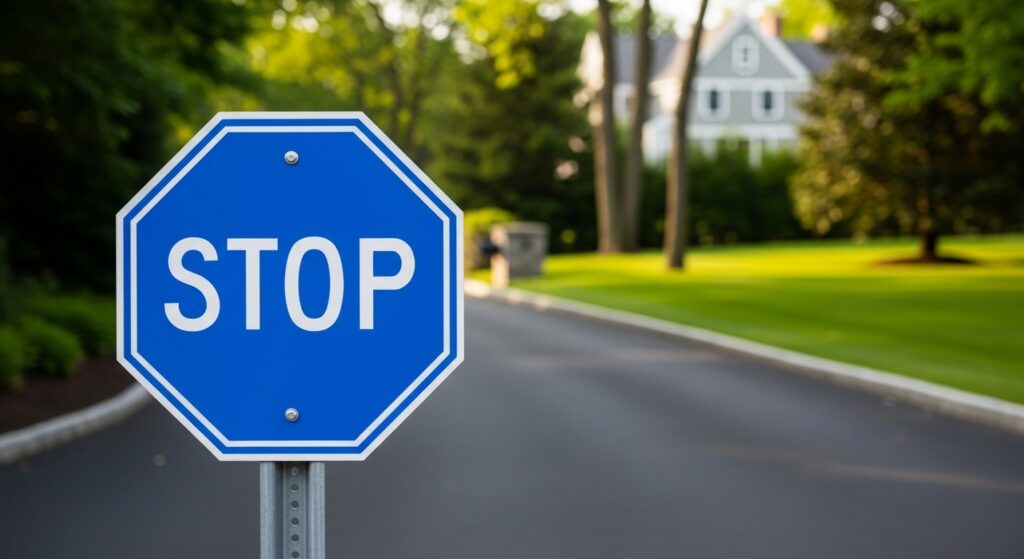
A blue stop sign is not an official government traffic control device. Instead, it is a privately manufactured sign used on private property — such as parking lots, gated communities, resorts, campuses, and HOA-managed roads — to signal drivers to stop without mimicking the federally regulated red stop sign.
The core reason blue is used? To distinguish private signage from public signage.
Under the Manual on Uniform Traffic Control Devices (MUTCD), published by the Federal Highway Administration (FHWA), official stop signs in the United States must be red with white lettering and conform to specific size and reflectivity standards. These regulations apply to all public roads.
Private property owners who want to regulate traffic on their own land — but don’t want to use (or legally can’t use) federally standardized red signs — sometimes opt for blue stop signs as an alternative.
Why Is the Official Stop Sign Red (Not Blue)?
Before diving deeper into blue signs, it helps to understand why red became the standard.
The use of red for stop signals dates back over a century. Red has long been associated with danger and “halt” across cultures — from railway signals to marine flags. The MUTCD standardization of red stop signs for public roads in the United States became federally uniform by 1954, when the first national edition of the MUTCD was adopted broadly across states.
Red is also highly visible at night due to retroreflective sheeting technology, which makes it one of the safest colors for high-speed public road signage.
Blue, on the other hand, is specifically not used for regulatory traffic signs on public roads — which is exactly why private property owners use it: it signals “this is not a government-issued sign.”
Where Are Blue Stop Signs Used?
Blue stop signs are most commonly found in:
- Private parking lots (shopping centers, apartment complexes, office parks)
- Gated communities and HOA neighborhoods
- College and university campuses
- Resorts, theme parks, and private recreational areas
- Industrial facilities and warehouses
- Private roads not maintained by local government
Some property owners also use blue stop signs simply for aesthetic differentiation — for example, a luxury resort might use custom blue signage to match its brand identity while still communicating the same “stop” instruction to drivers.
Are Blue Stop Signs Legally Enforceable?
This is where it gets nuanced — and important.
On Public Roads
A blue stop sign placed on a public road would not be a legally valid traffic control device. Under the MUTCD, only red stop signs meeting specific standards are enforceable by law enforcement on public streets. A blue sign on a public road could actually create legal liability for whoever placed it there, because it doesn’t conform to federal standards and could confuse drivers.
On Private Property
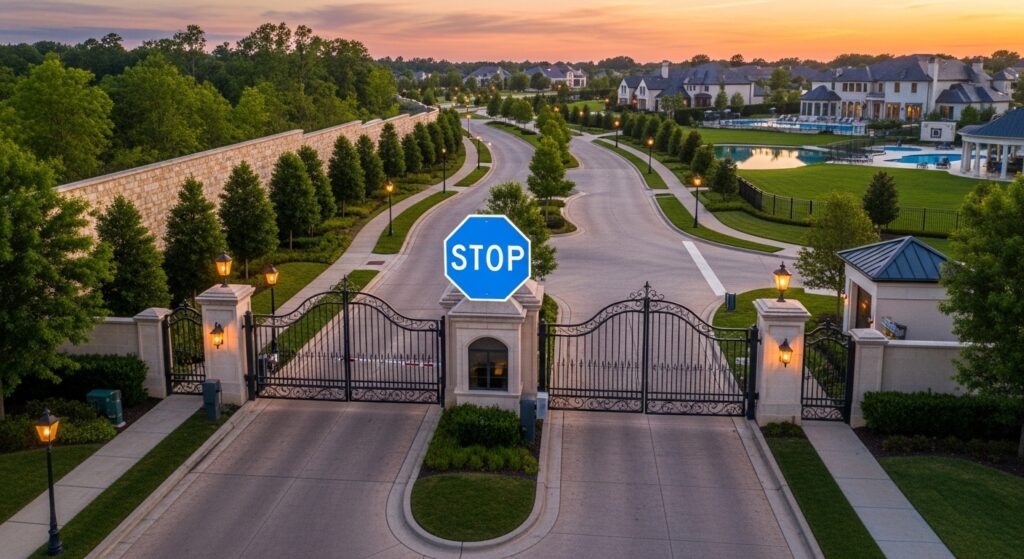
On private property, the situation is different. Property owners have the right to establish traffic rules on their own land. A blue stop sign in a private parking lot or HOA road carries the authority of the property owner — and in many states, private security or property management can enforce those rules.
However, law enforcement jurisdiction on private property varies significantly by state. In some states, local police can enforce traffic laws on private property open to the public (like shopping mall parking lots). In others, only the property owner or private security has authority.
If you’re unsure about the traffic laws in your area, resources like your state’s Department of Motor Vehicles (DMV) or local traffic authority can clarify the rules.
Blue Stop Sign vs. Red Stop Sign: Key Differences
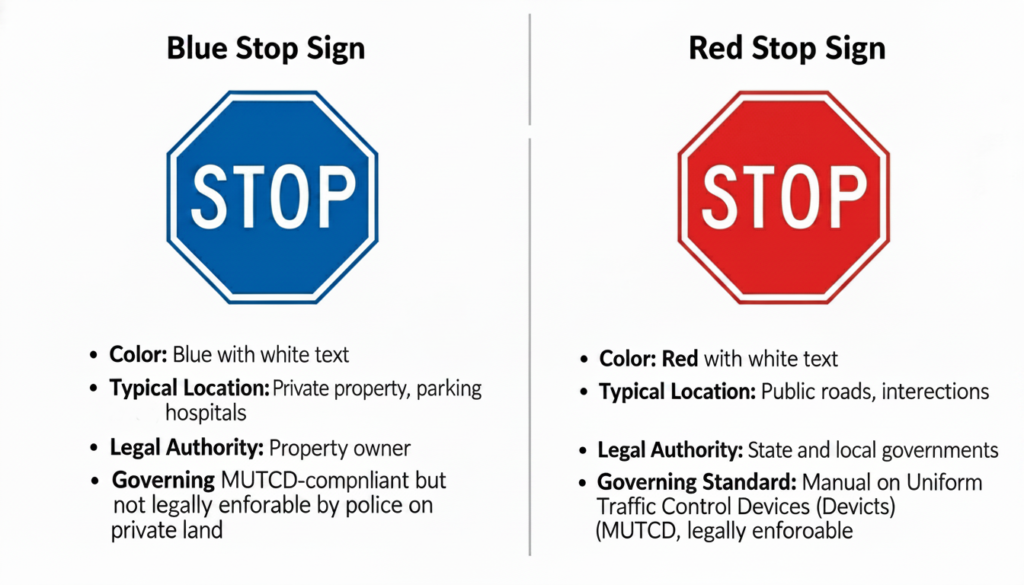
| Feature | Red Stop Sign | Blue Stop Sign |
|---|---|---|
| Color | Red with white text | Blue with white text |
| Legal Authority | Federally regulated | Property owner authority |
| Location | Public roads | Private property |
| Standard | MUTCD compliant | Non-MUTCD |
| Enforced by | Law enforcement | Property management / security |
| Shape | Octagonal | Octagonal |
| Purpose | Mandatory stop | Requested/required stop (private) |
What Does Blue Signs Mean in General Traffic Signage?
In the official MUTCD color coding system, blue is reserved for a very specific type of sign:
- Motorist service signs — indicating services like gas stations, hospitals, food, and lodging
- Interstate highway route markers (blue shields)
- Tourist information signs in some states
- Evacuation route signs in certain regions
Blue in official signage never means “stop” or indicates a regulatory command on public roads. That’s precisely why blue stop signs stand out — they’re immediately identifiable as non-standard.
Should You Stop at a Blue Stop Sign?
Yes — and here’s why.
Even though a blue stop sign isn’t a federally mandated traffic device, ignoring it on private property can have real consequences:
- Safety risk — The sign exists because there’s a genuine hazard at that intersection, even on private property.
- Property rules — Violating posted signs on private property can lead to being asked to leave, towed, or in some cases, cited.
- Liability — If you cause an accident by ignoring a posted stop instruction on private property, failing to observe the sign could count against you in an insurance or legal dispute.
Treat a blue stop sign the same way you’d treat any stop instruction: come to a complete stop, check for traffic and pedestrians, then proceed safely.
Expert Tips: What Property Managers Should Know About Blue Stop Signs
Choosing the Right Sign for Your Property
If you manage private property and are considering blue stop signs, here are some practical tips:
- Check local ordinances first. Some municipalities regulate signage even on private property, especially for lots open to the public. Contact your local city or county planning department before installing.
- Use retroreflective sheeting. Even on private property, visibility at night matters. Look for ASTM-rated retroreflective sheeting to ensure your sign is visible in low-light conditions.
- Match sign size to the speed environment. A busy private road inside a large industrial complex needs a larger sign than a slow residential HOA street.
- Consider ADA and safety compliance. Even private signs should meet reasonable safety standards. The American Traffic Safety Services Association (ATSSA) offers resources for private traffic management.
- Maintain signs regularly. Faded or damaged signs — regardless of color — lose their authority and create liability exposure.
Pros and Cons of Blue Stop Signs
Pros
- Clearly distinguishes private traffic control from public road signage
- Reduces confusion about governmental authority on private property
- Allows property owners to customize traffic management
- Can match brand or community aesthetic
Cons
- May confuse unfamiliar drivers who don’t recognize its authority
- Not enforceable on public roads
- Not universally understood — lacks the instant recognition of a red stop sign
- Requires consistent placement and maintenance to be effective
FAQs: Blue Stop Sign Meaning
1. Is a blue stop sign legal?
A blue stop sign is legal on private property but is not a valid traffic control device on public roads. On public streets, only MUTCD-compliant red stop signs carry legal authority. On private land, the property owner sets the rules.
2. Do you have to stop at a blue stop sign?
Yes, you should stop at a blue stop sign. Even though it’s not a federally regulated sign, it’s posted by the property owner for safety reasons. Ignoring it could create a hazard or make you liable in case of an accident.
3. Why would someone use a blue stop sign instead of a red one?
Property owners use blue stop signs to clearly signal that the sign is on private property and not an official government traffic control device. It avoids the appearance of mimicking federally regulated red stop signs while still communicating a stop instruction.
4. Can a blue stop sign be placed on a public road?
No. Placing a non-MUTCD-compliant sign on a public road is illegal and could expose the person who placed it to significant legal liability. Only authorized traffic control agencies can place signs on public roads.
5. What other colors do stop signs come in?
Officially, stop signs in the United States are always red. Non-standard colors like blue, yellow, or green stop signs are only found on private property or as novelty/decorative items. Some historical photos show yellow stop signs, which were used before red became the national standard in the 1950s.
Conclusion
A blue stop sign isn’t a mystery — it’s a practical solution for private property owners who need to manage traffic without using federally standardized red signage.
Whether you spotted one in a parking lot, a gated community, or a private campus, the meaning is the same: stop, check your surroundings, and proceed safely. The color signals its private nature; the octagonal shape still means the same thing it always has.
If you manage private property and are thinking about installing blue stop signs, make sure you understand your local ordinances, invest in quality retroreflective materials, and place signs where they’ll have maximum visibility.
And if you were just curious after seeing one on the road — now you know the full story.

