
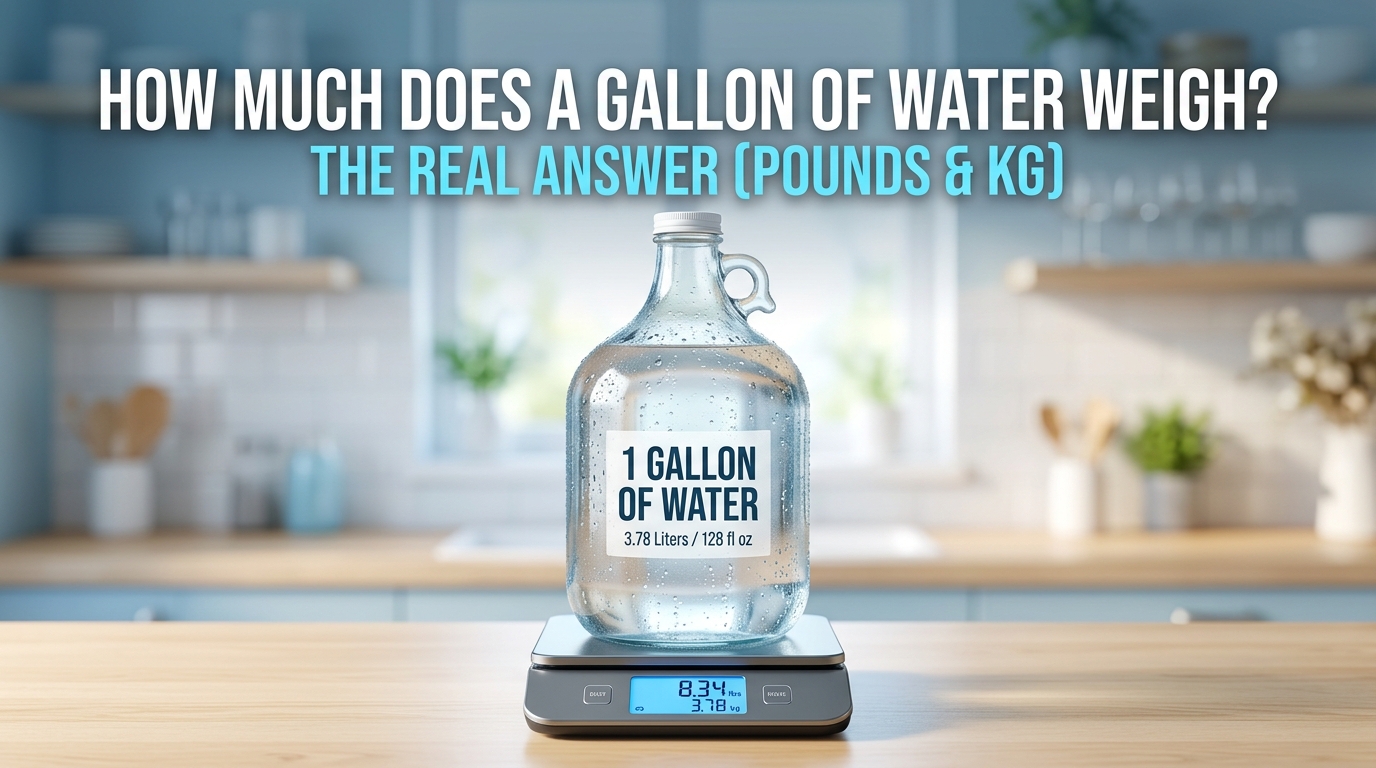
How Much Does a Gallon of Water Weigh?
Fill up a milk jug, lift it, and you already know water has some heft to it. But if someone asked you to put an exact number on that weight, would you be able to answer confidently?
It’s one of those questions that seems simple until you actually need the number — maybe you’re prepping emergency water storage, figuring out if your car can handle a full tank of drinking water in the trunk, or just settling a kitchen argument. Whatever brought you here, you’re about to get a clear, no-nonsense answer.
By the end of this guide, you’ll know exactly how much does a gallon of water weigh, why that number isn’t always fixed, and how it stacks up against gas, milk, and other everyday liquids. We’ll also walk through every common volume conversion — ounces, cups, quarts, pints, liters — so you never have to second-guess a recipe or a storage plan again.
People ask this question for all kinds of reasons, and most of them aren’t about science at all. A parent wants to know if their kid can safely carry a gallon jug to the car. A new homeowner is wondering if a leaking water heater tank could be a real problem for their floor. A hiker is doing math on how much extra weight a full hydration bladder adds to a backpack. None of these situations need a chemistry degree — they just need one solid, trustworthy number, explained simply.
That’s exactly what this guide delivers. No jargon, no unnecessary complexity — just the facts, explained the way you’d want a knowledgeable friend to explain them over coffee.
How Much Does a Gallon of Water Weigh? (Quick Answer)
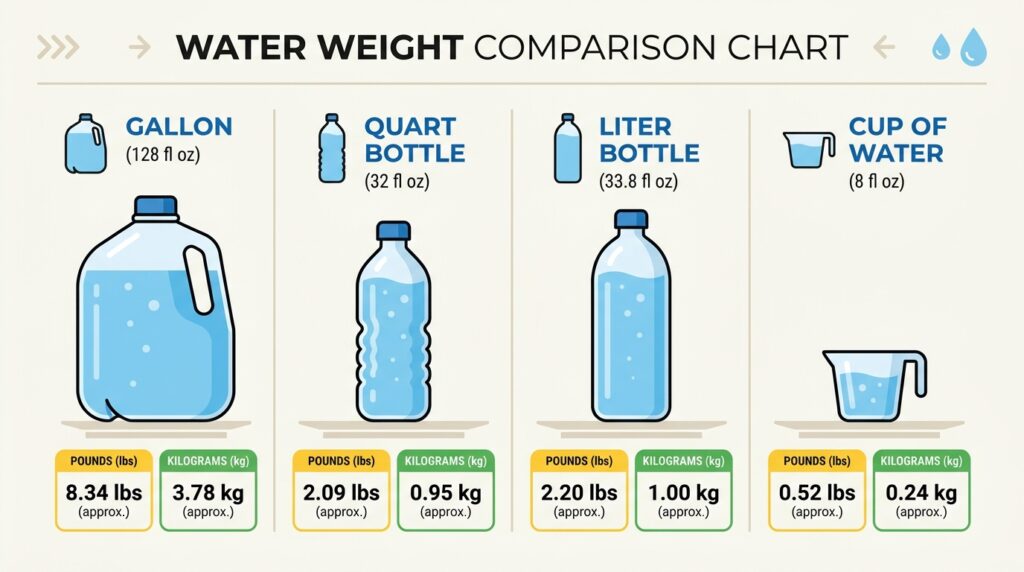
Here’s the number you came for: a US gallon of water weighs about 8.34 pounds, or roughly 3.78 kilograms, at normal room temperature.
That figure comes straight from water’s density, which sits very close to 1 gram per milliliter under everyday conditions. Since a US gallon equals 3.785 liters, and each liter of water weighs about 1 kilogram, the math works out to roughly 8.34 pounds per gallon.
You’ll sometimes see the number written as 8.33 pounds instead of 8.34. Both are correct — the tiny difference just comes from rounding and the exact temperature used in the calculation.
It helps to understand why this number exists in the first place. Water’s weight isn’t some arbitrary figure someone measured once and wrote down — it flows directly from a basic physical property called density, which is just a fancy way of describing how tightly packed the molecules in a substance are. Water happens to have a density very close to 1 gram per milliliter, which is actually the reason the metric system was designed around water in the first place — a liter of water weighing almost exactly one kilogram is not a coincidence, it’s intentional.
The US gallon, by contrast, is a customary unit with older roots, tracing back to historical English measurements. So when you convert a US gallon (3.785 liters) into water’s weight, you’re essentially translating between two measurement systems that were built for different purposes — one for everyday commerce, one for scientific precision. The 8.34-pound figure is where those two systems meet.
| Unit | Weight |
|---|---|
| 1 gallon of water | 8.34 lbs / 3.78 kg |
| 1 half gallon of water | 4.17 lbs / 1.89 kg |
| 1 quart of water | 2.08 lbs / 0.95 kg |
| 1 liter of water | 2.2 lbs / 1 kg |
| 1 cup of water | 0.52 lbs / 0.24 kg |
If you only remember one thing from this article, remember this: 8.34 pounds per gallon is the number to use for everyday math, whether you’re cooking, hauling jugs, or planning storage.
Why Doesn’t a Gallon of Water Always Weigh the Same?
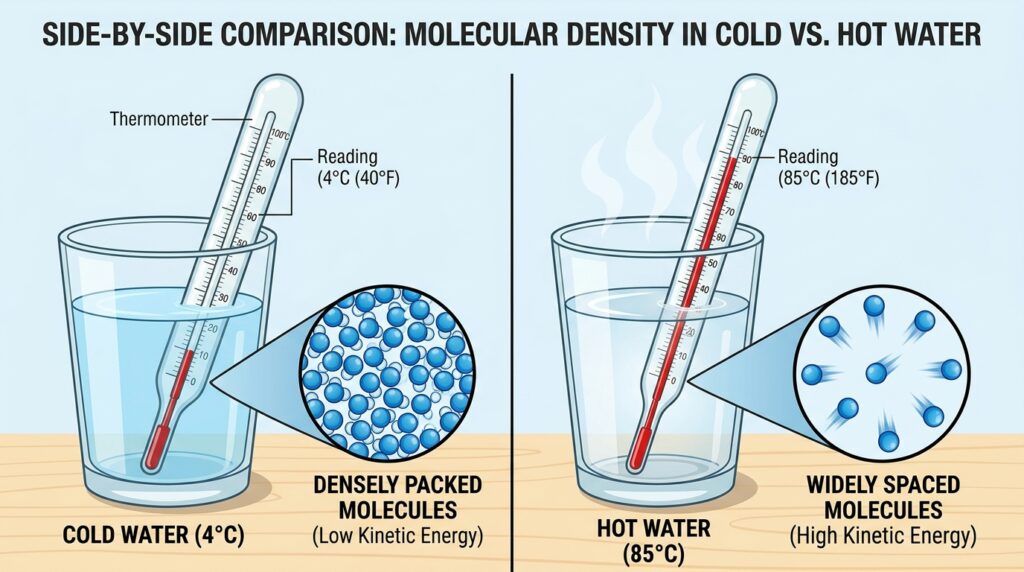
Here’s where it gets interesting. A gallon is a unit of volume — it tells you how much space something takes up. A pound is a unit of weight. Those two things aren’t permanently glued together, because the relationship between them depends on density, and density changes with temperature.
Think about it this way: when water heats up, its molecules get more energetic. They bounce around more and push each other farther apart. That means a hot gallon of water actually contains slightly fewer molecules than a cold gallon of water — even though both still measure exactly one gallon.
So a pitcher of ice-cold water from the fridge will weigh a touch more than the same pitcher filled with water straight off the stove.
The Temperature Effect on Water Weight
Water reaches its maximum density at 39.2°F (4°C). That’s the point where a gallon weighs the most — close to 8.345 pounds. As water gets colder than that (approaching freezing) or warmer (approaching boiling), it becomes very slightly less dense, and the weight per gallon drops a little.
According to data from Inch Calculator, a gallon of water can weigh anywhere between about 8.288 and 8.345 pounds depending on temperature. That’s a difference of less than an ounce — not something you’ll notice unless you’re working in a lab.
To put that in perspective: the gap between a gallon of ice-cold water and a gallon of boiling water is roughly a third of a pound — about 4 percent of the total weight. If you’re hauling jugs, cooking dinner, or filling a water cooler, that difference is completely invisible in practice. You’d need a precision scale to even register it. But in industries like plumbing system design, chemical processing, or laboratory work, that small variance can actually matter, which is why technical references include detailed temperature-versus-density tables rather than relying on a single rounded number.
It’s a neat bit of physics, too. As water cools toward freezing, something unusual happens — instead of continuing to get denser the way most substances do, water actually starts expanding again as it approaches 32°F. That’s why ice floats instead of sinking, and why a closed bottle of water can crack open in the freezer. Water is one of the few substances on Earth that behaves this way, and it’s a big part of why aquatic life can survive winter — ice forms on the surface of lakes and ponds rather than from the bottom up.
For virtually everything in daily life — cooking, drinking, gardening, hauling — 8.34 pounds per gallon is accurate enough.
Does Altitude or Pressure Change the Weight?
Technically, yes, but the effect is so small it’s not worth worrying about. Water’s weight is far more sensitive to temperature than to altitude or atmospheric pressure. Unless you’re doing precision engineering work, you can safely ignore this variable.
How Much Does 5 Gallons of Water Weigh?
If you’re storing emergency water, filling a cooler, or hauling jugs for a camping trip, you’re probably thinking in five-gallon increments rather than single gallons.
Using the standard 8.34 pounds per gallon:
5 gallons of water weighs about 41.7 pounds (18.9 kg).
That’s before you add the weight of the container itself. A typical empty 5-gallon water cooler jug adds another 1 to 2 pounds, bringing your total close to 43–44 pounds when full. That’s worth knowing if you’re planning to lift one onto a water cooler stand — it’s heavier than most people expect.
| Gallons of Water | Approximate Weight |
|---|---|
| 1 gallon | 8.34 lbs |
| 2 gallons | 16.68 lbs |
| 5 gallons | 41.7 lbs |
| 10 gallons | 83.4 lbs |
| 55 gallons (drum) | 458.7 lbs |
If you’re prepping for emergencies, the CDC’s emergency water guidance recommends storing at least one gallon of water per person, per day, for drinking and sanitation — so the weight adds up fast if you’re stocking a family supply for even a week.
Let’s actually run that math, because it’s more eye-opening than it sounds. A family of four following the CDC’s one-gallon-per-person guideline for a two-week supply would need 56 gallons of water. At 8.34 pounds per gallon, that’s just under 467 pounds of water — not counting the containers. That’s a genuinely significant amount of weight to store, move, and rotate, which is exactly why most emergency-preparedness guides recommend a mix of container sizes rather than one giant tank. Smaller jugs (one gallon or less) are easier to carry individually, even if larger drums are more space-efficient for long-term storage.
This is also why people storing water for emergencies often choose stackable, food-grade containers designed for the purpose rather than reusing old milk jugs or juice bottles — beyond hygiene concerns, the structural weight of dozens of gallons needs containers built to handle it without cracking or leaking over time.
Gallon of Water vs. Gallon of Gas: Which Is Heavier?
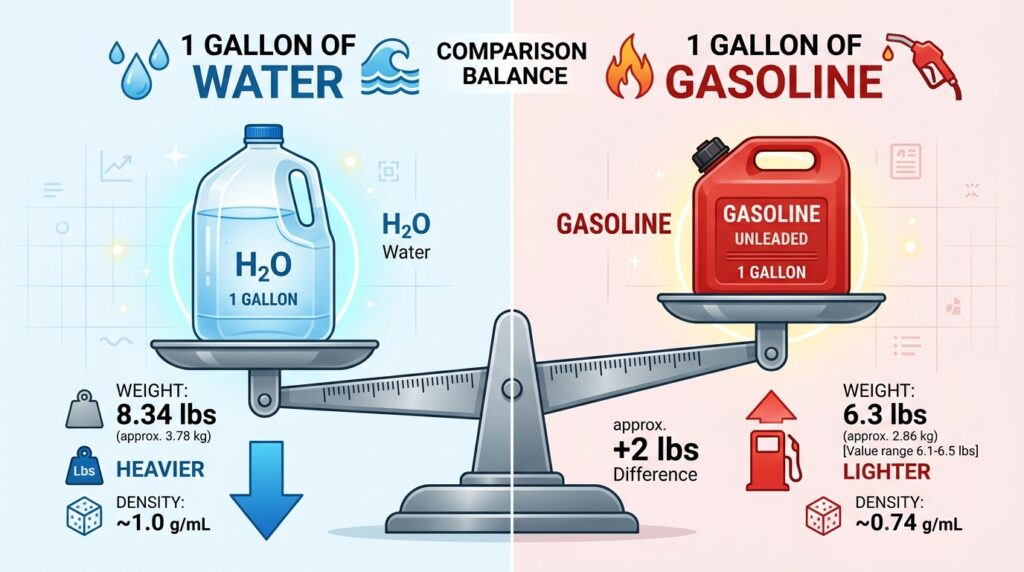
This is one of those comparisons that trips people up, because intuitively it seems like liquids should all weigh roughly the same. They don’t.
Water is heavier than gasoline. A gallon of water weighs about 8.34 pounds, while a gallon of gasoline weighs roughly 6.2 pounds on average (estimates generally range from about 6 to 6.3 pounds depending on blend and temperature).
This is exactly why gasoline floats on top of water rather than sinking — it’s less dense. It’s also part of why firefighters don’t use water to put out gasoline fires; the gas simply floats and keeps burning on the surface.
| Liquid | Weight per Gallon |
|---|---|
| Water | 8.34 lbs |
| Gasoline | ~6.2 lbs |
| Diesel | ~7.1 lbs |
| Whole milk | ~8.6 lbs |
| Honey | ~11.8 lbs |
If you ever need a sanity check on a fuel-weight question, the U.S. Energy Information Administration is a solid resource for how gasoline is produced, blended, and measured.
This density difference shows up in places you might not expect. Boat owners need to think about it when calculating total vessel weight, since a 30-gallon fuel tank and a 30-gallon freshwater tank on the same boat will pull very different amounts on the scale — roughly 186 pounds for gasoline versus 250 pounds for water. Pilots factor in similar math when calculating aircraft weight and balance, since fuel weight directly affects how much cargo or passenger weight a plane can safely carry.
It’s also worth noting that gasoline’s weight isn’t perfectly fixed either. Refineries blend fuel slightly differently across seasons — winter blends and summer blends have different compositions — and ethanol content can nudge the number up or down. None of this changes the big-picture comparison, though: gallon for gallon, water is reliably and noticeably heavier than gasoline.
How Many Ounces in a Gallon?
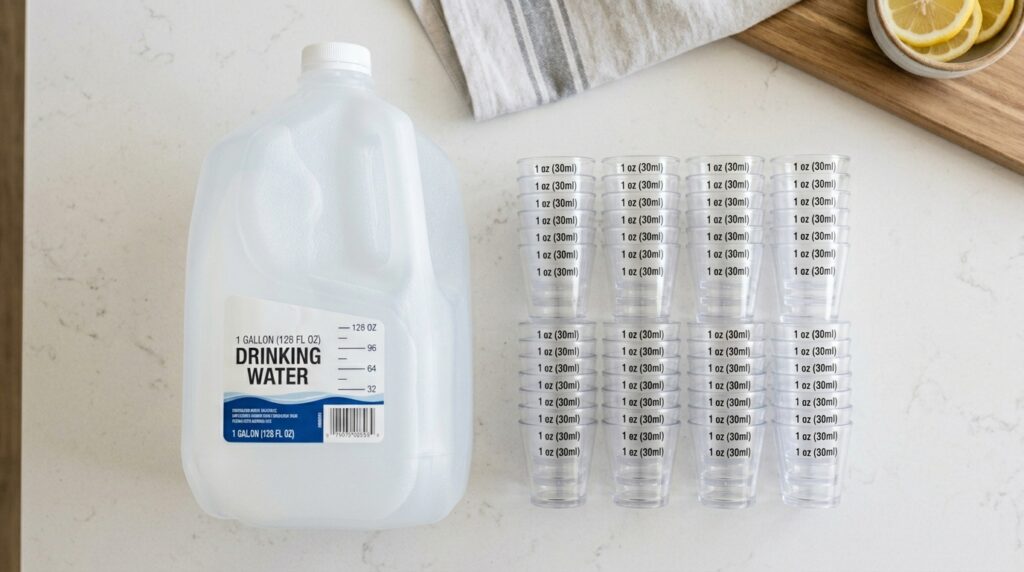
Now let’s get into the conversions, because once you know these, you’ll never need to Google “how many cups in a gallon” mid-recipe again.
There are 128 fluid ounces in a US gallon. This is an exact, standardized number — it’s not an estimate or a rounded figure. The relationship is fixed by NIST Handbook 44, the official US reference for weights and measures.
So whether you’re asking how many ounces are in a gallon, how many oz in a gallon, or how many fl oz in a gallon — the answer is always the same: 128.
How Many Ounces in a Half Gallon?
Cut that number in half and you get your answer for a half gallon. A half gallon contains 64 fluid ounces. That’s the same as two 32-ounce bottles, or a standard half-gallon carton of milk or orange juice from the grocery store.
So if you’ve been wondering how many ounces in half a gallon, how many oz in half a gallon, or how many oz is a gallon split in two — it’s 64 fl oz either way.
Why “Ounces” Can Be Confusing
Here’s a quick but important clarification, because this trips a lot of people up: when we say “ounces” in the context of a gallon, we mean fluid ounces, a measure of volume — not the avoirdupois ounce, which measures weight. They share a name, but they’re not interchangeable units. A fluid ounce of water happens to weigh very close to a regular weight-ounce (since water’s density is close to 1), but that’s a coincidence specific to water — it isn’t true for oil, honey, or flour. So when a recipe calls for “8 ounces of flour,” that almost always means weight, while “8 ounces of milk” usually means volume. Always check context, especially in baking, where the difference can ruin a recipe.
How Many Quarts in a Gallon?
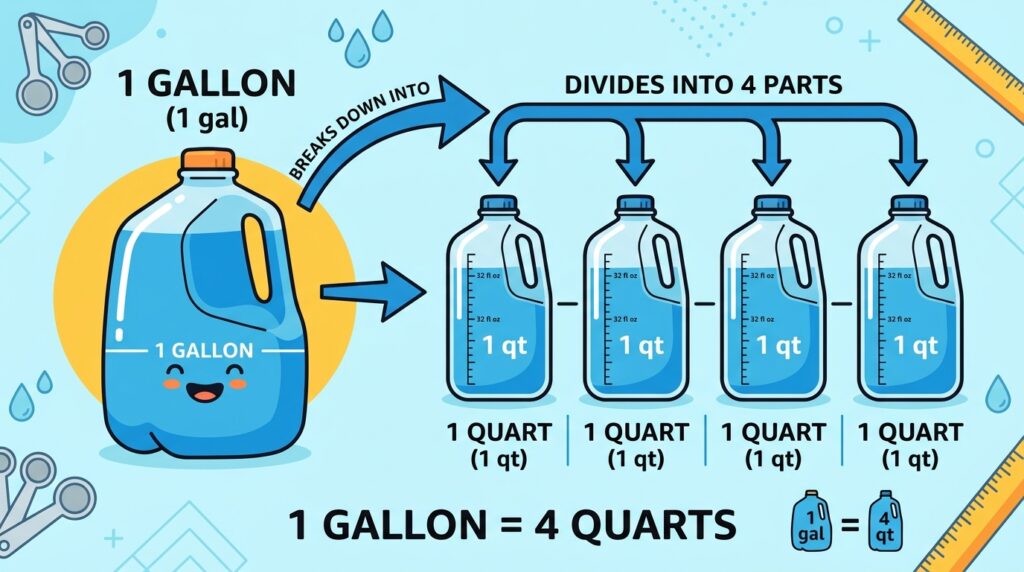
This one’s simple and worth memorizing: there are 4 quarts in a gallon.
It doesn’t matter how the question is phrased — how many quarts are in a gallon, how many quarts is a gallon, how many qt in a gallon, or how many quarts make a gallon — the answer is always 4.
This relationship is part of the standard US liquid measurement hierarchy:
- 1 gallon = 4 quarts
- 1 quart = 2 pints
- 1 pint = 2 cups
How Many Gallons in a Quart?
Flip the question around and you’re dividing instead of multiplying. 1 quart equals 0.25 gallons (a quarter of a gallon) — which is actually where the word “quart” comes from; it’s short for “quarter.”
This naming pattern actually runs through most of the US liquid measurement system once you know what to look for. A “pint” comes from an old French/Latin root related to “painted” marks on measuring vessels, while “quart” directly references the quarter-gallon relationship. Understanding the etymology isn’t just trivia — it’s a handy memory trick. If you ever forget how many quarts are in a gallon, just remember that a quart literally means “a quarter,” and the answer (4) falls right out of the name.
How Many Cups in a Gallon?
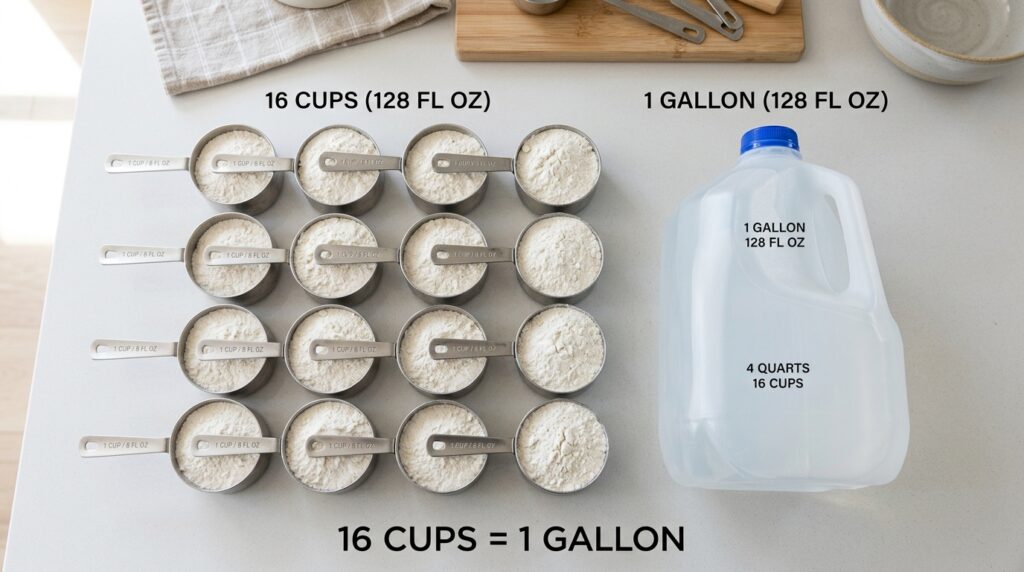
If you cook or bake regularly, this conversion comes up constantly.
There are 16 cups in a gallon. That’s based on the standard US measuring cup, which holds 8 fluid ounces — so 16 cups × 8 ounces = 128 ounces, which checks out against our gallon-to-ounce conversion from earlier.
So however you’re phrasing the question — how many cups in a gallon, how many cups are in a gallon — the number is 16.
How Many Cups in a Half Gallon?
Half of 16 is 8. A half gallon equals 8 cups. This is also why a half-gallon milk carton is sometimes described as holding “8 servings” when a serving is defined as one cup.
This conversion becomes genuinely useful the moment you’re scaling a recipe up or down. Say a soup recipe calls for 3 cups of broth, but you want to make a double batch for a big family dinner — that’s 6 cups, or just under half a gallon. Knowing the cup-to-gallon relationship by heart means you can eyeball container sizes at the grocery store and immediately know whether a given carton or jug will cover your recipe, without doing math in the checkout line.
How Many Pints in a Gallon?
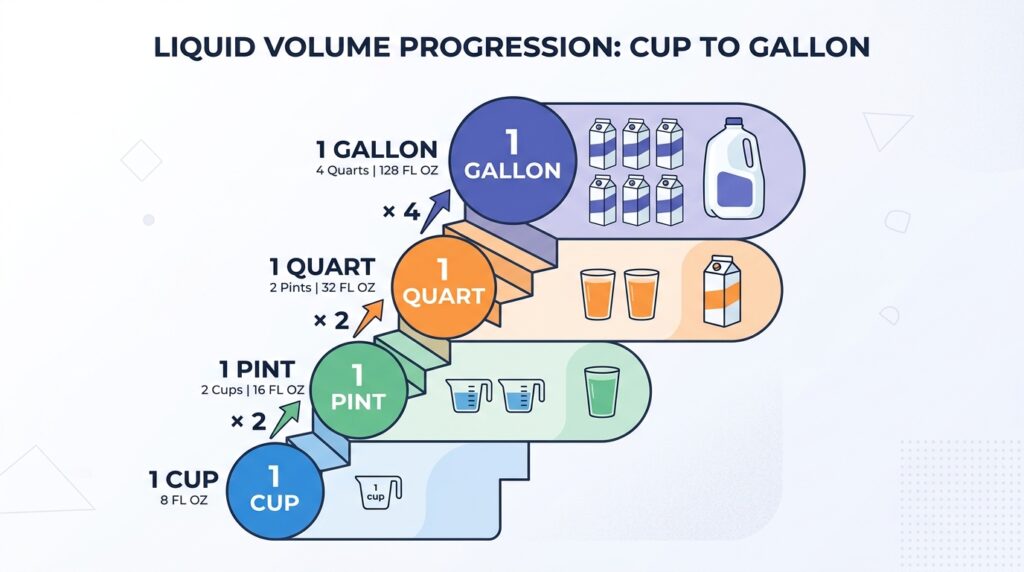
A pint sits between a cup and a quart in the measurement hierarchy.
There are 8 pints in a gallon. Since 1 pint = 2 cups, and there are 16 cups in a gallon, dividing 16 by 2 gives you 8 — consistent whether you’re asking how many pints in a gallon or how many pints are in a gallon.
Here’s the full breakdown so you can see how everything connects:
| Unit | Equivalent in Gallons |
|---|---|
| 1 cup | 1/16 gallon |
| 1 pint | 1/8 gallon |
| 1 quart | 1/4 gallon |
| 1 gallon | 1 gallon |
If you’ve ever bought beer or craft soda, you’ve probably already internalized this conversion without realizing it — a “pint glass” at a bar holds roughly 16 fluid ounces, matching the standard US pint measurement, and eight of those pours would theoretically empty an entire gallon keg or growler.
How Many Liters in a Gallon?
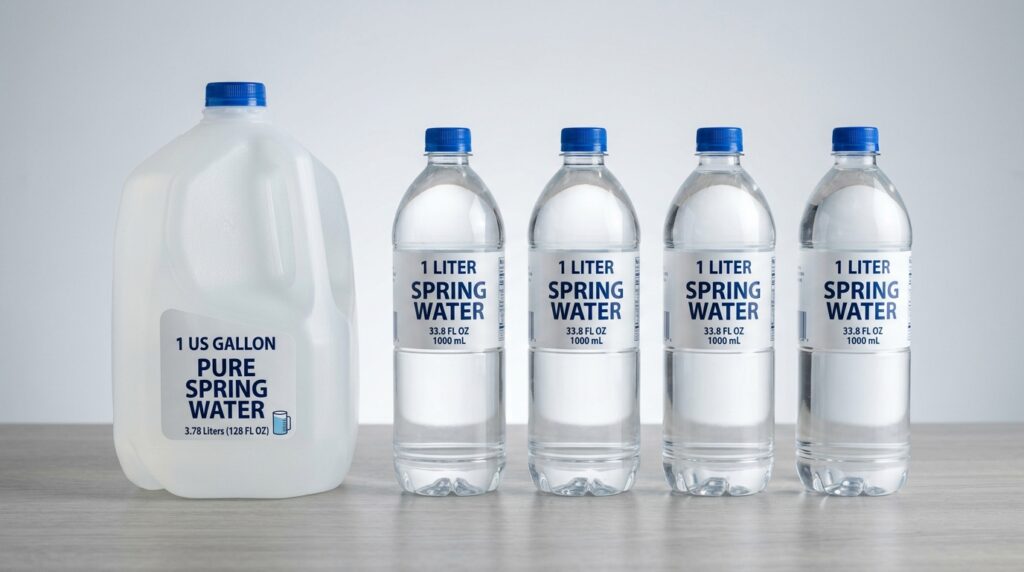
This is where US customary units meet the metric system, and it’s a genuinely useful one to know if you travel, read international recipes, or buy bottled beverages.
1 US gallon equals approximately 3.785 liters. The precise figure, as defined by NIST’s Guide to the International System of Units, is 3.785411784 liters — but for everyday use, rounding to 3.785 (or even 3.79) is more than accurate enough.
So if you’re asking how many liters in a gallon, how many liters are in a gallon, or how many litres in a gallon (same question, British spelling), the answer is about 3.785 liters.
How Many Gallons in a Liter?
Going the other direction: 1 liter equals about 0.264 gallons. That means it takes almost 4 liters to make up a single US gallon — which is part of why a 4-liter jug is sometimes marketed as “approximately a gallon” even though it’s technically a bit more.
How Many ml in a Gallon?
Since 1 liter equals 1,000 milliliters, you can scale up the conversion: 1 US gallon equals approximately 3,785 milliliters.
This conversion is especially handy if you’re reading nutrition labels, medication dosages, or scientific recipes that default to metric measurements, since most of the world outside the US uses liters and milliliters as the standard unit for liquid volume rather than gallons and ounces. If you’ve ever traveled internationally and tried to figure out how a 2-liter soda bottle compares to what you’re used to, this is the conversion doing the work behind the scenes — a 2-liter bottle holds a little over half a US gallon.
How Many Water Bottles Is a Gallon?
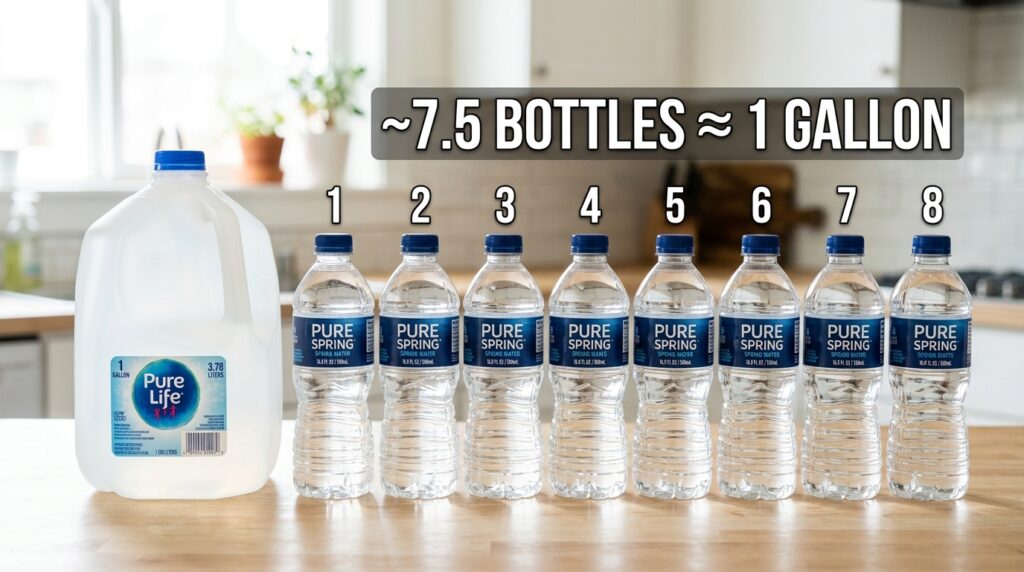
This question pops up constantly, especially among people tracking daily hydration goals.
The answer depends entirely on the bottle size you’re using, since “water bottle” isn’t a standardized unit. Here’s how it breaks down for the most common bottle sizes:
| Bottle Size | Bottles per Gallon |
|---|---|
| 16.9 oz (standard size) | ~7.6 bottles |
| 20 oz | ~6.4 bottles |
| 24 oz | ~5.3 bottles |
| 33.8 oz (1 liter) | ~3.8 bottles |
So if you’re working with the most common disposable water bottle (16.9 oz), it takes roughly 7 to 8 bottles to equal one gallon.
For reference, the National Academies of Sciences, Engineering, and Medicine recommends a total daily fluid intake of around 125 ounces for men and 91 ounces for women — including water from food, not just from bottles. That works out to less than a full gallon for most adults once food-based water is factored in.
How Many Gallons in a Cubic Foot?
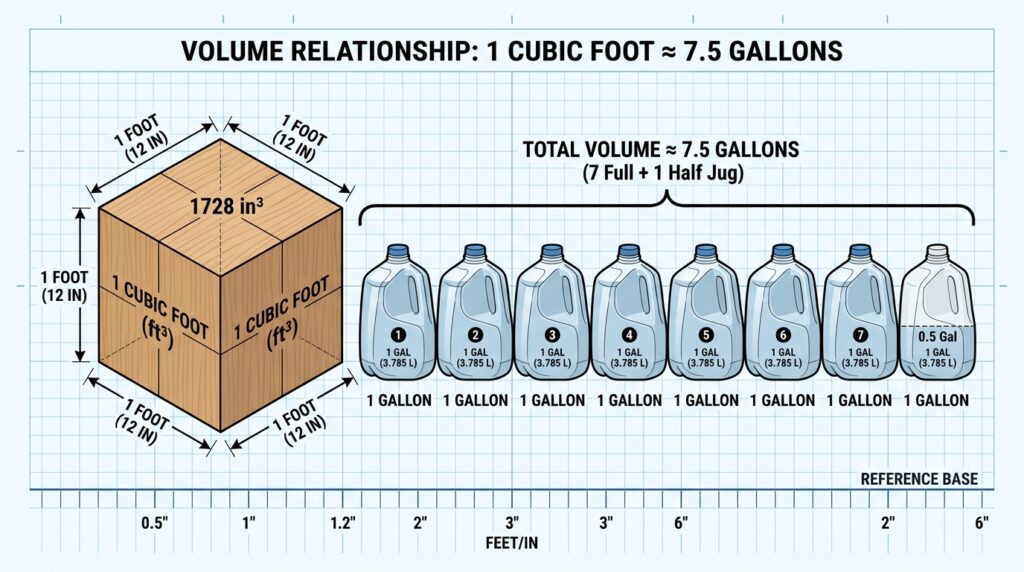
This conversion is less common in daily conversation but comes up often in gardening, aquariums, and home improvement projects — like figuring out how much a fish tank or raised garden bed will hold.
1 cubic foot equals approximately 7.48 gallons.
So if you’re building a raised garden bed that’s 4 cubic feet of soil volume, or filling an aquarium measured in cubic feet, multiply by 7.48 to get the gallon equivalent. This conversion is also useful for swimming pool volume calculations, where contractors often start with cubic footage and convert to gallons for water-fill estimates.
How Many Pounds in a Gallon? (It Depends on the Liquid)
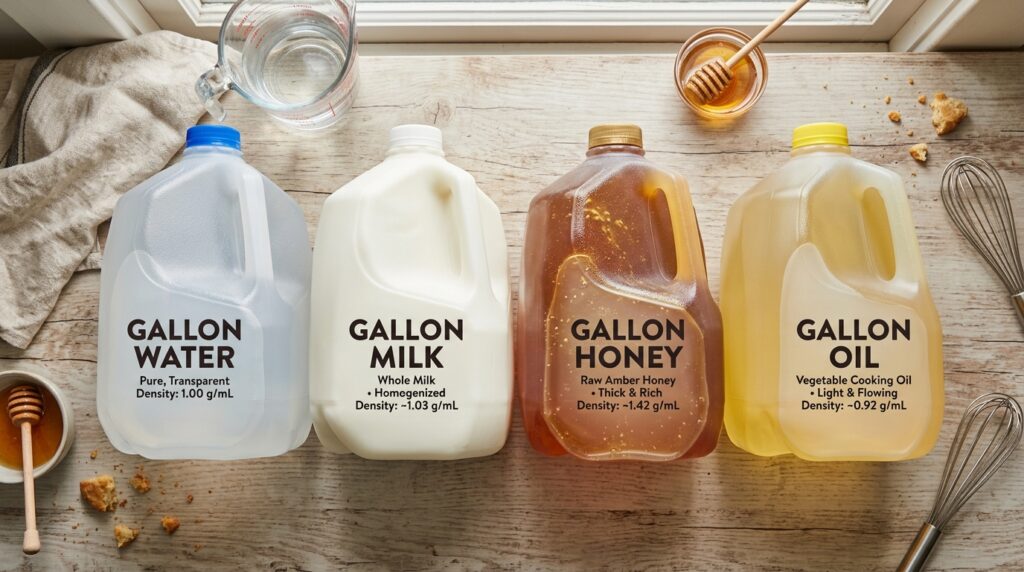
We’ve covered water specifically, but it’s worth being clear: the number of pounds in a gallon changes based on what liquid you’re measuring. A gallon always measures the same volume, but weight depends on density.
Here’s a quick reference for common household liquids:
| Liquid | Pounds per Gallon |
|---|---|
| Water | 8.34 lbs |
| Whole milk | 8.6 lbs |
| Vegetable oil | ~7.7 lbs |
| Honey | ~11.8 lbs |
| Gasoline | ~6.2 lbs |
| Diesel fuel | ~7.1 lbs |
Notice that honey is considerably heavier than water — that’s because it’s much denser, packed with sugars that add mass without adding much extra volume. Oil, on the other hand, is lighter than water, which is why it floats on top in a salad dressing.
How Much Does 1 Gallon of Water Weigh in Different Contexts?
Let’s apply everything we’ve covered to a few real situations where this number actually matters.
Emergency Water Storage
If you’re stocking up for hurricane season, winter storms, or general preparedness, weight matters because you need to actually move and store these containers. A case of six 1-gallon jugs weighs about 50 pounds — heavy enough that you’ll want a hand truck or at least a clear path to your storage shelf.
Moving or Shipping
If you’re relocating and have aquariums, water coolers, or large beverage containers, remember that every gallon adds 8.34 pounds. A 20-gallon tank, drained or not, makes a significant weight difference for movers — over 165 pounds of water alone if filled.
Fitness and Hydration Carrying
Some fitness routines involve carrying water as resistance (think farmer’s carries with water jugs). Knowing that a gallon is about 8.34 pounds helps you scale the challenge — two gallons is close to a 17-pound carry, which adds up fast over distance.
Gardening and Irrigation
If you’re hand-watering a garden bed and wondering about the physical effort involved, a standard 2-gallon watering can filled to the top weighs around 16.7 pounds, not including the can itself.
Aquariums and Pet Care
Aquarium owners run into water weight constantly, since fish tanks are almost always measured in gallons but the real concern is whether a piece of furniture or a section of flooring can support the load. A 20-gallon aquarium, once you account for the water, gravel, and the tank itself, can easily weigh well over 200 pounds. A 55-gallon tank — a popular size for serious hobbyists — can weigh close to 600 pounds fully set up, which is exactly why aquarium retailers are so insistent about using a properly rated stand rather than a regular piece of furniture.
Travel and Road Trips
Anyone road-tripping with a cooler full of ice and bottled water has felt this math firsthand. A cooler holding even 2 gallons of water plus ice can easily add 20-plus pounds to your trunk load — worth factoring in if you’re already close to a vehicle’s payload limit, especially with a fully loaded car for a long trip.
Expert Tips for Working with Water Weight
A few practical tips that go beyond the basic numbers:
- Round to 8.3 or 8.34 pounds for quick mental math. The difference between this and the more precise 8.345 figure is negligible for everyday purposes.
- Use the “pint’s a pound” trick. A common rhyme in US measurement is “a pint’s a pound, the world around” — referring to the rough equivalence between 16 fluid ounces of water and 16 ounces of weight. Since a gallon is 8 pints, that gets you to approximately 8 pounds as a fast mental estimate.
- Don’t assume all liquids match water’s weight. As shown earlier, oil, honey, milk, and fuel all weigh differently per gallon. Always check density if precision matters for a recipe or shipping calculation.
- Account for container weight separately. When estimating total carrying weight, remember that the jug, bottle, or tank itself adds extra pounds beyond the water weight alone.
- For precise lab or industrial work, use temperature-adjusted tables. If you’re in a field where small variances matter (water treatment, chemistry, manufacturing), reference temperature-specific density charts rather than the rounded 8.34 figure.
Pros and Cons of Using the Standard 8.34 lb/Gallon Figure
Pros:
- Accurate enough for virtually all everyday, cooking, and storage purposes
- Easy to remember and use in quick mental math
- Matches the figure most commonly cited by water treatment and engineering references
Cons:
- Not precise enough for laboratory or scientific applications requiring exact temperature-adjusted values
- Can shift by a small but measurable amount in extreme heat or cold
- Doesn’t account for impurities or dissolved minerals in tap water, which add a small amount of additional weight
Frequently Asked Questions
How much does a gallon of water weigh in pounds?
A gallon of water weighs approximately 8.34 pounds at normal room temperature. This can vary slightly — between about 8.3 and 8.4 pounds — depending on the water’s exact temperature.
How much does a gallon of water weigh in kilograms?
A gallon of water weighs approximately 3.78 kilograms. Since a gallon is a US customary unit and the kilogram is metric, this conversion is especially useful for anyone working between the two systems.
Why does a gallon of water weigh more than a gallon of gasoline?
Water is denser than gasoline, meaning more mass is packed into the same volume. A gallon of water weighs about 8.34 pounds, while a gallon of gasoline weighs roughly 6.2 pounds. This density difference is also why gasoline floats on top of water.
Does hot water weigh less than cold water in the same gallon container?
Yes. Heating water causes its molecules to spread apart slightly, lowering its density. A gallon of hot water will weigh marginally less than a gallon of cold water, though the difference is small enough that it rarely matters outside of scientific contexts.
How many 16.9 oz water bottles make up a gallon?
It takes approximately 7.6 standard 16.9-ounce water bottles to equal one gallon (128 fluid ounces). Most people round this to about 8 bottles for simplicity.
Is a gallon of water always exactly 128 ounces?
Yes — this part never changes. The 128 fluid ounce figure is a fixed volume definition set by official US measurement standards, so it stays constant regardless of temperature. What changes with temperature is the weight of that fixed volume, not the volume itself.
How much does 5 gallons of water weigh compared to 1 gallon?
Five gallons of water weighs about 41.7 pounds, exactly five times the weight of a single gallon (8.34 pounds). This linear relationship holds true for any quantity — weight scales directly with volume as long as the temperature stays consistent.
Final Thoughts
At the end of the day, a gallon of water weighs about 8.34 pounds (3.78 kg) — a number that holds steady enough for cooking, storage, fitness, and everyday planning, even though it shifts slightly with temperature.
Once you’ve got that number locked in, the rest of the conversions fall into place naturally: 128 ounces, 16 cups, 8 pints, 4 quarts, and roughly 3.785 liters all describe the exact same gallon, just sliced up differently.
Next time you’re staring at a recipe, packing for an emergency, or just settling a friendly debate about what’s heavier — water or gas — you’ll have the real numbers ready to go.

