
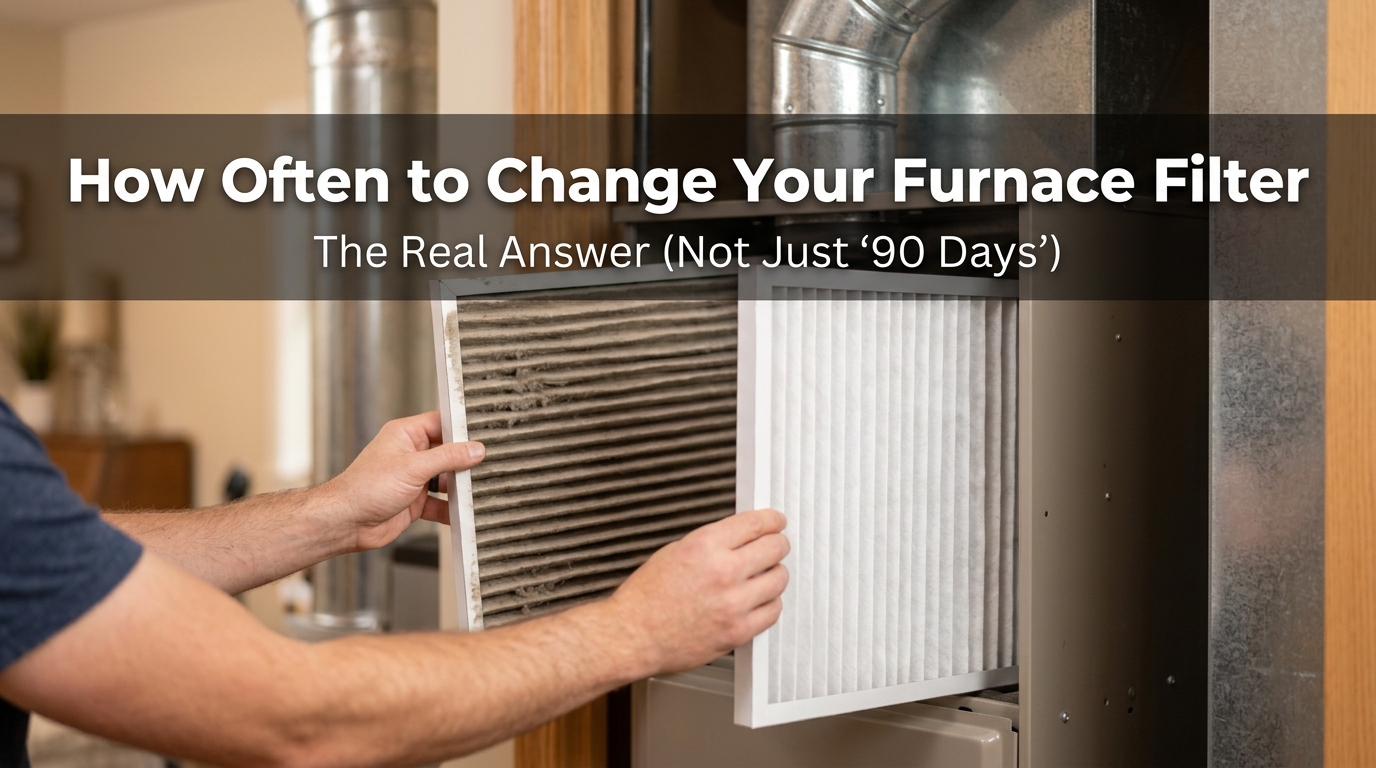
Most people change their furnace filter twice a year, if that. Some don’t change it at all until the furnace starts making a weird noise or the heating bill jumps for no obvious reason.
Here’s the thing — a furnace filter is one of the cheapest, easiest pieces of home maintenance you can do, and it’s also one of the most ignored. It sits behind a vent or inside a slot, quietly doing its job, until it’s so clogged with dust and pet hair that your whole system has to fight to push air through it.
So how often should you actually change it? The short answer: every 1 to 3 months for most homes, with some households needing monthly changes and others able to stretch to 6 or even 12 months depending on the filter type. But that one-size-fits-all answer hides a lot of nuance, and that’s exactly what this guide is going to walk you through.
By the end, you’ll know exactly how to figure out your own ideal schedule, what happens if you let it slide too long, and how to tell — just by looking — when it’s time for a new one.
Why Your Furnace Filter Matters More Than You Think
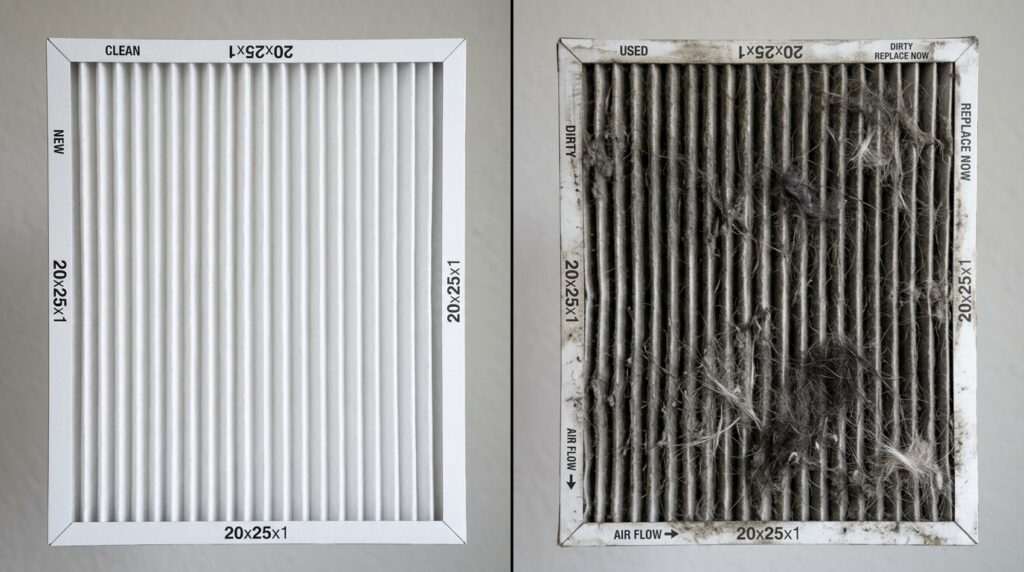
A furnace filter has two jobs. First, it protects your heating system by keeping dust, hair, and debris from building up on sensitive internal parts like the blower motor and heat exchanger. Second, it protects your indoor air by trapping particles before they get recirculated through your home.
When that filter gets clogged, both jobs suffer. Upgrading and properly maintaining the air filter in your central heating and cooling system is one of the practical ways to improve the air you breathe at home.
It’s also worth knowing that indoor air isn’t automatically cleaner than outdoor air. People spend the vast majority of their time indoors, which is part of why the EPA’s guide to air cleaners treats furnace filtration as a meaningful piece of the indoor air quality puzzle, not just a furnace accessory.
On the mechanical side, a clogged filter restricts airflow. Your blower motor has to work harder to push air through it, which raises energy use, stresses components, and in worst-case scenarios, can even trigger a safety shutoff or contribute to a cracked heat exchanger over time.
In short: a five-dollar piece of cardboard and fiberglass (or a thicker pleated filter) stands between “system running smoothly” and “system working overtime.”
How Often Should You Change Your Furnace Filter? The Standard Guideline
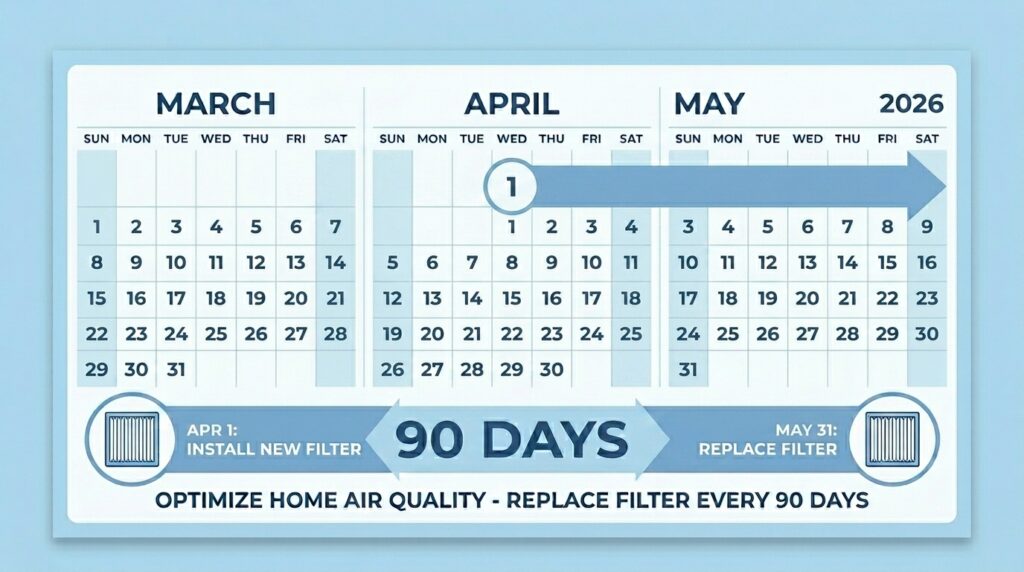
If you want one number to remember, it’s this: change a standard 1-inch furnace filter every 90 days.
That’s the baseline recommendation you’ll see from most filter manufacturers, and it lines up with what the EPA’s guide to air cleaners notes — manufacturers typically recommend replacement every 60 to 90 days, though the agency also points out that if a filter looks heavily soiled before that window is up, it should be changed sooner.
Change the filter every two to three months, or whenever it looks dirty — whichever comes first.
But “90 days” is a starting point, not a rule carved in stone. Here’s a quick-reference table to give you a more realistic range based on filter type:
| Filter Type | Typical Thickness | Recommended Change Frequency |
|---|---|---|
| Fiberglass (basic) | 1 inch | Every 30 days |
| Pleated (standard) | 1 inch | Every 60–90 days |
| Pleated (high-capacity) | 4–5 inches | Every 6–12 months |
| HEPA | Varies | Every 6–12 months |
| Washable/electrostatic | 1 inch | Clean monthly, per manufacturer instructions |
A Simple Rule of Thumb to Remember
If you only take one sentence away from this article, make it this one: check monthly, replace when it looks dirty, and don’t go past the maximum window for your filter type.
That single habit — a 30-second visual check once a month — solves 90% of the guesswork.
How Often Should You Change Your Furnace Filter Based on Your Household?
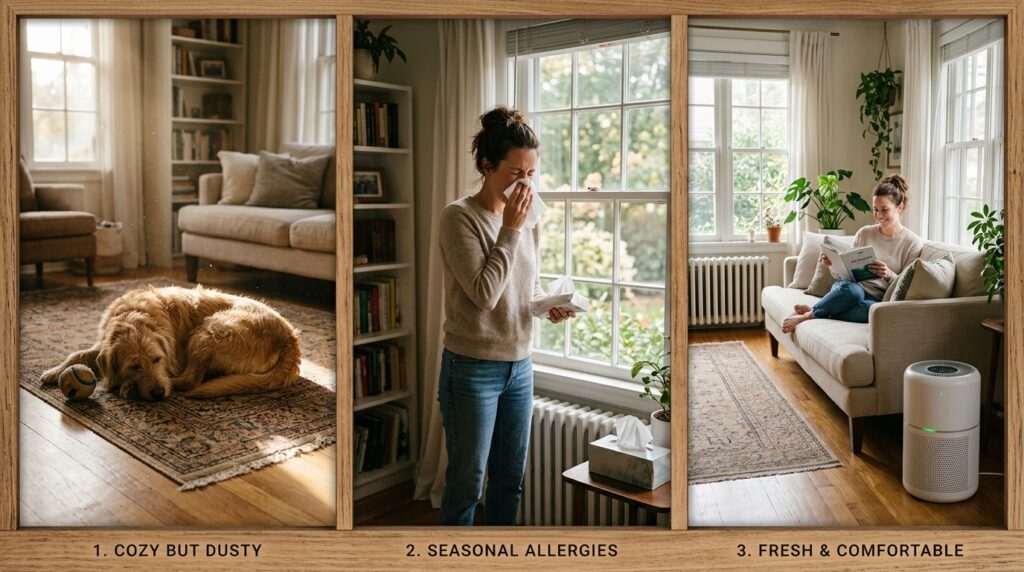
This is where the real answer lives. Your neighbor’s filter schedule might be completely wrong for your house, and here’s why.
If You Have Pets
Pet dander and shed fur are some of the fastest ways to clog a filter. If you have one cat or dog, sticking close to the manufacturer’s normal schedule (60–90 days) is usually fine. But if you have multiple pets, especially ones that shed heavily, plan to check the filter every 30 days and likely replace it on that same schedule, a recommendation echoed by Carrier’s home HVAC guidance.
If Someone in the Home Has Allergies or Asthma
Households dealing with allergies or asthma benefit from both a higher-efficiency filter (look for a MERV rating of 11–13) and a tighter replacement schedule, often every 30 days during high-pollen seasons. A clean filter actively reduces the dust, pollen, and dander circulating through your vents.
If You Live in a Dusty or High-Pollution Area
Homes near construction, unpaved roads, agricultural land, or areas prone to wildfire smoke tend to clog filters faster. During wildfire season specifically, upgrading filtration and checking more frequently is worth the extra effort, something the EPA’s wildfire smoke factsheet addresses directly when it comes to protecting indoor air during smoke events.
If You’re Mid-Renovation
Sanding, demolition, and flooring work throw enormous amounts of fine dust into the air. During any remodeling project, change the filter every 30 days, or even more often, until the dust settles.
If It’s Just You (or You and One Other Person), No Pets, Low Dust
You’re the exception that can often stretch toward the 90-day mark comfortably, sometimes a little beyond it with a higher-quality pleated filter.
Quick Household Reference Table
| Household Situation | Suggested Change Frequency |
|---|---|
| Single person / no pets, minimal dust | Every 90 days |
| Average family, 1–2 pets | Every 60 days |
| Multiple pets or heavy shedding | Every 30 days |
| Allergy or asthma sufferers in home | Every 30 days |
| Active renovation or construction nearby | Every 30 days |
| Vacation home / rarely occupied | Every 6–12 months (check seasonally) |
Seasonal Furnace Filter Changes: Does Time of Year Matter?
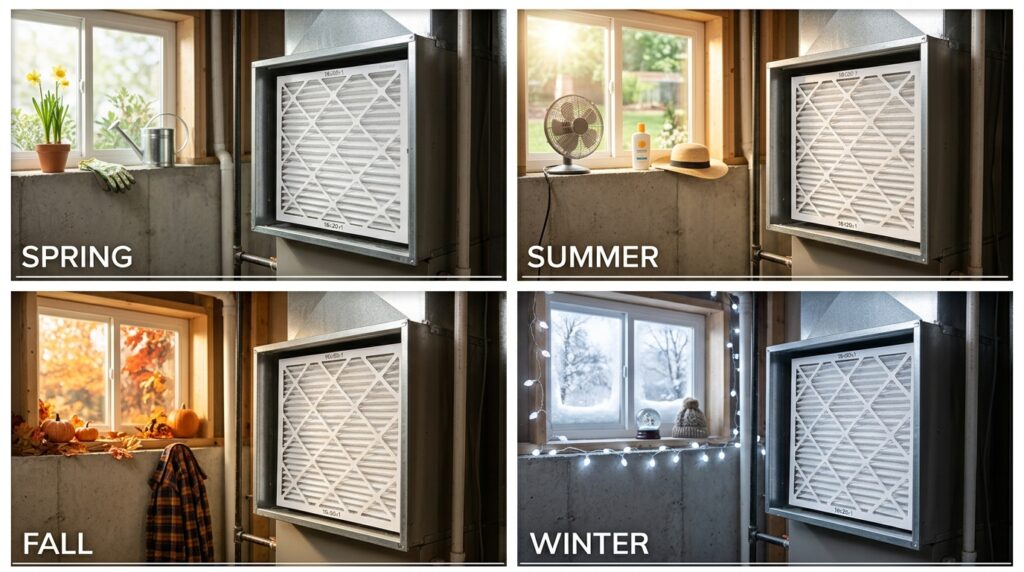
Yes, time of year genuinely changes how hard your filter is working. Many manufacturers actually recommend swapping filters at the start of each new season as an easy way to stay on schedule.
Here’s why seasonality matters:
- Winter: If you’re in a colder climate and running the furnace constantly for months, more air is pulled through the filter, so it clogs faster — sometimes within 30 to 60 days instead of 90.
- Summer: Your air conditioner usually shares the same air handler and filter as your furnace, so even though the furnace itself is off, the filter is still working hard.
- Spring: Pollen season can clog filters quickly, especially for allergy-prone households.
- Fall: A great time for your seasonal swap, right before heavy winter use begins, and a natural moment to schedule annual furnace maintenance.
If you live somewhere with a mild climate where you barely use the furnace, you might genuinely get away with the full 90-day window or longer. If you’re in a northern climate running the system nonstop from October through March, lean toward the 30–60 day range during that stretch.
How to Tell If Your Furnace Filter Needs Changing (Without Guessing)
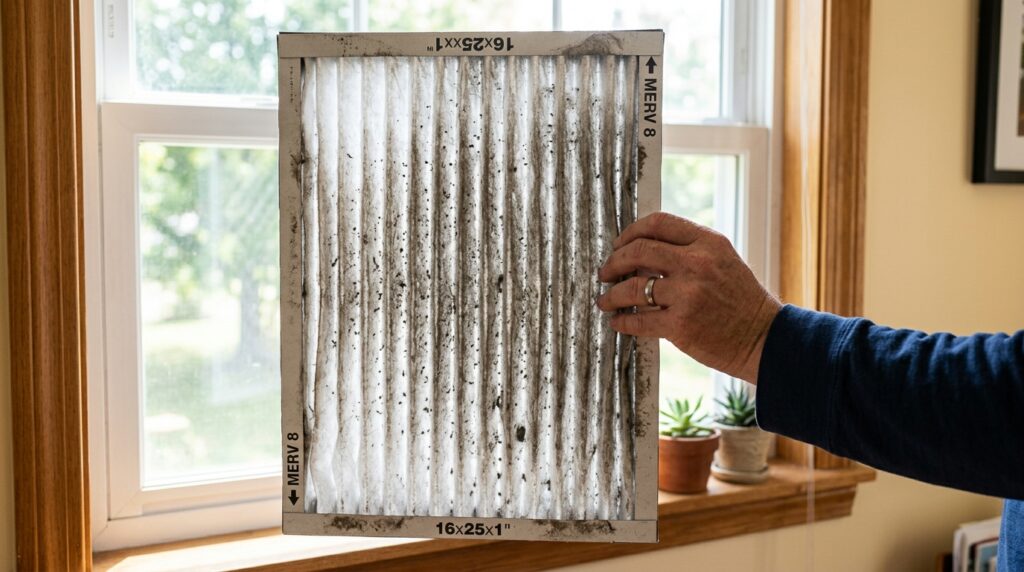
You don’t have to rely purely on a calendar. Your filter and your furnace will usually tell you when something’s wrong. Here are the clearest signs.
1. The Light Test
Pull the filter out and hold it up to a window or light bulb. If light passes through cleanly, it’s still good. If it looks gray, dusty, or you can barely see light through it, it’s time for a new one. This simple visual check is recommended across multiple HVAC resources, including HVAC.com’s filter guidance.
2. Uneven Heating Around the House
If some rooms feel noticeably colder than others, a clogged filter restricting airflow could be the culprit.
3. Your Energy Bill Creeps Up
A dirty filter forces your blower motor to work harder to push the same amount of air, which can show up as a higher-than-usual heating bill with no other explanation.
4. More Dust on Furniture, Faster
If you vacuum and dust regularly but notice buildup returning quickly, your filter may no longer be trapping particles effectively.
5. The Furnace Runs Longer Than Usual
Longer heating cycles often mean the system is struggling to pull air through a blocked filter.
6. Allergy Symptoms Flare Up Indoors
If allergy or asthma symptoms seem worse at home specifically, a saturated filter could be letting more allergens recirculate.
7. The System Shuts Off Unexpectedly
Frequent shutoffs can be a sign of overheating caused by restricted airflow, a safety feature kicking in to protect the unit.
If you notice two or more of these signs, skip the calendar and just check the filter directly.
What Does a Furnace Look Like? Finding and Identifying Yours
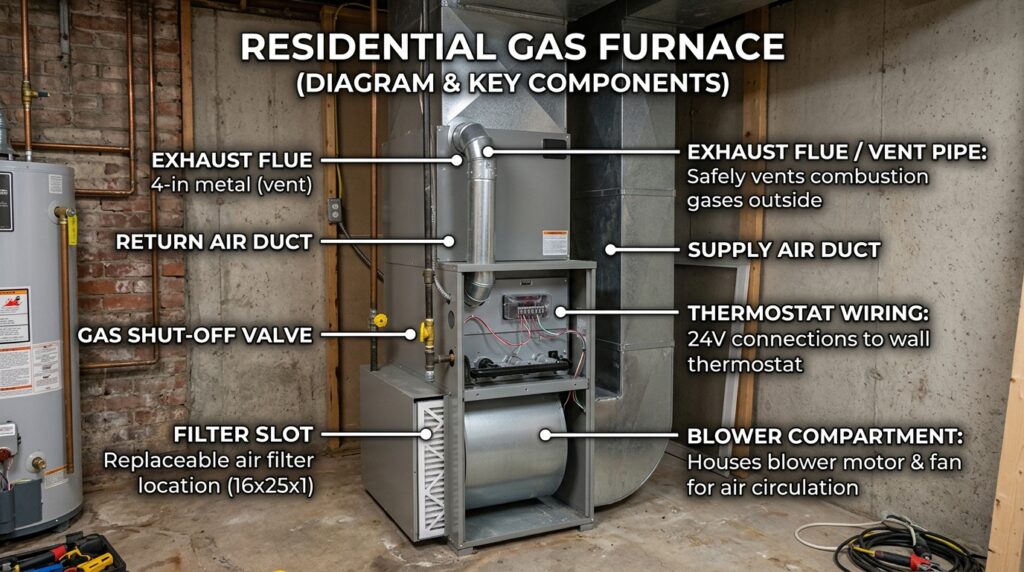
If you’re new to homeownership, you might not even be totally sure what your furnace looks like or where the filter lives, and that’s a completely normal place to start.
Most residential furnaces are tall metal boxes, usually somewhere between waist and chest height, finished in white, gray, or beige sheet metal. You’ll typically find one in a basement, utility closet, attic, or garage, often connected to a network of large metal or insulated ducts running overhead or through the floor.
On the outside, a gas furnace usually has:
- A metal cabinet with an access panel or door on the front
- Visible ductwork connecting to the top (supply) and sometimes the side or bottom (return)
- A flue pipe running to the outside, venting combustion exhaust
- A small window or status light showing the control board’s diagnostic codes
The filter itself is usually located in one of two spots:
- Inside the furnace cabinet, in a slot near where the return air duct connects, often behind a small door you can open by hand or with a screwdriver.
- In the ductwork itself, behind a return air grille somewhere in your home — often a louvered vent on a wall or ceiling, secured with screws or a simple latch.
If you’re not sure which setup you have, look for a rectangular vent cover larger than your typical floor or wall registers. That’s frequently your return air grille, and many homes have the filter tucked just behind it. Diagrams like the one from HomeTips’ gas furnace explainer can help you visually match your own setup to a standard layout.
Electric furnaces look similar from the outside but skip the gas valve, burners, and flue, relying instead on internal heating coils.
How to Change a Furnace Filter Yourself (Step-by-Step)
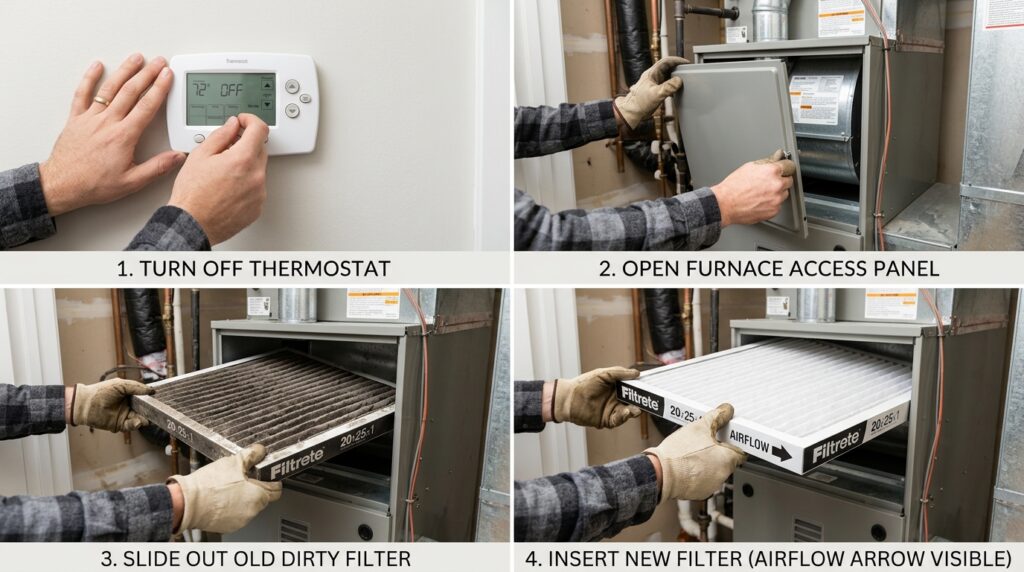
This is genuinely one of the easiest home maintenance tasks there is. No tools required in most cases, and it takes less than five minutes.
- Turn off the system. Use your thermostat or the power switch near the furnace (it often looks like a regular light switch on the unit itself).
- Find the filter slot. Check inside the furnace cabinet near the return duct connection, or behind your largest wall/ceiling vent grille.
- Note the size. The filter’s dimensions (like 16x25x1) are printed on the cardboard frame. Write it down or snap a photo so you buy the right replacement.
- Check the airflow arrow. Every filter has a small printed arrow showing which direction air should flow through it. This needs to point toward the furnace, not away from it.
- Remove the old filter carefully to avoid shaking loose dust back into the air. Bag it immediately for disposal.
- Insert the new filter, matching the airflow arrow direction.
- Close everything up and restore power.
That’s it. Set a recurring reminder on your phone for next time, since “I’ll remember” is exactly how most filters end up neglected for six months or longer.
What Happens If You Don’t Change Your Furnace Filter?
Skipping filter changes doesn’t just mean dustier air. It compounds over time:
- Reduced airflow forces your blower motor to work harder, increasing wear.
- Higher energy bills result from the system using more power to move the same amount of heat.
- Shortened equipment lifespan, since a furnace running under constant strain wears out faster than one operating efficiently.
- Frequent breakdowns and repairs, often centered on the blower motor or limit switch.
- Worse indoor air quality, since a saturated filter can’t trap new particles effectively and may even let some blow back into your living space.
- Potential safety shutoffs, where the furnace’s limit switch cuts power to prevent overheating.
None of these are exaggerations. They’re the predictable mechanical result of restricting airflow through a system designed to move a specific volume of air. Over months and years, that strain adds up — and it’s a major reason why furnaces fail earlier than their expected lifespan.
How Much Does It Cost to Replace a Furnace? (And Why Filters Matter Here)
Here’s where the cost of neglecting a five-dollar filter really comes into focus.
According to NerdWallet’s 2026 furnace cost analysis, replacing a furnace costs about $4,800 on average, with a typical range of roughly $2,823 to $6,888 depending on the system. Angi’s cost data lands in a similar range, putting most new furnace installations between $2,823 and $6,896.
Here’s a simplified cost breakdown by fuel type, based on data compiled by Today’s Homeowner and This Old House:
| Furnace Type | Typical Installed Cost Range |
|---|---|
| Electric | $2,000 – $7,000 |
| Natural Gas | $3,800 – $10,000 |
| Oil | $6,750 – $10,000 |
| National Average (all types) | Around $4,800 |
A few cost factors worth knowing:
- Labor typically runs $75–$100 per hour, with most installations taking five to eight hours.
- Old furnace removal can add $60–$330.
- New ductwork, if needed, can add $2,000–$5,000.
- Permits may cost $400–$1,500 depending on your area.
Most furnaces last between 15 and 20 years with proper maintenance, and replacement generally becomes the smarter financial move once a unit is in that 15-to-20-year range or repair costs start approaching a third of the replacement price. None of that lifespan happens automatically, though. Regular maintenance, starting with something as basic as filter changes, is what keeps a furnace running closer to the long end of that range instead of the short end.
Think about it this way: a pleated furnace filter costs somewhere between $10 and $50 depending on size and MERV rating. A full furnace replacement averages around $4,800. Religiously changing a $20 filter every 60–90 days for 15 years costs a few hundred dollars total. A single premature furnace failure caused by years of restricted airflow and an overworked blower motor can wipe that “savings” out instantly and then some.
Understanding MERV Ratings (So You Buy the Right Filter)
You’ll see “MERV” printed on every filter box, and it’s worth understanding before you buy.
MERV stands for Minimum Efficiency Reporting Value, a rating system developed by ASHRAE (the American Society of Heating, Refrigerating, and Air-Conditioning Engineers) to measure how effectively a filter captures particles between 0.3 and 10 microns. The scale runs from 1 to 16 for standard residential and commercial filters, and according to the EPA’s MERV rating explainer, the higher the number, the better the filter is at trapping smaller particles.
Here’s a simplified breakdown:
| MERV Range | What It Captures | Best For |
|---|---|---|
| 1–4 | Large particles: dust, lint, pollen | Basic, budget filtration |
| 5–8 | Mold spores, dust mites, pet dander | Standard households |
| 9–12 | Finer dust, some auto emissions | Homes with pets or mild allergies |
| 13–16 | Bacteria, smoke, some viruses | Allergy/asthma households, high-pollution areas |
One important caution: a higher MERV rating isn’t automatically better for your specific furnace. Denser filtration increases resistance to airflow, and older or smaller systems aren’t always built to handle that resistance. If you want to upgrade to MERV 13, it’s worth checking your furnace’s manual or asking an HVAC technician whether your blower motor can handle it without strain.
Expert Tips for a Smarter Furnace Filter Routine
A few small habits make this whole process effortless instead of something you have to remember on your own:
- Write the install date directly on the filter frame with a marker. It’s the simplest way to know exactly how long it’s been in use.
- Buy in bulk. If you know your home needs a filter every 60 days, buy six at once so you’re never caught without a replacement.
- Set a recurring phone reminder tied to your specific schedule rather than a generic “every 3 months” default.
- Inspect monthly even if you don’t plan to replace monthly. This single habit catches early warning signs before they become expensive problems.
- Match your filter size precisely. The dimensions on the frame (like 20x25x1) need to match your slot exactly. A gap around the edges lets unfiltered air sneak through.
- Don’t default to the highest MERV rating “just to be safe.” Check what your system can handle first.
- Schedule professional maintenance annually, ideally in the fall before heavy winter use begins. A technician can catch problems a filter check alone won’t reveal.
Pros and Cons of Different Filter Types
| Filter Type | Pros | Cons |
|---|---|---|
| Fiberglass | Cheapest option, easy to find | Low filtration efficiency, needs frequent changes |
| Standard Pleated (MERV 8–11) | Good balance of cost and filtration, widely compatible | Still needs changing every 60–90 days |
| Thick Media (4–5 inch, MERV 11–13) | Long lifespan (6–12 months), strong filtration | Higher upfront cost, requires compatible furnace cabinet |
| HEPA | Captures 99.97% of fine particles | Often too restrictive for standard residential furnaces without modification |
| Washable/Electrostatic | No ongoing filter purchases | Requires regular manual cleaning, can lose efficiency over time if not maintained properly |
If you’re unsure which type fits your system, the safest move is checking your furnace’s owner’s manual for the maximum MERV rating it supports before upgrading.
Frequently Asked Questions
How often should you change your furnace filter if you have no pets and no allergies?
For a typical household with no pets and no allergy concerns, every 90 days is generally sufficient for a standard pleated filter. Still, check it monthly just to confirm it’s not getting dirty faster than expected, especially during peak heating season.
How often change furnace filter during winter versus summer?
During winter, if your furnace runs constantly in a cold climate, plan on changing it every 30 to 60 days. In summer, your air conditioner shares the same filter, so even though the furnace itself is idle, the filter still needs regular attention, often monthly if your AC runs heavily.
How much does it cost to replace a furnace filter versus replacing the whole furnace?
A furnace filter typically costs $10–$50 depending on size and MERV rating. A full furnace replacement averages around $4,800, with a typical range of $2,823 to $10,000 depending on fuel type and system complexity. Regular filter changes are one of the most affordable ways to help avoid premature furnace failure.
What does a furnace look like, and how do I know if I even have one?
A furnace is typically a large metal cabinet, usually located in a basement, closet, attic, or garage, connected to ductwork running through your home. If your home has vents in the floor, walls, or ceiling that blow warm air, and a thermostat controlling the temperature, you almost certainly have a furnace somewhere on the property.
Can I just clean my furnace filter instead of replacing it?
Most pleated filters are disposable and shouldn’t be washed, since the process can damage the filter media and reduce its effectiveness. Some specialty electrostatic or washable filters are designed for cleaning, but always follow the manufacturer’s specific instructions rather than assuming.
Final Thoughts
If there’s one takeaway here, it’s that “how often to change your furnace filter” doesn’t have a single universal answer; it has a range, and your job is figuring out where your household falls within it.
Start with the 90-day baseline, check monthly, and adjust based on pets, allergies, filter thickness, and the season. That simple habit protects your air quality, keeps your energy bills in check, and meaningfully extends the life of a system that costs thousands of dollars to replace.
Grab a filter that matches your slot size, write today’s date on the frame, and set a reminder for next time. Future you (and your furnace) will be glad you did.

