
There’s a strange irony in succulent care: these are some of the toughest, most forgiving plants you can bring into a home, and yet they’re also the ones most people accidentally kill within a few months. The culprit almost every time is watering, specifically, watering too often, out of habit rather than actual need.
Figuring out how often to water succulents isn’t about memorizing a strict calendar. It’s about reading the plant and its soil, then adjusting based on light, season, and where the pot lives. Once that clicks, succulents become genuinely low-maintenance instead of a slow-motion mystery you’re constantly second-guessing.
Part of the confusion comes from how differently succulents behave compared to the average houseplant. Most tropical plants signal thirst clearly, drooping leaves, dry soil, an obvious need for water. Succulents do the opposite. They hold onto stress signs for weeks, quietly rotting from the inside while looking perfectly fine on the surface, right up until the stem suddenly turns to mush. That delay between cause and visible effect is exactly why so many well-meaning plant owners keep watering on a fixed schedule long after the plant actually needed a break.
The good news is that once you understand the handful of variables that actually drive watering frequency, light, season, pot type, and soil, the guesswork mostly disappears. What’s left is a simple routine you can apply to almost any succulent variety, whether it’s a jade plant on a kitchen windowsill or an echeveria out on a sunny patio.
Why Succulents Need So Little Water in the First Place
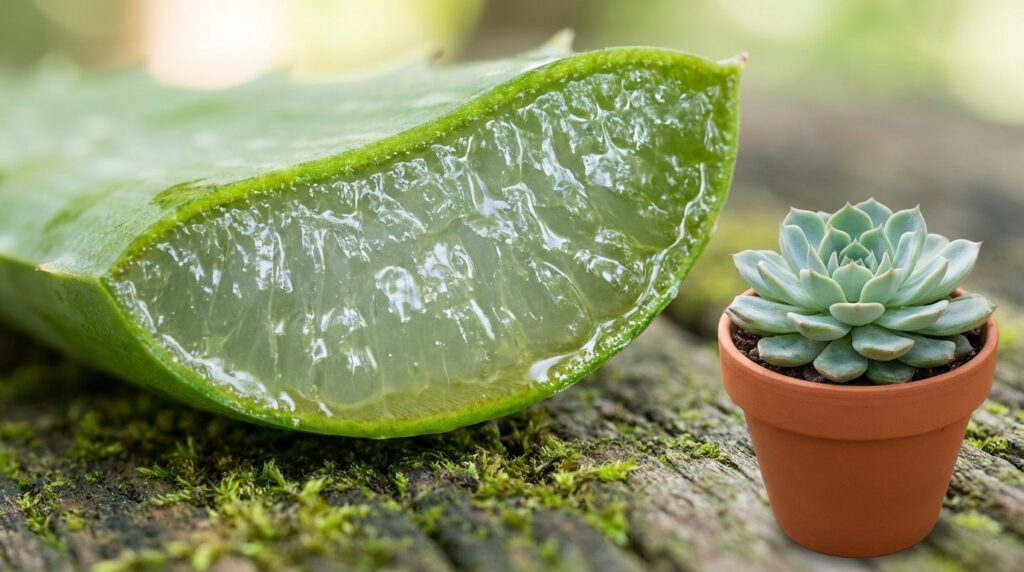
Succulents evolved in arid, drought-prone environments where rain is rare but sometimes heavy when it arrives. To survive long dry stretches, their leaves, stems, or roots developed the ability to store water internally, which is exactly what gives them that plump, fleshy look.
That storage capacity means a succulent isn’t relying on constantly moist soil the way a fern or a peace lily would. It’s drawing from its own internal reserves for days or weeks at a time. Water it on the same schedule you’d use for a tropical houseplant, and you’re essentially drowning a plant that was built to handle drought, not soggy roots.
There’s a useful comparison here: think about how a camel stores fat in its hump rather than needing constant access to food. A succulent’s leaves work the same way with water. When the soil is dry and the plant needs a drink, it pulls from that internal reservoir rather than immediately wilting the way a thirstier plant would. That buffer is also why succulents can survive travel, a missed watering week, or a forgetful houseguest far better than most other houseplants. It’s a feature, not a flaw, but it only works in your favor if you actually let the soil dry out between waterings instead of topping it off constantly.
So, How Often to Water Succulents, Really?
There’s no single number that works for every plant, every pot, and every home, but a reasonable starting point for most succulents grown indoors is watering roughly every one to two weeks during spring and summer, then stretching that out to every three to four weeks in fall and winter.
That range shifts quite a bit depending on a handful of factors, which is why soil-based checks (covered below) matter more than sticking to a fixed date on the calendar. Outdoor succulents in full sun and hot weather often need water more frequently, sometimes weekly, since heat and wind pull moisture out of soil much faster than an indoor environment does, a pattern well documented by cooperative extension research on desert-adapted plants.
The most reliable rule across nearly every source and expert on the subject is this: water thoroughly, then don’t water again until the soil has dried out almost completely. If you take away only one habit from this piece, that’s the one worth keeping.
Signs Your Succulent Needs Water
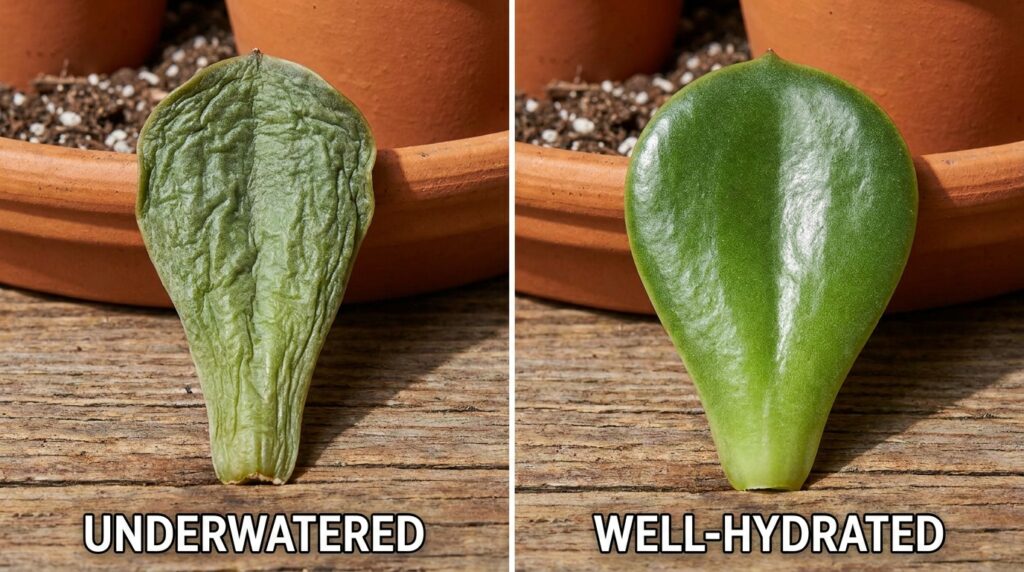
Rather than watching a calendar, it helps to watch the plant itself. A succulent that’s genuinely thirsty usually shows it in a few specific ways.
- Leaves that look slightly wrinkled, puckered, or deflated instead of plump and firm
- Lower leaves that feel softer than usual, even though they’re not discolored
- Soil that pulls away from the edges of the pot when you poke it
- A noticeably lighter pot than usual when you pick it up, since dry soil weighs less
The good news is that mild underwatering is easy to fix and rarely fatal. A thoroughly watered, slightly wrinkled succulent typically plumps back up within a day or two, which is one reason experienced growers tend to lean toward underwatering rather than overwatering when they’re unsure.
Signs You’re Overwatering (The Bigger Risk)
Overwatering is responsible for far more succulent deaths than underwatering ever is, and the early warning signs are easy to miss if you’re not looking for them.
Watch for:
- Leaves that turn translucent, mushy, or yellowish, especially near the base of the plant
- A soft, water-logged stem that gives way easily when gently squeezed
- A sour or musty smell coming from the soil
- Leaves dropping off with little to no resistance, even when gently touched
Once root rot sets in, it can spread quickly, turning roots black and slimy and cutting off the plant’s ability to take up water or nutrients at all. Catching these symptoms early, before the stem itself turns mushy, gives you the best shot at saving the plant by cutting back watering immediately and letting the soil dry out completely.
It’s worth noting that overwatering and underwatering can sometimes look confusingly similar at first glance, both can cause leaves to look a little deflated or off-color. The key difference is texture. An underwatered leaf feels dry, thin, and wrinkled, almost like a raisin. An overwatered leaf feels soft, squishy, and often translucent, more like something starting to spoil. Learning to tell those two textures apart with a gentle touch will save you from making the wrong call and either drowning an already-struggling plant or letting a genuinely thirsty one go without water even longer.
How to Check If the Soil Is Actually Dry
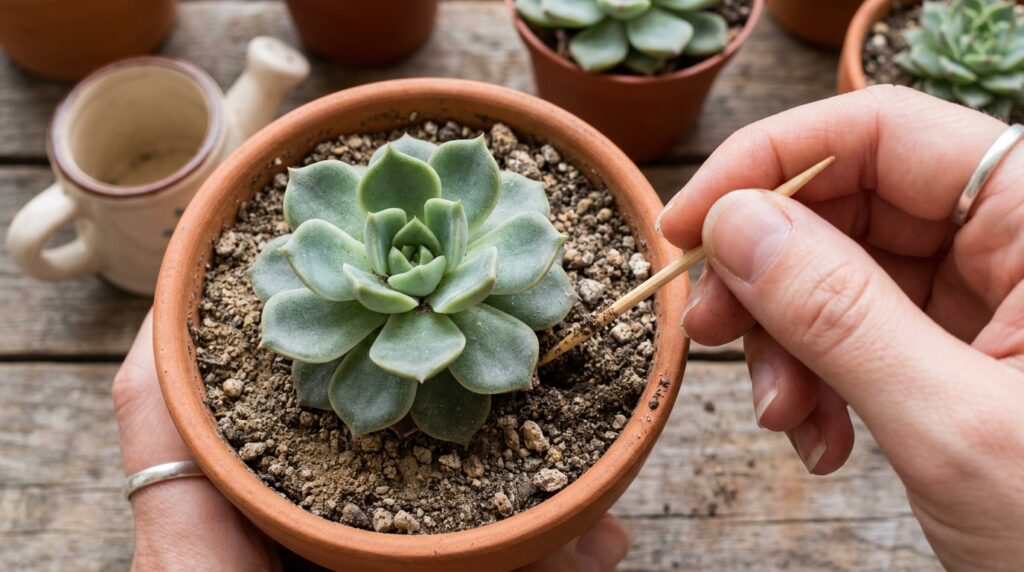
Guessing based on how many days have passed is far less reliable than physically checking the soil, since drying time depends on so many variables. A few simple methods work well:
- The finger test: Push a finger about one to two inches into the soil. If it feels cool or damp at that depth, hold off on watering.
- The toothpick test: Insert a wooden toothpick or skewer into the soil near the drainage hole. If it comes out clean and dry, the plant is ready for water; if soil clings to it, wait longer.
- The weight test: Lift the pot right after watering to get a sense of its “wet” weight, then compare that to how it feels before your next watering. A noticeably lighter pot usually means the soil has dried through.
Any one of these tests beats watering on autopilot, and combining two of them gives you an even more accurate read, especially for beginners still learning how a particular plant and pot dry out over time.
Factors That Change How Often You Should Water
Light Exposure
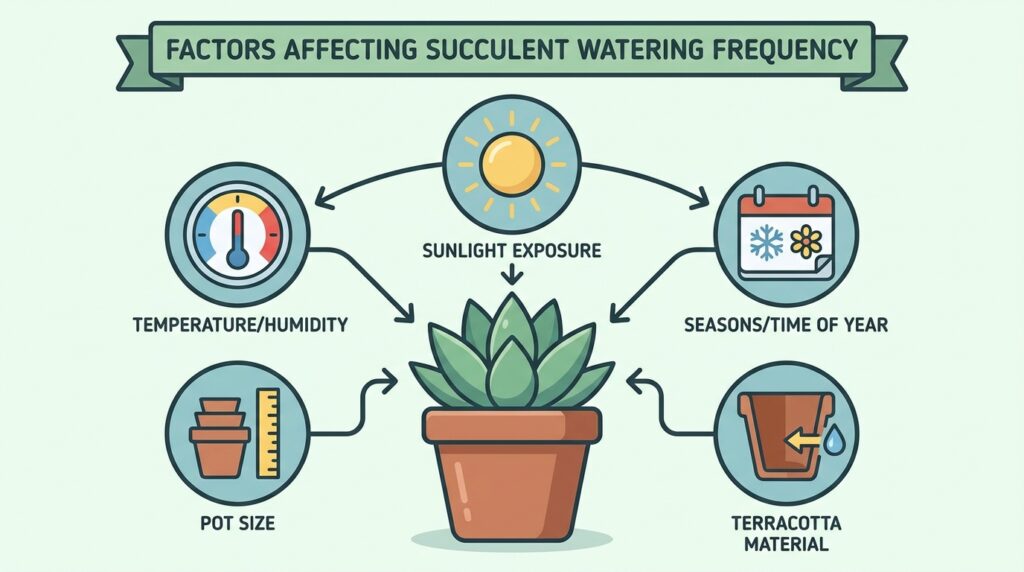
More light generally means faster-drying soil and a shorter gap between waterings. Light, temperature, and soil type all play a role in how often a succulent should be watered, and a succulent sitting in a bright, south-facing window will likely need water more often than one a few feet back from the glass in a dimmer spot. Outdoors, a plant in full, direct sun dries out considerably faster than one in partial shade.
Season and Growth Cycle
Most succulents grow actively in spring and summer, using more water to support new leaves and stems, then slow down significantly during fall and winter dormancy. Watering on the same schedule year-round is one of the most common mistakes people make, since a plant that needed water weekly in July may only need it monthly in January.
Pot Material
Unglazed terracotta is porous and allows moisture to evaporate through the pot itself, so plants in terracotta typically dry out faster and need slightly more frequent watering than the same plant in plastic or glazed ceramic, which hold moisture longer.
Pot Size and Plant Size
A small pot holds less soil and dries out faster, while an oversized pot can stay damp for a surprisingly long time even after a light watering, since there’s more soil mass to work through. A large plant crammed into a small pot will dry faster than a small plant sitting in an oversized one.
Indoor Climate
Central heating, air conditioning, and general indoor airflow all affect how quickly soil dries. Homes with dry winter heat often need slightly more frequent watering during that season than the “wait a month” rule of thumb suggests, simply because indoor humidity drops so much.
The Soak-and-Dry Watering Method
Most experienced growers rely on a technique often called soak-and-dry, which mimics how succulents experience rainfall in their native habitats: infrequent but thorough soakings followed by long dry stretches.
Here’s how it works in practice:
- Water slowly and evenly around the base of the plant, avoiding the leaves themselves where possible.
- Keep going until water runs freely out of the pot’s drainage hole.
- Let the pot drain completely, then empty any water that’s collected in a saucer underneath.
- Don’t water again until the soil has dried out almost entirely, checked using one of the methods above.
This approach delivers a genuinely deep soak that reaches the full root zone, rather than a series of light sprinkles that only wet the top layer of soil while leaving deeper roots dry. Learning how to build a full succulent care routine around this soak-and-dry rhythm, alongside the right light and soil, tends to solve most of the common problems people run into with these plants.
Bottom Watering as an Alternative
Some growers prefer bottom watering, especially for smaller succulents in shallow containers. This involves placing the pot in a shallow dish of water for around ten minutes, letting the soil absorb moisture through the drainage hole, then removing the pot and letting it drain fully before returning it to its usual spot.
Bottom watering has a couple of advantages: it keeps the leaves and crown of the plant completely dry, which reduces the risk of rot at the base, and it naturally prevents overwatering since the plant only pulls up as much moisture as the soil can hold. The main downside is that it takes a bit more hands-on time than simply pouring water from the top.
Does Soil Type Change How Often You Should Water?
Soil composition plays a bigger role in watering frequency than most beginners expect. Regular potting soil is formulated to hold moisture, which is exactly what most houseplants want and exactly what succulents don’t. A succulent planted in dense, moisture-retentive soil can stay wet for days longer than the same plant in a fast-draining mix, even with identical watering habits.
A proper succulent or cactus soil blend typically includes:
- Coarse sand or grit, which creates air pockets and speeds up drainage.
- Perlite or pumice, lightweight volcanic materials that prevent compaction and improve airflow around the roots.
- A smaller proportion of organic potting mix, just enough to hold a little moisture and provide basic nutrients.
If you’re using a heavier, all-purpose potting soil because that’s what was already on hand, you’ll likely need to water less often than the general guidelines above suggest, simply because that soil holds onto moisture longer. Switching to a proper succulent mix is one of the simplest upgrades you can make, since it lets you follow more standard watering intervals without constantly second-guessing whether the soil underneath is still wet.
A Seasonal Watering Reference
| Season | Indoor Succulents | Outdoor Succulents |
|---|---|---|
| Spring | Every 1–2 weeks | Every 5–10 days |
| Summer | Every 1–2 weeks (more in heat waves) | Weekly, sometimes more in extreme heat |
| Fall | Every 2–3 weeks | Every 10–14 days |
| Winter | Every 3–4 weeks or less | Minimal, rain-dependent in most climates |
Treat this table as a starting point rather than a fixed rule. Always confirm with a soil check before watering, since pot type, plant size, and indoor conditions can shift these numbers meaningfully in either direction.
Indoor vs. Outdoor Succulents: Key Differences
Indoor succulents are shielded from wind, direct rainfall, and the kind of intense heat that outdoor plants deal with, so their soil generally dries out more slowly and predictably. Outdoor succulents, on the other hand, are exposed to real weather, which means their watering needs can swing dramatically week to week depending on rainfall, temperature, and wind.
If you’re growing succulents outdoors in a region that gets regular rain, you may be able to skip manual watering entirely during wetter stretches of the year, and simply monitor soil moisture rather than watering on any fixed schedule at all.
Common Watering Mistakes to Avoid
- Watering on a fixed calendar instead of checking the soil. Conditions change with the seasons, so a rigid schedule eventually leads to either overwatering or underwatering.
- Letting the pot sit in a saucer of standing water. This keeps roots wet long after the visible soil surface looks dry, which is a common hidden cause of root rot.
- Using a pot without a drainage hole. Even careful, infrequent watering can’t compensate for water that has nowhere to go.
- Watering lightly and often instead of deeply and infrequently. Light sprinkles wet the surface but rarely reach the full root zone, encouraging shallow, weak roots.
- Ignoring seasonal changes. Continuing a summer watering schedule into winter dormancy is one of the fastest ways to trigger root rot.
What to Do If You’ve Already Overwatered
If you catch overwatering early, the fix is fairly straightforward: stop watering immediately and let the soil dry out completely before checking again. If the pot has no drainage hole, consider repotting into one that does, since standing water at the bottom of a container will keep causing problems no matter how careful you are going forward.
For more advanced cases where the stem or lower leaves have already turned soft, gently remove the plant from its pot and inspect the roots. Healthy roots look firm and pale, while rotted roots appear dark, mushy, or slimy. Trim away any damaged sections with a clean, sharp tool, let the remaining healthy plant callus over for a day or two in a dry spot, then replant it in fresh, fast-draining soil.
Pests can sometimes complicate recovery too. Overly damp soil tends to attract certain pests, and dealing with mealybugs on a stressed, overwatered succulent is far easier if you catch the infestation before it spreads to nearby plants.
Expert Tips for a Healthier Watering Routine
- Water in the morning rather than the evening, so any moisture on the leaves or soil surface has time to evaporate during the day.
- Rotate potted succulents every week or two so all sides get even light, which also helps the soil dry more uniformly.
- Use room-temperature water rather than very cold water straight from the tap, especially in cooler months.
- Keep a simple log, even just a note on your phone, of when you last watered each plant until you get a feel for its natural rhythm.
- When in doubt, wait. It’s far easier to recover an underwatered succulent than an overwatered one.
Pros and Cons of Succulent Watering Habits
| Habit | Pros | Cons |
|---|---|---|
| Soak-and-dry method | Encourages deep, healthy roots | Requires patience and soil checks |
| Bottom watering | Keeps leaves dry, reduces rot risk | Takes more hands-on time |
| Fixed calendar watering | Simple to remember | Doesn’t adjust for season or conditions |
| Checking soil before watering | Most accurate, prevents overwatering | Takes a few extra seconds each time |
Frequently Asked Questions
How do I know if my succulent needs water without a moisture meter?
Check the soil with a finger or toothpick a couple of inches deep, and look at the leaves. If the soil is dry and the leaves look slightly wrinkled or less plump than usual, it’s time to water.
Is it better to underwater or overwater succulents?
Underwatering is far safer. A dehydrated succulent typically recovers within a day or two of a thorough watering, while overwatering can cause root rot that’s much harder, and sometimes impossible, to reverse.
Do succulents need less water in winter?
Yes, most succulents go dormant or slow their growth significantly during winter, which means they use far less water than they do in spring and summer. Cutting back to once every three to four weeks, or even less, is typical during this period.
Can I set a fixed watering schedule for succulents?
A rough schedule can work as a starting reminder, but it should always be confirmed with a soil check before you actually water. Light, season, and indoor conditions shift drying time enough that a truly fixed schedule often leads to over or underwatering eventually.
Why is my succulent’s soil still wet a week after watering?
This usually points to poor drainage, either from a pot without a drainage hole, soil that’s too dense, or a container that’s too large for the plant. Consider repotting into a well-draining succulent mix and a pot with proper drainage if this keeps happening.
Bringing It All Together
Watering succulents well comes down to a simple mindset shift: stop thinking in terms of a fixed schedule and start reading the soil and the plant itself. Water deeply, let it dry out fully, and adjust for light, season, and pot type as you go.
Once you get a feel for how your specific plants and containers dry out, the whole process becomes second nature, just a quick check before you reach for the watering can, rather than a source of ongoing anxiety.
Give it a season or two, and you’ll likely find yourself barely thinking about it at all, glancing at a leaf, poking a finger into the soil, and knowing almost instantly whether it’s time to water or time to leave the plant alone for another week. That instinct is really the whole goal, and it comes faster than most new succulent owners expect.

