
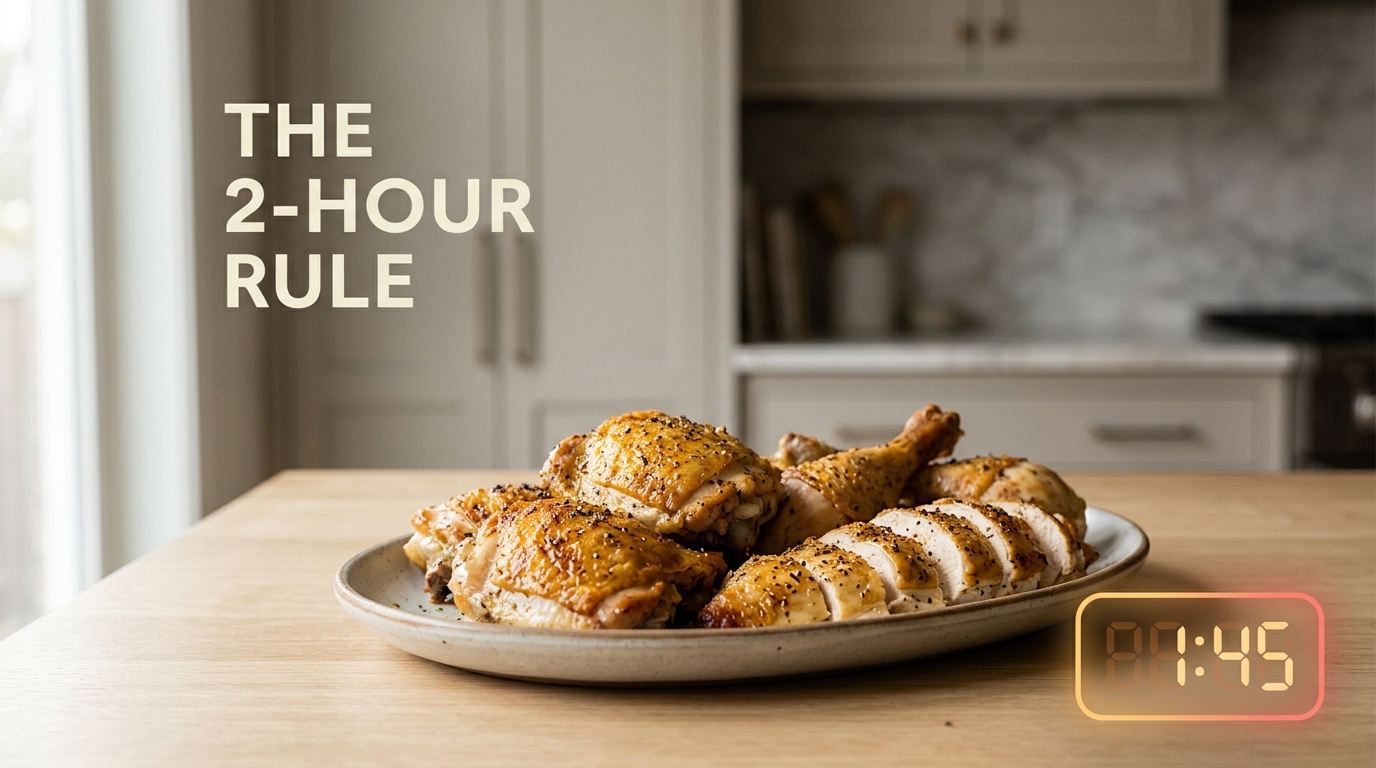
If you have ever left a plate of roasted or grilled chicken on the counter while you cleaned up dinner, you have probably asked yourself how long can cooked chicken sit out before it stops being safe to eat. The short answer is that cooked chicken should not sit at room temperature for more than two hours, and that window shrinks to just one hour once the room climbs above 90°F. This guide walks through why that limit exists, how it applies to real situations like buffets, picnics, and slow cookers, and what to do if your chicken has already been sitting out longer than it should.
Food safety rules can feel overly cautious until you understand the biology behind them. Bacteria that cause food poisoning do not need much time or warmth to multiply to dangerous levels, and chicken happens to be one of the foods most likely to carry them. Below, you will find the science, the exceptions, and practical habits that keep leftovers safe without turning every meal into a stopwatch exercise.
The Quick Answer: The Two-Hour Rule
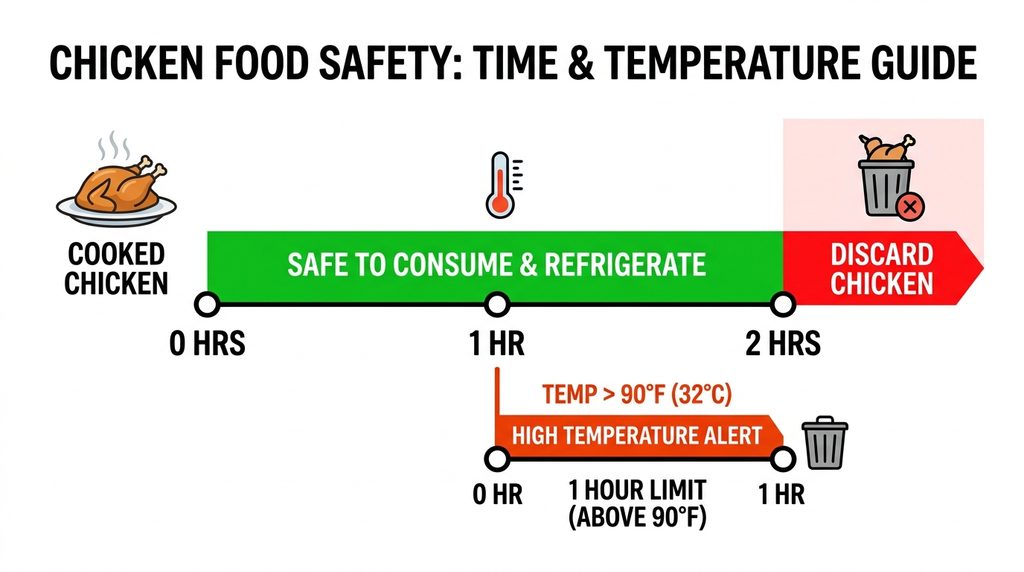
Cooked chicken is safe at room temperature for a maximum of two hours. If the surrounding temperature is above 90°F, such as at an outdoor cookout or in a hot car, that limit drops to one hour. This guidance comes from the U.S. Department of Agriculture’s Food Safety and Inspection Service, which tracks foodborne illness prevention for meat, poultry, and egg products nationwide.
A few things matter here:
- The clock starts the moment chicken drops below 140°F, not when you notice it sitting there.
- “Room temperature” generally means anywhere between about 40°F and 90°F.
- Once the two-hour (or one-hour) mark passes, the chicken should be thrown away, even if it still looks and smells fine.
That last point trips up a lot of home cooks, so it is worth repeating: appearance and smell are not reliable indicators of safety once chicken has spent too long in the wrong temperature range.
Why the “Danger Zone” Makes Chicken Risky So Fast
Food safety agencies refer to the range between 40°F and 140°F as the “danger zone” because bacteria multiply fastest within it. According to FSIS guidance, bacteria in this range can double in number in as little as 20 minutes under ideal conditions. Cooked chicken sitting on a counter at a typical room temperature of around 70°F falls squarely inside that zone the entire time it is out.
Cooking chicken to a safe internal temperature kills the bacteria present at that moment, but it does not make the meat immune to future contamination. Bacteria can land on cooked chicken from the air, from hands, from utensils that touched raw meat earlier, or simply from spores that survive cooking and begin multiplying again once the food cools. The most common culprits linked to poultry include Salmonella, Campylobacter, Staphylococcus aureus, and Clostridium perfringens, all of which thrive in warm, protein-rich environments.
| Temperature Range | What Happens |
|---|---|
| 140°F and above | Bacteria growth is suppressed; food is considered “hot held” safely |
| 40°F to 140°F (Danger Zone) | Bacteria can double roughly every 20 minutes |
| 40°F and below | Bacteria growth slows significantly; safe refrigerator storage |
| 0°F and below | Bacteria growth stops; freezer storage preserves safety indefinitely |
How the Clock Actually Starts in Real Situations
The two-hour rule sounds simple, but it plays out differently depending on the situation. Here is how it applies to common scenarios:
- Fresh off the stove or grill: The timer starts as soon as the chicken drops below 140°F, which can happen faster than expected in a cool kitchen.
- Buffets and potlucks: If chicken sits out on a serving table without a warming device, the full two hours includes prep time, serving time, and any time guests take seconds.
- Picnics and cookouts: Outdoor temperatures above 90°F cut the safe window to one hour, and shaded areas do not necessarily count as cooler if the ambient air is still hot.
- Delivery or takeout chicken: If it was hot when it arrived and then left on the counter, the same two-hour limit applies from the moment it left a heat source.
- Car trips: A parked car in summer can exceed 90°F within minutes, so chicken transported this way is often already near or past the one-hour limit by the time you arrive.
What Happens If You Eat Chicken That Sat Out Too Long
Eating chicken that has spent too long in the danger zone does not guarantee illness, but it meaningfully raises the risk of foodborne disease. The Centers for Disease Control and Prevention estimates that Salmonella alone causes more than a million foodborne illnesses in the United States every year, and poultry is one of the most frequently implicated sources.
Symptoms vary depending on the specific bacteria involved:
| Pathogen | Typical Onset | Common Symptoms |
|---|---|---|
| Salmonella | 6 to 72 hours | Diarrhea, fever, stomach cramps |
| Campylobacter | 2 to 5 days | Diarrhea (sometimes bloody), cramping, fever |
| Staphylococcus aureus | 30 minutes to 8 hours | Sudden nausea, vomiting, stomach cramps |
| Clostridium perfringens | 6 to 24 hours | Watery diarrhea, abdominal cramps |
Most healthy adults recover within a few days without medical treatment, but symptoms can be more severe in young children, older adults, pregnant people, and anyone with a weakened immune system. If symptoms include a high fever, bloody diarrhea, signs of dehydration, or symptoms lasting more than a few days, it is worth contacting a healthcare provider. This article offers general food safety information and is not a substitute for medical advice.
Can You Tell Chicken Has Gone Bad Just By Looking or Smelling It?
Not reliably. Many of the bacteria responsible for foodborne illness do not visibly change the texture, color, or smell of chicken. Food can look, smell, and taste completely normal while still carrying enough bacteria to make someone sick. That is exactly why the two-hour and one-hour rules exist as time-based limits rather than “use your senses” guidelines.
There are some signs that chicken has spoiled from a quality standpoint rather than a safety standpoint, including a sour or ammonia-like odor, a slimy or tacky surface, or a grayish tint. If you notice any of these, discard the chicken regardless of how long it has been out. But the absence of these signs does not mean chicken that sat out for four or five hours is safe. When there is any doubt about timing, the safer move is to throw it out.
Does Reheating Make Unsafe Chicken Safe Again?
This is one of the most persistent food safety myths, and unfortunately the answer is no, not always. Reheating chicken to 165°F kills most active bacteria, but some pathogens, including certain strains of Staphylococcus aureus, produce heat-stable toxins while multiplying. Once those toxins exist in the food, reheating does not neutralize them. This is one of the main reasons the two-hour rule focuses on preventing bacterial growth in the first place rather than relying on reheating as a fix afterward.
If chicken has been sitting out longer than the recommended window, reheating it will not restore its safety. The only reliable response is to discard it.
How Long Can Cooked Chicken Sit Out in Different Setups?
On the Kitchen Counter
Plain cooked chicken left uncovered on a counter follows the standard two-hour rule at normal indoor temperatures. Covering it with foil or plastic wrap does not extend this window, since the covering does not lower the internal temperature or stop bacteria that are already present from multiplying.
At a Party or Buffet
Buffet-style serving is one of the riskiest setups because chicken often sits out for the entire length of an event. If chicken will be displayed for more than two hours, it needs an active heat source such as a chafing dish, slow cooker, or warming tray that keeps it at 140°F or above the whole time, not just at the start.
In a Sealed or Airtight Container
A sealed container does not pause the clock. Bacteria already present on the chicken will continue multiplying inside a container just as they would in open air, since the container does not lower the internal temperature of the food.
In a Slow Cooker or Warming Tray
As long as the appliance consistently holds the chicken at 140°F or higher, it is considered safely held and the two-hour countdown does not apply in the same way. The catch is that many warming trays cycle on and off and may not maintain a true 140°F reading, so checking with a food thermometer periodically is a good habit, especially for extended gatherings.
At a Picnic or in a Cooler
Outdoor settings above 90°F cut the safe window to one hour. Packing chicken in a cooler with plenty of ice, and keeping it below 40°F, is the more reliable option for transporting or serving chicken outdoors for extended periods.
Practical Tips for Keeping Cooked Chicken Safe Longer
A few small habits make a meaningful difference in reducing risk:
- Move chicken into the refrigerator or a preheated warming appliance as soon as it is no longer actively being served.
- Cut large portions like a whole roasted or rotisserie chicken into smaller pieces before storing, since this speeds up cooling in the fridge.
- Use shallow containers, ideally less than three inches deep, so heat escapes quickly instead of keeping the center of the container in the danger zone.
- Set a timer the moment chicken comes off the heat, especially at parties where it is easy to lose track of time.
- Keep a food thermometer on hand for warming trays and slow cookers to confirm they are actually holding food above 140°F.
If you often deal with leftover chicken from a store-bought bird, it helps to know the storage limits for that specific product. Our guide on how long a rotisserie chicken stays good breaks down realistic timelines for both room temperature and refrigerated storage.
Common Mistakes People Make With Leftover Chicken
- Assuming a sealed container “resets” the clock. It does not change the internal temperature of the food.
- Leaving chicken on a warming tray without checking the actual temperature. Many trays run cooler than advertised.
- Judging safety by smell alone. As covered earlier, many harmful bacteria do not change odor or appearance.
- Cooling a whole chicken in one large container. Large volumes trap heat and take far too long to drop below 40°F.
- Reheating chicken that already sat out too long, assuming it “kills the germs.” Reheating does not remove toxins already produced by bacteria.
Storing Cooked Chicken Once It Comes Off the Counter
Once chicken is safely refrigerated within the two-hour window, it generally stays good for three to four days at 40°F or below, according to USDA storage guidance. For longer storage, cooked chicken can typically be frozen for two to six months without a significant safety concern, though texture and flavor are best within the first few months. Always reheat leftovers to an internal temperature of 165°F, checked with a food thermometer, before eating.
If you are managing multiple foods that raise similar “how long can it sit out” questions, our related guide on how long butter can safely sit out covers a different set of rules, since dairy behaves differently than protein in the danger zone.
A Simple Safety Checklist
Use this quick reference the next time you are unsure about a plate of chicken:
- Has it been less than 2 hours (or 1 hour above 90°F) since it left a heat source? If yes, it is likely still safe.
- Has it been sitting in a slow cooker or chafing dish holding a true 140°F or higher? If yes, it can stay out longer.
- Has it been sitting uncovered or in a sealed container at normal room temperature for longer than the limit? If yes, discard it.
- Does it smell sour, look slimy, or seem discolored? If yes, discard it regardless of timing.
- Are you unsure how long it has actually been sitting out? When in doubt, throw it out.
Frequently Asked Questions
Can I eat chicken that was left out overnight?
No. Chicken left out overnight has been in the danger zone for far longer than the two-hour limit, giving bacteria plenty of time to multiply to unsafe levels. It should be discarded even if it looks and smells normal.
Is four hours too long for cooked chicken to sit out?
Yes. Four hours is double the standard two-hour limit, and even further past the one-hour limit in hot conditions. Chicken left out for four hours should not be eaten.
Does covering chicken with foil or plastic wrap protect it from bacteria?
Covering chicken helps keep it clean from dust or insects, but it does not lower the food’s temperature or stop bacteria already present from multiplying. The two-hour and one-hour rules still apply to covered chicken.
How long can fried chicken sit out compared to other cooked chicken?
Fried chicken follows the same two-hour (or one-hour above 90°F) rule as any other cooked chicken. The breading does not change how quickly bacteria multiply inside the meat.
How long can chicken salad or a chicken dish with mayonnaise sit out?
Mayonnaise-based dishes follow the same two-hour rule, and some food safety educators recommend being even more cautious with these dishes at picnics since they are frequently served in warm outdoor settings.
Does reheating destroy toxins produced by bacteria in chicken that sat out too long?
Not necessarily. Reheating kills most live bacteria, but some bacteria, like Staphylococcus aureus, produce heat-stable toxins that survive normal reheating temperatures. This is why chicken left out too long should be discarded rather than reheated.
How can I tell if cooked chicken has gone bad?
Look for a sour or off smell, a slimy texture, or graying color, though these signs are not always present even when chicken is unsafe. Time spent in the danger zone matters more than appearance, so track how long the chicken has actually been out.
Is it safe to leave cooked chicken in a slow cooker on the “warm” setting all day?
It can be, as long as the slow cooker consistently holds the chicken at 140°F or above. Some slow cookers run cooler than their setting suggests, so checking the internal temperature with a food thermometer periodically is a good habit for long gatherings.
Final Thoughts
The two-hour rule for cooked chicken exists because bacteria do not wait for convenient timing, and chicken happens to be one of the foods most associated with foodborne illness in the United States. Keeping track of how long chicken has been sitting out, using shallow containers for faster cooling, and relying on a food thermometer rather than guesswork are simple habits that meaningfully lower risk without adding much extra effort to meal prep or hosting. The next time you are planning a dinner, potluck, or backyard cookout, set a timer when the chicken comes off the heat, and when in doubt, refrigerate it early or let it go. Your future self, and anyone else at the table, will thank you for it.

