
Grabbing a rotisserie chicken on the way home might be one of the smartest dinner shortcuts around. It is already cooked, it is affordable, and it can stretch across two or three meals if you plan it right. But once that bird has been sitting in your fridge for a few days, most people start wondering the same thing: how long is a rotisserie chicken good for before it becomes a food safety risk instead of a time-saver?
The short answer is that a rotisserie chicken stays safe in the refrigerator for three to four days when it is stored properly at 40°F or below. In the freezer, it can hold its best quality for up to four months. Those numbers apply whether the chicken came from a grocery store deli case or your own oven, because once it is cooked, the clock works the same way for any prepared poultry.
This guide breaks down exactly how those timelines work, what can shorten them, how to tell when a chicken has gone bad, and how to store and reheat it so you get every safe meal out of it.
How Long Is a Rotisserie Chicken Good For in the Fridge?
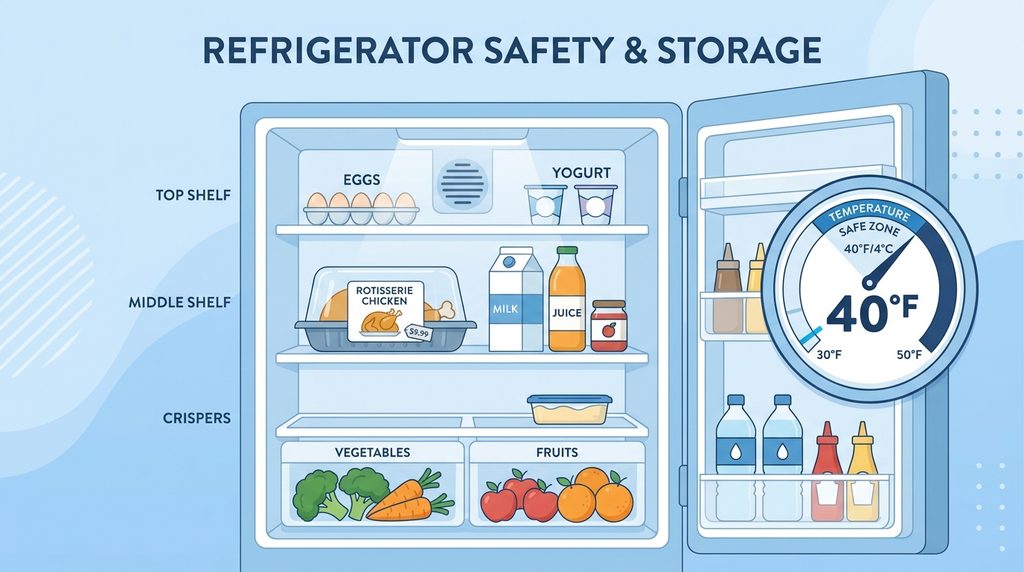
A properly refrigerated rotisserie chicken stays safe to eat for three to four days. The Food Safety and Inspection Service’s guidance on leftovers confirms this same three to four day window for cooked leftovers stored in the refrigerator. That window applies to whole rotisserie chickens, carved pieces, shredded meat, and any dish made from leftover chicken, as long as it was refrigerated promptly after cooking or purchase.
It helps to think of the countdown as starting the moment the chicken cools down enough to go into the fridge, not the moment you finish eating dinner. If you picked up a rotisserie chicken on Sunday evening and refrigerated it right away, day four would be Thursday. After that point, quality and safety both decline even if the chicken still looks fine on the outside.
A few things influence exactly where you land within that three to four day window:
- Refrigerator temperature. The USDA recommends keeping your fridge at 40°F or lower to hit the full four-day mark.
- How quickly it was chilled. Chicken left out too long before refrigeration loses time off its safe window.
- Storage method. Loosely covered chicken spoils faster than chicken sealed in an airtight container.
- Whether it has been reheated and re-cooled. Repeated temperature swings speed up bacterial growth.
Why the Two-Hour Rule Matters Before Refrigeration Even Starts
Before you even think about the three to four day window, there is an earlier deadline that determines whether your chicken is safe to store at all. Federal guidance on safe handling of leftovers recommends discarding any cooked food left out for more than two hours at room temperature, or just one hour once the temperature climbs above 90°F.
This rule exists because bacteria multiply fastest between 40°F and 140°F, a range food safety experts call the “danger zone,” where bacteria can double in number in as little as 20 minutes. A warm rotisserie chicken sitting on a kitchen counter is right in that zone the entire time it is out. If you picked up a hot chicken from the store and it sat in a warm car for 45 minutes, then on the counter for another hour while you made side dishes, you may already be close to that two-hour limit before the leftovers even reach the fridge.
In practical terms, this means:
- Get the chicken into the fridge or freezer within two hours of purchase or cooking.
- Cut that window to one hour on hot days, in a warm kitchen, or if the chicken came from a picnic or tailgate.
- If you are unsure how long it sat out, it is safer to treat it as expired than to guess.
How Long Does Rotisserie Chicken Last in the Freezer?
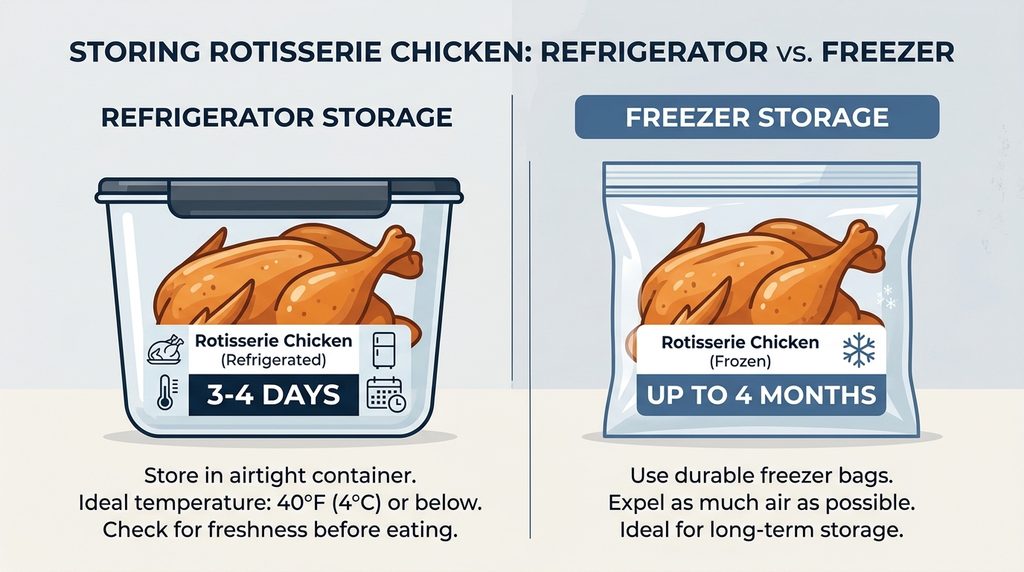
If you know you will not finish a rotisserie chicken within four days, freezing it is the better option. Cooked poultry, including rotisserie chicken, generally holds its best quality in the freezer for around four months when stored in an airtight container, and the longer it stays frozen, the more it tends to lose flavor and texture rather than safety.
Chicken frozen at 0°F or below stays technically safe to eat indefinitely, since freezing stops bacterial growth completely rather than just slowing it down. The four-month mark is really a quality guideline. Beyond that point, you are more likely to notice freezer burn, dryness, or a flat taste, even though the chicken itself is not dangerous.
To get the best results when freezing rotisserie chicken:
- Remove the meat from the bones first, since bones take up freezer space and do not reheat well.
- Portion the chicken into meal-sized amounts so you only thaw what you need.
- Use freezer-safe bags or airtight containers and press out as much air as possible.
- Label each container with the date so you are not guessing later.
Storage Timeline at a Glance
| Storage Method | Safe Timeframe | Best For |
|---|---|---|
| Refrigerator (40°F or below) | 3 to 4 days | Meals eaten within the week |
| Freezer (0°F or below) | Up to 4 months for best quality | Batch cooking, meal prep, longer storage |
| Room temperature | Under 2 hours (1 hour above 90°F) | Not for storage, only serving |
The Right Way to Store Rotisserie Chicken
Storage habits matter almost as much as the timeline itself. A chicken that is properly cooled, sealed, and placed in the fridge correctly can comfortably reach that four-day mark. One that is left in its original plastic dome or wrapped loosely often starts showing signs of spoilage sooner.
Here is a simple process that keeps rotisserie chicken fresher for longer:
- Let it cool slightly first. Do not put a piping hot chicken straight into a sealed container, since trapped steam can create excess moisture that speeds up spoilage. A few minutes of open-air cooling is enough.
- Remove the meat from the carcass. Carving or shredding the chicken lets it cool faster and more evenly than leaving it whole.
- Divide it into shallow, airtight containers. Shallow containers cool faster than deep ones, which helps the meat pass through the danger zone more quickly.
- Store it toward the back of the fridge. The back is typically the coldest and most stable part of the refrigerator, away from the door where temperatures fluctuate every time it opens.
- Keep the broth or skin separate if you plan to use it differently. Some people like to save the carcass for stock, which should also be refrigerated or frozen within the same two-hour window.
If your kitchen setup includes a lot of small containers and limited fridge space, it helps to build a simple routine around taking a proper break to reset your kitchen every so often, so containers do not pile up faster than you can track them. A well-organized fridge makes it much easier to spot leftovers before they pass their safe window.
Signs Your Rotisserie Chicken Has Gone Bad
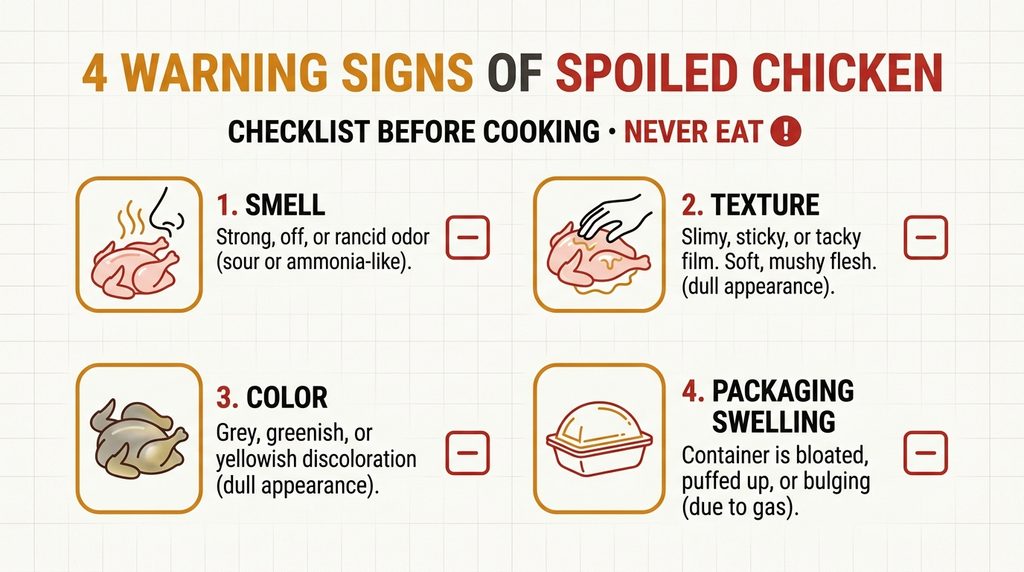
Even chicken that is technically still within the three to four day window can spoil early if something went wrong with storage. Knowing the warning signs matters more than memorizing a single number, because no expiration date can account for every situation.
Watch for these signals:
- Smell. Fresh cooked chicken has a mild, neutral scent. A sour, sulfur-like, or generally “off” smell is one of the clearest warning signs.
- Texture. Chicken that feels sticky, slimy, or tacky to the touch has likely started to spoil, even if the color looks normal.
- Color changes. Cooked chicken that turns gray, greenish, or develops an unusual sheen should be discarded.
- Mold. Any visible mold, fuzzy spots, or discoloration on the surface means the chicken needs to be thrown out immediately.
- Container clues. A swollen or bulging lid on a sealed container can indicate bacterial gas buildup inside.
If you notice any of these signs, it is best to throw the chicken away rather than take a chance. This is the same instinct that helps when checking other perishables, similar to the visual and texture checks people use to tell if eggs are still good or to spot early warning signs that potatoes have gone bad before cooking with them.
Rotisserie Chicken vs. Other Cooked Meats: Shelf Life Comparison
People often assume different cooked meats have wildly different storage windows, but most fall into a similar range. Here is how rotisserie chicken compares to other common leftovers, based on standard refrigerator and freezer storage guidance for cooked foods.
| Food Type | Refrigerator | Freezer |
|---|---|---|
| Rotisserie or roasted chicken | 3 to 4 days | Up to 4 months |
| Fried chicken | 3 to 4 days | Up to 4 months |
| Ground cooked meats | 3 to 4 days | 2 to 3 months |
| Cooked fish | 3 to 4 days | 4 to 6 months |
| Soups or stews with meat | 3 to 4 days | 2 to 3 months |
| Deli-style chicken salad | 3 to 5 days | Not recommended |
The takeaway is that rotisserie chicken is not unusually fragile compared to other cooked proteins. The same general rule of thumb applies across almost all cooked meat and poultry, which makes it easier to remember: refrigerate within two hours, eat within three to four days, or freeze for longer storage.
Common Mistakes That Shorten Rotisserie Chicken’s Shelf Life
A lot of people unintentionally cut their chicken’s safe window short without realizing it. These mistakes are worth watching for:
- Leaving it in the store’s plastic container. Those containers are designed for display and short transport, not long-term airtight storage. They often have small vents or loose lids that let air and moisture in.
- Storing it whole instead of carved. A whole chicken cools much more slowly than carved pieces, which means it spends more time in the temperature danger zone.
- Forgetting it is in the fridge. Without a clear date label, it is easy to lose track of when the chicken was purchased or cooked.
- Reheating and re-cooling multiple times. Every time chicken is reheated and put back in the fridge, it adds more opportunity for bacteria to grow. Try to reheat only the portion you plan to eat.
- Assuming smell alone is a reliable test. Some bacteria that cause foodborne illness do not produce a noticeable smell or taste, which is why the time-based guideline matters even when the chicken seems fine.
How to Safely Reheat Rotisserie Chicken
Reheating matters just as much as storage. The goal is to bring the chicken back to a safe internal temperature without drying it out or leaving cold spots where bacteria could survive.
Oven method (best for larger portions):
- Preheat the oven to 350°F.
- Place the chicken in a baking dish with a splash of broth or water to help retain moisture.
- Cover with foil and heat for 20 to 25 minutes, or until the thickest part reaches a safe internal temperature.
Microwave method (best for individual portions):
- Place chicken pieces on a microwave-safe plate.
- Cover loosely with a lid or damp paper towel to trap steam.
- Heat in 30-second intervals, checking and turning the chicken between each round.
Air fryer method (best for restoring crispy skin):
- Preheat the air fryer to 350°F.
- Heat the chicken for four to six minutes, flipping halfway through.
- Check the thickest part before serving.
No matter which method you use, reheat leftover chicken to an internal temperature of 165°F, measured with a food thermometer at the thickest part. This lines up with official food safety guidance on keeping food safe, which recommends reheating most cooked leftovers to 165°F before eating them. If you are reheating chicken that was previously frozen, thaw it in the refrigerator overnight first rather than at room temperature.
What Happens If You Eat Chicken That Has Gone Bad
Eating spoiled chicken carries real risk, since poultry is one of the most common sources of foodborne illness in the United States. The CDC’s guidance on chicken and food poisoning explains that chicken can carry Campylobacter, Salmonella, or Clostridium perfringens, and eating undercooked or spoiled chicken can lead to illness from these germs.
The CDC’s overview of food poisoning symptoms lists diarrhea, stomach pain or cramps, nausea, vomiting, and fever as the most common signs, while severe cases can involve bloody diarrhea, diarrhea lasting more than three days, a fever over 102°F, frequent vomiting, or dehydration. Symptoms can appear anywhere from a few hours to several days after eating contaminated food, which is part of why it is hard to pinpoint the exact source without medical testing.
If you or someone in your household develops these symptoms after eating chicken that may have been stored too long, it is worth contacting a healthcare provider, especially for young children, older adults, pregnant individuals, or anyone with a weakened immune system, since these groups face a higher risk of complications. This article is for general food safety information and is not a substitute for medical advice.
Smart Ways to Use Up Rotisserie Chicken Before It Expires
One of the easiest ways to avoid wasting a rotisserie chicken is to plan two or three meals around it as soon as you bring it home, rather than letting it sit untouched until day three. Shredded chicken works well in tacos, salads, sandwiches, and grain bowls, so it rarely needs much extra effort to repurpose.
A few practical ideas:
- Shred the meat and freeze half immediately if you know you will not use the whole bird within four days.
- Use the breast meat for sandwiches or wraps, since it dries out the fastest when reheated.
- Save the carcass to make a simple stock, which should also be refrigerated or frozen promptly.
- Turn leftover chicken and pan drippings into a quick sauce, using nearly the same method as making gravy from turkey drippings, which works well with chicken drippings too.
- Pair leftover chicken with a fast side dish, like a batch of perfectly steamed green beans, to round out a full meal without much extra cooking.
Frequently Asked Questions
How long is a rotisserie chicken good for after the sell-by date?
The sell-by date on packaging is a quality indicator, not a safety cutoff. Once you bring the chicken home and refrigerate it, the three to four day countdown starts from that point, regardless of the printed date. If the sell-by date is very close to your purchase day, use the shorter end of that window to be safe.
Can I eat rotisserie chicken cold straight from the fridge?
Yes, as long as it has been stored safely and is still within its three to four day window. Fully cooked chicken does not need to be reheated to be eaten, which makes it convenient for salads, sandwiches, and wraps.
Is it safe to eat rotisserie chicken on day 5?
It is not recommended. The USDA’s three to four day guideline exists because bacterial growth increases significantly after that point, even if the chicken shows no obvious signs of spoilage. If you are close to day five and have not used the chicken, freezing what remains is safer than eating it.
Does rotisserie chicken last longer if I keep it in its original container?
No, and it often lasts a shorter time. Store containers are designed for short-term display rather than airtight refrigerator storage. Transferring the chicken to a sealed container typically extends freshness compared to leaving it in the original packaging.
How can I tell if rotisserie chicken is still good without reheating it first?
Check the smell, texture, and appearance before reheating. A sour odor, slimy texture, or gray-green discoloration are all signs it should be discarded rather than eaten.
Can I refreeze rotisserie chicken that was already frozen once?
If it was thawed in the refrigerator and not left at room temperature, it can generally be refrozen, though texture and moisture may suffer slightly. Meat thawed using other methods, like the microwave or cold water, should be cooked before refreezing.
Why does my rotisserie chicken smell different but still look fine?
Smell often changes before visual signs appear, especially with bacterial spoilage. If the odor seems even slightly off compared to when you bought it, it is safer to trust your nose and discard the chicken rather than take a chance.
The Bottom Line
So, how long is a rotisserie chicken good for? Three to four days in the refrigerator, or up to four months in the freezer, as long as it is refrigerated within two hours of cooking or purchase and stored in an airtight container at 40°F or below. Beyond those windows, the risk of bacterial growth increases even when the chicken still looks and smells fine, so it is not worth pushing the limit.
The easiest way to stay on the safe side is to plan your meals around the chicken as soon as you bring it home, freeze what you will not eat within a few days, and always check for signs of spoilage before reheating. A little bit of planning turns one rotisserie chicken into several safe, convenient meals instead of a guessing game by the end of the week. If your fridge tends to get cluttered fast, taking a few minutes to reorganize your shelves can make it much easier to spot leftovers before they pass their safe window.

