
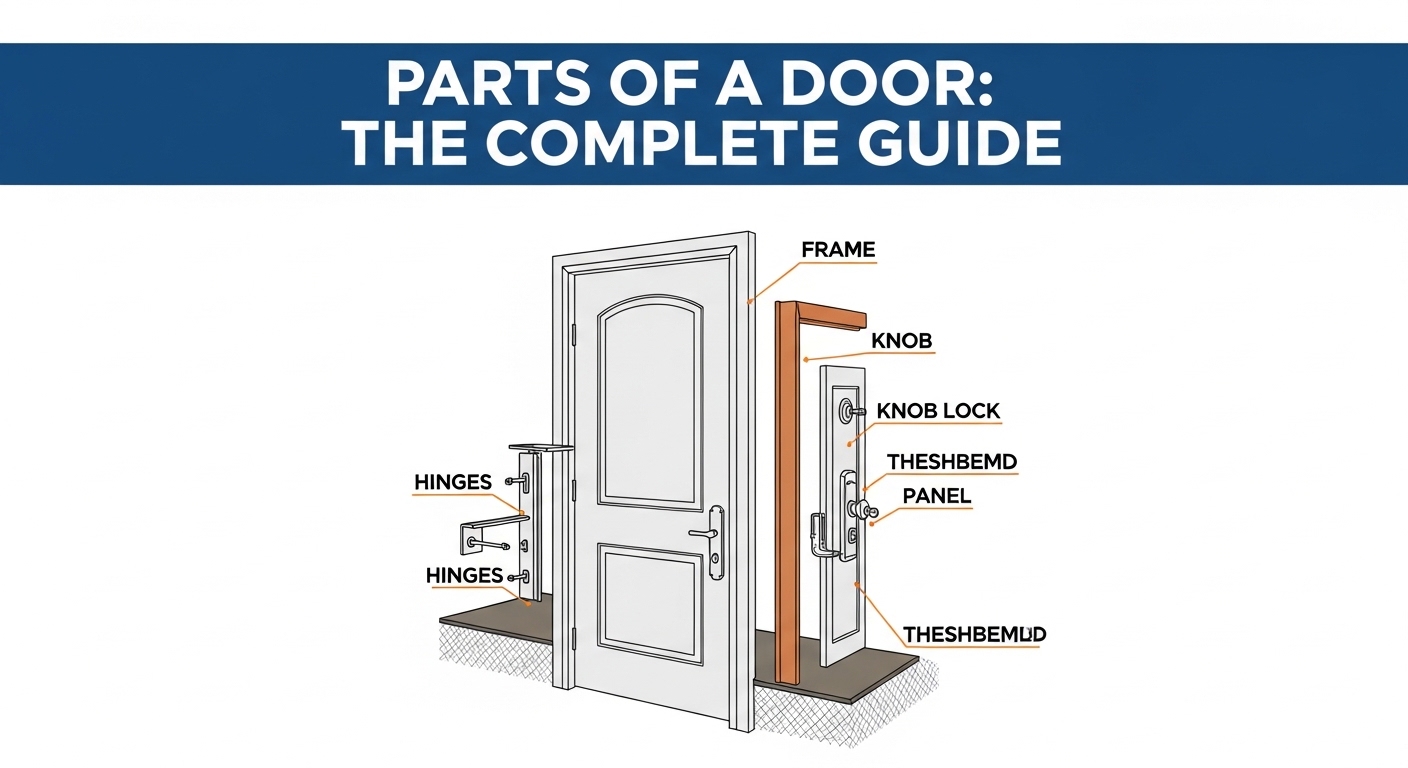
Have you ever stood in a hardware store, trying to describe a broken piece on your door, and completely blanked on what it’s actually called?
You’re not alone. Most homeowners know the door works — until it doesn’t. And when something goes wrong, understanding the anatomy of a door becomes surprisingly important. Whether you’re replacing a worn-out threshold, fixing a sticky latch, or shopping for new door hardware, knowing the right terminology saves you time, money, and a lot of frustration.
This guide covers every part of a door — from the frame to the lock cylinder — with clear explanations, labeled breakdowns, and practical tips. Whether you’re dealing with an interior bedroom door, a solid exterior front door, or a double entry door, we’ve got it covered.
Let’s start from the outside and work our way in.
What Are the Main Parts of a Door?
Before diving into specifics, it helps to think of a door as a system made up of four core categories:
- The door slab – the actual movable panel you open and close
- The door frame – the fixed structure that surrounds and supports the slab
- The door hardware – knobs, locks, hinges, and handles
- The door threshold and weatherstripping – the sealing components at the bottom and sides
Each of these has multiple sub-components with specific names. Let’s go through them one by one.
Parts of a Door Frame
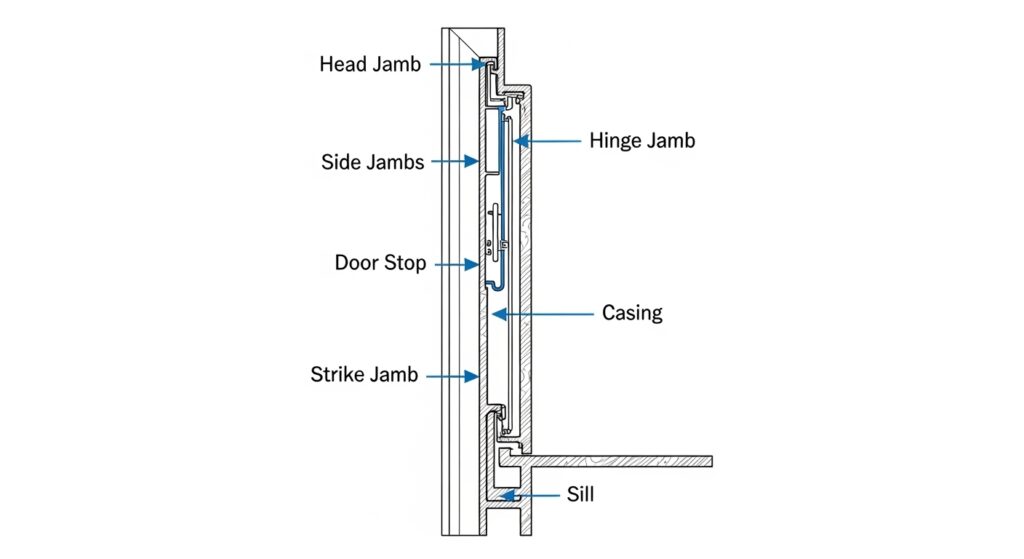
The door frame is the skeleton that holds your door in place. Without a properly installed frame, even the most expensive door will sag, stick, or fail to close properly.
Here are the main parts of a door frame:
Head Jamb
The head jamb is the horizontal piece at the very top of the door frame. It spans the full width of the doorway and connects the two vertical side jambs. When a door “drops” over time and starts scraping the top, the head jamb is usually involved.
Side Jambs (Hinge Jamb and Strike Jamb)
The two vertical members on either side of the frame are called side jambs. They each have a specific role:
- Hinge jamb – This is the side where the door hinges are mounted. The hinges connect the door slab to this jamb, allowing the door to swing open.
- Strike jamb (or latch jamb) – This is the opposite side, where the latch bolt engages with the strike plate when the door closes.
Door Stop
Running along the inside of the jambs and head jamb is a thin strip called the door stop. It’s the raised piece of wood (or metal) that the door rests against when it’s closed. Think of it as the “landing zone” for your door. Without it, the door would swing straight through the frame.
Rough Opening
Behind the finished frame is the rough opening — the structural hole in the wall framing that the door unit is installed into. Contractors always frame the rough opening slightly larger than the door unit to allow for shimming and leveling.
Casing
The casing is the decorative trim that covers the gap between the door frame and the wall. It’s the molding you see on both sides of a doorway. Casing profiles range from flat and modern to ornate colonial-style designs.
Sill (or Door Sill)
The door sill is the flat horizontal piece at the very bottom of the exterior door frame. Unlike the threshold (which sits on top of the sill), the sill itself is typically made of wood or aluminum and is part of the frame structure.
Parts of a Door: The Door Slab
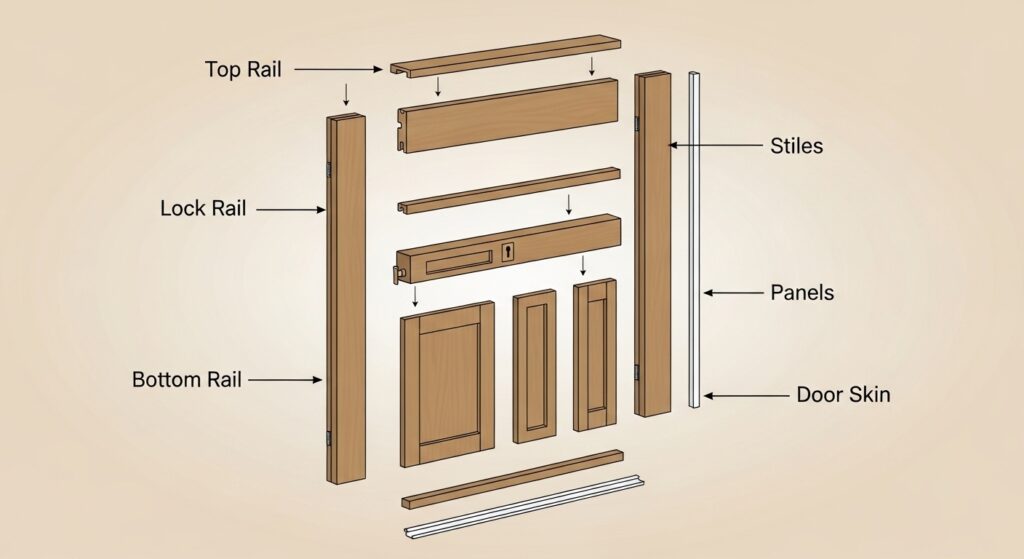
The door slab is the panel itself — the thing you actually open and close. It comes in many styles, but all door slabs share some basic structural components.
Door Panel
The panel refers to the flat or raised sections you see on traditional panel doors. A six-panel door, for example, has six individual rectangular panels set into the door’s frame. Panels are purely aesthetic in most cases, but they add visual depth and character.
Rails and Stiles
These are the internal framing members of a panel door:
- Stiles – The vertical members running down the left and right sides of the door slab
- Top rail – The horizontal member across the top
- Bottom rail – The horizontal member across the bottom
- Middle rail (or lock rail) – A horizontal member at roughly mid-height, often where the lockset is installed
Together, rails and stiles create the structural skeleton that holds the door panels in place.
Door Lite (Glass Panel)
If your door has glass in it, that glass is called a lite (not a typo — it’s the traditional construction term). A single large glass pane is a full lite; small decorative glass windows are called sidelites when they’re beside the door or transoms when above.
Door Skin
On hollow-core interior doors, the door skin is the thin surface material — typically hardboard, MDF, or veneer — applied over the internal frame. It’s what gives a hollow-core door its smooth face.
Parts of a Door Handle and Lock Hardware
This is where most people have questions — and for good reason. Door hardware has more components than it looks like from the outside. Let’s break down the parts of a door handle, knob, and locking mechanism.
Door Knob vs. Door Handle (Lever)
First, a quick distinction:
- A door knob is a round, ball-shaped grip that you rotate to operate the latch
- A door handle (lever) is the elongated lever-style grip that you push down to operate the latch
Both serve the same function but have different ergonomic and aesthetic profiles. Lever handles are increasingly popular because they’re easier to operate for people with arthritis or mobility limitations.
Parts of a Door Knob
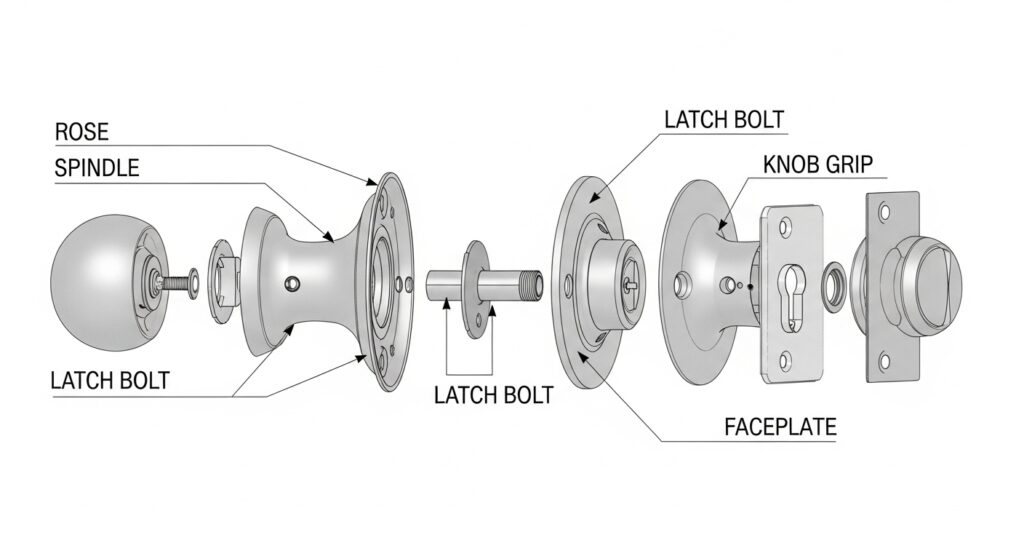
Here are the door knob parts names you need to know:
- Knob or lever – The grip itself, which you turn or press to retract the latch
- Rose (or escutcheon) – The circular or decorative plate that sits against the door face, covering the hole and mounting hardware
- Spindle (or square drive) – The metal rod that passes through the door and connects the two knobs/levers; when you turn the knob, the spindle rotates and retracts the latch
- Latch bolt – The spring-loaded tongue that slides in and out of the strike plate
- Faceplate – The rectangular metal plate on the edge of the door that the latch bolt passes through
- Backset – Not a physical part you see, but a critical measurement: the distance from the edge of the door to the center of the hole where the knob/lock is installed. Standard backsets are 2-3/8″ or 2-3/4″.
The Schlage door hardware guide has detailed installation diagrams if you need visual reference.
Parts of a Door Lock
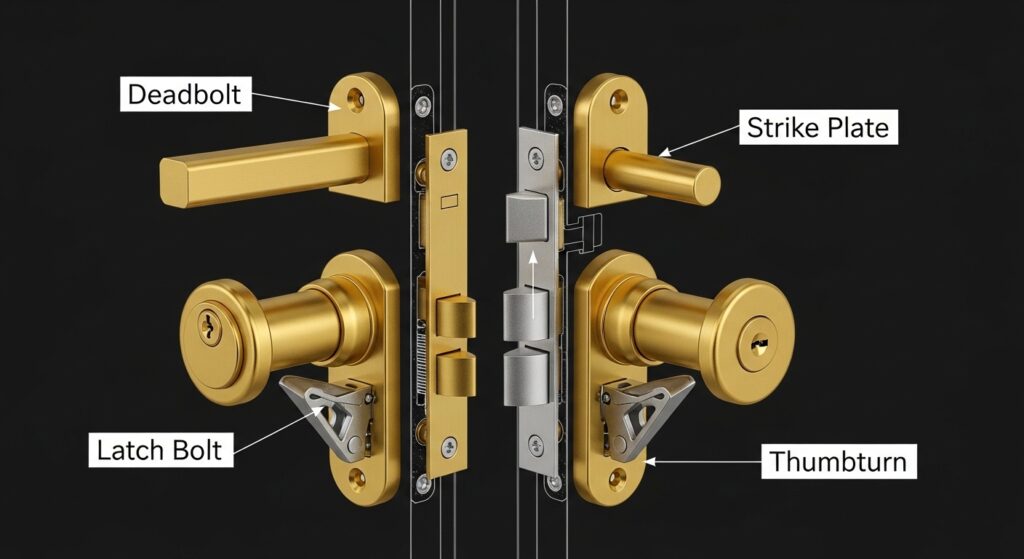
The door lock is separate from — but often integrated with — the knob or handle. Here’s a breakdown of door lock parts names:
Deadbolt
A deadbolt is a lock with a solid bolt (no spring mechanism) that can only be moved by turning a key or thumbturn. It provides significantly more security than a latch bolt alone. The Builders Hardware Manufacturers Association (BHMA) grades deadbolts for security and durability, with Grade 1 being the highest.
Key deadbolt parts:
- Bolt (or deadbolt throw) – The solid metal bar that extends into the strike plate
- Cylinder – The round barrel where you insert the key; also called the “lock core”
- Thumbturn – The twist piece on the interior side that retracts the deadbolt without a key
- Strike plate – The metal plate mounted on the door frame that the bolt slides into
- Strike box – A deep metal box behind the strike plate that provides additional holding strength
Knob Lock / Lever Lock (Latch Mechanism)
The latch mechanism inside a knobset includes:
- Latch bolt – The spring-loaded angled tongue that auto-latches when the door closes
- Latch retractor – The internal mechanism that pulls the latch back when the knob is turned
- Inside button or lever – The button or turn piece on the interior knob that locks the mechanism
Mortise Lock
A mortise lock is a more heavy-duty lock assembly that is recessed into a rectangular pocket (the mortise) cut into the edge of the door. Common on older homes and commercial properties, mortise locks integrate the latch bolt, deadbolt, and sometimes a nightlatch all in one body. Key parts include the lock body, trim (the visible plates and handles), cylinder, and cam.
Door Hinge Parts and Types
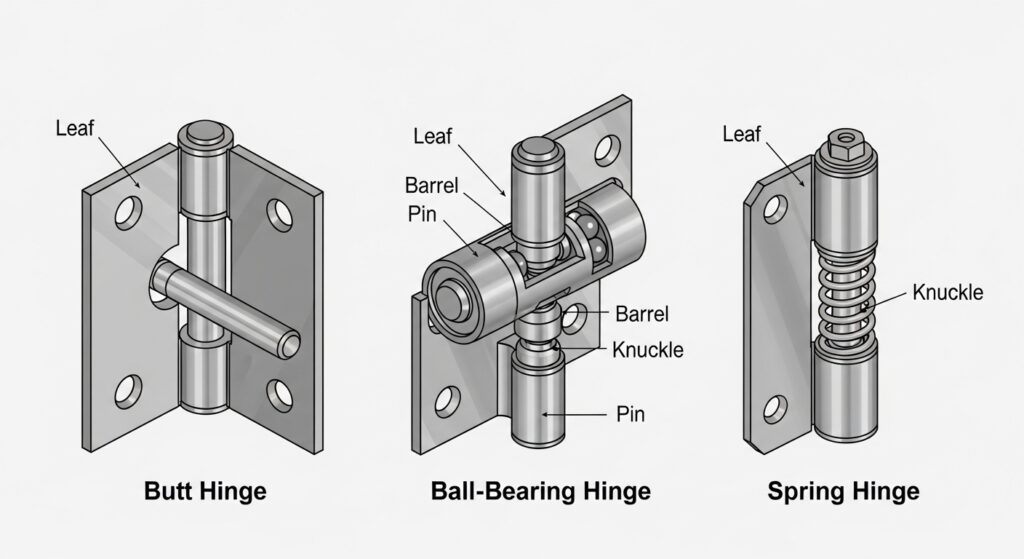
Hinges are the unsung heroes of every door. They carry the entire weight of the door slab and allow it to swing freely.
Parts of a Door Hinge
- Leaf – Each hinge has two rectangular metal plates called leaves; one mounts to the door, the other to the jamb
- Barrel – The cylindrical housing in the center of the hinge that the pin passes through
- Knuckle – The individual loops on each leaf that interlock and form the barrel
- Pin – The metal rod that passes through the barrel and holds the two leaves together; on most residential hinges, the pin is removable
Common Hinge Types
| Hinge Type | Common Use |
|---|---|
| Butt hinge | Standard residential doors |
| Ball-bearing hinge | Heavy doors, high-traffic areas |
| Spring hinge | Self-closing doors |
| Pivot hinge | Heavy commercial doors, barn doors |
| Concealed hinge | European cabinet-style, modern interiors |
Standard residential doors use three hinges spaced evenly along the hinge jamb. Heavier or taller doors (over 7 feet) typically require a fourth hinge. The Door and Hardware Federation provides detailed specifications for hinge sizing and placement.
Parts of a Door Threshold
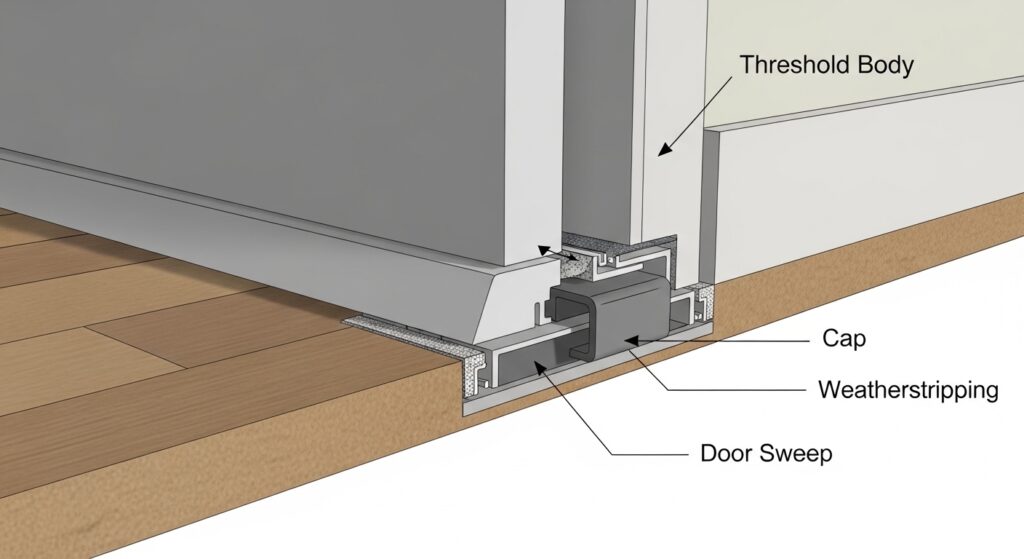
The threshold is the strip at the bottom of an exterior door — and it does more work than most people realize. It creates a seal between the bottom of the door and the floor, keeping out drafts, water, insects, and noise.
Door Threshold Components
- Threshold body – The main aluminum, wood, or composite strip that spans the width of the doorway
- Threshold cap – The top surface that the door contacts when closed; often made of a softer material like vinyl or rubber to improve the seal
- Door sweep – A strip attached to the bottom of the door slab (not the floor) that brushes against the threshold to create a seal
- Weatherstripping – The compressible seal material around all sides of the door (not just the bottom) that prevents air and moisture infiltration
Threshold Types
- Interlocking threshold – Has a raised ridge that mates with a corresponding groove on the door bottom
- Saddle threshold – A simple raised saddle-shaped bar; common in interior doorways
- ADA-compliant threshold – A low-profile threshold (max ½” height) required for accessibility
According to the U.S. Department of Energy, air leaks around doors and windows can account for 25–30% of a home’s heating and cooling energy use. A properly installed threshold and weatherstripping can make a meaningful difference.
Parts of an Exterior Door vs. Interior Door
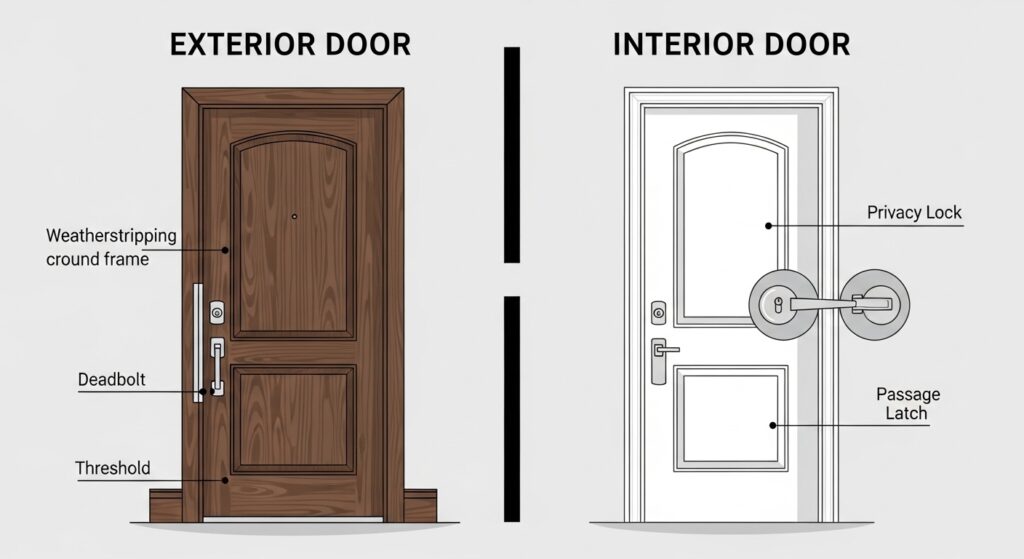
Not all doors are created equal. An exterior door and an interior door share many of the same basic components, but they have key differences designed for their specific purposes.
Exterior Door Parts
Exterior doors must handle weather, security, and insulation demands. Key unique components include:
- Door slab material – Typically steel, fiberglass, or solid wood (not hollow-core)
- Core – Exterior doors often have a foam insulation core for energy efficiency
- Weatherstripping – Runs along all four sides of the door frame
- Multi-point lock system – Premium exterior doors may have locks that engage at multiple points along the door edge for greater security
- Door sweep – More critical on exterior doors to block drafts and moisture
- Peephole (door viewer) – A small lens installed in the door slab for visual identification of visitors
- Deadbolt lockset – Standard on exterior doors for security
- Kick plate – A metal plate at the bottom of the door that protects the slab from foot traffic and damage
The National Association of Home Builders (NAHB) recommends a minimum 1¾” thickness for exterior doors for adequate security and insulation.
Interior Door Parts
Interior doors don’t need to deal with weather, so they’re simpler in construction:
- Hollow-core or solid-core slab – Most interior doors are hollow-core (lightweight, lower cost)
- Privacy lock – Bathroom and bedroom doors use a simple push-button or twist lock that can be unlocked from outside with a small pin (no key required)
- Passage latch – Hallway and closet doors often have a passage set — just a latch, no locking function
- Bifold hardware – Closet doors may use bifold track systems with top-mounted tracks, pivot brackets, and guide pins
Double Door Parts and Components
A double door setup (also called French doors or double entry doors) has all the same components as a single door, plus a few additional ones:
Astragal
The astragal is the vertical strip that runs down the center of a double door opening, between the two door slabs. It seals the gap between the doors and provides a surface for the latch bolt to engage. On active/passive double door setups, the astragal attaches to the inactive leaf (the door that stays closed most of the time).
Active Leaf vs. Passive Leaf
- Active leaf – The door you normally open and close
- Passive leaf – The stationary door; it’s typically held in place by flush bolts at the top and bottom
Flush Bolts
Flush bolts are recessed bolts built into the top and bottom edges of the passive door leaf. When engaged, they lock into the frame header and door sill, holding the inactive door in place.
Door Coordinator
On fire-rated double doors, a door coordinator ensures that the passive door always closes before the active door, preventing them from interfering with each other.
Door Accessories and Additional Hardware
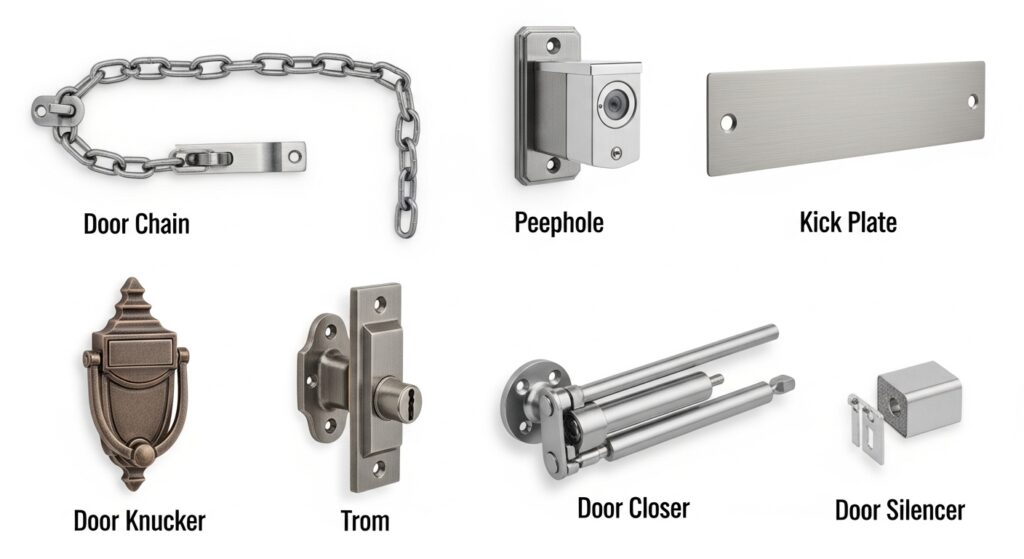
Beyond the core components, doors often include a range of additional hardware and accessories.
Door Viewer (Peephole)
A small optical lens installed in the door slab — typically at eye level — that allows you to see who’s outside without opening the door. Modern versions are wide-angle (typically 180°) and can include digital displays.
Door Chain and Door Guard
A door chain allows the door to be partially opened while remaining secured. A door guard (or door bar) serves a similar purpose but is more robust. Both are secondary security devices.
Door Knocker
A decorative hardware piece — usually cast iron or brass — mounted to the exterior face of the door. It’s used to announce a visitor’s presence.
Door Closer
Typically found on commercial and institutional doors, a door closer is a hydraulic or pneumatic device that controls the speed and force of a door’s closing motion. LCN and Norton are well-known door closer brands.
Kick Plate
A metal plate (usually aluminum or stainless steel) mounted at the bottom of a door, protecting the slab from scuffs, scratches, and damage from shoes and equipment.
Door Silencer (Door Stop Bumper)
A small rubber or nylon bumper mounted on the wall or baseboard behind a door. When the door swings open, it hits the silencer instead of the wall, preventing damage to both.
Hinge Pin Door Stop
A smaller alternative to a wall-mounted door stop, this device replaces or clamps onto the hinge pin to limit how far the door can open.
Door Frame Parts: A Detailed Look at the Anatomy of a Door Frame
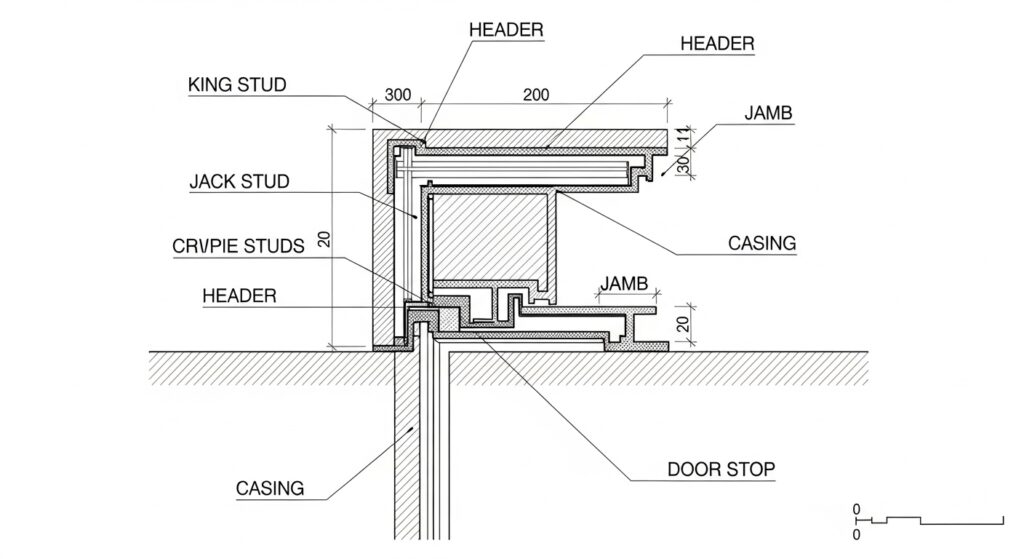
We touched on door frame basics earlier, but let’s go deeper — because the anatomy of a door frame involves more components than most people realize.
Structural Components
| Component | Description |
|---|---|
| King stud | Full-length vertical stud on each side of the rough opening |
| Jack stud (trimmer stud) | Shorter stud that supports the header; sits next to the king stud |
| Header | Horizontal structural member above the rough opening; carries the load from above |
| Cripple studs | Short studs above the header that fill the space to the top plate |
| Sill plate | Horizontal framing at the bottom of rough openings in framed walls (not always present in door openings) |
Finishing Components
| Component | Description |
|---|---|
| Head jamb | Horizontal finished piece at top of door frame |
| Side jambs | Vertical finished pieces on each side |
| Door stop | Raised strip inside the jamb that the door rests against |
| Casing | Decorative trim covering the gap between frame and wall |
| Shims | Thin wedge-shaped pieces used to level and align the door frame during installation |
The Family Handyman has an excellent visual walkthrough on how all these components fit together during installation.
Expert Tips: Getting the Most from Your Door Hardware
Understanding door parts is one thing — making smart decisions about them is another. Here are some practical expert insights:
Tip 1: Match Your Backset Before Buying a Lockset
Before purchasing a new lock or knob, measure your door’s backset (2-3/8″ or 2-3/4″). Buying the wrong backset means the hardware won’t line up with the existing holes in your door. Most locksets are adjustable between these two sizes, but always check.
Tip 2: Upgrade Your Strike Plate for Better Security
The weakest part of most door lock systems isn’t the lock itself — it’s the strike plate. A standard strike plate uses ¾” screws that only go into the door jamb. Replacing it with a heavy-duty reinforced strike plate (using 3″ screws that reach the wall studs) dramatically improves kick-in resistance. The Door and Hardware Federation recommends this upgrade for all exterior doors.
Tip 3: Choose Hinges Based on Door Weight, Not Just Size
A standard hollow-core interior door can use any basic butt hinge. But a solid wood exterior door — which can weigh 80–100+ pounds — needs ball-bearing hinges rated for the appropriate weight. Check the manufacturer’s load rating before installing.
Tip 4: Replace Weatherstripping Every 5–7 Years
Weatherstripping deteriorates with use, temperature cycling, and UV exposure. If you notice drafts, increased energy bills, or visible gaps around your door, the weatherstripping is likely worn. Energy Star offers guidance on selecting the right weatherstripping for different door types.
Tip 5: Don’t Ignore the Door Threshold
A sagging or cracked threshold lets in water, insects, and cold air. Most thresholds are replaceable without removing the door — they’re typically secured with two to four screws at the base.
Comparing Door Hardware Grades: ANSI/BHMA Ratings
When shopping for door hardware, you’ll often see reference to ANSI/BHMA grades. Here’s what they mean:
| Grade | Rating | Best For |
|---|---|---|
| Grade 1 | Heavy-duty commercial | High-traffic commercial buildings |
| Grade 2 | Medium-duty | Light commercial, heavy residential |
| Grade 3 | Light-duty residential | Standard interior residential use |
For exterior doors and entry doors, Grade 1 or Grade 2 hardware is recommended. For interior doors, Grade 3 is generally sufficient.
Door Terminology Quick Reference Glossary
Here’s a concise door terminology glossary to use as a quick reference:
| Term | Definition |
|---|---|
| Backset | Distance from door edge to lock center |
| Casing | Decorative trim around the door frame |
| Deadbolt | A lock with a solid, non-spring bolt |
| Door slab | The door panel itself (without frame) |
| Escutcheon | Decorative plate around a keyhole or lock |
| Faceplate | Metal plate on door edge where latch passes through |
| Hinge jamb | The door frame side where hinges are mounted |
| Hollow core | Door with a hollow interior (lightweight, interior use) |
| Jamb | The vertical or horizontal member of the door frame |
| Latch bolt | Spring-loaded bolt that auto-latches when door closes |
| Lite | Glass pane in a door |
| Mortise | A rectangular pocket cut into the door edge for a mortise lock |
| Rail | Horizontal structural member of a door panel |
| Rose | Circular plate at base of door knob |
| Spindle | Rod connecting two door knobs through the door |
| Stile | Vertical structural member of a door panel |
| Strike plate | Metal plate on the door frame where the latch bolt engages |
| Threshold | Strip at bottom of exterior door frame |
| Weatherstripping | Sealing material around door perimeter |
FAQs About Parts of a Door
1. What are the main parts of a door frame called?
The main parts of a door frame are the head jamb (top horizontal piece), side jambs (left and right vertical pieces), door stop (raised strip the door rests against), and casing (decorative trim). Structurally behind the finished frame are the king studs, jack studs, and header.
2. What are the parts of a door knob called?
The primary parts of a door knob include the knob or lever (the grip), the rose or escutcheon (the backing plate against the door face), the spindle (the rod passing through the door), the latch bolt (the spring-loaded tongue), and the faceplate (the metal plate on the door edge).
3. What is the piece at the bottom of a door called?
The strip at the bottom of an exterior door is called the threshold. The rubber or vinyl strip attached to the bottom of the door slab itself is called the door sweep. Together, they create a seal to keep out drafts, water, and insects.
4. What is the metal plate where the door latch catches called?
The metal plate mounted on the door frame that the latch bolt slides into is called the strike plate. Behind it is often a deeper metal box called the strike box or strike keeper, which provides extra depth for the bolt to engage.
5. What are the parts of an exterior door that are different from interior doors?
Exterior doors have several components not found on interior doors: weatherstripping on all four sides, a door sweep or threshold seal at the bottom, a deadbolt lockset for security, an optional peephole, a kick plate, and a door slab made of steel, fiberglass, or solid wood rather than hollow-core construction.
Conclusion: Know Your Door, Inside and Out
A door is one of the hardest-working elements in your home — and now you know why it has so many parts.
From the structural door frame components (head jamb, side jambs, header, and casing) to the functional door hardware (knobs, deadbolts, hinges, and strike plates) to the weather-sealing threshold and weatherstripping, every piece has a purpose.
Whether you’re troubleshooting a sticking door, upgrading your home’s security, or just shopping for new hardware, using the right terminology makes every project go smoother. You’ll get better results at the hardware store, clearer communication with contractors, and smarter decisions overall.
Ready to upgrade your doors? Start by identifying what you have and what you need — use this guide as your reference, and don’t hesitate to bring photos when shopping for replacement parts.

