
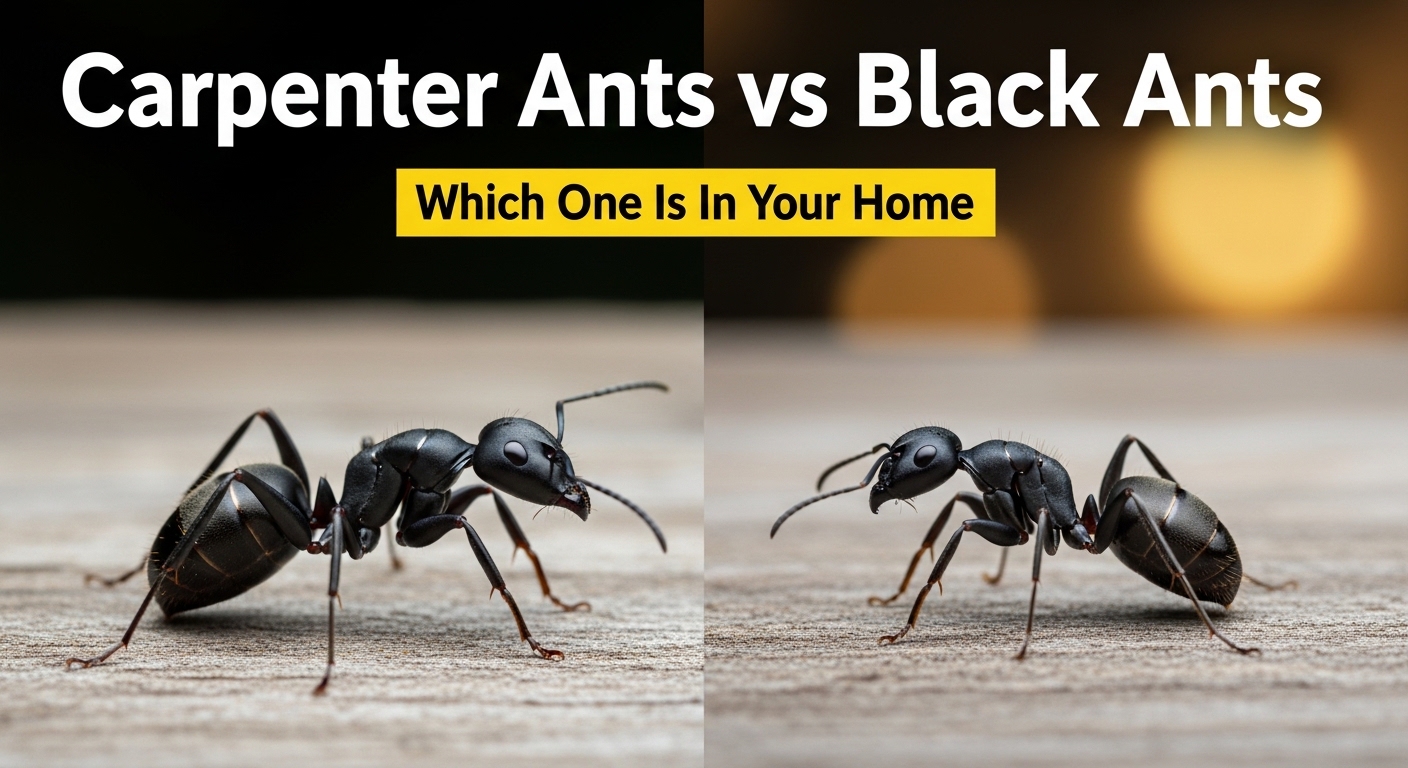
You spot a big black ant crawling across your kitchen counter. Your first instinct: grab a paper towel and squash it. Simple enough. But what if that one ant is a scout — a forward explorer from a carpenter ant colony quietly hollowing out the wooden beams inside your walls?
That’s not a scare story. It’s a situation that plays out in thousands of homes every year, and it almost always starts with a misidentification. Most people see a black ant and assume it’s just your average, harmless house ant. But not every black ant is the same, and confusing a carpenter ant for a common black ant can lead to structural damage that costs thousands of dollars to repair.
This guide is your complete, no-fluff breakdown of carpenter ants vs black ants — what makes them different, how to identify them, and exactly what to do if you suspect you’ve got a problem.
What Exactly Are Carpenter Ants?
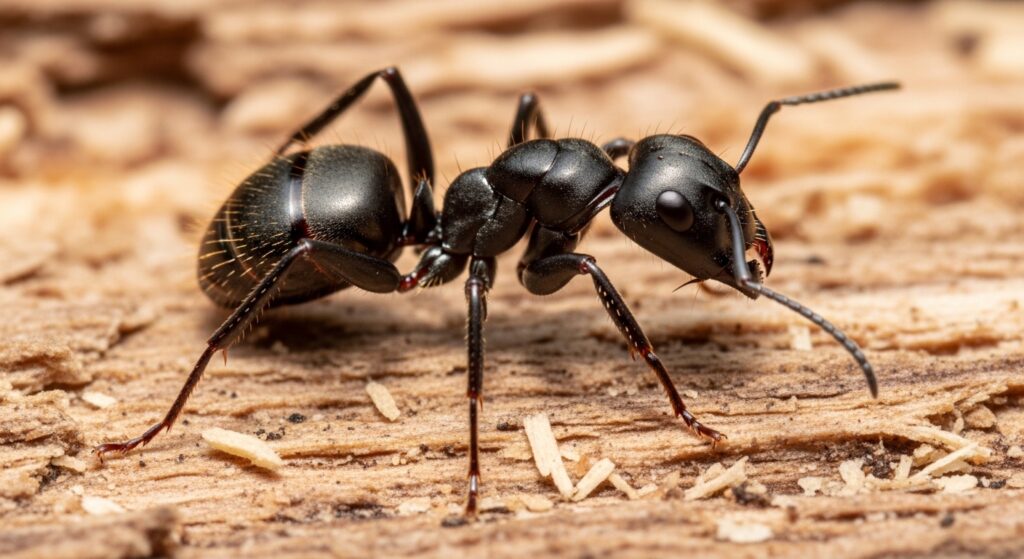
Carpenter ants belong to the genus Camponotus, one of the largest ant genera on the planet with over 1,000 known species. In North America, the most common species you’ll encounter is Camponotus pennsylvanicus — the black carpenter ant. These ants have a reputation, and it’s well-earned.
Unlike termites, which eat wood, carpenter ants tunnel through wood to build their nests. They excavate smooth, clean galleries inside timber — often in soft, moisture-damaged wood — creating elaborate tunnel systems where the colony lives and grows. The wood shavings they push out, called frass, look almost like coarse sawdust mixed with insect debris.
Carpenter ants are social insects. A mature colony can contain anywhere from 3,000 to 10,000 workers, according to Penn State Extension, and it typically takes three to six years for a colony to reach full size. During that slow buildup, the damage accumulates quietly — until one day a beam is compromised or a window frame crumbles.
They’re also nocturnal, which means most of their foraging happens at night. If you’re seeing large black ants inside your home during the day, that’s an even stronger signal that a nest may be nearby.
Where Do Carpenter Ants Live?
Carpenter ants prefer wood that’s been softened by moisture. Their satellite colonies — which are extensions of the main outdoor nest — are the ones most commonly found inside homes. They love:
- Roof eaves and attic spaces with any moisture intrusion
- Window and door frames with poor weatherstripping
- Wood directly in contact with soil
- Areas around plumbing leaks (under sinks, around toilets)
- Hollow wooden structural beams
The main (parent) nest is almost always outdoors — in a dead tree, log pile, or decaying stump. The satellite colonies branch off into nearby structures.
What Are Black Ants? (The Common Ones)
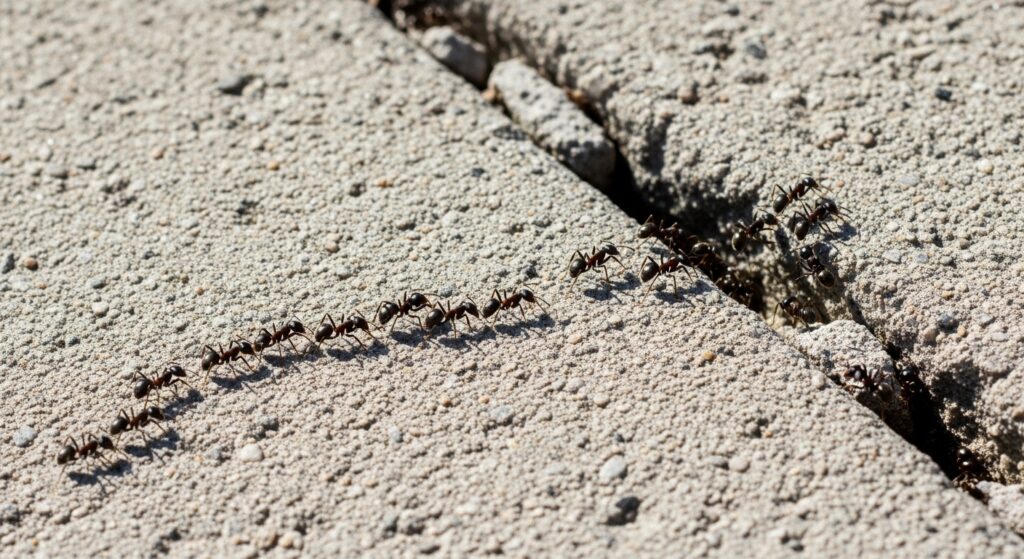
When most people say “black ants,” they’re usually referring to one of several smaller, very common species — none of which are anywhere near as destructive as carpenter ants. The most frequently encountered include:
Little Black Ant (Monomorium minimum) — Tiny, at just 1.5–2mm long, these ants are practically miniature. They nest in soil, under rocks, or in rotting wood, and are commonly seen in kitchens foraging for sugary or greasy food scraps.
Black Garden Ant (Lasius niger) — Also called the common black ant, this species is widespread across North America. Workers are typically 3–5mm long. They’re the ones most likely to show up at a picnic or trail along your baseboards. According to University of Florida IFAS, Lasius niger is one of the most ecologically abundant ant species in temperate regions.
Pavement Ant (Tetramorium caespitum) — These small, dark ants build their nests under slabs and sidewalks and are the cause of those familiar little sand piles you see pushing up through cracks in pavement.
The critical point: these ants do not damage your home’s structure. They’re a nuisance — they contaminate food, leave visible trails, and can be difficult to control — but they’re not eating your house from the inside out.
Black Garden Ant vs Carpenter Ant — A Quick Clarification
The term “black garden ant” sometimes confuses people because carpenter ants are also black and are sometimes found in gardens. Here’s the short version: a black garden ant (Lasius niger) is a small, uniform ant roughly the size of a sesame seed. A carpenter ant is 2–4 times larger, has a distinctly pinched waist, and is typically found near or inside wood. They are not the same insect.
Carpenter Ants vs Black Ants — The Key Differences
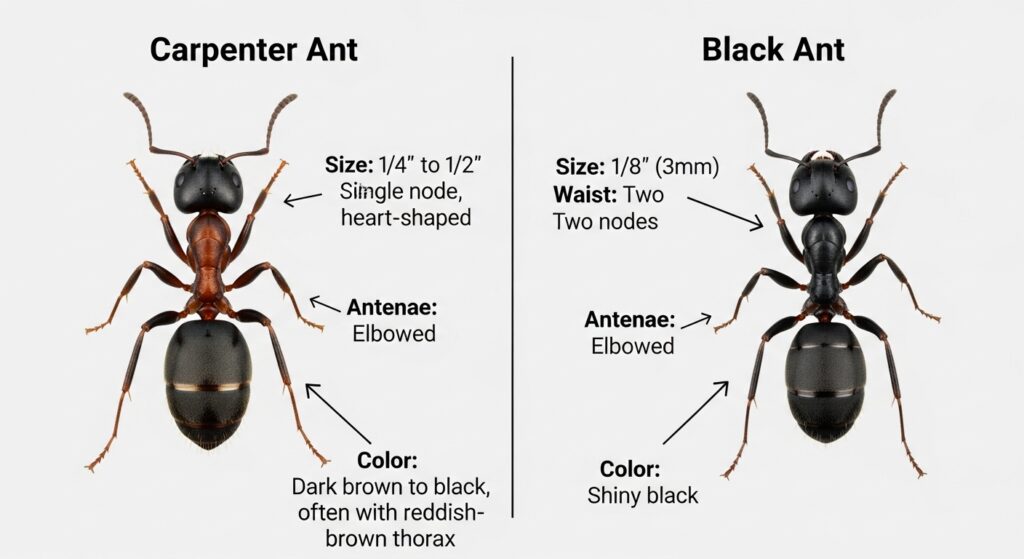
Here’s where we get into the heart of it. Let’s go through every meaningful difference you can use to identify these ants in the real world.
Size — The First and Most Obvious Clue
Size is usually the fastest way to separate these two types of ants, and it’s why so many people search for “big black ants vs carpenter ants” — because the size alone makes carpenter ants stand out.
| Feature | Carpenter Ant | Common Black Ant |
|---|---|---|
| Worker size | 6–13 mm (¼–½ inch) | 1.5–5 mm |
| Queen size | Up to 20 mm | 7–9 mm |
| Appearance | Large, robust | Small, slender |
| Visible to naked eye | Clearly visible | Small but visible |
For context: a carpenter ant worker is roughly the size of a watermelon seed. A common little black ant worker is about the size of a sesame seed. The difference is dramatic when you see them side by side.
The queen carpenter ant is even more impressive — up to 20mm (nearly an inch) long — and is sometimes mistakenly identified as a different species entirely.
Body Shape and the “Waist” Test
This is the most reliable identification technique for anyone who can get close enough to look. Carpenter ants have a single, distinctly constricted node (petiole) between the thorax and abdomen, giving them a visibly pinched waist. This is actually true of most ants, but in carpenter ants the effect is especially pronounced.
Common black ants also have a node, but their body profile tends to look more “smoothly connected” from a distance because of their smaller size.
Expert tip: If you can get a clear look at the ant’s profile, also check the thorax (the middle body section). Carpenter ant thorax has an evenly rounded, smooth upper surface with no bumps or indentations. This is a key entomological identification marker noted by the University of Minnesota Extension.
Color — Not Always Black
Here’s a nuance most articles skip: not all carpenter ants are black. While Camponotus pennsylvanicus is uniformly black, other carpenter ant species can be:
- Black with reddish-orange legs or thorax (very common in the western states)
- Bicolored — black abdomen, red thorax
- Entirely reddish-brown
This trips people up constantly. If you see a large ant that’s partly red and partly black, that’s almost certainly still a carpenter ant — just a different species than the all-black variety.
Common little black ants, by contrast, tend to be uniformly dark brown to black across their entire body.
Antennae Shape
Both carpenter ants and common black ants have elbowed antennae (bent at an angle), which is characteristic of all ants and distinguishes them from termites (which have straight, beaded antennae). However, carpenter ant antennae are noticeably longer in proportion to their body size — another clue if you’re looking closely.
Wings — The Swarmer Question
Both species produce winged reproductive ants (called alates or swarmers) during certain times of year. This is when new queens and males fly out to start new colonies.
- Carpenter ant swarmers have large, clearly visible wings, with the front pair noticeably longer than the rear pair. They swarm mainly in spring.
- Common black ant swarmers are much smaller, with more proportionally equal wings.
If you see large winged ants emerging from inside your home in spring, that is a serious warning sign of an established indoor carpenter ant nest. According to the National Pest Management Association, finding winged ants indoors almost always indicates a nearby colony.
Carpenter Ants vs Black Ants Size — A Visual Reference
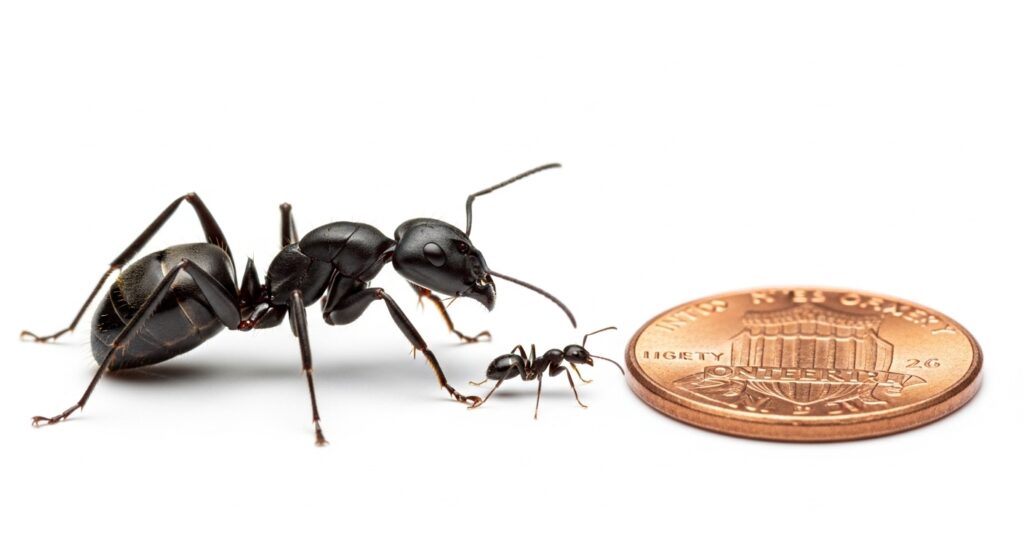
Numbers are helpful, but a real-world scale reference sticks better. Here’s how these ants compare to things you already know:
| Object for Scale | Approximate Size | Ant Comparison |
|---|---|---|
| Sesame seed (~1.5–2mm) | ≈ little black ant worker | Monomorium minimum |
| Watermelon seed (~6mm) | ≈ small carpenter ant worker | Camponotus pennsylvanicus (minor) |
| Pencil eraser (~10mm) | ≈ large carpenter ant worker | Camponotus pennsylvanicus (major) |
| U.S. dime (17.9mm) | ≈ carpenter ant queen | Queen Camponotus |
One of the most commonly searched questions is “are all big ants carpenter ants?” The answer is no — but a very large, all-black ant found inside or near wood in North America is a carpenter ant more often than not. Other large ant species (like Florida carpenter ants or red imported fire ants) have distinct coloring or geographic distributions that usually separate them.
How to Identify Carpenter Ants — Step-by-Step
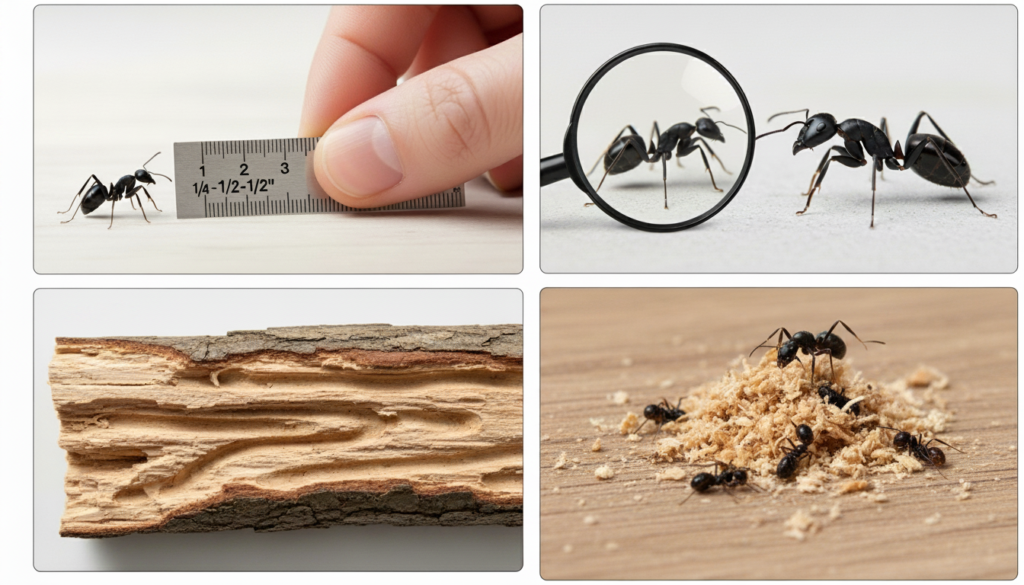
Let’s make this practical. If you’ve spotted a large, dark ant in or around your home and want to confirm what you’re dealing with, here’s how to do it.
Step 1: Size Check Is the ant larger than 6mm — roughly ¼ inch? Hold a coin near it. If the ant is half the width of a dime or more, you’re looking at something bigger than a common black ant.
Step 2: Color and Pattern Is the ant uniformly black, or does it have reddish-orange coloring on the thorax or legs? Both point to carpenter ant. Is it a very small, uniformly dark ant without any reddish tones? Likely a common black or pavement ant.
Step 3: Waist Profile If you can get a side view (a dead specimen works perfectly), look for the distinct single-node pinched waist of a carpenter ant. Also check that the top of the thorax is smoothly curved — not bumpy or uneven.
Step 4: Look at the Location Where did you find it? Near a window frame, a basement beam, or any wood showing moisture damage? Near a stack of firewood? These are classic carpenter ant habitats. Found in the kitchen near a sugar spill? More likely a common sweet-feeding ant.
Step 5: Check for Frass Look around baseboards, window sills, and wall junctions for frass — the carpenter ant’s calling card. It looks like coarse sawdust but also contains insect parts and debris. If you see it, you almost certainly have carpenter ants.
Step 6: Tap on Wood Tap on suspected wood surfaces with a screwdriver handle. Hollow, papery sounds from areas that should be solid — especially combined with any of the above signs — suggest tunneling activity inside.
Are All Black Ants Carpenter Ants?
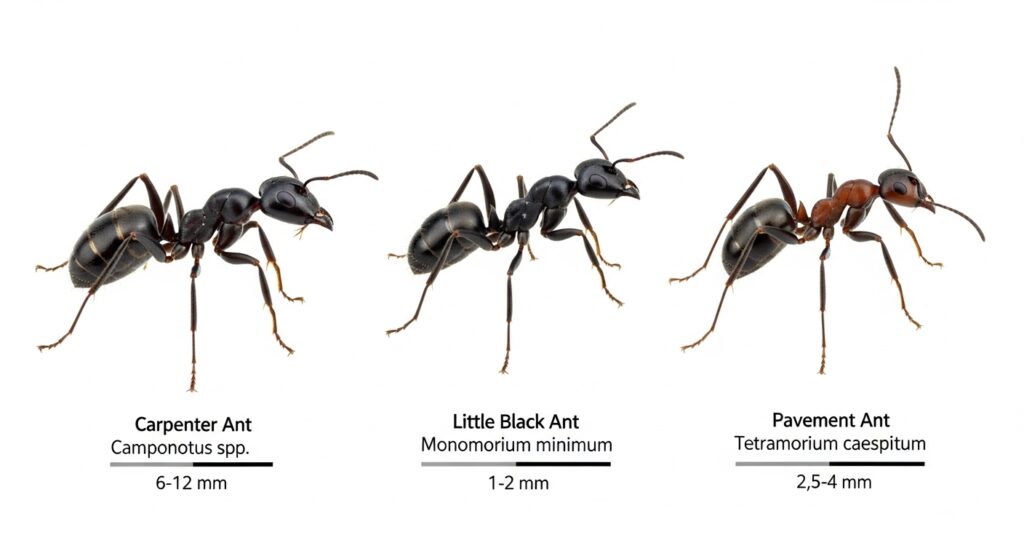
No — and this is one of the most important things to understand. Many homeowners assume that any large, dark-colored ant is a carpenter ant, or that any carpenter ant must be black. Neither is reliably true.
Here’s the reality:
Not all black ants are carpenter ants. The little black ant, pavement ant, odorous house ant, and black garden ant are all dark-colored insects that are significantly smaller than carpenter ants and do not damage wood.
Not all carpenter ants are black. As mentioned earlier, several Camponotus species in the western states are bicolored — black and red, or reddish-brown and black.
Not all big ants are carpenter ants. Some species of fire ant queens and winged reproductives from other ant species can be large. However, for most people in the continental U.S. finding a big, black, slow-moving ant near wood or moisture damage, the odds are high it’s a carpenter ant.
The University of California IPM Program notes that carpenter ants are among the most common pest ant species found inside structures in the U.S., and are frequently misidentified because of their variable appearance across species.
Carpenter Ant Damage vs. Black Ant Damage
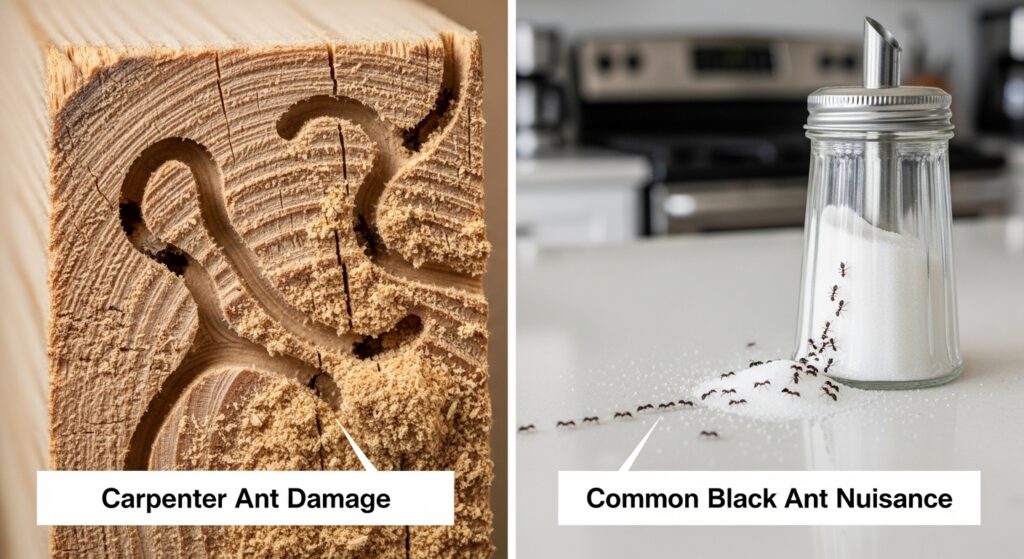
This is where the stakes become clear. The difference in the type of damage these ants cause is enormous — and it directly determines the urgency of your response.
Common Black Ant “Damage”
The nuisances caused by common black ants are largely hygiene and annoyance issues:
- Food contamination — They get into pantry foods, particularly sweet or greasy items
- Visible trails — Large trailing columns through kitchens, bathrooms, and along exterior walls
- Minor psychological stress — Nobody wants a kitchen full of ants
- Occasional biting — Most small black ants will bite if disturbed, though the bite is minor
These ants do not damage your home’s structure, electrical systems, or plumbing. They nest in soil, mulch, or cracks in pavement — not inside your walls.
Carpenter Ant Damage
Carpenter ants are a different story. While they don’t eat wood (they don’t digest cellulose like termites), the physical act of tunneling over years creates significant structural problems:
- Weakened load-bearing wood — Beams, joists, and headers can become compromised
- Damaged window and door framing — Making them difficult to open or close, with visible warping
- Hollow walls — In advanced infestations, you can hear hollow sounds when tapping
- Water intrusion worsening — As tunnels break through wood, they can allow moisture deeper into walls
According to Texas A&M AgriLife Extension, damage from carpenter ants can look similar to termite damage at first glance, though the galleries are smoother and cleaner, and frass is the clearest distinguishing sign.
The cost of repair for severe carpenter ant structural damage can run from $500 to $10,000 or more, depending on which structural members are affected and how long the infestation was active.
How to Get Rid of Them — Carpenter Ants vs Black Ants

Treatment strategies differ significantly depending on which ant you’re dealing with.
Controlling Common Black Ants
For small, common black ants, DIY solutions are usually very effective:
- Ant bait stations — Products like Terro (containing borax) are highly effective. Workers carry the bait back to the colony, poisoning it from the inside. EPA’s safer choice program lists several low-toxicity options.
- Eliminating entry points — Sealing cracks in foundation, gaps around pipes, and weatherstripping doors and windows
- Food storage — All pantry goods in sealed containers; no open pet food left out
- Removing attractants — Fixing moisture issues, clearing mulch from direct contact with the home’s foundation
- Perimeter sprays — Bifenthrin or other residual insecticides along the exterior foundation line
For most common black ant infestations, consistency and sanitation are the real weapons.
Eliminating Carpenter Ants
Carpenter ant control is more involved, because the goal isn’t just to kill the foragers you see — it’s to destroy the satellite and parent colonies.
- Locating the nest first — This is the most important step. Treating random spots won’t solve the problem. Follow ant trails, especially at night.
- Direct nest injection — If you can locate the gallery, injecting insecticide dust (deltamethrin, permethrin) directly into the void is highly effective.
- Bait products — Carpenter ant-specific baits (look for products containing abamectin or fipronil) work well placed along foraging trails.
- Exterior perimeter treatment — Liquid residual treatment around the foundation, windows, and any wood-to-ground contacts.
- Addressing the moisture source — Without fixing the moisture problem that attracted them in the first place, re-infestation is likely.
- Professional pest control — For any infestation that’s been active for more than a season, or where you can’t locate the nest, a licensed pest management professional is strongly recommended.
The National Pest Management Association provides a professional locator tool if you need to find a certified pest control company in your area.
Pictures of Carpenter Ants vs Black Ants — What to Look For
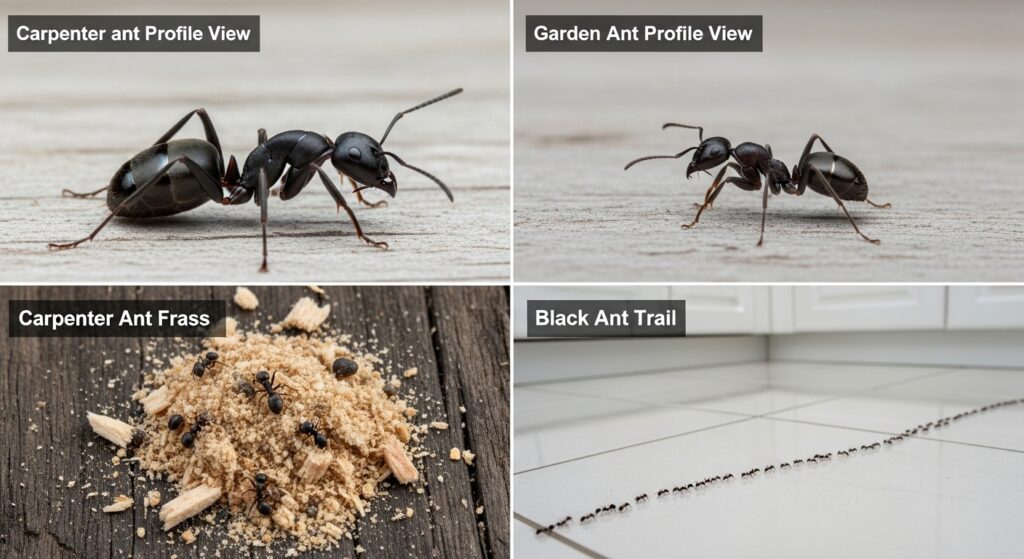
Because this is one of the most searched visual identification topics, here’s a written guide to what to look for in real photos or in person:
What a Carpenter Ant Looks Like in Photos:
- Large body, often as long as ½ inch for workers
- Smooth, shiny jet-black exoskeleton (or black + red/orange in bicolored species)
- Clearly visible pinched waist (the “hourglass” constriction)
- Large, prominent mandibles (jaw-like mouthparts) for chewing wood
- Longer legs relative to body compared to smaller ant species
- In swarmers: large, clear wings with brownish veins
What Common Black Ants Look Like in Photos:
- Small, ant-like — often barely noticeable individually
- Uniformly dark brown to black
- Body segments visible but proportionally smaller and tighter
- Travel in clearly defined, often straight trails
- Many individuals visible at once (they’re rarely seen solitary)
If you’re trying to make an ID from a photo you took yourself, place a coin in the frame for scale — it makes the difference between these species immediately obvious.
Expert Tips for Homeowners
For homeowners dealing with multiple pest risks rather than a single ant problem, a broader pest prevention plan can help address moisture, entry points, landscaping, and recurring activity together.

Based on best practices from entomologists, structural pest control professionals, and extension university resources, here are field-tested tips that go beyond the basics:
Do the nighttime inspection. Carpenter ants are most active between 10 p.m. and 2 a.m. If you suspect an infestation, do a slow walk through your home at night with a flashlight. You’ll see the ants actively moving — which makes it far easier to follow trails back to entry points or nesting sites.
Fix moisture first, always. No pesticide will solve a carpenter ant problem long-term if the moisture that attracted them in the first place remains. Fix roof leaks, improve attic ventilation, repair plumbing drips, and ensure gutters direct water away from the foundation.
Don’t store firewood against the house. Firewood piles are a classic carpenter ant habitat. Store firewood at least 20 feet from the home, elevated off the ground. The University of Minnesota Extension specifically lists firewood storage as one of the most common sources of carpenter ant introduction.
One ant inside is not a crisis — but don’t ignore it. Finding one or two large black ants inside in spring doesn’t necessarily mean there’s an established satellite colony. But it does mean you should monitor carefully over the following weeks and inspect for frass. Early detection is everything with carpenter ants.
Borax works great on common black ants, but not reliably on carpenter ants. Common carpenter ant bait products are specifically formulated differently. Read the label and choose accordingly. Using the wrong product is a common reason DIY treatments fail.
Use a free identification resource. iNaturalist (inaturalist.org) has a photo identification feature that can help confirm what species of ant you’re looking at. Upload a clear photo and community entomologists will often provide an ID.
Carpenter Ants vs Black Ants — Comparison Summary Table
| Category | Carpenter Ant | Common Black Ant |
|---|---|---|
| Size (workers) | 6–13 mm | 1.5–5 mm |
| Color | Black, or black + red/orange | Uniformly dark brown/black |
| Body shape | Pinched waist, smooth rounded thorax | Smaller, similar structure |
| Nesting location | Inside wood (especially moist) | Soil, cracks, under slabs |
| Structural damage | Yes — tunnels through wood | No |
| Food preference | Proteins + sweets | Sweets + greasy foods |
| Active time | Mostly nocturnal | Day and night |
| Signs of infestation | Frass, hollow wood sounds, large ants | Visible trails, food contamination |
| DIY controllable? | Difficult without locating nest | Often yes |
| Professional treatment needed? | Recommended | Only for large infestations |
| Swarmers? | Yes (spring, large winged ants) | Yes (smaller winged ants) |
Frequently Asked Questions (FAQs
What is the difference between carpenter ants and black ants?
The main difference between carpenter ants and black ants comes down to size, nesting behavior, and damage potential. Carpenter ants (Camponotus spp.) are significantly larger — typically 6–13mm — and nest inside wood by excavating tunnels, potentially causing structural damage over time. Common black ants (such as Lasius niger or Monomorium minimum) are much smaller, typically 1.5–5mm, nest in soil or cracks, and do not damage wood structures. Color alone is not a reliable identifier since both types can appear black, though carpenter ants are often bicolored.
Are all big black ants carpenter ants?
Not necessarily, but in North America, a large, jet-black ant found inside or near wood is most likely a carpenter ant. The size distinction is the most useful starting point. If you’re seeing ants that are half an inch or longer, with a clearly pinched waist and smooth, rounded thorax, and they’re in or near wood — there’s a high probability you’re looking at a carpenter ant. Other large species exist (such as Camponotus floridanus in the Southeast) but they’re all still within the Camponotus genus.
How can I tell if I have carpenter ants or regular ants in my house?
Start by checking size: carpenter ants are noticeably large compared to common black ants. Then look for frass — coarse, sawdust-like material mixed with insect debris near wall joints, window frames, or door frames. Check for hollow-sounding wood when tapped. Common “regular” ants will be small, numerous, visible in trails, and almost always found near food sources like the kitchen. Carpenter ants are larger, often found solo or in small groups, and frequently near moisture-damaged wood.
Can carpenter ants cause structural damage to my home?
Yes, over time. Carpenter ants don’t eat wood — they excavate it to create nesting galleries. A single new colony causes minimal damage. But a mature colony with 3,000–10,000 workers, active for multiple years, can hollow out significant sections of structural timber. Damage is most severe in wood that’s already been softened by moisture, such as around roof leaks, window frames, and areas near plumbing. Early detection and treatment is key to preventing serious structural harm.
What attracts carpenter ants to my home?
Carpenter ants are primarily attracted to moisture-damaged wood and protein + sweet food sources. The most common attractors include: water leaks from roofs or plumbing, wood in direct contact with soil, poorly sealed entry points around pipes and wiring, firewood stored against the home, and adjacent dead or decaying trees. Addressing moisture issues is consistently the most effective long-term prevention strategy, as noted by Purdue University Extension.
When to Call a Professional
DIY treatment is reasonable for common black ant infestations. But carpenter ants are a different calculation.
Call a licensed pest management professional if:
- You’ve found frass inside the home near wood structures
- You’re hearing rustling or crinkling sounds inside walls (especially at night)
- You’ve found winged ants emerging from inside the home
- You’ve spotted carpenter ants regularly for more than a few weeks
- You can’t locate the nest and DIY treatments haven’t worked after 2–3 weeks
- Any wood near the suspected nest area feels soft, spongy, or sounds hollow
A professional will do a thorough inspection — including moisture meter readings and infrared thermal imaging in some cases — to locate colonies that aren’t visible to the naked eye.
The EPA’s guide to pest control recommends always verifying that a pest management professional holds a current state license before hiring them.
Conclusion:
Confusing a carpenter ant for a common black ant is one of the most expensive mistakes a homeowner can make — not because of the misidentification itself, but because of the months or years of inaction that often follow it.
If you take one thing from this guide, let it be this: size matters. A tiny black ant marching across your kitchen floor in a column of hundreds is almost certainly a nuisance pest. A large, solitary, jet-black ant moving slowly near a wooden beam, or emerging from inside a wall — that deserves immediate attention.
Use the identification checklist in this article. Look for frass. Tap on wood. Do a nighttime inspection. And if anything about what you find raises a red flag, get a professional opinion before the colony has another season to expand.
Your home is likely your biggest investment. A pest inspection costs far less than structural repairs.

