
Introduction
Picture this: You’ve just set up your tent at a beautiful remote campsite. The stars are coming out, the fire is crackling, and then nature calls. You reach for your headlamp and follow a small sign pointing to the restroom facilities. You push open a wooden door and find — not a flushing toilet, not a portable plastic outhouse — but something different. A vault toilet.
If you’ve ever camped at a national forest, a state park, or any remote recreational area, there’s a good chance you’ve used one without knowing exactly what it was. And even if you’ve wondered about it in the moment, the question “what is a vault toilet, exactly?” deserves a real answer.
This guide covers everything you need to know about vault toilets — from how they work and why they’re used, to comparing vault toilet vs pit toilet, understanding costs, shopping for one (yes, they’re for sale), and getting practical tips for camping with vault restrooms.
Whether you’re a first-time camper, a land developer, or someone building a remote cabin, this is the most complete resource you’ll find on the subject.
What Is a Vault Toilet?
The Basic Definition
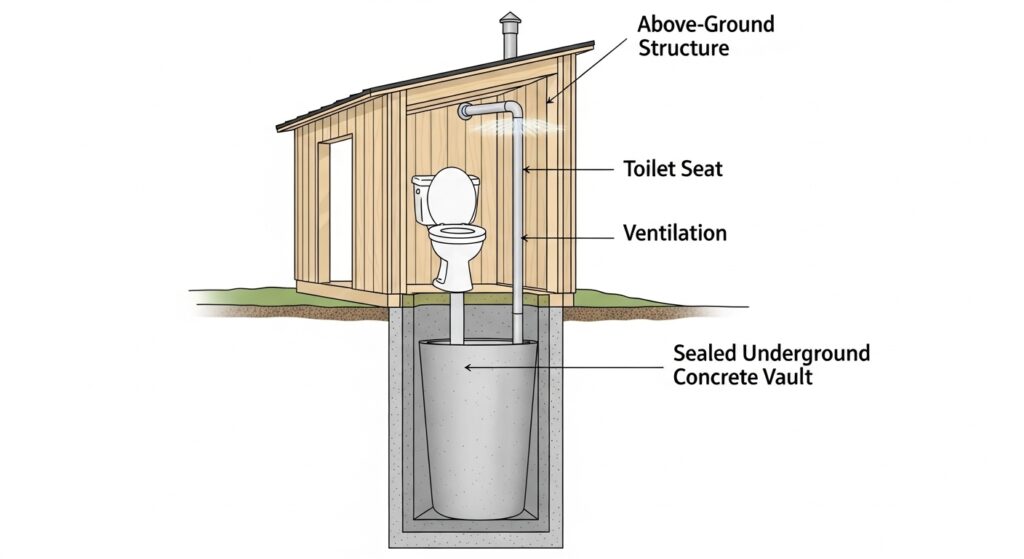
A vault toilet is a waterless, non-flushing restroom system built over a sealed underground storage container — called a vault — that holds human waste. Unlike a standard flush toilet connected to a septic system or sewer line, a vault toilet requires no water, no plumbing connections, and no electricity to operate.
The term “vault” refers to the impermeable underground container (typically made of pre-cast concrete or fiberglass) that collects and temporarily stores waste. When the vault reaches capacity, it is pumped out by a specialized service vehicle — similar to how portable toilets are maintained.
The U.S. Forest Service and National Park Service rely heavily on vault toilet systems across thousands of campgrounds and trailheads where traditional plumbing isn’t practical or environmentally appropriate.
Vault Toilet Meaning: Breaking It Down
The vault toilet meaning becomes clearest when you compare it to what most people are used to:
| Feature | Standard Flush Toilet | Vault Toilet |
|---|---|---|
| Water required | Yes | No |
| Plumbing needed | Yes | No |
| Underground storage | No | Yes (sealed vault) |
| Electricity needed | No (typically) | No |
| Waste treatment | Municipal/septic | Pumped out periodically |
| Best for | Urban/suburban | Remote/off-grid locations |
| Environmental impact | Variable | Low (if managed correctly) |
The “vault” in vault toilet isn’t just a poetic label — it’s an engineering descriptor. The underground container is sealed on all sides and bottom, meaning waste cannot seep into groundwater or surrounding soil. This is one of the key advantages over older, less sanitary options like pit toilets.
What Is a Vault Restroom?
A vault restroom is simply the full facility — the building and the toilet system combined. Some vault restrooms are single-occupancy units, while larger campgrounds may have multi-stall vault restroom buildings with separate men’s and women’s sides.
At higher-traffic locations like popular trailheads managed by the Bureau of Land Management (BLM), you might find a vault restroom that looks similar to a small permanent building — poured concrete or decorative wood exteriors, proper ventilation, and clean interiors. The presence of a proper structure around the vault system is what distinguishes a vault restroom from a standalone vault toilet unit in an open setting.
How Does a Vault Toilet Work?
Understanding how a vault toilet works helps you appreciate why it’s such a popular solution for remote locations.
The Core Components
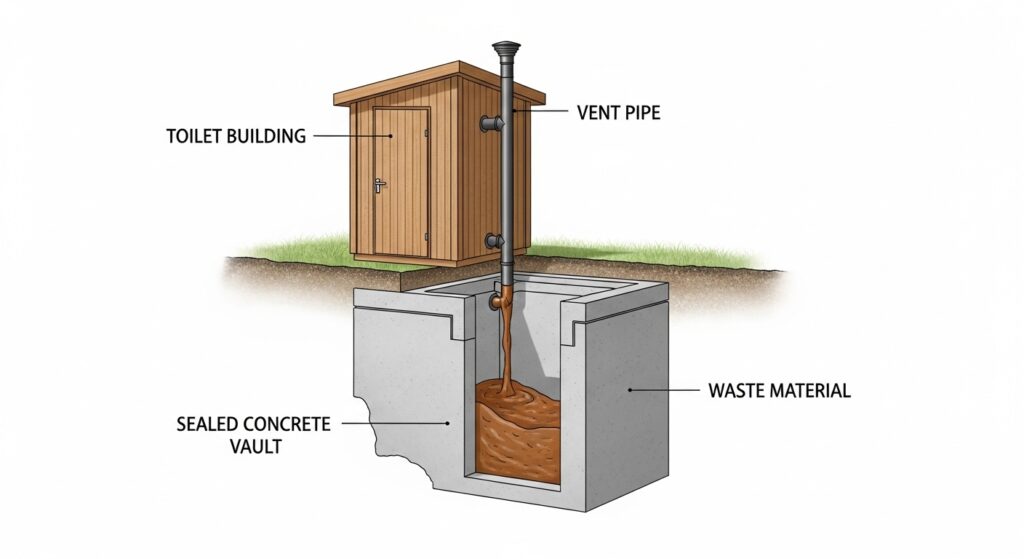
A vault toilet system has four main parts:
1. The Superstructure (The Building) This is the above-ground structure — the room you walk into. It can be made from wood, steel, fiberglass, or concrete block. The building houses the toilet riser (the seat and opening), provides privacy, and protects the system from weather.
2. The Toilet Riser This is the toilet seat and pedestal that sits over the vault opening. Waste drops directly through the riser into the underground vault below.
3. The Underground Vault This is the defining feature. The vault is a watertight, impermeable container — usually pre-cast concrete or heavy-duty fiberglass — buried beneath the superstructure. The Environmental Protection Agency (EPA) notes that sealed vault systems prevent ground contamination, which is a key distinction from pit latrines. Vault sizes vary, but common capacities range from 750 to 13,000 gallons.
4. The Ventilation Pipe A crucial component: a vent pipe extends from the vault up through and above the roof of the building. This pipe allows gases (methane and other waste gases) to escape upward and away from the user. Without proper ventilation, the odor inside would be overwhelming. In well-designed vault toilets, the vent pipe also creates a negative air pressure system that draws odors away from the toilet seat — which is why good vault toilets smell better than you might expect.
The Pumping Process
When the vault fills to about 75–80% capacity, it must be pumped. A licensed waste hauler uses a vacuum truck (similar to a septic pumping truck) to remove the waste through an access port. The waste is then transported to an approved treatment facility.
The frequency of pumping depends entirely on usage levels. At a busy trailhead, a vault might be pumped weekly. At a remote wilderness campsite, it might go months between services.
Vault Toilet vs Pit Toilet: What’s the Real Difference?
This is one of the most common questions, and the answer matters — especially from a public health and environmental standpoint.
Vault Toilet vs Pit Toilet — A Side-by-Side Look
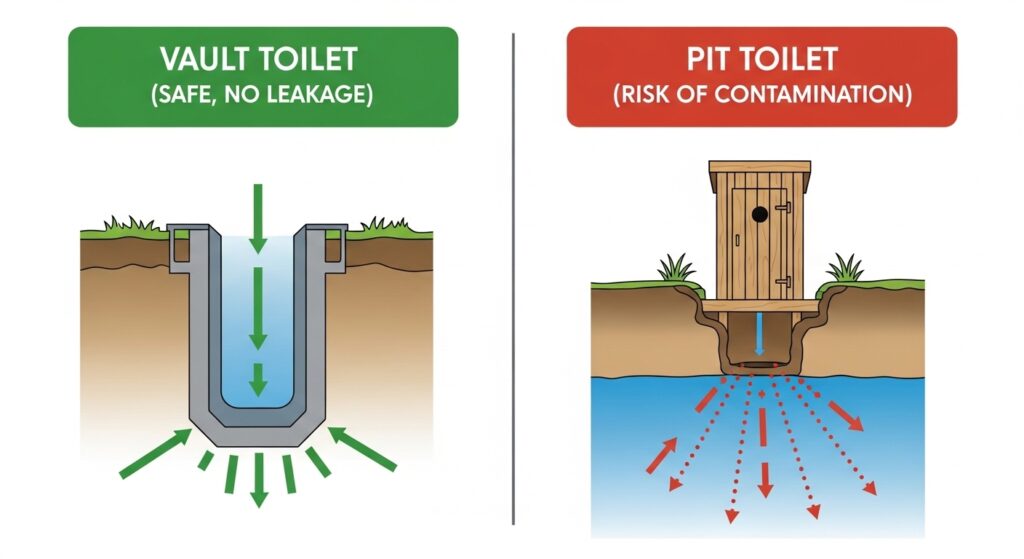
Both a vault toilet and a pit toilet are waterless waste systems used in remote locations. But they are fundamentally different in design.
A pit toilet (also called a pit latrine) is essentially a hole dug into the ground. The structure sits over the hole, and waste accumulates in the earth below. There is no sealed container. Waste is exposed to soil, which means:
- Bacteria and pathogens can migrate into the groundwater
- Decomposition happens naturally (slowly) in the ground
- The pit is eventually abandoned or covered when full
A vault toilet, by contrast, sits over a sealed, impermeable vault. Nothing leaks into the surrounding soil. The waste is entirely contained until it is professionally pumped.
| Factor | Vault Toilet | Pit Toilet |
|---|---|---|
| Sealed container | Yes | No |
| Groundwater protection | High | Low to moderate |
| Odor control | Better (with vent) | Worse |
| Installation cost | Higher | Lower |
| Environmental safety | Higher | Lower |
| Used by NPS/USFS | Yes — widely | Rarely today |
| Long-term solution | Yes | Temporary |
The Centers for Disease Control and Prevention (CDC) has long emphasized that sealed containment systems are superior to open pit systems for preventing disease transmission through groundwater contamination.
In modern campground and land management settings, vault toilets have largely replaced pit toilets because of environmental regulations and public health standards. When you see a pit toilet these days, it’s usually a very old or extremely low-use installation.
What Are Pit Toilets?
Since the question “what are pit toilets” often comes up alongside vault toilet research, here’s a quick answer: a pit toilet is an open-bottomed latrine structure built over a hand-dug or machine-dug pit. Waste collects at the bottom of the pit and slowly decomposes. While pit toilets have been used for thousands of years and are still common in developing nations, they present groundwater contamination risks when sited improperly. According to the World Health Organization (WHO), approximately 2 billion people globally still use unsafe sanitation systems including open pit latrines, making sealed vault systems a significant improvement in public sanitation.
For pit toilet camping, know that most developed campgrounds in managed public lands have phased out open pit toilets in favor of vault toilets or composting toilets for these reasons.
Vault Toilets at Campgrounds: What to Expect
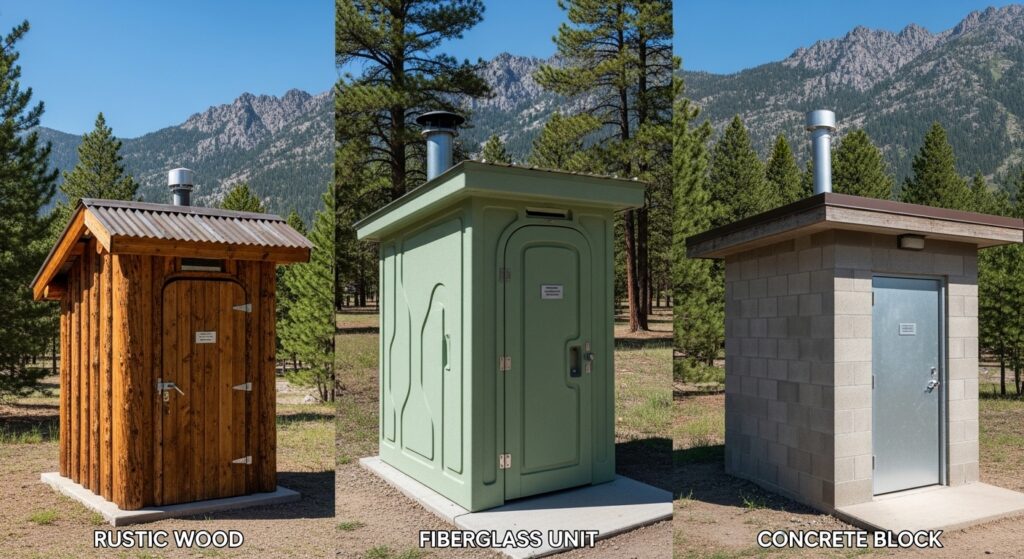
If you’re heading out for your first camping trip, knowing what to expect at a campground vault toilet can make the experience much less intimidating.
Types of Vault Toilet Buildings
Not all vault toilets look the same. Here’s what you might encounter:
Single-Unit Fiberglass Structures These look similar to portable toilets but are more permanent and built directly over a vault. They’re lightweight, easy to install, and common at low-traffic trailheads.
Wood-Frame Buildings Rustic wooden structures blending into the forest environment. Common in national forests and older state parks. They typically include ventilation and basic amenities like toilet paper holders.
Concrete Block or Prefab Concrete Structures More durable and vandal-resistant. These are used at high-traffic areas and look like permanent small buildings. Often have better odor control systems.
ADA-Compliant Vault Restrooms Under the Americans with Disabilities Act (ADA), many managed public lands have installed vault restrooms with larger interiors, grab bars, and accessible toilet heights. The U.S. Forest Service has guidelines specifically for accessible vault toilet installations.
Practical Tips for Using a Vault Toilet Camping
Vault toilet camping can feel strange at first, especially for first-timers. Here’s how to make the most of it:
- Bring your own supplies. Toilet paper is not always stocked consistently. Pack a small zip bag with TP, hand sanitizer, and feminine hygiene products.
- Use the vent. Modern vault toilets are designed so air flows down from the toilet seat and out through the vent pipe. Sitting normally (not hovering) actually helps the ventilation system work better — meaning less odor for you.
- Avoid dropping trash. Items like wipes, trash, or non-biodegradable materials can clog the pump-out equipment and create serious maintenance problems.
- Don’t add water or chemicals. Unlike portable toilets, vault toilets don’t use chemicals. Adding household cleaners can damage the vault or disrupt waste decomposition.
- Check the fullness indicator. Some vault toilets have a viewing port or level indicator. If a vault appears nearly full, report it to campground staff or the managing agency.
- Night visits. Bring a headlamp. Most vault restrooms at campgrounds have no electricity, so nighttime visits require your own light source.
Vault Bathroom Amenities: What’s Usually Included
The amenities inside a vault bathroom vary widely by location and agency management:
| Amenity | Available? |
|---|---|
| Toilet paper | Often, but not always |
| Hand sanitizer dispenser | Sometimes |
| Running water (sink) | Rarely — it’s a waterless system |
| Lighting | Sometimes (solar-powered) |
| Mirrors | Rarely |
| Baby changing station | In newer ADA units sometimes |
| Trash receptacle | Often outside the unit |
The keyword here: self-sufficiency. A vault bathroom is functional, not luxurious. Pack accordingly.
Vaulted Privy vs. Vault Toilet: Is There a Difference?
The terms vaulted privy and vault toilet are sometimes used interchangeably, but there’s a slight historical distinction.
A privy is an older term for any outdoor toilet structure — think pioneer-era outhouses. A vaulted privy specifically refers to a privy built over a sealed (vaulted) underground container, making it functionally equivalent to what we now call a vault toilet.
In modern usage, especially in National Park Service documentation and outdoor recreation contexts, “vault toilet” is the standard term. “Vaulted privy” may appear in older land management documents, historical preservation contexts, or in some regional uses.
Both refer to the same core concept: an above-ground structure over a sealed, impermeable underground waste storage container.
Waterless Restroom Systems: The Bigger Picture
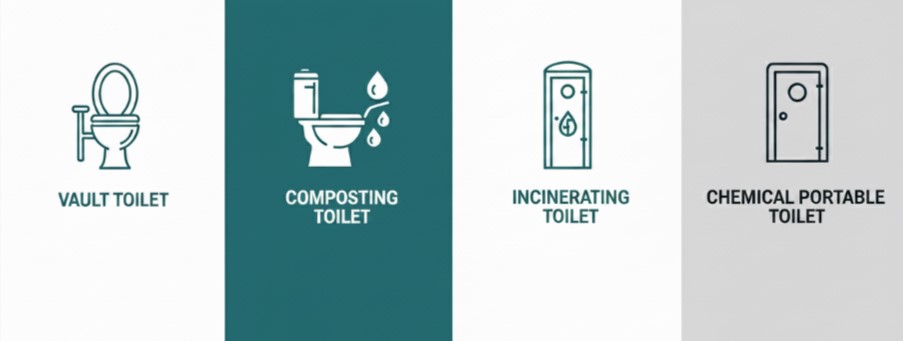
A vault toilet is one category within the broader world of waterless restroom technology. Understanding the landscape helps when choosing the right system for a property or project.
Types of Waterless Restrooms
1. Vault Toilets The most common in public land management. Sealed underground container, periodic pump-out.
2. Composting Toilets Instead of storage, composting toilets use aerobic decomposition to process waste into compost material. They’re popular in eco-lodges, tiny homes, and some high-altitude campsites where pumping is difficult. Brands like Nature’s Head and Sun-Mar are well known in this space.
3. Incinerating Toilets These use heat to reduce waste to ash. Less common due to energy requirements, but useful in extremely remote locations without vehicle access.
4. Chemical Toilets Portable units (like those used at events) that use chemicals to neutralize waste. Not considered a long-term waterless solution.
Among these, vault toilets remain the dominant choice for public lands because of their simplicity, low maintenance requirements, reliability in extreme weather, and low per-use cost at scale.
Vault Toilets for Sale: What You Need to Know
Yes, you can buy a vault toilet. If you’re a landowner, campground developer, or rural property owner, knowing how to purchase and install a vault toilet system is genuinely useful.
What “Vault Toilet for Sale” Actually Means
When people search for vault toilets for sale, they’re usually looking for one of two things:
- The superstructure (the building) — The above-ground unit that sits over the vault
- The complete system — Building + underground vault container, sometimes with installation
Most suppliers sell these components separately, and installation requires both a licensed contractor and, in most cases, local permits.
Major Suppliers of Vault Toilet Systems
Several reputable companies manufacture and supply vault toilet systems:
Romtec Utilities Romtec is one of the most well-known suppliers of restroom structures for parks, campgrounds, and public lands. They offer prefabricated vault toilet buildings in various sizes and materials.
American Sanitation Inc. A supplier specializing in vault toilet prefab structures for national forests and parks.
Satellite Industries Known primarily for portable sanitation, Satellite Industries also offers semi-permanent vault restroom solutions.
Local Precast Concrete Manufacturers For the underground vault itself, local precast concrete companies are often the best source. The vault is typically a standard precast concrete septic-style tank, modified for vault toilet use.
What to Look for When Buying
- Material: Fiberglass is lightweight and easy to transport; concrete is more durable; wood is aesthetically pleasing but higher maintenance
- ADA Compliance: If the facility will be open to the public, ADA requirements likely apply
- Ventilation System: Critical for odor control — ensure the unit includes a proper vent pipe design
- Vault Size: Match vault capacity to expected usage. The U.S. Forest Service Engineering recommends sizing based on visitor-days of use
- Security Features: Locking doors, vandal-resistant hardware
- Color/Finish: Units for public lands often need to blend with the natural environment
How Much Does It Cost to Build a Vault Toilet?
This is a critical question for landowners and project developers: how much does it cost to build a vault toilet?
The honest answer is: it varies quite a bit depending on size, location, soil conditions, access, and materials. But here’s a practical breakdown.
Cost Components
1. The Underground Vault A pre-cast concrete vault tank typically costs between $1,500 and $6,000 depending on size (750 to 13,000+ gallons). Larger vaults cost more and reduce pumping frequency.
2. The Superstructure (Building) Prefabricated structures range from:
- Basic fiberglass single-unit: $3,000–$8,000
- Wood-frame building: $5,000–$15,000
- Concrete block structure: $10,000–$30,000+
- Custom ADA-compliant multi-stall building: $25,000–$100,000+
3. Site Preparation and Excavation Digging and preparing the vault installation site: $1,500–$5,000, depending on soil type and access difficulty.
4. Delivery and Installation Crane or equipment delivery and placement of vault: $1,000–$4,000.
5. Permits and Engineering Local permits, soil testing, and engineering review: $500–$3,000+ depending on jurisdiction.
6. Ongoing Maintenance (Annual) Pumping costs: $200–$600 per pump-out depending on location and volume. Annual maintenance on the structure: variable.
Estimated Total Cost Ranges
| Project Type | Estimated Cost |
|---|---|
| Basic single-unit fiberglass + small vault | $8,000–$18,000 |
| Standard wood-frame + medium vault | $15,000–$35,000 |
| ADA-compliant concrete structure + large vault | $40,000–$120,000+ |
| Remote installation (helicopter access, etc.) | Add 50–200% premium |
According to project data shared by the USDA Forest Service and state recreation agencies, a typical single-unit vault toilet installation on accessible land runs between $15,000 and $50,000 in total installed cost — though high-end or remote projects can exceed $100,000.
Expert Tips for Vault Toilet Design and Management
Whether you’re a land manager, campground owner, or outdoor recreation developer, these expert-level insights will help you get the most out of a vault toilet installation.
Tip 1: Vent Pipe Placement Is Everything
The vent pipe should always be placed on the sunny side of the building (typically the south-facing side in the Northern Hemisphere). Solar heating of the vent pipe creates a stronger thermal updraft, pulling odors out more efficiently. Dark-colored vent pipes absorb more solar heat and outperform lighter ones.
Tip 2: Site Orientation Matters
Position the vault toilet entrance away from prevailing winds. This prevents wind from pushing odors back toward users. Many land managers also recommend orienting the toilet seat away from the vent pipe so that the downdraft draws odors in the correct direction.
Tip 3: Match Vault Size to Use Patterns
Under-sizing the vault is the most common and costly mistake. A general planning rule used by the National Park Service is to calculate expected visitor-days per year and size the vault so it requires pumping no more than two to four times annually at typical-use locations. At high-use trailheads, quarterly pumping may still be necessary regardless of vault size.
Tip 4: Pest Prevention
Insects — especially flies — can breed inside vault toilets and carry pathogens. Some agencies add vault toilet inserts (honeycomb foam risers) that reduce the fly access area. According to pest management research from land management agencies, physical barriers combined with proper ventilation dramatically reduce fly populations inside vault toilets.
Tip 5: Winter Maintenance
In cold climates, vault toilets require winterization inspection. Vent pipes can ice over, blocking airflow and causing odor issues. Insulated vent pipe extensions or heating inserts can address this in areas with extreme winter temperatures.
Tip 6: Chemical Additives — Use with Caution
Some managers add enzymatic or biological additives to vaults to help break down solids and reduce odors. These must be specifically designed for vault use — never use household bleach or disinfectants, as these kill the beneficial bacteria that aid decomposition and can damage fiberglass vault walls.
Vault Toilet Pros and Cons
Making an informed decision about vault toilets requires an honest look at both sides.
Pros of Vault Toilets
- No water or plumbing required — Ideal for locations without water infrastructure
- Sealed system protects groundwater — Far safer than pit toilets
- Low operating cost per use at scale
- Durable and reliable — Few mechanical parts means few mechanical failures
- Works in all weather — No freeze-up risk in properly maintained units (unlike composting toilets)
- Scalable — Can install multiple units or multi-stall buildings as usage grows
- ADA accessible options available
- Lower environmental footprint than flying waste out by helicopter at remote sites
Cons of Vault Toilets
- Higher upfront installation cost than a simple pit latrine
- Odor — Even well-designed vault toilets can smell, especially in hot weather or when near capacity
- Regular pumping required — Ongoing operational commitment and cost
- Not truly “off-grid permanent” — Relies on pump truck access periodically
- Limited amenities — No running water, no flushing
- Can be misused — People dumping trash, chemicals, or large objects can damage the system
Environmental Considerations
Vault toilets play a meaningful role in protecting natural environments — particularly in areas with high recreational pressure.
Protecting Sensitive Ecosystems
Many vault toilets are installed at high-elevation alpine areas, river corridors, and coastal sites where human waste contamination poses a serious environmental risk. The Leave No Trace Center for Outdoor Ethics emphasizes proper waste disposal as one of its seven core principles, and vault toilets are a primary infrastructure tool for achieving this at managed sites.
Research published in the Journal of Environmental Management has documented fecal coliform contamination in backcountry water sources near high-use trails, reinforcing the value of sealed waste containment systems.
Carbon Footprint Considerations
The pump-out process does involve diesel-powered vacuum trucks, creating a carbon cost. However, compared to alternatives — such as pack-out systems or helicopter removal of waste at remote sites — vault toilets represent an efficient, lower-carbon option for most accessible locations.
Vault Toilet vs Other Restroom Options: Full Comparison
For land managers or developers evaluating options, here’s a comprehensive comparison of vault toilets against all major alternatives.
| Feature | Vault Toilet | Composting Toilet | Flush Toilet | Chemical Porta-Potty | Pit Toilet |
|---|---|---|---|---|---|
| Water required | No | No | Yes | No | No |
| Sealed system | Yes | Yes | Yes | Yes | No |
| Groundwater safe | Yes | Yes | Yes | Yes | No |
| Initial cost | Medium-High | Medium | High | Low | Low |
| Ongoing cost | Low-Medium | Low | Medium | High (rental) | Low |
| Odor control | Good | Good-Excellent | Excellent | Poor-Fair | Poor |
| Capacity | Large | Small-Medium | Unlimited | Small | Medium |
| Access road needed | Yes (pump truck) | No | No | Yes (service) | No |
| ADA accessible | Yes | Sometimes | Yes | Sometimes | No |
| Cold weather use | Yes | Challenging | Yes | No | Yes |
| Best for | Remote public lands | Eco sites | Urban/developed | Events | Temporary/primitive |
FAQs
What’s a vault toilet, and how is it different from a regular toilet?
A vault toilet is a waterless restroom built over a sealed underground tank (the “vault”) that holds waste until it’s pumped out. Unlike a regular flush toilet, it requires no water, no sewer connection, and no plumbing. It’s the standard sanitation solution at campgrounds, trailheads, and remote public lands where water infrastructure doesn’t exist or isn’t practical.
Do vault toilets smell bad?
They can — but a well-maintained, properly designed vault toilet with good ventilation shouldn’t smell overwhelmingly bad. The key factors are: proximity to full capacity (nearly full vaults smell worse), outside temperature (heat increases odor), and the quality of the vent pipe system. Well-designed units use a solar-heated dark vent pipe to create an upward air draft that pulls odors away from the toilet seat. At many national forest and NPS campgrounds, vault toilets are regularly maintained and reasonably pleasant to use.
How often do vault toilets get pumped?
It depends on usage levels. At a busy trailhead with hundreds of daily visitors, pumping may happen weekly or even more frequently during peak season. At a remote campsite used occasionally, pumping might happen once or twice a year. The U.S. Forest Service and other land management agencies schedule pumping based on seasonal use patterns and vault capacity monitoring.
Can you buy a vault toilet for private property?
Yes — vault toilets are commercially available for private purchase. You’ll need to buy the superstructure (building) and the underground vault separately in most cases. Installation requires excavation, proper site preparation, and likely local building permits. Total installed costs typically range from $8,000 to $50,000+ depending on size, materials, and location. Check with your county or municipality about permitting requirements before purchasing.
What should you never put in a vault toilet?
The following should never go into a vault toilet:
- Trash or garbage — clogs the pump system
- Wet wipes or “flushable” wipes — these don’t break down and cause pump equipment failure
- Feminine hygiene products — same issue as wipes; use the trash receptacle
- Household chemicals (bleach, disinfectants) — damage the vault and disrupt decomposition
- Large foreign objects — can damage the pump equipment and create hazardous waste situations
- Cigarette butts — fire hazard in a methane-producing environment
Always use vault toilets only for their intended purpose — human waste and toilet paper.
Conclusion:
If this guide has done its job, you now see vault toilets in a completely different light. They’re not just “the smelly thing at the campsite.” They’re a thoughtfully engineered, environmentally conscious, cost-effective solution to one of the oldest human challenges — managing waste in places where modern plumbing can’t reach.
From understanding the vault toilet meaning to comparing vault toilet vs pit toilet, knowing what to expect at a campground vault toilet, exploring the costs involved, or researching vault toilets for sale — there’s a lot more depth to this topic than most people realize.
Whether you’re a first-time camper trying to figure out what you’re walking into (literally), or a land manager planning a new recreational facility, vault toilets represent one of the best tools available for responsible outdoor sanitation.
Call to Action
Planning your next camping trip? Check whether your destination has vault toilet facilities by visiting Recreation.gov or the official website of the managing agency (National Forest, BLM, National Park Service). Knowing what to expect helps you pack appropriately and enjoy your time outdoors without surprises.
Developing land or a campground? Reach out to a licensed sanitation engineer or contact your regional USDA Forest Service Engineering office or state parks department for guidance on vault toilet specifications, permits, and approved suppliers.
Have a question about vault toilets? Drop it in the comments below — we read every one.

