

There’s something almost magical about walking outside on a summer morning to find a fence or trellis exploding in purple, blue, and pink blooms — each one perfectly trumpet-shaped, each one facing the rising sun like a tiny satellite dish tracking light.
That’s the morning glory experience.
These fast-growing vines have been charming gardeners for centuries. They’re dramatic yet forgiving. Gorgeous yet low-maintenance. And whether you’re planting your first garden bed or you’ve had years of experience, morning glories fit right in.
But there are real questions that come up every season. Are morning glories annuals or perennials? Will they come back next year? Where do they grow best? How long do they take? This guide answers every one of those questions — and then some.
By the time you finish reading, you’ll know exactly how to plant, grow, and care for morning glories from seed to spectacular bloom. Let’s dig in.
What Are Morning Glories?
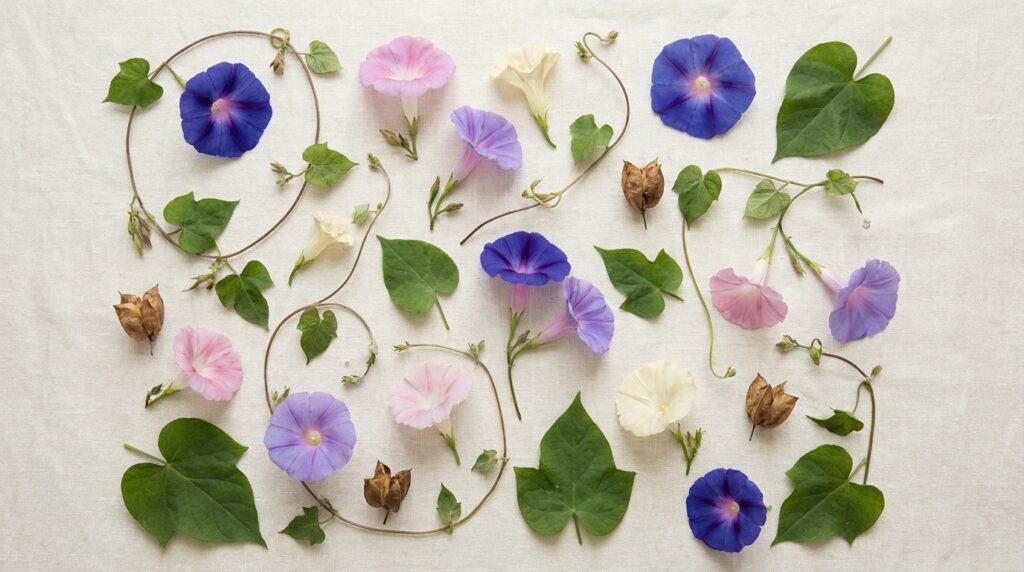
Morning glories (Ipomoea spp.) are flowering vines that belong to the family Convolvulaceae. The genus Ipomoea contains over 500 species, and the ones we typically grow in home gardens — primarily Ipomoea purpurea, Ipomoea tricolor, and Ipomoea nil — are prized for their fast growth, vivid color, and cheerful funnel-shaped blooms.
The name “morning glory” comes from the fact that the flowers open in the morning and typically close by midday or early afternoon, especially on hot days. On cooler, overcast days, blooms can last longer.
These vines are heavy producers. A single healthy plant can put out dozens of blooms per day throughout the growing season, creating a continuous show of color from midsummer right through the first frost.
Popular varieties include:
| Variety | Color | Notable Trait |
|---|---|---|
| Ipomoea tricolor ‘Heavenly Blue’ | Sky blue with white center | Most popular garden variety |
| Ipomoea purpurea ‘Grandpa Ott’ | Deep purple with red star | Heirloom, very prolific self-seeder |
| Ipomoea nil ‘Scarlett O’Hara’ | Deep crimson | Vigorous climber, heat tolerant |
| Ipomoea tricolor ‘Flying Saucers’ | Blue and white marbled | Striking bi-color pattern |
| Ipomoea alba (Moonflower) | White, fragrant | Opens at dusk instead of dawn |
Morning glories are closely related to sweet potatoes (Ipomoea batatas), which explains the similar leaf shapes in many varieties.
Are Morning Glories Annuals or Perennials?

This is the question most gardeners search for first, and the answer is a bit nuanced. So let’s break it down clearly.
The Short Answer
In most of the country, morning glories are grown as annuals. They complete their full life cycle — from seed to flower to seed — in a single growing season and are killed by frost.
However, in USDA Hardiness Zones 10–12 (think South Florida, Southern California, Hawaii, and similar warm climates), morning glories can behave as tender perennials, surviving year-round and continuing to grow and bloom without dying back. You can check your USDA Plant Hardiness Zone to know where you fall.
Do Morning Glories Come Back Every Year?
Sort of — just not in the way most people expect.
Even where winters kill the parent plants, morning glories are famous prolific self-seeders. The mature seed pods drop dozens of seeds into the soil in autumn. Those seeds lie dormant over winter and sprout the following spring, giving the impression that the same plant came back.
So if you planted morning glories this year and didn’t disturb the soil much, there’s a very good chance you’ll see them again next year — not from the same roots, but from seeds the plant generously dropped before dying.
This is why experienced gardeners treat them as reliably returning plants even in colder zones.
Key takeaway:
- Zones 3–9: Grow as annuals, self-seed freely
- Zones 10–12: Grow as perennials, evergreen in frost-free areas
- Everywhere: Expect them to return via self-seeding
Where Do Morning Glories Grow? Climate & Region Guide
Morning glories are remarkably adaptable. They’re native to tropical and subtropical regions of Central and South America, which explains their love of heat, sun, and fast growth. But they’ve naturalized across much of the world and thrive across a wide range of climates.
Where they grow well:
- Full sun locations with at least 6 hours of direct sunlight daily
- Warm to hot summers — they really hit their stride when temperatures are consistently above 65°F
- Well-drained soil — they tolerate poor soil surprisingly well
- Humid or semi-arid climates — though they need consistent moisture when becoming established
Where they struggle:
- Dense shade (they’ll grow but rarely bloom well)
- Waterlogged or consistently wet soil
- Very short growing seasons (under 120 frost-free days) — though fast-maturing varieties can still produce
In northern climates with short summers, start seeds indoors 4–6 weeks before your last frost date to get a head start on the season.
Best Place to Plant Morning Glories

Location makes or breaks a morning glory planting. Get this right and the rest is easy.
Sun Requirements: Morning Glory — Sun or Shade?
Morning glories are full sun plants. Plant them where they’ll receive at least 6 hours of direct sunlight per day, though 8 hours is even better.
In partial shade, you’ll get plenty of leafy vine growth but disappointing flower production. In full shade, they’ll barely thrive at all.
One practical tip: morning sun is particularly important. The blooms open in response to light, so a spot that gets strong morning sun helps ensure those flowers open fully and show off their best colors.
Ideal Planting Locations
Fences and walls — The classic. Morning glories are vigorous twiners (they wrap their stems around supports), making them ideal for chain-link, wooden, or wire fences. They can cover a 6-foot fence in a single season.
Trellises and arbors — A simple wooden or metal trellis in a garden bed gives them vertical space to climb and creates a living wall of color. Trellising guide from the University of Minnesota Extension explains the structural principles that apply equally well to flowering vines.
Mailbox posts and lamp posts — One of the most charming uses of morning glories is wrapping them around vertical posts. They’ll cover a mailbox post in weeks.
Containers with a support — Yes, you can grow morning glories in large pots (at least 12 inches deep and wide) with a trellis or bamboo support inserted. This is great for patios and balconies.
Hillsides and slopes — If you have an erosion-prone slope, morning glories work as a seasonal ground cover that prevents erosion while looking beautiful.
What to avoid: Don’t plant them near garden plants you’re trying to protect. Morning glories are vigorous growers and will climb anything — including your tomatoes and shrubs — if given the chance.
How to Plant Morning Glories: Step-by-Step
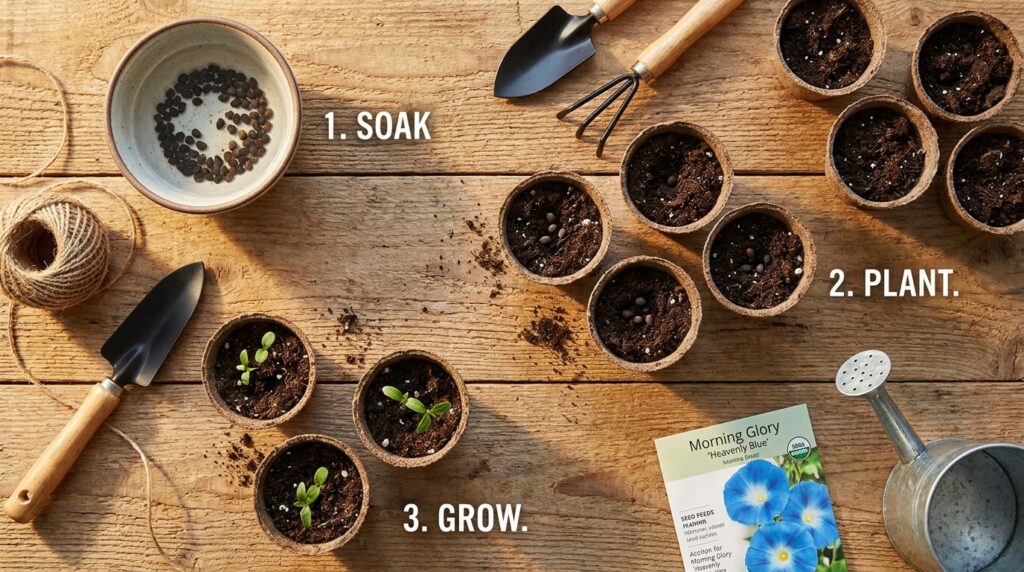
When to Plant
Morning glories are best planted directly outdoors after your last frost date, once soil temperatures have reached at least 65°F. In most temperate zones, that means late April through mid-May.
If you want to get a jump on the season, you can start seeds indoors 4–6 weeks before your last frost date, but morning glories don’t love being transplanted, so use biodegradable peat pots that go directly into the ground without disturbing the roots.
To find your specific last frost date, the Old Farmer’s Almanac frost date calculator is a reliable free resource.
What You’ll Need
- Morning glory seeds (fresh, or stored no more than 2–3 years)
- Warm water for soaking seeds
- Garden bed with well-draining soil, OR large containers
- Trellis, fence, or other climbing support
- Balanced slow-release fertilizer (low nitrogen)
- Watering can or garden hose with gentle spray
Step 1: Prepare the Seeds
Morning glory seeds have a hard seed coat that slows germination. Giving them a head start makes a real difference.
Soaking method: Place seeds in lukewarm water and soak for 24 hours before planting. You’ll notice them swell slightly — that’s the water breaking through the outer coat.
Nicking method (scarification): Use a nail file or sandpaper to gently scratch the seed coat on the rounded edge of the seed. Don’t cut too deep — just scuff the surface. This lets moisture reach the inner seed more quickly.
Either method works. Many gardeners do both.
Step 2: Prepare the Soil
Morning glories prefer moderately fertile, well-drained soil. Here’s the counterintuitive part: don’t over-enrich the soil. Soil that’s too rich in nitrogen produces lush, leafy vines with very few flowers. Morning glories actually perform better in slightly lean conditions.
If your soil is heavy clay or compacts easily, work in some compost or coarse sand to improve drainage — but skip the heavy fertilizing.
Ideal soil pH: 6.0–6.8 (slightly acidic to neutral). You can test your soil with an inexpensive soil pH test kit available at most garden centers.
Step 3: Plant the Seeds
Sow seeds ½ inch deep and 6 inches apart. If planting in rows (as along a fence), leave 12 inches between plants for good air circulation once they fill in.
If transplanting seedlings started indoors, make the transition gently. Harden them off over 7–10 days by setting them outside in a protected spot for a few hours each day before planting permanently.
Water gently after planting.
Step 4: Set Up Your Support
If you haven’t already, install your trellis, tie string or twine between fence posts, or ensure your fence structure is in place. Morning glories will need something to grab onto within the first few weeks of growth.
They climb by twining — wrapping their stems and leaf petioles around supports — so they need structures no wider than about ¾ inch in diameter (think wire, twine, or thin dowels) to grip effectively. They can’t cling to flat walls the way ivy does.
Growing Morning Glories: Full Care Guide
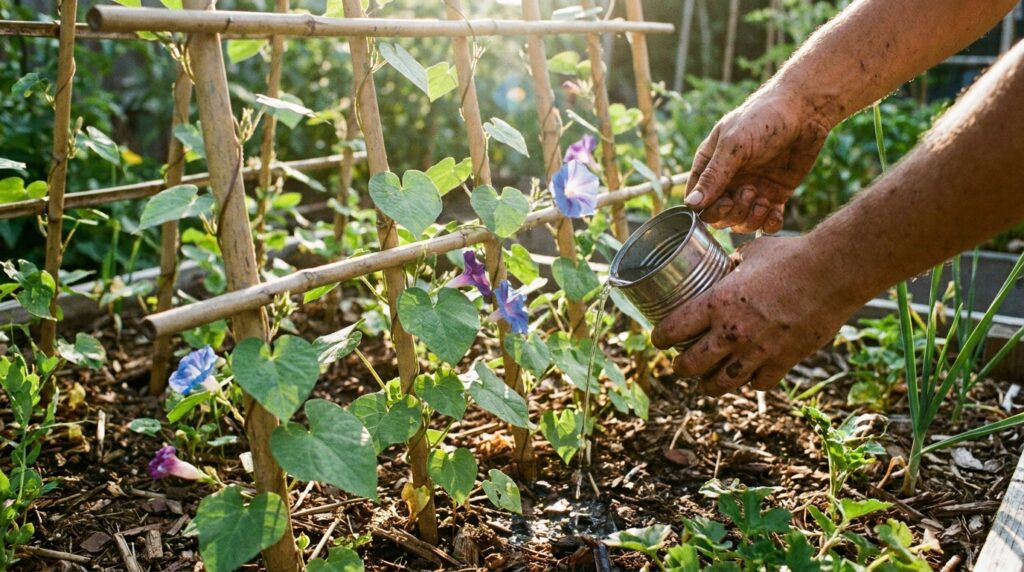
Watering
Morning glories like consistent moisture, especially when young. Once established, they’re surprisingly drought tolerant — but don’t let them dry out completely for extended periods.
General rule: Water when the top inch of soil feels dry. Deep, infrequent watering (about 1 inch per week) encourages deeper root growth and stronger plants compared to shallow daily watering.
During heat waves or periods of drought, increase watering frequency. Container-grown morning glories will need watering more often than those in the ground, as pots dry out faster.
Avoid wetting the foliage when possible, especially in the evening — this can encourage fungal diseases like powdery mildew.
How Long Do Morning Glories Take to Grow?
This is one of the most common questions, and the answer depends on what you mean by “grow.”
From seed to germination: With proper soaking and warm soil (above 65°F), seeds sprout in 5–7 days. In cooler or drier conditions, germination can take up to 14 days.
From planting to first bloom: Expect your first flowers approximately 60–90 days after planting from seed. This is weather-dependent — a warm, sunny summer pushes this toward the shorter end. Planting earlier with indoor starts can shave 2–4 weeks off this timeline.
Peak bloom period: Once blooming begins, plants typically peak from July through September in most growing regions, tapering off as nights cool in fall.
So if you plant seeds in mid-May, you can realistically expect flowers by mid-July to early August.
Fertilizing
Less is more when it comes to feeding morning glories.
Avoid high-nitrogen fertilizers — nitrogen boosts leafy green growth at the expense of flowers. A common mistake beginners make is giving their vines the same rich fertilizer they use on vegetables, then wondering why they get a wall of leaves and no blooms.
If your soil is very poor, a single application of balanced slow-release fertilizer (something like 5-10-5 NPK) at planting time is usually sufficient for the whole season.
If blooming is slow, a low-nitrogen bloom booster (like 2-10-10) in midsummer can help encourage flower production.
Deadheading and Pruning
Morning glories are not heavy-maintenance plants, but a little attention keeps them looking their best.
Deadheading (removing spent flowers before seed pods form) can extend the blooming period by redirecting the plant’s energy away from seed production. It’s not strictly necessary, but it helps.
If you want the plant to self-seed for next year, stop deadheading toward the end of the season and allow the seed pods to mature and dry naturally.
Pruning: If vines become unruly or are smothering neighboring plants, trim them back as needed. They recover quickly and won’t be harmed by cutting.
Morning Glory Plant Care: Pest & Disease Watch
Morning glories are generally quite pest-resistant, but a few problems can arise:
Aphids — Small clusters of soft-bodied insects on new growth. Control with a strong spray of water or insecticidal soap.
Spider mites — More common in dry, hot conditions. Look for fine webbing on the undersides of leaves. Increase humidity and moisture; use neem oil spray for heavy infestations.
Powdery mildew — A white powdery coating on leaves, more common in humid conditions or where air circulation is poor. Improve spacing between plants and avoid overhead watering. Penn State Extension has an excellent guide on powdery mildew management.
Leaf miners — Squiggly pale trails through the leaves. Mostly cosmetic; remove affected leaves and dispose of them.
Expert Tips: Getting the Most From Your Morning Glories
After years of growing these vines, seasoned gardeners have a few techniques that make a real difference.
1. Soak your seeds every time — no exceptions. The single biggest reason morning glory seeds fail to germinate or germinate slowly is a hard, intact seed coat. Even experienced gardeners who skip soaking often get spotty germination. Make soaking a non-negotiable step.
2. Don’t plant too early. Cold soil is the enemy. Morning glories planted in soil below 60°F germinate poorly and grow sluggishly. Waiting two extra weeks for soil to warm up pays dividends in faster, stronger establishment.
3. Keep soil slightly lean. As mentioned, overly rich soil pushes vegetative growth. If you have naturally fertile soil (like a well-amended raised bed), consider skipping fertilizer entirely and letting the plant work a little harder — it’ll bloom more.
4. Train the vines early. In the first few weeks of growth, gently guide young vines toward your support structure. Once they find something to twine around, they take off on their own. If you leave them to sprawl, they tangle and become a mess that’s hard to redirect.
5. Plant in succession. If you want continuous bloom from early summer through fall, make two or three plantings spaced 3–4 weeks apart. The second and third plantings will extend your flowering season even as the first planting finishes its peak.
6. Grow them from seed, not transplants. Morning glories have long taproots that don’t appreciate being disturbed. Unlike many flowering annuals, they perform significantly better when direct-seeded into the ground than when transplanted from pots.
7. Let some go to seed. If you love how your morning glories performed this year, let a few pods dry completely on the vine, then collect the seeds. Store them in a dry envelope over winter and plant next spring — they’ll come back true to the parent plant (especially with heirloom varieties).
Morning Glory Garden Design Ideas
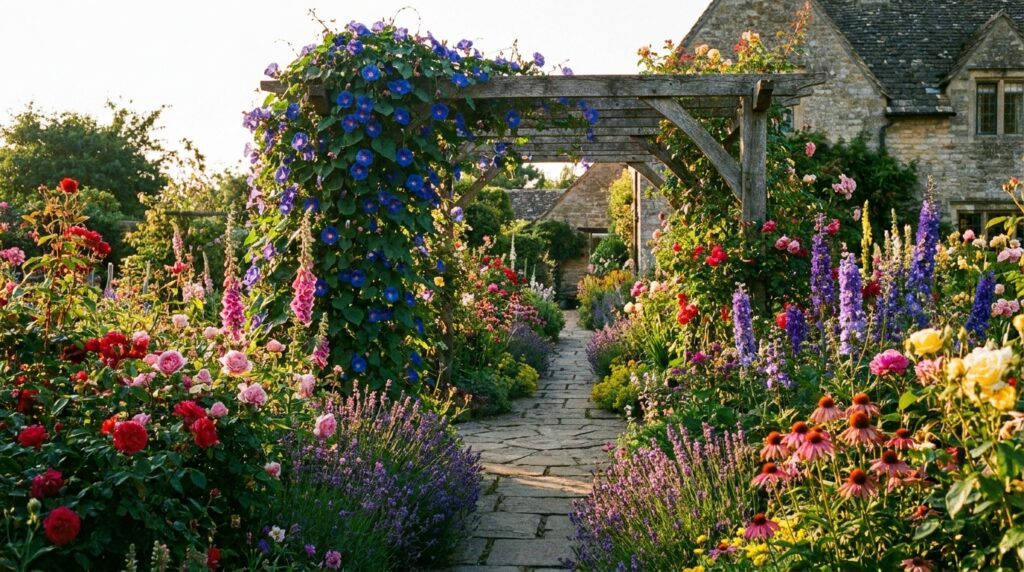
Morning glories are among the most versatile flowering vines for garden design. Here are some inspiring ways to use them:
Privacy Screens
Plant morning glories along a chain-link or wire fence in late spring. By midsummer, you’ll have a dense, flowering privacy screen that outperforms many expensive shrubs for seasonal coverage. They can easily cover a 6-foot fence in 8–10 weeks.
Vertical Gardens and Living Walls
In urban gardens or small spaces where ground planting is limited, grow morning glories in large containers against a wall with vertical wire or twine supports. This “living wall” approach works beautifully on apartment balconies, patios, and courtyards.
Pergola and Arbor Coverage
Train morning glories up pergola posts and across lattice tops for dappled shade and a floral canopy. Combine ‘Heavenly Blue’ (bright blue) with ‘Scarlett O’Hara’ (deep red) or white varieties for a dramatic multi-color overhead display.
Companion Planting
Morning glories make excellent companions for:
- Zinnias and marigolds — Same sun and water needs; contrasting colors at different heights
- Nasturtiums — Both thrive in lean soil; creates colorful low-to-high layering
- Black-eyed Susans — The warm gold and orange tones complement blue morning glories beautifully
- Moonflower (Ipomoea alba) — Plant alongside regular morning glories for round-the-clock blooms; morning glories open by day, moonflowers by night
Cottage Garden Style
In a loose, informal cottage garden, let morning glories scramble freely over fences and through shrubs. Combined with cosmos, foxglove, hollyhocks, and other tall cottage garden plants, they add a romantic, rambling quality that’s hard to replicate with other vines.
Collecting and Saving Morning Glory Seeds
One of the great pleasures of growing morning glories is how generously they reproduce. If you let even a handful of flowers go to seed, you’ll have more seeds than you can use.
When Are Seeds Ready?
Watch for flowers that have wilted and fallen off, leaving behind a small round pod. As the pod matures over 4–6 weeks, it will:
- Shift from green to tan or brown
- Dry and papery on the outside
- Begin to split open at the seams
When the pod is fully dry and starting to open, it’s ready to harvest.
How to Collect
Simply snap or snip the pods from the vine. If you’re collecting from multiple varieties, label them immediately — it’s easy to mix them up. Place the pods in a paper bag or envelope, not a sealed plastic bag (moisture causes mold).
Allow any pods that aren’t fully dry to continue drying in a warm, ventilated spot for another week before storing.
Storing the Seeds
Store seeds in a cool, dry, dark location — a drawer or closed cupboard indoors works well. Avoid the refrigerator, which can be too humid. Most morning glory seeds remain viable for 2–3 years if stored properly.
Label everything with the variety name and year collected.
Potential Issues: Is Morning Glory Invasive?
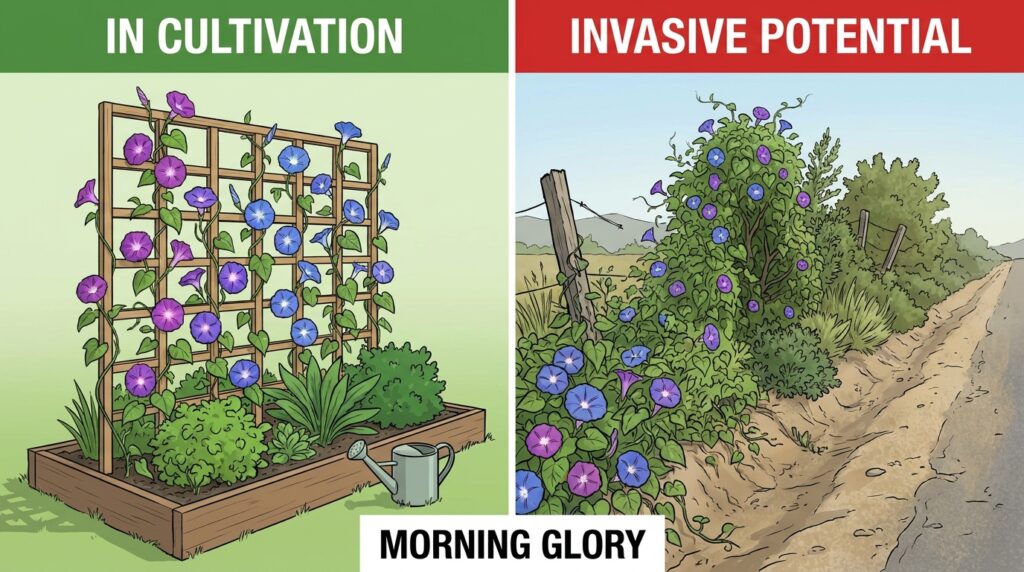
This is worth addressing honestly. Morning glories are enthusiastic self-seeders, and in some regions, that enthusiasm crosses into invasive territory.
The USDA’s invasive species database lists Ipomoea purpurea as invasive in several southeastern states, where it can escape cultivation and spread along roadsides, fields, and disturbed areas, outcompeting native vegetation.
To enjoy morning glories responsibly:
- Deadhead spent flowers before seed pods form if you’re near wild areas or natural habitats
- Choose sterile or less-aggressive cultivated varieties where available
- Collect seeds rather than letting them scatter freely
- Check with your local Cooperative Extension office to see if any varieties are of particular concern in your region
With a little mindfulness, you can enjoy their beauty without contributing to ecological problems.
Morning Glories in Containers: Everything You Need to Know
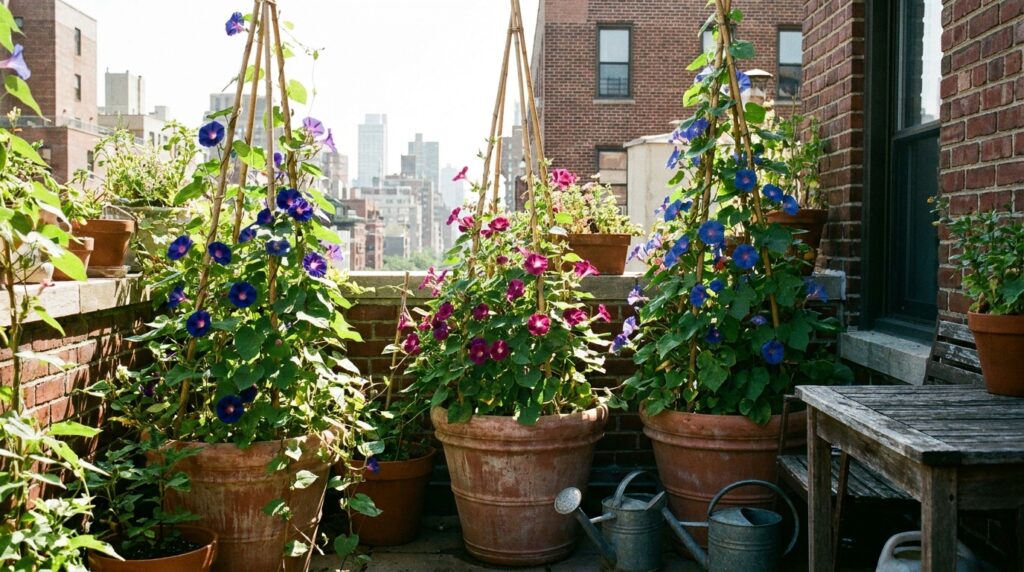
Don’t have garden beds? No problem. Morning glories grow beautifully in containers, making them ideal for apartment balconies, rooftop gardens, and paved patios.
Container Requirements
Size: Go big. Morning glories develop extensive root systems. Choose containers at least 12 inches deep and 12 inches wide per plant. Larger is better — a 5-gallon pot per plant is ideal.
Drainage: Ensure your container has drainage holes. Morning glories hate wet feet. If water sits in a saucer underneath, empty it after watering.
Potting mix: Use a good quality potting mix rather than garden soil (which compacts badly in containers). A standard all-purpose potting mix with some perlite added for extra drainage works well.
Support: Insert a bamboo tripod, wire cage, or small trellis into the pot at planting time, before the roots are established. Trying to add support later risks damaging the root system.
Container Care Differences
Container morning glories need more frequent watering than their in-ground counterparts — sometimes daily in hot weather. Check the soil every day and water when the top inch is dry.
They also benefit from a diluted liquid fertilizer every 3–4 weeks during the growing season, since frequent watering leaches nutrients from the potting mix faster than in garden beds.
Pros and Cons of Growing Morning Glories
Here’s an honest assessment to help you decide if morning glories are right for your garden:
| Pros | Cons |
|---|---|
| Extremely fast growth | Short bloom duration per flower (closes by afternoon) |
| Vibrant, prolific flowers | Can become invasive if not managed |
| Low maintenance once established | Mildly toxic if seeds ingested |
| Thrives in poor soil | Need reliable climbing support |
| Attracts pollinators (bees, hummingbirds) | Sensitive to transplanting; best direct sown |
| Self-seeds reliably year to year | Not deer-resistant |
| Great for covering unsightly fences | Can smother neighboring plants if unchecked |
A note on toxicity: Morning glory seeds contain compounds called ergine (d-lysergic acid amide), which are toxic if ingested in quantity. Keep them away from children and pets. The ASPCA’s toxic plant database lists morning glories as toxic to dogs, cats, and horses.
Pollinators and Wildlife: Morning Glories as Ecological Partners
Morning glories are excellent pollinator plants. Their large, funnel-shaped flowers are particularly attractive to:
- Bumblebees — The wide opening accommodates large bees that can access nectar efficiently
- Ruby-throated hummingbirds — Hummingbirds adore the tubular flower shape; red and pink varieties are especially attractive to them
- Hawk moths (sphinx moths) — These incredible insects hover like hummingbirds and visit flowers at dusk
- Monarch and swallowtail butterflies — Use morning glories as a nectar source during migration
If you’re interested in supporting pollinator populations in your garden, morning glories are a worthwhile addition. The Xerces Society for Invertebrate Conservation is a great resource for learning more about creating pollinator-friendly garden environments.
FAQs: Morning Glories
Are Morning Glories Annuals or Perennials?
Most morning glories are annuals that complete their life cycle in one growing season and die with the first frost. However, in USDA Hardiness Zones 10–12, where winters are frost-free, they can persist as tender perennials. In cooler zones, they reliably return each year through prolific self-seeding, which creates the impression of a perennial even though technically new plants sprout each spring.
How Long Do Morning Glories Take to Bloom?
After planting from seed (using the soaking technique), morning glories typically take 60 to 90 days to produce their first flowers. With warmer soil and ample sun, germination happens within 5–7 days, and the first blooms often appear by mid-to-late summer. Starting seeds indoors 4–6 weeks before the last frost date can move up the bloom timeline noticeably.
Do Morning Glories Prefer Full Sun or Shade?
Morning glories strongly prefer full sun — a minimum of 6 hours of direct sunlight daily, with 8 hours being ideal. In partial shade, they’ll produce primarily foliage with very few flowers. For best bloom performance, choose the sunniest spot available and ensure they face the morning sun, which triggers daily flower opening.
Why Are My Morning Glories Not Blooming?
Several factors can cause poor blooming:
- Too much shade — Move to a sunnier location or remove overhead obstacles
- Too much nitrogen — Overfertilizing (especially with high-nitrogen fertilizers) causes lush leaf growth and suppressed flowering. Switch to a bloom-boosting, low-nitrogen feed.
- Planted too late — Late planting means late blooming. In short-season climates, start seeds indoors earlier next year.
- Cool summer temperatures — Morning glories bloom best in warm weather. A cooler-than-normal summer will delay and reduce flowering.
- Root-bound containers — If growing in pots, make sure the container is large enough. Pot-bound plants stress easily and reduce flowering.
Are Morning Glory Seeds Poisonous?
Yes — morning glory seeds are mildly to moderately toxic if consumed in large quantities. They contain ergine (LSA), a naturally occurring compound. This is particularly a concern for children and pets. Ingestion can cause nausea, disorientation, and other symptoms. The ASPCA classifies morning glories as toxic to cats, dogs, and horses. If you suspect a child or pet has eaten morning glory seeds, contact Poison Control at 1-800-222-1222 or your veterinarian immediately.
Conclusion: Start Growing Morning Glories This Season
Few plants deliver the visual impact, ease of growing, and daily joy that morning glories do. From a handful of soaked seeds and a sunny fence to a spectacular summer-long show of color, the journey is as rewarding as the destination.
Here’s a quick recap of what you’ve learned:
- Morning glories are annuals in most zones, perennials only in Zones 10–12
- They self-seed prolifically, returning reliably year after year
- They need full sun, lean soil, and consistent moisture
- From seed to first bloom takes 60–90 days
- They thrive on fences, trellises, arbors, and in large containers
- Soak seeds for 24 hours before planting for best germination
- Don’t over-fertilize — lean soil produces more flowers
Whether you’re covering an unsightly fence, creating a pollinator haven, or just adding effortless color to your summer garden, morning glories earn their place every single year.
Ready to grow your own? Pick up a packet of heirloom morning glory seeds from a reputable source like Baker Creek Heirloom Seeds or Burpee, grab a spot in your sunniest garden bed, and get planting. Your future self — the one walking outside on a July morning to that wall of blue-purple trumpets — will thank you.

