

Introduction: Why Getting the Right Ceiling Fan Size Actually Matters
Picture this: You spend a weekend hunting for the perfect ceiling fan, finally find one you love, install it — and it looks comically small in your living room. Or worse, it’s so big it feels like a helicopter is about to land in your bedroom.
Sound familiar? You’re not alone. Picking the wrong fan size is one of the most common home improvement mistakes people make, and it’s almost always because no one told them the rules up front.
Here’s the good news: ceiling fan sizing is not complicated once you know what to look for. This guide will walk you through everything — from how to measure a ceiling fan to matching the right blade span to your room’s square footage. Whether you’re replacing an old fan or shopping for the first time, you’ll finish reading this knowing exactly what size you need.
Let’s start from the beginning.
What Does “Ceiling Fan Size” Actually Mean?
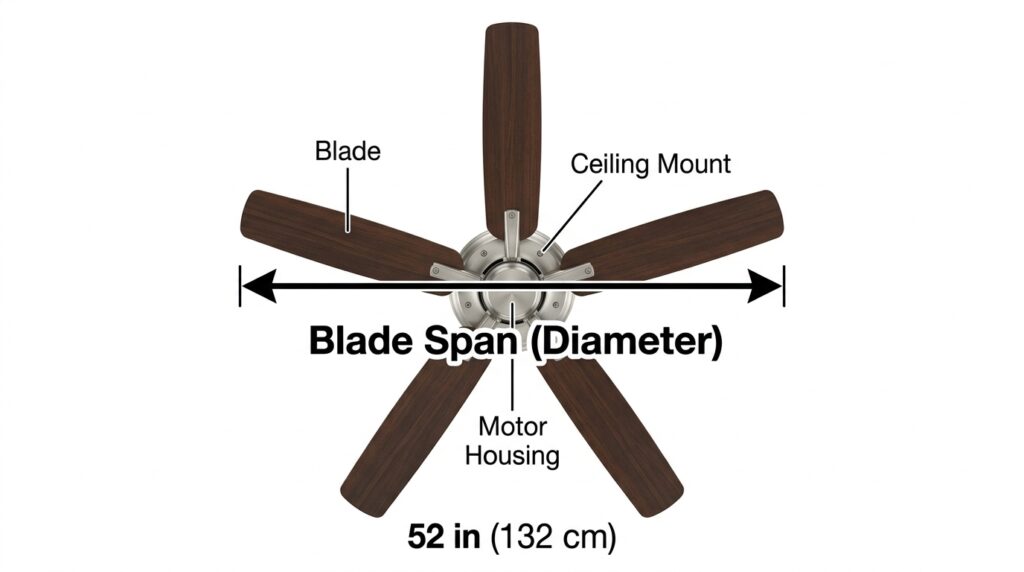
Before we get into numbers, it’s worth clearing up what “size” means when we’re talking about ceiling fans.
When manufacturers and retailers refer to ceiling fan sizes, they’re talking about the blade span — the diameter of the full circle traced by the rotating blades. It’s measured from the tip of one blade to the tip of the blade directly opposite it.
This measurement is given in inches, and it’s the single most important number when sizing a ceiling fan for a room.
Some people confuse blade span with blade length (the length of a single blade), which is only about half of the span. Others confuse it with the motor housing size or the overall fan width including light kits. Always look for the blade span or blade diameter when comparing fans.
Standard Ceiling Fan Sizes: The Full Breakdown
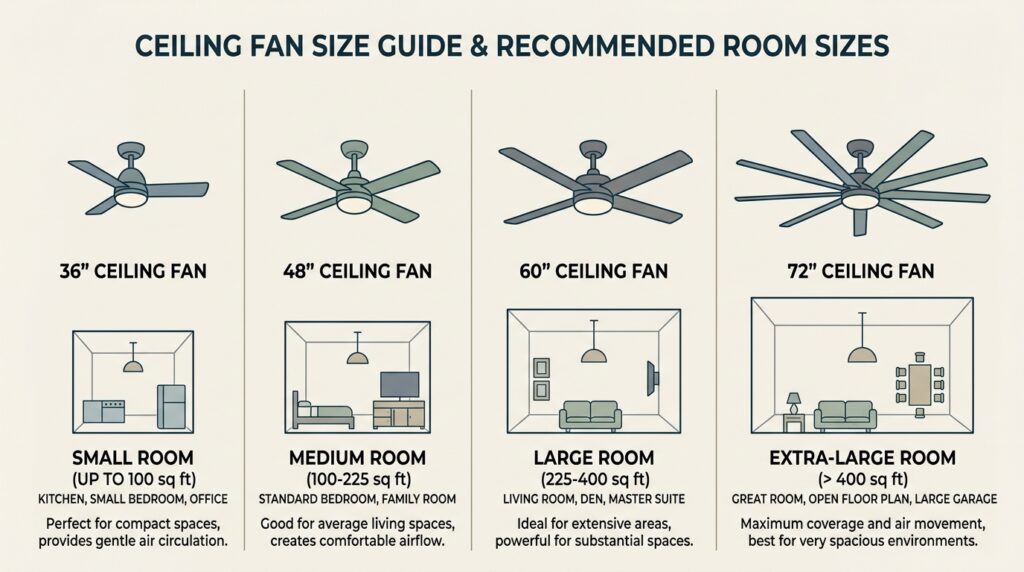
Ceiling fans come in a wide range of sizes. According to Energy Star, most residential fans fall between 42 and 60 inches in blade span. But the market actually offers everything from tiny 24-inch fans to massive 96-inch models for commercial spaces.
Here’s a look at the most common ceiling fan sizes you’ll find on the market:
| Blade Span | Room Type | Room Size |
|---|---|---|
| 24–36 inches | Small rooms, hallways, bathrooms | Up to 75 sq ft |
| 42–44 inches | Small bedrooms, kitchens | 76–144 sq ft |
| 48–54 inches | Medium bedrooms, offices | 145–225 sq ft |
| 56–60 inches | Large living rooms, master bedrooms | 226–400 sq ft |
| 62–72 inches | Open-plan spaces, great rooms | 400–600 sq ft |
| 84–96 inches | Commercial, large open spaces | 600+ sq ft |
These ranges are a general guide. The exact size you need also depends on ceiling height, room shape, and airflow needs — all of which we’ll cover below.
How to Measure a Ceiling Fan (For Existing Fans)
If you already have a fan installed and want to know its size — maybe to replace it or buy a matching one — measuring it is straightforward.
Step-by-Step: How to Measure an Existing Ceiling Fan
Step 1: Count the blades. Fans can have anywhere from 2 to 9 blades. This matters for the measurement method.
Step 2: For fans with an even number of blades: Use a tape measure to measure from the tip of one blade to the tip of the blade directly across from it. That’s your blade span.
Step 3: For fans with an odd number of blades: You can’t measure tip-to-tip directly. Instead, measure from the center of the fan motor (the hub) to the tip of one blade, then double that number.
Example: If the center-to-tip measurement is 26 inches, the blade span is 52 inches.
Step 4: Check your measurement. Most fans are manufactured in standard sizes (42″, 44″, 48″, 52″, 54″, 60″). If your measurement comes out to something like 53.5 inches, it’s most likely a 54-inch fan. Blade tips can warp slightly over time.
That’s it. No tools needed beyond a tape measure. According to The Home Depot’s fan buying guide, knowing your existing blade span is the fastest way to find a compatible replacement.
How to Size a Ceiling Fan for a Room (New Installations)
Now for the most important part: figuring out what size fan you need for a room you’re furnishing or renovating.
The primary factor is always room size (square footage). Here’s how to think about it:
Step 1: Measure Your Room
Measure the length and width of the room in feet, then multiply them together to get square footage.
Example: A room that’s 12 feet long × 14 feet wide = 168 sq ft
Based on the table above, that room falls in the 145–225 sq ft category, so a 48–54 inch fan would be ideal.
Step 2: Account for Room Shape
Square and rectangular rooms are easy to size using the table. But L-shaped or open-plan spaces need a different approach.
For open-plan areas over 400 sq ft, you often have two choices:
- One large fan (62–72 inches)
- Two or more medium fans (48–54 inches) spaced evenly
Multiple fans usually provide better airflow distribution than a single oversized one, especially in rooms over 600 sq ft. The American Lighting Association recommends positioning multiple fans so each one covers its own zone rather than relying on one fan to circulate air across a very wide space.
Step 3: Consider Ceiling Height
Ceiling height affects both safety clearance and airflow efficiency.
- Standard ceilings (8–9 feet): Use a flush-mount (hugger) fan with no downrod
- Medium ceilings (9–10 feet): Use a short downrod (3–6 inches)
- High ceilings (10–12+ feet): Use a longer downrod (12–24 inches or more)
The U.S. Consumer Product Safety Commission recommends that fan blades be at least 7 feet above the floor for safety. On a standard 8-foot ceiling, this means you need a fan with a low-profile mounting option.
Fan Size for Room Size: A Practical Room-by-Room Guide

Let’s get specific. Here’s how ceiling fan sizing works out for the most common rooms in a home.
Bathroom or Small Hallway (Up to 75 sq ft)
Small spaces call for compact fans. A 24–36 inch fan works well here. In bathrooms, make sure the fan is UL-rated for damp or wet locations depending on how close it is to a shower or tub.
Kitchen (75–175 sq ft)

Kitchens tend to have grease and moisture in the air, so look for easy-to-clean blades and a motor that can handle slightly harsher conditions. A 42–48 inch fan is right for most kitchen sizes. Avoid fabric-wrapped blades in cooking areas — flat ABS or wood blades are easier to wipe down.
Bedroom (100–200 sq ft)

The bedroom is where you’ll feel the fan the most — both for cooling and for noise. A quiet, energy-efficient model matters here. For a standard 10×12 bedroom (120 sq ft), a 42–48 inch fan is perfect. For a larger master bedroom (14×16 or bigger), step up to 52–56 inches.
Look for fans with a DC motor, which run significantly quieter and use less energy than traditional AC motors. Energy Star certified ceiling fans use about 60% less energy than standard models — a real difference over months of nightly use.
Living Room (200–350 sq ft)
The living room is often the most visible space in the home, so aesthetics matter as much as function. Most living rooms in the 200–300 sq ft range do well with a 52–60 inch fan. If you have a grand or two-story living space, consider going up to 72 inches.
Pay attention to the room’s décor style. Modern farmhouse interiors pair well with distressed wood blades; mid-century rooms look great with retro-style fans; minimalist spaces work best with sleek matte finishes.
Open-Plan Great Room (400+ sq ft)
Open concept living spaces are increasingly common, and they’re one of the trickier situations for ceiling fan sizing. A single 60-inch fan won’t adequately circulate air through a 500 sq ft open area.
Options include:
- One 72–84 inch fan positioned centrally
- Two 52–60 inch fans positioned in two activity zones (seating area + dining area)
For homes with vaulted ceilings over an open-plan area, a fan with an angled mounting kit (called a sloped ceiling adapter) may be required. Many fans include this in the box; check the product description before purchasing.
How Are Ceiling Fans Measured?
A few common questions come up around measurement that are worth addressing directly.
Is ceiling fan size measured with or without the blades? Always with the blades. The blade span is the standard measurement used across the industry, and it’s what you’ll see listed in product specs.
Does blade count affect the size? No — blade count doesn’t change the blade span. A 52-inch fan with 3 blades and a 52-inch fan with 5 blades cover the same diameter. However, more blades can affect airflow efficiency and noise levels.
Are blade length and blade span the same thing? No. Blade length is roughly half the blade span (the length of one blade from tip to root). Blade span is the full diameter. Always look for blade span when sizing.
What if my room is not square? Calculate the total square footage as accurately as you can. For oddly shaped rooms, break the space into rectangular sections, calculate each, and add them together.
Ceiling Fan Sizing for Outdoor Spaces
Outdoor fans follow the same blade-span-to-square-footage logic, but with added considerations:
- Covered porches and patios: Use fans rated for damp locations
- Pergolas and open-air areas: Use fans rated for wet locations
- Breezy coastal or rainy regions: Wet-rated fans with marine-grade construction are worth the investment
Outdoor spaces are often underestimated in square footage. A 12×20 covered porch is 240 sq ft — that needs at least a 52–56 inch fan, not the small 42-inch model many people default to for outdoor use.
According to Minka-Aire, a well-known ceiling fan manufacturer, outdoor airflow needs can be up to 20% higher than indoor equivalents because of natural air movement reducing the perceived effect of the fan.
CFM: The Airflow Metric You Shouldn’t Ignore
Blade span tells you how big a fan is. CFM (cubic feet per minute) tells you how much air it actually moves. These aren’t the same thing, and bigger isn’t always better.
A large fan with cheap blades at a low pitch might move less air than a well-designed smaller fan. When comparing fans, look at both the blade span and the CFM rating.
Here are general CFM targets by room type:
| Room Size | Recommended CFM |
|---|---|
| Up to 75 sq ft | 1,000–3,000 CFM |
| 75–144 sq ft | 1,500–4,000 CFM |
| 144–225 sq ft | 3,000–6,000 CFM |
| 225–400 sq ft | 5,000–9,000 CFM |
| 400–600 sq ft | 7,000–12,000 CFM |
The American Society of Heating, Refrigerating and Air-Conditioning Engineers (ASHRAE) notes that effective air circulation — not just raw CFM — is what matters most. A fan’s blade pitch (the angle of the blades) is one of the biggest factors in airflow efficiency. Most quality fans have blade pitches between 12–15 degrees.
Energy Efficiency and Ceiling Fan Size
Choosing the right size fan isn’t just about comfort — it has real energy implications.
An oversized fan running at a lower speed can move more air than an undersized fan at full blast. This is more energy-efficient. A fan that’s too small for a room forces you to run it at higher speeds constantly, which increases energy consumption and motor wear.
According to Energy Star, properly sized and used ceiling fans can allow you to raise your thermostat setting by about 4°F with no reduction in comfort — potentially reducing cooling costs meaningfully over a summer.
Key energy efficiency tips:
- Choose a DC motor fan — uses up to 70% less electricity than AC motors
- Use the right speed for the season — counter-clockwise in summer (downward airflow), clockwise in winter (upward, recirculates warm air)
- Don’t leave fans running in empty rooms — fans cool people, not rooms; they don’t lower the ambient temperature
What Size Ceiling Fan Do I Need? (The Quick Decision Tool)
Still not sure? Use this quick decision matrix:
Room under 75 sq ft → 24–36 inch fan
Room 75–144 sq ft → 42–44 inch fan
Room 144–225 sq ft → 48–54 inch fan
Room 225–400 sq ft → 56–60 inch fan
Room 400–600 sq ft → 62–72 inch fan or two 52-inch fans
Room over 600 sq ft → Multiple fans or 84–96 inch commercial fan
And remember: when in doubt between two sizes, go slightly larger. It’s better to have a fan that’s a touch big for the space than one that’s too small and underperforms.
Expert Tips: Getting the Most From Your Ceiling Fan
Here are a few things the pros know that most buyers overlook:
1. Motor quality matters more than blade count. Five cheap blades won’t outperform three quality blades on a high-torque motor. Hunter Fan Company, one of the oldest ceiling fan brands in the industry, notes that motor quality is the most direct predictor of long-term performance and quiet operation.
2. Don’t ignore blade pitch. A blade pitch of at least 12 degrees is considered the functional minimum for efficient airflow. Many budget fans ship with pitches as low as 8–10 degrees, which significantly reduces effectiveness.
3. Consider a fan with a remote or smart controls. Modern fans with smart home compatibility (works with Google Home or Amazon Alexa) make it easy to adjust speed and lighting without getting up, which actually encourages more consistent, efficient use.
4. Sloped ceilings need special attention. If your ceiling pitch is greater than 12 degrees, you’ll need a fan with a sloped ceiling adapter. Many fans include these, but confirm before buying. Running a fan on a sloped ceiling without the adapter can damage the motor over time.
5. Check the blade-to-ceiling clearance. The National Electrical Code (NFPA 70) recommends that fan blades be at least 7 feet above the floor and at least 18 inches from any wall. Always confirm these clearances before mounting.
Common Ceiling Fan Sizing Mistakes to Avoid
Even with a guide in hand, people still make a few recurring mistakes:
Mistake #1: Choosing based on looks alone. A fan might look beautiful in the showroom, but if it’s 42 inches in your 280 sq ft living room, it’ll look like a ceiling light with blades. Always size first, then shop for style within that size range.
Mistake #2: Not accounting for furniture arrangement. The fan doesn’t just need to fit the room — it needs to circulate air over the areas where people sit or sleep. Position the fan centrally over the primary seating or sleeping area, not necessarily in the geometric center of the room.
Mistake #3: Ignoring ceiling height on low ceilings. On an 8-foot ceiling, a fan with a 12-inch downrod drops the blades dangerously close to head level. Always choose a flush-mount (hugger) fan for standard-height ceilings.
Mistake #4: Buying the cheapest option in the right size. A correctly sized, poorly built fan will wobble, make noise, and wear out quickly. Read reviews, look for quality brands, and treat a ceiling fan as a multi-year investment.
Mistake #5: Skipping the CFM check. Two fans with the same blade span can have wildly different CFM ratings. Always compare CFM alongside blade span.
Ceiling Fan Size vs. Room Size: Pros and Cons Summary
Going Larger Than Recommended
| Pros | Cons |
|---|---|
| Better airflow at lower speeds | Can look out of place visually |
| More efficient at the right speed | May require higher ceilings |
| Covers more area | Higher upfront cost |
Going Smaller Than Recommended
| Pros | Cons |
|---|---|
| Lower cost | Runs at higher speeds constantly |
| Works for low ceilings | Less effective airflow coverage |
| More style options in smaller sizes | Motor wears out faster |
Frequently Asked Questions
1. What size ceiling fan do I need for a 12×12 room?
A 12×12 room is 144 sq ft, which places it right at the top of the small-to-medium category. A 42–48 inch ceiling fan is the right choice here. A 44-inch fan is often cited as the standard bedroom fan for exactly this room size.
2. How do you measure for a ceiling fan in a new room?
Measure the length and width of the room in feet and multiply them to get square footage. Then use the blade span chart to find the appropriate fan diameter. Also note your ceiling height to determine whether you need a flush mount, short downrod, or extended downrod.
3. Can a ceiling fan be too big for a room?
Yes. An oversized fan can create uncomfortable airflow that feels like a wind tunnel, and it often looks visually awkward — especially in low-ceilinged rooms. Stick to the recommended blade span for your room’s square footage.
4. How are ceiling fans measured — by blade span or motor size?
Ceiling fans are officially measured and labeled by blade span (the full diameter from tip to tip). Motor size is a separate spec and doesn’t determine the fan’s physical size category.
5. What is the standard ceiling fan size for a bedroom?
The most common standard ceiling fan size for a typical 10×12 or 12×12 bedroom is 42–52 inches. For a smaller guest bedroom, 42 inches works well. For a larger master bedroom (14×16 or bigger), 52–56 inches is more appropriate.
Conclusion:
Getting the ceiling fan size right from the beginning saves you time, money, and frustration. The math is simple — measure your room, check the blade span chart, and account for ceiling height. That’s really all there is to it.
A correctly sized fan doesn’t just look better. It runs more quietly, moves air more effectively, uses less energy, and lasts longer. Whether you’re outfitting a cozy bedroom, a busy kitchen, or a sprawling open-plan living area, there’s a fan that’s exactly right for your space.
Now that you know how to measure a ceiling fan, how ceiling fans are sized, and what size you actually need — you’re ready to shop with confidence.
Ready to find your fan? Start with your room’s square footage, pick a blade span from the guide above, and then choose the style that fits your space. If you’re still unsure, bring your measurements to a lighting or home improvement specialist who can point you to the right models in your size range.

