
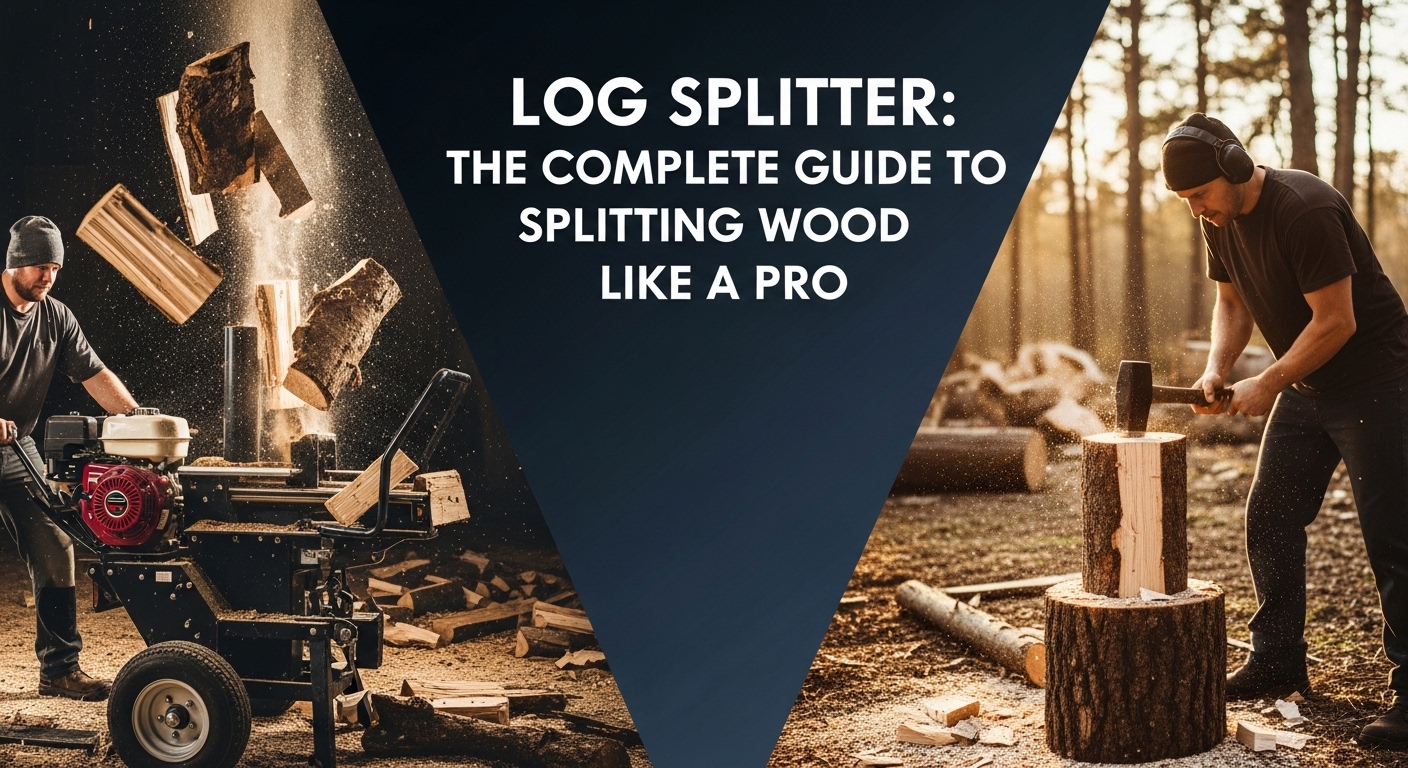
Whether you’re heating your home through winter or stocking up for campfire season, knowing how to split wood efficiently can save you hours of backbreaking labor — and a lot of money.
Why Splitting Wood the Right Way Actually Matters
Picture this: It’s October, the temperatures are dropping, and your woodpile looks embarrassingly thin. You’ve got a cord of unsplit logs sitting in the backyard, a splitting maul, and absolutely no idea where to start. Sound familiar?
Splitting firewood is one of those skills that looks simple until you’re standing in front of a stubborn, knotty oak round wondering why your maul bounced back at you for the third time. The truth is, there’s real technique involved — and the right equipment makes all the difference.
This guide covers everything from choosing the best log splitter for your needs to mastering the technique of splitting wood by hand. Whether you’re a first-timer or someone who’s been doing it the old-fashioned way for years, you’ll walk away with practical knowledge you can use right now.
Let’s get into it.
What Is a Log Splitter (and Do You Actually Need One)?
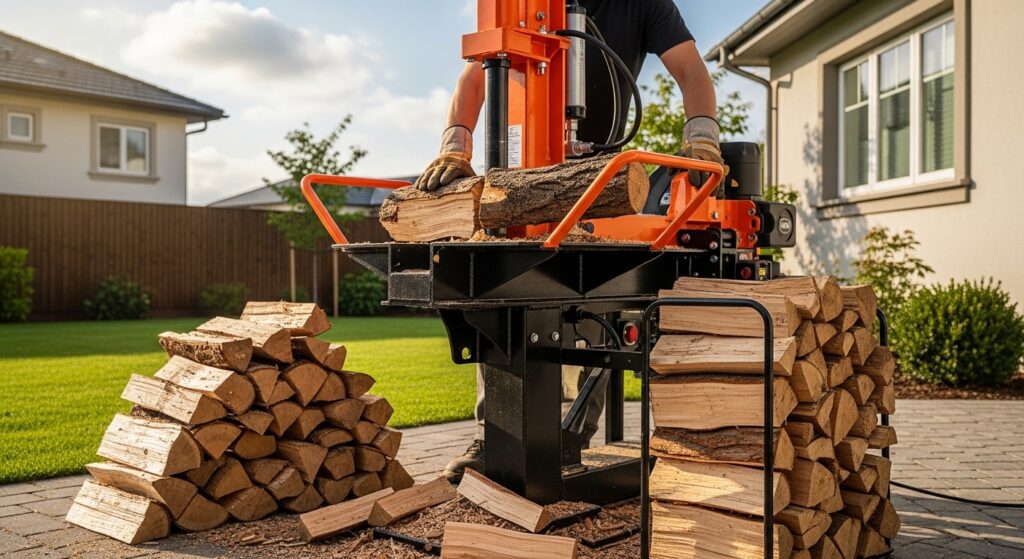
A log splitter is a machine designed to split logs into firewood-sized pieces using hydraulic pressure, kinetic energy, or manual force. Instead of swinging a maul repeatedly, a log splitter applies controlled, enormous force to crack logs along their grain — with far less physical effort.
Log splitters come in several core types:
- Hydraulic log splitters – The most common type. Uses hydraulic pressure (measured in tons) to drive a wedge through wood. Available in gas-powered, electric, and tractor-powered (3-point hitch) models.
- Kinetic (flywheel) log splitters – Use spinning flywheels to build up energy and release it rapidly. Extremely fast — can split a log in under 2 seconds.
- Manual/hand log splitters – A step up from a maul. These stand-alone devices use a slide mechanism to split smaller-diameter wood without electricity or gas.
- Wall log splitters – A wall-mounted design with a lever mechanism, ideal for splitting smaller pieces against a fixed surface. Great for kindling and smaller diameter wood.
Do You Actually Need One?
If you’re splitting fewer than half a cord of wood per season and the logs are relatively straight-grained, a quality splitting maul and some technique might be all you need.
But if you’re regularly processing a full cord or more, dealing with large-diameter rounds, or have physical limitations that make hand-splitting difficult, a log splitter pays for itself quickly — both in time saved and in your back’s long-term health.
When to Split Firewood: Timing Is Everything
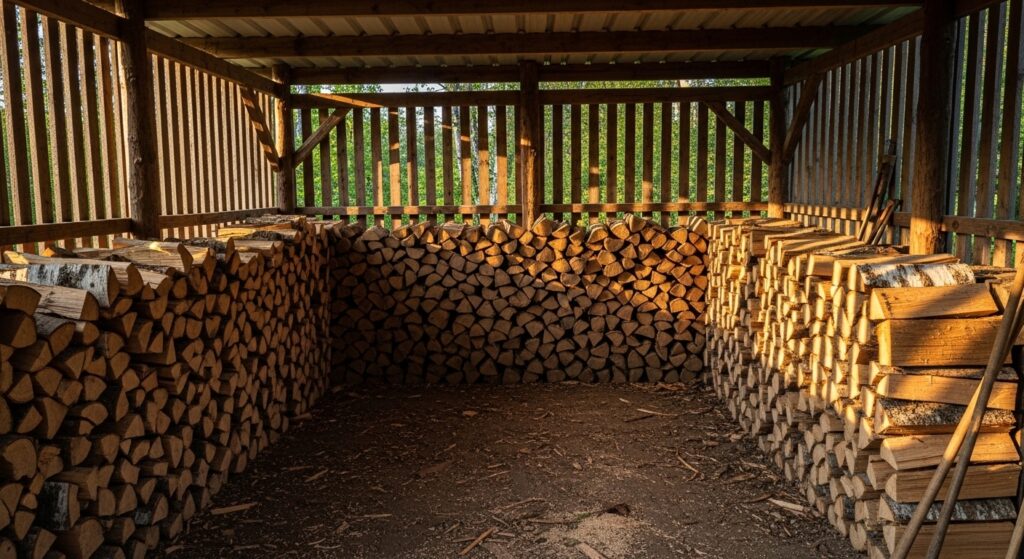
One of the most common questions beginners ask is: when should I split firewood?
The short answer: as early as possible.
Freshly cut (green) wood contains a high moisture content — often 40–60% by weight according to the U.S. Forest Service. To burn efficiently in a fireplace or wood stove, firewood needs to be dried (seasoned) down to below 20% moisture content. This process takes time — typically 6 to 12 months for most hardwoods when stored correctly.
Here’s a practical seasonal guide:
| Season | Action |
|---|---|
| Late Winter / Early Spring | Ideal time to cut and split — wood has lower sap pressure |
| Spring / Summer | Split and stack with good airflow — long drying season ahead |
| Early Fall | Last chance for adequate drying before winter |
| Winter | Burn seasoned wood; plan next year’s supply |
Pro Tip: Split wood dries much faster than whole rounds. The exposed grain surface dramatically increases the surface area for moisture evaporation. Splitting a log in half can cut drying time by 30–40% compared to leaving it whole.
For checking moisture levels accurately, a wood moisture meter (available at most hardware stores) is a worthwhile investment — Delmhorst and Wagner Meters make reliable options used by firewood processors.
Splitting Wood by Hand: Tools, Technique & Safety
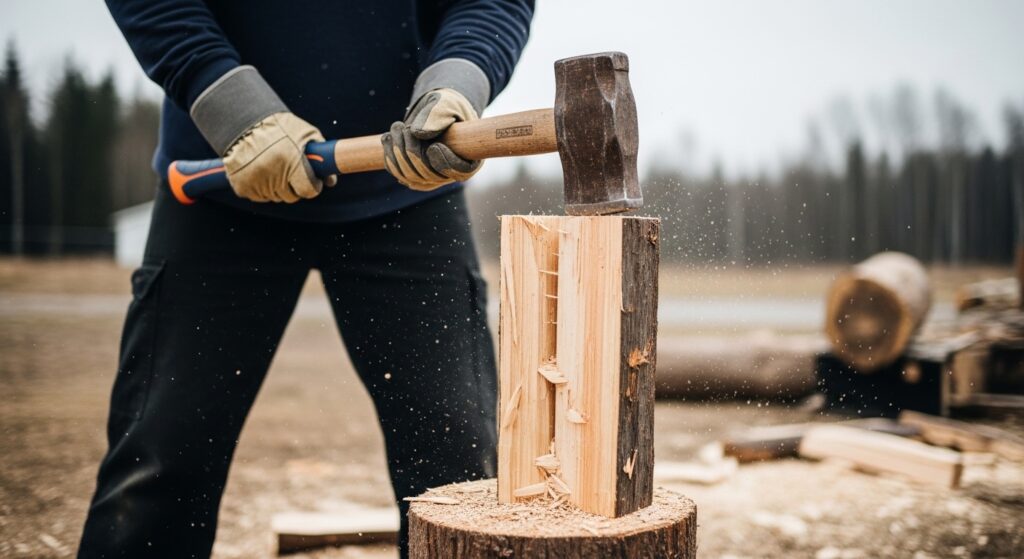
There’s something genuinely satisfying about splitting wood by hand. It’s a workout, a skill, and a deeply old-fashioned self-reliance practice. But doing it wrong leads to exhaustion, wasted effort, and potential injury.
The Core Tools for Splitting Wood by Hand
1. The Splitting Maul
A splitting maul is the primary tool for hand-splitting wood. It differs from a regular axe in critical ways:
- Heavier head – Typically 6–8 lbs (some up to 12 lbs), providing downward momentum
- Wider, wedge-shaped head – Designed to push wood fibers apart rather than cut through them
- Longer handle – Usually 28–36 inches for swing leverage
Understanding how to use a maul to split wood properly is the single biggest factor in whether hand-splitting feels hard or easy.
How to use a splitting maul correctly:
- Stand with feet shoulder-width apart, dominant foot slightly back
- Place the log on the chopping block, centered and stable
- Grip the maul with your dominant hand near the head, non-dominant hand at the base
- Raise the maul overhead, letting your dominant hand slide to meet your base hand
- Drive the maul down along the wood grain — aim for cracks or the edge of the log, not the center
- Let the weight do the work; don’t muscle it down
The most common beginner mistake is trying to chop wood like you’re cutting it with an axe. A maul splits — it doesn’t cut. You want a controlled, committed swing that uses gravity and momentum, not pure arm strength.
2. The Chopping Block (Wood Splitting Base)
Your chopping block for wood splitting matters more than most people realize. A proper splitting base:
- Raises the log to a comfortable working height (reduces back strain)
- Provides a stable, non-bouncing platform
- Absorbs the maul strike without damaging the tool edge
The best chopping block is a large, dense hardwood round — typically 18–24 inches in diameter and 16–20 inches tall. Elm, oak, and similar cross-grained hardwoods work well because they resist splitting themselves.
Place your chopping block on level ground. If it moves during use, secure it against a heavy object or dig it slightly into the ground.
3. Splitting Wedges
For stubborn logs that resist a maul, a steel splitting wedge driven with a sledgehammer is your best friend. Drive the wedge into a crack or the center of the log, then hammer it in to force the wood apart.
You can use two wedges simultaneously for especially large rounds.
The Easy Way to Split Firewood by Hand
Here are the techniques that experienced wood-splitters use to make the job dramatically easier:
Split the outside first. Don’t aim for the dead center of a log on your first swing. Instead, aim for the edge — splitting off slabs from the outside first weakens the log’s structure and makes the center easier.
Read the grain. Look at the end of the log. Cracks (checks) that form as the log dries are natural splitting lines. Hit those first.
Avoid knots. Wood fibers around a knot run in multiple directions, making them nearly impossible to split through. Aim to split around knots, not through them.
Cold wood splits easier. If you live in a region that gets freezing temperatures, splitting in winter is often easier — frozen wood is more brittle and cracks more readily along the grain.
Types of Log Splitters: Which One Is Right for You?
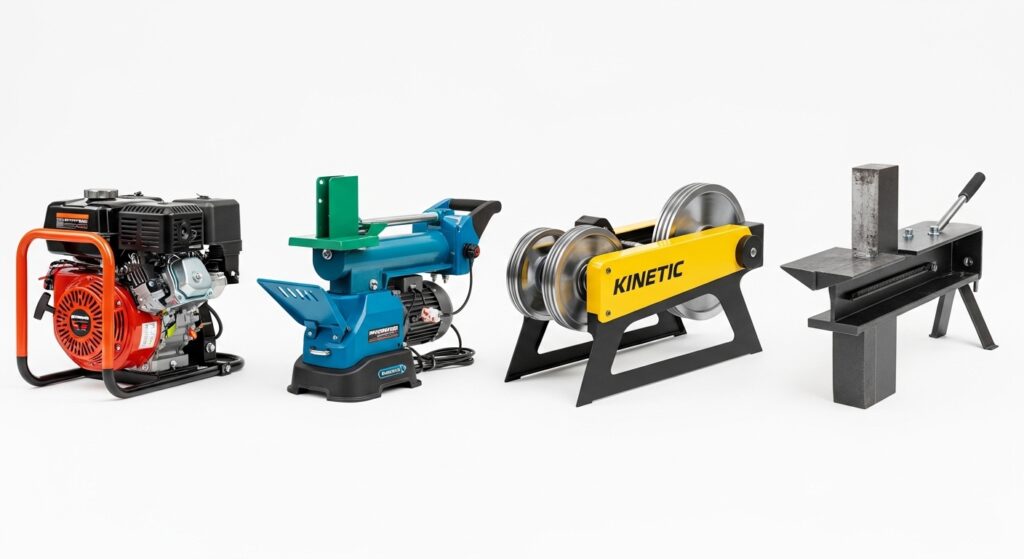
Choosing the right log splitter comes down to three factors: volume of wood, portability needs, and budget. Here’s a full breakdown.
Gas-Powered Log Splitters
Best for: High-volume splitting, remote locations, large-diameter logs
Gas splitters are the workhorses of the firewood world. Running on standard gasoline engines (typically 4-stroke), they generate 20–37 tons of splitting force and can handle logs up to 24–30 inches in length.
Pros:
- Maximum power — handles the biggest, gnarliest logs
- No power outlet needed — fully portable
- Can be used continuously for hours
Cons:
- Noisy (85–95 dB)
- Requires regular engine maintenance (oil changes, spark plugs)
- Heavier and bulkier — typically 300–700 lbs
- Higher purchase price ($800–$3,000+)
Top-rated brands include Boss Industrial, and NorthStar.
Electric Log Splitters
Best for: Homeowners, moderate volume, residential use
Electric log splitters have become dramatically more capable in recent years. Modern models generate 4–10 tons of force, sufficient for most standard firewood rounds up to 20 inches in diameter.
Pros:
- Quiet operation (indoor/outdoor use)
- No exhaust fumes — can be used in enclosed spaces
- Low maintenance — no engine oil, carb cleaning, etc.
- Lower cost ($200–$800)
- Lighter and easier to move
Cons:
- Requires access to an electrical outlet (or long extension cord)
- Less powerful than gas — struggles with large or knotty hardwood
- Cord length limits portability
The WEN 56207 electric log splitter and the Sun Joe LJ10M are popular entry-level options with solid reputations for homeowner use.
Kinetic Log Splitters
Best for: High-speed splitting, commercial firewood operations
Kinetic splitters use flywheel energy rather than hydraulic pressure. They’re extraordinarily fast — cycling in under 2 seconds in some models — but are generally more expensive.
Pros:
- Incredibly fast split cycle
- No hydraulic fluid to maintain
- Handles large rounds effectively
Cons:
- Higher price point ($1,500–$5,000)
- Larger footprint
- Overkill for typical homeowner use
Manual / Hand Log Splitters
Best for: Kindling, small rounds, occasional use
Manual log splitters are essentially standalone wedge-and-lever devices. You place a log in the machine and pull a lever to drive a blade through the wood. No electricity, no gas.
Pros:
- Very affordable ($50–$200)
- Silent operation
- Virtually zero maintenance
Cons:
- Limited to smaller-diameter logs (typically under 10 inches)
- Slower than powered options
- Not suitable for large firewood processing
Wall Log Splitter
A wall log splitter is a space-saving, lever-operated design typically mounted to a wall or sturdy post. The operator places a log into the mechanism and uses a handle to drive the splitting blade down.
These are popular in Europe (particularly Scandinavia) and are gaining traction for homeowners who want a quiet, low-maintenance option for splitting smaller pieces and kindling. Brands like Kindling Cracker offer cast iron versions that have become extremely popular.
How to Use a Log Splitter Safely: Step-by-Step
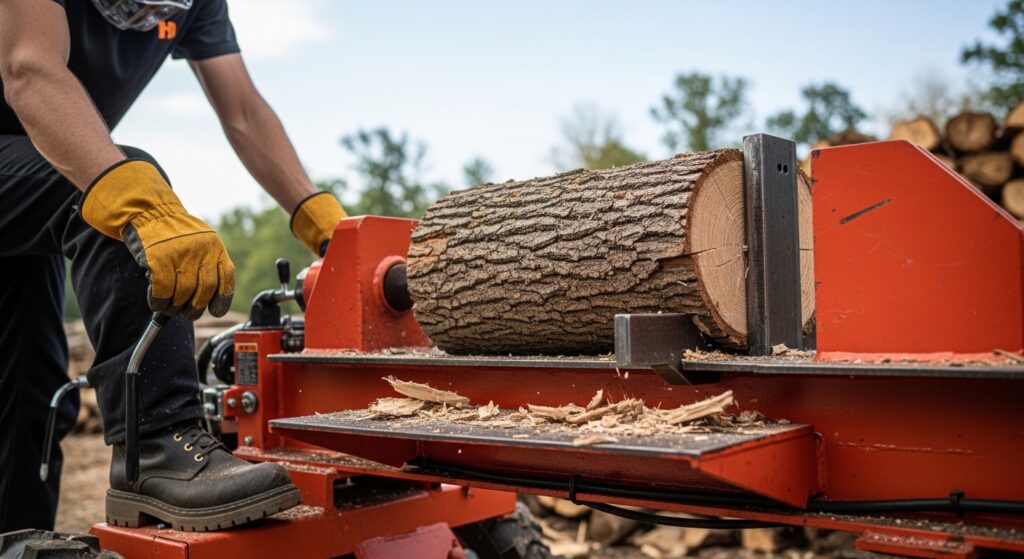
Safety should be your first consideration when operating any log splitter — mechanical or manual. The U.S. Consumer Product Safety Commission (CPSC) records thousands of equipment-related injuries annually, and log splitters account for a meaningful share of those incidents.
Pre-Operation Safety Checklist
- Wear safety glasses at all times — wood chips and bark fragments can fly unpredictably
- Use heavy leather work gloves — protects against splinters and pinch points
- Wear steel-toed boots — logs can roll or fall at any moment
- Keep bystanders and children well away from the splitting area
- Never place your hands near the beam or wedge while the machine is cycling
- Inspect hydraulic hoses and fittings for leaks before each use
- Ensure the log splitter is on stable, level ground before operating
Operating a Hydraulic Log Splitter: Step-by-Step
- Set the splitter to the correct position. Most horizontal/vertical combo splitters work horizontally for smaller logs and vertically for heavy rounds (lifting large rounds onto a horizontal beam is unsafe).
- Start the engine or plug in the electric unit. Allow a gas engine to warm up for 30–60 seconds.
- Place the log on the beam. Position it flat against the end plate, centered on the beam.
- Engage the control valve. Push the lever to advance the wedge into the wood. Keep both hands on the handle — never reach toward the splitting zone.
- Allow the split to complete. Let hydraulic pressure do the work. If the log doesn’t split fully, retract the ram and reposition before trying again.
- Clear split pieces before the next cycle. Remove all wood before advancing the ram again.
- Shut down properly. Release all hydraulic pressure, turn off the engine, and engage any safety locks before walking away.
Common Mistakes to Avoid
- Never split a wet or unsupported log — it can shift and bind the wedge
- Don’t overdrive the ram into a stuck log repeatedly — let the pressure work slowly
- Never operate with one hand while loading with the other
- Don’t use the log splitter as a work table or step
The Best Way to Split Firewood: Choosing the Right Method
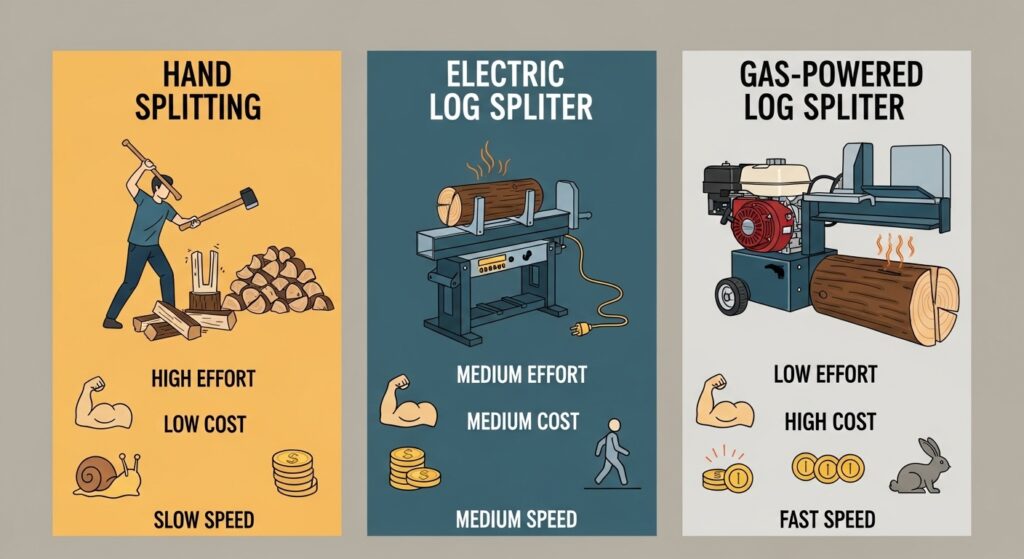
Which method is truly the “best” for splitting firewood? It depends on your situation. Here’s a practical framework:
The Decision Matrix
| Situation | Best Method |
|---|---|
| Splitting < ¼ cord, small logs | Splitting maul by hand |
| Splitting ¼–1 cord, mixed wood | Electric log splitter |
| Splitting 1+ cords, hardwood | Gas-powered log splitter |
| High volume, commercial use | Kinetic log splitter |
| Only kindling | Manual/hand splitter or Kindling Cracker |
| Remote location, no power | Gas log splitter or splitting maul |
Efficiency Tips That Actually Work
1. Process in batches. Don’t split one log, stack it, then grab another. Process all your rounds first, then stack. Moving back and forth between tasks kills efficiency.
2. Sort by size first. Split the largest, most difficult logs first when your energy is highest. Save smaller rounds for the end.
3. Dry run before stacking. Don’t rush split wood into a pile. Check moisture with a meter first — mixing green and seasoned wood in a single stack causes confusion later.
4. The “Star” splitting pattern. For large rounds on a splitter, make your first split through the center, then rotate each half and split again. You’ll get consistently sized pieces far more efficiently.
5. Use a log cradle or holder. For hand splitting, a log splitting holder keeps rounds upright and stops pieces from flying outward. It can genuinely double your productivity when working alone.
Comparing the Best Log Splitters on the Market
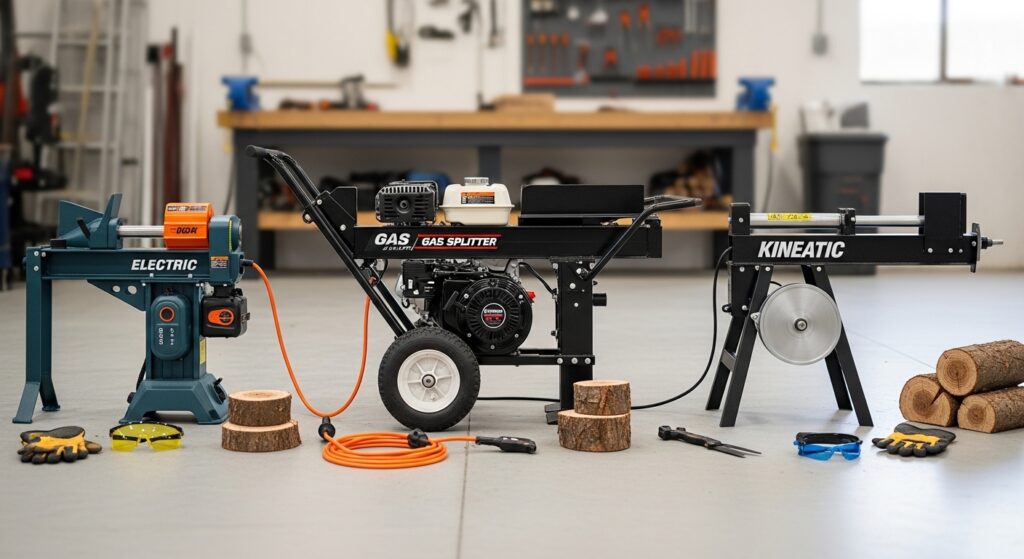
Here’s an honest look at some of the top-performing log splitters across categories, based on performance reputation and user experience:
Best Electric Log Splitter: WEN 56207 (6.5-Ton)
The WEN 56207 is consistently rated among the top electric log splitters for homeowners. It generates 6.5 tons of splitting force and handles logs up to 12 inches in diameter — enough for most residential firewood needs.
- Motor: 15-amp, 120V
- Splitting force: 6.5 tons
- Max log length: 12 inches
- Weight: ~70 lbs
- Best for: Homeowners splitting a cord or less per season
Best Gas Log Splitter: NorthStar 27-Ton
For serious firewood production, the NorthStar 27-Ton horizontal/vertical combo is a favorite among homesteaders and firewood sellers. Its 196cc Honda GX200 engine is legendary for reliability.
- Engine: 196cc Honda GX200
- Splitting force: 27 tons
- Max log length: 24.5 inches
- Cycle time: ~14 seconds
- Best for: Processing 1–5+ cords per season
Best Budget Pick: Sun Joe LJ10M (10-Ton)
For budget-conscious buyers who still want meaningful power, the Sun Joe LJ10M delivers 10 tons of electric splitting force at a price point under $400.
- Motor: 15-amp
- Splitting force: 10 tons
- Max log length: 18.9 inches
- Weight: ~91 lbs
Best Kinetic Log Splitter: Swisher LSKT22528
Swisher’s kinetic splitter combines dual flywheel technology with a 22.5 HP V-Twin engine for commercial-grade output. It can cycle in under 2 seconds — genuinely impressive for high-volume operations.
- Engine: 22.5 HP Briggs & Stratton V-Twin
- Splitting force: ~50-ton equivalent
- Cycle time: Under 2 seconds
- Best for: Firewood businesses, very high-volume splitting
How to Stack and Store Split Firewood
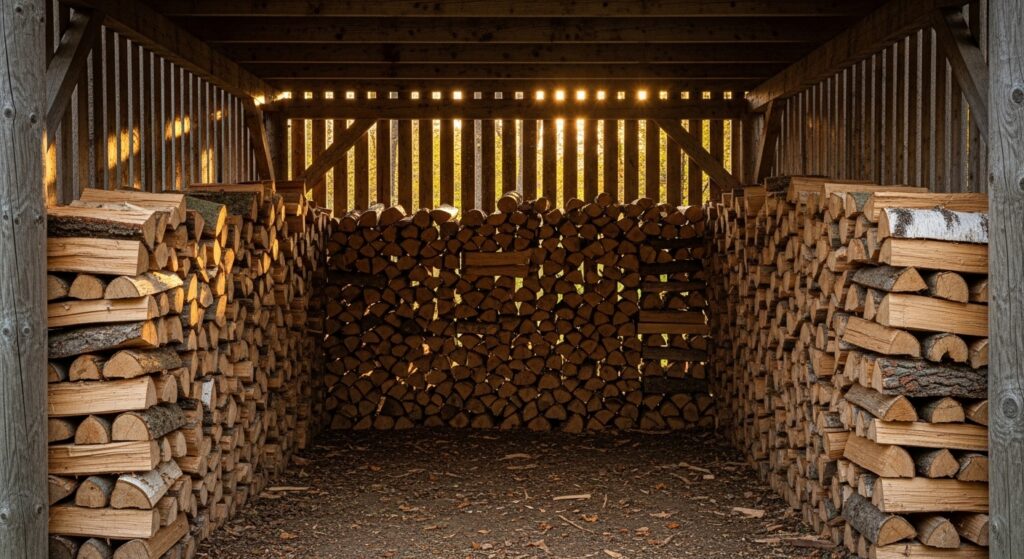
Splitting the wood is only half the job. How you store split firewood determines how well it seasons and whether it stays usable through the winter.
The Right Way to Stack Firewood
Use a raised base. Never stack wood directly on the ground. Ground contact traps moisture and promotes rot and insect infestation. Use pallets, pressure-treated lumber rails, or purpose-built firewood racks.
Stack with bark side up. The bark acts as a natural moisture shield. Orienting logs bark-side up helps rain and moisture run off rather than absorbing into the wood.
Maximize airflow. Don’t stack wood directly against a building or cover all sides with a tarp. Air needs to circulate through the pile to wick away moisture. Cover only the top with a tarp, canvas, or metal roofing — leave the sides open.
The Holz Hausen (round stack) method. Traditional European woodsmiths have been building self-supporting circular wood stacks for centuries. The conical shape sheds rain naturally, and the design allows excellent airflow. For anyone processing large quantities, the Holz Hausen method is worth learning — Mother Earth News has a solid guide.
How Long Does Firewood Need to Dry?
Drying time depends on the wood species and conditions:
| Wood Type | Approximate Drying Time |
|---|---|
| Softwoods (pine, fir, cedar) | 6–12 months |
| Light hardwoods (cherry, maple) | 12–18 months |
| Dense hardwoods (oak, hickory) | 18–24 months |
| Very dense hardwoods (black locust) | 24+ months |
These timelines assume good stacking practice — raised off the ground, bark up, tops covered, sides open. Poor storage can double or triple these times.
Expert Tips for Faster, Safer Log Splitting
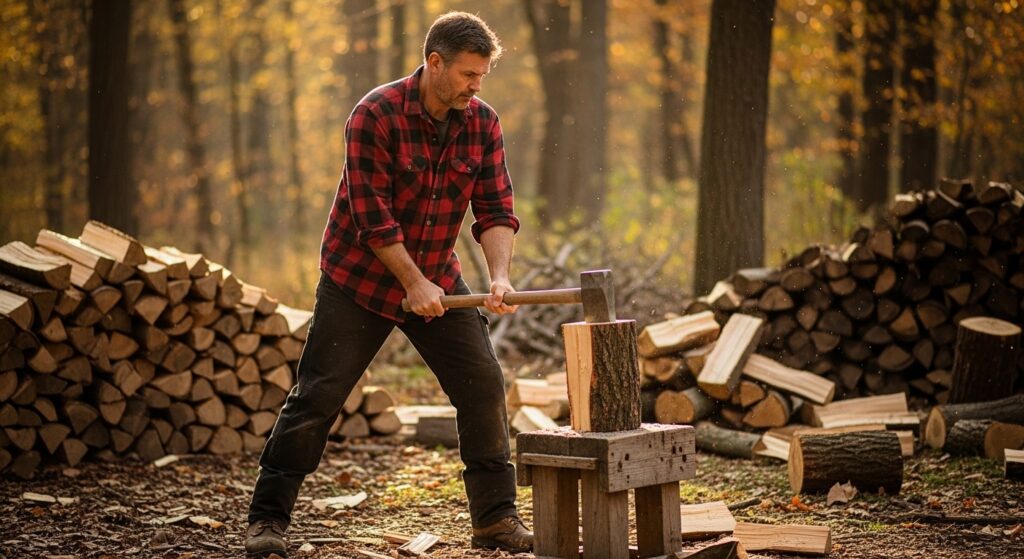
These are the insights that experienced firewood cutters have developed over years of working with wood. If you’re new to splitting, integrating even two or three of these will noticeably change your results.
Expert Tip #1: Raise Your Chopping Block Height
Most people’s chopping blocks are too low. Your maul should contact the log when your arms are roughly parallel to the ground — not swinging downward at a steep angle. A taller block means less bending, less wasted energy, and less back strain. Aim for 12–18 inches off the ground for your log surface.
Expert Tip #2: Let the Grain Tell You Where to Split
Before you swing, spend 5 seconds looking at the log. End-grain checks (the cracks that appear as wood dries) are natural split lines. Splits that start along a check take 30–50% less effort than forcing a split through intact fibers.
Expert Tip #3: Use a Splitting Ring for Safety
A splitting ring (a heavy rubber or metal ring placed around the log) keeps the pieces from flying outward when the maul strikes. This lets you place your next swing immediately without chasing pieces around the yard. The Kindling Cracker XL works on this principle at a larger scale.
Expert Tip #4: Sharpen Your Splitting Maul Occasionally
Splitting mauls don’t need to be razor-sharp, but a badly nicked or rolled edge dramatically reduces splitting efficiency. Use a metal file or bench grinder to maintain a clean, symmetrical bevel. The American Axe & Tool Society has detailed resources on axe and maul maintenance.
Expert Tip #5: Plan Your Splitting Session
Splitting wood is significantly more efficient when done in focused sessions rather than a few logs here and there. Batch your work: spend 2–3 hours processing all available rounds, then stack all at once. You’ll accomplish far more in each session.
Expert Tip #6: Know When NOT to Split
Some logs are simply not worth hand-splitting. Heavily knotted wood, logs with twisted grain, and crotch pieces (where the tree forked) can frustrate even experienced splitters. For these, use a gas splitter with maximum tonnage — or consider cutting them into smaller pieces with a chainsaw first.
Pros and Cons of Log Splitters vs. Splitting by Hand
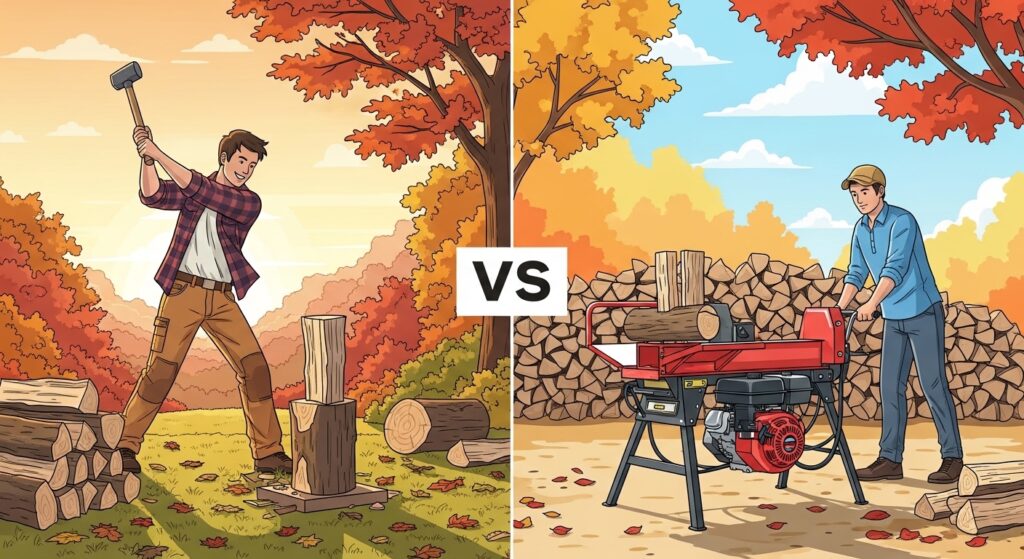
Log Splitter
Pros:
- Dramatically faster for large volumes
- Handles knotty, difficult wood that resists a maul
- Less physically demanding
- Vertical models handle heavy rounds without lifting
- Can split very large-diameter logs
Cons:
- Purchase cost ($200–$3,000+)
- Electric models require power access
- Gas models need fuel, oil, and maintenance
- Less portable than a maul for remote locations
- More setup and cleanup time for small jobs
Splitting by Hand (Maul)
Pros:
- No purchase cost beyond the maul ($40–$120)
- Excellent exercise and meditative activity
- Works anywhere, no fuel or power needed
- Immediate, no setup required
- Very portable
Cons:
- Time-consuming for large volumes
- Physically demanding — not suitable for everyone
- Struggles with knotty or large-diameter wood
- Risk of overuse injuries (shoulder, back, elbow) if form is poor
Bottom Line: For most homeowners heating primarily with wood, a combination approach works best. Use a mid-range electric log splitter for the bulk of your processing, and keep a quality splitting maul for occasional use and the satisfaction of hand-splitting.
FAQs: Log Splitter & Firewood Splitting Questions Answered
Q1: What is the easiest way to split firewood?
The easiest way to split firewood is with a hydraulic log splitter — specifically a combination horizontal/vertical model. For the largest rounds, flip it vertical so you don’t have to lift heavy logs. An electric model like the Sun Joe LJ10M or WEN 56207 handles most homeowner wood easily with minimal physical effort.
If you’re splitting by hand, the easiest approach is to use a quality 8-lb splitting maul, aim for existing cracks in the wood, and split pieces off the edges before tackling the center. Never try to split through knots.
Q2: How many tons do I need in a log splitter?
For most homeowners splitting standard firewood rounds (12–16 inches in diameter) from typical hardwood species like maple, cherry, or ash, 6–10 tons from an electric splitter is sufficient. For larger rounds, denser hardwoods (hickory, oak, elm), or knotty wood, you’ll want 20–27 tons from a gas-powered unit. Commercial firewood operations typically use 30+ tons.
Q3: What is the difference between a splitting maul and an axe?
A splitting maul has a heavy, wedge-shaped head (6–12 lbs) designed to push wood fibers apart along the grain. It does not cut. A felling axe has a thin, sharp, lightweight head designed to sever wood fibers across the grain for cutting down trees or bucking logs. Using a felling axe to split wood is inefficient and damages the axe edge. Use the right tool for each job.
Q4: How do I know when firewood is ready to burn?
Properly seasoned firewood shows several clear signs:
- Moisture meter reading below 20% (most reliable method)
- Darkened, grayish end grain (green wood has bright, white-ish ends)
- Cracks and checking on the log ends — radial cracks from the center
- Hollow sound when two pieces are knocked together (green wood sounds dull and thuddy)
- Lighter weight than when freshly cut — moisture adds significant mass
Burning unseasoned wood in a wood stove or fireplace causes excessive creosote buildup in your chimney, which is a leading cause of chimney fires. The Chimney Safety Institute of America (CSIA) recommends annual chimney inspections when burning wood regularly.
Q5: How do you split very large or knotty logs that won’t budge?
For stubborn logs that resist splitting:
- Use steel splitting wedges — drive one or two wedges into the end grain with a sledgehammer
- Work from the outside in — split slabs off the edges before trying to crack the center
- Cut the log shorter — halving the length dramatically reduces resistance
- Use a gas splitter with 25+ tons — most knotty wood will surrender to enough hydraulic force
- Score the log with a chainsaw — making a shallow cut along the desired split line gives the wedge a starting point
Extremely knotty or crotch wood sometimes simply isn’t worth the effort as firewood. Consider using it for wood turning, carving, or as decorative pieces instead.
Log Splitter Maintenance: Keeping Your Machine Running
A well-maintained log splitter lasts 15–25 years. Neglect it, and you’ll face expensive repairs or premature replacement.
Gas Log Splitter Maintenance Checklist
Before each use:
- Check engine oil level
- Check hydraulic fluid level (most use AW32 or AW46 hydraulic oil)
- Inspect hydraulic hoses for cracks or seeping
- Check the wedge for damage or dulling
- Ensure the log cradle and beam are clear of debris
Every 25–50 hours of operation:
- Change engine oil (follow manufacturer specs — typically SAE 30 for small engines)
- Check air filter — clean or replace if dirty
- Check spark plug — replace annually or per manufacturer guidance
Seasonally / annually:
- Change hydraulic fluid every 100–150 hours or annually
- Grease all grease fittings (beam slide, wheel bearings)
- Inspect and tighten all bolts and fasteners
- Drain fuel stabilizer mixture if storing for the off-season (or run the engine dry)
- Check tire pressure and condition
Electric Log Splitter Maintenance
Electric splitters are simpler but still need attention:
- Check hydraulic fluid level before each use
- Inspect the power cord for damage — never operate with a compromised cord
- Keep the wedge clean and free of bark buildup
- Store indoors or under a cover to protect the motor from moisture
How to Buy a Used Log Splitter: What to Look For
Buying a used log splitter can save you 40–60% off retail. But it also carries risk if you don’t know what to inspect.
What to Check Before Buying Used
Engine (gas models):
- Does it start easily after a few pulls?
- Does it run smoothly at idle and under load?
- Any smoke from the exhaust (blue = oil burning, white = coolant issue, black = rich fuel mix)?
- Check the oil — is it black and thick? Indicates poor maintenance
Hydraulic system:
- Any visible hydraulic fluid leaks around hoses, fittings, or the cylinder?
- Does the beam extend and retract smoothly with good speed?
- Is the hydraulic fluid discolored or milky? Milky fluid indicates water contamination — expensive to fix
Structural:
- Is the beam straight and free of cracks or welds?
- Is the wedge intact and not cracked?
- Are the log cradle and end plate intact and secure?
General:
- Are the tires holding air?
- Are all safety guards and the two-hand control mechanism present and functional?
- Ask for the maintenance history — a well-kept used splitter is a great deal
Good sources for used log splitters include Craigslist, Facebook Marketplace, local equipment dealers, and farm auctions. Prices for used hydraulic log splitters typically range from $200 for a basic electric unit to $1,500+ for a quality gas model.
Log Splitting & Environmental Considerations
Wood heating is often viewed as a sustainable, carbon-neutral energy source — but it’s worth understanding the nuances.
The U.S. Energy Information Administration (EIA) notes that while wood is technically a renewable fuel, its carbon neutrality depends heavily on responsible forestry practices. When burned efficiently in modern EPA-certified wood stoves or fireplace inserts, well-seasoned firewood produces significantly fewer particulate emissions than older, dirtier stoves.
Key environmental practices for responsible firewood use:
- Burn only well-seasoned wood — wet wood produces far more particulate matter (smoke) and creosote
- Use an EPA-certified wood stove or fireplace insert — EPA’s certified wood heater database lists compliant appliances
- Source wood responsibly — purchase from licensed firewood dealers or harvest from your own property with proper permits
- Don’t transport firewood across state lines — invasive species like the Emerald Ash Borer spread in firewood, devastating forests
Conclusion:
There’s a real satisfaction in looking at a neatly stacked woodpile that you processed yourself. Whether you’re drawn to the meditative rhythm of hand-splitting with a maul or you prefer the efficient power of a hydraulic log splitter, getting the right equipment and technique in place changes everything.
Here’s what to take away from this guide:
- Split wood early — firewood needs months to season properly, so plan ahead
- Choose your tool based on volume — a maul for small jobs, electric for moderate, gas for serious production
- Safety first — always use protective gear and follow safe operating procedures
- Stack and store correctly — good storage practice is just as important as good splitting technique
- Maintain your equipment — a well-maintained log splitter will outlast you
If you’re just starting out and processing a modest amount of wood, an electric log splitter like the WEN 56207 or Sun Joe LJ10M is an excellent starting point. If you’re heating your home primarily with firewood, step up to a quality gas-powered unit with at least 25 tons of force.
Whatever you choose, the best log splitter is the one that fits your actual needs — not the most powerful one on the shelf.
Ready to start building your woodpile? Check out our recommendations above, invest in quality PPE, and get to work. Your future self — warm by the fire next January — will thank you.

