
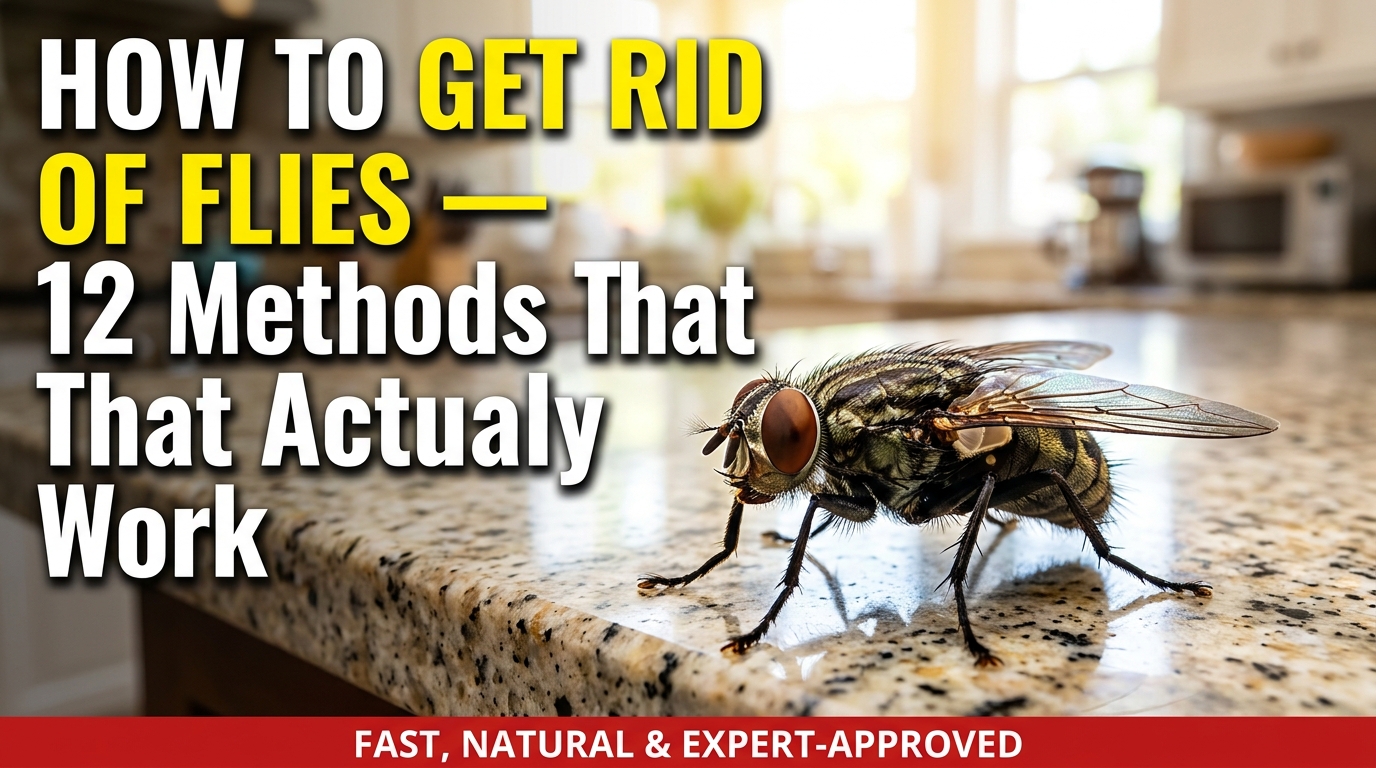
You pour yourself a glass of lemonade, settle into the couch, and within seconds — buzz. That unmistakable, infuriating sound. A fly lands on your drink. Then your food. Then your arm.
Sound familiar?
Flies are one of the most common household nuisances in the country, and they’re not just annoying — they’re a genuine health concern. According to the World Health Organization, houseflies are known to carry and transmit over 65 diseases, including salmonella, typhoid fever, and E. coli, by landing on contaminated surfaces and then on your food.
The good news? Getting rid of flies — both quickly and for good — is absolutely doable. You don’t need to call an exterminator right away or douse your home in harsh chemicals.
This guide walks you through 12 proven, practical methods to get rid of flies in your house, from fast DIY fixes you can try today to longer-term prevention strategies that keep them from ever coming back. Whether you’re dealing with a full-on infestation or just a few persistent pests, you’ll find the right solution here.
Let’s get into it.
Why Are There So Many Flies in Your House?
Before you can effectively deal with flies, it helps to understand why they’re showing up in the first place.
Houseflies (Musca domestica) are attracted to a very specific set of conditions. They’re not randomly wandering in — they’re following signals that tell them your home is a great place to eat, breed, and live.
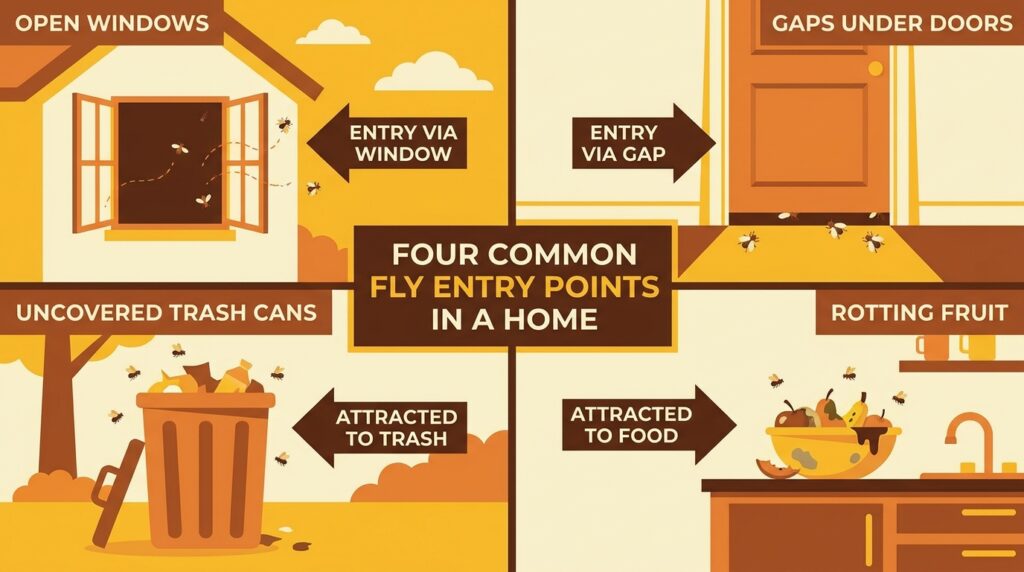
The most common attractants include:
- Uncovered garbage or compost — Flies can smell decomposing organic matter from up to a mile away.
- Pet waste — Dog and cat feces are prime breeding grounds.
- Exposed food and dirty dishes — Even crumbs left on a counter are enough.
- Overripe or rotting fruit — Particularly attractive to fruit flies (Drosophila melanogaster).
- Standing water or moisture — Drain flies thrive in damp, humid environments like sink drains and shower floors.
- Open doors and windows without screens — The most direct entry point.
- Indoor plants with wet soil — Fungus gnats often come in through this route.
The University of Florida’s Institute of Food and Agricultural Sciences notes that a single female housefly can lay up to 500 eggs in her lifetime, and those eggs hatch in as little as 12–24 hours under warm conditions. That means a “small fly problem” can become a serious infestation very fast.
Understanding what’s drawing them in is the first step. Now let’s talk about how to get them out.
How to Get Rid of Flies in the House — 12 Proven Methods
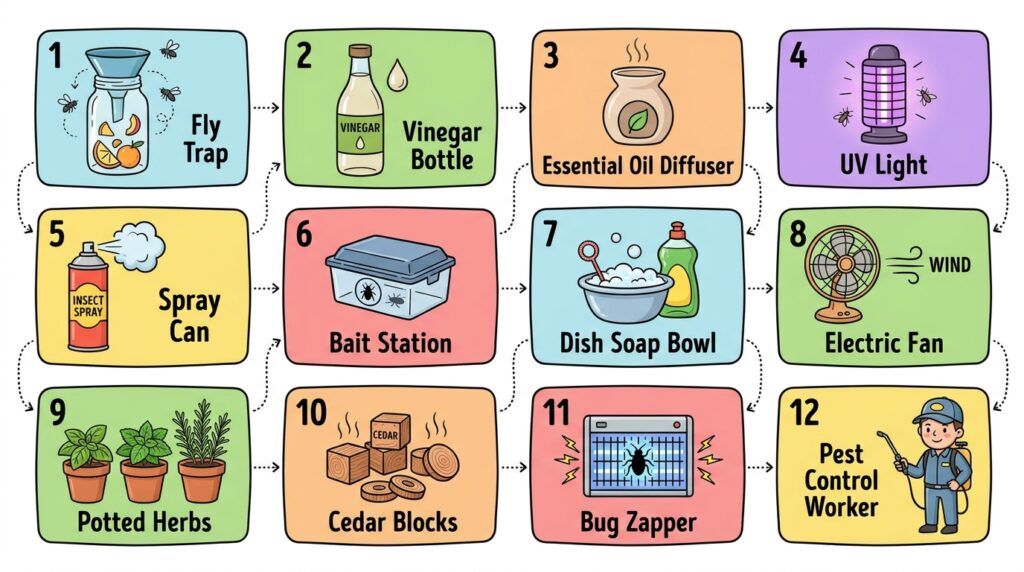
Here are the methods that genuinely work. We’ve ranked them roughly from least to most aggressive, so you can start with the simplest fixes and escalate only if needed.
1. Use Fly Traps and Sticky Strips
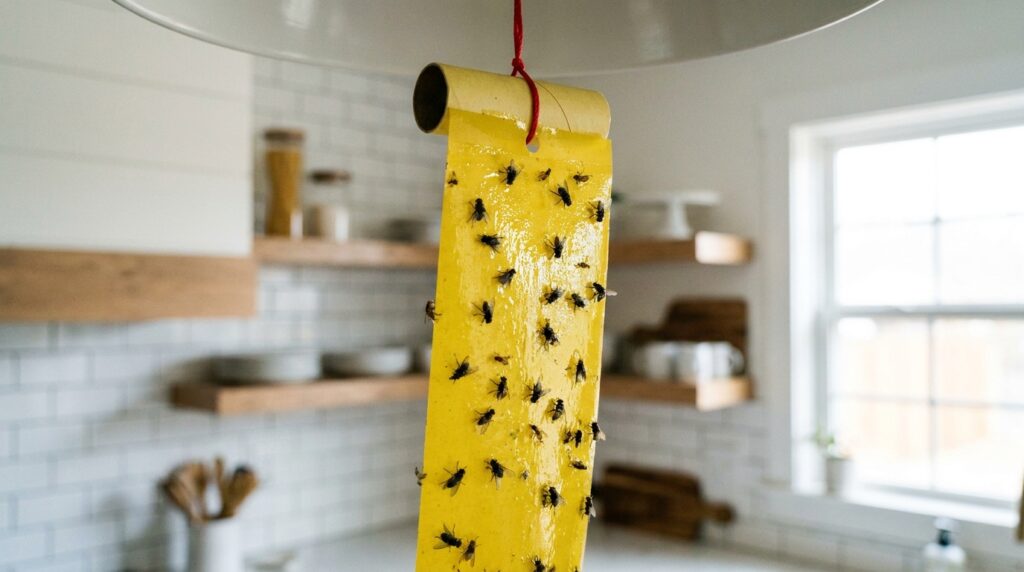
Sticky fly strips are cheap, non-toxic, and surprisingly effective. They work by using a scented adhesive that attracts flies, which then get stuck and can’t escape.
How to use them:
- Hang them near windows, trash cans, or wherever flies congregate most.
- Replace them every 2–4 weeks or when they’re covered.
- Avoid placing them directly over food prep areas.
Brands like RESCUE! make non-toxic, disposable fly traps that are highly rated for indoor use. Their Big Bag Fly Traps use a specially-formulated attractant and are one of the best-reviewed products on the market for outdoor and porch areas.
Best for: Moderate fly presence; ongoing monitoring.
Not ideal for: Large infestations or fruit flies (which need different attractants).
2. Try an Apple Cider Vinegar Trap (DIY)
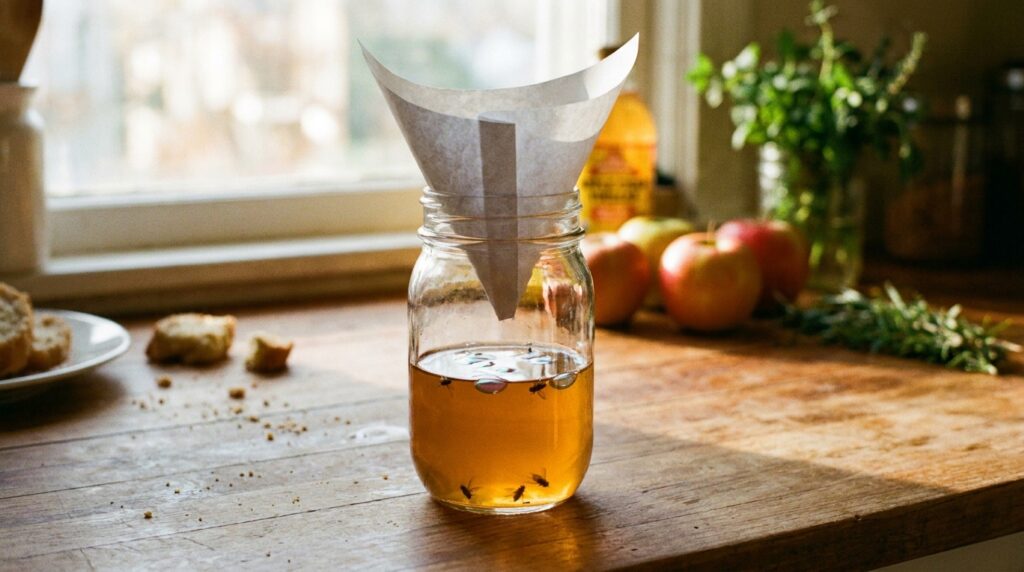
This is one of the most popular home remedies for flies — and it works especially well for fruit flies. The strong scent of fermented apple cider vinegar mimics rotting fruit, luring flies in. A few drops of dish soap breaks the surface tension so they can’t escape.
How to make it:
- Pour about half an inch of apple cider vinegar into a glass or jar.
- Add 2–3 drops of liquid dish soap.
- Cover the top with plastic wrap and poke several small holes in it — or use a paper cone/funnel inserted downward into the jar.
- Place it near fruit bowls, trash cans, or drains.
The University of Kentucky College of Agriculture confirms that fermentation-based traps are particularly effective for controlling Drosophila (fruit fly) populations.
Replace the trap every few days and wash the jar thoroughly before reusing.
Cost: Under $1 per trap
Effectiveness: Excellent for fruit flies; moderate for houseflies
3. Essential Oils That Repel Flies

Flies have a highly developed sense of smell — and certain scents are deeply unpleasant to them. Essential oils offer a natural, pleasant-smelling way to keep flies away without any toxins.
Most effective essential oils against flies:
| Essential Oil | How It Works | Best Application |
|---|---|---|
| Peppermint | Strong menthol irritates fly receptors | Spray diluted around doors and windows |
| Eucalyptus | Natural insect repellent | Diffuser or cotton balls near entry points |
| Lavender | Flies dislike its intense floral compounds | Sachets, sprays, or diffuser |
| Lemongrass | Contains citral, toxic to insects | Candles or diluted surface spray |
| Clove | High eugenol content repels many insects | Cotton balls, potpourri |
DIY repellent spray recipe:
- 10 drops of peppermint or eucalyptus oil
- 1 cup of water
- 1 tsp of witch hazel or rubbing alcohol (helps emulsify)
- Combine in a spray bottle and shake before use
The National Pesticide Information Center acknowledges that plant-based repellents can be effective short-term deterrents, particularly when used consistently in entry points and problem areas.
Best for: Light fly presence; people who prefer non-chemical methods.
4. Set Up a UV Light Trap (Electric Fly Killer)
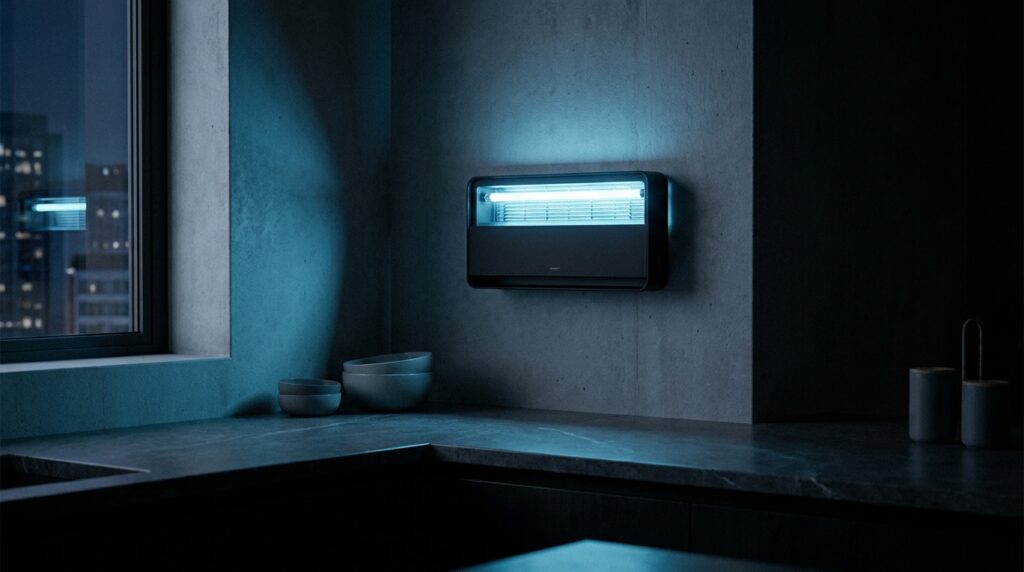
UV light traps, also called electric fly killers (EFKs), are a favorite for restaurants and commercial kitchens — but they work just as well at home. Flies are attracted to ultraviolet light and fly toward the trap, where they’re either electrocuted on a charged grid or caught on a glue board.
Types:
- Electric grid traps: Kill on contact. Best for heavy infestations.
- Glue board traps: Non-toxic, silent, hygienic. Better for homes.
Look for models from brands like Flowtron or Aspectek, which have strong reviews for residential use. Position them:
- 5–8 feet above the floor
- Away from competing light sources (windows)
- Near kitchen areas or garbage cans
These traps work 24/7 and require minimal maintenance — just replace the glue boards or clean the grid monthly.
Best for: Kitchens, garages, basements with recurring fly problems.
5. Use Chemical Fly Sprays Strategically
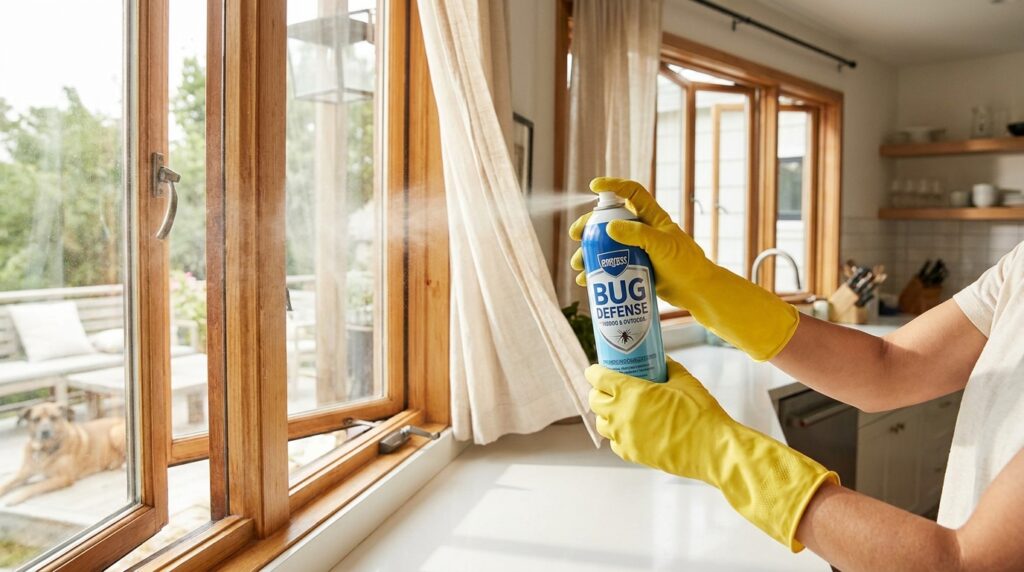
Sometimes, especially during peak summer months or a sudden infestation, a chemical spray is the fastest way to kill flies quickly. However, it should be used strategically — not as your first or only defense.
Active ingredients to look for:
- Pyrethrin — A natural insecticide derived from chrysanthemum flowers. Fast-acting and relatively low toxicity for humans. Approved by the Environmental Protection Agency for indoor use.
- Permethrin — A synthetic version of pyrethrin. Very effective but should not be used around cats.
- DEET — Less common in sprays but effective in some barrier applications.
Popular products:
- Raid Flying Insect Killer
- Hot Shot Flying Insect Killer
- Spectracide Bug Stop Indoor Plus
Safety tips:
- Always ventilate the room before and after spraying.
- Keep children and pets out of the area during application.
- Never spray directly on food or food prep surfaces.
The EPA’s Safer Choice Program labels certain pesticide products that are safer for home use — check the label before purchasing.
Best for: Quick knockdown of a visible infestation.
Not ideal for: Ongoing prevention or homes with young children or pets.
6. Set Out Fly Bait Stations
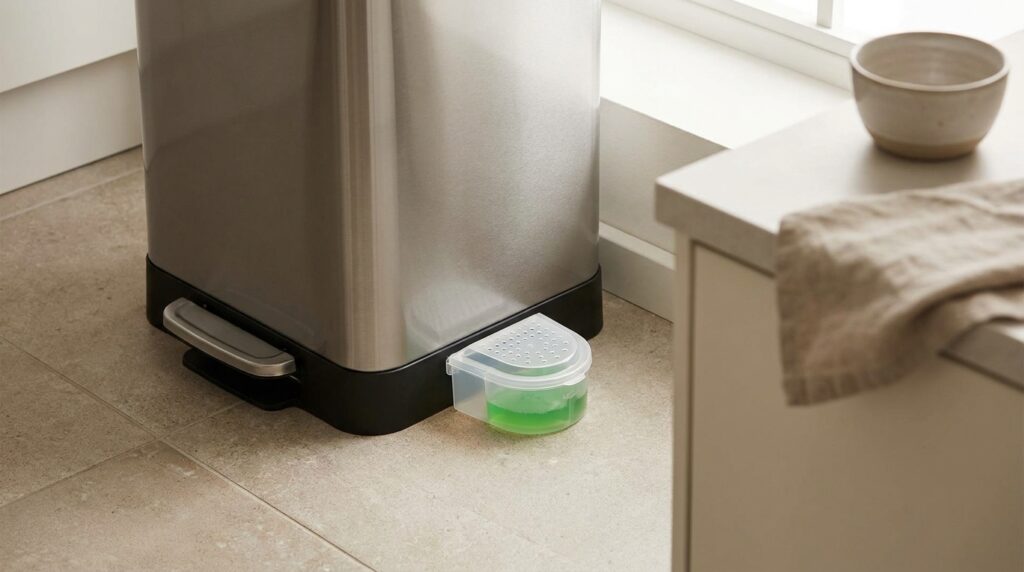
Fly bait stations use a combination of attractant and insecticide to lure flies in and kill them. They’re more targeted than spray and safer to use around the home when placed correctly.
Products like Farnam QuikStrike Fly Abatement Strip or Golden Malrin Fly Bait are widely used and effective. These baits typically use methomyl or imidacloprid as the active insecticide.
Placement tips:
- Near trash cans, compost bins, or recycling areas
- In garages or near outdoor-indoor transition areas
- Not directly on food-preparation surfaces
Always read the label. Some commercial baits are intended for outdoor use only.
7. Dish Soap and Water Bowl Trap
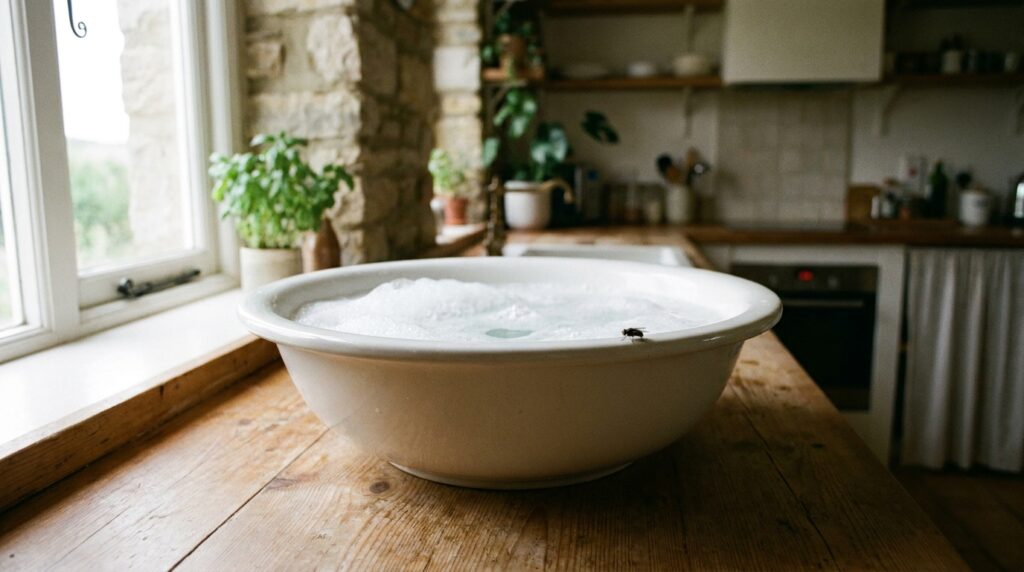
This is one of the simplest and most low-cost tricks in the book. Flies land on water to drink — but dish soap reduces the surface tension, causing them to sink and drown.
How to set it up:
- Fill a wide, shallow bowl with water.
- Add several drops of dish soap and stir gently.
- Place it near where flies congregate — near windows, fruit bowls, or drains.
- Refresh every day or two.
You can add a splash of sugar water, apple juice, or fruit scraps to make it more attractive to flies.
Best for: Casual, zero-cost fly control. Works well alongside other methods.
8. Use a Fan to Keep Flies Away
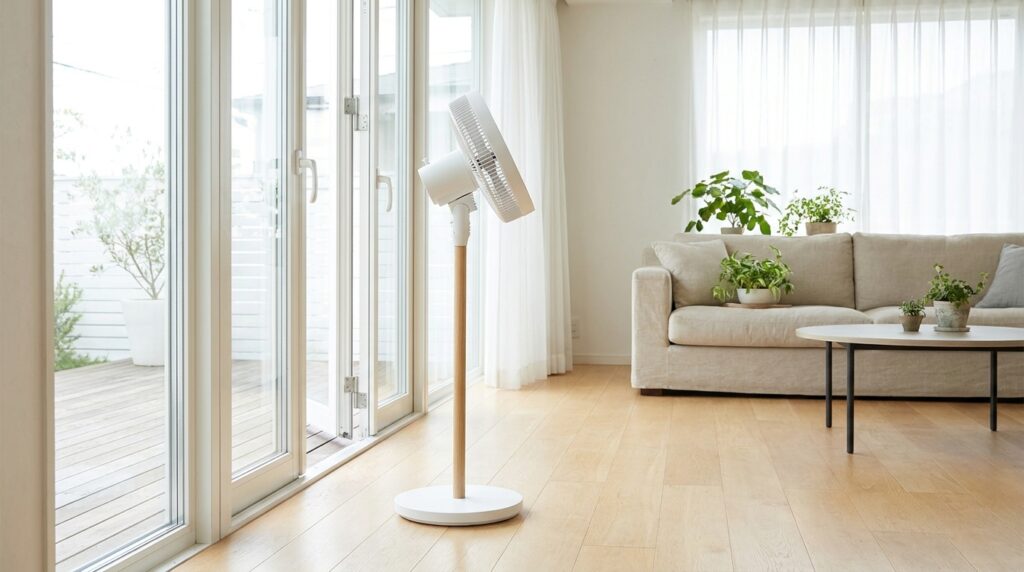
This one often surprises people, but it’s backed by real logic. Flies are weak fliers relative to their size. A steady airflow of even 2–3 mph can deter them from landing or entering an area.
Restaurants often use industrial fan units near entrances for exactly this reason. At home, placing a portable or ceiling fan near doors, windows, or dining areas can noticeably reduce fly activity.
A study published in the Journal of Medical Entomology found that airflow had measurable effects on the landing behavior of houseflies, particularly at table height.
Best for: Dining areas, patios, doorways.
Cost: Free if you already own a fan.
9. Plants and Herbs That Naturally Repel Flies
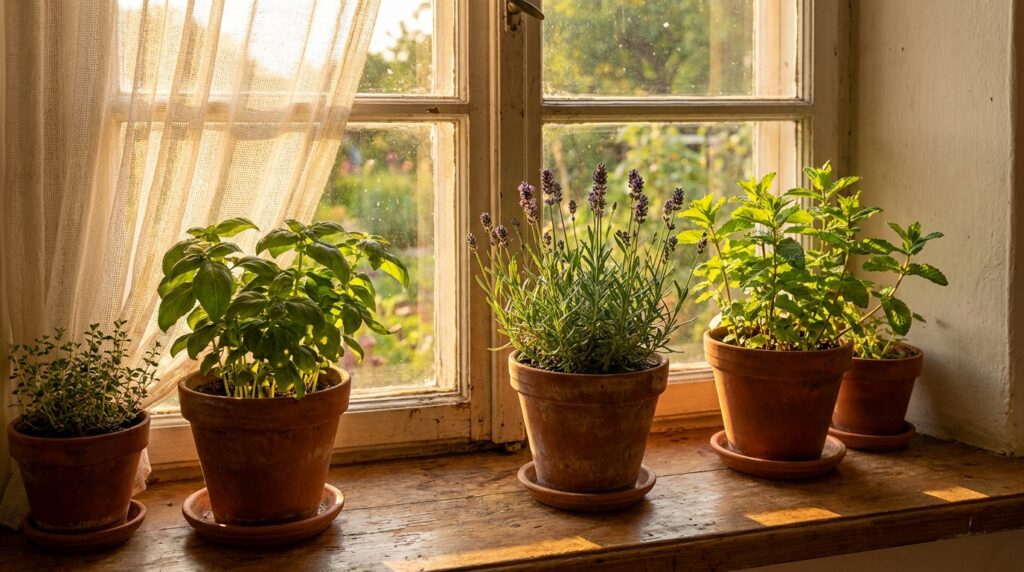
Nature has its own fly repellents. Certain plants produce compounds in their leaves that flies genuinely dislike. Growing these near entry points or in your kitchen can help keep flies away naturally.
Best plants to repel flies:
- Basil (Ocimum basilicum) — Emits a strong scent that flies find irritating. Place pots near windows and doors.
- Lavender — The high concentration of linalool is well-documented as a fly deterrent.
- Mint (Peppermint or Spearmint) — The intense menthol aroma keeps many insects at bay.
- Rosemary — Works well outdoors on the patio or near a front door.
- Bay Laurel — Dried bay leaves placed in cabinets and pantries repel flies and pantry moths.
- Rue (Ruta graveolens) — A traditional insect-repelling plant, though avoid direct contact with skin.
The Royal Horticultural Society documents several of these plants for their pest-deterrent properties. The bonus: you’ll have fresh herbs for cooking, too.
10. Cedar, Cloves, and Citrus Peels

These natural materials have been used for centuries as insect deterrents — and they still work.
- Cloves + Citrus: Stud half an orange or lemon with whole cloves and place it on your dining table or kitchen counter. The combination of citric oils and eugenol from cloves is a potent fly repellent.
- Cedar: Cedar wood blocks, chips, or sachets placed in pantries and drawers help repel flies as well as moths and other insects.
- Dried herbs (lavender, rosemary): Bundle them in sachets and hang near entry points.
These methods work best as supplementary measures — they won’t eliminate an existing infestation, but they’re excellent at keeping flies from settling in after you’ve dealt with the main problem.
11. Bug Zappers (Outdoor & Indoor Models)
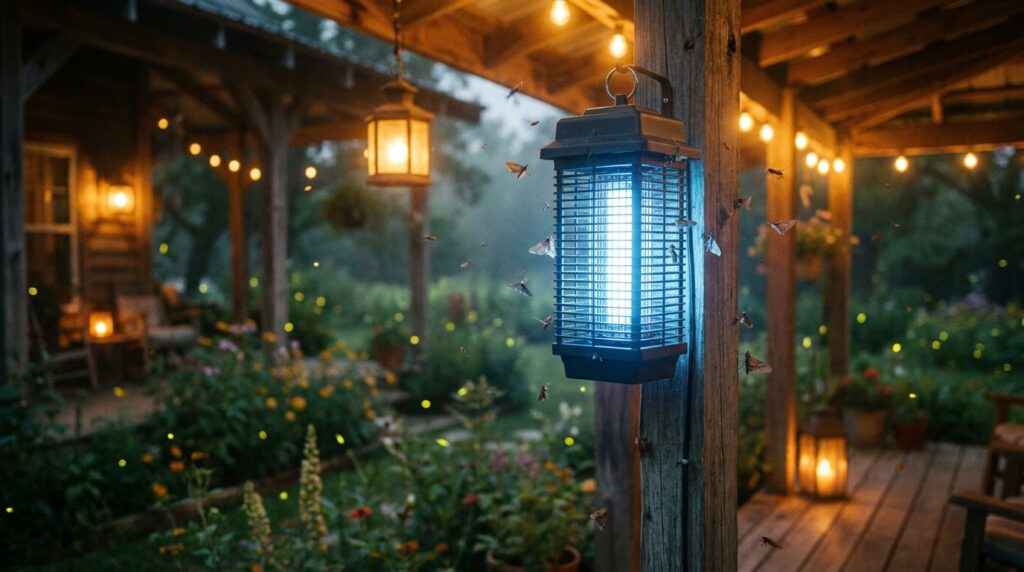
Bug zappers use UV light to attract insects and kill them on contact with an electrified grid. They’re especially effective outdoors — on porches, patios, garages, and near back doors.
For indoor use, opt for a glue-board UV trap rather than a traditional zapper, as outdoor zappers can be noisy and messy indoors.
What to look for:
- Coverage area (some cover up to one acre)
- Safety casing (important if children or pets are nearby)
- Waterproof rating for outdoor use
- Easy-clean collection tray
Brands like Flowtron and Black Flag offer reliable, well-reviewed models.
Best for: Patios, porches, garages, and outdoor entertaining areas.
12. Call a Professional Pest Control Service
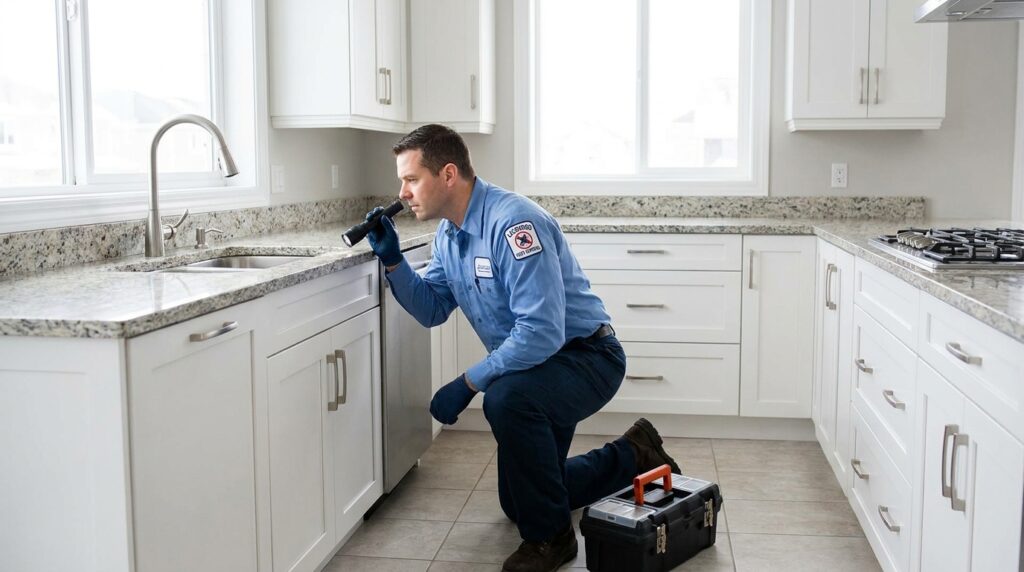
If you’ve tried multiple methods and the flies keep coming back, or if you’re dealing with a large, persistent infestation, it’s time to bring in a professional.
Pest control specialists can:
- Identify the exact species of fly and their breeding source
- Locate hidden breeding grounds (like a dead animal in a wall cavity, which is a surprisingly common cause of sudden fly explosions)
- Apply professional-grade treatments safely
- Provide a prevention plan tailored to your home
Services like Orkin, Terminix, and Rentokil offer residential fly control programs. Many offer free inspections.
When to call:
- You can’t identify the source of the infestation
- The problem persists after 2–3 weeks of self-treatment
- You find maggots (fly larvae) in hidden areas
- The fly species is unusual or unfamiliar
How to Get Rid of Flies Quickly Inside — Emergency Fixes
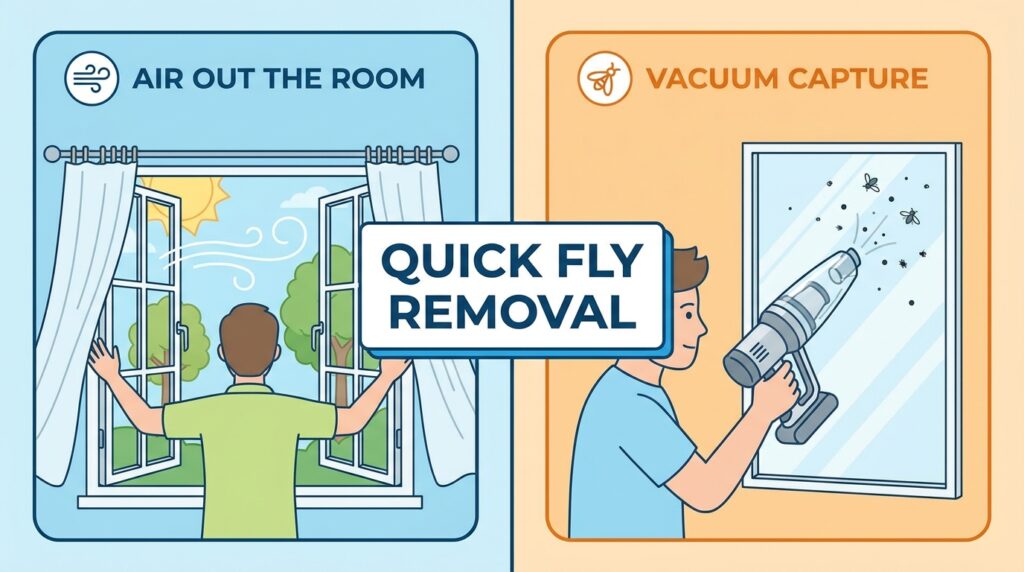
Need to deal with flies right now — before guests arrive, or before dinner? These emergency tactics work fast:
1. Use a Vacuum Cleaner
A handheld or upright vacuum with a hose attachment can suck flies off windows, walls, and ceilings in seconds. They tend to congregate near light sources. After vacuuming, empty the bag or container into an outdoor bin immediately.
2. Close Off the Room and Use a Spray
Shut the windows, spray a flying insect aerosol (like Raid) into the room, leave for 10 minutes, then ventilate thoroughly before re-entering.
3. Use a Flyswatter — Efficiently
Old school, but it works. Target flies when they’re resting on walls or windowpanes rather than chasing them in flight. A damp cloth works too — the moisture slightly weights their wings.
4. Set a Quick ACV Trap
Apple cider vinegar + dish soap in a bowl takes under two minutes to set up and starts attracting flies within the hour.
5. Open One Window and Cover the Others
Flies are drawn to light. If you darken the room and leave one exit window open with light coming through, flies will naturally navigate toward it and out of the house.
How to Keep Flies Out of Your House — Long-Term Prevention
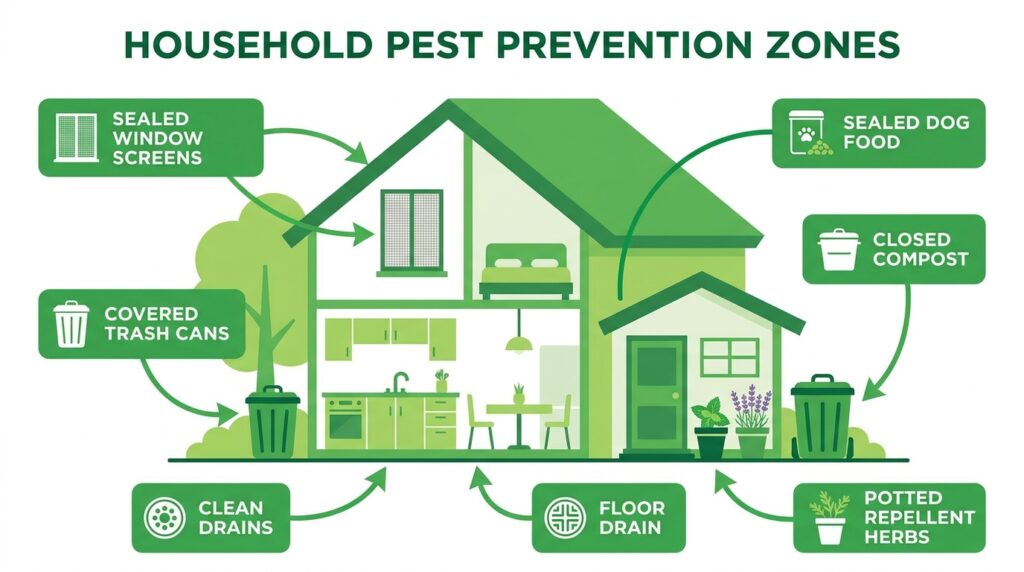
Getting rid of flies is one thing. Keeping them gone is another. Here’s how to make your home genuinely inhospitable to flies long-term.
Seal Entry Points
- Install tight-fitting window and door screens (16-mesh or finer is the standard recommendation from the CDC).
- Check for gaps around door frames, window sills, and utility pipes.
- Use door sweeps on exterior doors to eliminate the gap at the bottom.
- Repair any torn or damaged screen mesh immediately.
Eliminate Breeding Grounds
This is the most important step. Without breeding sites, flies can’t multiply.
- Empty and clean trash cans at least twice a week. Use bins with tight-fitting lids.
- Rinse recycling before placing it in bins — residue from bottles and cans attracts flies fast.
- Clean drains regularly — pour boiling water or a baking soda + vinegar solution down kitchen and bathroom drains weekly to clear organic buildup.
- Pick up pet waste daily — feces are a top fly breeding site.
- Don’t leave dirty dishes in the sink overnight.
- Store compost properly — use an airtight indoor composting system or keep the outdoor bin far from your house.
Food Storage Habits
- Keep ripe fruit in the refrigerator during warmer months.
- Use airtight containers for leftovers and pantry items.
- Never leave pet food out for extended periods.
- Wipe down counters and stovetops after every meal.
Control Moisture
- Fix any leaking pipes or faucets.
- Use a dehumidifier in damp basement or bathroom areas.
- Don’t overwater houseplants.
- Keep shower drains clean and flowing freely.
Clean Outdoor Areas
- Keep garbage cans away from doors and windows.
- Clean up fallen fruit from trees.
- Remove standing water from flower pots, bird baths, or gutters.
- Mow the lawn regularly — tall grass retains moisture and organic debris.
The Environmental Protection Agency recommends integrated pest management (IPM) as the most effective long-term strategy — combining sanitation, exclusion, and targeted treatment rather than relying on any single solution.
What Kills Flies — Commercial Products That Work
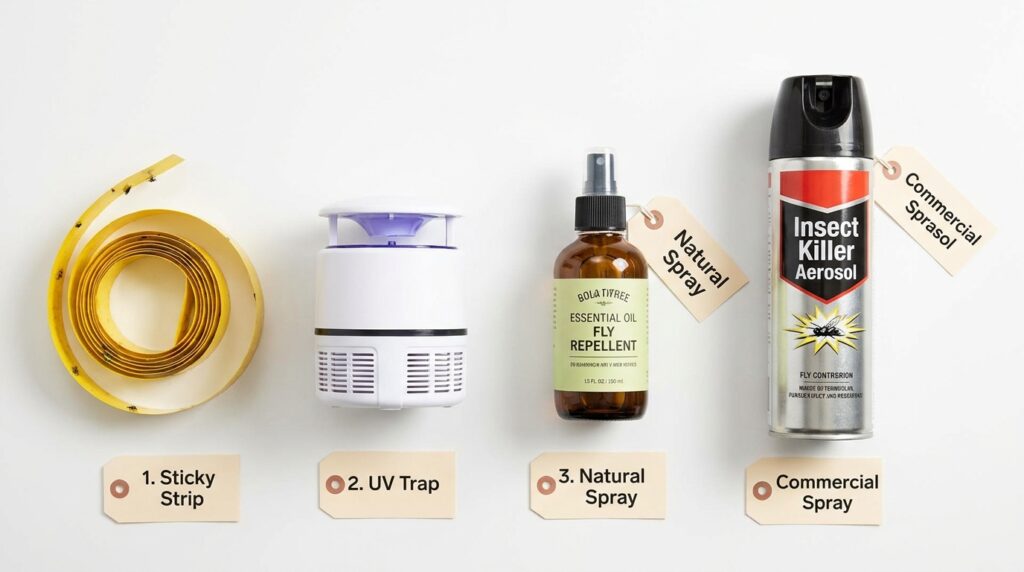
Here’s a quick-reference breakdown of commercial products by category:
| Product Type | Best Product Options | Best For | Price Range |
|---|---|---|---|
| Sticky Fly Strips | RESCUE! Sticky Strips, Black Flag Fly Paper | Light–moderate fly presence | $3–$10 |
| Fly Bait Stations | Farnam QuikStrike, Golden Malrin | Kitchens, trash areas | $10–$25 |
| UV Light Traps | Aspectek 20W, Flowtron BK-15D | Indoor continuous use | $25–$80 |
| Plug-In Repellers | Neatmaster Ultrasonic Repeller | Rooms, offices | $15–$40 |
| Insect Sprays | Raid Flying Insect Killer, Hot Shot | Immediate knockdown | $5–$12 |
| Natural Sprays | Wondercide Indoor Pest Spray | Pet-friendly households | $15–$30 |
| Professional Bait | Maxforce Fly Spot Bait | Heavy infestations | $20–$50 |
Note on ultrasonic repellers: These are widely sold but scientific evidence for their effectiveness against flies is limited. They may work for some insects in controlled settings, but don’t rely on them as a primary solution.
Natural vs. Chemical Fly Control — Pros and Cons
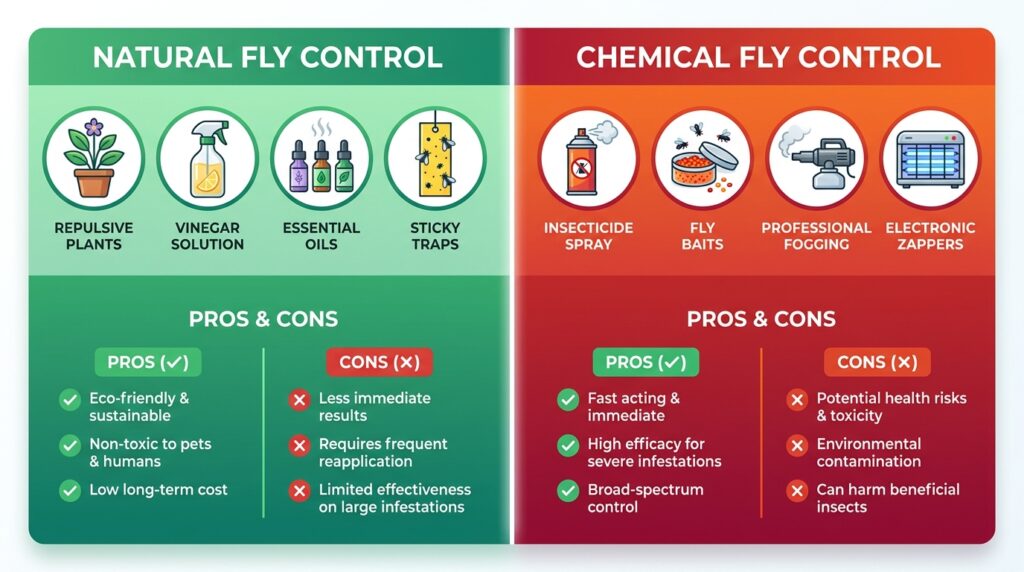
Choosing between natural and chemical fly control often comes down to your household situation. Here’s an honest comparison:
Natural/Non-Toxic Methods
Pros:
- Safe for children, pets, and sensitive individuals
- Environmentally friendly
- Can be used continuously without health concerns
- Often inexpensive or free
Cons:
- Slower results; require consistency
- Less effective during heavy infestations
- Need to be refreshed regularly
- May not work in all environments
Chemical Methods
Pros:
- Fast-acting — can kill flies within minutes
- More effective against large infestations
- Wide range of products for different situations
Cons:
- Some products are toxic to pets (especially cats)
- Not safe to use near food without precautions
- Chemical resistance can build over time
- Environmental impact of synthetic pesticides
The Bottom Line:
For most households, a combined approach works best. Use natural methods for day-to-day prevention and reserve chemical treatments for acute problems. This is the philosophy behind integrated pest management (IPM), endorsed by both the EPA and USDA.
Different Types of Flies and What to Use Against Them
Not all flies are the same, and knowing which type you’re dealing with makes a huge difference in choosing the right solution.
Common Housefly (Musca domestica)
What it looks like: Gray, about 6–7mm long, four dark stripes on thorax.
Where it breeds: Garbage, feces, decaying organic matter.
Best solution: UV traps, sticky strips, chemical sprays, sanitation.
Fruit Fly (Drosophila melanogaster)
What it looks like: Tiny (3–4mm), tan/brown body, bright red eyes.
Where it breeds: Overripe fruit, fermented beverages, drains, compost.
Best solution: ACV traps, drain cleaning, removing overripe produce.
Drain Fly (Psychoda spp.)
What it looks like: Very small, moth-like, fuzzy wings, gray/brown.
Where it breeds: Organic film inside sink and shower drains.
Best solution: Deep-clean drains with a drain brush and enzyme cleaner like Bio-Clean; eliminate the biofilm.
Blowfly / Bottle Fly (Calliphoridae family)
What it looks like: Larger, metallic blue or green, loud buzzer.
Where it breeds: Dead animals, rotting meat, sometimes wet garbage.
Best solution: Locate and remove the carcass (sometimes inside walls — call a professional); deep clean the area.
Fungus Gnat (Bradysia spp.)
What it looks like: Dark, delicate, mosquito-like but tiny (2mm).
Where it breeds: Moist soil of potted plants.
Best solution: Let soil dry between waterings, use yellow sticky traps, and apply beneficial nematodes to soil.
Expert Tips: What Pest Professionals Actually Recommend
We’ve pulled together the core advice that licensed pest professionals consistently give homeowners who are dealing with fly problems:
“The biggest mistake homeowners make is treating the symptoms instead of the source. You can spray all day, but if there’s a breeding site you haven’t found, the flies will keep coming.”
— Standard advice from National Pest Management Association (NPMA) member professionals
Here are their top recommendations:
1. Do a “fly audit” first. Before you buy anything, spend 10 minutes identifying where flies are most concentrated. That tells you the most likely breeding area nearby.
2. Focus 80% of your effort on sanitation. Every professional agrees: removing food and moisture sources is more effective than any spray or trap alone.
3. Think “layers.” A single trap won’t solve a real infestation. Layer your approach: fix entry points + eliminate breeding sites + use traps + apply treatment if needed.
4. Time your treatments. Flies are most active in the morning. Clean drains, reset traps, and spray (if using) in the early morning for maximum effect.
5. Don’t forget the outdoors. If flies are breeding outside and migrating in, fixing things inside only goes so far. Treat the outdoor area — garbage cans, pet areas, compost — simultaneously.
6. Check for dead animals. A sudden, severe infestation of large flies (blowflies or bottle flies) almost always points to a dead mouse, bird, or larger animal somewhere nearby — inside walls, under the house, or in the attic.
7. Be consistent for at least 2 weeks. The fly life cycle from egg to adult takes 7–14 days. You need to maintain your control measures long enough to break the cycle completely.
Seasonal Fly Control Tips
Fly populations are strongly seasonal. Understanding when and why they peak helps you stay ahead of the problem.
Spring:
- Fly populations begin to grow as temperatures rise above 50°F.
- Install or repair window and door screens now, before the season peaks.
- Start composting habits early.
Summer (Peak Season):
- Flies are most active and reproductive between 70°F–90°F.
- The USDA notes that housefly development accelerates significantly above 80°F — eggs can hatch in as little as 8 hours.
- Use UV traps continuously; empty sticky traps weekly.
- Pay extra attention to garbage management during heat waves.
Fall:
- Flies seek warmth indoors as outdoor temperatures drop.
- Cluster flies and blowflies may try to enter through attic vents and wall gaps — seal these before fall.
- Keep screens on until nighttime temperatures consistently fall below 50°F.
Winter:
- Most fly species die off or become dormant.
- A small number of flies may overwinter in wall voids, attics, or basements.
- Use this time to deep-clean problem areas, seal gaps, and set up prevention systems for spring.
Frequently Asked Questions
Q1. What is the fastest way to get rid of flies in the house?
The fastest immediate solution is to use a chemical flying insect spray (like Raid Flying Insect Killer) in an enclosed room, then ventilate. For a non-chemical option, a vacuum cleaner can suck flies off windows in seconds. Long-term, eliminating breeding sources is always the most effective strategy — no spray works if the flies keep multiplying.
Q2. What keeps flies away permanently?
There’s no single permanent solution, but the combination of tight window/door screens + consistent sanitation + natural repellents (like planted herbs or essential oils) comes closest. Remove every attractant — uncovered food, garbage, pet waste, and standing water — and flies will have no reason to stay.
Q3. Why do I suddenly have so many flies in my house?
A sudden surge in flies almost always means there’s a nearby breeding source that’s been established. Common culprits include: a forgotten bag of trash, rotting fruit, a blocked drain, pet feces in the yard, or — in the case of blowflies — a dead animal somewhere in or near the house. Track down the source first.
Q4. Are flies dangerous to have in your home?
Yes, more than most people realize. Houseflies are mechanical vectors of disease — they pick up pathogens from garbage, feces, and dead matter and deposit them on food and surfaces. The World Health Organization links flies to the spread of diseases including typhoid, cholera, dysentery, and food poisoning. While a few flies are a nuisance, an infestation is a genuine hygiene concern.
Q5. What smell do flies hate the most?
Flies are particularly repelled by peppermint, eucalyptus, lavender, cloves, and lemongrass. Cinnamon and citrus scents also deter them. Of these, peppermint is the most widely supported by anecdotal and preliminary research as an effective fly deterrent. You can use any of these as essential oils, fresh plants, or scented sachets.
Conclusion:
Flies are one of the most persistent household nuisances — but they are not unbeatable.
The key is understanding that getting rid of flies is a system, not a single action. You need to:
- Identify the type of fly you’re dealing with.
- Find and eliminate the breeding source — this is non-negotiable.
- Seal entry points so new flies can’t come in.
- Use traps, repellents, or treatments appropriate to the severity of the problem.
- Maintain habits — sanitation and prevention are the only long-term answers.
Whether you’re dealing with a few fruit flies hovering over your banana bowl or a full-on housefly infestation coming in through a broken screen door, the methods in this guide give you everything you need to handle it effectively — without losing your mind (or your appetite).
Start with the simplest fixes. Layer in more aggressive methods if needed. And if the problem is beyond what DIY can handle, don’t hesitate to bring in a professional — it’s often faster and cheaper in the long run than a prolonged battle.
Ready to get started? Bookmark this guide, pick the two or three methods that fit your situation best, and commit to them consistently for two weeks. That’s all it takes to break the fly cycle and reclaim your home.

