
Introduction
Your refrigerator starts making a strange noise one night. By morning, everything inside is lukewarm. Panic sets in. How old is this thing? Should I repair it or replace it?
If you’ve ever been in that situation — or you’re trying to avoid it — you’re in the right place.
Knowing how long a refrigerator lasts isn’t just trivia. It helps you budget smarter, avoid food spoilage disasters, and decide when it’s worth calling a repair tech versus just shopping for a new one.
So, how long do refrigerators last? The honest answer: it depends. But in this guide, we’ll break down everything — average lifespans by fridge type, the factors that cut life short, the warning signs to watch for, and the practical steps you can take to squeeze every last year out of your appliance.
Let’s get into it.
How Long Does a Refrigerator Last on Average?
According to the National Association of Home Builders (NAHB), the average life expectancy of a refrigerator is approximately 13 years. However, that number isn’t set in stone.
Some fridges die at 8 years. Others keep humming along for 20. The lifespan of a refrigerator varies based on the brand, model type, how it’s used, and how well it’s maintained.
The U.S. Department of Energy notes that refrigerators manufactured today are significantly more energy-efficient than older models, but that doesn’t always mean they last longer — modern fridges are more feature-rich and, in some cases, more complex to repair.
Here’s a quick snapshot of the average refrigerator lifespan:
| Refrigerator Type | Average Lifespan |
|---|---|
| Top-Freezer | 14–17 years |
| Bottom-Freezer | 12–17 years |
| Side-by-Side | 14–17 years |
| French Door | 12–15 years |
| Mini Fridge | 6–10 years |
| Built-in / Counter-depth | 15–20 years |
These ranges come from appliance industry research and consumer data compiled by organizations like Consumer Reports.
Refrigerator Lifespan by Type: What You Need to Know
Top-Freezer Refrigerators
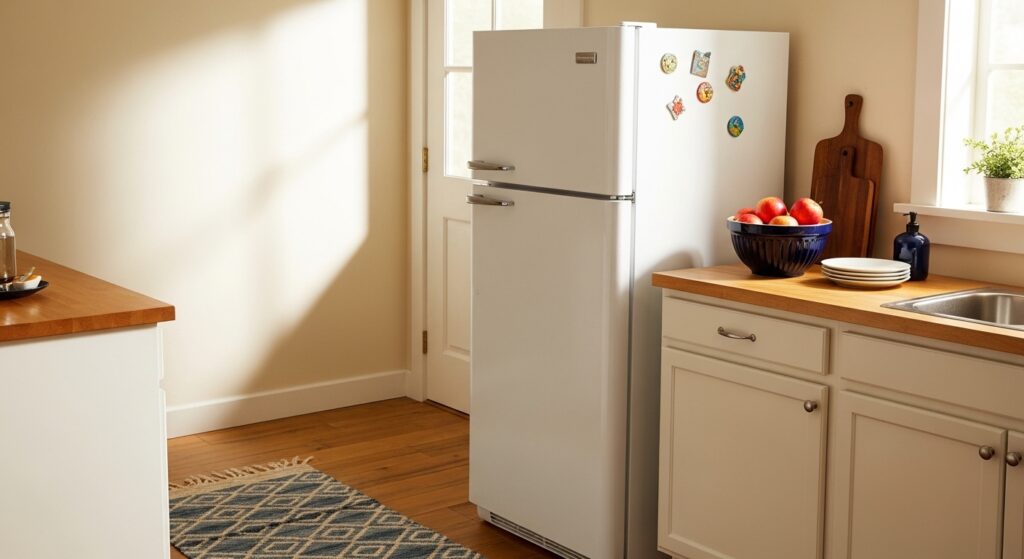
Top-freezer models are the workhorses of the appliance world. They’ve been around the longest, and their simpler mechanical design means fewer things can go wrong.
On average, a top-freezer refrigerator lasts 14 to 17 years — sometimes longer with proper care. If you’re looking for longevity and you’re not prioritizing aesthetics, this style is hard to beat.
Bottom-Freezer Refrigerators
These have a similar lifespan to top-freezers — roughly 12 to 17 years — though they tend to be slightly more expensive to repair because the freezer drawer mechanism can wear over time.
They’re ergonomically popular (fresh food at eye level), but keep in mind that the more complex the design, the more potential repair points.
Side-by-Side Refrigerators
Side-by-side models offer convenience with both fridge and freezer sections at eye level. Their average lifespan lands at around 14 to 17 years.
These models often include ice makers and water dispensers — and those components tend to be the first things to need attention. The ice maker, in particular, is a known trouble spot across many brands.
French Door Refrigerators
French door refrigerators are wildly popular right now. They look great, offer spacious storage, and often come with premium features. But their fridge lifespan tends to run 12 to 15 years — slightly shorter than their simpler counterparts.
More electronics, more components, and more complexity all contribute to a higher likelihood of issues over time. Consumer Reports reliability surveys have consistently shown French door models with higher repair rates than top-freezer models.
Mini Fridges
Mini fridges are convenient but not built for longevity. Most last just 6 to 10 years, and because they’re inexpensive to purchase, they’re often not worth repairing.
Built-in and Counter-Depth Refrigerators
These higher-end models — often from brands like Sub-Zero or Thermador — can last 15 to 20 years or more. They’re built with commercial-grade components and typically come with more robust warranties. The tradeoff is cost: they’re significantly more expensive to buy and repair.
What Factors Affect How Long a Fridge Lasts?
Understanding the refrigerator life expectancy isn’t just about knowing the averages. You also need to understand what shortens — or extends — that lifespan.
1. Brand and Build Quality
Not all refrigerators are created equal. Wirecutter’s appliance reliability data consistently points to brands like Whirlpool, LG, and Samsung as popular choices, though reliability can vary by model.
Generally speaking, simpler designs from established brands tend to last longer than feature-heavy models from newer entrants to the market.
2. How You Use It
Refrigerators that are opened frequently — think a large household versus a single person — experience more wear on door seals, hinges, and compressor cycles. The more the compressor has to work, the shorter its life.
Overfilling your fridge is also a culprit. When air can’t circulate properly, the compressor compensates by running more often, shortening its life.
3. Maintenance (or Lack of It)
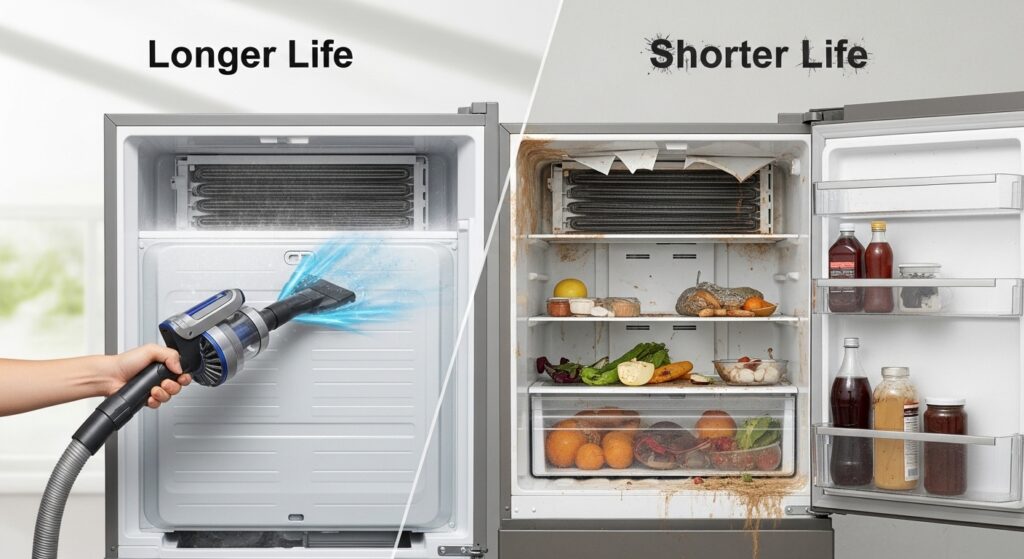
This is the biggest controllable factor in the average life of a refrigerator. Regular maintenance — cleaning condenser coils, checking door gaskets, keeping the fridge at the correct temperature — can add years to its lifespan.
According to GE Appliances, dirty condenser coils are one of the leading causes of compressor failure in home refrigerators.
4. Location and Environment
A garage fridge in extreme heat or cold has to work harder. Refrigerators perform best in controlled indoor environments between 60°F and 95°F. The Association of Home Appliance Manufacturers (AHAM) outlines performance standards that assume typical indoor temperature conditions.
5. Repair History
A fridge that’s already had major component repairs — compressor, evaporator, condenser — may not have as much life left regardless of its age. Each major repair is a signal to pay attention.
Warning Signs Your Refrigerator Is Dying
Sometimes, fridges don’t die suddenly. They give you warnings first, and recognizing these critical signs that you need major home appliance repair can help you address problems before they become more expensive.
- Food is spoiling faster than normal. If your milk goes bad before the expiration date, your fridge may not be maintaining proper temperature. The FDA recommends keeping your refrigerator at or below 40°F.
- Excessive condensation or frost buildup. This often points to a failing door seal or defrost system problem.
- The motor runs constantly. A refrigerator compressor should cycle on and off. If it’s running all the time, something is wrong.
- Unusual noises. Clicking, banging, or buzzing sounds can signal failing components.
- The exterior is hot to the touch. Some warmth is normal, but excessive heat suggests the compressor is struggling.
- Rising energy bills. An inefficient refrigerator uses more electricity to maintain temperature. If your utility bills spike without explanation, the fridge could be to blame.
- Visible rust or cracks inside. These aren’t just cosmetic — they can affect food safety and insulation.
- It’s more than 15 years old. At this point, even without symptoms, it’s worth monitoring closely.
How Long Should a Refrigerator Last Before You Replace It?
This is where the decision gets practical. Not every repair is worth making.
Appliance repair professionals often use the “50% rule”: if the cost of repairing your refrigerator exceeds 50% of the cost of a new one, replacement usually makes more financial sense.
For example: if a new comparable fridge costs $1,000, and your repair estimate is $600, replacing it is the wiser call — especially if the fridge is already 10+ years old.
The U.S. Energy Information Administration (EIA) also notes that older refrigerators consume significantly more energy than newer ENERGY STAR models. Over time, the energy savings from a new fridge can help offset its purchase price.
Repair vs. Replace Decision Table:
| Fridge Age | Repair Cost vs. Fridge Value | Recommendation |
|---|---|---|
| Under 5 years | Any amount | Repair (still under typical warranty) |
| 5–10 years | Under 40% of new cost | Repair |
| 5–10 years | Over 40% of new cost | Consider replacing |
| 10–15 years | Under 30% of new cost | Repair cautiously |
| 10–15 years | Over 30% of new cost | Replace |
| Over 15 years | Any significant repair | Replace |
How to Make Your Refrigerator Last Longer: Expert Tips
The good news is that you have real control over your fridge’s lifespan. These aren’t complex steps — they’re simple habits that pay off over time.
Clean the Condenser Coils Regularly
Condenser coils are located either on the back or underneath your refrigerator. When they’re coated in dust, the compressor works harder and runs hotter. GE Appliances recommends cleaning them every 6 to 12 months using a coil brush or vacuum.
This single step may be the most impactful thing you can do for refrigerator longevity.
Check and Replace Door Gaskets
The door gasket (the rubber seal around the door) is critical. If it’s cracked, stiff, or loose, cold air escapes and warm air enters — forcing the compressor to compensate constantly.
Test yours with the paper test: close the door on a piece of paper. If you can pull it out easily, your seal is weak. Replacement gaskets are inexpensive and widely available.
Set the Right Temperature
Set your refrigerator to 37°F and your freezer to 0°F. Running colder than necessary wastes energy and strains the compressor. The FDA’s food safety guidelines confirm these as the optimal temperature ranges.
Don’t Overfill (or Under-Fill) the Fridge
Yes, both extremes are a problem. Overfilling blocks airflow and makes the system work harder. But a nearly empty fridge also struggles — food and beverages act as thermal mass, helping the fridge maintain temperature when the door is opened.
A good rule of thumb: keep it about 75% full.
Allow Proper Ventilation
Refrigerators need breathing room. Make sure there’s adequate clearance on the sides, top, and back for heat to dissipate. Check your owner’s manual for the manufacturer’s recommended clearance distances.
Defrost the Freezer (If It’s Not Frost-Free)
If you have an older manual-defrost model, frost buildup reduces efficiency and strains the system. Don’t let frost exceed ¼ inch.
Keep the Coils and Drain Pan Clean
Beyond the condenser coils, the drain pan underneath the fridge can accumulate bacteria and mold. Clean it annually. A musty smell coming from your fridge is often the drain pan, not the interior.
Schedule Professional Inspections
Every few years — especially once your fridge is over 10 years old — consider having an appliance technician do a check-up. Catching small issues early (like a weak compressor start relay) is far cheaper than waiting for a full failure.
Brands and Their Typical Refrigerator Life Expectancy
Not all brands perform equally over time. Here’s what appliance reliability research generally shows:
- Whirlpool: Known for reliability and longevity, often rated among top performers in Consumer Reports reliability surveys.
- LG: Popular for features and design, but some models have had compressor issues — particularly linear compressors in certain production years, which led to class action lawsuits.
- Samsung: Similar story to LG — popular and feature-rich, but some models have documented ice maker and cooling problems.
- Maytag: Long-standing reputation for durability; owned by Whirlpool and often shares platform reliability.
- GE / GE Profile: Generally reliable mid-tier performance; the Profile line offers premium features with acceptable longevity.
- Sub-Zero: Premium tier with 20+ year expected lifespans, backed by Sub-Zero’s own warranty and service network.
- Bosch: Well-regarded for quiet operation and European-style reliability, often performing well in long-term durability assessments.
The takeaway: brand matters, but so does model. Always check recent owner reviews and reliability data from Consumer Reports before purchasing.
Does an Older Refrigerator Cost More to Run?
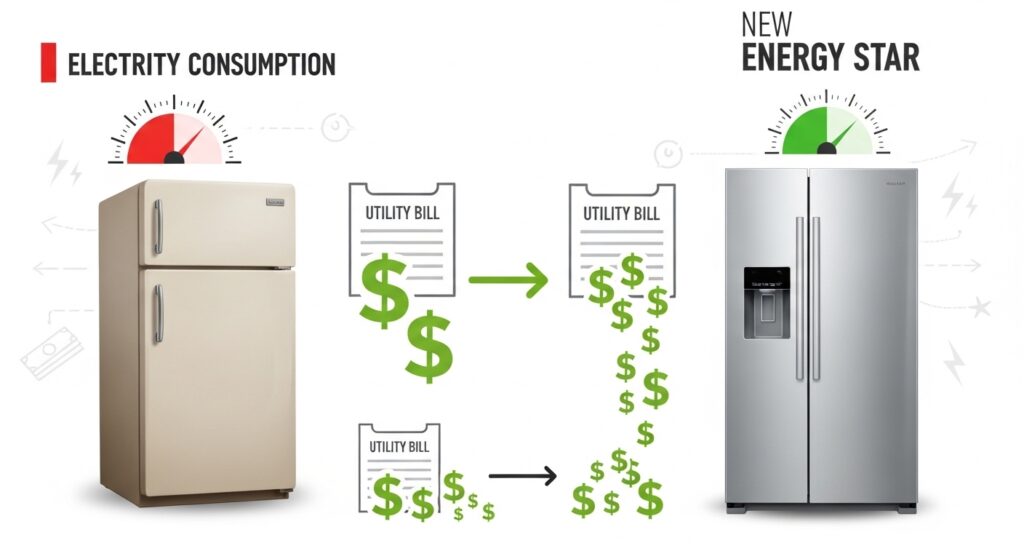
This is worth considering seriously. Refrigerators manufactured before 2001 use roughly two to three times more electricity than models that meet today’s ENERGY STAR standards.
According to ENERGY STAR, a certified refrigerator uses about 9% less energy than the federal minimum standard. Over 10–15 years, that difference adds up to hundreds of dollars in utility costs.
If your fridge is 15+ years old, there’s a real financial argument for replacement even if it’s still technically functional.
When Is It Time to Recycle Your Old Refrigerator?
When the time comes to replace your fridge, don’t just put it on the curb. Old refrigerators contain refrigerants that must be properly disposed of under EPA regulations.
Many utility companies offer appliance recycling programs that will pick up your old fridge for free — and some even offer rebates. Check with your local utility provider or visit the ENERGY STAR Rebate Finder to see what’s available in your area.
FAQs: How Long Do Refrigerators Last?
How long can a refrigerator last with proper maintenance?
With consistent maintenance — including cleaning coils, replacing gaskets, and keeping it at the right temperature — a refrigerator can last 15 to 20 years or more. High-end built-in models are known to exceed 20 years in well-maintained homes.
Is it worth repairing a 10-year-old refrigerator?
It depends on the repair cost and what needs to be fixed. Minor repairs (door gasket, ice maker, thermostat) on a 10-year-old fridge are usually worth it. Major component repairs (compressor, evaporator coil) on a 10+ year-old model often aren’t — the 50% rule applies here.
How do I know if my refrigerator compressor is failing?
Signs of a failing compressor include the fridge running constantly but not cooling properly, unusual clicking or humming sounds when the motor tries to start, and significantly higher electricity bills. A technician can test the compressor’s amperage draw to confirm.
Do French door refrigerators last as long as top-freezer models?
Generally, no. French door refrigerators have more components (dual evaporators, complex ice systems, electronic controls) and tend to have a slightly shorter average lifespan of 12 to 15 years versus 14 to 17 years for top-freezer models. However, proper maintenance can close that gap.
What temperature should I set my refrigerator to maximize its lifespan?
Set your refrigerator to 37°F and your freezer to 0°F. These temperatures are optimal for food safety (per FDA guidelines) and don’t overwork the compressor the way overly cold settings do.
Expert Tips: Getting the Most Life Out of Your Refrigerator
- Never place your refrigerator directly next to a heat source like an oven or in direct sunlight. Heat forces the compressor to work much harder.
- If you’re going on vacation, don’t turn the fridge off — it’s harder on the compressor to restart after a complete power-down than it is to maintain a set temperature. Instead, set it to a slightly warmer temperature and consume or remove perishables before you leave.
- Listen to your fridge. Changes in operating sounds — especially clicking when starting or stopping — are early warning signs. Catching issues early almost always means lower repair costs.
- Keep a maintenance log. Note when you cleaned the coils, replaced the water filter, or had a technician visit. This helps you stay on schedule and can be useful if you ever sell your home.
- If you’re buying a new refrigerator, prioritize purchasing an extended warranty or home warranty that covers appliances. American Home Shield and Choice Home Warranty are two commonly used providers, though coverage and reviews vary — always read the fine print.
Conclusion: Know Your Fridge’s Lifespan and Plan Accordingly
The average life of a refrigerator is around 13 years, but your specific fridge could last anywhere from 8 to 20+ years depending on how it’s made, how it’s used, and how well it’s maintained.
The key takeaways:
- Top-freezer models tend to last longest; French door and mini fridges tend to have shorter lifespans
- Maintenance is the biggest factor you can control — clean coils, check seals, set correct temps
- Know the warning signs so you’re not caught off-guard
- Use the 50% rule when deciding whether to repair or replace
- Older fridges cost more to run — factor that into your replace-or-keep decision
Whether your fridge is brand new or approaching retirement age, this knowledge puts you in control. Don’t wait for a breakdown to think about it. A few simple maintenance habits today can mean years — and hundreds of dollars — saved tomorrow.
Ready to take action? Start with one simple step this week: pull your fridge away from the wall and vacuum those condenser coils. It takes 10 minutes and could add years to your appliance’s life.
And if you’re already shopping for a replacement, check ENERGY STAR certified models and read the latest Consumer Reports refrigerator ratings before you buy.

